Doctor Li Wenliang who sounded one of the first warnings on the Wuhan coronavirus, and was silenced by Chinese authorities, has died from the virus. This has actually led to a widespread protest in China emphasizing the problems with a sometimes authoritative local government. The clash between the local government’s decisions and those on the national level are coming under closer review in Beijing.
Earlier today President Trump hosted a business luncheon with U.S. governors to discuss economic expansion and administration policy efforts to assist the states.
[Video and Transcript Below]
.
[Transcript] – THE PRESIDENT: Wow. Thank you. Thank you. (Applause.) Thank you very much. Thank you very much. Thank you. Thank you. It’s a great honor to have you at the White House, a very special place. Beautiful and so meaningful in so many ways. And our country has never done better. You’re all doing really well. Every state is doing well. I can say most every state in the room today is setting records. And we’d like to think that the federal government has been helping you a lot.
But it is wonderful being with you. And we had a great evening last night. And the talent of those musicians — they could be anywhere in the world. Many of them could work in the great opera houses, but they love the military.
When you heard the violins and the talent, the great talent — I don’t know if anybody has an ear for music. Believe it or not, a long time ago, I was told I have a great ear for music by somebody. (Laughter.) I took a test. They said, “He has a wonderful aptitude for music.” I said, “I do?” (Laughter.)
But when you listen to that, it’s really incredible, the talent. They’re great people. They want to be in the military; they don’t want to be anywhere else. So it’s really — really something.
As I said in my State of the Union last week, we’re in the midst of a great American comeback. With the help of many of the people in this room — and you’ve done, really, a fantastic job — I think I can say that just about everybody — I’ll say “just about,” just in case. Someday, somebody is going to run or do something that I won’t like, and I can have a little bit of an out when I say “just about.” (Laughter.) I said, “No, he was included in the ‘just about.’” But we’re creating the most prosperous economy and the most inclusive society ever to exist, actually.
Since my election, America has gained 7 million new jobs. We added 225,000 jobs in January alone, crushing expectations. The unemployment rate reached the lowest level in 50 years. And a statistic that’s incredible to me is: The average unemployment that we’ve had during this three-year period is the lowest in the history of our country. Compared to any other administration, the lowest in the history of our country. The unemployment rate for African American, Hispanic American, and Asian Americans have reached the lowest level ever recorded.
Low-income workers have seen a 16 percent pay increase since my election — something that’s so great to see. When I campaigned, they hadn’t had rate increases, pay increases for 20 years, 21 years. They were working three jobs and two jobs, and making less money than they made 20 years ago.
Median household income, as you all know very well, is the highest ever recorded, by far. Since 2016, 28 states have reached or matched their lowest unemployment rate on record. So we have 28 and you — I think, soon, we’re going to have just about everybody. And at the end of last year, a record 39 states had unemployment below 4 percent. Again, another record.
Just as I promised during my campaign, we’re fighting every day to expand opportunity for African American communities all across our country. African American youth — we have such great news on African American youth — unemployment has reached its lowest level ever recorded. It’s a great statistic. African American poverty rates have plummeted to their lowest rate ever in history. And wages for African American workers have increased $2,400 a year. That’s also a record.
At the center of our economic agenda are Opportunity Zones. I hope you’re embracing them. I think many of you are. My administration has worked with the governors in this room to create nearly 9,000 Opportunity Zones in our most vulnerable communities. Jobs and money are pouring into these areas that have never seen investment. I mean, they haven’t seen them in decades and decades and decades. And hundreds of millions of dollars are pouring into certain communities — individual communities. Hundreds of millions of dollars. And there’s never been anything like it: Opportunity Zones. Tim Scott did a great job on that. Senator Tim Scott.
I urge all governors to create a state-level version of our White House Opportunity and Revitalization Council to coordinate the efforts of state government to provide maximum support for the Opportunity Zones. And we’re there to help you. If you have a problem, call me. Literally, call me and we’ll work it out. But the Opportunity Zones — and that’s Democrat or Republican, by the way. Opportunities have been fantastic.
We must not stop until we have delivered equal and abundant opportunity for every community in our land. And that’s what’s happening.
To give former prisoners a second chance — this has worked better than any program ever — I was proud to sign the landmark criminal justice reform into law. And since that time, 10 states have passed legislation following our lead. And there were numerous states. I know Texas was there, Governor, with criminal justice reform. Amazing. And Kentucky and a few others that were thought of as being very strict states and yet they had criminal justice reform. We looked at a lot of what Texas did and some of the other states where it worked so well.
And Alice Johnson, as an example, she was in for 22 years and she had another 20 years to serve on something that — everything is bad, but to be in jail for 40 and 50 years for what Alice did on a telephone was crazy.
Thanks to our roaring economy, former inmates are now finding jobs. And the employers are so happy. Now, the economy is really helping, but it’s the first time ever where prisoners coming out of jail are finding jobs, loving it. And the employers — the feedback we’re getting from so many people, so many employers are: These are among the best people they have. And they were, in a way, forced by the economy, the good economy, because it’s hard to get people. Down to 3.5 [percent] and actually, it went to 3.6 [percent] because we’re opening up the valve. They’re hiring more and more people. That was a positive. Two hundred and twenty-five thousand, as I said.
But the prisoners are now working and they’re doing a phenomenal job, for the most part.
Our booming prosperity is being fueled by our historic regulatory reduction campaign. In my first month in office, I imposed a “two-for-one” rule, requiring for every one new regulation, two old ones must be eliminated.
Well, that turned out to be — we went to four, we went to six, we went to eight. We had a period where we were at 22 to 1. Twenty-two to one. And we’re eliminating, on average, $3,100 in regulation costs per family a year. Nobody has ever even heard of such a thing.
And we’re getting housing built too. We have rules and regulations — made it impossible. I hope California gets their act together because the cost of regulation is almost the cost of a house. And they need housing, and they can’t — they can’t build it. They don’t know what they’re doing.
The Governors’ Initiative on Regulatory Innovation is designed to continue our unprecedented progress through straight — state-level deregulation.
Governor Doug Ducey has achieved 3 for 1 on cuts. Where’s Doug? Good job, Doug. (Laughter.) Well, you only won by about 17 percent, so, you know. He should be — in fact, at 17 percent, you should be at 4 to 1, I think. Right? (Laughter.) That was a big win. A big win. That was a great win.
And Governor Kevin Stitt of Oklahoma has reached 2 for 1 and going to 3 for 1. Where’s Kevin? Hi, Kevin. Good job. Great.
We’re also working together — and many of you in the room have done much better than 1 for 1. Some of you, you’re up to four.
We’re also working together to reform occupational licensing. Just this year, at least 12 governors have taken action to reduce burdensome occupational licensing requirements. That means licensing, where either it’s unnecessary or where you actually can do it very quickly. There are some licensing requirements that takes years to get approved, and it could take a matter of days. Could take a matter of days.
Governors understand the need to get infrastructure projects quickly approved. To speed up permitting and reduce traffic conjection — congestion, last month, we issued a proposed new rule to reduce permitting and the permitting time for new infrastructure by more than 70 percent. Highways that were taking 12 years to get approved, 14, 15, 17, 21 years, we’re trying to get it down to one year. That means you may get rejected if you have an environmental problem or a safety problem. In many cases, these highways became much more unsafe and they took a long time because they’d try and get away from certain problems, including nesting. But they’d try and get away, and instead of having a straight run, they’d create curves in the highway, which obviously make it much more dangerous. And they had problems with some of those highways. And they’re much more expensive to build — not only the time — the design but the time. I mean, by the time they get it approved.
So we have highways that would take 21 years. We have roads that took 10 years, 11 years, 12 years to get approved. And Elaine Chao has been fantastic. Elaine, thank you very much. The job you’re doing at transportation, we appreciate it very much.
And, Jeff, you were over there for a long while, I will tell you, so I have to give you at least partial credit. Right now you’re at a different location. (Laughter.)
But you really did — you did a great job on that. And — so we have it down to two years now, but we — I think we’re going to get it down to one. And very good chance you’ll be rejected if it doesn’t meet environmental standards and tests.
And we are rescuing students from failing government schools by introducing the Education Freedom Scholarships and Opportunity Act, which will replicate the great success of tax-credit scholarships available in 18 states. We believe very strongly, or at least many of the people in this room — not all of them — but believe very strongly in school choice.
We’re also working closely with the states to improve public safety. This includes the incredible work being done by our nation’s heroic ICE officers. We’ve moved thousands of MS-13 out of the country, back to where they came from — whether it’s Guatemala, Honduras, El Salvador, Mexico.
And, as you know, we reached agreements with those countries so that we can do that. And the past administration, they wouldn’t accept them. They’d come from one of the countries, tough countries, and we would send them back and they wouldn’t take them. Not me. They take them now. Now they say, “Thank you so much for sending them back. We were looking for this killer. Thank you very much. We appreciate it.” But they all take them now. They take them very quickly.
Before, they used to say, “Don’t ever even think about landing that airplane. We don’t want those people.” So they take them back rapidly. Someday they’ll tell the real story as to why, but that’s the way it has to be. We have thousands and thousands of killers and gang members that we’re bringing back to countries that now accept them. They were not taking them back.
Last year alone, ICE officers arrested 120,000 criminal aliens charged with nearly 10,000 burglaries, 5,000 sexual assaults, 45,000 violent assaults, and 2,000 murders. You know, some of them we keep here when they — it’s very egregious. We don’t necessarily trust other people to take care of justice, so we keep them here. But, you know, we don’t like having people in our prisons for 50 years, 60 years. And we have to pay for it. And so, for the most part, we bring them back to their countries and give them a very bad recommendation.
State and local cooperation is the backbone of this effort. We have a tremendous relationship with many of the states and governments, cities. It’s essential that all of our states and cities honor ICE detainer requests to ensure that safe transfer of criminal aliens into federal custody takes place.
Jurisdictions that adopt sanctuary policies that instead release these criminals put all of Americans in harm’s way. A very, very, serious problem. I mean, we’re all here for the same thing. I know we have different policies, different feelings, different everything, but sanctuary cities are causing us a tremendous problem in this country.
We have stone-cold killers that they don’t want to hand over to us, and then they escape into communities and they cause, in some cases, tremendous havoc.
Another vital element of federal and state cooperation is the relentless fight against opioids and the drug epidemic. We’ve had great progress. We’re down 18, 19, 20 percent in some of the communities. The First Lady has been very much involved in that. Kellyanne has been very much involved in that. A lot of the people in this room — almost everybody in this room has been involved in it.
So — and I want to thank you for that. We’re making progress. Very tough. All over the world — this is a problem all over the world. This is a big problem here, but it’s a big problem almost everywhere.
For the first time in three decades, we’ve achieved a decline in drug overdose deaths, including, as an example, Ohio. Mike is around here someplace. Mike? Mike? Mike?
AIDE: He left, sir.
THE PRESIDENT: Twenty-three percent in Ohio. Nineteen percent in Pennsylvania. Ten percent in Wisconsin. And we’re averaging probably about 16, 17 percent. So it’s been — it’s not enough, but we’re making a lot of progress. And if we had more help in Congress, we could get it even lower.
My administration is truly grateful for the leadership, cooperation, partnership, and friendship of the governors in this room. No matter our party, we must work together and really do the job. And I think that’s what’s happening. Our country is now receiving thousands and thousands of companies that are coming into the United States. Some had left and some had never been here before, but they all want to be where the action is.
We lost 60,000 plants and factories over the years. Sixty thousand. It’s hard to even conceive. And we’ve got many of them back, and many are coming back. And they’re moving to a lot of your states. I know a lot of them are coming into Texas and Florida and a lot of different locations — South Carolina, North Carolina, Pennsylvania. It’s incredible what’s happening. Ohio is a big beneficiary. Michigan is a tremendous beneficiary, with the car companies. Tremendous. Somebody was saying they’re so happy in Michigan.
And I meet with Prime Minister Abe of Japan. I say, “You have to — Shinzo, you have to get more car companies here. We have a deficit with you. You have to get them in.” And they are — they’re sending a lot of companies. We hadn’t built a plant in years and years and decades, frankly. And now we have car plants being built all over the United States. And we have expansions — a lot of expansions of existing plants.
So it’s been, really, an incredible thing. We’re doing incredible work. And we’re the number-one country in the world right now, in terms of the economy.
When I was running, and long before I was running, I’d always heard that China — I have great respect for President Xi and great respect for China, frankly — but that China was going to be the number-one economy in the world during 2019. Actually, it was 2018, 2019. You all heard it, that we were going to go to number two.
And I will tell you, we had our battle. And we took in hundreds of billions of dollars in tariffs and other things. And you saw the — it was just announced the trade deficit was the lowest it’s been in years with China. It just happened two days ago. They just announced.
But we are now so far ahead of China, in terms of the size of our economy, that if somebody is smart that’s at this position for times into the future — hopefully, after five years — I won’t joke by saying “nine, thirteen, fifteen.” (Laughter.) It drives them crazy — for the governors. It drives them crazy. (Laughter.) Even when I joke, it drives them crazy, so I won’t say that. But if somebody smart is in this position, it’ll never happen where China overtakes us. It’ll never happen.
So we, right now, have — we’re so far ahead of them. They’re not catching us for a long time. If the wrong person stands here or sits in the White House — that beautiful chair in the White House, in the Oval Office — sure, they’re going to — you know, they’re going to catch. They have 1.5 billion people; we have 350 million people. But we have a very special place and a very special country, and nobody is going to catch us if we have great leadership. And you have been great leaders for your states, and we appreciate very much that you’re at the White House. Thank you very much.
So what we’re going to do is — I thought maybe we could take a few questions. If you want, we could leave the press there. The press would love that, I’m sure. Or we could have them leave and we could talk in a different fashion. You won’t have to showboat. (Laughter.)
So would anybody prefer — we’ll leave them here for a little while, and then we’ll go a different route perhaps. Any questions, please? Please.
GOVERNOR PARSON: Mr. President, (inaudible) do you feel like your infrastructure? You’ve got a budget coming out, I think, today. Where are you going to be on infrastructure?
THE PRESIDENT: We’re doing a big infrastructure potential deal. We need — obviously, we need help from — we need the votes of Democrats. They’ve been so focused on something else and wasting a lot of people’s time, although my poll numbers have been driven way the hell up, so that’s one way to do it, I guess.
But they have been so focused on the impeachment hoax that they haven’t had time to do anything else. But we’re ready to go with a big infrastructure bill if they’re ready to approve it. We’re also ready to lower drug prices very substantially. We did — last year was the first time in 51 years that drug prices — prescription drug prices — went down. First time in 51 years.
But to get them really down, we have to do exactly what we’re doing. We’re — we have — we need the votes of the Democrats, and they just didn’t have the time to do anything. So maybe they will now have the time.
But we’re all ready to go on infrastructure, on reducing drug prices very substantially. We can reduce drug prices unbelievably easily and substantially, but we have to get Democrat votes. Okay?
Thank you. Thank you, Governor. Please.
GOVERNOR RICKETTS: Mr. President, you’ve had a lot of successes on trade — USMCA, China, and Japan. What’s next on your agenda for trade?
THE PRESIDENT: So, Europe has been treating us very badly. European Union. It was really formed so they could treat us badly. So they’ve done their job. That was one of the primary reasons. But they treat us badly there and they treat us badly, frankly, on NATO. But NATO, I’ve gotten, as you know, $130 billion more they will pay.
Because NATO was going down like a rocket ship. Our past leaders would go over, make a speech, and leave. I went over, made a speech, and said, “You got to pay more.” Because the United States was paying everything. Essentially, they were paying close to 100 percent. And I let them know: “You have no choice.” And they are paying more. They paid $130 billion.
I think my biggest fan in the whole world is Secretary General Stoltenberg, head of NATO. And he said he can’t believe it, because for 20 years it went down. It’s like a roller coaster dip. No — none of this; just down. They paid less and less and less. And it got more expensive and more expensive with time.
But I raised $130 billion my first meeting, and I raised $400 billion the second meeting. So now it’s in good shape. But, you know, we were taken advantage of by a lot of countries — a lot of allies, frankly. Sometimes allies do a better job on you than the enemy, because the enemies you watch out for, right?
So, Pete, I think that the next thing could be Europe where we talk to them very seriously and they have to do it because they’ve — there’s been a — over the last 10, 12 years, there’s been a tremendous deficit with Europe. They have barriers that are incredible. I didn’t do — I didn’t want to do them while we were doing China, Japan, South Korea. You know, I didn’t want to do the whole world at one time. Does that make sense? (Laughter.) People have learned that doesn’t work out too well, even on trade.
So we’re going to be starting that. They know that. They know that. They’re ready for it. You know, we made a good deal with Japan. We’re going to do a bigger, much more comprehensive deal. But we’re taking in $40 billion from Japan, which they didn’t expect. Nobody expected. We’ve done great on the trade. It’s going to have a tremendous impact.
Now, the virus that we’re talking about having to do — you know, a lot of people think that goes away in April with the heat — as the heat comes in. Typically, that will go away in April. We’re in great shape though. We have 12 cases — 11 cases, and many of them are in good shape now. So — but a very good question.
Yes, please. Colorado.
GOVERNOR POLIS: Yeah. You mentioned deporting criminal aliens. What about also — what are your ideas for fixing it for the — for the, kind of, for the DREAMers and the folks who are here that are hardworking? And, you know, it’s really tough out there, and they work on our farms, and the kids who grew up here. And how do we do that, and at the same time you’re also, kind of, enforcing the other side for those who violate our laws?
THE PRESIDENT: Well, we almost had a deal on that with the Democrats, as you know. It was done. And then we lost the decision, and the Democrats said, “Trump? Who’s that? Trump? Who’s that?” But we were very close to having a deal on the DREAMers with the House and with the Senate. It would’ve been a very good deal for everybody.
So we’re looking at that, but now we’re before the Supreme Court. I think we’re going to win, because if we don’t win, that gives the President of the United States unbelievable powers.
You know, President Obama signed that bill. It was an executive order. And when he signed it, he said — essentially, he said, “I don’t have the right to do this, but I’m going to do it anyway.” And he was upheld by a judge. And anyway, it will be before the Supreme Court pretty soon. And at some point, I think we’ll probably make a deal on that. I do feel that way. Okay? Good question.
A question? Yes, please, Gary.
How’s Mitt Romney?
GOVERNOR HERBERT: I haven’t talked to him.
THE PRESIDENT: You keep him. (Laughter.) We don’t want him. Go ahead.
GOVERNOR HERBERT: States are used to —
THE PRESIDENT: Doing a great job in Utah, by the way. Go ahead, Gary.
GOVERNOR HERBERT: States are used to balancing the budget. So I think, by and large, we don’t spend more than we take in. And I know you’ve unveiled your budget today, and I know there’s — a concern for you is the growing debt.
THE PRESIDENT: Yeah.
GOVERNOR HERBERT: I know we’ve had nonpartisan economists talk to us as governors saying this is going to come back to bite us in the future if we don’t do something about it.
THE PRESIDENT: Yeah, I agree.
GOVERNOR HERBERT: What are we doing, and how can we get to a more balanced budget — certainly reduce the debt as opposed to continuing to grow the debt?
THE PRESIDENT: So we’re putting out a plan today that, over a period of — not that long a period of time, brings our budget and our deficit down to what it should be, which is close to zero. And I think people are going to be very impressed by it.
We’re not touching Medicare. We want to keep Medicare. We’re not touching Social Security. We’re making our country stronger again. We’re not decreasing Medicaid. But we’re doing a lot of things that are very good, including waste and fraud — tremendous waste and tremendous fraud.
So we’re doing that, in terms of certain programs. And we’re taking good care of our military. We’re increasing spending on our nuclear program because we have no choice — because of what China is doing, what Russia is doing in particular. And so we have a very big number in for that.
Now, at the same time, Russia and China both want to negotiate with us to stop this craziness of spending billions and billions of dollars on nuclear weapons. But the only way, until we have that agreement — the only thing I can do is create, by far, the strongest nuclear force anywhere in the world, which, as you know, over the last three years, we very much upgraded our nuclear.
But we’re buying new. We have the super-fast missiles — tremendous number of the super-fast. We call them “super-fast,” where they’re four, five, six, and even seven times faster than an ordinary missile. We need that because, again, Russia has some. I won’t tell you how they got it. They got it, supposedly, from plans from the Obama administration when we weren’t doing it. And that’s too bad. That’s not good. But that’s how it happened. And China, as you know, is doing it.
So we have a tremendous $740 billion for military. But again, it’s also jobs in the United States. So it’s — you know, everything is made in the United States, proudly. And we have the best in the world. We have the best equipment in the world. The best missiles, planes, rockets. Everybody wants our equipment. We have to be very selective, obviously.
But we’re — we’re going to have a very good budget with a very powerful military budget because we have no choice — okay? — about that.
Ron, do you have something about, for instance, your plan of buying and cutting prescription drugs? You want to tell them what we’re doing?
GOVERNOR DESANTIS: Well, so we had a panel about the — your administration’s approval under an old 2003 law that prior administrations did not utilize to allow safe and affordable drugs to be imported from Canada. So that’s going through the regulatory process.
We, in Florida, are working our own parallel track. As soon as your rules are done and in place, you know, we’re looking to buy. And, you know, we can save a lot of money just for things like our prison system —
THE PRESIDENT: Right.
GOVERNOR DESANTIS: — because the drugs are a lot cheaper.
So we think there’ll be good savings here. But I think it opens up a larger conversation, which I know you want to have, about: Why are we funding the drugs for everyone in the world?
THE PRESIDENT: Right.
GOVERNOR DESANTIS: You know, Americans want relief and I know you’ve fought hard for that. But thanks for approving the Florida program.
THE PRESIDENT: You can go — and Colorado is doing that also — you can go to certain countries, and the exact same pill, made in the exact same plant, factory — wherever it may be — from one of the big companies will sell for 50, 60, 70 percent less than the United States is paying, because it’s broken; it’s a broken system.
And so one of the things I’ve authorized is that certain states have requested — probably after this, everybody in this room will go back — (laughter) — but if we buy from Canada, you’ll save 50 percent at this moment.
Now, that may go up or everything may come down. One thing is going to happen or another. Either the drug companies are going to raise it and not make it possible to buy. They’re going to raise it in Canada, meaning so you won’t be able to do it, or everyone is going to go down. Because you have a middleman in the middle that are making a fortune. Nobody knows who these people are, but they’re getting rich. Because we had a broken system and it’s about time it gets fixed. So a lot of — a lot of shakeup is going to take place.
But if we had Democrats helping us, we could solve this problem in one day, but they don’t want to vote again. They don’t have any time to vote. They don’t have any time to do anything other than what they do. So they seem to be freed up a lot now. They’re freed up a lot, actually, I hear.
How about a couple of more and then we’ll let the press go and relax and take it easy? (Laughter.)
Please, Governor.
GOVERNOR ABBOTT: Your administration has done a — your administration has done a great job with regard to addressing the opioid crisis.
THE PRESIDENT: Thank you.
GOVERNOR ABBOTT: An aspect about that is the growing problem of fentanyl, especially fentanyl coming across the southern border.
THE PRESIDENT: Right.
GOVERNOR ABBOTT: And it is my understanding that there’s some information about a lot of that coming from China.
THE PRESIDENT: Yes.
GOVERNOR ABBOTT: What I’m curious about is what the status is with regard to the reduction of fentanyl coming from China and our ability to corral that and to reduce that.
THE PRESIDENT: So, as you know, it’s gone down. I met with President Xi on the trade deal. And I said, “You have to stop fentanyl coming into our country. You have to do me a favor and stop it. You have to get it stopped.” It has to end — because it’s a favor for our country. And we’re losing thousands and thousands of people to fentanyl. I mean, the size of a pinhead can kill a lot of people. It’s unbelievably bad. And they send it direct and they send it through Mexico and through the border. And we would catch a lot of it, but even if a little bit got through, it’s a very deadly drug.
And they have cut it way back. And they’ve also criminalized — it wasn’t a criminal. They considered a corporate kind of a thing. It was a drug of a different nature. And now, they’ve put it into their criminal statutes. And criminal, in China, for drugs, by the way, means that’s serious; they’re getting a maximum penalty. And you know what the maximum penalty is in China for that. And it goes very quickly.
It’s interesting: Where you have Singapore, they have very little drug problem; where you have China, they have very little drug problem. States with a very powerful death penalty on drug dealers don’t have a drug problem. I don’t know that our country is ready for that. But if you look throughout the world, the countries with a powerful death penalty — death penalty — with a fair but quick trial, they have very little, if any, drug problem. That includes China.
But they’ve put fentanyl now into their — he’s working on that, and we’ve — it’s gone down a lot, as you know. They’ve put it into their penalty system, and people will be getting the death penalty in China now for fentanyl. That was a big thing. It’s not — it’s not part of the trade agreement, but it is part of the trade agreement. And they have acted on it.
Now, of course, they’re working on something else. And I think they’re doing a good job on that, on the virus. I had a long talk with President Xi — for the people in this room — two nights ago, and he feels very confident. He feels very confident. And he feels that, again, as I mentioned, by April or during the month of April, the heat, generally speaking, kills this kind of virus. So that would be a good thing.
But we’re in great shape in our country. We have 11, and the 11 are getting better. Okay?
It’s a great question. I think that fentanyl is a huge problem. It’s almost, at this moment, 100 percent made in China. And they are starting to enforce it on our behalf. We have a good relationship with China now. Probably the best we’ve ever had. Okay.
Okay, so I think what we’ll do — any other questions from the governors? Yes, please.
GOVERNOR HUTCHINSON: Mr. President, I want to thank you for giving the states more flexibility in healthcare, particularly. Last week, your Health and Human Services announced the Medicaid block grant —
THE PRESIDENT: Right.
GOVERNOR HUTCHINSON: — waiver authority for the states. Arkansas will be pursuing that. But I wanted to thank you for that and also ask you: In terms of your State of the Union Address, you talked about healthcare. Is there anything that we can expect this year in Congress, with an election year — is there anything that we can get done that you’re going to be a priority in Congress this year?
THE PRESIDENT: So we did a big thing on healthcare. We got rid of the individual mandate on Obamacare, which basically made Obamacare not Obamacare anymore. It was the most unpopular thing in Obamacare, and basically, you paid a lot of money for the privilege of not paying to have bad healthcare. And nobody wanted that. And we got rid of it. Big, big move.
And I had a choice: I can make — so it really isn’t Obamacare anymore, but I can — and we do — as you know, we left preexisting conditions and everything. We left it. Because preexisting will always have — and I think I can speak for Democrats too. But we are all going to have preexisting conditions. We are always going to make sure that that’s taken care of, the preexisting condition situation.
I think I can speak — I know I can speak for Republicans. I think I can speak for Democrats. It’s a — it’s a part of our society right now, and nobody is going to change it. If a law is overturned, that’s okay because the new law is going to have it in. The new law would replace the old law that was overturned. It would have preexisting conditions. So I think that’s important to say.
But one thing that we will be doing is, at least from a Republican standpoint — you have 180 million people out there that have great health insurance. They love it. Private health insurance. And we’re going to save it. Other people are thinking about terminating it, which is brutal for unions and others. So I don’t know how they’re going to get around that, but we’re going to be saving that.
But when I took over, I had a choice. We got rid of the most unpopular thing in Obamacare, almost got rid of Obamacare, but essentially we did. But now I said: Do we run it really well, or do we run it really poorly? Do we make everybody unhappy and blame the Democrats, or do we make people relatively happy with a bad law? It’s a bad law. Bad — it’s a bad policy. But do we make people relatively happy? And I chose — I felt I had an obligation to do the latter.
So it’s been working out pretty well, and it goes along, and we’ve done block grants. We’ve done a lot of different things with different states. And we’re tailor-made — really, it’s tailor-made for different states. We are doing thing for states. Some people want block grants, some people want something else. And we’re working with individual states, and I think governors are really happy and really surprised that we’re doing that.
I could’ve just cold-lined it and just said, “We’re not doing anything,” and everybody would be happy, everybody would be complaining. But I think the best thing for our country to do is the way we’re doing it, until we get a replacement for Obamacare, a full replacement, that’s going to be great.
And I would say this: If we change the House — if we get the House, the Republicans get the House back, we will have that; otherwise, we’ll just have to negotiate with the Democrats. And I think at some point they will come around and start negotiating these things, because they really are good.
So, media, thank you very much. We appreciate it and we’ll have a little more discussion. Thank you very much. (Applause.)
The more traditional bird flu has appeared in the same area of China. The bird flu outbreak was reported Saturday in Hunan, which borders the province of Hubei where the coronavirus broke out in December. Officials said, “The farm has 7850 chickens, and 4500 of the chickens have died from the contagion.” This is a known virus that is a fatal illness among birds, known as H5N1 virus, which causes “a highly infectious, severe respiratory disease in birds,” according to the World Health Organization. The Chinese government announced that it has culled 17,828 chickens as a result of the H5N1 outbreak, according to Reuters.
Keep in mind that these viruses that start in animals can make the jump to humans. Even the AIDS virus, HIV, came from monkeys. Back in 1999, researchers found a strain of SIV (called SIVcpz) in a chimpanzee that was almost identical to HIV in humans. These scientists then conducted more research into how SIV could have developed in the chimps. What they discovered was that the chimps had hunted and eaten two smaller species of monkeys (red-capped mangabeys and greater spot-nosed monkeys). These smaller monkeys were infected and then the chimps consumed these infected monkeys and the two different strains of SIV mutated and joined together to form a third virus (SIVcpz) that could be passed on to other chimps. This is the strain that can also infected humans.
The coronavirus appears to have made the cross to humans by people eating bats. This new outbreak of a bird flu is not easily transmissible to people. The World Health Organization has called on countries to be on guard because the virus can mutate into a transmissible form to cross to humans (The New York Times).
This version of the bird flu is far more deadly to humans than the coronavirus that the conspiracy world has turned into some zombie apocalypse with spliced HIV. Humans who would contract this bird virus would have a mortality rate of 60% in cases studied over the past 15 years. That makes it far more dangerous than SARS or this novel coronavirus, which has had a 2% mortality rate so far despite all the conspiracy mongering of 10% and the attribution of the fall in the US share market is caused by this coronavirus.
OMG! If we all do not drown from climate change or get skin cancer because ice and snow reflect and magnify the sun (which is why you can get sunburn while skiing), then the virus will get us. Just close all the markets and governments should abolish all taxes and we party like its 1999
Even before the Coronavirus surfaced in China there was lower manufacturing factory activity within the Chinese economy. The necessary response within China to control the spread of the Coronavirus has been to shut down most commerce. Factories, schools & businesses throughout China are empty as various containment measures are underway.
The direct result of this response is a severe drop in economic activity. Many analysts are speculating about how this cessation of production might impact supply chains that use Chinese component goods. Obviously, with manufacturing facilities closed any downstream multinational company relying on those products may have supply issues as soon as existing inventories deplete.
There is a natural lag before the manufacturing void hits the consumer market; however, the financial markets are forward looking and they are already reflecting severe drops in stock prices, depending on the dependency/exposure of the company and/or sector.
BEIJING/SHANGHAI (Reuters) – Chinese stock and commodity markets fell heavily on Monday as the death toll from a coronavirus epidemic in China rose to 361 and investors retreated into safe-haven assets in the first trading session after an extended Lunar New Year break.
Markets plunged at the open in their first session since Jan. 23, when the outbreak of the newly identified virus had claimed only 17 lives in Wuhan city, the epicenter of the outbreak, in Hubei province.
[…] The Shanghai Composite index shed 8% to hit one-year low on Monday, wiping almost $370 billion off the market value, according to Reuters calculations.
The yuan began trade onshore at its weakest level this year. Iron, oil and copper traded in Shanghai all dropped by their daily limits, catching up with global price falls as the spread of the virus has weighed on the world’s growth outlook.
Investors were bracing for volatility when onshore trade in Chinese stocks, bonds, yuan and commodities resumed, following a steep global selldown on fears about the impact of the virus on the world’s second-biggest economy.
Looking to head off panic, China’s central bank injected 1.2 trillion yuan ($173.8 billion) of liquidity into the markets via reverse repo operations on Monday. (read more)
In a very ironic way, any company that readjusted their supply chain, during the two years of uncertainty over U.S. -vs- China trade discussions and tariffs, will likely be in a much better position than those companies who remained anchored to Chinese manufacturing dependency.
It is going to be interesting to see what the scale of these downstream economic effects are going to be. Many multinationals have adopted very thin supply chains and use ‘just-in-time’ delivery for replenishment. If those companies cannot get resupplied they will be at the greatest financial risk.
Simultaneously, there’s an ironic cover for China within the lack of economic activity. Any pre-existing economic malaise or contraction can now be disguised by Beijing as the result of the current Coronavirus shut-downs.
The conspiracy network is alive and thriving and the gist of this is that the coronavirus is created in some lab because it has a sequence that is similar to HIV. I have two very good sources and they point out that this claim is MOST LIKELY completely bogus. Why? Because this very same sequence also exists in many other viruses and it is NOT unique to the coronavirus or HIV, which by the way was a virus.
This claim comes from a questionable scientist based in India where he took the genome sequences of Wuhan coronavirus, without any peer review, and claimed that it had similarities to the genome of…HIV. Some have argued this is why it is even spreading so fast. Sorry, that is because of how it is transmitted which is like the seasonal flu whereas HIV was transmitted predominantly from sexual contact.
Reliable sources found 4 insertions in the spike glycoprotein (S) which are unique to the 2019-nCoV and are not present in other coronaviruses. Most interestingly, amino acid residues in all the 4 inserts have identity or similarity to those in the HIV-1 gp120 or HIV-1 Gag.
Before we jump to the next zombie apocalypse, I question why any reliable scientist would sport out such findings without peer-review. Everything is turning on this distrust of China. If the coronavirus was splice in a lab by them for military purposes, then surely they would not hand the evidence over to the rest of the world. Let’s be rational here.
Given that the Wuhan coronavirus (2019-nCoV) appears to have four additions to its genome that similar viruses, like SARS and MERS, are lacking. This implies a lower death-rate, but perhaps a higher contagion rate being more similar to the seasonal flu. These additions being touted by the scientist in India claim they are identical or extremely similar to parts of the HIV genome. The authors go on to speculate that this may be why the coronavirus is spreading so quickly, and also that something sinister may be afoot. He did not bother to elaborate on what methods were used to genetically insert these into the coronavirus.
Sources checking whether it was true that HIV and coronavirus have similarities found that while these sequences do pop up in HIV, they ALSO pop up in so many other viruses. There’s absolutely NO EVIDENCE that they are immediately suspect or that they were somehow genetically spliced in by the lab in China which is the implication. One out of four sequences is indeed found in both Wuhan coronavirus and HIV. The same sequence also appears in a virus that infects Streptococcus (spherical bacteria), which is of a rat virus in origin. They also appear in what is known as an “acute bee paralysis virus.”
Sorry, perhaps the culprit may just be mother nature and not some mad scientist in a lab. We should wait for a peer-to-peer review, but this claim from India appears to be bogus on the surface. It is not pointing out that this sequence also appears in many other viruses
QUESTION: Marty, it seems that this virus is turning into a major scaremongering contest to boost ratings for people like CNN. Even if we take 10,000 cases in China with a population of 1.3 billion, the number of people infected is infinitesimal. Most people who get flu symptoms do not go to hospitals. It seems to me that even if there were 200,000 people infected with the vast majority never going to the hospital, this is really blown way out of proportion. Do you have any other info?
Thank you for being the only sane person out there.
CS
ANSWER: The population of China is 1.386 billion. If we look at the stats from last year’s flu season, which peaks between December and February according to CDC, the 2018-2019 season, the CDC estimated that 16.5 million people went to a health care provider for the flu and more than 34,000 people died in the US last year. That was 5% of the American population. The proportion of outpatient visits for influenza-like illness increased slightly to 1.7%, which is below the national baseline of 2.2%. Even if we assume that 5% of the population in China get this coronavirus, that would still be less that 0.005% of the population of which about 2% would die. Even if the death rate were 10% as the conspiracy theories love to claim, then the loss to the population would still minimal.
This is by no means at the Black Plague level or some biological weapon with a kill ratio of 90%+. There may be many more people with the virus, but they do not seek medical outpatient help because it is still only like normal flu.
The Coronavirus has been declared by the World Health Organization (WH) to be an emergency. As I reported yesterday, the death rate may not be as high as SARS which was 10%, but its spread rate is far greater. The number of cases jumped in a day from 7700 to 9682. The WHO defines a global emergency — formally, a Public Health Emergency of International Concern — as “an extraordinary event which is determined to constitute a public health risk to other States through the international spread of disease and to potentially require a coordinated international response.” This is the sixthdeclared in the past decade.
There have been only five such emergencies declared in the past decade:
the H1 virus that caused an influenza pandemic (2009),
West Africa’s Ebola outbreak (2013-2016),
polio (2014),
Zika virus (2016),
and the ongoing Ebola outbreak in the Democratic Republic of Congo (2019)
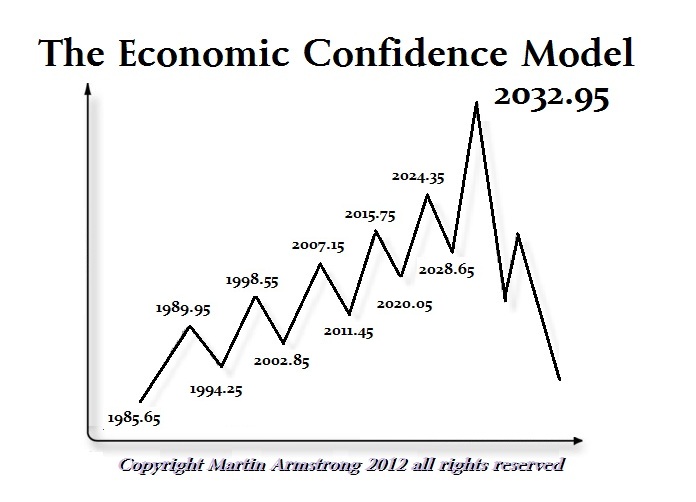
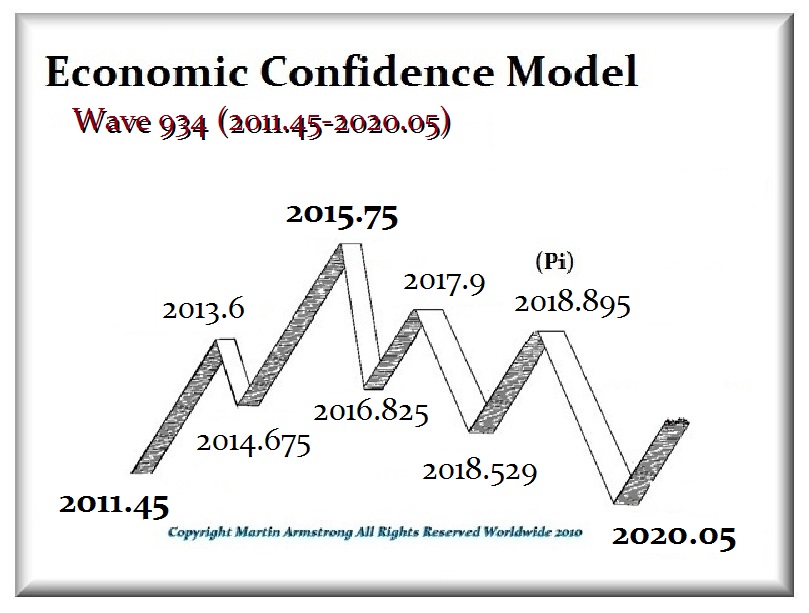
Four of those six global emergencies took place during the last ECM and this one began on the turn at the bottom. Since our disease model on influenza is a 13-year cycle, that is also pointing to 2022 as a crisis year. If this coronavirus has the same life-expectancy for its global spread before reaching a peak, that also points to 2022. The good news, the death rate seems to be legitimate and it still runs less than 3%.
This has the potential to reduce economic growth further on an overall global scale
COMMENT: Hi Martin,
I totally agree with you that there is absolutely ZERO evidence to support any conspiracy theories about a “weaponized virus”.
But I would like to stress that I still think there is no coincidence that the epicenter occurred in Wuhan where the only Chinese BSL-4 lab exists – a lab that only became fully operational last year, first major “bug” studied was SARS and one of the main researchers working there has published papers regarding novel coronaviruses and bats. I will point out that there have only been three further SARS incidents and TWO of them were due to lab problems with protocols.
I have worked in a few companies where we had BSL labs. There were always “accidents” – most due to typical human attempts to reduce work by ignoring protocols. If you step back and objectively look at probabilities for a novel SARS-like virus to suddenly erupt at exactly this point in time due to some random “shady seafood market” it just seems…highly improbable.
But I will point out that there are some confounding factors if you add in a brand new BSL-4 facility in the vicinity. There are a couple of obvious “vectors” for anyone who has worked in these labs and also understands China – my wife is from Sichuan and I’ve been to China (more than 10 cities across the cardinal directions).
#1: Lots of work at a BSL-4 lab actually takes place at a BSL-2 level. CDC and Chinese officials have pointed out that BSL-2 protocols are completely inadequate for 2019-nCoV.
#2: BSL-4 (and any serious study of both virii and bacterial agents) requires both incubations as well as “test subjects”. These can (and often do) bite…or at least escape from cages.
There is a good Lancet article on the Wuhan origins. Again, having worked in BSL related to study for infectious agents, the Lancet overview of infections and also knowing Chinese “culture” there are a couple of salient points:
#1 Gloves. If BSL-2 protocols were not sufficient and yet lots of tests were being run there….Gloves got contaminated. For the lab – no problems, just toss them out – but for any poor person picking through the garbage and suddenly finding a “treasure trove” of “hardly used” gloves…Well. I’ve been to these markets and the sellers all wore gloves. Filthy gloves.
The massive spike of infected people going to some random market suddenly got an incredible boost as a disease vector.
#2: Serious study of bats for SARS-like virii requires a LOT of bats. Likely brought from the original SARS site. If there is trade in bats…well…overstock is easily sold in the market.
The most interesting facet is not really the origin but the long-term effects on China. Both cultural and, for you models, financial. I think we are about to see a significant “step function” that will impact globally.
It is very significant to me that your model seems to have landed on the “tipping point” for the 2019-nCov. This is extremely significant and, from my perspective, likely to have much broader implications than even your models may predict.
take care and stay warm,
YK
REPLY: We may never know the precise origin. Whether the impact of this virus will be significant and run into 2022 is of extreme interest. There is no question the fact that this took place on the ECM turn date holds the potential for this to be very important. With the American CDC going to China, perhaps this will help to verify the true death rate and stop all the conspiracy stories which do not help us get a true picture of what is taking place. Conspiracy claims that it’s always far worse are the very foundation of the Climate Change activists.
Many have asked that since this Coronavirus appears to have caught everyone’s attention with the turn in the ECM on January 18th, 2020, the questions have poured in asking if this was a major event given our model had been projecting a rise in disease would begin in 2020 coinciding with the new Solar Cycle which should be the lowest in probably 200 years+ meaning colder weather. There is certainly an interesting correlation that we should not ignore. This at the very least warrants a review of the Spanish Flu which killed millions back in 1918.
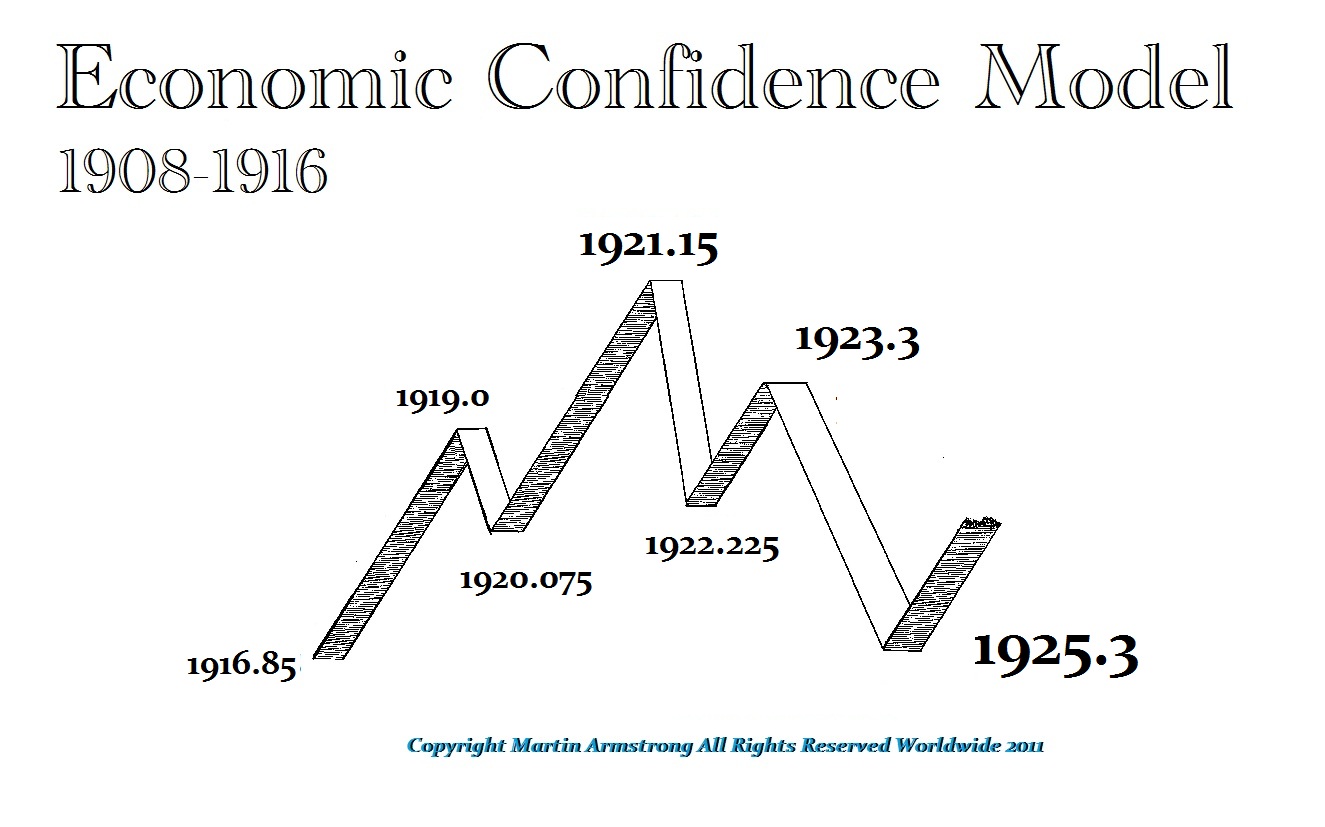
The first reported case in the Spanish Flue was March 4th, 1918. That did peak out by December 1918 so in that case it was more of the end rather than the beginning which aligned with the ECM. Therefore, the turning point was December 31/Jan 1, 1919. The Journal of the American Medical Association final edition of December 29, 1918 wrote:
“The 1918 has gone: a year momentous as the termination of the most cruel war in the annals of the human race; a year which marked, the end at least for a time, of man’s destruction of man; unfortunately a year in which developed a most fatal infectious disease causing the death of hundreds of thousands of human beings. Medical science for four and one-half years devoted itself to putting men on the firing line and keeping them there. Now it must turn with its whole might to combating the greatest enemy of all–infectious disease.”
While governments are seeking to impose travel restrictions, this virus has a lower death rate under 3% compared to the SARS outbreak of 2003 which reached a 10% death rate. However, what is different with this version of the virus is the infection rate is far greater. This virus escalates exponentially insofar as its infection rate. Clearly, this will impact tourism on a global scale for the media attention with this is far greater and the conspiracy spin is unbelievable from it being a biological weapon and something that was stolen from Canada.
The first reported cases of SARS back in 2003 took about a month before it translated into a surge in cases. Then there was a second surge of infection which hit the hospital sector which came about two months later. This version has a greater infection rate but a lower death rate. This introduces a risk of a greater potential for a pandemic. Therefore, our model shows choppiness in the financial markets until April and a general turning point come around May.
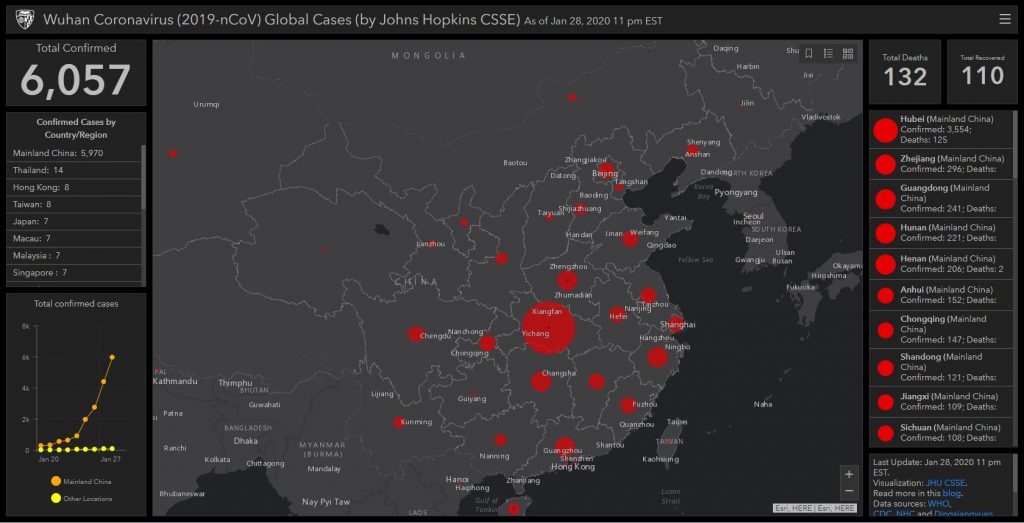
There is clearly a potential for a pandemic in this case of the yet unnamed 2019-nCoV which merits heightened concern. At the time of writing this post, there is still less than 7,000 cases. If the people infected in turn infect 2 to 4 others, compared to the normal flu which is about 1.4 infections, then the 6,000 could reach 200,000 within a couple of weeks. The total amount of infections under SARS was only 8,098 across the globe back in 2003. Therefore, given this version of a coronavirus has a faster infection rate, a pandemic appears likely. The question is our model is pointing to 2022. This virus has already begun to mutate. Does this imply it will mutate and continue into 2022 or will there be yet something else coming our way?
Many people are claiming that the death toll is really 10% and that China is lying. The CDC from America is flying there to assist so we will know a bit more about the veracity of that claim. They also claimed it was a biological weapon and it was stolen from a lab on Canada.
COMMENT: Thank you for not being the crazy doomsday guy who latches onto every story and then blows it out of proportion. The death rate is as you say, less than 3%. All the wild stories from nurses claiming there 90,000 infected to others trying to claim the death rate will rise to 10% or higher. These just scare tactics from the same people who always claim the end of the world is next week.
BE
ANSWER: The number of cases is up to 2,794 and the reported deaths at 80. The incubation period for this coronavirus is about 14 days. The incubation periods for the last two coronaviruses SARS and MERS, was 2 to 7 days and about 5 days, respectively, according to the CDC.
The duration might be 2 to 3 weeks before you recover fully, but that’s pretty much on par with most flu epidemics. There is absolutely no indication that this is a biological weapon. Had it been, China would NEVER have shared the genetic code. We still see the worst season with 4 different models converging on 2022.
I have pretty good sources and they do not expect this to cause a lot of deaths. As of January 24th, U.S. officials have screened more than 2,000 people from about 200 flights in the active entry screening program which is underway at five U.S. airports. There have been no cases identified as part of the program. China has halted ALL flights out of Wuhan, quarantined the entire city, and canceled major Lunar New Year celebrations.
I wish the world was ending next week. I am tired of paying outrageous taxes. It would be nice to migrate to a different plane of existence. Hopefully, they don’t have corrupt governments, regulations, and taxes there.
I have created this site to help people have fun in the kitchen. I write about enjoying life both in and out of my kitchen. Life is short! Make the most of it and enjoy!
This is a library of News Events not reported by the Main Stream Media documenting & connecting the dots on How the Obama Marxist Liberal agenda is destroying America











 Centinel2012