Posted originally on the CTH on March 3, 2023 | Sundance
Earlier today President Trump made a bold policy announcement, to create modern cities throughout the nation with the low cost use of a small portion of federally controlled land. A massive investment in a new infrastructure initiative that would rebuild and reignite the America First economic engine. {Direct Rumble Link}
“President Trump unveiled his new Quantum Leap plan that will create a new American future and modernize communities across the country. By building new cities, investing in transportation, lowering the cost of living for everyone, and modernizing public spaces across the country, President Trump has laid out a bold strategy to revolutionize the American Standard of Living.” more
While almost every other political candidate debates the best process for dividing up diminishing economic pie, this initiative doesn’t make the pie bigger, it creates new ones. This is bold leadership pushing the boundaries. WATCH:
[Transcript] – Past generations of Americans pursued big dreams and daring projects that once seemed absolutely impossible. They pushed across an unsettled continent and built new cities in the wild frontier. They transformed American life with the interstate highway system—magnificent it was. And they launched a vast network of satellites into orbit all around the earth.
But today, our country has lost its boldness. Under my leadership, we will get it back in a very big way. If you look at just three years ago, what we were doing was unthinkable, how good it was, how great it was for our country.
Our objective will be a quantum leap in the American Standard of Living. That’s what will happen. Here are just a few of the ways we can do it.
Almost one third of the land-mass of the United States is owned by the federal government. With just a very, very small portion of that land— just a fraction [of] one half of one percent—would you believe that? We should hold a contest to charter up to 10 new cities and award them to the best proposals for development.
In other words, we’ll actually build new cities in our country again. These Freedom Cities will reopen the frontier, reignite American imagination, and give hundreds of thousands of young people and other people, all hardworking families, a new shot at home ownership and in fact, the American Dream.
Another big opportunity is in transportation. Dozens of major companies in the U.S. and China are racing to develop vertical-takeoff-and-landing vehicles for families and individuals. Just as the United States led the automotive revolution in the last century, I want to ensure that America, not China, leads this revolution in air mobility. These breakthroughs can transform commerce, bring a giant infusion of wealth into RURAL America, and connect families and our country in new ways.
Likewise, through our Strategic National Manufacturing Initiative, which is going to be very big and very, very successful, we will turn forgotten communities into hives of industry, producing the goods we will no longer import from China.
We will also have a major initiative on lowering the cost of living, with a special focus on lowering the cost of a new car and lowering the cost to build a single-family home. And they will be beautiful homes.
And I will ask Congress to support “Baby Bonuses” for young parents to help launch a new baby boom.
Finally, I will challenge the governors of all 50 states to join me in a great modernization and beautification campaign—getting rid of ugly buildings, refurbishing our parks and our public spaces, making cities and towns more livable, ensuring a pristine environment, and building towering monuments to our true American heroes.
Very importantly, I will also make sure all of these new places are safe. We love and cherish our police. They will do the job the way they have to.
It is time to start talking about GREATNESS for our country again.
I will dramatically increase living standards and build a future that brings our country together through excitement, opportunity, and success.
President Trump proposes a national contest to charter up to 10 new cities on a very small portion of federal land and award these charters to the best ideas and proposals for development.
Of the approximately 640 million acres owned by the federal government, 10 charters roughly the size of the District of Columbia would amount to just a few one-hundredths of a percent—about 0.06%.
Freedom Cities will be built on federal land that is undeveloped and not part of any of our country’s magnificent national parks or other natural treasures. These cities will give hundreds of thousands of hardworking American families a new opportunity for home ownership and the American Dream.
Posted originally on the CTH on February 27, 2023 | Sundance
This is it. This is pure MAGA. President Trump is announcing the big one… “Economic Agenda 47“
This is the economic policy blade to drive a stake through the vampire heart of corporatism, globalism and the exploitation of the U.S. economy by multinational corporate interests. This “universal baseline tariff” approach, is the policy that slays the dragons of the World Economic Forum, destroys the Beijing dragon and simultaneously ends the EU Marshal Plan advantage. This is a big deal.
President Trump makes the economic policy announcement today, and it is an incredible structure of trade and economic proposals that would be resoundingly effective at restoring every financial mechanism within the United States as a sovereign country. The proposal is economic nationalism in policy form.
[Transcript] – “Joe Biden claims to support American manufacturing—but in reality, he is pushing the same pro-China globalist agenda that ripped the industrial heart out of our country. It ripped us apart. Biden and the globalists support RAISING taxes on American production. They support MORE crippling regulations killing American jobs. They support skyrocketing domestic energy costs. And they support massive anti-American multinational agreements that send our wealth and factories overseas.
Very simply, the Biden agenda taxes AMERICA to build up CHINA.
China is the big beneficiary. We cannot let that happen. And just a couple of years ago, it wasn’t happening. China paid to the United States hundreds of billions of dollars and no other president got ten cents. Legitimately, ten cents from China.
My agenda will tax CHINA to build up AMERICA.
The heart of my vision is a sweeping pro-American overhaul of our tax and trade policy to move from the Biden system that punishes domestic producers and rewards outsourcers, to a system that REWARDS domestic production and taxes FOREIGN companies and those who export American Jobs. They will be rewarded and rewarded greatly. And our country will benefit.
To achieve this goal, we will phase in a system of universal, baseline tariffs on most foreign products. On top of this, higher tariffs will increase incrementally depending on how much individual foreign countries devalue their currency. They devalue their currency to take advantage of the United States, and they subsidize their industries, or otherwise engage in trade cheating and abuse. And they do it now like never before, and we had it largely stopped and it was going to be stopped completely within less than a year.
As tariffs on foreign producers go up, taxes on American producers will go down and go down very substantially. And that means a lot of jobs coming in.
Not only will this system end our gaping trade deficits—and they are massive right now—and bring back millions of American jobs—it will also bring trillions and trillions of dollars pouring into the U.S. Treasury from foreign countries and allow us to invest that money in American workers, American families, and American communities.
This plan will be the linchpin of a new Strategic National Manufacturing Initiative, that builds on my historic success in ending NAFTA, which was a tremendous thing, a tremendous achievement, nobody thought it could be done, and we did USMCA—US-Mexico-Canada, and it was an incredible thing. But we’re also going to end other unfair trade deals, and we’ll end them quickly.
In addition, as a matter of both economic and national security, I will implement a bold series of reforms to completely eliminate dependence on China in all critical areas.
We will revoke China’s Most Favored Nation trade status, and adopt a 4-year plan to phase out all Chinese imports of essential goods—everything from electronics to steel to pharmaceuticals. This will include strong protections to ensure China cannot circumvent restrictions by passing goods through conduit countries—countries that don’t make a product, but all of a sudden they’re making a lot of the product, it comes right through China, right out of China, and right into our country.
We will also adopt new rules to stop U.S. companies from pouring investments into China, and to stop China from buying up America, allowing all of those investments that clearly serve American interests. We’re not going to allow bad things to happen to our country anymore. And we will eliminate federal contracts for any company that outsources to China.
Biden will never get the job done. He is weak on China because the corrupt Biden family has received millions and millions of dollars from entities tied to the Chinese Communist Party. Everybody knows that. They try and hide it, and the Fake News doesn’t want to talk about it.
Biden’s pro-China economic program puts America LAST, and it’s killing our country—my cutting-edge trade agenda will revitalize our economy by once again putting America FIRST.
And by the way, we’ll get along very well with China. And you know what the reason is? They’ll respect us again, like they did just two years ago.
We will quickly become a manufacturing powerhouse like the world has never seen before.
♦UNIVERSAL BASELINE TARIFFS: President Trump has announced a plan to replace the Biden system of punishing domestic producers and rewarding outsourcers with a new system that rewards domestic production while taxing foreign companies.
Rather than raising taxes on American producers, President Trump will impose tariffs on FOREIGN producers through a system of universal baseline tariffs on most imported goods.
Higher tariffs will increase incrementally if other countries manipulate their currency or otherwise engage in unfair trading practices.
As tariffs on foreign countries go up, taxes on American workers, families, and businesses can come down.
The Biden administration has proposed nearly $2 trillion in tax increases on American citizens and levied draconian tax hikes on Americans’ household energy, 401ks, and pension plans.
The Biden administration’s globalist policies sell out American citizens and result in a windfall for foreign countries.
In 2022, the United States trade deficit reached $948.1 billion, the largest on record, and the agricultural trade deficit exceeded $2 billion.
President Trump’s trade policy is firmly rooted in American history. America used to impose tariffs on over 95% of all imports, and for decades the federal government took in over 80% of its revenue by taxing foreign producers through tariffs—not by taxing American workers and businesses.
♦ENDING RELIANCE ON CHINA: President Trump’s America First trade policy will completely eliminate U.S. dependence on China–the primary beneficiary of Democrats’ globalist agenda.
In addition to universal baseline tariffs on most foreign goods, President Trump’s plan will reclaim our economic independence from China. President Trump will revoke China’s Most Favored Nation trade status and adopt a 4-year plan to phase out all Chinese imports of essential goods—everything from electronics to steel to pharmaceuticals. This will include strong protections to ensure China cannot circumvent restrictions by passing goods through conduit countries.
President Trump will establish new rules to stop U.S. companies from investing in China and stop China from buying up America, allowing only those investments that serve American interests.
President Trump will ban federal contracts for any company that outsources to China.
Under Biden and the Democrats, American wealth and jobs are being exported to China.
The U.S. trade deficit with China has risen almost 10% under Biden to $382.9 billion last year alone.
♦A BETTER DEAL FOR AMERICAN WORKERS, FAMILIES, AND COMMUNITIES: President Trump’s plans will bring back millions of American jobs and generate trillions of dollars of new wealth to strengthen American society.
President Trump’s tariff plans will be the linchpin of a new Strategic National Manufacturing Initiative that will rebalance the global trading system and dramatically strengthen America.
Raising tariffs on foreign producers while lowering taxes for domestic producers will help keep jobs and wealth in the United States.
Higher tariffs create millions of new jobs, increase real household income, boost GDP, increase domestic manufacturing output, and generate hundreds of billions of dollars in new government revenue.
President Trump’s universal baseline tariffs will restore a level playing field for American businesses worldwide.
U.S. exports have historically faced higher tariffs from foreign countries than nearly all of America’s trade competitors.
President Trump will build on his historic success in abolishing NAFTA, which Joe Biden voted for, after which 60,000 factories closed and 4.5 million manufacturing jobs were lost. President Trump replaced NAFTA with the USMCA, a historic breakthrough in leveling the playing field for American workers, famers, and manufacturers.
Fortunately, we do not have to guess if President Trump is correct. We have his actual economic policy results to look at and see how the expansion of the economy was creating the type of growth that would sustain Social Security and Medicare. This was/is MAGAnomics at work.
…. Make America Great Again!
We know it works, because we have the results to cite.
It was the Fourth Quarter of 2019…..
Right before the pandemic would hit a few months later…. Despite two years of doomsayer predictions from Wall Street’s professional punditry, all of them saying Trump’s 2017 steel and aluminum tariffs on China, Canada and the EU would create massive inflation, it just wasn’t happening!
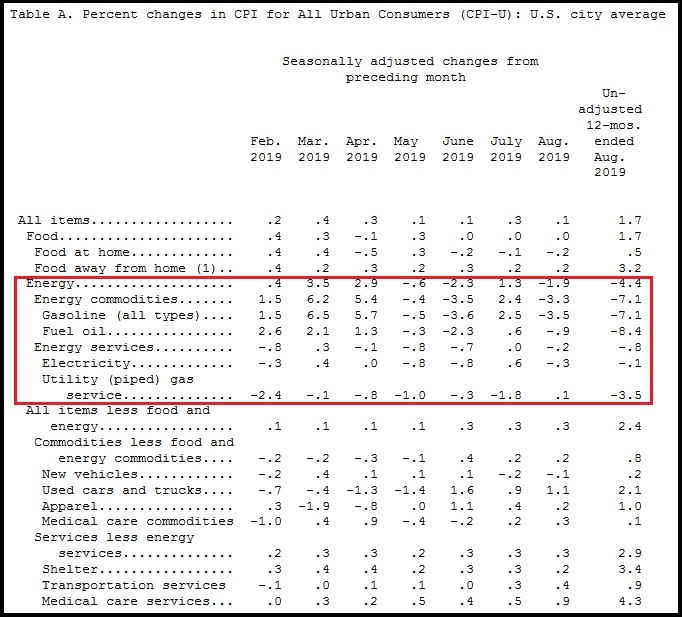
Overall year-over-year inflation was hovering around 1.7 percent [Table-A BLS]; yup, that was our inflation rate. The rate in the latter half of 2019 was firmed up with less month-over-month fluctuation, and the rate basically remained consistent. [See Below] The U.S. economy was on a smooth glide path, strong, stable and Main Street was growing with MAGAnomics at work.
A couple of important points. First, unleashing the energy sector to drive down overall costs to consumers and industry outputs was a key part of President Trump’s America-First MAGAnomic initiative. Lower energy prices help the worker economy, middle class and average American more than any other sector.
Which brings us to the second important point. Notice how food prices had very low year-over-year inflation, 0.5 percent. That is a combination of two key issues: low energy costs, and the fracturing of Big Ag hold on the farm production and the export dynamic:
(BLS) […] The index for food at home declined for the third month in a row, falling 0.2 percent. The index for meats, poultry, fish, and eggs decreased 0.7 percent in August as the index for eggs fell 2.6 percent. The index for fruits and vegetables, which rose in July, fell 0.5 percent in August; the index for fresh fruits declined 1.4 percent, but the index for fresh vegetables rose 0.4 percent. The index for cereals and bakery products fell 0.3 percent in August after rising 0.3 percent in July. (link)
For the previous twenty years food prices had been increasingly controlled by Big Ag, and not by normal supply and demand. The commodity market became a ‘controlled market’. U.S. food outputs (farm production) was controlled and exported to keep the U.S. consumer paying optimal prices.
President Trump’s trade reset was disrupting this process. As farm products were less exported the cost of the food in our supermarket became reconnected to a ‘more normal’ supply and demand cycle. Food prices dropped and our pantry costs were lowered.
The Commerce Dept. then announced that retail sales climbed by 0.4 percent in August 2019, twice as high as the 0.2 percent analysts had predicted. The result highlighted retail sales strength of more than 4 percent year-over-year. These excellent results came on the heels of blowout data in July, when households boosted purchases of cars and clothing.
The better-than-expected number stemmed largely from a 1.8 percent jump in spending vehicles. Online sales, meanwhile, also continued to climb, rising 1.6 percent. That’s similar to July 2019, when Amazon held its two-day, blowout Prime Day sale. (link)
Despite the efforts to remove and impeach President Trump, it did not look like middle-class America was overly concerned about the noise coming from the pundits. Likely that’s because blue-collar wages were higher, Main Street inflation was lower, and overall consumer confidence was strong. Yes, MAGAnomics was working.
Additionally, remember all those MSM hours and newspaper column inches where the professional financial pundits were claiming Trump’s tariffs were going to cause massive increases in prices of consumer goods?
Well, exactly the opposite happened [BLS report] Import prices were continuing to drop:
This was a really interesting dynamic that no-one in the professional punditry would dare explain.
Donald Trump’s tariffs were targeted to specific sectors of imported products. [Steel, Aluminum, and a host of smaller sectors etc.] However, when the EU and China respond by devaluing their currency, that approach hit all products imported, not just the tariff goods.
Because the EU and China were driving up the value of the dollar, everything we were importing became cheaper. Not just imports from Europe and China, but actually imports from everywhere. All imports were entering the U.S. at substantially lower prices.
This meant when we imported products, we were also importing deflation.
This price result is exactly the opposite of what the economic experts and Wall Street pundits predicted back in 2017 and 2018 when they were pushing the rapid price increase narrative.
Because all the export dependent economies were reacting with such urgency to retain their access to the U.S. market, aggregate import prices were actually lower than they were when the Trump tariffs began:
[…] Prices for imports from China edged down 0.1 percent in August following decreases of 0.2 percent in both July and June. Import prices from China have not advanced on a monthly basis since ticking up 0.1 percent in May 2018. The price index for imports from China fell 1.6 percent for the year ended in August.
[…] Import prices from the European Union fell 0.2 percent in August and 0.3 percent over the past 12 months.
So yes, we know President Trump can save Social Security and Medicare by expanding the economy with his America First economic policy. We do not need to guess if it is possible or listen to pundits theorize about his approach being some random ‘catch phrase’ disconnected from reality. Yes folks, we have the receipts.
This was MAGAnomics at work, and this is entirely what created the middle-class MAGA coalition. No other Republican candidate has this economic policy in their outlook because all other candidates are purchased by the Wall Street multinationals.
America First MAGAnomics is unique to President Trump because he is the only one independent enough to implement them.
That’s just the reality of the situation. They hate him for it…
Author’s note as said in 2016: “If I absolutely did not believe this economic model was doable, I would never expand the concept and place advocacy upon it. I am an absolute believer that we can, as a nation, reignite a solid manufacturing base and generate an expanding middle class.” Yes, I bet on Trump, and he was right.
Posted originally on the CTH on February 8, 2023 | Sundance
Just an fyi, I encountered this issue with Twitter and cannot even express the problem on The Twitter due to the restriction.
If you want to help share the word, see if you can retweet this notification.
Like I said I cannot tweet or reply to tweets. So I have no way to notify followers or those who use Twitter to get feeds from CTH.
The CTH Account: “TheLastRefuge2” sent or re-tweeted 15 times today. Apparently, there’s a new limit. Additionally, exceeding the limit also means I cannot reply to any messages. So, there’s that.
Posted originally on the conservative Tree house on February 8, 2023 | Sundance
Sundance is that quietly salty cuss who prefers to swing the sharp machete alone amid the deep weeds; clearing the path simply for the sake of creating clarity and larger understanding about the topography of the stuff the professional political class would prefer to keep hidden in the weeds. At times, he settles himself atop the bluff, opens his lunchbox and thermos to eat a simple sandwich, shirt sleeves will suffice as a napkin, while looking at the flow coming into the clearing…
Amid this era of insufferable pretending, our dear and rebellious non-pretending CTH friend, the Great Lou Dobbs, is a voice to cherish – he gets it. There is a wisdom that comes with age and experience battling against the Machiavellian schemes of the professional political class; it also can make you quick-tempered, and that’s ok. Hell, it’s to be expected.
In this brief video segment {Direct Rumble Link}, Lou Dobbs cuts to the chase when analyzing the Republican party rebuttal to the Joe Biden state of the union speech. Arkansas Governor Sarah Huckabee-Sanders delivered the remarks, they were poignant deliberate and accurate; however, they were also party managed, and party approved.
Just as Lou Dobbs has accurately and presciently called the Wall Street play-by-play for decades, amid the multinational schemes of the U.S. Chamber of Commerce & Business Roundtable, Mr Dobbs accurately notes the Republican Governor’s Association (RGA) as the originating approvers for the prepared rebuttal. WATCH:
The Great Lou Dobbs is 100% correct.
The approved GOPe script, a construct of multinational financial influence and background motive, was/is intended to write President Donald Trump out of the Republican political framework. Governor Huckabee-Sanders went along with the plan. She, along with all of the non-pretenders, knows this, as all of them do. It is a sad acceptance to realize just how metastasized the political cancer has become, and how few can hold firm against the power of the corrupt political apparatus.
As I said last night, Huckabee-Sanders points about the damage from the Biden administration were accurate and well delivered.
That said, her acquiescence to the machinery of the professional republican system is both disheartening and pathetic.
Oh sure, she will backtrack sometime soon, filled with artificial pearl-clutching prose and promises of mistaken intent…. that’s the way it rolls. But once you see the strings attached to the marionettes you can never unsee them. Authenticity, trust and integrity are lost in sunlight moments when decisions are made.
CTH noted several weeks ago that based on the background moves in advance of Ron DeSantis’s reelection efforts, it became increasingly clear the Republican Governor’s Association (RGA) was going to play a bigger role in 2024 in full alignment with the GOP establishment.
In some ways the leveraging of the RGA is the difference between the Big Club’s 2016 (Jeb!) effort, and the 2024 (Ron!) effort. It was obvious in 2022 with the amount of money the RGA poured into the FL governor’s coffers, a reelection race with a consistent double point lead, the RGA was not doing it for the 2022 reelection – they were building the DeSantis war chest for 2024.
The DeSantis management and branding group are in alignment with, and in close coordination with, the RGA.
At CTH we accept things as they are, not as we would wish them to be.
The Big Club is fooling many, but not here, not now and not today – or ever.
Once you see the strings on the marionettes, you can never return to that moment in the performance when you did not see them.
There are far more of us than them, and once people realize the scale of the duplicity and professional Republican corruption, the backlash against this Big Club branding and management team -together with their “influencers” and willing conscripts- is going to leave a lot of “conservative pundits” very isolated, alone and irrelevant.
Posted originally on the CTH on February 7, 2023 | Sundance
Speaking in plain terms without jargon or political catch phrase, President Donald Trump presents the non-pretending state of our union in a prebuttal to Joe Biden’s national impression of Baghdad Bob tonight. {Direct Rumble Link Here} WATCH:
Posted originally on the CTH on February 2, 2023 | Sundance
This is so critically important to the understanding of the core, central element where the globalism atom splits and the resulting destruction begins, that I must pause all personal recovery efforts -immediately- and explain. This is an incredible example of where corporations and government merge. This is the atom split. This is the root, the nub, the place where “trillions at stake” takes context.
Strong HatTip to Gateway Pundit for this exceptional video and example {Direct Rumble Link Here}. The understanding comes via a Canadian dairy farmer, who, like thousands of other farmers around the world, is a private business under government control. This example is about dairy, specifically milk, however, the underlying premise goes much further.
This is modern corporatism, the nexus of govt intervention, regulations and the multinational exploitation of industry. This is also the globalist example that shows how the concepts of “capitalism” and “free markets” have been destroyed. First, watch the video:
What you are witnessing in that video is something we have talked about at length for years.
Influential people, politicians (rules) and corporate leaders (profits), both with vested financial interests in the process, have sold a narrative that global manufacturing, global sourcing, and global production is the inherent way of the future. The same voices claimed the American economy was/is consigned to become a “service-driven economy.”
What was always missed in these discussions is that advocates selling this global-economy message have a vested financial and ideological interest in convincing the information consumer it is all just a natural outcome of economic progress.
It’s not.
It’s not natural at all. It is a process that is entirely controlled, promoted and utilized by large conglomerates, lobbyists, purchased politicians and massive multinational corporations.
To understand who opposes President Trump, Jair Bolsonaro, or any economic nationalist, specifically because of the economic leverage against multinational corporations their policy creates, it becomes important to understand the objectives of the global and financial elite who run and operate the institutions. The Big Club.
Understanding how trillions of trade dollars influence geopolitical policy we begin to understand the three-decade global financial construct they seek to protect. That is, global financial exploitation of national markets.
FOUR BASIC ELEMENTS:
♦Multinational corporations purchase controlling interests in various national outputs (harvests and raw materials), and ancillary industries, of developed industrial western nations. {example}
♦The Multinational Corporations making the purchases are underwritten by massive global financial institutions, multinational banks. (*note* in China it is the communist government underwriting the purchase)
♦The Multinational Banks and the Multinational Corporations then utilize lobbying interests to manipulate the internal political policy of the targeted nation state(s).
♦With control over the targeted national industry or interest, the multinationals then leverage export of the national asset (exfiltration) through trade agreements structured to the benefit of lesser developed nation states – where they have previously established a proactive financial footprint.
For three decades economic “globalism” has advanced, quickly. Everyone accepts this statement, yet few actually stop to ask who and what are behind this – and why?
Every element of global economic trade is controlled and exploited by massive institutions, multinational banks and multinational corporations.
Institutions like the World Trade Organization (WTO), World Bank and International Monetary Fund (IMF), control trillions of dollars in economic activity. Underneath that economic activity there are people who hold the reins of power over the outcomes. These individuals and groups are the stakeholders in direct opposition to principles of America-First national economics.
The modern financial constructs of these entities have been established over the course of the past three decades. When you understand how they manipulate the economic system of individual nations you begin to understand why they are so fundamentally opposed to President Trump.
In the Western World, separate from communist control perspectives (ie. China), “Global markets” are a modern myth; nothing more than a talking point meant to keep people satiated with sound bites they might find familiar; but the truth is ‘global markets’ have been destroyed over the past three decades by multinational corporations who control the products formerly contained within global markets. This is the function of the World Economic Forum.
The same is true for “Commodities Markets.” The multinational trade and economic system, run by corporations and multinational banks, now controls the product outputs of independent nations. The free market economic system has been usurped by entities who create what is best described as ‘controlled markets’.
Bulletpoint #1:♦ Multinational corporations purchase controlling interests in various national elements of developed industrial western nations.
This is perhaps the most challenging to understand. In essence, thanks specifically to the way the World Trade Organization (WTO) was established in 1995, national companies expanded their influence into multiple nations, across a myriad of industries and economic sectors (energy, agriculture, raw earth minerals, etc.).
This is the basic underpinning of national companies becoming multinational corporations.
Think of these multinational corporations as global entities now powerful enough to reach into multiple nations -simultaneously- and purchase controlling interests in a single economic commodity.
A historic reference point might be the original multinational enterprise, energy via oil production. (Exxon, Mobil, BP, etc.)
However, in the modern global world, it’s not just oil; the resource and product procurement extend to virtually every possible commodity and industry. From the very visible (wheat/corn) to the obscure (small minerals, and even flowers).
Bulletpoint #2 ♦ The Multinational Corporations making the purchases are underwritten by massive global financial institutions, multinational banks.
During the past several decades national companies merged. The largest lemon producer company in Brazil, merges with the largest lemon company in Mexico, merges with the largest lemon company in Argentina, merges with the largest lemon company in the U.S., etc. etc. National companies, formerly of one nation, become “continental” companies with control over an entire continent of nations.
…. or it could be over several continents or even the entire world market of Lemon/Widget production. These are now multinational corporations. They hold interests in specific segments (this example lemons) across a broad variety of individual nations.
National laws on Monopoly building are not the same in all nations. Most are not as structured as the U.S.A or other more developed nations (with more laws). During the acquisition phase, when encountering a highly developed nation with monopoly laws, the process of an umbrella corporation might be needed to purchase the targeted interests within a specific nation. The example of Monsanto applies here.
Bulletpoint #3 ♦The Multinational Banks and the Multinational Corporations then utilize lobbying interests to manipulate the internal political policy of the targeted nation state(s).
In underdeveloped countries the process of buying a political outcome is called bribery. Within the United States we call it lobbying. The process is exactly the same.
With control of the majority of actual lemons the multinational corporation now holds a different set of financial values than a local farmer or national market. This is why commodities exchanges are essentially dead. In the aggregate the mercantile exchange is no longer a free or supply-based market; it is now a controlled market exploited by mega-sized multinational corporations.
Instead of the traditional ‘supply/demand’ equation determining prices, the corporations look to see what nations can afford what prices. The supply of the controlled product is then distributed to the country according to their ability to afford the price. This is essentially the bastardized and politicized function of the World Trade Organization (WTO). This is also how the corporations controlling WTO policy maximize profits.
Back to the lemons. A corporation might hold the rights to the majority of the lemon production in Brazil, Argentina and California/Florida. The price the U.S. consumer pays for the lemons is directed by the amount of inventory (distribution) the controlling corporation allows in the U.S.
If the U.S. lemon harvest is abundant, the controlling interests will export the product to keep the U.S. consumer spending at peak or optimal price. A U.S. customer might pay $2 for a lemon, a Mexican customer might pay .50¢, and a Canadian $1.25.
The bottom line issue is the national supply (in this example ‘harvest/yield’) is not driving the national price because the supply is now controlled by massive multinational corporations.
The mistake people often make is calling this a “global commodity” process. In the modern era this “global commodity” phrase is particularly nonsense.
A true global commodity is a process of individual nations harvesting/creating a similar product and bringing that product to a global market. Individual nations each independently engaged in creating a similar product.
Under modern globalism this process no longer takes place. It’s a complete fraud. Massive multinational corporations control the majority of production inside each nation and therefore control the global product market and price. It is a controlled system.
EXAMPLE: Part of the lobbying in the food industry is to advocate for the expansion of U.S. taxpayer benefits to underwrite the costs of the domestic food products they control. By lobbying DC these multinational corporations get congress and policy-makers to expand the basis of who can use EBT and SNAP benefits (state reimbursement rates).
Expanding the federal subsidy for food purchases is part of the corporate profit dynamic.
With increased taxpayer subsidies, the food price controllers can charge more domestically and export more of the product internationally. Taxes, via subsidies, go into their profit margins. The corporations then use a portion of those enhanced profits in contributions to the politicians. It’s a circle of money.
In highly developed nations this multinational corporate process requires the corporation to purchase the domestic political process (as above) with individual nations allowing the exploitation in varying degrees. As such, the corporate lobbyists pay hundreds of millions to politicians for changes in policies and regulations; one sector, one product, or one industry at a time.
These are specialized lobbyists.
EXAMPLE: The Committee on Foreign Investment in the United States (CFIUS)
CFIUS is an inter-agency committee authorized to review transactions that could result in control of a U.S. business by a foreign person (“covered transactions”), in order to determine the effect of such transactions on the national security of the United States.
CFIUS operates pursuant to section 721 of the Defense Production Act of 1950, as amended by the Foreign Investment and National Security Act of 2007 (FINSA) (section 721) and as implemented by Executive Order 11858, as amended, and regulations at 31 C.F.R. Part 800.
The CFIUS process has been the subject of significant reforms over the past several years. These include numerous improvements in internal CFIUS procedures, enactment of FINSA in July 2007, amendment of Executive Order 11858 in January 2008, revision of the CFIUS regulations in November 2008, and publication of guidance on CFIUS’s national security considerations in December 2008 (more)
Bulletpoint #4 ♦ With control over the targeted national industry or interest, the multinationals then leverage export of the national asset (exfiltration) through trade agreements structured to the benefit of lesser developed nation states – where they have previously established a proactive financial footprint.
The process of charging the U.S. consumer more for a product, that under normal national market conditions would cost less, is a process called exfiltration of wealth. This is the basic premise, the cornerstone, behind the catchphrase ‘globalism‘.
It is never discussed.
To control the market price some contracted product may even be secured and shipped with the intent to allow it to sit idle (or rot). This is where the dumping of the milk comes into play. None of this is a market driven outcome. All of this is being controlled by guiding hands of politicians, rule makers, and the partnership with the private sector corporations.
It’s all about controlling the price and maximizing the profit equation. We are discussing food and agricultural production, but the issue (the process of control) covers far more than just food, farming and Ag in general. It’s everything folks. Everything.
To gain the same $1 profit a widget multinational might have to sell 20 widgets in El-Salvador (.25¢ each), or two widgets in the U.S. ($2.50/each).
Think of the process like the historic reference of OPEC (Organization of Petroleum Exporting Countries). Only in the modern era massive corporations are playing the role of OPEC and it’s not oil being controlled, thanks to the WTO it’s almost everything.
Again, this is highlighted in the example of taxpayers subsidizing the food sector (EBT, SNAP etc.), the multinational corporations can charge domestic U.S. consumers more.
Ex. more beef is exported, red meat prices remain high at the grocery store, but subsidized U.S. consumers can better afford the high prices.
Of course, if you are not receiving food payment assistance (middle-class) you can’t eat the steaks because you can’t afford them. (Not accidentally, it’s the same scheme in the ObamaCare healthcare system)
Agriculturally, multinational corporate Monsanto says: ‘all your harvests are belong to us‘. Contract with us, or you lose because we can control the market price of your end product.
The downside is that once you sign that contract, you agree to terms that are entirely created by the financial interests of the larger corporation, not your farm. Additionally, the rule makers (govt), are working hand in glove with the corporations who control the outcome.
The multinational agriculture lobby is massive. We willingly feed the world as part of the system; but you as a grocery customer pay more per unit at the grocery store because domestic supply no longer determines domestic price.
Within the agriculture community the (feed-the-world) production export factor also drives the need for labor. Labor is a cost. The multinational corps have a vested interest in low labor costs. Ergo, open border policies. (ie. willingly purchased republicans not supporting border wall etc.).
This corrupt economic manipulation/exploitation applies over multiple sectors, and even in the sub-sector of an industry like steel. China/India purchases the raw material, coking coal, then sells the finished good (rolled steel) back to the global market at a discount. Or it could be rubber, or concrete, or plastic, or frozen chicken parts etc.
The ‘America First’ Trump-Trade Doctrine upsets the entire construct of this multinational export/control dynamic. Team Trump focus exclusively on bilateral trade deals, with specific trade agreements targeted toward individual nations (not national corporations).
‘America-First’ is also specific policy at a granular product level looking out for the national interests of the United States, U.S. workers, U.S. companies and U.S. consumers.
Under President Trump’s Trade positions, balanced and fair trade with strong regulatory control over national assets, exfiltration of U.S. national wealth is essentially stopped.
This puts many current multinational corporations, globalists who previously took a stake-hold in the U.S. economy with intention to export the wealth, in a position of holding contracted interest of an asset they can no longer exploit.
Perhaps now we understand better how massive multi-billion multinational corporations and institutions are aligned against President Trump. In essence, Donald Trump is the anti-WEF weapon of the American people.
They will even organize a western corporate war against Russia to stop anyone from blocking their financial goals.
Posted originally on the CTH on January 26, 2023 | Sundance
President Trump transmitted a message to congress, warning them not to cut Social Security and Medicare {Direct Rumble Link}. Many politicians and pundits will look at Trump’s position from the perspective of it being good to campaign for older voters, but that’s not the core of his reasoning.
In 2016 CTH was the first place to evaluate the totality of President Trump’s economic policies; specifically, as those policies related to the entitlement programs around Social Security and Medicare. We outlined the approach Trump was putting forth and the way he was approaching the issue. In the years that followed, he was right. He was creating a U.S. economy that could sustain all of the elements the traditional political class were calling “unsustainable.”
Before getting to the details, here’s his video message and policy as delivered yesterday. WATCH:
Fortunately, we do not have to guess if President Trump is correct. We have his actual economic policy results to look at and see how the expansion of the economy was creating the type of growth that would sustain Social Security and Medicare. This was/is MAGAnomics at work.
♦ On Social Security – Unlike many other 2016 Republican candidates, Donald Trump did NOT call for rapid or wholesale changes to the current Social Security program; and there’s a very good reason why he was the only candidate who did not propose wholesale changes.
With the single caveat of “high income retirees” (over $250k annually), which previously Trump said he was open to negotiating on, President Trump does not consider these programs as “entitlements”. The American people pay into them, and the federal government has an obligation to fulfill the promises made upon collection.
To fully understand how Donald Trump views the solvency of Social Security, you must again understand his economic model and how it outlines growth.
The issue with Social Security, as viewed by Trump, is more of an issue with receipts and expenditures. If the aggregate U.S. economy is growing by a factor larger than the distribution needed to fulfill its entitlement obligations, then no wholesale change on expenditure is needed. The focus needs to be on continued and successful economic growth.
What you will find in all of Donald Trump’s positions, is a paradigm shift he necessarily understood must take place in order to accomplish the long-term goals for the U.S. citizen as it relates to “entitlements” or “structural benefits”.
All other candidates and politicians begin their policy proposals with a fundamentally divergent perception of the U.S. economy.
The customary political economy theory, carried by most politicians, positions them with an outlook of the U.S. economy based on “services”; a service-based economic model.
While this economic path has been created by decades old U.S. policy and is ultimately the only historical economic path now taught in school, President Trump initiated his economy policy with the intention to change the dynamic entirely, and that’s exactly what he did.
Because so many shifts -policy nudges- have taken place in the past several decades, few academics and even fewer MSM observers, were able to understand how to get off this path and chart a better course.
Donald Trump proposed less dependence on foreign companies for cheap goods, (the cornerstone of a service economy) and a return to a more balanced U.S. larger economic model where the manufacturing and production base can be re-established and competitive based on American entrepreneurship and innovation. This is the essence of MAGAnomics.
The key words in the prior statement are “dependence” and “balanced”. When a nation has an industrial manufacturing balance within the GDP there is far less dependence on the economic activity in global markets. In essence the U.S. can sustain itself, absorb global economic fluctuations and expand itself or contract itself depending on the free market.
When there is no balance, there is no longer a free market. The free market is sacrificed in favor of dependency, whether it’s foreign oil or foreign manufacturing, the dependency outcome is essentially the same. Without balance there is an inherent loss of economic independence, and a consequential increase in economic risk.
No other economy in the world innovates like the U.S.A. President Donald Trump saw/sees this as a key advantage across all industry – including manufacturing and technology.
The benefit of cheap overseas labor, which is considered a global market disadvantage for the U.S., is offset by utilizing innovation and energy independence. This was the core of the economic program that created so much immediate GDP growth in 2017, 2018 and 2019.
2017: […] “This policy will be successful in moving the U.S. economy away from low-growth secular stagnation towards significantly more buoyant performance. We would not be taken by surprise by a doubling of the growth rate of real GDP in the U.S. over the next two years, nor by a further significant move up of equity valuations and a material further appreciation of the dollar.” ~ David Folkerts-Landau, Chief Economist, Deutsche Bank
The third highest variable cost of goods beyond raw materials first, labor second, is energy. If the U.S. energy sector was unleashed -and fully developed- the manufacturing price of any given product would allow for global trade competition even with higher U.S. wage prices. This is why President Trump traveled to Saudi Arabia as his first foreign trip, followed closely by a trip to Asia. He was putting the basics of his U.S. economic policy into place.
Additionally, the U.S. has a key strategic advantage with raw manufacturing materials such as: iron ore, coal, steel, precious metals and vast mineral assets which are needed in most new modern era manufacturing. President Trump proposed we stopped selling these valuable national assets to countries we compete against – they belong to the American people; they should be used for the benefit of American citizens. Period. This was the central point of the Steel and Aluminum tariffs.
EXAMPLE: Prior to President Trump, China was buying and recycling our heavy (steel) and light (aluminum) metal products (for pennies on the original manufacturing dollar) and then using those metals to reproduce manufactured goods for sale back to the U.S.
As President, Donald Trump stopped that practice immediately, triggering a policy expectation that we do the manufacturing ourselves with the utilization of our own resources. Then he leveraged any sales of these raw materials in our international trade agreements.
When you combine FULL resource development (in a modern era) with the removal of over-burdensome regulatory and compliance systems, necessarily filled with enormous bureaucratic costs, Donald Trump began lowering the cost of production and the U.S. became globally competitive. In essence, Trump changed the economic paradigm, and we no longer were a dependent nation relying on a service driven economic model.
The cornerstone to the success of this economic turnaround was the keen capability of the U.S. worker to innovate on their own platforms. Americans, more than any country in the world, just know how to get things accomplished. Independence and self-sufficiency are part of the DNA of the larger American workforce.
In addition, as we saw in 2018 and 2019, an unquantifiable benefit came from investment, where the smart money play -to get increased return on investment- became putting capital INTO the U.S. economy, instead of purchasing foreign stocks.
With all of the above opportunities in mind, this is how President Trump put us on a pathway to rebuilding our national infrastructure.
The demand for labor increased, and as a consequence so too did the U.S. wage rate which was stagnant (or non-existent) for the past three decades.
As the wage rate increased, and as the economy expanded, the governmental dependency model was reshaped and simultaneously receipts to the U.S. treasury improved.
More money into the U.S Treasury and less dependence on welfare/social service programs have a combined exponential impact. You gain a dollar and have no need to spend a dollar – the saved sum is doubled. That was how the SSI and safety net programs were positioned under President Trump. Again, this is MAGAnomics.
When you elevate your America First economic thinking you begin to see that all of the “entitlements” or expenditures become more affordable with an economy that is fully functional.
As the GDP of the U.S. expands, so does our ability to meet the growing need of the retiring U.S. worker. We stop thinking about how to best divide a limited economic pie and begin thinking about how many more economic pies we can create. Simply put, we begin to….
…. Make America Great Again!
We know it works, because we have the results to cite.
It was the Fourth Quarter of 2019…..
Right before the pandemic would hit a few months later…. Despite two years of doomsayer predictions from Wall Street’s professional punditry, all of them saying Trump’s 2017 steel and aluminum tariffs on China, Canada and the EU would create massive inflation, it just wasn’t happening!
Overall year-over-year inflation was hovering around 1.7 percent [Table-A BLS]; yup, that was our inflation rate. The rate in the latter half of 2019 was firmed up with less month-over-month fluctuation, and the rate basically remained consistent. [See Below] The U.S. economy was on a smooth glide path, strong, stable and Main Street was growing with MAGAnomics at work.
A couple of important points. First, unleashing the energy sector to drive down overall costs to consumers and industry outputs was a key part of President Trump’s America-First MAGAnomic initiative. Lower energy prices help the worker economy, middle class and average American more than any other sector.
Which brings us to the second important point. Notice how food prices had very low year-over-year inflation, 0.5 percent. That is a combination of two key issues: low energy costs, and the fracturing of Big Ag hold on the farm production and the export dynamic:
(BLS) […] The index for food at home declined for the third month in a row, falling 0.2 percent. The index for meats, poultry, fish, and eggs decreased 0.7 percent in August as the index for eggs fell 2.6 percent. The index for fruits and vegetables, which rose in July, fell 0.5 percent in August; the index for fresh fruits declined 1.4 percent, but the index for fresh vegetables rose 0.4 percent. The index for cereals and bakery products fell 0.3 percent in August after rising 0.3 percent in July. (link)
For the previous twenty years food prices had been increasingly controlled by Big Ag, and not by normal supply and demand. The commodity market became a ‘controlled market’. U.S. food outputs (farm production) was controlled and exported to keep the U.S. consumer paying optimal prices.
President Trump’s trade reset was disrupting this process. As farm products were less exported the cost of the food in our supermarket became reconnected to a ‘more normal’ supply and demand cycle. Food prices dropped and our pantry costs were lowered.
The Commerce Dept. then announced that retail sales climbed by 0.4 percent in August 2019, twice as high as the 0.2 percent analysts had predicted. The result highlighted retail sales strength of more than 4 percent year-over-year. These excellent results came on the heels of blowout data in July, when households boosted purchases of cars and clothing.
The better-than-expected number stemmed largely from a 1.8 percent jump in spending vehicles. Online sales, meanwhile, also continued to climb, rising 1.6 percent. That’s similar to July 2019, when Amazon held its two-day, blowout Prime Day sale. (link)
Despite the efforts to remove and impeach President Trump, it did not look like middle-class America was overly concerned about the noise coming from the pundits. Likely that’s because blue-collar wages were higher, Main Street inflation was lower, and overall consumer confidence was strong. Yes, MAGAnomics was working.
Additionally, remember all those MSM hours and newspaper column inches where the professional financial pundits were claiming Trump’s tariffs were going to cause massive increases in prices of consumer goods?
Well, exactly the opposite happened [BLS report] Import prices were continuing to drop:
This was a really interesting dynamic that no-one in the professional punditry would dare explain.
Donald Trump’s tariffs were targeted to specific sectors of imported products. [Steel, Aluminum, and a host of smaller sectors etc.] However, when the EU and China respond by devaluing their currency, that approach hit all products imported, not just the tariff goods.
Because the EU and China were driving up the value of the dollar, everything we were importing became cheaper. Not just imports from Europe and China, but actually imports from everywhere. All imports were entering the U.S. at substantially lower prices.
This meant when we imported products, we were also importing deflation.
This price result is exactly the opposite of what the economic experts and Wall Street pundits predicted back in 2017 and 2018 when they were pushing the rapid price increase narrative.
Because all the export dependent economies were reacting with such urgency to retain their access to the U.S. market, aggregate import prices were actually lower than they were when the Trump tariffs began:
[…] Prices for imports from China edged down 0.1 percent in August following decreases of 0.2 percent in both July and June. Import prices from China have not advanced on a monthly basis since ticking up 0.1 percent in May 2018. The price index for imports from China fell 1.6 percent for the year ended in August.
[…] Import prices from the European Union fell 0.2 percent in August and 0.3 percent over the past 12 months.
So yes, we know President Trump can save Social Security and Medicare by expanding the economy with his America First economic policy. We do not need to guess if it is possible or listen to pundits theorize about his approach being some random ‘catch phrase’ disconnected from reality. Yes folks, we have the receipts.
This was MAGAnomics at work, and this is entirely what created the middle-class MAGA coalition. No other Republican candidate has this economic policy in their outlook because all other candidates are purchased by the Wall Street multinationals.
America First MAGAnomics is unique to President Trump because he is the only one independent enough to implement them.
That’s just the reality of the situation. They hate him for it…
Author’s note as said in 2016: “If I absolutely did not believe this economic model was doable, I would never expand the concept and place advocacy upon it. I am an absolute believer that we can, as a nation, reignite a solid manufacturing base and generate an expanding middle class.” Yes, I bet on Trump, and he was right.
Posted originally on the CTH on January 22, 2023 | Sundance
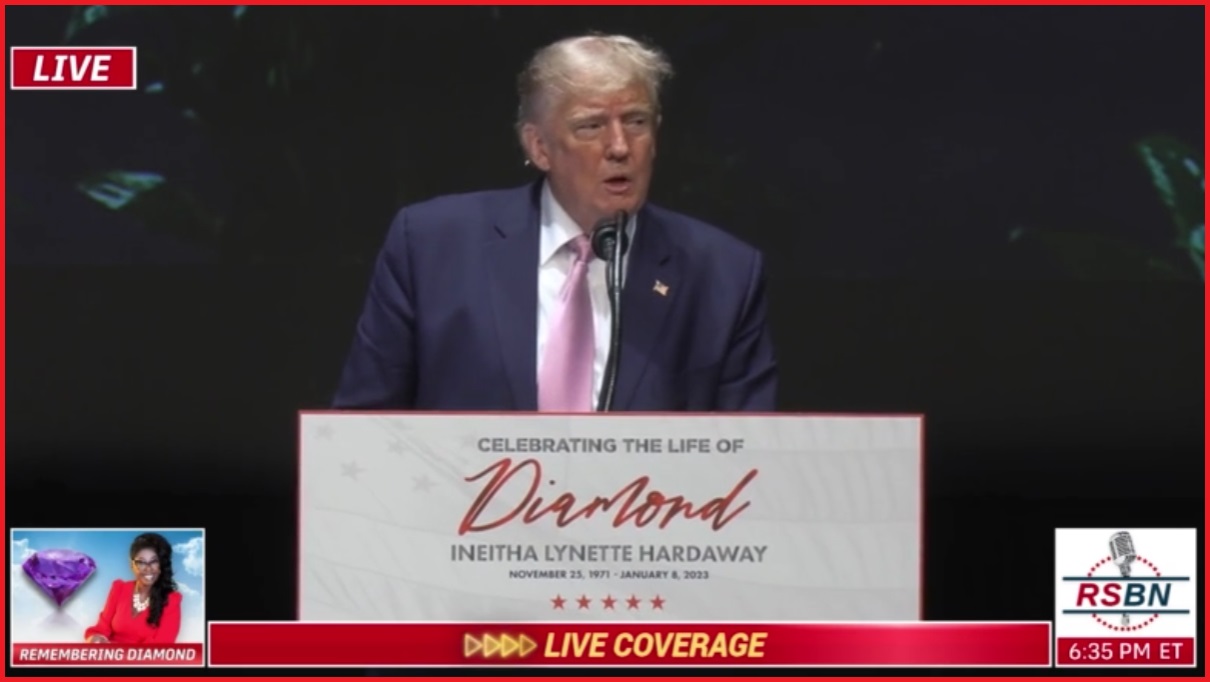
President Donald J Trump delivered remarks yesterday during the celebration of life for Lynette “Diamond” Hardaway {Direct Rumble Link}.
Delivering remarks in his authentic style, President Trump delivered a mostly ad lib speech to celebrate the life of Diamond and the joy she delivered to all around her. While interplaying personal anecdotes about the time they spent together, President Trump overlays the positive impact of both Diamond and Silk amid the cultural and political dynamics of the day. WATCH:
Posted originally on the CTH on January 21, 2023 | Sundance
President Trump transmitted a message to congress, warning them not to cut Social Security and Medicare {Direct Rumble Link}. Many politicians and pundits will look at Trump’s position from the perspective of it being a good position to campaign on for older voters, but that’s not the core of his reasoning.
In 2016 CTH was the first place to evaluate the totality of President Trump’s economic policies; specifically, as those policies related to the entitlement programs around Social Security and Medicare. We outlined how the approach Trump was putting forth and the way he was approaching the issue. In the years that followed, he was right. He was creating a U.S. economy that could sustain all of the elements the traditional political class were calling “unsustainable.”
Before getting to the details, here’s his video message and policy as delivered yesterday. WATCH:
Fortunately, we do not have to guess if President Trump is correct. We have his actual economic policy results to look at and see how the expansion of the economy was creating the type of growth that would sustain Social Security and Medicare. This was/is MAGAnomics at work.
♦ On Social Security – Unlike many other 2016 Republican candidates, Donald Trump did NOT call for rapid or wholesale changes to the current Social Security program; and there’s a very good reason why he was the only candidate who did not propose wholesale changes.
With the single caveat of “high income retirees” (over $250k annually), which previously Trump said he was open to negotiating on, President Trump does not consider these programs as “entitlements”. The American people pay into them, and the federal government has an obligation to fulfill the promises made upon collection.
To fully understand how Donald Trump views the solvency of Social Security, you must again understand his economic model and how it outlines growth.
The issue with Social Security, as viewed by Trump, is more of an issue with receipts and expenditures. If the aggregate U.S. economy is growing by a factor larger than the distribution needed to fulfill its entitlement obligations, then no wholesale change on expenditure is needed. The focus needs to be on continued and successful economic growth.
What you will find in all of Donald Trump’s positions, is a paradigm shift he necessarily understood must take place in order to accomplish the long-term goals for the U.S. citizen as it relates to “entitlements” or “structural benefits”.
All other candidates and politicians begin their policy proposals with a fundamentally divergent perception of the U.S. economy.
The customary political economy theory, carried by most politicians, positions them with an outlook of the U.S. economy based on “services”; a service-based economic model.
While this economic path has been created by decades old U.S. policy and is ultimately the only historical economic path now taught in school, President Trump initiated his economy policy with the intention to change the dynamic entirely, and that’s exactly what he did.
Because so many shifts -policy nudges- have taken place in the past several decades, few academics and even fewer MSM observers, were able to understand how to get off this path and chart a better course.
Donald Trump proposed less dependence on foreign companies for cheap goods, (the cornerstone of a service economy) and a return to a more balanced U.S. larger economic model where the manufacturing and production base can be re-established and competitive based on American entrepreneurship and innovation. This is the essence of MAGAnomics.
The key words in the prior statement are “dependence” and “balanced”. When a nation has an industrial manufacturing balance within the GDP there is far less dependence on the economic activity in global markets. In essence the U.S. can sustain itself, absorb global economic fluctuations and expand itself or contract itself depending on the free market.
When there is no balance, there is no longer a free market. The free market is sacrificed in favor of dependency, whether it’s foreign oil or foreign manufacturing, the dependency outcome is essentially the same. Without balance there is an inherent loss of economic independence, and a consequential increase in economic risk.
No other economy in the world innovates like the U.S.A. President Donald Trump saw/sees this as a key advantage across all industry – including manufacturing and technology.
The benefit of cheap overseas labor, which is considered a global market disadvantage for the U.S., is offset by utilizing innovation and energy independence. This was the core of the economic program that created so much immediate GDP growth in 2017, 2018 and 2019.
2017: […] “This policy will be successful in moving the U.S. economy away from low-growth secular stagnation towards significantly more buoyant performance. We would not be taken by surprise by a doubling of the growth rate of real GDP in the U.S. over the next two years, nor by a further significant move up of equity valuations and a material further appreciation of the dollar.” ~ David Folkerts-Landau, Chief Economist, Deutsche Bank
The third highest variable cost of goods beyond raw materials first, labor second, is energy. If the U.S. energy sector was unleashed -and fully developed- the manufacturing price of any given product would allow for global trade competition even with higher U.S. wage prices. This is why President Trump traveled to Saudi Arabia as his first foreign trip, followed closely by a trip to Asia. He was putting the basics of his U.S. economic policy into place.
Additionally, the U.S. has a key strategic advantage with raw manufacturing materials such as: iron ore, coal, steel, precious metals and vast mineral assets which are needed in most new modern era manufacturing. President Trump proposed we stopped selling these valuable national assets to countries we compete against – they belong to the American people; they should be used for the benefit of American citizens. Period. This was the central point of the Steel and Aluminum tariffs.
EXAMPLE: Prior to President Trump, China was buying and recycling our heavy (steel) and light (aluminum) metal products (for pennies on the original manufacturing dollar) and then using those metals to reproduce manufactured goods for sale back to the U.S.
As President, Donald Trump stopped that practice immediately, triggering a policy expectation that we do the manufacturing ourselves with the utilization of our own resources. Then he leveraged any sales of these raw materials in our international trade agreements.
When you combine FULL resource development (in a modern era) with the removal of over-burdensome regulatory and compliance systems, necessarily filled with enormous bureaucratic costs, Donald Trump began lowering the cost of production and the U.S. became globally competitive. In essence, Trump changed the economic paradigm, and we no longer were a dependent nation relying on a service driven economic model.
The cornerstone to the success of this economic turnaround was the keen capability of the U.S. worker to innovate on their own platforms. Americans, more than any country in the world, just know how to get things accomplished. Independence and self-sufficiency are part of the DNA of the larger American workforce.
In addition, as we saw in 2018 and 2019, an unquantifiable benefit came from investment, where the smart money play -to get increased return on investment- became putting capital INTO the U.S. economy, instead of purchasing foreign stocks.
With all of the above opportunities in mind, this is how President Trump put us on a pathway to rebuilding our national infrastructure.
The demand for labor increased, and as a consequence so too did the U.S. wage rate which was stagnant (or non-existent) for the past three decades.
As the wage rate increased, and as the economy expanded, the governmental dependency model was reshaped and simultaneously receipts to the U.S. treasury improved.
More money into the U.S Treasury and less dependence on welfare/social service programs have a combined exponential impact. You gain a dollar and have no need to spend a dollar – the saved sum is doubled. That was how the SSI and safety net programs were positioned under President Trump. Again, this is MAGAnomics.
When you elevate your America First economic thinking you begin to see that all of the “entitlements” or expenditures become more affordable with an economy that is fully functional.
As the GDP of the U.S. expands, so does our ability to meet the growing need of the retiring U.S. worker. We stop thinking about how to best divide a limited economic pie and begin thinking about how many more economic pies we can create. Simply put, we begin to….
…. Make America Great Again!
We know it works, because we have the results to cite.
It was the Fourth Quarter of 2019…..
Right before the pandemic would hit a few months later…. Despite two years of doomsayer predictions from Wall Street’s professional punditry, all of them saying Trump’s 2017 steel and aluminum tariffs on China, Canada and the EU would create massive inflation, it just wasn’t happening!
Overall year-over-year inflation was hovering around 1.7 percent [Table-A BLS]; yup, that was our inflation rate. The rate in the latter half of 2019 was firmed up with less month-over-month fluctuation, and the rate basically remained consistent. [See Below] The U.S. economy was on a smooth glide path, strong, stable and Main Street was growing with MAGAnomics at work.
A couple of important points. First, unleashing the energy sector to drive down overall costs to consumers and industry outputs was a key part of President Trump’s America-First MAGAnomic initiative. Lower energy prices help the worker economy, middle class and average American more than any other sector.
Which brings us to the second important point. Notice how food prices had very low year-over-year inflation, 0.5 percent. That is a combination of two key issues: low energy costs, and the fracturing of Big Ag hold on the farm production and the export dynamic:
(BLS) […] The index for food at home declined for the third month in a row, falling 0.2 percent. The index for meats, poultry, fish, and eggs decreased 0.7 percent in August as the index for eggs fell 2.6 percent. The index for fruits and vegetables, which rose in July, fell 0.5 percent in August; the index for fresh fruits declined 1.4 percent, but the index for fresh vegetables rose 0.4 percent. The index for cereals and bakery products fell 0.3 percent in August after rising 0.3 percent in July. (link)
For the previous twenty years food prices had been increasingly controlled by Big Ag, and not by normal supply and demand. The commodity market became a ‘controlled market’. U.S. food outputs (farm production) was controlled and exported to keep the U.S. consumer paying optimal prices.
President Trump’s trade reset was disrupting this process. As farm products were less exported the cost of the food in our supermarket became reconnected to a ‘more normal’ supply and demand cycle. Food prices dropped and our pantry costs were lowered.
The Commerce Dept. then announced that retail sales climbed by 0.4 percent in August 2019, twice as high as the 0.2 percent analysts had predicted. The result highlighted retail sales strength of more than 4 percent year-over-year. These excellent results came on the heels of blowout data in July, when households boosted purchases of cars and clothing.
The better-than-expected number stemmed largely from a 1.8 percent jump in spending vehicles. Online sales, meanwhile, also continued to climb, rising 1.6 percent. That’s similar to July 2019, when Amazon held its two-day, blowout Prime Day sale. (link)
Despite the efforts to remove and impeach President Trump, it did not look like middle-class America was overly concerned about the noise coming from the pundits. Likely that’s because blue-collar wages were higher, Main Street inflation was lower, and overall consumer confidence was strong. Yes, MAGAnomics was working.
Additionally, remember all those MSM hours and newspaper column inches where the professional financial pundits were claiming Trump’s tariffs were going to cause massive increases in prices of consumer goods?
Well, exactly the opposite happened [BLS report] Import prices were continuing to drop:
This was a really interesting dynamic that no-one in the professional punditry would dare explain.
Donald Trump’s tariffs were targeted to specific sectors of imported products. [Steel, Aluminum, and a host of smaller sectors etc.] However, when the EU and China respond by devaluing their currency, that approach hit all products imported, not just the tariff goods.
Because the EU and China were driving up the value of the dollar, everything we were importing became cheaper. Not just imports from Europe and China, but actually imports from everywhere. All imports were entering the U.S. at substantially lower prices.
This meant when we imported products, we were also importing deflation.
This price result is exactly the opposite of what the economic experts and Wall Street pundits predicted back in 2017 and 2018 when they were pushing the rapid price increase narrative.
Because all the export dependent economies were reacting with such urgency to retain their access to the U.S. market, aggregate import prices were actually lower than they were when the Trump tariffs began:
[…] Prices for imports from China edged down 0.1 percent in August following decreases of 0.2 percent in both July and June. Import prices from China have not advanced on a monthly basis since ticking up 0.1 percent in May 2018. The price index for imports from China fell 1.6 percent for the year ended in August.
[…] Import prices from the European Union fell 0.2 percent in August and 0.3 percent over the past 12 months.
So yes, we know President Trump can save Social Security and Medicare by expanding the economy with his America First economic policy. We do not need to guess if it is possible or listen to pundits theorize about his approach being some random ‘catch phrase’ disconnected from reality. Yes folks, we have the receipts.
This was MAGAnomics at work, and this is entirely what created the middle-class MAGA coalition. No other Republican candidate has this economic policy in their outlook because all other candidates are purchased by the Wall Street multinationals.
America First MAGAnomics is unique to President Trump because he is the only one independent enough to implement them.
Authors note as said in 2016: “If I absolutely did not believe this economic model was doable, I would never expand the concept and place advocacy upon it. I am an absolute believer that we can, as a nation, reignite a solid manufacturing base and generate an expanding middle class.” Yes, I bet on Trump, and he was right.
I have created this site to help people have fun in the kitchen. I write about enjoying life both in and out of my kitchen. Life is short! Make the most of it and enjoy!
This is a library of News Events not reported by the Main Stream Media documenting & connecting the dots on How the Obama Marxist Liberal agenda is destroying America










 Centinel2012