Martin Armstrong – Rates are Going to Jump to 10% Instantaneously


Published on May 19, 2018

Where does renowned financial and geopolitical analyst Martin Armstrong see big trouble brewing? Look no further than the bond market. Armstrong explains, “The bond market is going down. . . . We’ve already started into it. . . .You have to understand both Japan and Europe have destroyed their bond markets. They have completely and utterly destroyed them. They are the buyers. That’s it. There is no pension fund that can buy 10-year paper at 1.3% when they need 8% to break even. They are locking in a 10 year loss. They can’t do it. We have been helping major funds shift into equities because it is the only place they can go. . . . Once you start seeing the cracks in Europe, you are going to see interest rates rise faster than you have ever contemplated in your life. There is nobody in their right mind that can buy an Italian bond at 1.3%. It’s just not going to happen. Once the ECB is forced to stop, those rates are going to jump to 10% instantaneously. Once it starts to crack, that’s it, it’s gone. What is going to make everyone know it is cracking is when you see rates going up dramatically, and the ECB is at a point it just can’t buy any more.” Armstrong does not see a big War in the near term, but one is brewing in the Middle East. What Armstrong does see right now is “increasing civil unrest.” On gold, Armstrong sees the yellow metal “fighting a stronger dollar” but predicts it will have its day sometime after 2020 to 2021. Join Greg Hunter as he goes One-on-One with financial and geopolitical expert Martin Armstrong. Donations: https://usawatchdog.com/donations/

Irish Pension Invested in Italian Bonds?


QUESTION:

Hi Marty,

I hope you’re keeping well? More news from the “EU beacon of light” for you. I’ve enclosed an article regarding Irish pension money in Italian bonds. This is very very scary if true and we really are heading for a disaster from which a little country like ours won’t recover if we ever did anyway! In the article Mercer says that “after the financial crisis the ECB put in place a system to limit a contagion”.

Is this just more whistling in the dark? I believe it is.

Kind regards,

E

ANSWER: The very design of the euro promotes contagions. Because there was no national debt, the “reserve” status for banks is the debt of all member states. In the United States, ONLY the national debt federally is acceptable. Therefore, if California or Illinois goes bust they do not create a contagion that brings down the whole. Even the government has come out and warned there may be a contagion will emerge if Italy fails and/or breaks with the EU.

The euro crashed BECAUSE there is no such prevention of a contagion. That is totally FALSE and a made up excuse. Fears of the new Italian government of the five-star movement and the right-wing populist Lega came into the markets and sent the euro crashing. A risk of contagion sparked by Italy infecting the entire Eurozone was “not yet completely off the table,” said ECB Vice President Vitor Constancio. This applies in particular if the sharp rise in Italian government bond yields. At the same time, Constancio came out and said that US Treasuries have the greatest risk because the Fed keeps raising interest rates. There is no such mechanism to prevent contagions – PERIOD! It is all smoke & mirrors.

How Can There be Thousands of Cryptocurrencies?


QUESTION: Mr. Armstrong; There are these people so desperate to argue that cryptocurrency will change the world, I have heard the same pitch behind gold and I suspect most are just goldbugs who gave up and moved to cryptocurrencies. The same arguments of fiat and central banks are at the base of this as well. Do you think that cryptocurrency can somehow emerge as a solution after the Crash and Burn? How can there be thousands of these cryptos? If the dream they pitch is even plausible, then does there not have to be just one cryptocurrency?

Thank you

Hank
 

ANSWER: We have to ask what is at the core of this trend. In essence, it is the very same trend that put Trump in office. The entire 2007-2009 global financial crisis and bank bailout created an entirely new “skepticism” of government in most countries. This is where the digital assets have come into play. Are they capable of altering or influencing traditional global monetary policy? The answer: absolutely no possible way. To accomplish that we MUST end socialism. I doubt these people really understand the full scope of structural changes that would need to be made to move to any cryptocurrency. Adam Smith’s Invisible Hand rules the question. Until it is in the self-interest of those in power to hand back the scepter of power itself, there is just no way to accomplish such a monumental change without the house burning down FIRST. The other possibility is that governments just usurp the crypto world like they confiscated gold and then control it for taxes. They do want to eliminate all paper currency to collect 100% taxes they believe are avoided. They also pitch it would end crime as we know it. The black market would then no doubt emerge as barter once again. To think that cryptocurrency can defeat central banks and governments is really far-fetched.

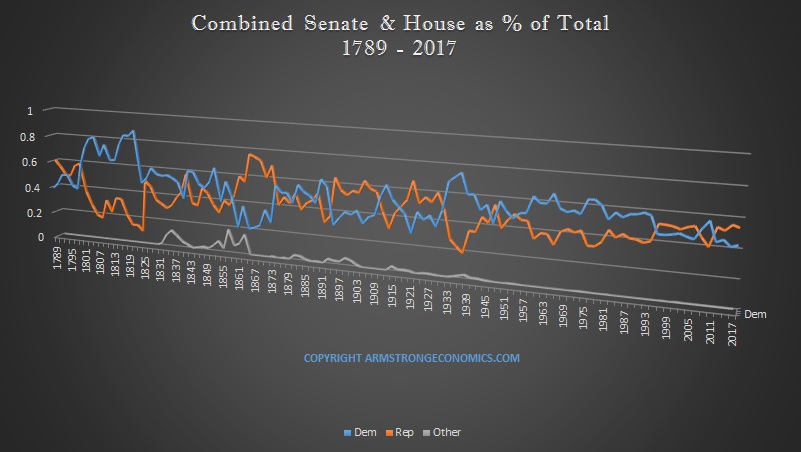
The political changes are monumental. Politicians can no longer run for office promising benefits by robbing the rich and handing it to the poor. In order for crypto assets to replace money, it would require a profound change in politics. It is not simply central bank money. The entire pitch of cryptocurrency is that it will take the creation of money away from central banks and thus government. Think that through. Career politicians would be completely at a loss. They have no qualifications with respect to management of an economy. The Democrats have been selling the same promise since FDR’s first election. Just look at the chart above and you will see that the Democrats have been in a bear market ever since FDR. They pretend that someone cannot get rich without oppressing the poor. Wealth to them is very Marxist and a zero-sum game. They are stuck in the idea that someone makes a product and the capitalist profits on their labor. They fail to comprehend that someone can invent something like Google, Amazon, Microsoft, or our Socrates Platform that by no means oppressed some poor individual to create it. They are frozen in time and cannot comprehend the Invisible Hand of Adam Smith. This is why I say that socialism is dead and indeed the entire cryptocurrency movement is part of that collapse in the public’s confidence in government.
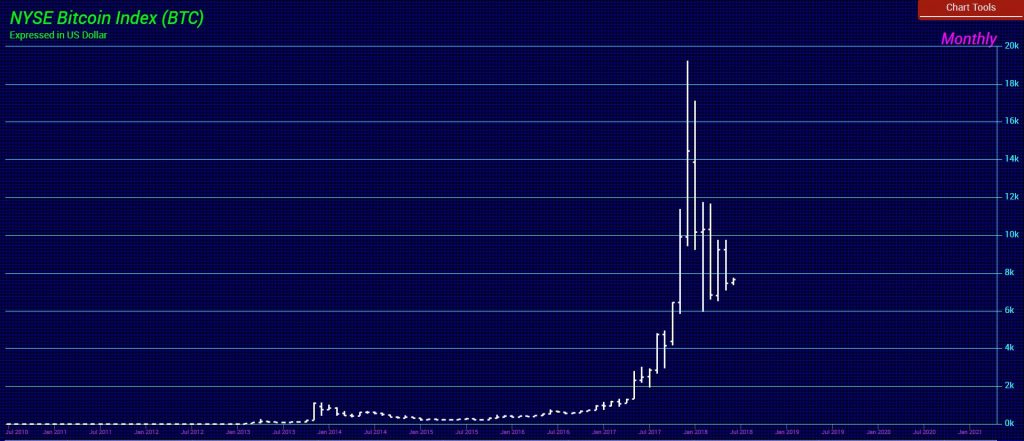


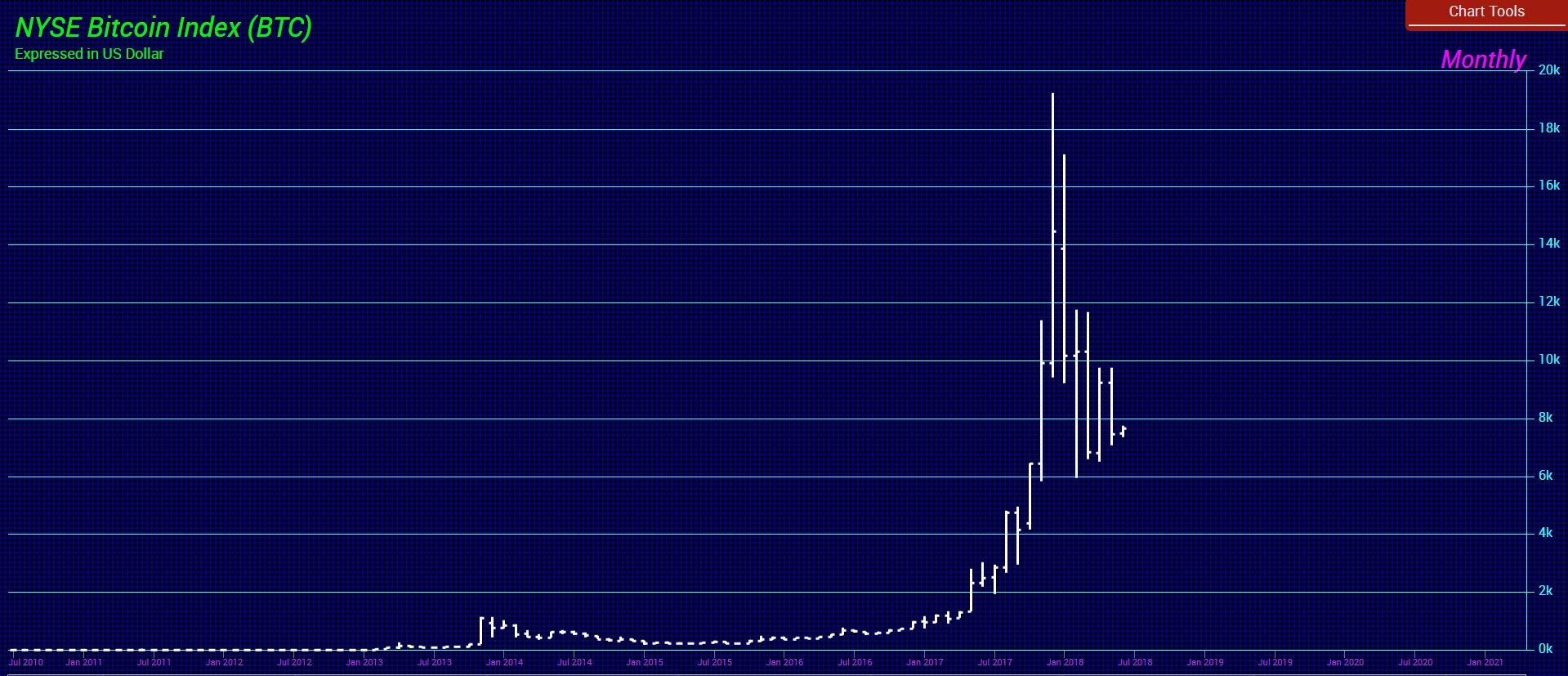
Additionally, cryptocurrencies are promising to end fiat currencies, and in reality, it is a return to a sort of commodity-based money not so dissimilar from a gold standard. The problem with all of this is the idea that if we somehow returned to a gold standard, then money would be worth “something” as if it would never change in value. That just cannot exist and NEVER has. Whatever you define as money, it will rise and fall against assets. That is fundamental to the economy. It is why communism failed. Here is a chart of Bitcoin. It has risen and crashed. It did not hold on to value permanently at some fixed level. This is why I say it is an “asset class” fluctuating against the currency – the dollar.
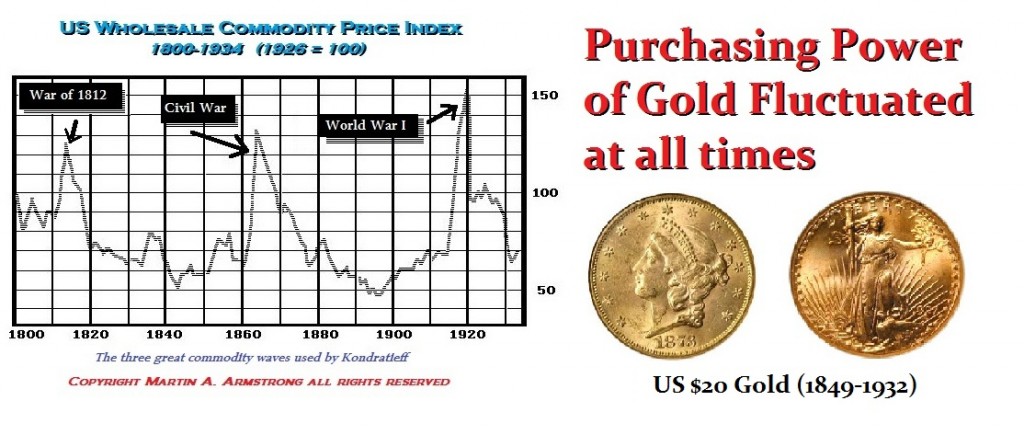
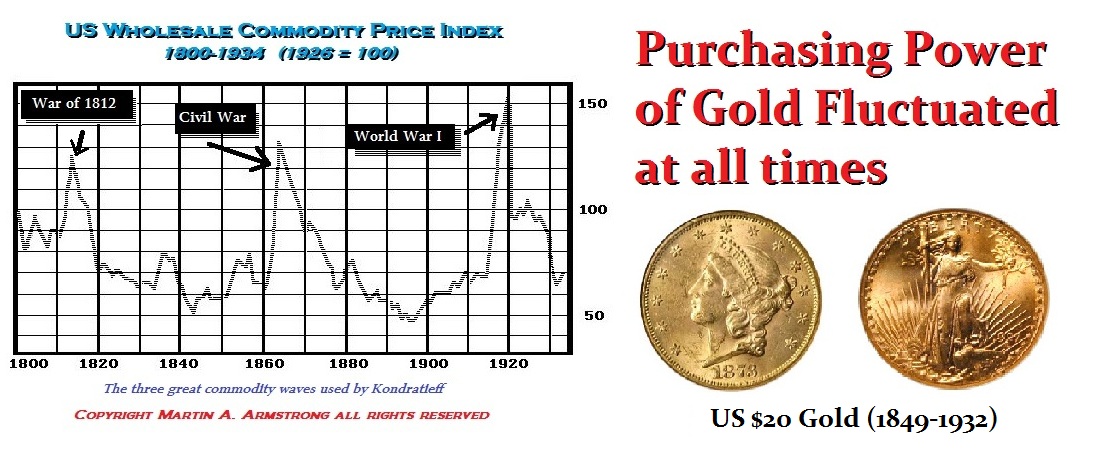
Here is a chart of the rise and fall of the inflation index when gold was money. These very swings in the economy are what Kondratieff studied and created his long wave. Gold did NOT prevent the boom and bust cycle. That is part of nature that CANNOT be eliminated. When gold was money and the stock market rose in value, that meant money declined in purchasing power which was gold. It acted economically NO DIFFERENT it money were paper, seashells, or cattle.

So, will cryptocurrencies replace paper currency? The actual amount of transactions today in physical money is less than 5%. So we are already using electronic money every day, such as when you buy something online. So will that emerge eventually as a cryptocurrency? Perhaps. There is nothing to prevent that once we get the crash and burn, and the “burn” is the replacement of the political system.

Will there be only ONE cryptocurrency for the entire world? Unlikely. I would probably bet on each government adopting a cryptocurrency per nation and prohibit the use of “foreign” cryptocurrency domestically. We also must respect that government WANTS to create some sort of cryptocurrency to ensure that everyone pays taxes. Australia already uses the phrase – “Cash is for Criminals.” 

What I disagree with is the notion that somehow cryptocurrency will force political change and government will simply yield and hand back the scepter of power when politely asked. That has NEVER taken place, not even one time throughout history. Governments do NOT voluntarily surrender power. They will use whatever power they have to the bitter end. So, sorry. History is on my side on this one. Dream all you want. Human nature never changes throughout the centuries. Those in power will act in their own self-interest and defend against the loss of that power.

We are headed into a major economic crisis. Cryptocurrency will not save the day. We have to crash and burn. That is the ONLY way such economic imbalances have been resolved throughout history. That is NOT my personal OPINION. It is simply reality

Marxism is ignorant of the Pareto principle | Jordan Peterson & Bret Weinstein


Published on Sep 8, 2017

Marx observed in capitalist economies the manifestation of a fundamental law — the Pareto principle. However, he erred in his diagnosis and prescription for the problem. Jordan Peterson and Bret Weinstein explain.


Europeans Pray for QE to End?


There is much hope buzzing around in Europe that Draghi is planning on ending Quantitative Easing. This is giving the Euro a bit of a lift in hopes that higher interest rates will stem to drastic capital outflows from Europe that resemble rats fleeing a sinking ship. Back on May 14th, Mario Draghi said the European Central Bank would avoid surprising investors with sudden changes to its stimulus plans. He further stressed that inflation was still too low and U.S. trade policies meant that a stronger Euro was a concern. Meanwhile, back in April, the ECB hinted that they would wait until the July meeting to talk about ending the QE program.

Meanwhile, the new Italian government has outlined the first guidelines of its economic policy. The new Prime Minister Giuseppe Conte said Wednesday that he wanted to organize the cooperative banking sector differently than the previous governments. His plan will most likely meet with considerable resistance from the financial sector and most likely Brussels. He seems to be toying with the idea that he wants to separate the banks as Glass-Steagall did during the aftermath of the Great Depression. He wants the future investment banks to be separated from retail banks.

The banking crisis in Europe has been perpetuated by the fact that there is the prejudice to actually merge economies despite a central government structure in Brussels. In the USA, the bad loans were taken from the banks whereas in Europe that has not taken place. The Italian banks are still sitting on a huge mountain of bad loans. If the ECB had actually created a program like the USA to take the bad loans from than banks, then this would have resulted in a disparity among member states. The southern states would have received a bailout at the expense of the northern members. This is the same structural problem of the Euro which infects almost every crucial policy to actually make the Eurozone function as a collective economy.

Winnipeg Grain Exchange Closing Right in Time for the Cycle


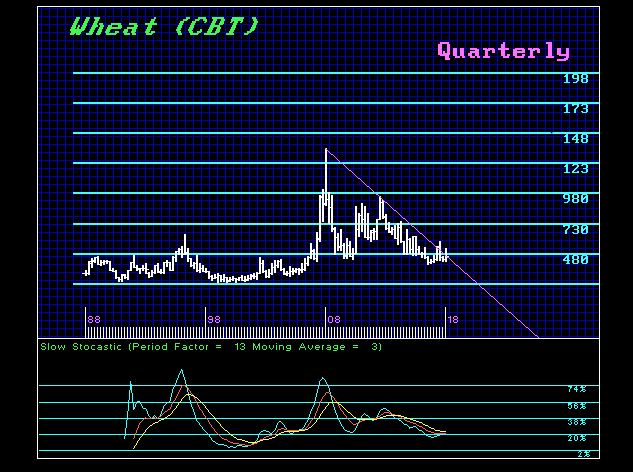
Canada’s last commodity exchange is closing. The Winnipeg Grain Exchange, which was established in 1887, will shut down for good after its owner transfers the bourse’s only remaining futures contract to New York. It is ironic that when a decision like this is made, it is often a sign of a major change in trend. Wheat peaked during the first quarter of 2008. We are just now starting to play with the Downtrend Line in preparation for a commodity boom into the 2024 time period.

I have been focusing on the energy output of the Sun declining and how we are headed back toward the climate getting much colder. People like Al Gore are politicians. He has no expertise in climate whatsoever. Nevertheless, he runs around the world arguing for global warming, preaching something that to him has become just a religion. He is THE person who made global warming a presidential issue that has stigmatized the entire world and prevented people from actually just looking at how everything works.

The markets are lining up and what they are showing is that we are in store for climate change, but it’s getting much colder and that is far worse than global warming. Civilization expands when the climate warms, and it contracts when it gets cold. This is also why Kim Jong-Un of North Korea used missiles to force the West to accept his country back into the world fold. Why? North Korea lost more than 2 million people when the crops failed in 1995/1996. The summer of 2017 saw a dramatic decline in crop production in North Korea, down by some 30%. They are headed to another cycle of cold and starvation. His father’s policies of feeding the army first has created a 1 million man army with nothing to do. People joined the army just to eat.

Everything we see in the computer’s projections WARNS that we are indeed in for climate change, but it is a natural cycle not caused by humankind. We are looking at a sharp rise in food prices in the years ahead. The closing of the Winnipeg Grain Exchange is strangely the way the commodity industry always works. You see mining companies close at the lows and expand at the highs. They can never see the future even when it punches them in the face. So stockpile food as we enter this period of rising prices. There will be shortages in the years ahead.

Fed is Moving to Allow Proprietary Trading Again?


QUESTION: Why is the Fed moving to relax the Volcker Rule and allow banks to once again engage in proprietary trading?

I figure if anyone knew the truth, it would be you

Thank you in advance

PH

ANSWER: Yes, the Federal Reserve Board wants to roll back the Volcker Rule, which was imposed to make banks safer after the 2008 meltdown. The Fed is moving to begin the administrative process aimed at significantly reducing compliance costs for financial firms but ALSO the problem behind the curtain has been that the LIQUIDITY in the markets has collapsed. Since remaining participation in the markets is still about 50% of 2007 levels, removing the banks from proprietary trading has contributed to a completely new risk – the flash crash.

The rule was intended to bar banks with federally-backed deposit insurance from suffering counter-leveraged losses by restricting their ability to bet with their own capital. Financial firms have been arguing that the rule is unnecessarily complex and almost impossible to adhere to. This is partially true. However, prosecutors who do not know how the financial markets truly function have been bringing criminal actions and demanding huge fines for basic things that have always existed and are part of any poker game. They have turned “spoofing” into a crime when in fact if you have a large position, you cannot let the other side know what you intend to do or they will front-run you every day of the week. So if you pretend you will be a buyer so you can sell, that is the nature of the game. Even the Libor Scandal was not “manipulation” of the trend in interest rates. That’s is what central banks do. They were playing within the “noise” of any market gunning for stops as the floor brokers have done since the birth of trading. They by no means altered the trend of interest rates – that is the privilege of central bankers.

Revising the Volcker rule is now something quietly supported by five agencies and among policymakers behind the curtain and it is all being driven by the lack of LIQUIDITY. Even the high-frequency trading systems shut down in the middle of high volatility. With retail participation minimal, banks out of the game, turn up the volatility and the high-frequency traders abandon ship rapidly. This allows for wide gaps in trading that are a concern for the future.

The proposed changes will be opened up for public comment for 60 days. But do not expect any serious discussions with respect to the crisis building in the decline in LIQUIDITY.

The proposal calls for the removal of an assumption included in the original rule that positions lenders hold for fewer than 60 days are proprietary. Meanwhile, the plan would scrap a component of the test for determining whether a trade is for a bank’s account. It would be replaced with new criteria based on how the bank accounts for the trades, according to the summary. They want to provide banks with more flexibility to execute trades that serve as hedges against potential losses. Banks now have to submit continuous and precise documentation to prove they are hedging. This is really onerous and in a crisis, it will magnify the events if banks cannot hedge. Nonetheless, the central purpose of the regulation of the regulation to prohibit banks from speculative trading will be maintained, but there will be a wide lateral movement to really allow them back at the speculative table. They can alter regulations but they CANNOT repeal the Volcker Rule for that would require an act of Congress.

German Healthcare Deficit 300% Greater than Expected Due to Refugees


Healthcare costs have been exploding even in Germany. The revisions in healthcare of about two years ago did expand the coverage, but the expanded costs were completely unexpected. That means Germany is also looking to now raise taxes to cover the higher costs due to their legislative reforms. The reforms have brought in more people in need of care and relatives than expected.

Currently, the tax contribution rate for healthcare in Germany is 2.55% of the gross wage and those who are childless pay even more since they lack a family to burden part of the costs. Their rate stands at 2.8% of their gross wage. In the United States, the Medicare tax is a fixed percentage of your gross pay as well with the percentage rate of 1.45%. There is no income cap for Medicare tax, so all of your gross pay is subject to this tax. Your employer pays another 1.45%.

The statutory long-term care insurance deficit in Germany came in at about three billion euros, which was much higher than expected. In fact, it was about 300% higher than the government’s forecasts. The Central Association of Statutory Health Insurance (GKV) has come out and stated that the sharp rise in the deficit was triggered by the reforms of the past two years. The move is to raise taxes even further since once benefits are given, they cannot just take them back. But what is absent from the discussion is the deficit has risen not simply because of the reforms. This sharp increase is due to the refugees who must be taken care of even though they do not work or pay the tax

Scandinavia Receiving Capital Inflows As Well As Poland & Hungary


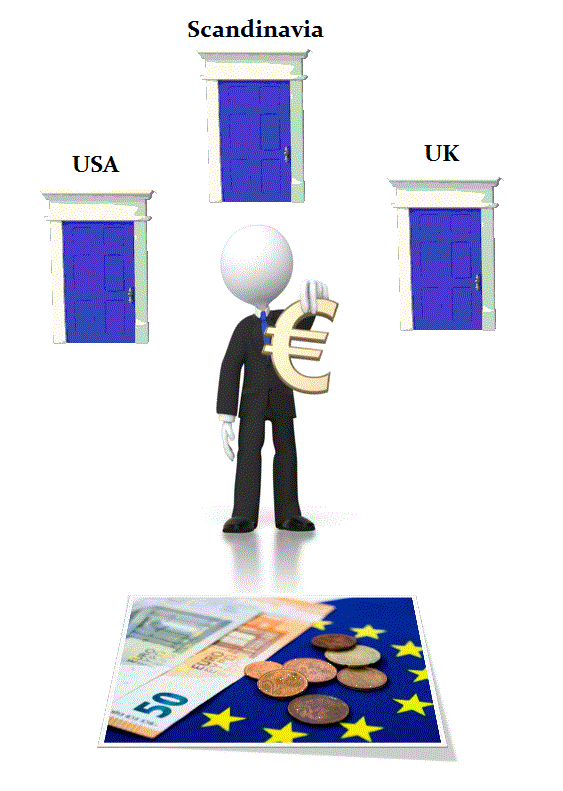
Just to Clarify, we are also picking up Capital Inflows from the EU moving into Scandinavia – Denmark, Sweeden & Norway. We also see money moving into Poland and Hungary which appears to be some diversification movement. What has become increasingly apparent is the mere fact that confidence among SERIOUS money is starting to realize the EU is a failure.

As I have stated previously, the failure to consolidate the debts (see our original reports on the Euro) reflects the failure to really respect the different cultures within the EU no less trust them. This is why the debt was never consolidated and they adopted bail-ins so that one country would NOT be bailing out banks in another. This has all reflected at its core a refusal to accept the principle of a federalize Europe that MUST include transfer payments among states without prejudice.

You cannot have a system that dictates from the center but then refuses to actually respect the member states are one political body. This European Experiment has been a complete failure because it is trying to create some sort of half-baked-country in name only.

The EU should have remained as simply a trade union. Leave it at that. Centralized control was the downfall of Russia and China under a communist state system. People know best how to expand and respond to economic conditions. Germany depends on an export model and Greece depends on a tourist model. These are starkly different economics models.

Moreover, the EU should respect the individual member states that one-size does not fit all. Furthermore, the average family is better equipped to save for their future than pretend social programs that if operated by a private individual would be a criminal charge of frau

Euro & Varying Volatility


QUESTION: Hello Mr. Martin Armstrong. Why is it that if EURUSD goes down 20 – 30 pips other pairs with the EUR – such as the EURAUD or EURNZD go down 50 – 150 pips? Why such difference and volatility with these pairs?

JMF

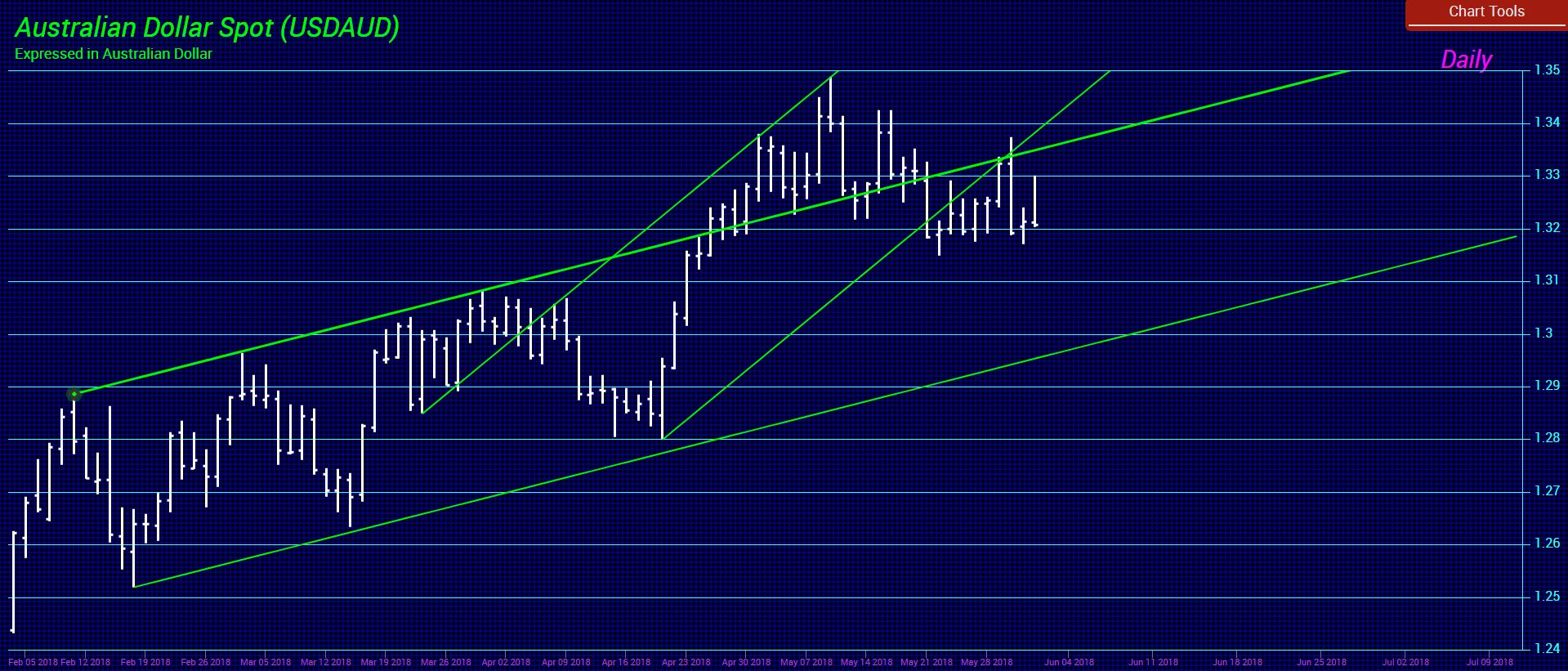
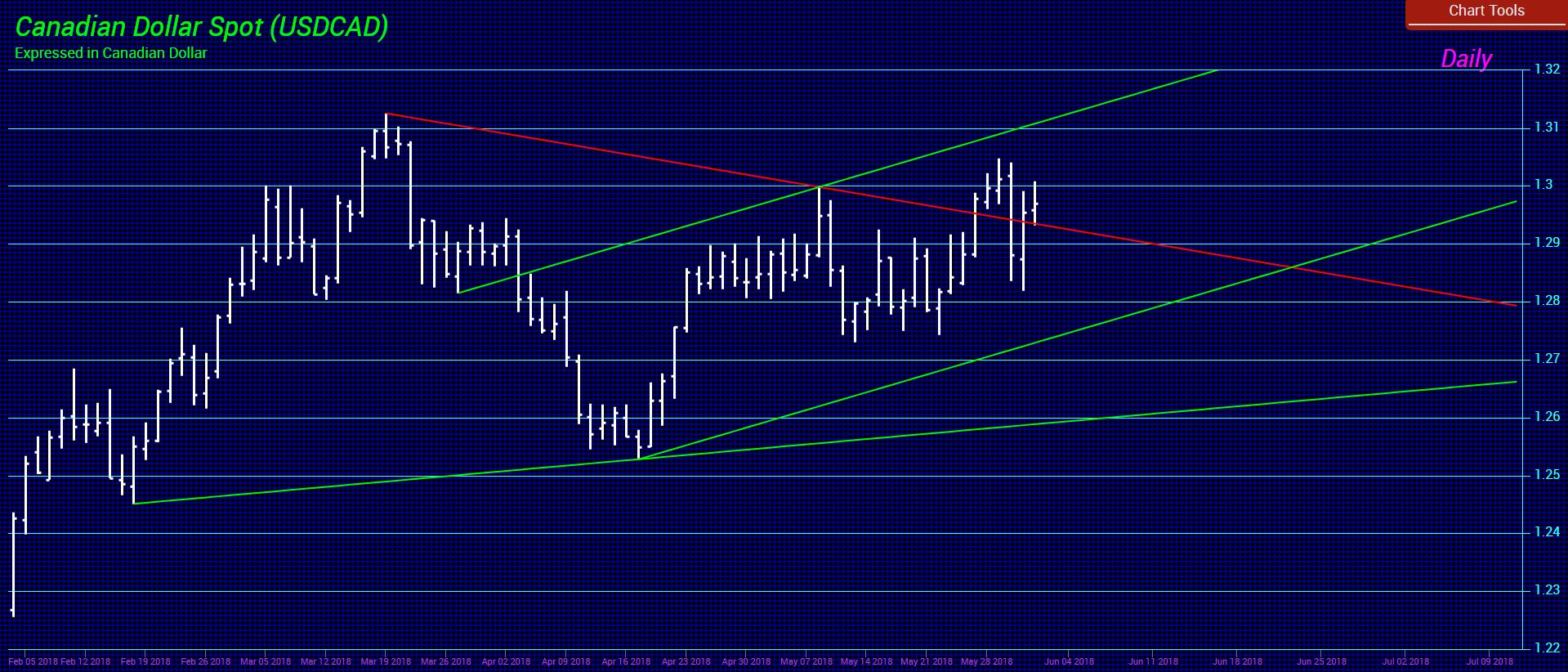
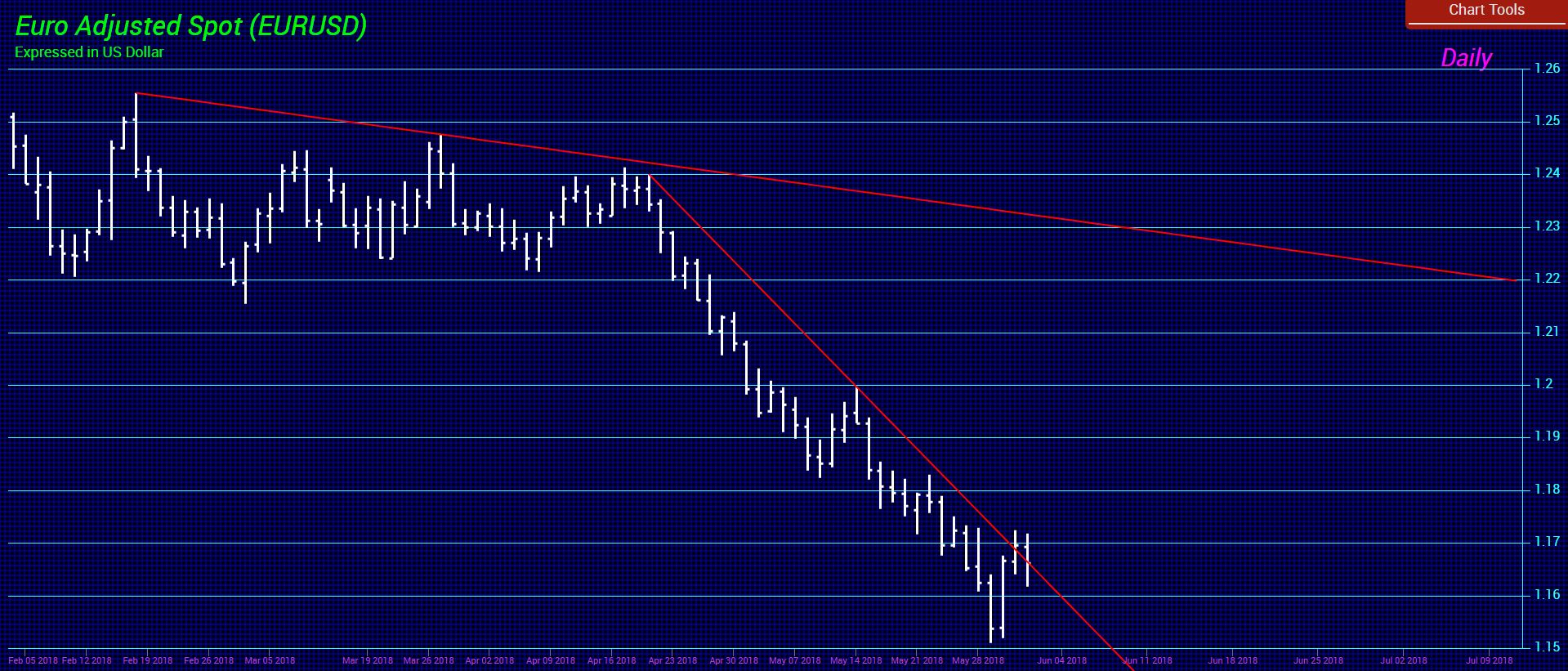
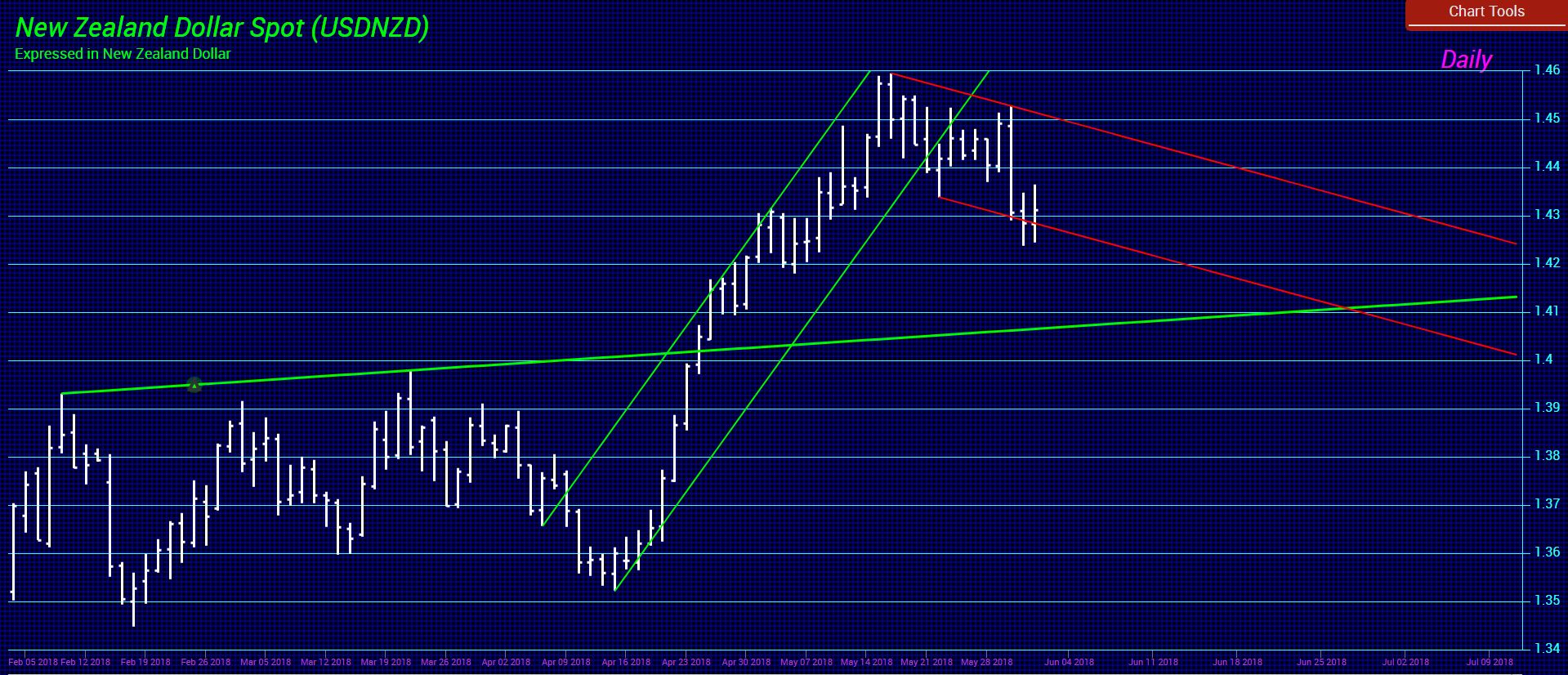
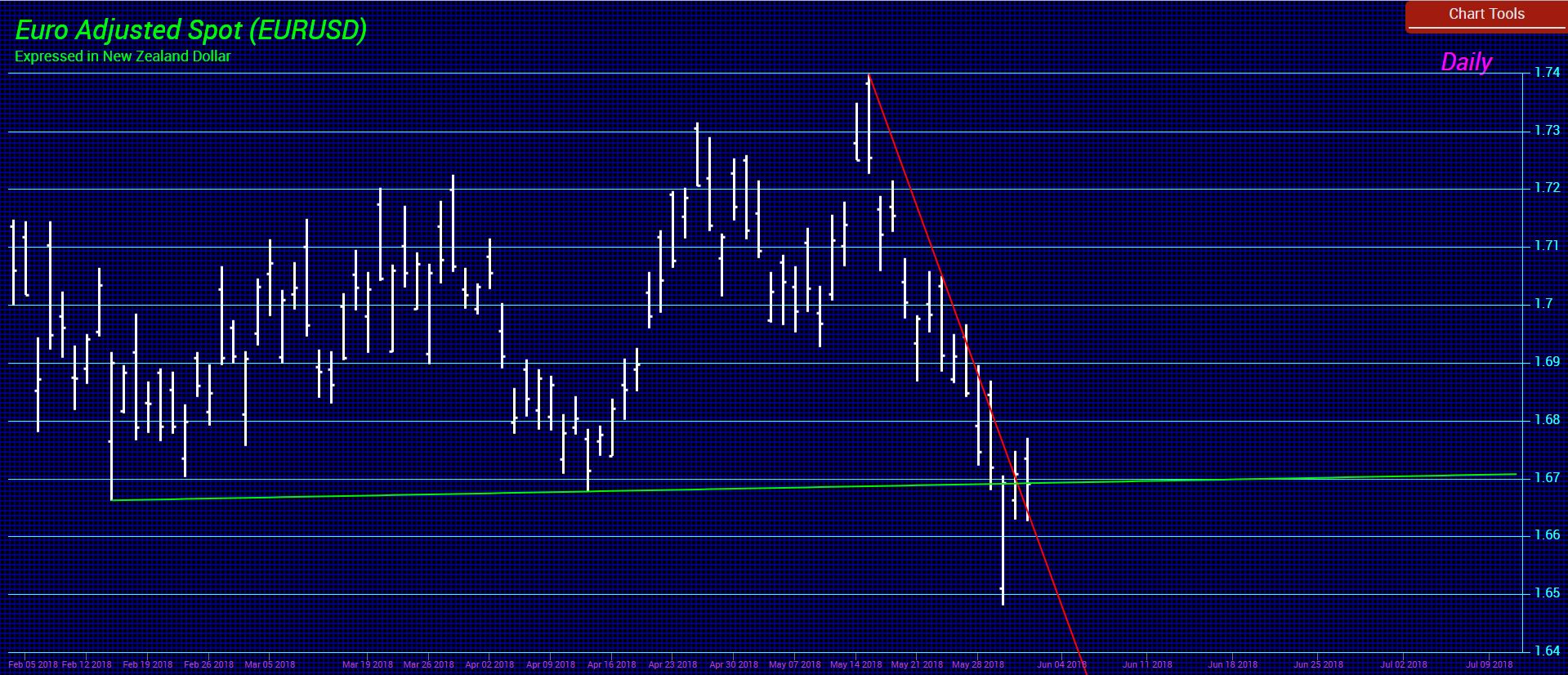
ANSWER: The reason for this is simply that the US dollar is in a broader bull market. This is how the world monetary system collapses. A lower dollar devalues debt and everyone is fat and happy. You determine a trend by monitoring the performance of any market and observing it from a host of different perspectives. Each market is reflecting the differences in trends that are influenced by both domestic political trends and the local business cycle, as well as by the external influences from capital flows moving in or out of a country. Keep in mind that we have some countries that are PUNISHING foreign investors for daring to invest in their country. They are deliberating trying to prevent a rise in real estate and that sets in motion an economic decline domestically since it tends to reverse the capital flows altogether.