“The Crisis Has Become Pandemic” – System To Collect Defaulted Student Loans Is No Longer Functioning


Tyler Durden's picture

The system used by the Dept. of Education to collect on defaulted student loans came to a standstill in the last month, leaving an estimated 91,000 accounts in limbo, when the agency ordered debt collectors under contract to stop making collections on accounts.

As Consumerist’s Ashlee Kieler reports, consumers who expected their student loan payments to be deducted from their bank accounts this month have reportedly found the funds untouched, and their calls to the companies unanswered thanks to a Department of Education’s order prohibiting the debt collection companies from working on default accounts in response to two lawsuits against the agency.

The strange turn of events began with a lawsuit filed by two debt collection companies, who claim they were unfairly were fired by the Obama-era Education Department for poor performance. On March 29, the judge issued a temporary restraining order that prevented any new defaulted borrowers from being assigned to debt collectors and put into rehabilitation programs. Instead, the borrowers have piled up inside the department’s system, waiting.

On April 21, the government ordered the debt collectors involved in the suit to stop work altogether on defaulted accounts: no phone calls, no withdrawals from student accounts, nothing.

The Education Department and the Justice Department are partly to blame for “unnecessarily” throwing a wrench into the entire defaulted loan system, one attorney with knowledge of the case told BuzzFeed News, because they’ve been unable to come to a resolution that allows the loan system to kick back into gear. “There’s no fix in sight.”

Judge Susan Braden has extended the emergency order [PDF] several times since then, noting that it was made to “preserve the status quo to protect the interests of all parties and to afford the government an opportunity to reach a global solution” to two lawsuits against the Dept. of Education.

The cases, filed separately by several debt collection firms, claim that the Dept. of Education unfairly terminated their contracts with the companies.

More recently, the Dept. of Education ordered servicers to stop work on defaulted accounts. The actions, the companies argued in court filings [PDF], “fundamentally alter the status quo and are not fiscally responsible to the borrowers or to the federal taxpayers.”

“Thus, the well-documented student loan crisis will become a pandemic not because this Court ordered that result, but because [Dept. of Education] thinks that is what this Court expects,” the companies argue.

This week, the Dept. of Education submitted a court filing detailing how the Judge’s order and its subsequent suspension of collection activities has affected consumers, Career Education Review reports.

The Dept. claims that the action “has effectively shut down the Government’s defaulted student loan collection program,” with an estimated 91,000 borrowers now stuck in limbo because their accounts weren’t assigned to a debt collector in April.

Additionally, the Dept. argues that by not assigning borrowers to collectors “tens of thousand of borrowers have been prevented from gaining access to rehabilitation programs” and other benefits.

BuzzFeed News reports that debt collection agencies say that since the Department ordered a stop to collection activities they have been inundated with calls from borrowers.

However, the companies can’t help the customers. This, they claim, has resulted in thousands of messages and complaints from borrowers.

The collectors, BuzzFeed reports, claim that because of this borrowers will re-default and those enrolled in repayment programs could lose their eligibility.

Suzanne Martingale, policy staff attorney for our colleagues at Consumers Union, tells Consumerist that the stop in collections and payments could do “untold damage to borrowers.”

“Meanwhile, they’re going to rack up a ton of charges as more interest accrues on their loans,” she adds.

As the work stoppage drags on, consumer protection advocates are confused about where borrowers stand, especially given a tangle of other lawsuits involving the loan companies and the government. “The whole process has been completely mind-boggling,” said Persis Yu, the director of the Student Loan Borrower Assistance Project at the National Consumer Law Center, who called the standstill “mystifying from a consumer protection standpoint.”

Bill Blain: “Macron Will Prove A Disappointment As Nothing Is Actually Fixed In Europe”


Tyler Durden's picture

From Bill Blain’s latest Morning Porridge edition

“To summarise the summary: anyone who is capable of getting themselves made President should on no account be allowed to do the job..”

The best thing about the French Election is I’ve just won a case of very fine French wine on the result!

The papers and financial blogosphere are full of positivity – France is fixed, therefore the Euro is safe and its all great news. Put yer buying boots on.. And on the back of Friday’s very strong US numbers.. don’t worry that bonds continue to rally in the face of a likely Fed Hike..

Please.. the only thing good about the French vote is the least bad candidate won.

I question the grand expressions of upside the market is calling for. France has dodged a bullet, perhaps, but they aint solved the crisis – which boils to down to being the wrong economy using the wrong currency and absolutely no control of monetary or fiscal policy to fix it.

Macron has a head full of supply side policy cliches about sorting the labour market, and some catchy soundbites on Franco-German European hegemony – including the sacrifice of a fraction of the bloated state payroll. For all the hype, he’s a compromise of compromise candidates.

Lets not forget that fully 12% of the votes were spoilt – meaning a significant minority of Frenchmen made a conscious choice that neither candidate was any good!

I’ll make a grand prediction: Macron will prove a disappointment. His lack of power base from which to actually effect long term change across France means we’ll get one or other of the Le Pens in 5 years time.

Although he will no doubt trade on his youth and popularity – don’t be surprised if the lustre quickly fades. A number of blogs say he’ll quickly build a coalition of the willing.. I doubt it. He’s going to struggle to form any kind of working government in the face of the established parties, and hostility from right and left.

There is also the likelihood the electorate will come to realise the gifted young game-changer is actually as establishment as they come. Don’t forget he is the protégé of Jacques Attali –  those of us of a certain vintage will remember Attali as the archetypal enarch – squandering billions on titivating the Glistening Bank (The EBRD) with marble lifts and ego-building offices rather than actually lending. Macron’s paid up membership of the discredited French upper class is something a better organised Front Nationale will play to in coming years.

On the upside, the numbers are moving in Macron’s direction. The state isn’t in the same perilous debt position pre ECB intervention. A wee bit inflation will massage the numbers nicely. There are no immediate risks on the horizon. Unemployment is trending down (slowly), and is likely to boost his popularity. Merkel looks a shoe in for the German Election (very strong showing at the weekend in Danish Germany).

But, but and but again..

When Europe looks calm and sorted, its not. Nothing is actually fixed.. For all the happy posts this morning about Euro strength, which stocks to buy on the basis of French recovery, and the rest… I doubt it.

Although there is apparently nothing to worry about in Euroland anymore – we’ve still got the festering pustule that is Italy, episode 47 of the Greek Crisis on our doorsteps, and the who knows what coming from the Brexit negotiations. Europe will continue to amuse, fascinate and frustrate..

I don’t normally spend my Sundays watching the TV wallpaper paste that passes as “political comment” but as I supped my coffee, one soundbite caught my ear: “the aim of Europe is to ensure the economic collapse of the UK to make clear leaving the EU is never an option.”

Oh dear….

Is there a danger the now pointless UKIP decides to establish some convoluted relevance as the force of anti-Europeanism? Sure enough, someone later suggested we should mount a European boycott. If we stop buying French plonk, German cars, Spanish holidays, etc, then that’ll teach ’em.

It so happens an American chum of mine was in Yoorp over the weekend and he popped down for dinner last night. As he is an economist of some renown, and a former Scotsman before he went all Yankee on us, I asked his opinion on Brexit and what America thinks. He was succinct: “We don’t give a fig. As long as you all play nice and don’t break the global economy meaning we’ll have to bail it out, we really don’t care about Europe and the UK.” Nice.. but to the point..

A trade war with Europe and the nihilistic post UKIP politics of aggression would be a very bad idea… If I can’t get good European wine, it will inevitably mean drinking more Argentine Malbec.. Not a bad wine, but it’s impossible to function properly afterward!

The Dollar Remains King


QUESTION:  Hi, I’ve read your blog for a couple of months now and it clearly opened my eyes. But I’m wondering if I’m getting crazy now.. I can see a pattern between rising Chinese yields (despite weaker growth), parked Chinese money in the Canadian & Australian housing bubble, plunging commodities (very bad for Australian and Canadian people who have to pay of their massive mortgages) and why all this will lead to a rising dollar. Am I looking in the right direction?

A.S.

ANSWER: Yes. The only way to reach the economic crisis that forces political change is to put on the maximum amount of pressure. It does not even require that what people BELIEVE will happen, happens. Human nature is such that we all act in anticipation of events. Sure the Euro has bounced on belief that BREXIT is a passing phase. But the election of Macron was the worst possible outcome as it should have been for it now seals the fate of Europe. The Euro that will crumble as Brussels now tries to federalize everything to secure its own survival against the people of Europe to defeat this populist movement by political decree.
The dollar rose between 1980 and 1985 on the fears that the USA would default creating a two-tier monetary system with red dollars externally and green dollars internally. The US national debt hit $907.7 billion in 1980 and the Eurodollar market was about the same. The Europeans were convinced that the US would default by adopting a two-tier dollar. Consequently, between 1980 and 1985, Eurodollar deposits fell by about 50% and the Europeans moved their accounts to the USA where they thought they would get green dollars. That was the number one question I would get at seminars and conferences in Europe between 1980 and 1985. It never happened. Yet the “belief” it might moved capital to USA and that sent even the British pound to $1.03 in 1985.

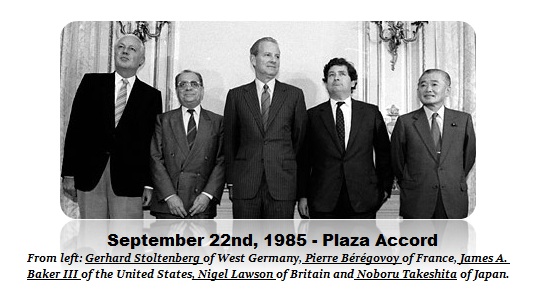
Only the dollar moving to all time record highs in 1985 sparked the Plaza Accord. However, that is where the whole idea of the Euro was born. Jim Baker saw THE PROBLEM AS THERE WAS NO CURRENCY TO COMPLETE AGAINST THE DOLLAR. Baker urged Europe to create a single currency to prevent the dollar from rising, which then reduced US exports.

The national debt continued to rise reaching $2.125 trillion by 1986 and $3.2 trillion by 1990 and now we are at $20 trillion by 2017. The Dow Jones Industrial average was 1,000 in 1980. So exactly how is 21,000 on the Dow today out of like from just the expansion in debt?

You can see the correlation below. Our number remains 23,000 on the Dow where things begin to get interesting. So far, it is just keeping pace with international value. The first opportunity for a major dollar high is 2018 and after that comes 2020/2021.

1980-1990

Why Central Banks & Buying Equities


QUESTION: Mr. Armstrong; Why is the Swiss Central Bank buying American equities? On the one hand you would think it is manipulation, but on the other, why manipulate the US share market?

Any clue since you have met with them directly?

LW

ANSWER: I wrote about that explaining that the central banks have been buying equities since 2014. The Swiss National Bank posted its latest 13-F holdings showing it has been buying equities at a stepped up pace during the first quarter 2017. Their total equity holdings have now reached $80.4 billion, up $17 billion from the $63.4 billion at the end of 2016.

The central banks are trapped. Lowering interest rates to virtually zero reduced their yield on reserves and they cannot sell off government securities. The only viable hedge is US treasuries in the bond world against the chaos of the Eurozone. That offers no diversification just more government debt. The ECB owns 40% of European government debt. The Swiss are buying US equities as a hedge against the Euro and political unrest. This is not manipulation. They lost a fortune trying to maintain the peg the franc with the Euro. They cannot use pegs, so the only alternative to just buying US Treasuries is private equities.

The central bankers understand what our model is warning about. As confidence continues to decline in governments, the central banks can go bankrupt UNLESS they too diversify out of government bonds.

Granted, nobody wants to talk about this yet in public. This is NOT manipulation – this is cover your ass time. We have been recommending this trade to institutions for the past 5 years

California Wants to Tax Space Flights Per Mile They Travel


California Taxing Rockets

Believe it or not, the California Politicians & Regulators just spend all their time trying to figure out how to tax something new for they will never reform, it’s always give me more. California wants to collect taxes from space transportation companies based upon, get this, a formula of how frequent a company launches spacecrafts out of the state, and most absurdly, how far a commercial spacecraft travels from California soil. They want to tax space travel per mile and claim 62 miles above California belongs to the State. Sooner or later, they will want a tax from all satellites that just pass by their state once a day.The space launches are taking place from Vandenberg Air Force Base, in Santa Barbara.

The California Politicians are a special breed. They must have brain damage or they are just so corrupt it is no longer funny. They have claimed that taxing space travel from California “will lead to increased activity in the industry and will foster an atmosphere of growth and prosperity once present during the golden age of California’s aviation industry, thereby creating jobs as the industry thrives in this state.”

Any company should look for prosperity in Texas or Florida and forget California. The State is beyond help at this stage.

This should be the new theme song for California

Hunting Tourists in Europe for Fines


Milan Bus

COMMENT:

Hi Marty,

The hunt for taxes is really getting out of control.

I enjoyed a week of vacation in Italy and on my way back home I had a few hours to kill in Milan.
So i decided to spend some time in the City center of Milan before leaving from Linate airport.

I bought 3 bus tickets Linate – Milan, enjoyed my stay and on my way back I bought again 3 tickets.
On my way back to the airport the bus way half full, many of them tourists like me on their way to the airport.

Halfway 2 public officers got on the bus and started to check for valid bus tickets.
Although I nicely bought my tickets (6 in total) I did get fined because I did not validated my tickets in a machine that was nowhere in site.

Tickets where completely in Italian language, not even the bus driver pointed out to stamp the tickets.
No excuse was taken seriously. The fine had to be payed.

What stroke me was that only the non local persons on the bus got checked (easily identified by caring luggage).
All locals/native Italian where left alone.

After discussing this with Italian friends at the airport, I understood this was just common practice.
The Italian public officers are worse than mafia.
RVL

REPLY: Italy is becoming notorious for extorting tourists. If you rent a car, after one year they will start sending you traffic tickets and never identify where or when you committed some offense. One friend paid the first ticket, then the second, and stopped paying. When they sent me tickets from Rome, I refused to even pay anything. They then turned it over to a collection agency and I blew them off the phone so aggressively they never called again. They cannot legally turn it over to a collection agency with no validation of anything and they can never put it on your credit report. It’s just one giant fraud. The collection agency cannot prove you owe anything.

Use taxis and make sure they turn on the meter. They like to talk and pretend to be friendly to distract you from noticing they never turned on the meter. They then try to get you to pay twice or three time what the trip would have been.

Ah – the pleasures of tourism in Europe these days. France is no better. You have a red target on your forehead and it says sucker.

French Elections – A Sell Signal Long-term for the EU Regardless of Who Wins


2017 Election

QUESTION:  Martin, I know your computer has a prediction for the French election and I am sure you have an opinion, I am of the opinion that the French deplorables will come out in mass to vote for LePen. Vive la France!!! What is your opinion. This could be the event that crumbles the EU for good. Thoughts?

ANSWER: This is the craziest election because the computer projected Le Pen would beat both the socialists and the conservatives back in 2015. I gave that forecast back then when it really sounded nuts. It’s my job to say what the computer is forecasting. I have learned over the years that my opinion comes in second-place.

So strangely, the computer is correct even if Macron wins because all mainstream parties were defeated by Le Pen in the first round.

I really hope Le Pen wins because that will force Brussels to look in a mirror just once. If Macron wins, we are looking at a very hard landing for the EU next year. This will probably rise up even violently and places Europe at risk of civil war from the standpoint that Brussels has federalized Europe behind everyone’s back.

The French polls being reported put Macron at 63% and Le Pen at 37%. Her followers will be more passionate about voting and the polls are making a serious mistake as they did in BREXIT. They are trying to manipulate the election. Even Brussels is desperately trying to hand out huge bills to leave. They want €100 billion from Britain and they have threatened Italy and France if they try to leave. How do they enforce their demands? Invade with the federal army they are trying to build? Or will Germany, Netherlands and others lend troops to invade Italy or France? Oh, let’s see. The reason to federalize Europe was to eliminate European War. Hm!

CAC40-M 1998-2017


The CAC40 has finally broken the Downtrend Line on the Monthly Chart. This has not been because of bullishness for the French Economy – this is capital fleeing the government sectors and running into private assets. With BREXIT, the bankers support the government ALWAYS!!!!!!!!!!!!!!!!!!!!!!!!!!!!!!!!!!!!!!!!!!!!!!!!!!!!!!!!!!! Even HSBC said they would leave Britain if BREXIT passed and move to Paris. Hm. The European banking system is in serious danger of crumbling. A good stiff wind can blow it over. ANY bank that were to be stupid enough to move to the EU is a MAJOR SHORT for the long-term.

Italy Dependent On ECB “Buyer Of Last Resort” As Foreign Investors Dump Bonds Amid Capital Flight


Tyler Durden's picture

Authored by Mike Shedlock via MishTalk.com,

Italy is increasingly dependent on the ECB to hold down bond yields as foreign investors dump Italian bonds like mad.

Eurointelligence bills this as Further Evidence of Capital Flight in Italy“. 

In a column earlier this week, Federico Fubini notes that, according to the Bank of International Settlements, in 2016 international banks reduced their exposure to Italy by 15%, or over $100bn, half of it in the last quarter of the year. The counterpart to this exposure reduction is the increase in the negative Target2 balance of Italy, which the ECB has already attributed to foreign investors selling into its asset purchase programs, and reinvesting the proceeds away from Italy. As a result of all this, Italy’s financial stability is increasingly dependent on the ECB.

The Capital Flight article by Federico Fubini is in Italian. Here is an unmodified snip from the article.

Distrust Widespread

Clearly, therefore, there is a conspiracy, but a widespread distrust of the direction being taken in the third euro area economy. Especially the banking system in Germany seems to have developed a deep-seated distrust. His exposure to the country late last year is worth little more than a quarter of that of the French banks, and now has dropped so much that is 30% below that that German institutions had on Italy at Euro 1999 debut. No other major banking system has implemented a retreat of these proportions, as if the integration of the single currency had never even begun.

The loss of one hundred billion dollars by large foreign banking investors would be a blow, not for purchases of Italian bonds by the European Central Bank. Throughout 2016 we continued at the rate of about ten billion Euros per month, on corporate bonds and especially on sovereign bonds. In fact the release of foreign banks is linked to the ECB intervention, because those have the opportunity to sell at the Institute of Frankfurt good part of their Roma government bonds. It is no coincidence if the public debt held abroad fell by 42 billion in just the first nine months of 2016, according to Bruegel. The irruption of the ECB in the market and the withdrawal of foreign banks are thus two sides of the same coin. The result is that the Italian financial stability is becoming more and more dependent on the support of an international institution, that next year will almost certainly cease.

I spoke about this process before in Target2 and Secret Bailouts: Will Germany be Forced Into a Fiscal Union with Rest of Eurozone.

One person I highly respect is adamant (or at least was) that rising Target2 does not represent capital flight.

But what else do you call it when foreign investors dump Italian bonds to ECB, the buyer of only resort

The Hunt for Taxes is Global


Hadrian-TaxRevolt

Trajan-Welfare-YouthTaxes are the root of all evil for this is the confrontation against the people that historically leads to civil unrest and then revolution. The American and French Revolutions were over taxes. Historically, even the Roman Empire was forced from time to time to grant tax amnesty as was the case in 119AD. You even have Roman Emperors such a Trajan (98-117AD) engaging in social legislation known as the Alimenta, which was a welfare program that helped orphans and poor children throughout Italy. The Alimenta provided general funds, food and subsidized education for children. The funding came from the Dacian War booty initially. When that ran out, it was funded by a combination of estate taxes and philanthropy.The state provided loans like Fannie Mae providing mortgages on Italian farms (fundi). The registered landowners in Italy received a lump sum from the imperial treasury. In return, the borrower was expected to pay yearly a given proportion of the loan to the maintenance of an Alimentary Fund – a kickback so to speak. Taxes and social programs have been a very long time.

Today, debts are never reduced. Consequently, governments only raise taxes continually. We see this is some of the richest countries in the world. Now Singapore is passing three amendments expanding the power of the Ministry of Finance (MOF) under the Property Tax Act. This new legislation is one that will hand the Inland Revenue Authority of Singapore (IRAS) more enforcement and investigative powers. Singapore government is using the law to force people to pay more in taxes. There will be no privacy. Under this legislation, the tax authorities will be able to summon people to appear personally before them and to provide all information. They will be interrogated orally for investigation be it their own taxes, or another person’s property/properties.

Governments are moving ever more closer to totalitarian states eliminating privacy and human rights. This is a global trend that will come to a head for governments will never reduce their costs and will always demand more and more taxes from the people until the bubble bursts.

March Trade Deficit Shrinks To Smallest Since October


Tyler Durden's picture

The US Trade Balance shrank to $43.7 billion in March, from an upward revised $43.8 billion in February, marking the month’s deficit the smallest since October and less than the conesnus estimate of $44.5 billion. Imports declined by $1.7 billion, or 0.7%, to $234.7 billion, while exports dipped fractionally more, or 0.9%, even as the recently weaker dollar did little to boost US exports. Notably, the US trade deficit with China was $31.4 billion, followed by the European Union at $10 billion. The trade deficit excluding petroleum stood at $35.82b in March.

The details: the deficit decreased in March 2017 according to the U.S. Bureau of Economic Analysis and the U.S. Census Bureau. The deficit decreased from $43.8 billion in February (revised) to $43.7 billion in March, as imports decreased more than exports. The previously published February deficit was $43.6 billion. The goods deficit increased $0.4 billion in March to $65.5 billion. The services surplus increased $0.4 billion in March to $21.8 billion.

The March decrease in the goods and services deficit reflected an increase in the goods deficit of $0.4 billion to $65.5 billion and an increase in the services surplus of $0.4 billion to $21.8 billion.

Year-to-date, the goods and services deficit increased $9.4 billion, or 7.5 percent, from the same period in 2016. Exports increased $38.0 billion or 7.1 percent. Imports increased $47.5 billion or 7.1 percent

Exports

Exports of goods and services decreased $1.7 billion, or 0.9 percent, in March to $191.0 billion. Exports of goods decreased $2.1 billion and exports of services increased $0.4 billion.

  • The decrease in exports of goods mainly reflected decreases in industrial supplies and materials ($1.8 billion) and in automotive vehicles, parts, and engines ($0.9 billion). An increase in capital goods ($0.7 billion) partly offset the decreases.
  • The increase in exports of services mainly reflected increases in financial services ($0.1 billion) and in maintenance and repair services ($0.1 billion).

Imports

Imports of goods and services decreased $1.7 billion, or 0.7 percent, in March to $234.7 billion. Imports of goods decreased $1.7 billion and imports of services decreased less than $0.1 billion.

  • The decrease in imports of goods mostly reflected decreases in capital goods ($0.9 billion) and in industrial supplies and materials ($0.7 billion). An increase in automotive vehicles, parts, and engines ($1.1 billion) partly offset the decreases.
  • The decrease in imports of services mainly reflected a decrease in transport ($0.1 billion), which includes freight and port services and passenger fares.

Broken down geographically, the March figures show surpluses, in billions of dollars, with Hong Kong ($2.9), South and Central America ($2.6), Singapore ($0.5), United Kingdom ($0.5), and Brazil ($0.2). Deficits were recorded, in billions of dollars, with China ($31.4), European Union ($10.0), Mexico ($6.5), Japan ($6.5), Germany ($5.0), South Korea ($2.5), Italy ($2.1), Canada ($1.9), India ($1.7), OPEC ($1.6), Taiwan ($1.1), Saudi Arabia ($0.8), and France ($0.1).

  • The deficit with Japan increased $1.6 billion to $6.5 billion in March. Exports decreased $0.2billion to $5.3 billion and imports increased $1.4 billion to $11.8 billion.
  • The deficit with South Korea increased $0.6billion to $2.5 billion in March.Exports increased $0.1billion to $3.9 billion and imports increased $0.8 billion to $6.5 billion.
  • The deficit with France decreased $1.2 billion to $0.1 billion in March.Exports increased $0.6billion to $3.3 billion and imports decreased $0.6 billion to $3.5 billion.

While still a significant hole, the declining deficit trend will likely provide some satisfaction to president Trump; that said the US has a monumental task ahead of it if it wants to shrink the gap to zero.