The corruption and rot that remains inside the DOJ is specifically because AG Bill Barr refuses to deal with it. A result was the Roger Stone sentencing recommendation fiasco.
AG Bill Barr cannot admit rogue anti-Trump prosecutors defied his leadership because that would embarassingly highlight his own weakness and inability; so he blames President Trump.
Matt Whitaker notes how Michael Flynn and Andrew McCabe were charged with exactly the same issue, lying to FBI investigators. Andrew McCabe is told he will not be prosecuted, Michael Flynn has had his life destroyed. This is a big problem.
A 2019 Judicial Watch FOIA Lawsuit resulted in the release of a May 16, 2017, memo written by then Acting FBI Director Andrew McCabe. [Link Here] At the time of the FOIA release most people focused on Deputy AG Rod Rosenstein willingness to wear a wire to record the President; however, the memo content actually revealed much more.
There are three aspects to the McCabe memo that warrant attention: (1) Rosenstein’s willingness to wear a wire. (2) Evidence that Rosenstein took Mueller to the White House on May 16, 2017, as a set-up to interview Mueller’s pending target; and (3) the CURRENTredactions to the memo indicate CURRENT efforts by the CURRENT AG Bill Barr to protect the corrupt intent of Rod Rosenstein. While all three points are alarming; given recent events the last aspect is most concerning.
In order to show the significance of this FOIA release CTH is going to present the McCabe memo in two different ways. First, by highlighting the raw memo release; and then secondly, to highlight the important context by inserting the memo into the timeline.
The first two substantive issues within the McCabe memo can only be accurately absorbed against the background of those two context links.
Now we can insert the McCabe memo information into the timeline. This will help better understand what was happening in/around the dates in question.
Start by noting the May 16, 2017, date of the meeting at 12:30pm is immediately before Rod Rosenstein took Robert Mueller for an interview with President Trump in the oval office. The oval office “interview” is where Mueller reportedly left his “cell phone” at the White House.
“Crossfire Hurricane” – During 2016, after the November election, and throughout the transition period into 2017, the FBI had a counterintelligence investigation ongoing against Donald Trump. FBI Director James Comey’s memos were part of this time-period as the FBI small group was gathering evidence. Then Comey was fired….
♦TuesdayMay 9th – James Comey was fired at approximately 5:00pm EST. Later we discover Rod Rosenstein first contacted Robert Mueller about the special counsel appointment less than 15 hours after James Comey was fired.
According to his own admissions (NBC and CBS), Deputy FBI Director Andrew McCabe immediately began a criminal ‘obstruction’ investigation. Wednesday May 10th; and he immediately enlisted Deputy Attorney General Rod Rosenstein.
A few hours after the Rosenstein-Mueller phone call James Comey’s office was being searched by the SSA Whistleblower per the IG report on Comey’s memos.
♦Thursday May 11th – Andrew McCabe testified to congress. With the Comey firing fresh in the headlines. McCabe testified there had been no effort to impede the FBI investigation.
Also on Thursday May 11th, 2017, The New York Times printed an article, based on information seemingly leaked by James Comey, about a dinner conversation between the President and the FBI Director. The “Loyalty” article [link]. The IG report shows: “[Daniel] Richman confirmed to the OIG that he was one of the sources for the May 11 article, although he said he was not the source of the information in the article about the Trump Tower briefing“.
♦Friday May 12th – Andrew McCabe met with DAG Rod Rosenstein to discuss the the ongoing issues with the investigation and firing. Referencing the criminal ‘obstruction’ case McCabe had opened just two days before. According to McCabe:
… “[Rosenstein] asked for my thoughts about whether we needed a special counsel to oversee the Russia case. I said I thought it would help the investigation’s credibility. Later that day, I went to see Rosenstein again. This is the gist of what I said: I feel strongly that the investigation would be best served by having a special counsel.” (link)
According to Andy Biggs questioning of Mueller, on this same day, May 12th, evidence shows Robert Mueller met “in person” with Rod Rosenstein. This is the same day when SSA Whistleblower went to James Comey’s house to retrieve FBI material and both Rybicki and Comey never informed the agent about the memos:
May 12th, is the date noted by David Archey when FBI investigators had assembled all of the Comey memos as evidence. However, no-one in the FBI outside the “small group” knows about them.
♦On SaturdayMay 13th, 2017, another meeting between Rod Rosenstein and Robert Mueller, this time with AG Jeff Sessions also involved. [Per Andy Biggs]
♦Sunday May 14th – Comey transmitted copies of Memos 2, 4, and 6, and a partially redacted copy of Memo 7 to Patrick Fitzgerald, who was one of Comey’s personal attorneys. Fitzgerald received the email and PDF attachment from Comey at 2:27 p.m. on May 14, 2017, per the IG report.
♦Monday May 15th, McCabe states he and Rosenstein conferred again about the Special Counsel approach. McCabe: “I brought the matter up with him again after the weekend.”
On this same day was when James Rybicki called SSA Whistleblower to notify him of Comey’s memos. The memos were “stored” in a “reception area“, and in locked drawers in James Rybicki’s office.
♦Tuesday May 16th – Per the IG report: “On the morning of May 16, Comey took digital photographs of both pages of Memo 4 with his personal cell phone. Comey then sent both photographs, via text message, to Richman.
Back in Main Justice at 12:30pm Rod Rosenstein, Andrew McCabe, Jim Crowell and Tashina Guahar all appear to be part of this meeting. I should note that alternate documentary evidence, gathered over the past two years, supports the content of this McCabe memo. Including the text messages between Lisa Page and Peter Strzok:
[Sidebar: pay attention to the redactions; they appear to be placed by existing DOJ officials in an effort to protect Rod Rosenstein for his duplicity in: (A) running the Mueller sting operation at the white house on the same day; and (B) the appointment of Robert Mueller as special counsel, which was pre-determined before the Oval Office meeting.
While McCabe was writing this afternoon memo, Rod Rosenstein was taking Robert Mueller to the White House for a meeting in the oval office with President Trump and VP Mike Pence. While they were meeting in the oval office, and while McCabe was writing his contemporaneous memo, the following story was published by the New York Times (based on Comey memo leaks to Richman):
Also during the approximate time of this Oval Office meeting, Peter Strzok texts with Lisa Page about information being relayed to him by Tashina Guahar (main justice) on behalf of Rod Rosenstein (who is at the White House).
Later that night, after the Oval Office meeting – According to the Mueller report, additional events on Tuesday May 16th, 2017:
It is interesting that Tashina Gauhar was taking notes presumably involved in the 12:30pm 5/16/17 meeting between, Jim Crowell, Rod Rosenstein, and Andrew McCabe. But McCabe makes no mention of Lisa Page being present.
It appears there was another meeting in the evening (“later that night”) after the visit to the White House with Robert Mueller. This evening meeting appears to be Lisa Page, Rod Rosenstein and Andrew McCabe; along with Tashina Gauhar again taking notes.
♦ Wednesday May 17th, 2017: Rod Rosenstein and Andrew McCabe go to brief the congressional “Gang-of-Eight”: Paul Ryan, Nancy Pelosi, Devin Nunes, Adam Schiff, Mitch McConnell, Chuck Schumer, Richard Burr and Mark Warner.
… […] “On the afternoon of May 17, Rosenstein and I sat at the end of a long conference table in a secure room in the basement of the Capitol. We were there to brief the so-called Gang of Eight—the majority and minority leaders of the House and Senate and the chairs and ranking members of the House and Senate Intelligence Committees. Rosenstein had, I knew, made a decision to appoint a special counsel in the Russia case.”
[…] “After reminding the committee of how the investigation began, I told them of additional steps we had taken. Then Rod took over and announced that he had appointed a special counsel to pursue the Russia investigation, and that the special counsel was Robert Mueller.” (link)
Immediately following this May 17, 2017, Go8 briefing, Deputy AG Rod Rosenstein notified the public of the special counsel appointment.
We Exit The Timeline:
♦Back to the memo. Notice the participants: Andrew McCabe, Rod Rosenstein, Tashina Gauhar and Jim Crowell:
Now remind ourselves about who was involved in convincing Jeff Sessions to recuse himself:
The same two people (lawyers) Tasina Guahar and Jim Crowell, were involved in recusal advice for Jeff Sessions and the “wear-a-wire” conversation a few months later.
♦Back to the redactions. Notice how in the McCabe memo FOIA release, the DOJ is redacting the aspects of the appointment of a special counsel.
The redaction justification: b(5) “inter-agency or intra-agency memorandums or letters which would not be available by law to a party other than an agency in litigation with the agency.” Or put another way: stuff we just don’t want to share: “personal privacy” etc.
Again, when combined with the testimony by Mueller in response to the questioning by Rep. Andy Biggs, the redacted information looks like current DOJ officials hiding the timing of the decision-making to appoint Mueller, thereby protecting Rod Rosenstein.
More motive for this scenario shows up during a statement by Matt Whitaker who appeared on Tucker Carlson television show. Whitaker outlined why Rosenstein could never admit to having said he would wear a wire at the time the story broke.
When the “wear-a-wire” story first surfaced was when DAG Rosenstein was trying to convince President Trump not to declassify any information until after the Mueller special counsel was concluded. Rosenstein’s justification for his instructions surrounded President Trump possibly obstructing justice during Mueller’s investigation.
.
Reminder when Rod Rosenstein convinced President Trump not to declassify the documents that were being requested by Congress (Sept. 2018):
While McCabe is a known liar, there is enough ancillary supportive information, circumstantial and direct evidence, to make the content of the McCabe memo essentially accurate.
Also Rod Rosenstein expanded the scope of Mueller’s investigation twice, the second time in October 2017 targeting Michael Flynn Jr. Also, Rosenstein participated in the indictment of fictitious Russia trolls and a Russian catering company. Yes, all indications are that Rod Rosenstein was a willing participant in the overall McCabe/Mueller effort. We have not been allowed to see those scope memos.
Ultimately all of the DOJ delay and hidden information under AG Bill Barr appears to have an identical motive: help protect Rod Rosenstein.
That effort continues with the lack of released information and the ongoing, internal, DOJ and FBI redactions…
….The problem for Attorney General Bill Barr is not investigating what we don’t know, but rather navigating through what ‘We The People’ are already aware of…. (link)
While pressing her agenda to expand means-tested welfare programs, Democratic Congresswoman Alexandria Ocasio-Cortez is claiming that the federal government’s poverty statistics vastly undercount the number of Americans who are “destitute.”
In reality, the exact opposite is true because those statistics omit a broad range of government benefits, charity, and unreported income. When these are counted, the poorest fifth of U.S. households consume five times more goods and services than the poverty stats reveal. These material resources amount to an average of more than $50,000 per household per year, making the poorest fifth of Americans richer than the averages for all people in most developed nations of the world.
AOC’s Claims
In a recent video, AOC alleges: “You would not know that our country is posting record profits because 40 million Americans are living in poverty right now, and if the poverty line was real—if it was around what some people think it should be—about $38,000 a year, we will be shocked at how much the richest society on the planet is allowing so much of its people to live in destitute [sic].”
Her number of 40 million is roughly equal to the Census Bureau’s figure of 38.1 million, or 11.8% of the U.S. population. This represents merely one of the widely different ways of measuring poverty, but it is the federal government’s official measure, and the media follows suit. As stated in a 2019 paper in the American Economic Journal: Applied Economics: “The official poverty rate is also one of the most cited government statistics in the popular press.”
What’s Excluded
Without vital context—which AOC and most news reports fail to provide—the oft-cited Census poverty stats are highly misleading. For as the Census Bureau explains, they don’t “include the value of noncash benefits such as those provided by SNAP [Food Stamps], Medicare, Medicaid, public housing,” and a host of other goods and services that the poor receive from government and charities. More specifically:
Food Stamp beneficiaries received an average of $3,200 per household in Food Stamps during 2017.
Medicaid beneficiaries received an average of $7,794 per person in healthcare benefits during 2016.
Section 8 voucher beneficiaries received an average of $8,333 per household in rental assistance during 2016.
Head Start beneficiaries received an average of $9,871 per child in childcare and preschool benefits during 2017.
Other government programs provide noncash welfare benefits in the form of utility assistance, college grants, school lunch, school breakfast, community health centers, family planning services, prescription drugs, job training, legal services, cell phones, cell phone service, and internet service.
Federal law requires most hospitals with emergency departments to provide an “examination” and “stabilizing treatment” for anyone who comes to such a facility and requests care for an emergency medical condition or childbirth, regardless of their ability to pay and immigration status.
Private charities provide additional benefits to low-income people, such as food, clothing, housing, and healthcare.
Furthermore, Census income and poverty figures are obtained through household surveys, and low-income households don’t report much of their cash income in such surveys. Regarding this:
A study published by the American Economic Journal in 2019 found that 63% of all New York State households who received benefits from two major cash welfare programs did not report any of this money to the Census Bureau.
The same study found that people who did report receiving cash welfare from these two programs received an average of 65% more money from the programs than they reported to the Census Bureau.
In 2013, the chief actuary of the U.S. Social Security Administration estimated that 3.9 million illegal immigrants worked “in the underground economy” during 2010.
In 2016, the IRS reported that 63% of income not reported to the IRS by third parties (like employers) is never reported to the IRS by the people who receive the money.
The Big Picture
An official federal measure that accounts for all of people’s material resources is called “consumption.” Recorded by the federal government’s Bureau of Economic Analysis, it is a comprehensive measure of the goods and services consumed by households. It is also the World Bank’s “preferred welfare indicator, for practical reasons of reliability and because consumption is thought to better capture long-run welfare levels than current income.” Significantly, a 2003 paper in the Journal of Human Resources explains that “consumption standards were behind the original setting of the poverty line,” but government changed to the current method because of its “ease of reporting.”
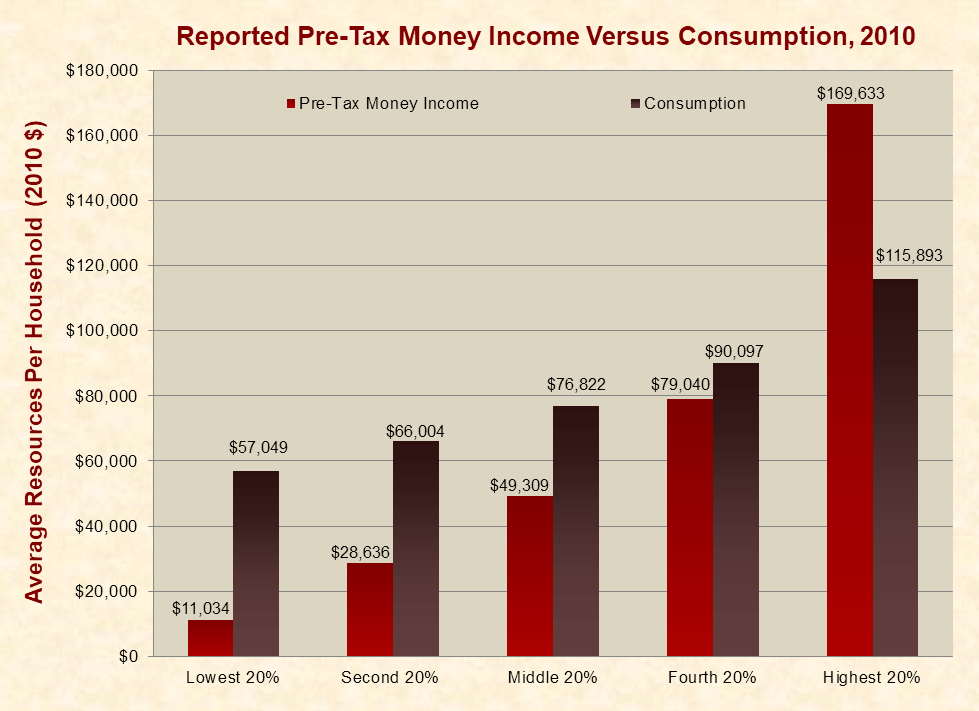
The Bureau of Economic Analysis normally reports consumption for the entire nation and doesn’t break down the data to show how people at different levels fare. However, it published a report in 2012 that does that for 2010. Placed side-by-side with the Census Bureau income figures that underlie its poverty stats, the differences are striking—particularly for the poorest and richest U.S. households:
The federal data graphed above shows that the poorest 20% of U.S. households consumed an average of $57,049 of goods and services per household in 2010, while they reported an average of $11,034 in pre-tax money income to the Census Bureau. This means that widely reported federal poverty stats exclude about 80% of the material resources of low-income households. Put simply, the poorest fifth of U.S. households consume five times more goods and services than the poverty stats reveal.
AOC argues that the federal poverty line for “1 earner & a mother home full-time” should be $38,000/year, as compared to the current line of about $26,000 for a family of four. She attempts to justify this by saying that the current line “doesn’t include cost of childcare, geographic cost of living, or healthcare.” What she neglects to say is that low-income households typically receive such items and many others for free or greatly reduced prices.
In contrast, most U.S. households earn their healthcare, housing, food, childcare, phone service, and such for themselves, while also paying taxes that fund these items for others. As a result, U.S. middle-income households consume only 26% more goods and services than the poorest fifth.
The impacts of this wealth redistribution are even more drastic for the richest fifth of U.S. households, who forfeit a large portion of their income to taxes and receive few government benefits. They report 15 times more pre-tax money income than the poorest fifth of households, but they consume only twice as much goods and services as the poorest fifth.
Given that the available data treat the poorest 20% of households as a single group, while 11.8% of U.S. residents are officially in poverty, one might assume that poor households consume markedly less than the $57,049 average for the group. However, other government data suggests that is not the case. The U.S. Bureau of Labor Statistics collects data on a subset of consumption called “consumer expenditures.” These show a mere $2,179 difference between the lowest 10% of U.S. households and the second lowest 10%. Since consumer expenditures exclude many forms of non-cash welfare, and eligibility for welfaredeclines as income rises, the poorest 10% may consume more goods and services than the second-poorest 10%.
Conclusion
Contrary to AOC, the facts are clear that frequently reported federal poverty stats vastly overstate the number of Americans who are destitute. Moreover, Just Facts’ recent study of data from the World Bank and the U.S. Bureau of Economic Analysis reveals that the poorest fifth of Americans consume more goods and services than the averages for all people in most developed nations of the world. In spite of these facts, AOC decries “economic injustice in America” and insists that the U.S. cannot “capitalism our way out of poverty.”
Leading presidential candidates and major media outlets are claiming that school districts with high concentrations of minorities and poor children generally receive less funding per student than other districts. That hasn’t been true for at least half a century, but people are spreading this myth through deceptive studies that exclude federal funds.
In reality, a broad range of credible studies that include all funding sources show that such school districts are as well-financed as others.
The Claims
According to Democrat presidential hopeful and U.S. Senator Elizabeth Warren, “our current approach to school funding at the federal, state, and local level underfunds our schools and results in many students from low-income backgrounds receiving less funding than other students on a per-student basis.”
Along the same lines:
Sarah Mervosh of the New York Timesreported in early 2019 that “on average, nonwhite districts received about $2,200 less per student than districts that were predominantly white….”
Maria Danilova of the Associated Press (AP) reported in 2018 that “the highest-poverty” school districts “receive an average of $1,200 less per child than the least-poor districts, while districts serving the largest numbers of minority students get about $2,000 less than those serving the fewest students of color….”
Democrat presidential contender and U.S. Senator Bernie Sanders claims that “less is invested in the education of children from low-income families compared with their more affluent peers” because “school districts are funded out of local property taxes.”
Clare Lombardo of National Public Radio (NPR) reported in 2019 that “high-poverty districts serving mostly students of color receive about $1,600 less per student than the national average.”
With the exception of Sanders—who provides no evidence to support his claim—all of the others misrepresent their sources by failing to reveal that they ignore federal funds. Moreover, their sources obscure this fact in the following ways:
Warren cites a study by the Education Law Center, which refers to federal funding on page 2 but then never accounts for any of it. Instead, the study mentions on page 5 that it uses “actual state and local revenues” for its analysis.
The New York Times and NPR cite a report from EdBuild, which doesn’t say a word about the exclusion of federal revenues. Instead, it tacitly slips this into a separate webpage of “research methods“ that references “revenues from state and local sources” while ignoring federal revenues except when subtracting out charter school funding.
The AP cites a report from the U.S. Commission on Civil Rights that repeatedly mentions federal funding, but when it presents the $1,200 and $2,000 underfunding figures quoted by the AP, it cites a study from the Education Trust that explicitly excludes “federal sources.” The Commission on Civil Rights doesn’t even allude to this fact—and to discover it, readers must go to the footnote and then locate the study from a citation with an unclickable link.
In short, these politicians and journalists never hint that their statistics exclude federal funds, and the sources they appeal to bury this crucial caveat. This ensures that only diligent readers with time to investigate will learn the truth.
Moreover, those who propagate this falsehood often call for more federal funds to fix this contrived disparity. But since they ignore federal funding, their proposals to increase it will not change the statistics they present.
Warren’s K–12 education plan, for instance, makes the false claim quoted above and then calls for “quadrupling Title I funding—an additional $450 billion over the next 10 years—to help ensure that all children get a high-quality public education.” Title I is the largest source of federal K–12 education funding, but because Warren doesn’t count this money in her statistics, her plan won’t affect her own measure of school funding.
The Reality
Wide-ranging studies that include all education funding—like those conducted by the U.S. Department of Education (1996), Ph.D. economist Derek Neal (2006), the left-leaning Urban Institute (2008), and the conservative Heritage Foundation (2011)—have all found that school districts with higher portions of minority students spend about the same amount per student as districts with smaller portions of minorities.
The Urban Institute study, which looks the furthest back in time, found that “differences in spending per pupil in districts serving nonwhite and white students are very small” since at least 1972.
Likewise, a study published by the journal Education Next in 2017 found that “per-student K–12 education funding from all sources (local, state, and federal) is similar, on average, at the districts attended by poor students ($12,961) and non-poor students ($12,640), a difference of 2.5 percent in favor of poor students.” The study also found that “this difference has not changed much since 1994–95,” the earliest data in the study.
Within school districts, research published by the Brookings Institution in 2017 found that “on average, poor and minority students receive between 1-2 percent more resources than non-poor or white students in their districts, equivalent to about $65 per pupil.”
The Property Tax Charade
Warren alleges that “school systems rely heavily on local property taxes, shortchanging students in low-income areas.” This was previously the case, but it hasn’t been so for decades. As explained by the Urban Institute:
In the past, because public schools were funded largely by local property taxes, property-rich and -poor school districts differed greatly in expenditures per pupil. Since the early 1970s, however, state legislatures have, on their own initiative or at the behest of state courts, implemented school finance equalization programs to reduce the disparity in within-state education spending.
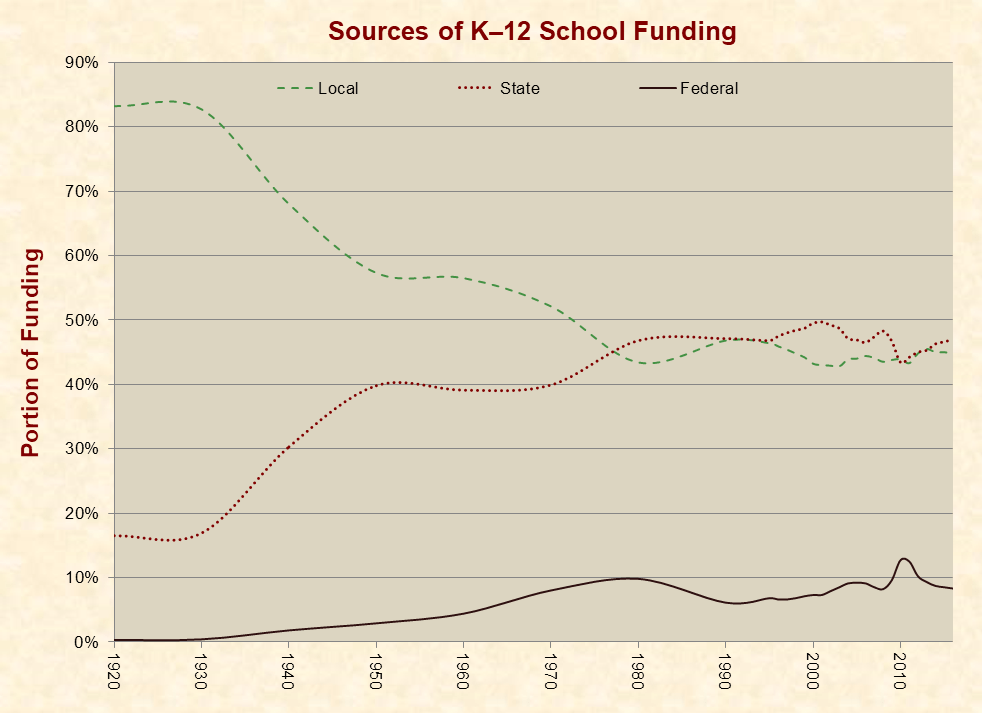
Consequently, data from the U.S. Department of Education show that local revenues have declined from 83% of all school funding in 1920 to 45% in 2016:
Furthermore, the chart above only shows national averages. These don’t reveal the fact that school districts in low-income areas typically receive greater portions of their budgets from state and federal funds. For example, the U.S. Government Accountability Office reported in 2011 that some school districts receive no federal Title I education funding, while others receive as much as 36% of their budget from it.
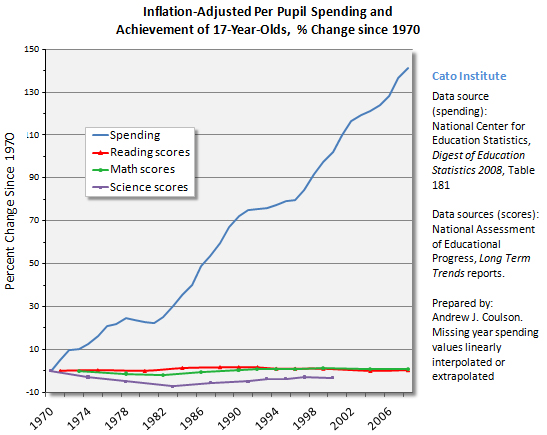
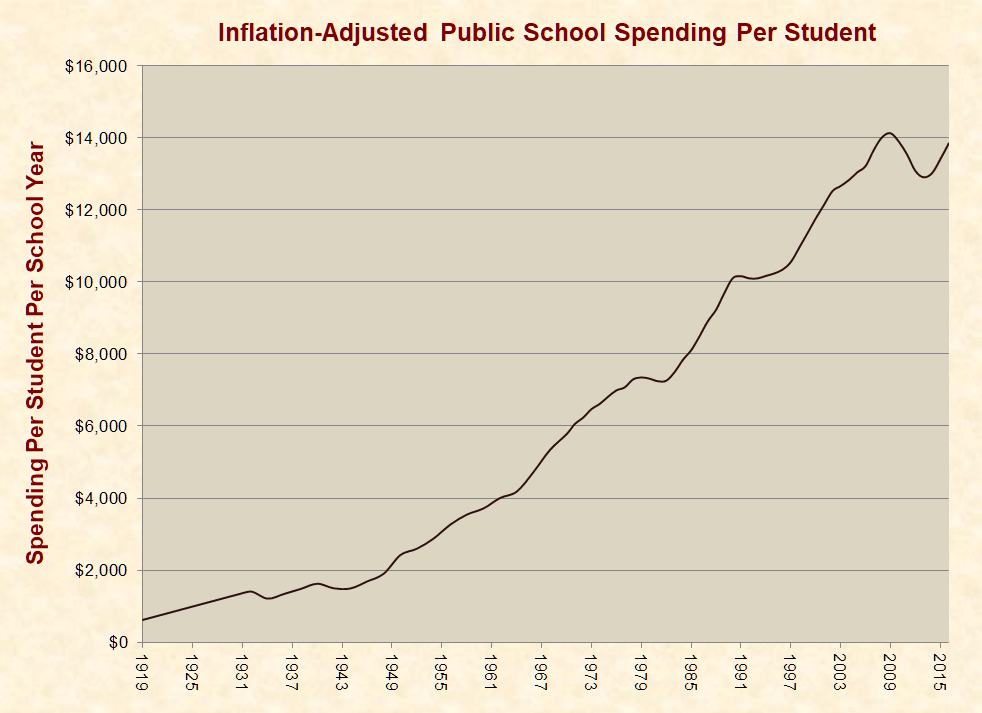
Along with increasing shares of school funding paid by state and federal taxpayers, the inflation-adjusted average spending per student grew by 22 times in the same era:
False Justifications
Some people openly argue that federal funding should be ignored when comparing schools, because this money is meant to help disadvantaged students. However, federal law is at odds with such logic.
The Education Trust, for example, writes that it excludes such funds from its analysis because “federal dollars are intended—and targeted—to provide supplemental services to such specific groups of students as those in poverty, English learners, and students with disabilities.”
In accord with that view, the Obama administration published an issue paper stating that federal education funding “is intended to provide the extra help low-income students need to succeed, but it cannot do that if state and local funds are not evenly distributed to start with.” The administration also drafted regulations to impose this requirement on school districts.
In contrast, the applicable federal law explicitly states that “nothing in this subchapter shall be construed to mandate equalized spending per pupil for a state, local educational agency, or school.” Thus, the Congressional Research Service determined that the Obama administration’s proposed regulations “appear to directly conflict” with the law.
Federal law does require that states and localities not reduce their funding to schools when they receive federal funds. This provision says that states and localities can only use federal funds “to supplement the funds that would, in the absence of such federal funds, be made available from state and local sources,” “not to supplant such funds.” This does not require that funding be equal before or even after federal funding. It simply requires that states and localities don’t cut other funding just because they receive federal funds.
The law also requires that local school districts provide services that “are at least comparable” to all schools within their district before they receive federal funds. New York City, for example, cannot provide unequal services to schools and then use federal funds to equalize them. To meet this requirement, districts must provide similar staff-to-student ratios, “curriculum materials,” and “instructional supplies” to schools in their district in order to receive federal funds.
Nevertheless, politicians and unions sometimes create funding disparities within local school districts by agreeing to contracts that give senior teachers more pay and discretion to choose the schools where they work. These higher-paid teachers tend to avoid inner-city schools with high rates of crime and student discipline problems, resulting in lower spending-per student in poor neighborhoods. Federal law permits this practice by excluding “staff salary differentials for years of employment” from its compliance provisions.
Conclusion
Regardless of any rationale for excluding federal funds from school funding comparisons, it is deceitful to omit such money without even a hint. Yet, Elizabeth Warren, Bernie Sanders, the New York Times, National Public Radio, and the Associated Press are doing just that.
Such disinformation is enabled by advocacy groups like EdBuild and the Education Law Center, which publish reports that exclude federal funds while burying this vital fact.
Warren takes the deception even further by leading people to believe that she actually accounts for federal funds. She does this by claiming that “the current investment in Title I—$15.8 billion—is not nearly enough to make up for state-level funding inequities,” but her supposed evidence for this is a study that excludes all of this money. This provides false grounds to continually demand more from taxpayers and to portray the U.S. education system as systemically racist.
During the throes of the Senate impeachment trial, the Associated Press has published a fact check that claims President Trump is giving a “false account” and making “distorted statements” about “the circumstances that got him impeached.” This AP article is riddled with unsubstantiated assertions, gross mischaracterizations, and blatant falsehoods. Furthermore, dozens of news outlets are carrying the AP story, thus multiplying the reach of its misinformation.
In an article titled “Trump’s False Account of Ukraine Episode,” AP reporters Calvin Woodward and Hope Yen claim that President Trump’s stated motive for releasing the transcript of his July 25th phone call with President Zelensky is “demonstrably untrue” and “easily refuted by the calendar.” This is because Trump said that if he “didn’t release” the transcript, people would believe false portrayals of the call, like the one that Democrat Congressman Adam Schiff made at the opening of the House’s whistleblower hearing.
However, the AP’s quote of Trump actually undermines the AP’s argument. Trump stated, “I released the conversation, because if I didn’t release it, people would have said that I made the statement that he made. This guy is a fraud,” referring to Schiff. Trump’s words, particularly the phrase “would have said,” reveal that he anticipated his political opponents would mischaracterize the phone call, which is exactly what Schiff did just one day after the transcript release.
The AP also ignores the fact that media outlets had begun distorting the call before Trump released the transcript. For example, four days before Trump released it, the Wall Street Journal reported that Trump “repeatedly pressured” Zelensky “to investigate Joe Biden’s son” during the call, “urging” him “about eight times to work with Rudy Giuliani on a probe that could hamper Mr. Trump’s potential 2020 opponent.” Yet, the call transcript shows no evidence of pressure, and the claim of “eight times” is a complete fabrication. The totality of Trump’s statements about Biden, which are interspersed with comments by Zelensky, are as follows:
“There’s a lot of talk about Biden’s son, that Biden stopped the prosecution and a lot of people want to find out about that so whatever you can do with the Attorney General would be great. Biden went around bragging that he stopped the prosecution so if you can look into it … It sounds horrible to me.”
“I will have Mr. Giuliani give you a call and I am also going to have Attorney General Barr call and we will get to the bottom of it. I’m sure you will figure it out. I heard the prosecutor was treated very badly and he was a very fair prosecutor so good luck with everything.”
“I will tell Rudy and Attorney General Barr to call.”
In sum, people were misrepresenting the phone call, Trump saw this occurring, and he declassified the transcript to combat these and future allegations. Trump’s suspicions were confirmed one day later when Schiff distorted the call during a broadly televised Congressional hearing.
The AP also spreads Schiff’s falsehood that his description of the Trump-Zelensky call was simply a “parody” and that Schiff “made clear in the hearing he was not to be taken literally.” The truth is that Schiff claimed his statements were a “parody” only after Republican Congressman Mike Turner challenged him an hour later into the hearing. More significantly, a parody is defined by its “comic effect” or “ridiculous imitation.” Schiff’s statements, detailed below, have neither of these qualities. Schiff later called impeachment a “solemn action,” which further undercuts the notion that this was a parody.
Likewise, the AP uncritically relays Schiff’s claim that he was conveying “the essence” or the “sum and character” of what “the President was trying to communicate.” Yet, Schiff’s description is in conflict with the reality of what occurred:
Schiff alleges that the call transcript reads like “an organized crime shakedown” where Trump asks Zelensky “seven times” to “make up dirt on my political opponent.” Trump does not ask Zelensky to “make up dirt” on anyone. Trump requests an investigation into the Bidens for possible corruption, stating “whatever you can do with the Attorney General would be great.”
According to Schiff, Trump tells Zelensky, “Don’t call me again. I’ll call you when you’ve done what I asked.” In reality, Trump says, “feel free to call,” and “I look forward to seeing you in Washington and maybe in Poland.”
Importantly, Schiff uttered these falsehoods at the opening of a widely televised hearing. ABC, CBS, NBC, CNN, CNN en Espanol, Fox News, MSNBC, and C-SPAN all dropped regularly-scheduled programming to air the hearing live.
Casting aspersion on Trump’s motives for delaying aid to Ukraine, the AP writes that “previous rounds of assistance were not similarly disrupted.” This half-truth leaves out the fact that the President has held up foreign aid to an array of countries to ensure that U.S. interests are served. He has done this with Afghanistan, El Salvador, Honduras, Guatemala, Lebanon, and Pakistan.
The AP also cites Trump’s oft-repeated statement, “I would like you to do us a favor,” as evidence of Trump pressuring Ukraine to investigate Biden. In doing so, the AP takes Trump grossly out of context, as the rest of his sentence says, “because our country has been through a lot, and Ukraine knows a lot about it. I would like you to find out what happened with this whole situation with Ukraine, they say CrowdStrike.” This is the private company that investigated the hack of the Democratic National Committee’s email servers, which the DNC refused to provide to the FBI. Trump then says, “The server, they say Ukraine has it.”
Thus, the “favor” is a request for Ukraine to help investigate 2016 election interference, which is exactly what the Democrats spent two years doing. In fact, three Democratic Congressmen sent a letter to the government of Ukraine in 2018 stating that “we strongly encourage you” to cooperate with the Mueller investigation.
This AP “fact check” also claims that Trump “dangles the possibility of a White House visit for Zelensky,” naming it as another instance of Trump pressuring for investigations. However, the AP fails to mention that Trump committed to meet with Zelensky three months earlier in April of 2019, and the transcript provides no evidence that a meeting was “dangled.” In fact, Trump offered to meet on Zelensky’s terms, stating: “Whenever you would like to come to the White House, feel free to call. Give us a date and we’ll work that out. I look forward to seeing you.”
The AP attempts to debunk Trump’s statement that he held up Ukrainian aid to ensure that other countries contributed more to helping the Ukraine. The article claims that other countries have “provided far more developmental assistance” to Ukraine than the United States. It also states that the EU has provided “more than $16 billion” to help Ukraine since 2014 and that NATO “contributes a variety of military-assistance programs and trust funds.” However, the AP provides no hyperlink or documentation for these assertions, does not explain any context for the aid, and neglects to reveal that the U.S. provides 22% of NATO’s direct funding and 67% of its indirect funding. Most importantly—the AP fails to mention that Zelensky himself emphatically confirms Trump’s statement.
On their phone call, Zelensky said he agreed “not only 100%, but actually 1,000%” with Trump’s assertion that other countries are not doing their fair share to help Ukraine. When Trump states that the U.S. spends “much more” effort and time to help Ukraine than many European countries and that “they should be helping you more than they are,” Zelensky responds, “Yes you are absolutely right” and “the European Union should be our biggest partner, but technically the United States is a much bigger partner.” Contrary to the AP’s unsupported narrative, President Zelensky’s appraisal of Ukraine’s foreign support directly aligns with Trump’s concerns.
The article also criticizes President Trump for claiming that Zelensky said the phone call was “perfect.” Although Zelensky never used the word “perfect,” Trump is conveying the essence of Zelensky’s statements. Unlike Adam Schiff’s definition of “essence,” the President’s characterization is accurate. Zelensky has made public statements denying any pressure, bribery, extortion, or quid pro quo, which the AP article admits. Yet, the AP splits hairs, scolding the President for accurately describing Zelensky’s assessment of the call because he doesn’t use Zelensky’s exact words.
With regard to the same issue, the AP asserts that Zelensky “told Time last month that Trump should not have blocked military aid to Ukraine. Zelensky also criticized Trump for casting the country as corrupt.” However, in that same interview, Zelensky acknowledged corruption in Ukraine and also denied the presence of a quid pro quo. Zelensky’s disagreement with Trump’s description of Ukraine as corrupt and the hold on the aid do not have any bearing on whether the President inappropriately pressured the Ukrainian government.
The AP closes the article by stating: “In any event, Zelensky knew months before the call that much-needed U.S. military support might depend on whether he was willing to help Trump by investigating Democrats.” Once again, the AP provides no source or evidence for this claim. In fact, Ambassador Bill Taylor, Ambassador Kurt Volker, and NSC Official Tim Morrison testified that the Ukrainian government did not even know that the aid was held up at the time of the call, much less that it was dependent on any investigations.
This AP “fact check” violates its own standards of credible journalism, which condemn “inaccuracies, carelessness, bias or distortions.” Put simply, the AP promotes the exact kind of misleading propaganda that it accuses President Trump of spreading.
Anna Lynn is a writer and researcher for Just Facts, a think tank dedicated to publishing rigorously documented facts about public policy issues.
Not exactly surprising, but late last night ABC released the transcript of the Bill Barr interview. A review of the transcript compared to the broadcast shows there was significant interview material left on the editing floor.
Approximately two-thirds of the interview was never broadcast. Additionally, major sections of answers were completely cut out (chopped up/edited) after the question(s) was/were asked.
Below is the full transcript of the interview (including parts not broadcast), and the full, raw, 25 minute video of the interview:
.
[Transcript] – ABC NEWS CHIEF JUSTICE CORRESPONDENT PIERRE THOMAS: General Barr, thank you for your time.
ATTORNEY GENERAL BILL BARR: Thank you.
THOMAS: This is the first time we’re hearing from you since the Roger Stone story erupted. At minimum, there appears to be an appearance problem. Trial prosecutors recommended 7 to 9 years on Monday evening. The president tweets at 1:48 AM Tuesday morning calling the recommendations – quote “horrible, unfair and a miscarriage of justice.”
Then word comes out from DOJ headquarters Tuesday morning that the recommendations are too severe and suggests a lesser sentence is more appropriate. Four of the trial attorneys resigned from the case. One of them quitting the Justice Department altogether.
What happened, sir, and what was your role?
BARR: Well, as you know, the Stone case was prosecuted while I was attorney general. And I supported it. I think it was established, he was convicted of obstructing Congress and witness tampering. And I thought that was a righteous prosecution. And I was happy that he was convicted.
The issue then became the sentencing. A new U.S. attorney had just started in Washington D.C. and the week before the filing, he engaged in conversations with senior staff here who raised some questions about the sentencing because he was concerned that the so called guidelines, the sentencing guideline formula, was indicating a sentence between 7 and 9 years.
Which, he felt and all of us immediately felt was very, very high and excessive in this case. And so he wanted to discuss that and over a number of days it became clear that the prosecution team wanted to recommend to the judge, and by the way, sentencing is a function for the judge and not the Department of Justice, we’re not the decision maker. But they wanted to advocate for a sentence that was, at the top, between 7 and 9 years.
And, in those discussions here at the department, you know, I came to the view as my colleagues did that I wouldn’t support affirmatively advocating what I thought was an excessive sentence.
So, what I wanted to do what to provide dis — defer to the discretion of the judge, let the judge make the determination.
THOMAS: You wanted to do that from the outset?
BARR: Yes. And then point out different features of the case that she should consider if she wanted to go below the 7 to 9 years. And I won’t get into the wires on that, but there were a lot of, I think, very legitimate arguments to be raised, there are points to be raised there. But at the end of the day, we deferred to her. Or, and that was what the approach was, I thought, we were going to take.
THOMAS: So the US attorney for the District of Columbia signed off on, his name is on the recommendation that went in there.
BARR: Yeah.
THOMAS: How did that happen?
BARR: On Monday, he came by to briefly chat with me and say that the team very much wanted to recommend the 7-9 year to the judge. And, but he thought that there was a way of satisfying everybody and providing more flexibility.
And there was a brief discussion of that. I was under the impression that what was going to happen was very much what I had suggested, which is deferring to the judge and then pointing out the various factors and circumstances. On Monday night, when I first saw the news reports, I said, “Gee, the news is spinning this. This is not what we were going to do.”
MORE: A timeline of the extraordinary turn of events in the Roger Stone case
THOMAS: So you were surprised?
BARR: I was very surprised. And once I confirmed that that’s actually what we filed, I said that night, to my staff, that we had to get ready cause we had to do something in the morning to amend that and clarify what our position was.
So the following morning — and by the way, I don’t look at tweets, I don’t read tweets unless they’re brought to my attention. So early the next morning I was you know, putting that in motion and directing that be done when someone walked in and told me that, about the president’s tweet.
That sort of illustrates how disruptive these tweets can be for the Department of Justice, because at that point, I had made a decision that I thought was fair and reasonable in this particular case and once the tweet occurred, the question is, Well, now what do I do? And do you go forward with what you think is the right decision or do you pull back because of the tweet? And that just sort of illustrates how disruptive these tweets can be.
THOMAS: So you’re saying you have a problem with the tweets?
BARR: Yes. Well, I have a problem with some of, some of the tweets. As I said at my confirmation hearing, I think the essential role of the Attorney General is to keep law enforcement, the criminal process sacrosanct to make sure there is no political interference in it. And I have done that and I will continue to do that.
And I’m happy to say that, in fact the president has never asked me to do anything in a criminal case. However, to have public statements and tweets made about the department, about our people in the department, our men and women here, about cases pending in the department, and about judges before whom we have cases, make it impossible for me to do my job and to assure the courts and the prosecutors in the department that we’re doing our work with integrity.
THOMAS: Mr. Barr, the president does not like to be told what to do. He may not like what you’re saying. Are you prepared for those ramifications?
BARR: Of course. As I, you know, said during my confirmation, I came in to serve as Attorney General. I am responsible for everything that happens in the department, but the thing I have most responsibility for are the issues that are brought to me for decision.
And I will make those decisions based on what I think is the right thing to do and I’m not going to be bullied or influenced by anybody. And I said, whether it’s Congress, newspaper editorial boards, or the president. I’m going to do what I think is right. And, you know, the, I think the — I cannot do my job here at the department with a constant background commentary that undercuts me.
THOMAS: Why does it make it so difficult for you to do your job and if he keeps doing it, what are you prepared to do?
BARR: Well you know I think—
THOMAS: Commenting specifically on criminal investigations?
BARR: Well again if some examples would be if you tweet something about, someone should be investigated for this or someone should go to jail and it turns out you are investigating them at that point, let’s say, this is a hypothetical, then what do you do? Because people might think that if you proceed with the investigation, it was prompted by the tweet. It’s the same kind of thing that happened here. So, and there are other examples where if you have a case before a judge to be attacking the judge, you know, it is not helpful or productive at all.
And also, you know, I think attacking- for people to attack people here in the department or in the FBI in general terms is unfair and, you know, I think I came back into government because I love the department and I believe strongly in it as an institution and I think we have great people here. And I can – and so, you know, it makes it difficult to be a leader here if —
THOMAS: How strongly do you feel about this?
BARR: Well I feel strongly about it.
THOMAS: So just to be clear, did you talk to the President at all about your decision regarding the recommendations?
BARR: The recommendations on this case? Never.
THOMAS: Anybody from the White House call you to try to influence you?
BARR: No. Nope. [crosstalk] have not discussed the Roger Stone case at the White House.
THOMAS: At all?
BARR: At all.
THOMAS: Lisa Murkowski, Senator from Alaska. Here’s what she said this week,“I think most people in America would look at that and say hmm that just doesn’t look right.” And then she goes on to say, “I don’t think the President needed to jump in the middle of this in the first place.” And Lindsey Graham, Chairman of the Senate Judiciary Committee, strong defender, supporter of the president, he defended his frustration with all that’s happened to him in Washington. He added this, “I don’t think the President should have tweeted about an ongoing criminal case.” So you share their position?
BARR: Yes. I do. [crosstalk] It makes it very hard. You know, it doesn’t affect the decision. It doesn’t affect my decision. As I said at the beginning during my hearing, I don’t pay attention to tweets. If the President has something to say, I expect that he will talk to me directly and call me. So I don’t pay attention to tweets and I – I’m not going to pay attention to directions and do something that I think is wrong.
I’m going to handle each case as I think the law requires and is fair, and even-handed. But I think Senator Murkowski is right that people who see these tweets can get a misimpression that they… that the work of the department is being influenced by it.
THOMAS: So when you heard him or you saw him say, “Congratulations to the Attorney General Bill Barr for taking charge of a case that was totally out of control and perhaps should not have been brought. Evidence now clearly shows that Mueller- the Mueller scam was improperly brought and tainted, even Bob Mueller lied to Congress.” He criticized the judge, as you mentioned earlier. How does that impact the department? The people that work here. And the impression of the American people?
BARR: Well I think the people who know me, know me here in the Department, know me in town and have worked with me, know that that stuff has no effect on what we do here. That we’ll make our decisions, as I say, based on the merits. But most people in the country don’t have that kind of exposure, and I think I can understand why people are concerned that it could influence the work of the department.
THOMAS: You’re telling the American public that had absolutely nothing to do with it?
BARR: Absolutely. And just, I, I’ve heard very few people actually suggest that 7 to 9 year sentence would be appropriate in this case. Very few people. Even the people who were criticizing me. It was very excessive. And I didn’t want my department to be behind that. Because I believe that each individual as unsavory as they may be, and I’m not a fan of Roger Stone, but he’s entitled to the particularized and careful application of the law to his case.
And as I say, I could not support the 7 to the 9 year- and I didn’t need anybody to tell me that 7 to 9 years was an excessive sentence. You think I need the president’s tweet to tell me that 7 to 9 years is excessive? That was the reaction of you know the senior staff here that, you know, there’s not really a comparable situation where that kind of sentence has been used.
THOMAS: And so, I guess I’m confused as to how that recommendation could get filed when you clearly were indicating that shouldn’t go down like that.
BARR: Yeah well, it’s, I’m afraid it’s one of those situations, I’m confused too. And I think it really was a situation of miscommunication. It was a very brief meeting, it was actually in between two meetings I had and the U.S. Attorney stuck his head in and described what he, how he thought he could reconcile things. And I thought that he was saying, was in accord with my view that we should not affirmatively recommend 7 to 9 years.
But we should allow the judge or say that we defer to the judge, you know, there appears to have been something lost in translation.
THOMAS: Do you feel like you still have confidence in U.S. Attorney Shea?
BARR: Yes I do. I mean I’ve known Tim Shea for a long time as you know he was with me here at the department last time I was Attorney General so that was many years ago. He has a great a great record so – and he was just- to be fair he had just entered into that office and you know I think we’ll establish better communications.
THOMAS: I just wanted to go back to the 4 prosecutors who resigned. Were you surprised that they stepped away from the case, including one who quit the department altogether?
BARR: Yeah. My understanding is one left the department but the other three did not resign from the department.
THOMAS: Just resigned from the case?
BARR: I, I thought — I was a little surprised because at the end of the day, what this was about was whether we — this was a sentencing decision that a judge was going to make — going to be making. It wasn’t, you know, the department wasn’t the decision maker.
And the difference of opinion was whether we should affirmatively advocate a 7 to 9 year sentence, or whether we should let the judge decide and explain why a lower sentence could be justified. And, I’m not, I’m not sure why that would prompt anyone to resign. On the other hand, again there may have been a communication problem because of the way the information leaked out.
THOMAS: Now, some people would say, look, they worked the case. They know the case best. They’re just wrong in your eyes?
BARR: No, this actually gets to a very important point about the Department, which is, you know, what other industry allows you know, life or death decisions to be made by the most junior level of the, of the business, so to speak. We at the department, we want people with a lot of energy and commitment. And so we express — we hope for a lot of, of that energy and commitment.
At the same time, when people are working on one case, and devoting a lot to it, they can sometimes lose perspective. And that’s exactly why we have a, a system of checks and balances within the department with multiple level of reviews that fan out with people with broader and broader responsibility. And most cases don’t come up to the attorney general, because people are doing a great job in the department.
And, a lot of the work doesn’t involve much controversy. But every once in a while, there are disputes or arguments over cases and those are the ones that come up. And the AG has to make the decision. So, some people say, you know, the AG intervening in a case.
That’s preposterous, we have an escalation system that tries to get the difficult issues that are, you know, people are arguing about, to get them up for resolution and it’s the attorney general’s responsibility to resolve it.
THOMAS: And you know, people have pride, though, and you could see how they would see as a public rebuke. You think that’s part of why they resigned in protest? From the case?
BARR: I don’t know why they resigned.
THOMAS: So you’ve not had a chance to talk to them?
BARR: No.
THOMAS: And do you expect any other resignations, are you getting any hint of any other resignations in regard to this case? People tied to the case?
BARR: I hope, I hope there are no more resignations. We, we like our prosecutors and hope they stay.
MORE: William Barr: Everything you need to know about Trump’s controversial attorney general
THOMAS: You’re known around town as someone who believes that the president vast authority, broad authority, to do the job, to execute the wills of the state. Does the president have the authority to just direct you to open an investigation and you have to do it? Can you help people at home understand? Can he do that?
BARR: Well I discuss this in detail in my confirmation hearings. I think in many areas such as- that don’t affect his personal interest-
THOMAS: Terrorism?
BARR: Terrorism or fraud by a bank or something like that where he’s concerned about something, he can certainly say I think someone should look into that. That’s perfectly appropriate. If he were to say, you know, go investigate somebody because – and you sense it’s because they’re a political opponent, then an attorney general shouldn’t carry that out, wouldn’t carry that out.
THOMAS: Democrats on Capitol Hill have said they believe that you were somewhat misleading in how you described the Mueller Report initially, before the full report came out. You said openly that you thought the president was spied on in the congressional hearing. You expressed skepticism about the launch of the origins of the Russia investigation. So they would say that you have maybe let the president feel like- that he can have the latitude to say those things. What would you say to them?
BARR: I would say that- that is not a valid conclusion, obviously the whole point of the Muller exercise was to determine if there was collusion. There wasn’t. And frankly I think you recognize, having looked at the material directly, that I didn’t mislead anyone about Mueller’s conclusions, but in terms of the Durham effort, which is to take a look at what happened that’s a legitimate area of investigation.
And you know starting a legitimate investigation as to what happened is- that’s the work of the Attorney General and Department of Justice. That- that’s not like a- you know, like a running commentary from someone on the outside about what we’re doing.
THOMAS: New York Times reported that John Bolton wrote in his book that after the president’s July 25th phone call with the Ukrainian president, he raised concerns about Guiliani and that he was pursuing the Ukraine with you. Is that true?
BARR: I don’t – I don’t recall that that was the exact quote. I’m not going to get into, into Bolton but, yeah, just not going to get into it.
THOMAS: Were you surprised when the president mentioned you on the — when you heard that he mentioned you on the July 25th call and he did so 5 times and kind of created the impression that you were working with Guiliani?
BARR: Yes.
THOMAS: Your reaction when you heard it?
BARR: I was a bit irritated by it. But, you know, the conversation jumped around, so, I’m not sure what he meant by some of what he was saying.
THOMAS: And this sounds like it’s in the same vein as creating the impression that you’re doing exactly what he wants you to do when he wants you to do. Is that what frustrated you?
BARR: Well, I think that it’s very clear, and I’ve always said this publicly and I think people know it, that what I am dealing with is the review of the 2016 election. That’s what I’m looking at. I’m not looking, you know, at other more general things about the Ukraine. And I think mixing them together created confusion in people’s minds.
THOMAS: And so now we have Guiliani, who’s gone to the Ukraine, come back, he’s presenting information and you told me earlier this week that he would go through the appropriate channels.
But he worked with two men to get this information who currently under indictment in the Southern District. Can you ensure- can you ensure that to the American public that the Justice Department is not going to be used as a weapon in a highly charged political season?
BARR: Absolutely. And as you know, Pierre, one of my passions is the feeling that we have to ensure that the Department of Justice is not used as a political football. And one of the things I’m distressed about is the increasing use of the criminal process to achieve political results. And I want to- I want to get away from that.
As you know, I put out a memo to make sure that any investigation that could have these kinds of political effects during an election year have to be approved at the very highest level of the FBI and the Department of Justice.
THOMAS: Do you think the Democrats will accept you as the messenger though?
MORE: Pelosi accuses Trump of abusing power by interfering in Roger Stone case
BARR: I don’t know. [crosstalk] They, many of them didn’t vote for me for confirmation.
THOMAS: Right. And they held you in contempt.
BARR: We live, unfortunately, you know, one of the things that makes it difficult is the hyper-partisan age we live in. That makes it very difficult.
THOMAS: You know, having known you and covered you for years, you’re not a person that responds a lot to criticism. But I am wondering, in this version of the job, you in the job, and when you hear people on Capitol Hill saying “Barr is acting more like the personal attorney to the President rather than the chief law enforcement officer,” how irritated does that make you and what do you say to those people?
BARR: Well, this goes back to the fact we are in a very polarized situation. And so in that kind of situation, I expect a lot of low blows, and there are a lot of low blows.
But I don’t respond to that, as you say. But I do think that in the current situation, as I’ve said, you know, the fact that the tweets are out there and correspond to things we’re doing at the department sort of give grist to the mill and that’s why I think it’s time to stop the tweeting about Department of Justice criminal cases.
THOMAS: How would you describe your relationship with the President in general terms. I know you don’t talk specifics, but in general terms, how is the relationship?
BARR: I think our relationship is good. I support his program, I think he’s doing great things for the country. I feel that, you know he’s faced a lot of resistance and he’s still able to accomplish a lot of good things. And we have a good working relationship.
THOMAS: You’re clearly setting some parameters for that relationship. Do you have any expectation of how he’ll react to some of the things you’ve said today?
President Trump mentioned the likelihood the military would take a look at the conduct of Lt. Col Alexander Vindman in the wake of his leaking classified information to construct a fraudulent whistle-blower complaint with CIA ally Eric Ciaramella.
Today Army Secretary Ryan McCarthy said Vindman will not be investigated for his role in breaching national security protocol, fabricating claims and breaking chain of command.
WASHINGTON DC – The Army will not investigate Lt. Col. Alexander Vindman, the former National Security Council staffer who testified in the president’s impeachment investigation, the service’s top civilian said Friday.
Army Secretary Ryan McCarthy made the announcement at an event just days after President Donald Trump said he imagined the military would “take a look at” whether Vindman should face disciplinary action for the “horrible things” he told House investigators about the president’s phone call with Ukrainian President Volodymyr Zelensky last July. (link)
When we consider that Lt. Col. Vindman was carrying out what he believed to be his role; and when you overlay his military purpose; and when we accept Vindman was assisting CIA agent Eric Ciaramella in constructing his dossier to remove President Trump; and when we stand back and look at the aggregate interests involved; and when we consider there was ZERO push-back from the ranks of military leadership, specifically the Joint Chiefs of Staff; and when you accept Vindman was simply allowed to return to his post inside the White House – where he remains today; well, the alarming aspect increases in direct proportion to the definition of the word: “coup”.
Beyond the debate about the optics of the “coup“, within the testimony of Lt. Col Vindman, the NSC witness readily admits to understanding the officially established policy of the President of The United States (an agreement between President Trump and President Zelenskyy), and stunningly admits that two weeks later he was giving countermanding instructions to his Ukrainian counterpart to ignore President Trump’s policies.
The coup against President Donald Trump went from soft, to hard. Consider…
Borrowing from Roscoe B Davis, here are some highlights:
Representative John Ratcliffe begins deconstructing Lt. Col Vindman, while his arrogant attorneys begin trying to interfere with the questioning.
This next section is very interesting, and very important.
Congressman John Ratcliffe begins questioning Vindman from the perspective of an Article 92 violation {READ IT}, coupled with an Article 88 violation {READ IT}. President Trump, is Lt. Col Vindman’s superior. President Trump sets the foreign policy.
Any commissioned officer who uses contemptuous words against the President, the Vice President, Congress, the Secretary of Defense, the Secretary of a military department, the Secretary of Homeland Security, or the Governor or legislature of any State, Commonwealth, or possession in which he is on duty or present shall be punished as a court-martial may direct. [Article 88, UCMJ]
Two weeks after President Trump has established an agreement with Ukraine President Zelenskyy, and established the policy direction therein, Lt. Col. Vindman is now giving contrary instructions to the Ukranian government. Vindman’s lawyer recognizes where the questioning is going and goes absolutely bananas:
Anyone who has followed DC for a while could see this one coming a mile away… including the synergy of self-interested timing. Catherine Herridge of CBS reports on a ‘tick-tock’ letter from Senator Lindsey Graham to AG Bill Barr where Graham announces his request for witnesses. The Graham list is an assembly of various DOJ/FBI officials who participated in Crossfire Hurricane and the fraudulent FISA application(s).
The timing of the letter, alluding to some possible hearing at some possible later date, follows a DC pattern. [Chaff and Countermeasures] In essence, cover for visible inaction; an attempt to convince people to put down the pitchforks.
A “Countermeasure” is a measure or action taken to counter or offset a preceding one.
Politically speaking, the deployment of countermeasures is a tactic used by professional politicians in Washington DC to counter incoming public inquiry and protect themselves from anger expressed by the electorate.
Weaponized government takes action and creates victims. Beyond the strategy – the countermeasures are politicians assigned a role to control the incoming righteous inquiry from voters who find out about the weaponized or corrupt governmental action.
1.) The electorate become aware of a political issue or action; often illegal.
2.) The electorate become angry.
3.) DC needs to protect itself.
4.) Countermeasures are assigned and deployed to delay, obfuscate and create the illusion of investigation of the illegal governmental action.
“Hashing it Out” is a Washington Examiner podcast hosted by Siraj Hashmi. This week HPSCI ranking member Devin Nunes appears for a lengthy 45-minute discussion covering the never-ending coup against President Trump.
Representative Nunes discusses the counterintelligence investigation into the Trump campaign during the 2016 election, what he discovered through his own investigation, Objective Medusa, and how this all led to Trump’s impeachment and acquittal.
Creepy porn lawyer and former CNN political analyst, Michael Avenatti, has been found guilty on all three counts in the $25 million Nike Extortion case.
New York – Disgraced lawyer Michael Avenatti was convicted Friday by a jury of all three charges related to his efforts to extort up to $25 million from athletic apparel giant Nike.
[…] Avenatti was accused in the Nike case of trying to shake down the company by threatening to expose alleged evidence of bribing amateur basketball players and their families unless the company paid up. (link)
CPL still faces two more prosecutions: one in New York for defrauding client Stormy Daniels of $300k; and another in California for fraud, embezzlement, tax crimes and perjury.
I have created this site to help people have fun in the kitchen. I write about enjoying life both in and out of my kitchen. Life is short! Make the most of it and enjoy!
This is a library of News Events not reported by the Main Stream Media documenting & connecting the dots on How the Obama Marxist Liberal agenda is destroying America




 Centinel2012