Happy Pi Day – Tomorrow is the Ides of March


Pi Day-R

While today is know as Pi Day, tomorrow is the fateful Ides of March and indeed to Trump we must say – Beware! It clearly appears that the Treasury has been deliberately trying to get rid of its cash reserves which stood at $435 billion before the election. They obviously expected President Hillary Clinton would be in the White House and the Democrats would control Congress so there would be no problem in raising the debt ceiling as always.

However, Trump resiodes not Hillary and it clearly seems that the Treasury since January 20th has moved into high gear to create an intentional crisis to blame Trump with 70 years+ of deficit spending post-World War II. The Treasury’s cash has vanished and it has collapsed rapidly down to $88 billion. The massive drain of cash has been deliberate. Never has such a raid decline taken place.
There is a coming disaster thanks to the Obama/Boehner selling out the country. Politicians know that they can do anything as long as you push it off into the future after they leave office for all blame will fall of the next person holding office. Hence, Trump will be blamed for the entire debt – just watch. This will not end nicely.

Can the EU Return to just a Trade Union?


greek-protest-natzi

QUESTION: Hi Marty,

When the EU reaches their “Oh shit!” moment will it be able to devolve back into an Economic union? Is there any possibility that the fall in the Euro will rescue the EU?

Regards,
F

ANSWER: Human nature seems to dictate that will not happen. The attempt by the elite to force a federalized government will only foster the resentment. The Foreign Minister Witold Waszczykowski of Poland said: “We now know what that is, an EU under the dictate from Berlin.”  The Greeks are resentful of Germany as are the Spanish and Italians and we see the same trend emerging in France. This attempt to force a single government upon Europeans has only fanned the flames the burning wounds from previous world wars.

Those who have taken up jobs in Brussels have no job without a federalization of government. So you have tens of thousands of people who suddenly will be out of work and then you have pensions they voted for themselves. They have far too much self-interest NOT to compromise. It will be an all or nothing affair and that is the sad ending for the EU. It will be too late to return to a simple trade union like NAFTA.

$21,714 For Every Man, Woman And Child In The World – This Global Debt Bomb Is Ready To Explode


Tyler Durden's picture

Authored by Michael Snyder via The Economic Collapse blog,

According to the International Monetary Fund, global debt has grown to a staggering grand total of 152 trillion dollars.  Other estimates put that figure closer to 200 trillion dollars, but for the purposes of this article let’s use the more conservative number.  If you take 152 trillion dollars and divide it by the seven billion people living on the planet, you get $21,714, which would be the share of that debt for every man, woman and child in the world if it was divided up equally.

So if you have a family of four, your family’s share of the global debt load would be $86,856.

Very few families could write a check for that amount today, and we also must remember that we live in some of the wealthiest areas on the globe.  Considering the fact that more than 3 billion people around the world live on two dollars a day or less, the truth is that about half the planet would not be capable of contributing toward the repayment of our 152 trillion dollar debt at all.  So they should probably be excluded from these calculations entirely, and that would mean that your family’s share of the debt would ultimately be far, far higher.

Of course global debt repayment will never actually be apportioned by family.  The reason why I am sharing this example is to show you that it is literally impossible for all of this debt to ever be repaid.

We are living during the greatest debt bubble in the history of the world, and our financial engineers have got to keep figuring out ways to keep it growing much faster than global GDP because if it ever stops growing it will burst and destroy the entire global financial system.

Bill Gross, one of the most highly respected financial minds on the entire planet, recently observed that “our highly levered financial system is like a truckload of nitro glycerin on a bumpy road”.

And he is precisely correct.  Everything might seem fine for a while, but one day we are going to hit the wrong bump at the wrong time and the whole thing is going to go KA-BOOM.

The financial crisis of 2008 represented an opportunity to learn from our mistakes, but instead we just papered over our errors and cranked up the global debt creation machine to levels never seen before.  Here is more from Bill Gross

 My lesson continued but the crux of it was that in 2017, the global economy has created more credit relative to GDP than that at the beginning of 2008’s disaster. In the U.S., credit of $65 trillion is roughly 350% of annual GDP and the ratio is rising. In China, the ratio has more than doubled in the past decade to nearly 300%. Since 2007, China has added $24 trillion worth of debt to its collective balance sheet. Over the same period, the U.S. and Europe only added $12 trillion each. Capitalism, with its adopted fractional reserve banking system, depends on credit expansion and the printing of additional reserves by central banks, which in turn are re-lent by private banks to create pizza stores, cell phones and a myriad of other products and business enterprises. But the credit creation has limits and the cost of credit (interest rates) must be carefully monitored so that borrowers (think subprime) can pay back the monthly servicing costs. If rates are too high (and credit as a % of GDP too high as well), then potential Lehman black swans can occur. On the other hand, if rates are too low (and credit as a % of GDP declines), then the system breaks down, as savers, pension funds and insurance companies become unable to earn a rate of return high enough to match and service their liabilities.

There is always a price to be paid for going into debt.  It mystifies me that so many Americans seem to not understand this very basic principle.

On an individual level, you could live like a Trump (at least for a while) by getting a whole bunch of credit cards and maxing all of them out.

But eventually a day of reckoning would come.

The same thing happens on a national level.  In recent years we have seen examples in Greece, Cyprus, Zimbabwe, Venezuela and various other European nations.

Here in the United States, more than 9 trillion dollars was added to the national debt during the Obama years.  If we had not taken more than 9 trillion dollars of consumption and brought it into the present, we would most assuredly be in the midst of an epic economic depression right now.

Instead of taking our pain in the short-term, we have sold future generations of Americans as debt slaves, and if they get the chance someday they will look back and curse us for what we have done to them.

Many believe that Donald Trump can make short-term economic conditions even better than Obama did, but how in the world is he going to do that?

Is he going to borrow another 9 trillion dollars?

A big test is coming up.  A while back, Barack Obama and the Republican Congress colluded to suspend the debt ceiling until March 15th, 2017, and this week we are going to hit that deadline.

The U.S. Treasury will be able to implement “emergency measures” for a while, but if the debt ceiling is not raised the U.S. government will not be able to borrow more money and will run out of cash very quickly.  The following comes from David Stockman

 The Treasury will likely be out of cash shortly after Memorial Day. That is, the White House will be in the mother of all debt ceiling battles before the Donald and his team even see it coming.

 With just $66 billion on hand it is now going to run out of cash before even the bloody battle over Obamacare Lite now underway in the House has been completed. That means that there will not be even a glimmer of hope for the vaunted Trump tax cut stimulus and economic rebound on the horizon.

Trump is going to find it quite challenging to find the votes to raise the debt ceiling.  After everything that has happened, very few Democrats are willing to help Trump with anything, and many Republicans are absolutely against raising the debt ceiling without major spending cut concessions.

So we shall see what happens.

If the debt ceiling is not raised, it will almost certainly mean that a major political crisis and a severe economic downturn are imminent.

But if the debt ceiling is raised, it will mean that Donald Trump and the Republicans in Congress are willingly complicit in the destruction of this country’s long-term economic future.

When you go into debt there are consequences.

And when the greatest debt bubble in human history finally bursts, the consequences will be exceedingly severe.

The best that our leaders can do for now is to keep the bubble alive for as long as possible, because what comes after the bubble is gone will be absolutely unthinkable.

The US Government Now Has Less Cash Than Google


Tyler Durden's picture

Authored by Simon Black via SovereignMan.com,

In the year 1517, one of the most important innovations in financial history was invented in Amsterdam: the government bond.

It was a pretty revolutionary concept.

Governments had been borrowing money for thousands of years… quite often at the point of a sword.

Italian city-states like Venice and Florence had been famously demanding “forced loans” from their wealthy citizens for centuries.

But the Dutch figured out how to turn government loans into an “investment”.

It caught on slowly. But eventually government bonds became an extremely popular asset class.

Secondary markets developed where people who owned bonds could sell them to other investors.

Even simple coffee shops turned into financial exchanges where investors and traders would buy and sell bonds.

In time, the government realized that its creditworthiness was paramount, and the Dutch developed a reputation as being a rock-solid bet.

This practice caught on across the world. International markets developed.

English investors bought French bonds. French investors bought Dutch bonds. Dutch investors bought American bonds.

(By 1803, Dutch investors owned a full 25% of US federal debt. By comparison, the Chinese own about 5.5% of US debt today.)

Throughout it all, debt levels kept rising.

The Dutch government used government bonds to live beyond its means, borrowing money to fund everything imaginable– wars, infrastructure, and ballooning deficits.

But people kept buying the bonds, convinced that the Dutch government will never default.

Everyone was brainwashed; the mere suggestion that the Dutch government would default was tantamount to blasphemy.

It didn’t matter that the debt level was so high that by the early 1800s the Dutch government was spending 68% of tax revenue just to service the debt.

Well, in 1814 the impossible happened: the Dutch government defaulted.

And the effects were devastating.

In their excellent book The First Modern Economy, financial historians Jan De Vries and Ad Van der Woude estimate that the Dutch government default wiped out between 1/3 and 1/2 of the country’s wealth.

That, of course, is just one example.

History is full of events that people thought were impossible. And yet they happened.

Looking back, they always seem so obvious.

Duh. The Dutch were spending 68% of their tax revenue just to service the debt. Of course they were going to default.

But at the time, there was always some prevailing social influence… some wisdom from the “experts” that made otherwise rational people believe in ridiculous fantasies.

Today is no different; we have our own experts who peddle ridiculous (and dangerous) fantasies.

Case in point: this week, yet another debt ceiling debacle will unfold in the Land of the Free.

You may recall the major debt ceiling crisis in 2011; the US federal government almost shut down when the debt ceiling was nearly breached.

Then it happened again in 2013, at which point the government actually DID shut down.

Then it happened again in 2015, when Congress and President Obama agreed to temporarily suspend the debt ceiling, which at the time was $18.1 trillion.

That suspension ends this week, at which point a debt ceiling of $20.1 trillion will kick in.

There’s just one problem: the US government is already about to breach that new debt limit.

The national debt in the Land of the Free now stands at just a hair under $20 trillion.

In fact the government has been extremely careful to keep the debt below $20 trillion in anticipation of another debt ceiling fiasco.

One way they’ve done that is by burning through cash.

At the start of this calendar year in January, the federal government’s cash balance was nearly $400 billion.

On the day of Donald Trump’s inauguration, the government’s cash balance was $384 billion.

Today the US government’s cash balance is just $34.0 billion.

(Google has twice as much money, with cash reserves exceeding $75 billion.)

This isn’t about Trump. Or even Obama. Or any other individual.

It’s about the inevitability that goes hand in hand with decades of bad choices that have taken place within the institution of government itself.

Public spending is now so indulgent that the government’s net loss exceeded $1 trillion in fiscal year 2016, according to the Treasury Department’s own numbers.

That’s extraordinary, especially considering that there was no major war, recession, financial crisis, or even substantial infrastructure project.

Basically, business as usual means that the government will lose $1 trillion annually.

Moreover, the national debt increased by 8.2% in fiscal year 2016 ($1.4 trillion), while the US economy expanded by just 1.6%, according to the US Department of Commerce.

Now they have plans to borrow even more money to fund multi-trillion dollar infrastructure projects.

Then there’s the multi-trillion dollar bailouts of the various Social Security and Medicare trust funds.

And none of this takes into consideration the possibility of a recession, trade war, shooting war, or any other contingency.

This isn’t a political problem. It’s an arithmetic problem. And the math just doesn’t add up.

The only question is whether the government outright defaults on its creditors, defaults on promises to its citizens, or defaults on the solemn obligation to maintain a stable currency.

But of course, just like two centuries ago with the Dutch, the mere suggestion that the US government may default is tantamount to blasphemy.

Our modern “experts” tell us that the US government will always pay and that a debt default is impossible.

Well, we’re living in a world where the “impossible” keeps happening.

So it’s hard to imagine anyone will be worse off seeking a modicum of sanity… and safety.

Do you have a Plan B?

Real Estate & the Financial Crisis


Financial Crisis

QUESTION: Hello Armstrong, Thank for you the great post “The Future – Putting it All Together”. It helps a lot to get a good overview, considering everything is connected. One question, you say “Real estate is nice for some part of a cash holding, but it is taxed to hold it and it is not liquid.” regarding where to put your money when it all comes crashing down with the Sovereign debt crisis. Is this just for risk management, considering we are currently in a long wave down from 2015.75 to 2032 in real estate? Referring to your forecast on the real estate market. Also is this model for the US only, or global?

Thank you!

ANSWER: There are two types of investment – the hedge and the speculation. The overall real estate is in a decline. A friend of mine in the business said more than 33% of the houses in New Jersey would all come on the market if prices ever got back to 2007 levels. The areas that has risen sharply when looked at closely are those attracting foreign capital. This is the hedge trying to get off the grid. They are often buying places and not even renting them out as in Scandinavia. We even see some of that in Dubai. This is money simply parking.

The real estate cycle peaked and it is headed down in terms of appreciation. This is the general market and not the high-end, although that has begun to turn down in many places often due to taxation of rising regulation as in Miami or Sydney Australia.

However, because of the Sovereign Debt Crisis, we will begin to see this surface with the Obama-Boehner Debt Crisis Crisis that pushed off into 2017 when they would not be accountable. As this starts to become more and more aware to the general public, that is when the confidence in currencies begins to drop. That appears to be on schedule for 2018.

All tangible assets will rise in value according to the decline in a currency. This will be “currency inflation” that is expressed by the old joke a man is frozen until a cure is found and he can be revived. He put his $1 million into stocks and calls his stock brokerage house upon his revival. They say his portfolio is worth $50 million. He jumps for joy until the operator breaks in and says he owes $1 million for the next 3 minutes.

When we swap to a new currency, then tangible assets will make that transition in value. It is not that you will make a profit, the name of the game is that you just break-even.

There are still some areas where there will be profit opportunities. Stay tuned for those

Where to Keep Your Money


Hiding Money Matress

QUESTION: Mr. Armstrong, I am 82 years old and ask the question which is much on my mind—- Where is the best place to park cash in this very difficult time. Right now almost all of my cash is in money market funds with the returns very low, yet there is still risk of loss. I simply do not know what to do—I am too old to take big losses, not enough time to recover.

ANSWER: Right now stay in cash. We will most likely see a change come May.

Real Estate – the Faces of Buyers


Housing Property Real Estate

QUESTION:  Dear Mr. Armstrong, as a daily reader of your blog I noticed the recent comment on the norweigian real estate market. You wrote that it was capital flight from the eurozone that made the prices go higher. Parking, not speculation, It seemed, in the light of everything, as a very natural development. As the Euro has been rising against the Krone, it would give Euro buyers some extra space to buy too. My question though is if the swedish real estate market is similar? Here in Sweden we have the common people buying too, with wages still pretty strong, fairly low unemployment and low interest rates on mortgages. This has resulted in highly leveraged households. Domestically “everyone” believes in rising real estate prices. Is this a bubble (with the majority preaching new highs), or is it similar to the norweigian situation?

Btw, I will, with excitement, attend your conference in Hong Kong this year.

Kind regards

PM

ANSWER: There are two distinct faces of real estate buyers. First, we have the capital flight as in Norway. They are using the property market as a place to park money. This is why they do not even both to rent them out. This trend has also engulfed most of the major cities such as New York and Miami where the IRS in the States demands that the true owner be revealed. In Australia, they made a criminal act for a foreigner not to disclose he owns property. We see the same in Toronto and Vancouver. The rural areas have not recovered from the crash in 2007-2009. In the States, this tends to be a bit steeper because it was the focus of huge leverage sold by the banks.

The other side of the market are the people who also are starting to buy property as a hedge using the low interest rates. The pessimism in Europe is reaching epic proportions. It is quickly becoming that the majority fear the breakup of the EU and the collapse of the Euro. This is also manifesting in the sharp rise in demand for physical paper dollars. First it was the fall of Communism 1989-1991. Then it expanded and has extended into Europe in general. Europe does not have the over-leveraged property that USA ended up with as a general rule. This is also reflected in the shorter mortgage duration in places like Canada and Europe. So at this point, any real gains in purchasing power may not really materialize in Europe, but it may appear to gain in nominal terms. Then there was the speculation that housing prices would rise because of the influx of refugees.

FED Money Base 2-2017

All of this said, the continued rise in demand for paper dollars outside the USA has actually surged after Trump was elected. The pattern clearly shows the trend has changed at the high is not isolated by a triple top. This warns from a pattern recognition perspective, that the monetary base will rise to new record highs.

Consequently, it is reasonably estimated that more than 40% of US paper currency now resides outside the USA. There are more than 300 million people traveling through the US border and there is no means to track the currency outflow in actual paper dollars.  When communism fell, dollars became the number one circulating medium of exchange in Russia and China. The Federal Reserve Bank of New York, in collaboration with Citibank and  Republic National Bank of New York of Edmond Safra, shipped out of the USA physical dollar bills worth $348 billion. The called it the Money Plane. There were even Congressional hearings on the exportation of dollars to foreign lands. History repeats because the passions driving mankind never change. We have witnessed the dollarization of the world economy.

The Federal Reserve in the States is well aware that the dollar has become a global currency and its demand outside the USA has been increasing sharply since 2007-2009. This we see this trend reaching a peak as early as 2020. The Fed itself states: “U.S. currency has long been a desirable store of value and medium of exchange in times and places where local currency or bank deposits are inferior in one or more respects. Indeed, as noted in earlier work, a substantial share of U.S. currency circulates outside the United States. Although precise measurements of stocks and flows of U.S. currency outside the United States are not available, a variety of data sources and methods have been developed to provide estimates.”

This also warns that the confidence in the euro among the average person in Europe has declined with the political turmoil.

Will Trump Succeed? If he can’t fix DC than Nobody Can!


Trump Whtehouse

QUESTION: Do you think Trump is really a racist? I do not quite understand this. It seems like this has been manufactured simply because of his travel ban. Can you shed some light on this? Do you think Trump will really make a difference?

Thanks

MW

ANSWER: There is no evidence that Trump is a racist. This is hype to cloud the real agenda and that is to stop any reform in Washington. As far as Trump succeeding, I remain skeptical. Everyone is really against him on Capitol Hill. That includes Republicans. There is no difference between Republicans and Democrats for they both love to spend other people’s money.

This is really the left trying to sustain the status quo. Democrats talk a good game how they are for the poor, but then sell tax loopholes to special interests in return for financing their campaigns. Why would the bankers and hedge funds back Democrats if they were really against them?

The truth is nothing like the press and politicians try to project. We can see the trend toward this popular uprising because everyone knows something is wrong. I do not see the racism being alleged and Muslim is not a race anyhow. I have friends and staff who are Muslim and my staff work in Europe and come into the USA for meetings with no problem. If they were not allowed in because of their faith, I would be screaming loud myself. We have every race among our staff and female as well as male staff. So I have a vested interest in making sure there is no discrimination that would disrupt our staff or curtail business in any way.

The real issue is economics. I believe the election of Trump was a reflection of the uprising among the people and Trump happened to be at the right place at the right time. Do I support him personally? No. I am not naive nor a fool. I wish him well, but I doubt that his agenda will work for he lacks international trading and creating jobs in America with tariffs is not the answer. That will force the consumer to pay more – that is subsidizing manufacture and that goes against free trade where every country should pursue its comparative advantage (see David Ricardo).

Secondly, based upon my sources, I seriously doubt that Trump has the votes to get his Tax Agenda through. Plus we have the debt ceiling about to explode and that will hurt the dollar short-term defeating ultimately Trump for the press will turn this around and blame 50 years of spending on him.

What I do support is the people. They elected Trump because they want a change. This is the anti-establishment movement that is growing globally. This is what will bring the whole system crashing down. This is separate and distinct from Trump. So I am not a fool. Trump cannot reverse the inevitable. It would be nice to think he could, but he will fail, not for lack of trying, but because the system is the system. Yes I support that he was elected compared to Hillary. I also support that he has caused a lot of anxiety on Capitol Hill and has all the politicians talking about the rise in “populism” putting them on notice that everything is not just fine.

The Euro & the Pending Bounce


IBEUUS-D 3-11-2017

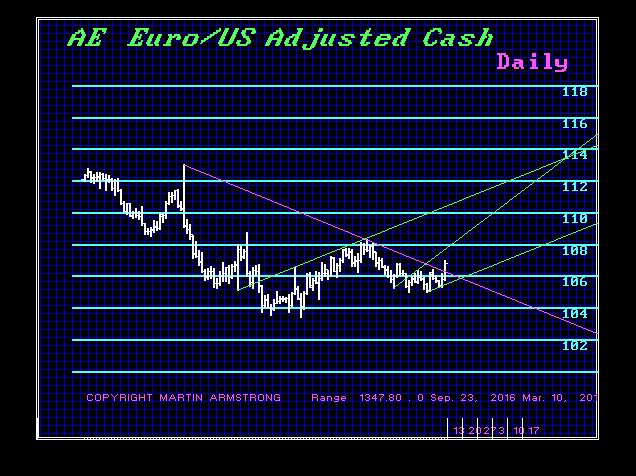
While Europe is certainly not turning bullish, what we do see is a bounce due to the fundamental focus of the pending US debt ceiling battle looming on the horizon. Naturally, the press will be blaming Trump so we should be prepared for headlines like US going to default. The press will use this incident created by Obama and Boehner to score as many points against Trump as possible. Facts mean nothing to mainstream press. They have their agenda and that is not going to suddenly change. So we should expect dire headlines about how the USA will default and all this may provide a bounce for the Euro for up to two months until the French elections on May 7th. Keep in mind, this is a slow and agonizing process that cannot be stopped. The economic and politics of Europe are a total disaster because politicians now make decision to protect their jobs and pensions from Brussels. There is traditionally the false move that get people off-side so we should bounce before we collapse.

The key resistance will be 10855 and a weekly closing above that level will point to a rally back to the 11050 area and a monthly closing above that would then point to 112-115 level. March needs to close above 11300 on a pure technical perspective to raise any hope of a more prolonged rally beyond 2 months.

When This All Blows Up…


Tyler Durden's picture

Authored by Chris Martenson via PeakProsperity.com,

This report marks the end of a series of three big trains of thought. The first explained how we’re living through the Mother Of All Financial Bubbles. The next detailed the Great Wealth Transfer that is now underway, siphoning our wealth into the pockets of an elite few.

This concluding report predicts how these deleterious and unsustainable trends will inevitably ‘resolve’ (which is a pleasant way of saying ‘blow up’.)

The Ka-POOM Theory

In terms how this will all end, we favor the scenario put forth by Eric Janszen in 1998 called the Ka-POOM theory.

This theory rests on the belief that the Federal Reserve along with the other world central banks looked at Japan’s several decades of economic stagnation and decided that deflationary recessions are to be avoided at all costs — even if that means blowing asset bubbles and then cleaning up the destruction left behind in their aftermath.

Because the Fed, et al. have a limited playbook (which is: print, and then print some more), the Ka-POOM model calls for limited periods of disinflation, followed by massive money printing sprees that then produce high inflation.

Despite the trillions and trillions in thin-air money printed by the world’s central banks over the past 8 years, a common rebuttal we hear is “But there’s been no inflation so far!”  To which I reply, “Yes, that’s what we’re being told. But that’s not actually true.”

Remember: inflation is simply “too much money chasing too few goods.”  We can detect today’s excess of money in the rising prices in our cost of living — but those higher prices are symptoms, not causes. Inflation is not “higher prices”. Inflation is “too much money”.

Next, inflation is not an evenly-distributed event. It’s not like the price of everything rises 10% at the same time. The inflation rate is an average, which contains some prices going up, while others stay flat or even go down going down. It’s always a lumpy experience.  The reason why is that money is not evenly distributed across the economy, and it doesn’t always chase (or desire) the same things.

So the Fed and other central banks have printed up trillions and trillions of dollars, euros and yen, which they then essentially handed over to the financial markets and the very few people who work within them (as well as their biggest clients).  As a direct consequence, we’ve seen enormous inflation in the prices of things that relate to that tiny universe of people – stocks, bonds, trophy city apartments, Gulfstream 5 jets, fine art, and rare gems.

These items have all gotten massively more expensive over the past decade. Just as would have happened if the Fed had printed up a trillion dollars and given them everyone living in a trailer park in the American South, with the restriction that the money could only be used to buy other trailers in the region. Do you have any doubt that the price of trailers in the South wouldn’t explode upwards?

Well, that’s exactly analogous to what has happened to financial and trophy assets. The amount of money created and poured into the financial markets by that central banks has been incredibly enormous. As a first-order event, it raised the prices of nearly all financial assets. And then, as a second-order derivative, it then flowed into the properties and cherished possessions of the financial industry insiders.

The summary is that we’ve already had lots of inflation – but it has (so far) been mostly contained to the areas where the freshly-printed money was first directed. No surprise there.

But it’s certainly not only been limited to the rarified items the rich enjoy. Anyone who is currently looking to purchase a home, car or college education has a pretty good idea how prices have jumped substantially over the past decade.

Here’s the thing about the attempts by central banks to circumvent the workings of the actual economy by simply printing up money: It is doomed to fail. It always does; one cannot simply ‘print up’ prosperity.  Printing up money merely creates the illusion of free wealth for those with first access to it. In reality, what happens is that it secretly transfers the wealth from everyone else to those lucky few.

The Fed and the rest of the central banking cartel are consciously and very pointedly picking winners and losers.

It’s not in their power to make everyone a winner.  So they have decided to throwing granny (and savers and pensions) under the bus while financial elites and well-connected speculators (e.g. JP Morgan and other large banks) extremely wealthy in the process.  Wealth is being transferred from Parties B-Z to Party A – from the many to the few.

What the Fed promised would happen along with all of this money printing has not materialized. There has been no return to rapid economic growth. And there won’t be, because we have massive structural problems in our economy that can’t be papered over forever.

This stark fact makes the Fed’s entire money printing misadventure not just pointless, but dangerously destabilizing from a social and political perspective. The world’s central banks, especially the Fed, have done an enormous amount of damage. These institutions, as well as the decision-makers within them, are going to have a heck of lot to answer for when the inevitable crack-up comes.

A Quick Re-Cap

And so here we find ourselves, at the final torturous, grinding part where the final bubble top is formed. The über-bubble. The Greatest Of Them All.

A bubble this spectacular requires a top worthy of its size. A long, massive top, full of increasing exuberance — until the very last investor is sucked in.

Where I’ve noted humans’ remarkably silly behavior during bubble episodes in the past – tulip bulbs, railroads, swampland  – I still struggle to understand or even explain this one.

It’s so obvious at this point. And yet, like its brethren bubbles of the past, a lot of otherwise thoughtful and careful people are getting sucked in by its siren song.

I guess the best economic description of it might be “a credit bubble” with sub-components like sovereign and household debt, and sub-sub-components like Toronto real estate and the IPO price for SNAP shares (that’s Snapchat, which soon after its launch, had a valuation of $40 billion. This mind you, is a company that has no identifiable revenue model).

A credit bubble occurs when the issuance of credit grows faster than income supporting it. Here’s what that looks like on a national scale for the US. The bottom red line is income (GDP) and the top blue line is Total Debt. We can see that debt has been growing at twice the rate of GDP since 1970:

Debt to GDP

You have to be quite delusional to think that debt can be compound at twice the rate of income forever. Unfortunately, there are more than a few of those ungrounded optimists working in central banks and governments the world over. Their thinking is simply, The sky’s the limit! 

Those of us living in reality find this mindset puerile and insulting. And, of course, dangerously reckless. And it’s also maddening to hear the media cheerleaders for Wall Street selling us this bunk as if it were somehow sensible.  It is not.

Look, millions — likely billions — of people are at risk of getting badly hurt. When this bubble blows, it’s going to be enormously destructive and take out a lot of wealth along the way.  Millions of jobs will be destroyed. What people think of as wealth will evaporate as though it never existed in the first place (it didn’t). Political dynasties and major financial institutions will be ruined.

As I wrote recently, this will be widely and popularly referred to a period of wealth destruction. It will feel that way to must, but it will be actually be a period of wealth transfer:

The summary here is this: We are still printing and borrowing enormous amounts of money and credit, but the world is not growing any larger in response.  The pressure is building.  Nobody knows when all of that money and credit will have to be ‘trued up’ against the amount of real stuff out there. But it will. History shows us that it always does.

And that moment will be referred to by most as a period of wealth destruction. 401ks will be shredded, bonds will become worthless, defaults will spike, institutions and entire countries will fail – but the truth is that all of that paper ‘wealth’ was an illusion. People’s faith in it had been betrayed long before, when those in power started abusing the system by creating too many tertiary claims.

After the dust settles, there will be winners and losers, and those with the proper framework will understand that what actually happened was that all of the wealth was transferred from those who thought they owned it, to those who actually did.

The biggest remaining question is whether the wealth transfer comes about in the form of an inflationary destruction, like in Venezuela today, or as a deflationary bust more in the fashion of Greece.

(Source)

The only thing that capable of preventing this coming carnage would a resumption of rapid economic growth. And I mean growth that exceeds the rate of debt creation.

But that’s simply not going to happen.

The Problem With Growth

We can dispense with the idea of “solving” our too-much-debt problem by a resumption of rapid economic growth either by deduction or observation.  Both work just as well on their own, but each tells a similar story in this case.

The deductive route notes that economic growth stimulated by ever-higher amounts of borrowing simply requires greater and greater debt loads to accomplish.  Eventually debt levels simply become too high, and pinch off growth.

We can also deduce that because economic growth is tightly linked to energy consumption, lower amounts of usable energy flowing through an economy will cause that economy to stall out as well. Because we know that both the quantity as well as the net yield we get from our energy-producing activities are flattening, this explains why GDP growth is flattening too.

Thus, from a deductive standpoint, combining what we know about high levels of debt and flattening energy returns energy there’s really no more room for confusion about why GDP growth is, and will remain, anemic (at best).

Observationally, we now have more than a full decade of sub-par (i.e., ‘too low’) world GDP growth:

Debt to GDP

(Source)

Notice that the last year of data, 2016, is coming in at the lowest reading since the Great Recession, while the next two years are estimated to also come in at less than 3%.  The world hasn’t averaged 3% GDP growth in a decade. Even the mighty US has gone more than ten straight years without breaking into the 3% range.

We have to ask: How many years does it take to finally admit that there’s something seriously wrong with our hopeful story line that robust growth is going to save our debt-ridden bacon?

Just for the record, things are not shaping up any better here in 2017 either…

Atlanta Fed GDPNow model predicts 1.2% 1Q17 growth

And, just for kicks, we might also note that the GDP forecasting agencies of the world have consistent in over-estimating future growth.  Of course, this doesn’t deter them from continuing to predicting higher future growth each year. As a case in point, here are the IMF’s predictions for world growth over the past 6 years:

Debt to GDP

(Source)

Each of those colored lines is a forecast.  Each of them foresaw growth going notably higher in the near future.  Not only was every one of them utterly wrong in direction, each failed at getting even the next quarter anywhere close to right.  See how none of those lines ever dips below 3%?  See in the prior chart how global growth never breached 3% in any of these same plotted years?

For a variety of reasons, with aging demographics being a huge factor, future growth in the OECD countries must slow:

Debt to GDP

(Source)

My ‘prediction’ is that these projections will turn out to be far too high. Mainly because I include declining net energy in my views and no mainstream economist ever does.  But the track records of these outfits shows that taking the ‘under’ side of the over/under bet offers incredibly safe odds.

At any rate, the main story here is that the only way we can begin to justify the astronomical levels of debt currently on the books, let alone slathering on new tranches just to keep the whole thing form imploding, is to have a story of endless, rapid future economic growth. Which is, we’ve already shown, a delusional fantasy.

Stagnating growth, ever more trillions of debt, and a finite amount of depleting net energy all adds up to an unsustainable mess.  With asset price bubbles everywhere and wealth transfer mechanisms already in place, the end-game involves a very few winners and a lot of losers.

Anything that is this unsustainable will someday end. But how? And how should we position ourselves for it? 

In Part 2: The Ka-POOM! Survival Guide, we detail in depth the most likely progression predicted by the Ka-POOM! model. First, a punishing crash in prices as natural market forces eventually overwhelm the Fed’s doomed efforts to print the world to prosperity. Think of the 2008 crash, but on steroids.

Then will come the inevitable response from the central banking cartel: Set the printing machines on maximum speed! While this may seem to work for a brief while, it will soon collapse the world’s currencies in a hyperinflationary deluge.

This will be a very tricky time for preserving wealth as things swing violently from disinflation to inflation. Understanding the mechanics and knowing what to expect will be critical — not just for safeguarding your money, but for taking advantage of what will surely be some of the best bargains of our lifetime.

Click here to read the report