EU Collapse on Schedule


ECM-Euro

Merkel admitted that the European Union is in a “critical situation” as the EU leaders met in Slovakia. I greatly appreciate all the emails asking why I do not go to Europe to push our solution to save the continent. But what you have to understand is we will ONLY get a call when there is blood on the streets and there is absolutely no other choice. I am not sure we could do much at that late stage in the game. Typically, you have to just capitulate in order to reverse the trend.

As we move into 2018, Europe is going to go through some very hard times. This is all being caused by bureaucrats in Brussels who are not willing to give up their pensions and jobs. They found the promised land for themselves and are determined to hold on til the end. Former Greek Finance Minister Yanis Varoufakis is now calling for “a pan-European movement of civil disobedience and state that grows into a broad democratic opposition to the actions of the European elite at local, national and at EU level.”

However, the framework is just not functioning. The bureaucrats are trying to regulate everything and refuse to realize that they are responsible for BREXIT. They have become Byzantine and are killing the economy. British economic growth peaked in 1973 on an annual basis and has been declining ever since it joined the EU. The movie “BREXIT” was an excellent review of EU regulation to the point that they took away British fishing rights in their own waters. What if the government say you were not allowed to walk into your backyard, but everyone else could?

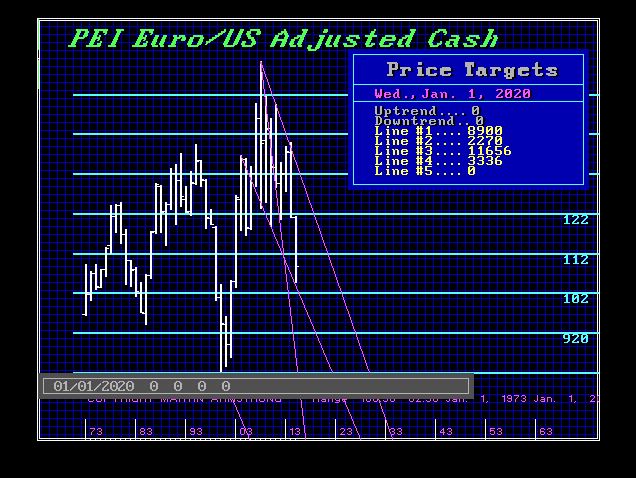
IBEUUS-Y TEK TO 2020 1-22-2016

The Polish Prime Minister came out and plainly said, “The EU has to change, we have to reform it.” But Brussels refuses to change or ever concede defeat from their dream of an authoritarian power over Europe. This one-size-fits-all approach is destroying Europe. The EU has been doing nothing but defending its insane policies since 2008 when the euro peaked. The high in Europe came exactly on time with the ECM Wave on the EU.

Fed Seeks to Prohibit Companies from Merchant Banking to Promote Lending


FederalReserve-1

The Federal Reserve wants to take away the ability of Goldman Sachs and other banks to invest in companies rather than acting as bankers and lending. The U.S. banking regulators are urging Congress to prohibit merchant banking where firms buy stakes in companies rather than lend them money. They are pushing for limits on Wall Street’s ownership of physical commodities after lawmakers accused Goldman Sachs and other banks of seizing unfair advantages in metal and energy markets in recent years.

Merchant banking has generally become the business of making private equity investments in non-financial firms, in particular, equity investments that have a venture capital character. Based upon a report on a multi-agency study of banks’ investment activities required by the Dodd-Frank Act, they highlighted ways to fix potential risks that regulators didn’t think were handled by the Volcker rule ban on certain trading and investments. However, Congress needs to pass legislation and they are subject to bribes that we call lobbying, which presents the greatest hurdle to actually changing anything. The Fed’s recommendations on merchant banking would end the ability to operate mines, warehouse metals, and engage in shipping oil.

Indeed, there was a 2014 Senate investigation into banks’ commodities businesses. That revealed Goldman Sachs had almost $15 billion in merchant banking investments, not loans. Goldman Sachs’ most recent filings illustrated that it booked $1.2 billion in revenue through the first six months of this year in its division that takes equity investments under its merchant banking division.

This has been a wide-ranging agency investigation. The Office of the Comptroller of the Currency (OCC), said it must restrict lenders’ holdings of the hard-to-value securities. Indeed, such activity cannot be marked-to-market and becomes fertile territory to hide major losses. The OCC’s proposed a rule would curtail banks’ investments in certain industrial metals including copper and aluminum. They fear not merely price fixing, but the scandals of market manipulation.

The Fed has also called for the repeal of exemptions for industrial loan companies. These are generally lenders owned by non-financial firms, which allows them to operate outside of rules that effect banks. The Fed is seeking a fair and level the playing field among financial firms to separate banking and commerce, which was effectively the foundation of Glass-Steagall repealed by the Clinton Administration at the urging of Goldman Sachs’ Robert Rubin.

The bankers’ biggest savior is, of course, congressional gridlock. During the DOT.COM bubble crash back in 2001, the Fed and the U.S. Treasury Department adopted a merchant banking rule following the 1999 Gramm-Leach-Bliley Act, which actually gave the banks the right to make these very investments. Every crisis creates the solution that becomes the crisis for the next cycle. They allowed the bankers to get into these investments to support the banks. That led to the manipulation of markets and a host of scandals ever since.

Actually altering merchant banking and other industry laws requires Congressional intervention and they are only in this for whoever pays them the most. Therefore, the likelihood of any immediate impact is minimal. No one in Congress is willing to go after the bankers in times when they need their donations.

Let us make no mistake about this issue. Indeed, Goldman Sachs, Morgan Stanley, and JPMorgan were the very targets of public criticism that led to the 2014 Senate review of their commodities businesses. The bottom line was that they used their ownership of metals and other physical commodities to dominate markets and gain unfair trading advantages. The physical commodities businesses at Goldman Sachs and Morgan Stanley were protected by grandfathering that allowed them wider abilities than most banks. This is the very unfair advantage that the Fed is trying to attack under Yellen.

Morgan Stanley did sell-off its oil business last year and backed away from industrial metal trading. JPMorgan has also greatly reduced its physical commodities business in 2014. Even Goldman Sachs dumped its coal-mining operation in 2015, but that was because of the market shift toward cleaner fuels and anticipating that their support for Hillary would lead to a reduction in coal mines.

So that is perhaps some perspective on insider trading, but selling off before Hillary crosses the threshold makes it only a good guess. Nonetheless, Goldman Sachs has confirmed that trading commodities is a “core” part of the firm’s business and they have no intention of getting out of that business.

Greenspan Sees Inflation or Stagflation? There is a Difference!


greenspan-bloomberg

QUESTION #1: Marty, Greenspan reads you without a doubt. You warned back in 2012 that we have to be concerned about the USA moving into stagflation with deflation in Europe and Japan. He said the same on Bloomberg. He also said the crisis is the aging population, lower birthrate, and that will result in higher costs without economic expansion. That is everything you said two years ago.

QUESTION #2: Marty,

Deflation is gripping Europe but Greenspan warns of inflation in the USA.
Is he right? What are your thoughts?
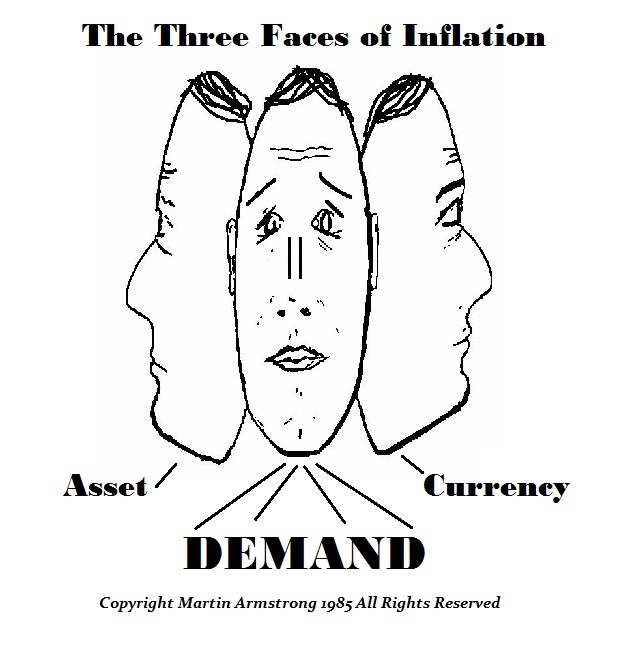
3FACESn of Inflation

ANSWER: Inflation, like deflation, is multifaceted. There is no single dimension for it is not black and white. Most of the debate concerning inflation is fixated upon this basic expectation assuming that increasing money supply must be inflationary. That is just flat outright WRONG! There are times we have Currency Inflation since everything has a true international value. If a currency declines, assets will generally rise in proportion to the decline as long as there is no political risk as to the collapse of government or military invasion.

brexit-currency-inflation-1

It is astonishing to me how people who claim they are analysts, economists, or political scientists, were all seriously wrong about BREXIT. Not that it won at the polls, but the aftermath. Goldman Sachs, Morgan Stanley and Credit Suisse are just the top three banks who were all WRONG on their forecasts predicting of a post-referendum recession as trade deficit narrows. None of them understand capital flows. They have never spent a dime to even do historical research. They are only interested is a quick buck and nothing more. To them, the economy is control by the state so bribe them to get what you want to see is generally their motto.
ferrari-328Note that the day of BREXIT, yes the currency collapsed because of their forecasts. But the stock market rose that day. It did not collapse. This is CURRENCY INFLATION and these people are clueless when it comes to understanding real international capital flows. I have told the story before that I bought a 328 Ferrari in London for about £30,000 when the pound fell to $1.03. The same car in dollars was selling for about $50,000. The pound had been over $2 when Ferrari priced what they would sell that car for to Brits. Since the pound fell so hard, the Italians raised the price to £45,000. Then the pound rallied back to almost $2. I drove the car in London for about two years and then sold it used for about $50,000. This created the false assumption that a Ferrari was a great investment and people began buying and storing them. It was just the currency — not the car. The same thing took place with property in London. Americans rushed in buying everything.

british_airways_concordeI also ran to British Airways and asked how many open tickets they would sell me for the Concorde. They looked at me like some sort of dodgy person and could figure out why I would do such a thing. They came back and said 25. I said great. A round trip was £2,000. Back when the Concorde began, it was about a $5,000 ticket when a first class ticket was about $3,000. So the Concorde was overpriced and mostly empty. With the drop in the pound to par, it was now cheaper than a first class ticket. I bought as many as they would sell me. I got on the Concorde and suddenly it was full with Americans all saying what a deal.

CURRENCY INFLATION is not created by normal supply and demand conditions they teach you in school. Perhaps if you were not an international traveler as I have been, you would never experience it. I use to have an American Express card from every office we had around the world. I would pay in the currency of my choice depending upon the market. Today, American Express will only issue you a credit card where you are domiciled.

euro-jumpASSET INFLATION is different again. This unfolds much like negative interest rates and it is the same mechanism that is creating it. This is when money fears government, banks, or whatever, and it seeks to get off the grid. It will run into property, stocks, gold, art, collectibles, or antique cars. People are buying bonds at negative yields because they are parking money. In Europe, they have been rushing into Germany assuming if the euro breaks, they will get Deutsche marks. However, what is Deutsche Bank fails and the government has to blink and back-off of this insanity of bail-ins? They will suddenly find their conservative bet on Germany will turn into a blood-bath.

supply-demandThe traditional view of inflation is DEMAND INFLATION where a shortage in supply will result in hire prices. But this assumes demand will not change. The whole theory of creating a monopoly is confined solely to this aspect. A Monopoly is actually impossible for if the assumption is prices can just be raised and people will have not choice.


Yes in “Debt is Destroying Everything. Where is Common Sense When We Need it the Most?” published August 19th, 2012 I wrote:

So we have to be concerned about STAGFLATION, rising costs with collapsing economic growth. We are living so far beyond our income that we are completely unconnected to any productive capacity. The debt can no longer be paid off. It is beyond several generations. Charles Dickens wrote in Little Dorrit that “[Credit is a system whereby] a person who can’t pay, gets another person who can’t pay, to guarantee that he can pay.”
Even the demographics are changing. As the older generation exceeds the working population, the Ponzi Scheme government established to pretend they would be there to take care of everyone are collapsing. This is why Obamacare is also collapsing. The youth are not joining the crowd. As the greater proportion of society is no longer productive, GDP declines while costs rise. This is the core of STAGFLATION. So we are not looking at inflation as we know in pre-1981.

Fed has become World Central Bank


The Federal Reserve confronts a possibility it never expected: No exit.


That is where it is at that is true; if the leave rates low the pension funds go bust if the raise the interest rates to save the pension funds the government goes brook sadly its one or the other. The FED can not save both!

Canada’s Household Debt Exceeds Total GDP for First Time


credit-cards

us-household-debtFor the first time in history, the total private debt of the Canadian public has exceeded the total national Gross Domestic Product (GDP) after reaching 100.7%. This is significantly higher than in the United States, which has been declining since 2008. Household debt in the United States is now under 80% of GDP. Clearly, Canada’s private household debt is counter-trend.

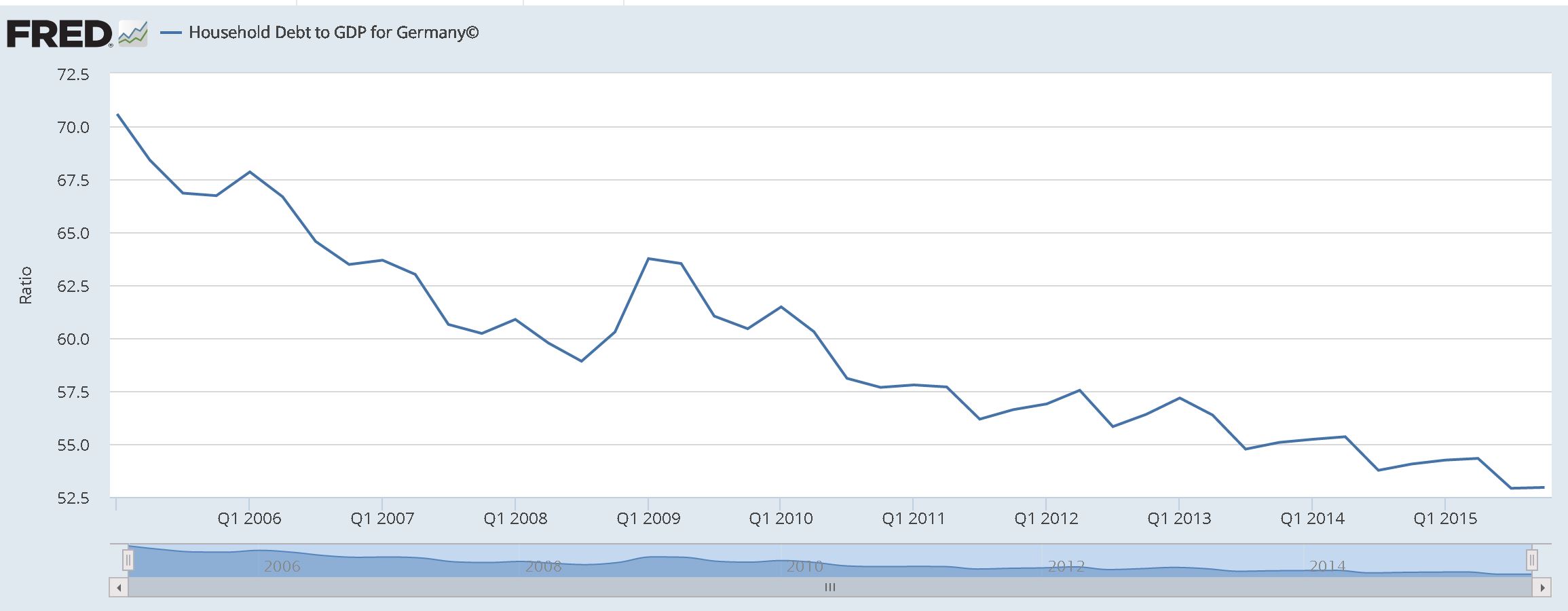
german-household-debt

Germany’s household debt has been declining longer than in the United States, reflecting the problem the central bank has had in trying to compel people to borrow. If they do not TRUST the future, they will not take on debt at any price level.

A$ – Wheat & Wool – the Outlook


whcbt-y-9-16-2016

On the yearly level in Wheat CBT Futures, the last important low was established during 2010 at 4254, which was down 2 years from the high made back during 2008 at 13494. However, the highest closing was during 2007 at 8850. Right now, the market is trading below last year’s low of 4606. Overall, the market has been in a long-term bearish trend. At this time, the market is trading in a bearish position below our yearly momentum indicators warning resistance starts at 5990.

Honing in on the longer term yearly level, we see turning points where highs or lows on an intraday or closing basis should form will be, 2017, 2020, 2023 and 2025. Considering all factors, there is a possibility of a decline moving into 2017 with the opposite trend thereafter into 2020. This is a realistic potential since we have already penetrated last year’s low of 4606. The Yearly Bearish Reversal lies at 3110. Wheat has fallen to 3866 so far here in 2016. As long as 2016 holds 3110 for the year-end closing, then we should be looking a forming as early as 2017. We have already penetrated also the 2010 low of 4254.

Focusing an important timing model, the Directional Change Model target is 2017. This model often picks the high or low, but can also elect a breakout to a new higher trading zone or a breakdown to a new lower trading level.

YEARLY TECHNICAL ANALYSIS
01/01/2016… 2198 4523 5450 8460
01/01/2017… 2219 4656 4445 8510
01/01/2018… 2240 4790 3439 8560
01/01/2019… 2261 4923 2434 8610
01/01/2020… 2282 5056 1428 8660
01/01/2021… 2303 5190 423 8710
01/01/2022… 2325 5323 8760

YEARLY ANALYSIS

In the event of new intraday lows developing beyond this year, then the final low could extend into 2017. Broadly speaking, a month-end closing BELOW 3070 is where the critical support lies. Only a monthly closing BELOW 3070 will confirm a long-term bear market is in motion. Otherwise, here lies important dynamic support within this market and holding this level is a clear line of demarcation in long-term trend. Make no mistake about this key level. If it is breached on a closing basis, then a continued decline is the most likely broader outcome. However, this appears to be a remote possibility. An annual closing back above 7997 will confirm a breakout to the upside is unfolding into the years ahead. Nevertheless, we have penetrated last year’s low of 4606. A year end closing below 4606 will warn of a further decline ahead ideally into 2017.

whcbt-y-a-9-16-2016

In A$, the key monthly closing to watch lies at 4190. This is actually equivalent to the US$ number 3070. In terms of A$, wheat has also made a new low so far in 2016 reaching 5111 during August. We need a monthly closing back above 5733 to signal wheat will rise in A$ terms. The only thing to unleash that result requires the dollar to rise sharply.

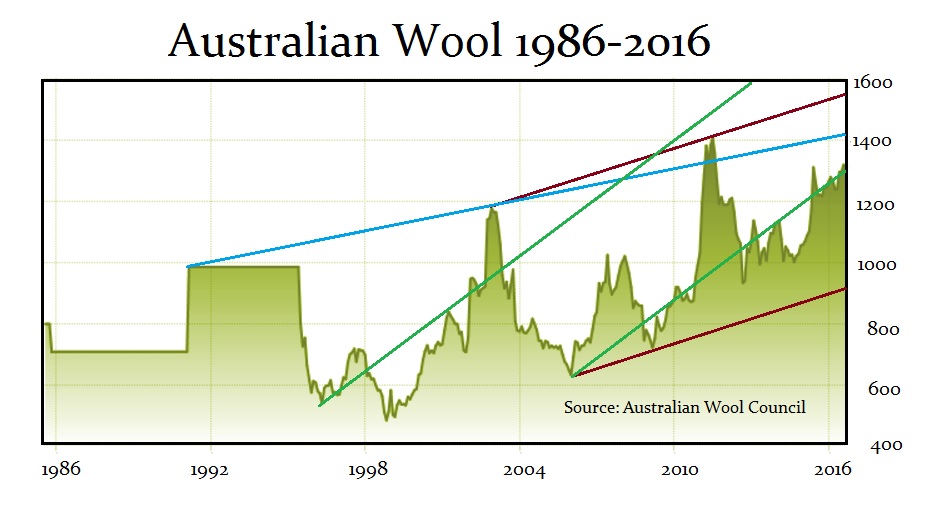
wool-2016

The Australian Wool market is poised to make new highs in nominal terms, but it is still nowhere near the 1951 high in real terms. The Australian wool industry peaked in 1950-51 when the average greasy wool price reached 144.2 pence per pound, (about $37 per kilogram). Today’s prices in the area of $3.20 per kilogram illustrate the stark difference. That major high in terms of wool was created by a two-prong influence. First, the British pound was devalued in 1949 from $4.86 to $2.80. The British demand for Australian wool had consumed about 50% of the annual production. The prices reached in 1950-1951 surged initially, as always, to reflect the devaluation of a currency. This was 9x the 1945-46 United Kingdom contract price, and almost 14x the average for the 10 seasons ending in 1938-39. Nonetheless, the rally in wool was also furthered by the short-lived surge in American demand created by the Korean War.

It is very clear that Australian Wool has been greatly influenced by the cycle in gold and thus mining. The low in wool coincided cyclically with gold in forming a 1999 low. The peak is also 2011 as was the case in gold. We are pushing against resistance at this point and we need to close above 1300 to maintain a bullish posture at year-end. However, unlike gold, the decline was confined to the two-year reaction phase. Therefore, wool is in a better position than gold. Breaking through the 2011 high should see the price test the high 1500s to 1600.

wool-in-us-dollars

When we look at Wool expressed in US dollars, we can see the significant difference this makes. Overall, we do see 2017 as a potential turning point also for the wool market. Take the lead from wheat in A$ terms for now.

Fuldaer Zeitung: “When increasing money supply causes deflation”


fuldaer-zeitung-9-17-2016

COMMENT: Mr. Armstrong, I read your piece published in the German Press Fuldaer Zeitung yesterday how “When increasing money supply causes deflation”. Thank you so much for publishing in the German media. This has opened my eyes to why we continue to decline into deflation. This proves the old saying a prophet is never recognized in his home country.

Alles Gute

REPLY: Well I am not a prophet, just a forecaster, but I see what you mean. The media is the USA are beholding to the government and banks. They cannot publish a piece like this without getting those who hold their chains angry. That is just reality.

We are in danger of going into a Dark Age. It is absolutely imperative to understand the root causes or we will turn toward more authoritarian power to emerge as a totalitarian state. We are in grave danger because the press has surrendered the very fundamental role they were to play in protecting our liberty. The surrender of the press is the surrender of all checks and balances against a corrupt government. They vilified Richard Nixon for erasing 18.5 minutes of a tape while the coronate Hillary who cannot even hold a press conference because of her Parkinson’s disease. They have doomed their own children all to obey their masters.

Can the Dow Crash with Little Retail Participation?


 djind-m-9-17-2016

QUESTION: Hi Martin,

thank you for your great work with Socrates and especially for presenting the Indicators for us whom are still outside of the Trader Level.


I have some question about the recent sell off in the DOW. True, it was really time for a correction/drop. But the retail investors are still on the side-lines and the interest rates are lowest ever in history. To sell off the DOW on fears of increased rates and slower GDP growth is one thing, but then what? Where to run? Interest rates are close to zero. Bonds will loose much of their value when interest rates go up. Gold does not yield. Real Estate has already topped.

You are so right that the hunt for yield will soon be transformed into the hunt for preservation of value.

So we are back to the DOW anyway, right?


Do you see in Socrates Indicators that this Phase Transition may emerge already in the end of 2016?

Kind regards,

HJ

ANSWER: You are correct. There will be no choice but to run into equities. With the European banking crisis looming on the horizon, real estate on the high-end has been targeted by governments around the world passing various laws against foreign ownership from making it criminal in Australia to demanding 15% of the sales by a foreigner in the USA is seized by the IRS, this does not leave a lot of room for big money to get off the grid.


Then there are the mandates by countries that pension funds MUST be invested in government bonds. This negative interest rate is creating the next major crisis. As a matter of law, these funds cannot even divest all government bonds in many countries. We are looking at a crisis far worse than any derivative or banking crisis. It is the Pension Crisis that nobody talks about. This is the political crisis that is bringing socialism to an end.


You are correct, gold offers no yield for income, only capital appreciation. That does not provide a base for institutional money to park, besides storage problems. But here to, government are tracking all buying and selling of gold. Only the institutions had to turnover their gold in 1934. Individuals could hold their gold at home in a sock drawer. So this distinction has always existed between big money and individual investors. Gold is for the individual. It cannot satisfy institutional money on a yield perspective and it cannot be protected by an institution. Consequently, gold is eliminated from a major institutional portfolio, which limits that type of investment into directing it into gold stocks for some yield.


All of that said, you are also correct about retail participation. That remains at historic lows for a bull market. So many people were hurt in 2007 to 2009, that they are reluctant to step back in. There can be ABSOLUTELY no major crash of 1929 proportion despite the choir of analysts all claiming “SELL” for it will go to anywhere from 50% to 10% of current value. Such a move just does not seem plausible.

dow-m-energy-study-9-17-2016

Nonetheless, our accumulative Energy Models reached the overbought stage that nearly matched our next target objective. That warned that we were getting toppy and a brief correction was likely. Likewise, the accumulative energy in 2009 at the low went seriously negative also warning this was overdone on the downside.


We will be issuing a special report because 2016 is 7 years up and that warned we could indeed see even a slingshot type of move. That means you have excessive bearishness and the pros will short the market. They are typically trapped and will then panic to get out.


Despite the claims that the bankers are too big to fail, too big to jail, and too politically controlling in Washington, keep in mind if Trump wins, we may see reality hit the bankers in the face. Without Hillary, they are in big trouble for the next loss may be their’s to keep. The “pros” are not the star traders, they are the political manipulators. The entire Glass Steagall Act was proposed BECAUSE of Goldman Sachs.


Goldman Sachs got caught up in the whole bull market just like everyone else. Under the leadership of Waddill Catchings who led the firm into joining the hot market by now creating an “investment trust” where he saw that a giant fund could maximize profits by buying and selling stocks. He promoted this as a business that was professional and the profession was investing.

The “investment trust” was sort of the domestic “hedge fund” of its day. Everyone was jumping into the game. Catchings just got caught-up in the whole thing and was very bullish going into the high of 1929. He gave this new entity the name: Goldman Sachs Trading Corporation. The deal was that Goldman Sachs would be paid 20% of the profit and the stock was offered at $104 per share. It jumped to $226 per share, that was twice its book value. This would be the very same mistake that became exposed in the Crash of 1966 when shares in mutual funds were then traded on the exchange allowing them to be bid up well beyond their asset value.

The whole bullish atmosphere was very intoxicating. Just three months into the fund, Goldman Sachs arranged for a merger of the trust fund with Financial & Industrial Corporation that controlled Manufacturers Trust Company that was a giant group of insurance companies. This doubled the assets of Goldman Sachs Trading Corporation taking it up to a staggering near $245 million. This was huge money in those days. The trust now, exploded and the assets under control are said to have exceeded $1 billion back then. Goldman Sachs expanded the leverage going right into the eye of the storm that was about to hit starting on September 3rd, 1929. In the summer of 1929, Goldman Sachs launched two more trusts Shenandoah and the memorable Blue Ridge. The shares were over­subscribed and Shenandoah was offered at just $17.80 and it closed on the first trading day at $36 per share. Blue Ridge was even more leveraged and the partners at Goldman Sachs put pressure on everyone to buy as a sign of support. The leverage was astonishing for with just about $25 million in capital, now there was more than $500 million at stake.

The disaster was monumental to say the least. Goldman Sachs Trading Company, whose shares had stood at $326 at their peak, fell during the Great Depression to $1.75. They fell to less than 1 % of their high value. The loss suffered at Goldman Sachs on a percentage basis was far worse than at any other trust. In fact, of the top trusts, Goldman Sachs had lost about 70% of everyone else’s losses combined.

So sometimes the bigger they are, the harder they fall.

Why East Coast Gas Prices Are About To Explode


Shutting off the gas for any length of time will certainly cause Gas prices to sky rocket!