The Euro & the Dollar


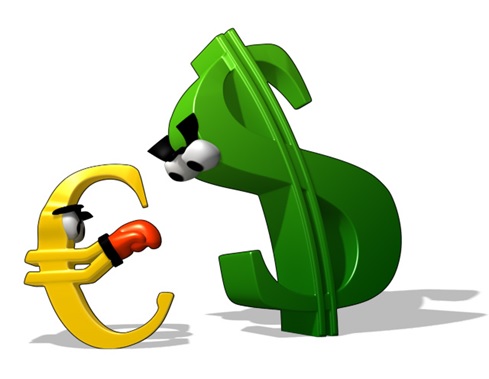
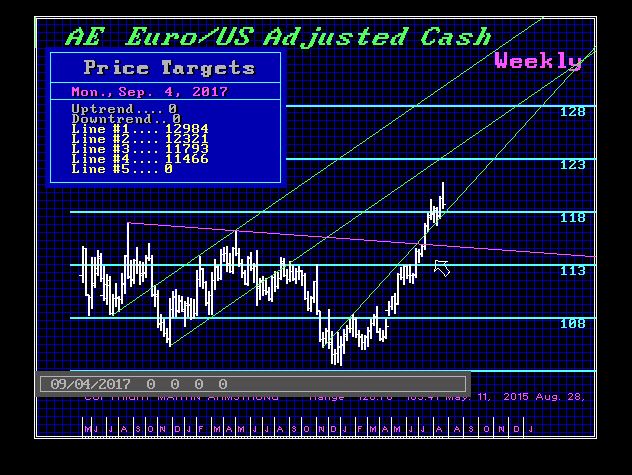
Nothing has yet changed. We are still 500 points away from the start of important resistance. Keep in mind that the ONLY way to break the bank of the monetary system will be a STRONG DOLLAR – not a weaker on. People far too often make a serious mistake and believe that a strong currency reflects a strong economy. Trump wants a lower dollar to reduce the trade deficit, increase sales of US products, and hence create more jobs.

Europe remains caught up in the postwar thinking when the higher the currency the more they were recovering from World War II. A rising Euro is deflationary – not inflationary. It reduces the price of imports from energy to manufactured goods and food.

The counter-trend rally should have been in play going into the German elections due September 24th, 2017. Keep in mind that the Monetary Crisis Cycle begins NEXT YEAR not now. We have the correction in the dollar and the potential pull back in the Dow in dollar terms.

When we look at the Dow in terms of Euros, the peak was the week of 02/27 and we have not yet reached out target to retest the key technical support. This just takes some patience, but we MUST suck everyone in on these counter-trend moves in order to set everything up for the slingshot in the opposite direction next year.

The Rising Tone of Private Equity v Public


QUESTION: Dear Martin,

With the U.S. stock market hits all-time highs, some sources say a lot of smart money is pulling out of the stock market and piling into private equity. One of the reasons being increased regulation making many companies choose to avoid the hassle to go public and stay private.
The thing is, very few small investors have access to private equity. Could the remainder of the Private Wave develop in private equity rather than in stocks?
Thanks for all the advise,
ANSWER: There is a major thrust toward private equity. We have been getting serious offers to come in now asking to hold off on going public. The amount of money in cash looking to go someplace is really staggering to put it mildly. If it were just a question of money, yes it would be tempting. But personally it would require a good fit – not simply money.
With all the buy-backs over the years, there is also a growing shortage of stock. This is one reason why the market has a lot more to go on the upside broader-term, with the near-term correction put aside.
There is no question that we suffer from serious over-regulation and if we were to go public it will be in Asia – not the USA. From a personal perspective, I see where you are coming from. Even the Hollywood movie seems to be a vehicle that is best to open up to investors to finance and many people want to join in for the profits and tax-credits.
Things are changing, indeed. Private equity is rising. Even a friend just sold his small business to a public company who sought to raise funds for the purchase and they were shocked to receive 3 times what they sought to raise in offers. It clearly seems that those who are first get in.

Opening the Door to September


QUESTION: Mr. Armstrong; I have followed you for many years. I have to say, I am truly amazed at what your computer projects. You have never missed a move yet. Here we have the rally in gold into September, yet the August high stands in the market, and even Korea went nuts on your target date and your next target for the 11th concerning Korea I do not want to think what is going on.

I understand you say you never pursued this research based upon a preconclusion but bumped into this in the middle of the night. My question is this. Do you think what you have discovered is somehow a mysterious force that just compels things to happen on target? It’s hard for me to put into words. Do you have any idea why all these things happen when you forecast they will happen?

Definitely see you in Orlando.

PH

ANSWER: I get this question a lot. I really do not know what is the answer. We clearly respond to events the same today as humans did in Roman times. Politicians never change and are always greedy and will exploit the people. If this was not true, then we should all be speaking Babylonian.

I can see that is you do X then Y will always follow. But this is some strange complexity that is far beyond what people are willing to expect. The government simply said I manipulated the world economy. Now that’s really nuts. All I have done is comprehend the inter-connectivity and mapped it out with TIME.

There is a very interesting regularity to everything and it is truly predictable. Yet the majority still prefer to blame me (messenger) rather than stop and explore that there is a mysterious order of complexity far beyond comprehension. The consequence of that (Invisible Hand) runs contrary to politicians who try to manipulate society in the spirit of Karl Marx. So if I am right, that means a politicians can not keep their promises for they cannot control the world economy.

EU Refuses to Honor Solidarity to Share Expenses of Refugees


The EU has been dictating to the member states but has failed to shoulder common costs for the refugee crisis they did not create. The EU denied Italy to subtract the cost of feeding refugees from their budget restrictions imposed by the EU. Now the Hungarian Prime Minister Viktor Orban called for a payment of €400 million for the Hungarian border fence. What is clear is that “European solidarity” is a one-way street. Everyone must do as the EU commands and pay up to support Brussels, but Brussels will not share the costs of the crisis they have created. This is tearing the “solidarity” apart because it is clearly a one-way arrangement.

The Crash & No Bid


QUESTION: Hey Marty,

Love your blog and the insight you have given all your readers. However I am wondering that when you say the markets are going to become more volatile – how does that effect the trigger that sets off the dominoes ??
what i mean is, if the economy around the world hits rough water; what is the rogue wave that sinks the ship? is it a quantity/ volume of capital money that shifts, or is it a short circuit due to political turmoil?
I read that the whole 2008 “crash” was triggered by 500 billion dollars, which is minuscule amount of the total USA GDP. But i have also read from your blog that Germany has 5X its GDP in synthetics on the book !
*IF the markets are more volatile, does that mean there is LESS threshold due to a minor tremor in the gov or markets?
your insight on how volatility increases with regards the tipping point, and WHY the tipping point may happen would be of great interest.
N From Canadaor
ANSWER: Markets crash when the majority are long and anything can spook them because there is a lack of new buyers coming in to carry the market higher. Some longs try to sell and they find a lack of bids. The crash comes when you hit the no bid and market-makers withdraw. That is the sharp increase in price volatility that is different from volume volatility. With price volatility, there need not be major volume – just a gap and a lack of bids. The event need not even be real – just a rumor.
The panic unfolds because of price movements rather than volume. When large gaps appear WITHOUT supporting news, even professionals sell because they cannot make a decision in a vacuum.

Wyoming’s Money Grab Against VW Dismissed


A Federal Judge Breyer ruled against Wyoming and in favor of Volkswagen (VW) dismissing the claim that because of VW’s manipulation of diesel emissions, they caused environmental damage and should pay damages to the State in addition to individual car owners. Judge Breyer stated that despite the fact that VW was indeed responsible for manipulation. However, since these were carried out during the production of the diesel cars, the Congress had decided that the EPA, rather than the individual federal states, was in the best position to deal with damage regulations.

VW had agreed with Wyoming and most other states in the controversy about claims from buyers. What this suit was focused on getting fines in the billions of dollars from the company based upon alleged environmental damage. This was clearly a political decision because if Wyoming was allowed to proceed, every state and local country would jump on the free lunch and claim they too are entitle to damages that could never be proven since the air is not stagnant over any single State or county.

VW had already agreed to pay $2.9 billion as punishment for the increased pollution caused by its diesel cars. The company had committed $25 billion to meet claims from buyers, dealers, environmental authorities and federal states. In addition, the company has offered to repurchase half a million diesel vehicles. If every single jurisdiction then sued VW, they company would go into bankruptcy.

Gold – Oil – Dollar


QUESTION: Mr. Armstrong; At the cocktail party in Hong Kong I am the one who asked you how China should proceed to make the yuan a reserve currency. You said the rule of law must first protect property and surprisingly you said to issue commodity contracts redeemable in gold. Well, everyone knows whatever you seem to advise China does and very fast. The news is they will now do exactly that. Start a oil contract redeemable in gold. Can you explain why you took this position? You were surrounded at that moment and did not explain in detail why oil should be redeemable in gold.

DK

ANSWER: It was not based upon the rise or fall of gold. The objective is to establish the yuan as a reserve currency until we reach the Monetary Crisis Cycle conclusion. The logical step is to try to boost the yuan as a redeemable reserve currency with stability. You either PEG it to the dollar (unwise for political reasons) or you “LINK” it to gold – but do not PEG it to gold. If you attempt to PEG the yuan to gold, that would fail for you are making the same mistake as Bretton Woods. The only possible way is to “LINK”  it to gold but on a floating exchange rate. That way you are encouraging confidence in the yuan allowing it to be redeemed on a floating basis with gold. Hence, the political risk of the currency is reduced for it could become possible that the currency system breaks apart and politically currencies could be politically frozen and nonredeemable.

This is a long-term structural reform. Do not expect it to be a real game-changer just yet. There will be hype, of course, but we are looking at structural reforms that will take some time. Naturally the hype will claim this is the end of the “petro dollar” for they will use any excuse to call the dollar down. They do not understand that ONLY a rising dollar will break the world monetary system. A lower dollar will buy everyone a lot more time because most foreign borrowing is in dollars. They also are living in the past. The USA is not a net exporter – its a net importer.

ECB – Draghi & Tapering


The European Central Bank (ECB) is expected to begin reducing its bond purchases gradually tampering its stimulation program of Quantitative Easing (QE). Nevertheless, reliable sources tell of the ECB being extremely cautious fearing what will happen if buyers do not appear and rates begin to rise sharply. The difference between the ECB and the Fed is stark. The ECB owns 40% of Eurozone government debt. The Fed does not even come close.

Obviously, the European financial markets have become addicted to the unprecedented inflow of cheap money even though there has been no appreciable rise in economic growth or inflation as was expected. This raises the question only asked behind the curtain: Will the economy spiral downward if QE ends? The Fed never reached the levels of ECB’s QE program so there is no comparison with the States.

The ECB expects to gradually lower the constant QE purchases of government debt in the Eurozone, which has really kept the governments on life-support. In part, this is why Macron is pushing to federalize Europe in its budgetary and financial markets. There is a fear that there will be severe distortions on the exchanges in the months ahead. What is hoped is that the Euro will decline and make the difficult weaning more tolerable by increasing exports and creating inflation. A lower currency will help to stimulate the Eurozone whereas a rising currency will only add to the deflationary pressures.

The ECB will most likely allow bonds to simply mature rather than sell them back to the marketplace. Any news of the ECB actually selling bonds would send a wave of panic through the European markets. Thus, the only practical way to approach this is to (1) reduce purchases and (2) allow current holding to mature and hopefully they money will be reinvested by the private sector. Accordingly, allowing bonds to simply mature and not the ECB will not reinvest, will eventually lead not to a meltdown of bond purchases but and transfer of buying to the private sector. This wonderful scenario of private reinvestments will not take place at current interest rate levels. It is more likely that the ECB will be compelled to continue to be a major player in the Eurozone bond market for many years to come. They are more likely than not trapped and unable to escape from this life-support system without grave consequences.

The central bank itself, however, is covered by how it reinvests the money from maturing papers. The ECB announced that it would be flexible and as long as necessary. European analysts predict that the majority of funds from matured securities will flow into federal bonds. They hope that Italian and French government securities will also benefit. The ECB has been buying government bonds and other securities on a large scale since March 2015. The purchases of public debt securities were with maturities of two to thirty years. The total program has now amounted to €2.28 trillion.

Draghi has put off any discussion until this month’s meeting at best. The ECB will proceed as slowly as possible. The ECB is expected to reduce its monthly purchases from  €60 billion to €40 billion in 2018, but it will most likely avoid any definitive target leaving it open for fear of market disruptions. His June 2017 speech that the ECB could possibly go a less expansive course because of economic recovery, sent the markets down, not up. The DAX peaked in June with Draghi’s first statement on reversing QE. That result was painful and Draghi has been criticized behind the curtain.

Scandal of Selling Insurance on Products, Mortgages & Loans


One of the biggest rackets contributing to digging a deeper hole of economic decline in growth since the 1990s has been the insurance protection scam. When you go to a store they offer you protection on whatever you buy. The profits on these deals is exceedingly high. In many cases, computers or a TV has some warranty and they are just getting you pay for something you already have.

In Britain, this has become known as the PPI Scandal. They were selling you insurance that if something happened they would pay your mortgage payment. PPI policies were being sold since the 1990s on mortgages, and loans and credit cards. They were supposed to repay people’s borrowings if their income fell because they became ill or lost their jobs. In reality, their payout was just 15% according to the Guardian. The British courts have ruled against the bankers and insurance companies and they have to repay billions of pounds.

Selling such insurance has been outrageous exploiting consumers and reducing disposable income that has contributed to the lower economic growth in recent years. In the States, add the ballooning healthcare costs under Obamacare and the average person has little left after basic living expenses. This is resulting in fewer marriages, declining birth rates, and children still living with their parents well into their 30s.

It is time to clean up the insurance scam in every aspect.

WHY are banks Too Big to Fail & Too Big To Jail


There is something much more sinister going on behind the curtain. I have warned that you really are taking your life in your hands doing business in New York City with a bank because NOBODY ever wins against the bankers no matter what they do. This begs the question about why are banks paying huge fines, yet nobody goes to jail, and there is never a trial while class action suits are summarily dismissed? Something is seriously wrong here. To discover the answer, as always, just follow the money!

Back in 2003, Judge Milton Pollack dismissed two class action suits against Merrill Lynch for putting out bogus research during the DOT.COM Bubble after the investment bank plead guilty and paid huge fines. Judge Pollack wrote a 43 page decision protecting banks even when they produce intentional fake research. The judge said that investors were eager to take that risk and were to blame for their own losses. Pollack then dismissed another 25 lawsuits against the bankers. Similarly, another judge dismissed suits against Credit Suisse First Boston, Goldman Sachs, and Morgan Stanley. Why is it impossible to sue the bankers in America where justice is supposed to exist for all?

So why are the banks paying huge fines but then nobody can sue them? An inside source coming from a lawyer who worked internally at a bank, explained that the New York Attorney General simply walks into his office and informs them they will hand over $1.2 billion in fines and he does not care about defenses or the rule of law. It is plain criminal extortion.  The bankers pay these fines because they cannot afford to go to trial and lose for then class action lawsuits from depositors and shareholders will bury the institution. So the judges are in on the scam and class action lawsuits are dismissed with absurd reasoning and the government makes billions in the process. Hence this corruption (1) leads to too big to jail and (2) it merely encourages bankers to do whatever they desire knowing they will pay a small percentage of what they make.

Who pays for all these fines? I was told they simply set aside an amount for what is called “protection” money just like dealing with the Mafia. The bankers raise fees to fund these so the consumer is the one paying for these huge fines not really even the shareholders. It is indeed organized crime at the government level.