
Armstrong Economics Blog/European Union
Re-Posted Mar 29, 2019 by Martin Armstrong
The British Parliament has rejected Prime Minister May’s BREXIT plan for a third time. This now leaves them to come up with a plan that Brussels must accept by April 12th or face a hard exit. On top of that, the phone here is melting down with questions about how “hard” is a “hard-landing” going to be from various political sources. Central banks are shifting already to once again stimulate. This is not looking very good, to say the least. Ten years of stimulation has been a complete failure in Europe. We have major political and banking turmoil and financial chaos looking ever more serious for May.
The Only Solution
Armstrong Economics Blog/Reports and DVDs
Re-Posted Mar 29, 2019 by Martin Armstrong
QUESTION: Re Solution to a new monetary system::
In the “Solution” presented it was suggested that the existing US bonds be required to invest in companies in the USA. Does the govt just print the money for the bond values to give to the companies? If the companies receive the bonds, how are they liquidated otherwise?
KB
ANSWER: It becomes a debt for equity swap. The debt must be retired. It is replaced with just the creation of money. Now people will yell that is hyperinflationary. Not true. Since 1971, government debt is acceptable for collateral when you trade your accounts at a broker. It is simply cash that pays interest. It is already part of the money supply. What you are implying is really old school economics that believe increasing the money supply will be inflationary. This is just not the case. Even after 10 years of Quantitative Easing, we still have deflationary trends in pockets like Europe and Japan.
Some wrongly believe that you are just increasing the money supply. Pre-1971, when bonds were not allowed to be collateral, then yes, it was less inflationary to borrow than to print. However, since the debt is already cash that now pays interest post-1971, it is just a swap. Huge distinction.
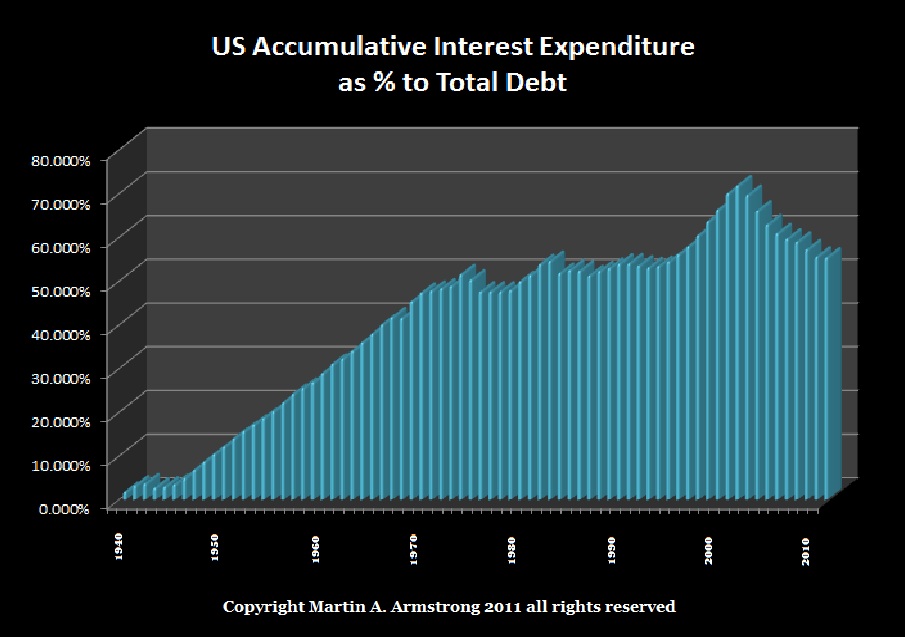
Interest expenditures will soon exceed that of the military. This solution will reduce the cost of government, and thereafter, you outlaw any possible right to borrow once again.
Regulating the Virtual & Cryptocurrency World
Armstrong Economics Blog/Cryptocurrency
Re-Posted Mar 28, 2019 by Martin Armstrong

While many believe that the off-exchange trading platforms in Bitcoin bypass fiat central banks, there are developments in the legal world that warn of regulation is headed into the field with a vengeance. There were three important recent actions in federal courts that illustrate the interplay among the Securities and Exchange Commission (SEC) & Commodity Futures Trading Commission (CFTC) federal regulators seeking to expand their jurisdiction into the virtual currency world. This movement to expand their jurisdiction does not come from Congress. Instead, they charge people and create legal precedents and this is how most “law” is actually made. Clearly, these actions illustrate that they are moving into the virtual currency arena. The three cases are:
- On September 26, 2018, Judge Rya W. Zobel of the U.S. District Court for the District of Massachusetts handed down an important decision in a case alleging the fraudulent sale of a virtual currency called My Big Coin (MBC).2 In denying the defendants’ motion to dismiss, Judge Zobel confirmed the CFTC’s sweeping assertion of authority to police virtual currency markets under the antifraud and manipulation provisions of the Commodity Exchange Act (CEA) and its implementing regulations.
- On September 11, 2018, Judge Raymond J. Dearie of the U.S. District Court for the Eastern District of New York denied a motion to dismiss the United States’ indictment for fraud under the Securities Exchange Act of 1934 (Exchange Act) in connection with the sale of virtual currencies claimed to be backed by real estate and diamonds.3 In denying the defendants’ motion to dismiss, Judge Dearie found that the virtual currencies at issue could reasonably be considered investment contracts and thus securities
- On September 27, 2018, the SEC and the CFTC filed parallel complaints in the U.S. District Court for the District of Columbia against an online trading platform and its CEO offering swaps based on underlying securities and commodities funded with bitcoin, alleging violations of the federal securities and commodities laws.
My biggest concern is that it will be a tiny step for mankind to declare off-exchanges to be illegally operating without registration and it would not be too far behind for they to be criminally prosecuted for also money laundering just like any bank for the failure to report every individual trading on these platforms. I would suspect we will see the further expansion into the virtual currency world by the SEC, CFTC, and DOJ long before we see any real legislation from Congress. They will ALWAYS pick the worse cases to make law and then apply it to everyone.
The Risks of a Cashless Society
Armstrong Economics Blog/Economics
Re-Posted Mar 22, 2019 by Martin Armstrong

QUESTION: Hi Mr Armstrong,
Thank you for continuous education. I hope to get your view on cashless societies.
There are worries that nations will move to cashless transactions in the near future. Do you think this will actually happen? My guess is it will be a failure and there will be “black” markets where transactions in physical notes will flourish. I see this similar to situations where hyperinflation occurs and the respective governments trying to control their exchange rates by declaring them. However, as this happens, black markets having more accurate rates sprout up.
As usual, they can’t dictate anything that has to do with the real world. What do you think?
MC
ANSWER: That is one of the reasons the Deep State is fighting so hard to remove Trump. They simply believe it will take a seasoned Bureaucrat to sign such a bill. That said, a cashless society will be arriving in Europe before it will appear anywhere else. You must understand that all governments are in their death throes. Instead of stepping back and looking at this from a practical perspective, they remain fixated on their debt crisis that is propelling them to raising taxes. They firmly believe if everyone paid their taxes, they would have no problem. Of course, that is a fantasy. Whatever they collect will NEVER be enough to sustain their power.

In Europe, there is already the tradition of canceling their currency. This is done to prevent people from hoarding cash and not paying taxes. This was a step in the direction of a cashless society for it was intended to add risk to accumulating cash and not paying taxes. Hyperinflation only takes place when confidence in government collapses. When governments are on the hunt for taxes, you actually get the opposite — DEFLATION. This is when people curb their investments and hoard their wealth. The elimination of physical money presents a new twist to the historical record. Hyperinflation in the classic sense becomes impossible for there is no printing of money to pay bills in that sense. Assets will rise in value reflecting the fear of government. That is the emotional equivalent to hyperinflation. Nobody will buy government bonds and capital will hoard and hide in assets whenever possible. There will no doubt arise a black market based upon a barter system. That is why I tend to recommend old silver coins that the average person can identify by a simple date.
New York City Heading for Bankruptcy
Armstrong Economics Blog/Gov’t Incompetence
Re-Posted Mar 22, 2019 by Martin Armstrong

They continually try to force socialism upon society so a few can live off of other people’s money. The problem is that capital can flee, as we have just witnessed with Amazon bailing out of New York City and AOC calling it a victory for the little people because they will not have to give them a $3 billion tax incentive to come to NYC.
The entire crisis for New York City is indicative of the way big cities are all on the verge of economic collapse. In the case of New York City, their long-term debt is now more than $81,100 per household and the interest will keep exploding because, like all governments, they borrow with no intention of paying the debt off. Mayor de Blasio has increased spending by as much as $3 billion in the new budget over last year which was $89.2 billion.
 With the Economic Confidence Model (ECM) turning down into 2020 very hard, NYC will run a deficit as tax revenues decline thanks to a recession. The more they raise taxes on businesses and the rich, the more they have begun to leave NYC. De Blasio has detailed $750 million in spending reductions but Gov. Cuomo’s preliminary budget has also reduced $600 million in aid to NYC.
With the ECM turning down, de Blasio’s socialistic policies have led to an increase in spending of 32% since he took office. Socialists just simply think they can constantly live off of other people’s money. The city’s long-term pension obligations have exploded and he has increased the city’s workforce by more than 33,000 people, with even more unfunded pensions in the last five years.
We are adding New York City to the list of expected economic disasters
Is the FED Throwing in the Towel?
Armstrong Economics Blog/Central Banks
Re-Posted Mar 22, 2019 by Martin Armstrong
QUESTION:
Dear Martin,
you commented very intensively on the ECB destroying bond markets and the failure of monetary policy in Europe. By yesterday the US Fed also declared the end of the shrinking of the balance sheet. Possibly they will start QE4. So I would warmly welcome your comment on the US Fed – throwing in the towel, finally – and the situation getting worse also in the US!
Many thanks.
regards,
AS
ANSWER: The Fed also sees the handwriting on the wall. We are headed into a hard-landing in the global economy. They have come under a lot of pressure externally to stop raising rates. This notion that they will not stop shrinking its balance sheet is really pointless when the dollar is the only game in town.
The FED is not in the same position as either the ECB or the bank of Japan. There is a viable bond market that is actually used as the reserve assets among central banks. When we talk of the dollar being the reserve currency that does not mean simply holding cash. They hold US government treasuries – not cash.
Nevertheless, the Fed knows that QE does not work. China as rejected adopting that tool. Nevertheless, the Fed feels compelled to do something even if it fails. They will be vulnerable if they actually do nothing. This is the first step. At risk here is the final straw that breaks the back. Once it becomes more obvious that central banks cannot manage the economy, then we arrive at the game changer.
Clearly, the Fed stopping the reduction of its balance sheet is a reflection that we are headed into an economic recession globally following the ECM.
Britain – Hard Exit or Cancellation of BREXIT
Armstrong Economics Blog/BRITAIN
Re-Posted Mar 18, 2019 by Martin Armstrong

After months of political deadlock, the House of Commons voted by 413-202 last week to ask the EU to delay Britain’s exit. Prime Minister May has simply refused to listen to advice and keeps hoping that Parliament will surrender to her. Normally, after such a defeat, Prime Ministers would resign. But May withstood a no-confidence vote last year and cannot be challenged until December 2019. If the EU tries to force Britain to surrender, then there remains the risk of a hard-exit come March 29th, 2019.
The EU is fighting for its survival. To see Britain crumble would bring them great joy and they could use this against Italy or anyone one else who dares to think about leaving. Indeed, in recent days there has been a chorus of warnings coming from the key EU figures. They are kicking Britain when it is politically impotent and they are demanding that any British request for an extension of the two-year negotiating period must come with a “credible” plan for next steps. This appears to be deliberately trying to force Britain to capitulate and remains in the EU as a second rate member at best.
The European Council president, Donald Tusk, has said the EU wants a “reasoned” request for an extension, while Guy Verhofstadt, the European Parliament Brexit co-ordinator, said there must be a “clear opinion” from the House of Commons on what it really will accept. The vote in itself won’t prevent Britain from a hard exit. Actually, under the law, Britain will leave the EU on March 29th, with or without a deal. What the Eu is now gambling on is that Britain will be unable to come up with any plan that they would accept so they hope the stark choice between a hard-exit and an outright cancelation of Brexit altogether will mean the EU wins with the latter.
German Government Approves a Merger of Banks
Armstrong Economics Blog/Gov’t Incompetence
Re-Posted Mar 18, 2019 by Martin Armstrong

Deutsche Bank and Commerce Bank have announced that they will begin merger talks after the government has finally approved that they can lay off workers. For those unfamiliar with the real world behind the curtain, you must realize the extent of socialism in Europe. A major telecom company in Germany called me and asked me to attend an emergency board meeting. They would not even tell me in advance what was so urgent. I flew in that morning from London and to my surprise, the board voted to make me the adviser to the company pension fund and never even asked me for a proposal of a fee structure. Then the majority of members resigned.
I asked what was this all about? The German government had approved that they could lay off 25% of its workforce. At the last minute, the government changed its mind and told the company it was not fair for them to pick and choose. Instead, the company had to make a flat offer with a pay-out of about €150,000 to volunteer to surrender your job. The end results were devastating. Every worker who knew they could get a job with no problem took the €150,000 and left. The company lost its best workers and was then left with the very people they wanted to get rid of. The board directors resigned for they did not want their career associated with what they expected to be a disaster over the years ahead.
This is how government works behind the curtain. There is absolutely ZERO common sense. We will undoubtedly witness a lot of crazy conditions behind the curtain because the approvals are never logical
Global Recession & Hard Landing
Armstrong Economics Blog/Gov’t Incompetence
Re-Posted Mar 18, 2019 by Martin Armstrong
QUESTION: Mr. Armstrong, it is becoming very obvious that we are headed into a recession here in Europe. I have never felt how ominous things seem as they do right now. Will you be covering Scandinavia at the WEC in Rome?
ANSWER: Yes. We will be focusing on the political & economic crisis that is unfolding. Besides the government of Finland just collapsing out of thin air, we have the insanity of BREXIT, the EU trying to punish Britain in hopes of making an example of them to prevent anyone else from leaving, while we have the ECB unable to do anything whatsoever and the European people have become Draghi’s collateral damage. With leading economies starting to slow and key indicators in the risk zone, we are headed into a hard landing for the bottom of the Economic Confidence Model come 2020.
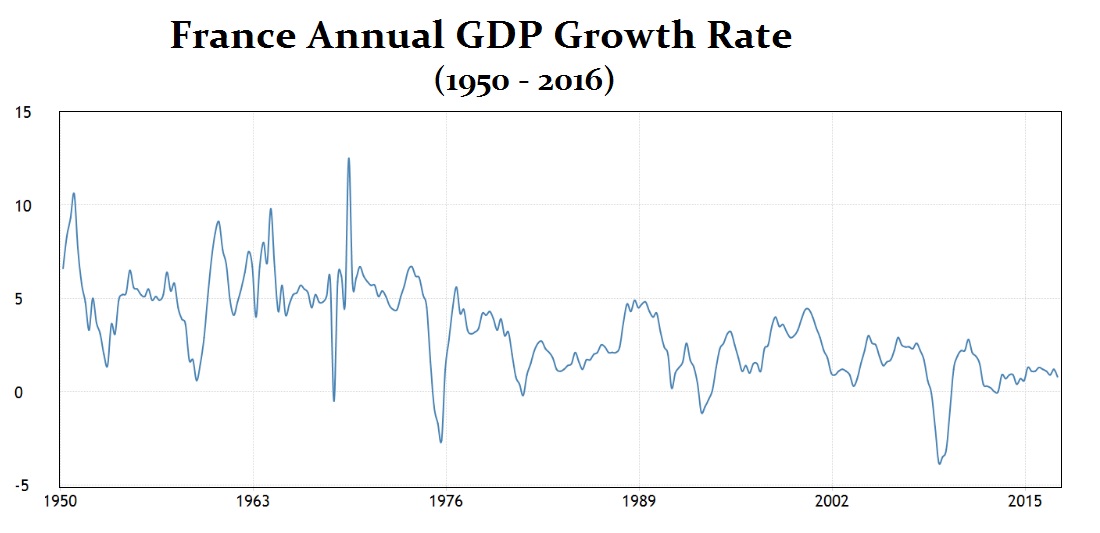
We are in a global recession that has been underway with economic growth rates running just a fraction of what they use to be decades ago. This global recession that others are just beginning to see on the horizon has been in motion. Our focus at this WEC will be how you can position yourself. So while others just see a recession emerging, as always, they will be unable to comprehend the real shifts within the global economy as a whole. We simply must approach this from an international perspective for China is also slowing but thank God they have rejected Quantitative Easing which I have warned is a complete failure.

Even the US economy has been gradually slowing since the 1950s. As taxes rise and the share of the economy government consumes keeps growing, they are starving the real economy and suppressing its economic growth rate. We are headed into a very hard landing. It has been the rise in taxes and regulation that is also behind the trend to automate replacing workers as much as possible.
Draghi – The Opportunity & the Nightmare
Armstrong Economics Blog/Central Banks
Re-Posted Mar 14, 2019 by Martin Armstrong

 I cannot stress enough that Mario Draghi has really destroyed the European economy on an unprecedented scale. I know people who worked on trading desks years ago when Mario Draghi before he was head of the ECB, was there to observe how things operated. His policy of perpetual low to negative interest rates is a barbaric ancient theory based on the assumption that if you make it insanely cheap to borrow, people will run out and buy everything. He has kept this failed theory up for 10 years without success. He owns the bulk of sovereign debt in Europe; he cannot sell or even stop rolling over without causing a major debt crisis among member states. The ECB is trapped and incapable of managing the economy whatsoever.
Add to that the fact that Draghi never considered the impact upon those who saved all their lives to retire and suddenly discovered their life savings earned nothing. He leaves the ECB in October. But the May elections are approaching and the stress his Quantitative Easing has inflicted upon Europe is causing a ripple effect within the political discontent. With the economy turning down hard once again into 2020, he has no means to even try to pretend he can manage the economy. We are headed into a NEW ERA in which the belief in central banks and government being in control is about to collapse before our eyes.
We are witnessing a real major crisis unfold. Of course, this will make our Rome WEC probably the most interesting for Europeans and how to survive this Draghi’s nightmare. Where there is such confusion, there is a tremendous opportunity as well for those who understand the events. There are always winners and losers when history is in the making.
 Centinel2012