Bank Bloodbath Batters Stocks; Bonds, Bullion Bounce As Trumpcare Vote Doubts Rise


Tyler Durden's picture

Does this look like policy ‘success’ or ‘failure‘?


VIX is jumping as stocks sink…


And Bank stocks are collapsing…


With the Financials ETF breaking below a key technical level…Bank stocks have now gone nowhere since Dec 8th.


Lots of chatter about selling due to doubts on TrumpCare passing on Thursday – which will delay the tax reform foundation that the market is settled on (and any banking system reform).

The Exchange Stabilization Fund – What Is It?


US Treasury Bldg

Apparently, some people have discovered the Exchange Stabilization Fund and are now touting this as some major power in manipulating the world economy. This is simply an emergency reserve fund of the US Treasury Department, which is typically used for foreign exchange intervention. This arrangement really goes back to the birth of the G5 and is the alternative to having the central bank intervene directly in foreign exchange. This is a Treasury function, which allows the US government to try to influence currency exchange rates without affecting domestic money supply created by the Federal Reserve.

Unlike those who are trying to sell newletters touting this as the new great manipulator, it holds less than $125 billion in funds which includes special drawing rights (SDR) from the International Monetary Fund. Trust me, there is no such great power that can manipulate the world economy. They have done their best to try to prevent the dollar from rising. They will fail as they did in 1987 and every other attempt to peg currencies. They are INCAPABLE of altering the capital flows.

Are Cycles Universal or Regional?


PopulationOfRome

QUESTION:  I have a question regarding cycles. You provide some very detailed, historic references showing why certain events are occurring now (again). Is there a disposition for something that occurred in the past to be destined re-occur for a particular region/country (i.e. Greeks abandoning property due to excessive taxation) because it happened once and now the propensity to repeat that causal action again is “in their DNA”. Is that something we as Americans do not yet possess because we have not been around long enough to experience a “fall of Rome” type event?

SM

ANSWER: Cycles are based upon two element – (1) nature and (2) human nature. Some regions will be prone to natural disasters while others are not. Ironically, many of the best ports where cities grew such as Tokyo and San Francisco just as examples, were great harbors because of earthquakes. The landscape in California is strikingly beautiful compared ot the flat plain in Oklahoma, again because of earthquakes. The rocks that appear in Central Park in New York City are there because an earthquake fault runs through New York City making the harbor what it was. Hence, there are cycles that impact only on a regional basis due to nature.

With regard to Greeks walking away from inheritance because they cannot pay the tax, this is inherent to all societies when government goes too far. They imposed harsh laws in Vancouver against foreign real estate buyers and the market crashed. Because it was a local law, they moved to Victoria and Toronto. In Australia, they are seizing properties own by foreigners and selling them off. All of these types of interventions are reactions to events set in motion externally.

realestate

That said, this is the US cycle for real estate as a national whole. I just bought a house in Florida at about 50% of its 2007 high value. Trophy spots for the high end where people are just parking money we warned would make new highs going into 2015.75 – but that is not the bulk of the market. Why is the US market (minus trophies) down hard when that is not the case in other countries? The difference is the regional issue. In the USA, many people have 30 year mortgages. In Canada, the best you can get is a 10-year fixed mortgage. In Germany, you can get up to a 15-year fixed mortgage.

We must understand that property values are LEVERAGED, so if the money for fixed rate loans dries up because of interest rate hikes and political uncertainty, then real estate prices MUST fall. This is all because of the leverage that was deliberately injected into the real estate market during the Great Depression for property fell  in value so far, only cash buyers could buy anything. Farm land fell in value to below what it was sold for by the government more than 80 years before.

Real estate is different from stocks and gold. Yes it is a place to park money. However, be careful because without mortgages available, it falls further than other tangible assets because it has been LEVERAGED! Moreover, it is a fixed asset meaning you cannot leave with it. Therefore, people are forced to simply walk away when (1) the tax burden is too high and (2) there is war and the region is being invaded.

Deutsche Bank: “The Probability Of A Negative Shock Is High”


Tyler Durden's picture

For the second week in a row, Deutsche Bank’s strategist Parag Thatte has a somewhat conflicted message for the bank’s clients: on one hand, he writes that positive economic surprises continue “but are getting less so”, and although the divergence between har data surprises and sentiment is diminishing the bank is somewhat confident that a “pullback in the very near term is unlikely” (here DB disagrees with Goldman Sachs). However, Thatte is increasingly hedging, and notes that because a “rally without a 3-5% sell-off that is typical every 2-3 months is now running over 4 months and is in the top 10% of such rallies by duration”, he cautions that “the probability of seeing a negative shock is high” especially since Q1 buyback blackout period has begun.

Here are the key observations from the Deutsche Bank strategist:

  • The equity market rally has been going uninterrupted for a long time, driven by the unusual resurgence of positive data surprises. Strong data surprises drove equity inflows and fund positioning, adding to the steady support from buybacks. An expectation that positive data surprises were likely to persist underpinned DB’s call 2 weeks ago that a pullback was unlikely in the very near term. The bank takes stock of the current situation below:
  • Duration of rally now in top 10%. The rally without a 3-5% sell-off that is typical every 2-3 months is now running over 4 months and is in the top 10% of such rallies by duration.

  • Data surprises positive but getting less so. While incoming data in the last week has continued to surprise to the upside relative to consensus, it has done so at a more modest rate and DB’s data surprises index, the MAPI, is now declining off its highs.

  • Divergence between sentiment and hard data surprises diminishing. Attention has focused on the divergence between sentiment data which has run up strongly and hard data which has so far lagged. In terms of surprises, i.e., relative to what’s priced into consensus forecasts, hard data surprises have fallen back to neutral over the last two weeks, while sentiment surprises have declined this week but remain elevated. The surge in sentiment data is getting built into consensus forecasts and sentiment surprises also moving down to neutral over the next 3-4 weeks.

  • Fund positioning already trimmed in line with neutral hard data surprises. US funds have already been trimming equity exposure for the last three weeks in line with the decline in hard data surprises suggesting funds may already be anticipating a modest slowdown in overall data. Real money equity mutual funds are already close to neutral but asset allocation funds and long-short equity hedge funds are still overweight. Macro hedge funds are exposed to short rates positions in our view, not long equities.

  • Inflows accelerate. The pace of US equity fund inflows has accelerated over the last 4 weeks ($36bn). However flows have been closely tied to overall data surprises and could start to moderate in turn.

  • Buyback blackout period has begun. Heading into the Q1 earnings season, the pace of buybacks will slow as an increasing number of companies enter earnings blackout periods starting this week.

* * *

DB’s summary take on near-term equity moves:

Continued muddle through most likely in the near term. The fundamental drivers as well as demand-supply considerations for equities point to a continued muddle through in the near term. However history suggests that with the duration of the rally already in the top 10% by duration, the probability of seeing a negative shock is high. But the medium term outlook remains robust with the unfolding growth rebound having plenty of legs while from a demand-supply point of view flow under-allocations to US equities and robust buybacks remain very supportive.

* * *

Away from equities, the picture in rates, commodities and currencies based on trader flows is as follows:

  • Oil falls but still expensive and long positioning still elevated. Following the November OPEC supply-cut announcement oil prices became very expensive on our medium term valuation framework for oil and commodities based on the trade-weighted dollar and global growth (Trading The Commodity Underperformance Cycle, Apr 2013). The decline in oil prices over the last two weeks has trimmed the extent of overvaluation but leaves oil prices slightly above the upper-end of the historical 30% overvaluation band which has marked extremes (currently $48). Net long positions are off of recent record highs but remain quite elevated.
  • Extreme short positions remain an overhang for rates moving up. Bond yields fell sharply after the rate hike this week much like they did after the December one. While real money bond funds remained close to neutral going into the FOMC this week, leveraged funds shorts in bond futures remained near extreme highs. Outside of HY funds which saw a large outflow as oil prices fell this week, bond funds have continued to receive robust inflows. Indeed duration sensitive funds have this year completely recouped all of the outflows seen in the aftermath of the elections.
  • Gold valuations stretched again. Gold prices have rallied on the back of a return of inflows into gold funds this year reversing the modest outflows in Q4. Massive cumulative inflows since early 2016 ($40bn) remain an overhang. Gold longs had been declining heading into the FOMC meeting. Gold prices have again disconnected sharply to the upside from the historical drivers of the dollar and the 10y yield as well as global growth. Copper long positions continued to slide for a 6th straight week.

  • Shorts in the Mexican peso, the best performing currency this year, have collapsed to neutral. Mexican peso shorts fell sharply last week to the lowest levels in over 15 months as gross shorts fell sharply while longs also rose. Aggregate long dollar positions had been rising going into the FOMC meeting reflecting rising shorts in the yen and sterling even as euro shorts were pared.

Bitcoin’s ‘Fork’ In The Road


Tyler Durden's picture

Authored by Vinny Lingham,

I’ve been very surprised with the amount of vocal support for a Bitcoin Hard Fork – especially from many Bitcoin supporters who believe it is either inevitable or “not a bad thing”. I get it, but you’re wrong. I know everyone is tired of the scaling debate. I’m not going to go into the technical details around this debate for this post, but instead, I’m going to focus this post on debunking the non-technical arguments for a Hard Fork and highlighting the ensuing confusion and market impact that a contentious Bitcoin Hard Fork will have, if we indeed have a split between Bitcoin Core and Bitcoin Unlimited.

Exchanges today have just confirmed they will be listing BTU as an altcoin if there is a Hard Fork?—?this scares me because although the industry person knows what an altcoin is?—?the average person outside the industry doesn’t. This was the catalyst for my post today.

I have predicted that Bitcoin should hit $3,000 by end of this year?—?but not if there is a contentious Hard Fork.

Keep in mind that the hope of this post is that it changes the mindset around support for a contentious Hard Fork, which creates another Bitcoin, because I believe this needs to be avoided at all costs. In fact, if any of the scenarios below begin to play out, we’re already in trouble… If you agree with the logic below, translate this post into Mandarin and any other language and let’s convince miners and the community to not consider even doing a Bitcoin Unlimited Hard Fork.

Also, even after the big bug in Bitcoin Unlimited yesterday, more nodes are back up and running signalling it. I know many people don’t believe it will happen and they may be right, but we cannot ignore a persistent and growing threat to the ecosystem and so I’m speaking out about it now.

For more background on the Bitcoin Unlimited vs Segwit debate, check the bottom of this post for links, including a number of technical reasons why a Hard Fork is a risky proposition for Bitcoin. I’m also not delving into the technical debate as that has been done ad nauseam elsewhere.

Bitcoin’s greatest asset is its brand awareness!

It’s inarguable that Bitcoin is the single strongest brand in the crypto space. I believe it probably received $2–5bn in free media exposure over the years. A Hard Fork would create 2 brands of Bitcoin?—?essentially handing over some brand value to Bitcoin Unlimited. I wrote a post about Bitcoin’s power and network effect over 2 years ago?—?it’s worth reading if you haven’t.

The moment there is a hard fork, we are going to allow brand confusion to step in. This is a HORRIBLE idea.

The security of the Bitcoin network comes from the computational hash power that the miners bring. This is driven by the price of Bitcoin?—?higher the price, more hashing power. High prices are in turn driven by market demand. Market demand is driven by PR & media and the long term narrative that Bitcoin is the first and only true cryptocurrency which is a long term store of value. If we mess with this, I believe we can expect negative consequences…

When the media declared Bitcoin was dead in 2014, it took us a long time to recover, price wise.

Bitcoin Unlimited will just become an altcoin if it doesn’t have majority support?—?why does it matter?

In the event that 35–50% of miners broke away and created an altcoin, in this case?—?Bitcoin Unlimited, we would essentially then have 2 coins. Bitcoin (BTC) & Bitcoin Unlimited (BTU). One could argue that BTU is not Bitcoin, but it may still be called Bitcoin by the man on the street. For instance, if he buys what he thinks is Bitcoin, to buy some gift cards at Gyft, only to discover that he bought the wrong Bitcoin?—?can you imagine the issues that merchants are going to have now in dealing with the customer support fallout. In all or many cases, they may even remove Bitcoin as a payment method, unless the business is Bitcoin only, in order to avoid customer confusion or the risk of the individual coins fluctuating in price between purchase and usage.

As much as the crypto world is smart enough to understand the differences, the average person barely understands Bitcoin today and forcing them to tell the difference between BTU & BTC is going to be a big challenge.

Let’s not forget some other important points: Roger Ver (the force behind Bitcoin Unlimited aka Bitcoin Jesus) also owns Bitcoin.com (and a number of other strong domain names) and he also owns a couple of hundred thousand Bitcoins (apparently around 300k BTC).

When Bitcoin forks, everyone who is holding BTC, would receive an equal amount of BTU?—?so Roger would have presumably 600k coins (300BTC +300 BTU) according to industry rumours.

The moment Bitcoin splits, he is able to legitimize Bitcoin Unlimited using Bitcoin.com?—?which for the uninitiated would actually be a legitimate source of information, and is highly ranked on search engines like Google. Bitcoin Unlimited would effectively become Bitcoin.com. My first company was in search engine marketing?—?I know this world all too well.

If there was a fork and Roger wanted to pump Bitcoin Unlimited, he could literally dump all his Bitcoin (BTC) holdings into the market. I don’t want to even guess what 300,000+ coins being moved in a short space of time would do to prices, especially after a contentious hard fork where new money investors would already be on the sidelines. This happened to Ether Classic after the Ether Fork?—?the Ether Foundation sold off 90% of their coins and depressed the price. Just the threat of this alone will cause the market to tank for BTC, just for starters. If Roger wants to kill Bitcoin’s price and legitimacy, there is no reason to not fear this and the market will start pricing in this risk.

Roger would not be the only person to sell down BTC. Other BTU loyalists who have two sets of coins would do the same, initially in order to drive down BTC. Conversely, all the long term BTC holders would now receive equal amounts of BTU. Even the most hard core BTC Hodlers would probably sell down BTU with all their BTU coins in order to try and crush it. Given the importance of BTC as a reserve asset in altcoins, many traders could use weakness in price to short BTC and drive their altcoin prices up.

Long story short?—?none of these scenarios (or any others I can think of) play out well for Bitcoin, either in the markets or the media and this fundamental divide means that you’re going to have increased volatility from both sides, as more coins will pour into the market?—?crushing any demand side driven rally.

The whole point about Bitcoin being a long term store of value is that there are only 21m coins, ever. Stability, security and scarcity are the differentiation properties of Bitcoin, a contentious Hard Fork attacks these properties and will be strongly reflected in the price. After a Hard Fork, we will be sitting with 33m “Bitcoins”, on track for 42m and we’ll be having arguments about which one is the legitimate Bitcoin for years to come. You can expect legal cases to arise around the use of the brand, as the Ethereum Classic Investment Trust has shown.

Imagine someone says: I want to buy Bitcoin. Next question is: Which one?! After that, the very next question will be :

“What if one of these coins fork again?—?then we will have 63m coins, and so on and so forth.”

But, aren’t two coins are better than one! The market will adjust!

Let’s say the price of Bitcoin today is $1,000?—?if doing a 75%/25% split would now mean that you have have 2 coins, this should mean they are worth $1,000 ($750+$250). So, I did a simplified calc based on Metcalfe’s law, and it estimated the new coins combined could be worth more than 33% less almost immediately after a Hard Fork due to reduced network effects, and that’s assuming everything went well… With the ensuing FUD and negative press/media?—?you can expect this to drop even further! Bitcoin’s enemies can’t wait for an opportunity like this.

Creating two networks destroys network effects (payment providers, merchants, etc) and the Bitcoin price is non-linear to size of network, so the two coins combined will not equal the same price. You can compare this to the Ether split, as Bitcoin is at scale ($20bn) and Ether wasn’t at the time and it definitely set them back.

Bitcoin has died many times, it can survive a Hard Fork! Even Ethereum did.

Let’s start over. Ethereum is a B2B facing platform?—?consumers & media don’t know or really care about it. Bitcoin is a $20bn asset class. And yes, after the media declared Bitcoin dead after the last “bubble”, it took us 2+ years to rebuild the price by generating demand organically. The media attention this time during the recovery and cross the price of gold does not even come close to last time when it was taking off like a rocket. If a split is portrayed badly in the media and creates confusion, we will possibly go into another 2 years of sideways and down. Do we have that much time again with other competitors on the heels? And let’s be frank, a Hard Fork is not Bitcoin dying. It’s Bitcoin duplicating. Now we have two Bitcoins, both won’t die, maybe one will. Which one is the real Bitcoin? Do not underestimate how many enemies Bitcoin has?—?a fork will just give them all the ammunition they need to confuse the market.

Who cares if 30% of the miners fork off?

Bitcoin’s price is a function of faith and network security, given the large amount of computing power that goes into it. Metcalfe’s law dictates that the value of the network is the square of the network. By splitting the network even 70/30, it’s inarguable that it’s less secure. Yes, it could rebuild but, depending on the price of each coin after the split, hash power may move from one coin to the other. These are highly specialized machines and one coin surges in price, you can expect hash power to follow suit.

Remember that one of the biggest mining companies, Bitmain, is now signaling support for Bitcoin Unlimited. It’s very clear that the current difficulty of Bitcoin makes it harder and harder to compete in this market, but after a Hard Fork, there would need to be a difficulty adjustment on both new forks, given the reduced hash power?—?this opens up the opportunity for Bitcoin mining companies to sell more hardware to miners on both sides of each coin.

The sales of mining equipment are a huge economic disincentive to maintain the status quo without a block size increase, unless the Bitcoin price surges which I don’t believe will happen unless Segwit is adopted and then this debate is over. I called 1300 as a key resistance level and it’s proving to be.

Bitcoin was largely built on the premise that economic forces and self interest would help govern the security of the network. We talk a lot about decentralization but the reality is that the hardware that powers Bitcoin is produced by a handful of companies who also control mining pools which can be used against the network.

Bitcoin has a product & people problem, not a technical problem. A fork will resolve it because both sides get what they want.

The real issue, I believe is two-fold. The community wants Bitcoin to be all things to all people?—?Roger wants cheap coffee transactions, Core wants to ensure its sufficiently decentralized and secure, Vinny wants a store of value, etc.

We have a governance problem in Bitcoin and we have no way to resolve conflict except to fight about it, publicly and given that it’s quasi-democratic, unless we all agree on something, nothing gets done. This has burned a lot of people and I can see why we have so many altcoins out there trying to replace Bitcoin.

Bitcoin cannot be all things to all people, at least, not a for a long time. Right now, it needs to be stable, secure and unchallenged. We can continue to argue amongst ourselves as a community, but for now I am against any contentious Hard Fork that would see us creating two separate code bases with two different brands of Bitcoin.

Companies like Coinbase, BitPay, Gyft, BitPesa, Bitgo and many others have invested years to build consumer adoption and understanding of Bitcoin and create outlets for people to use it. A fork now would undermine all these efforts, investments and limit adoption of Bitcoin in general. Unlike in the Ethereum Hard Fork, 100s of companies use Bitcoin and this would lead to a lot of counterproductivity. Companies should be focused on advancing adoption of their products, not in protocol fights. This debate has already been a strain on the community.

I understand and appreciate many of the different perspectives?—?some which I have not had the time to mention in this post, but given a balance of risks to the Bitcoin ecosystem, I believe that the adoption of Segwit right now is imperative in order for us to get to the next stage in the evolution of Bitcoin and remove the risks of a contentious Hard Fork. The Core Dev team has had a lot of criticism leveled at them and clearly they are not good at community relations, managing perceived conflicts of interests (like Blockstream’s involvement), which has resulted in emotions flaring up against them which is causing an uprising of sorts as we are now seeing. Technically, however, it’s inarguable that they are the best technical team in Bitcoin today.

If we all just breathe out, and put aside our differences and emotions (even just for a while), let’s accept that doing a Hard Fork right now is NOT in the best interest of Bitcoin and let’s please just adopt Segwit.

This post is not trying to be an endorsement or critique of either BU or Core. This post is asking the community to put aside their differences and come together to prevent an irreparable splinter.

I’ll keep posting more links below, but here one for starters:

The Broken Bond Market – All Noise, No Signal


Tyler Durden's picture

Via Global Macro Monitor blog,

The Fed tightens on Wednesday and bonds rally.  What the hay?

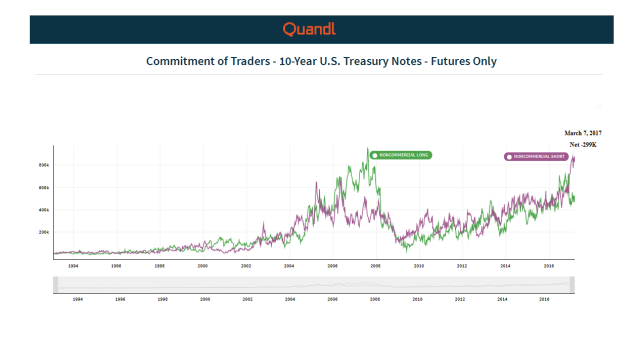
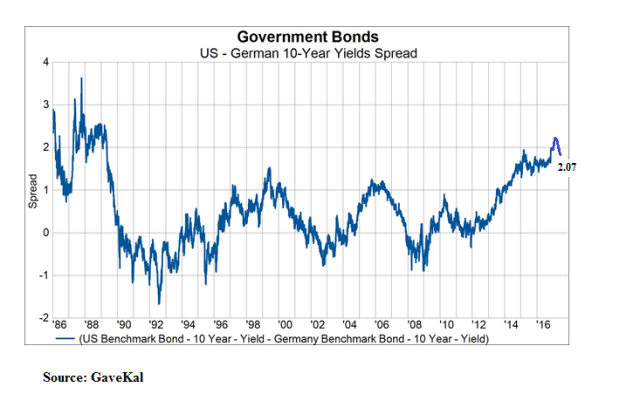
GaveKal, Jeff Gundlach,  and Jim Bianco nailed it in that every spec and their mother are/were short 10-year Treasuries.

Source: Quandl (see here for interactive chart)

But this is only a small part of the story:  The global bond markets are broken.

There are no signals, there is no noise.  Trying to infer any sense of economic or financial information from bond yields is futile.

QE Distortion

The intervention into the bond markets by central banks through quantitative easing (QE) in the big four sovereign bond markets – U.S., Japan, Eurozone, and UK – has created a structural shortage of risk-free instruments and distorted the most important price in the world — the yield on 10-year hard currency sovereign bonds.

Furthermore, past QE in the U.S, coupled with the recycling of foreign capital flows back into the U.S. bond market, has, in particular, created an acute structural shortage of longer-term Treasury securities.  The totality of short positions of the fast money in both the cash and derivatives market are probably a much larger proportion of the effective float of longer-term marketable Treasury securities than what the market currently perceives.  Hence the stickiness of U.S. bond yields.

Fed and Foreign Ownership of the U.S. Yield Curve

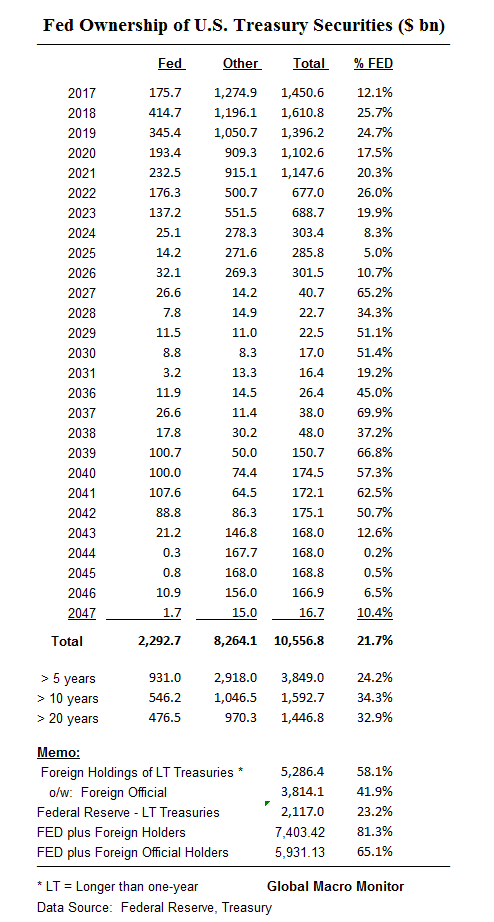
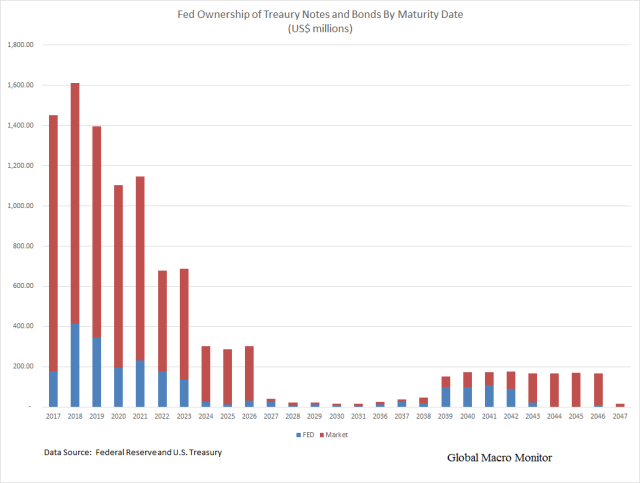
The table and chart below illustrate just how small the actual float of longer-term marketable U.S. Treasury securities is available to traders and investors.  The data show the Fed owns about 35 percent of Treasury securities with maturities 10-years or longer.  Note the data only include notes and bonds and excludes T-Bills.

The Fed’s holdings combined with foreign ownership of longer maturities — more than 1-year — exceeds 80 percent of marketable Treasuries outstanding.   The Fed combined with just foreign official holdings, mainly, foreign central banks,  is 65 percent of maturities longer than 1-year.  Thus, almost 2/3rds of tradeable Treasuries longer than 1-year are held by entities with no sensitivity to market forces.

Note, the Treasury International Capital  (TIC) data does not break down foreign holdings by year of maturity, only by short-term and long-term – that is, greater than 1-year.

.

.

Foreign Holding of Treasuries

We hear a lot these days about a 1994 bond market debacle.  We lived through that bond bear and it wasn’t fun.   However, the microstructure of the Treasury market  is entirely different today than it was back then.

First,  the Fed did not hold long-term Treasuries.   Second,  foreign holdings of Treasuries were only about 15 percent of the outstanding debt versus around 50 percent today and everybody, including, Ross Perot, who said the trade was “a no brainer”,  were levered long riding the yield curve – short short-term, long long-term.

Foreign inflows,  mainly the result of the recycling of U.S. current account deficits,  resulted in Alan Greenspan’s bond market conundrum and the Fed losing control of the yield curve just prior to the 2007-08 financial crisis.

In this environment, long-term interest rates have trended lower in recent months even as the Federal Reserve has raised the level of the target federal funds rate by 150 basis points. This development contrasts with most experience, which suggests that, other things being equal, increasing short-term interest rates are normally accompanied by a rise in longer-term yields.

…In the current episode, however, the more-distant forward rates declined at the same time that short-term rates were rising. Indeed, the tenth-year tranche, which yielded 6-1/2 percent last June, is now at about 5-1/4 percent. During the same period, comparable real forward rates derived from quotes on Treasury inflation-indexed debt fell significantly as well, suggesting that only a portion of the decline in nominal forward rates in distant tranches is attributable to a drop in long-term inflation expectations.

Alan Greenspan,  Feb 2005

A paper published by the Federal Reserve Board (FRB) in 2012 estimated the impact on interest rates of the capital flow recycling into the U.S. bond market,

We find that a $100 billion increase in foreign official inflows into U.S. Treasury notes and bonds lowers the 5-year yield by roughly 40 to 60 basis points in the short run. However, our VAR analysis shows that in the long-run, when we allow foreign private investors to react to the effects induced by a shock to foreign official holdings, the estimated effect is roughly -20 basis points per $100 billion. Putting these results into context, between 1995 and 2010 China acquired roughly $1.1 trillion in U.S. Treasury notes and bonds. A literal interpretation of our long-run estimates suggests that if China had not accumulated any foreign exchange reserves during this period, and therefore not acquired these $1.1 trillion in Treasuries, all else equal, the 5-year Treasury yield would have been roughly 2 percentage points higher by 2010. This effect is large enough to have implications for the effectiveness of monetary policy. – FRB

Extrapolating the above analysis to the current stock of foreign official Treasury holdings of around $4 trillion leads to nonsensical results, such as the 5-year yield should be 800 basis points higher than it is today.   Obviously, the analysis should truncate the dependent variable – 5-year note yield — and ceteris paribus (other things being equal) does not hold in the real world.

But we should not miss the article’s main point that market interest rates would be much higher if not for foreign central bank interventions into their FX markets and the recycling of those reserves back into the Treasury market.    We take the above analysis seriously but not literally and wonder if the Trump Administration considers it when they rail on “so-called” currency manipulators.

The Yield Curve During Monetary Tightening

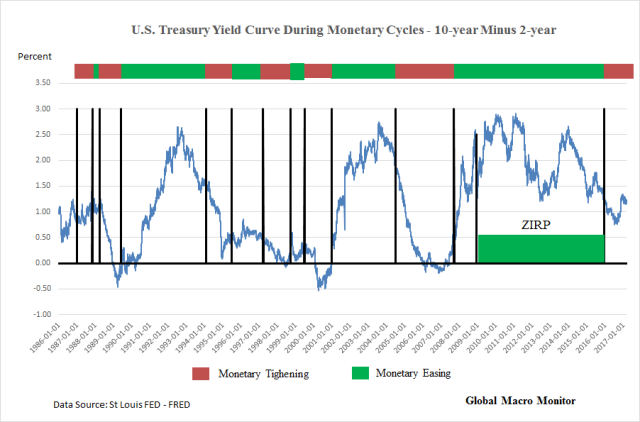
We have looked at the data and constructed some charts that show that in monetary tightening cycles in the U.S. the yield curve (10-2 years) usually flattens.

.

In only two of the past six prior tightenings did the 10-year bond rise in yield from the day of the first tightening to the day of the first easing.  This is entirely possible due to the fact the Fed often “tightens until something breaks” and the bond market front runs the expected easing cycle.

During the 2004-07 tightening cycle,  the era of the Greenspan bond market conundrum,  for example, the 10-year yield managed to rise only a maximum of 64 bps during the entire cycle from a beginning yield of 4.62 percent to a cycle high yield of 5.26 percent.   This as Greenspan raised the fed funds rate by 4.25 percent, from 1.0 percent to 5.25 percent.

Was the market forecasting the coming financial crisis?   Hardly.

Alan Greenspan blames the Fed’s loss of control of the yield curve, mainly due to the recycling of capital flows by foreign central banks,  as a major cause of the housing bubble.  Notice the importance of the 10-year yield on the allocation of resources and on how its distortion can be at the root of financial and economic bubbles.

This Time Is Different

Those dreaded words, “this time is different.”   We should warn readers that this time is truly different, however.   When the Fed first raised interest rates in December 2015, for example, the 10-year yield was at 2.24 percent and more than 50-75 percent lower than at the beginning of any other monetary tightening cycle over the past 30 years.  There are many “unprecedents” in this cycle and therefore more uncertainty.

.

Forecasting With The Yield Curve

Given the technical distortion of the bond market, we find it kind of silly with statements such as “what is the bond market telling us?”   Nothing!

There is no price discovery.  Given the intervention and distortion to bond yields caused by the Fed and foreign central banks, who knows what the right interest rate is for longer-term Treasury securities.

We will never forget the words of a prominent market strategist when rates were super depressed.

“ We’re in a depression. That is what the bond market is telling us.”

Even at the Friday close,  we hear equity traders are worried about why the 10-year yield is so low and fell after Wednesday’s Fed tightening.

Information Feedback Loops

One of just many dangers of the lack of price discovery in the bond market is the potential formation of positive feedback loops, where other markets fail to discount these distortions and act accordingly.   That is, for example, the equity markets sell off because they freak out interest rates are declining when they should be rising.  Or the private sector fails to invest in CapX as they wrongly anticipate an economic downturn because of falling or excessively low bond yields.   Their actions thus become a self-fulfilling prophecy.

A flatter than normal yield curve could also adversely affect bank lendingLook at how financial stocks have been underperforming recently as the yield curve has flattened about 7 bps this year.

Conclusion

Welcome to Bond Market Conundrum 2.0.

Asset prices are artificially elevated and foreign exchange rates are distorted due to the repression of the risk-free interest rates because of lack of supply.   Capital has been misallocated and the Fed has once again lost control of the yield curve simply by the very fact it owns the yield curve.

Monetary policymakers probably won’t regain control of the yield curve until they begin to reduce their balance sheets and the supply/demand balance moves closer to equilibrium.

That’s when we suspect everybody and their mother will front run the central bank selling and we will have the real bond market debacle some in the market have been expecting. Will or can that day ever come?  We don’t know.

Of course,  governments could go on a tax cut/spending binge and increase the primary supply of government bonds.   Possible but doubtful and a longer term story,  if any.

Until then?   We still believe bonds are in a slow bleed bear market, which will see fits of massive nutcracking short covering, as interest rates slowly drift higher.

Remember,  there are no signals, there is no noise.   Here’s to hoping the markets understand that.

A Few Caveats

The data points presented above should be taken as rough, but good, approximations.  The dates of each source of data may differ and the same is true for the different data sources.

Furthermore, we may be entirely wrong in our conclusions.

Abraham Lincoln used to tell a story as a young Illinois circuit court lawyer when trying to convince the jury to render a verdict in his favor.

The story goes that Lawyer Lincoln was worried he had not convinced the jury during the closing argument of a civil case against a railroad.   The jurors had gone to lunch to deliberate.  Lincoln followed them and interrupted their dessert with a story about a farmer’s son gripped by panic,

“Pa, Pa, the hired man and sis are in the hay mow and she’s lifting up her skirt and he’s letting down his pants and they’re afixin’ to pee on the hay.” “Son, you got your facts absolutely right, but you’re drawing the wrong conclusion.”

The jury ruled in Lincoln’s favor.

Similarly, when looking at data and charts — the facts —  we often draw the wrong conclusion about future direction.

Stay tuned.

Data Appendix

Morgan Stanley: “Only One Thing Will Allow Central Banks To Keep The Party Going”


Tyler Durden's picture

Last week, we presented readers with the latest note from SocGen strategist. Albert Edwards, who explained why after so many years of false rate hike starts, the market not only responded to last week’s hike in a dovish manner – interpreting last Wednesday’s 0.25% hike as a 0.25% rate cut- but as Goldman Sachs showed previously, the dovish reaction was one of the strongest ones since the financial crisis, in other words: “the market no longer believes the Fed.” This is what Edwards said, citing his FX colleague Kit Juckes:

[T]he Fed’s reluctance to send an aggressive tightening signal, instead preferring to again shuffle upwards its dots just slightly, has disappointed markets. But to be fair, the problem isn’t really with the famous dots. It’s with the market, which just doesn’t believe the Fed will tighten as fast as they say they plan to (see left-hand chart below). If the market took the FOMC at their word and discounted a 3% Fed Funds rate at the end of 2019 and beyond, then we’d probably have a 3% nominal 10-year Treasury yield by now.”

That said, a 3% Fed Funds rate would also lead to steep selloff in risk assets as the dividend yield on the S&P, currently at about 2%, would be about 1% below the risk free rate, leading to a wholesale “great rotation” out of stocks.

And while the market may not believe the Fed is ready – and willing – to push rates that high, the relationship also cuts both ways.

As RBC also noted last week, explaining that while the Yellen put is alive and well, the market will simply not tighten financial conditions on its own, forcing Yellen to aggressively hike further… which the Fed may be reluctant to do.

That is the argument in a note released late last week by Morgan Stanley’s credit strategists, who note that while the party is still going strong, some 93 months into the current cycle, it may not continue should the Fed engage in an aggressive rate hike scenario. This is what they say:

At 93 months, the current cycle is already longer than all but two post-war recoveries (out of 12 total). We could certainly debate why this expansion is already longer than normal, but strong growth is clearly not the reason. In fact, quite the opposite – a lackluster economic backdrop for years, leading to massive central bank support,has likely kept the cycle going more than anything else. Last year is a good example. As we show below, early in the year, with oil collapsing and the economic data rolling over, recession risks were seemingly rising. As Exhibit 3 shows, central banks across the globe responded. Even the Fed provided stimulus (verbally) by allowing the market to go from pricing in almost three rate hikes at the end of 2015 to almost zero rate hikes in summer 2016. Markets recovered, and the economic data followed.

What is Morgan Stanley’s conclusion? Simple: for the party to continue, not only must the Fed revert back to its quasi-dovish mode, but for that to happen the recent economic “rebound” has to end (the sooner the better), extinguishing any reflationary impulse, removing the impetus for Yellen to hike aggressively further, and allowing the Fed to remain on hold for an indefinite period of time.  In short: “In our view, for the cycle to last another several years, we want to see more of the same – a continued environment of ‘ok’ growth and low inflation, which allows central banks to keep the party going.”

Hopefully Trump, whose policies threaten to upstage this delicate balance benefitting the 1%, has read the memo.

The Long Run Economics Of Debt Based Stimulus


Tyler Durden's picture


Onward vs. Upward

Something both unwanted and unexpected has tormented western economies in the 21st century.  Gross domestic product (GDP) has moderated onward while government debt has spiked upward.  Orthodox economists continue to be flummoxed by what has transpired.

What happened to the miracle? The Keynesian wet dream of an unfettered fiat debt money system has been realized, and debt has been duly expanded at every opportunity.  Although the fat lady has so far only cleared her throat (if quite audibly, in 2008) and hasn’t really sung yet, it is already clear that calling this system careening toward a catastrophic failure.

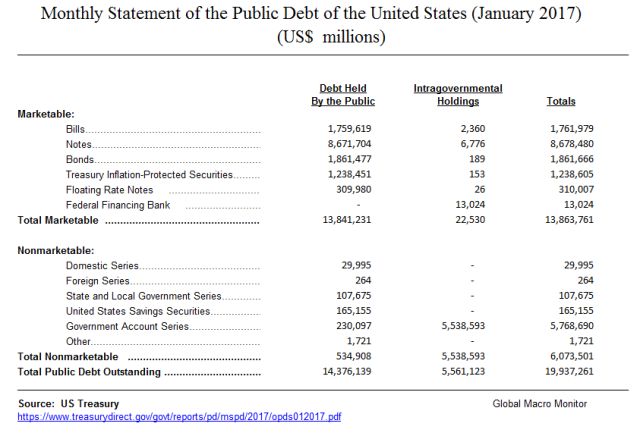
Here is the United States, since the turn of the new millennium (starting January 1, 2001) real GDP has increased from roughly $10.5 trillion to $18.6 trillion, or 77 percent.  Over this same time government debt has spiked nearly 250 percent from about $5.7 trillion to $19.9 trillion.  Obviously, some sort of reckoning’s in order to bring the books back into balance.

Throughout this extended episode of economic and financial discontinuity, the government’s solution to jump-starting the economy has been to borrow money and spend it.  Thus far, these efforts have succeeded in digging a massive hole that the economy will somehow have to climb out of.  We’re doubtful such a feat will ever be attained.

In short, additions of government debt over this time have been at a diminishing return.  Specifically, at the start of the new millennium the debt to GDP ratio was about 54 percent.  Today, it’s well over 100 percent.

US GDP and US federal debt, indexed (1984 = 100). Mises noted back in the late 1940s already that “it is obvious that sooner or later all these debts will be liquidated in some way or other, but certainly not by payment of interest and principal according to the terms of the contract.”  If it was obvious then, it is glaringly obvious today. Greece and Cyprus demonstrated what happens when modern socialist welfare states have no independent access to a printing press and are thus unable to extend and pretend in the traditional Keynesian way. The Potemkin village disintegrates on the spot at the first whiff of suspicion. All the nations that have postponed the reckoning by printing money and the flight forward mechanism of amassing even more debt have simply made the eventual denouement more profound – click to enlarge.

The idea that the government could spend borrowed money to grow the economy out of debt has become patently ridiculous.  Nonetheless, government economists continue to advocate these policies because, academically, they have no other alternatives.  At the same time, politics may now conspire to push the U.S. government into debt default.

Arrested Development

This week the Obama administration’s debt ceiling suspension expired, and a debt ceiling of $20.1 trillion was triggered.  This reestablished debt ceiling is just a horse’s hair above the U.S. government’s current debt level.  Furthermore, getting the debt ceiling lifted will likely require an epic Congressional battle, including elaborate displays of Kabuki theater.

There’s a possibility a new debt ceiling agreement won’t be reached before the Treasury’s money runs out sometime in late-summer or early-fall.  This would put the U.S. government in a position of not being able to pay its debts.  At a minimum, even if some Congressional deal’s worked out at the 11th hour, the full faith and credit of the U.S. government will be tarnished.

Best case, a timely debt ceiling resolution will cut into President Trump’s plans to boost the economy by borrowing money and spending it on infrastructure and defense.  This will also cut into his plans to reduce taxes.  A stumble in either of these areas could prompt a long overdue stock market panic.

The debt ceiling could become a real problem this time, as the treasury has massively drawn down the cash balance it amassed by issuing humongous amounts of debt to US money market funds in 2016. In the final quarter of 2016, i.e., the dying days of the Obama administration, the federal deficit exploded by a stunning 208 billion dollars – click to enlarge.

The fact is, perpetual economic growth is required to sustain life as we know it in today’s debt-driven economic social order.  Any slight blip, such as 2008, massively disrupts the lives of hundreds of millions of people.  What’s more, economic growth must be at a level where the plebs believe they’re adequately reaping the fruits of their labors.

What that rate of economic growth happens to be is uncertain.  But so far the U.S. economy of the 21st century has failed to attain it.  What is known is that an economy that expands at 3 percent annually, will double the average living standard every 24 years.  In contrast, an economy that expands at an annual rate of 2 percent, will take 36 years to double the average living standard.

The average annual rate of real GDP growth of the U.S. economy in the 21st century has been at a 1.78 percent state of arrested development.  The average annual rate of real GDP growth of the U.S. economy for the 16 preceding years was 3.43 percent – nearly double.  Alas, it has been 12 years since the U.S. economy’s eked out a single year of 3 percent GDP growth.

In spite of statistical distortions reaching fresh heights of absurdity year after year (their goal is generally to make “inflation” look smaller and GDP larger than they really are), economic output as measured by GDP is seemingly on a permanent downward trajectory. Many European countries look even worse. For instance, France had strong growth for more than two decades after WW2, but it collapsed thereafter. Today, government spending in France accounts for 58% of GDP and the country’s microscopic growth rates have become downright embarrassing. But don’t worry, Europe’s political elites and bureaucrats continue to prosper! – click to enlarge.

The Long Run Economics of Debt Based Stimulus

“In the long run, we are all dead,” said 20th Century economist, John Maynard Keynes.  This, in a nut shell, was Keynes’ rationale for why governments should borrow from the future to fund economic growth today.  Why wait for recessions to do the work of equilibrating the economy when a little counter-cyclical stimulus can push growth onward and upward?

J.M. Keynes is certainly dead, but we are still alive and can rightly be referred to as his victims. Keynes is often depicted reading a book, but evidently he must have read the wrong book. And all those who assert that he “didn’t really mean it this way or that way”  should perhaps take the time to read what he wrote. Keynes really was a Keynesian!

Of course, attempting to spend a nation to prosperity using borrowed money is not without consequences.  In the short run, an illusion of wealth can be erected.  In the long run, that illusion slips into decay and disrepair.

Over the past week we’ve been roaming the streets of Mexico City, visiting family and conducting  field research on your behalf.  In particular, we’ve been investigating the chronic effects of what happens when a government spends too much borrowed money, and then attempts to lighten its debt burden by inflating its currency. 

What follows a brief summation of our findings.

On surface, what happens is what you’d expect.  The currency gets utterly destroyed.  This has the effect of blowing the price of just about everything – especially imports – through the roof.  But it’s what happens after which is less obvious.  For the ill-effects of a debased currency express themselves in asymmetric ways.

On a Saturday afternoon walk through the historic city center along Avenida Francisco I. Madero between El Zócalo and the Palacio de Bellas Artes we were greeted with the appearance of consumer prosperity.  Bustling crowds of shoppers made their way through the chic fashion stores that are interspersed between historic 17th and 18th century colonial mansions and buildings.  Modern skyscrapers were in the distance.

Similarly, during a Friday night visit to El Moro, the famous churro and chocolate restaurant that has been in operation since 1935, we encountered a line extending out the door and down the street.  Customers were dressed to impress.  There was hardly a hint of economic hardship about the place.

The original El Moro outlet in Mexico City.

But venture outside the most inner streets of the city’s center and the conditions quickly deteriorate.  An endless sea of multilevel residential dwellings mixed with commercial and industrial properties in varying degrees of decay extend for miles and miles across the high altitude Valley of Mexico.  It appears that, perhaps 50 or 60 years ago, these structures were clean and well-kept.  However, that was before crumbled concrete and exposed rebar became the norm for these vast residential dwellings.

Contrary to what Keynes posited, counter-cyclical debt based stimulus didn’t produce the nirvana of rising long run living standards.  Rather it produced the disparity of stagnating GDP and rapidly rising government debt.  Later it produced the hell of declining living standards over the long run.

The truth is, in the long run we’re not all dead.  Actually, some of us are still here, living with the consequences of shortsighted economic policies.

Residents of Mexico know this all too well.  In the United States, the scope and magnitude of debt has been able to support an illusion of prosperity.  Still, as far as we can tell, many residents are experiencing the transformation of small pockets of slums into vast expansive ghettos.

Storing up a small hoard of gold and silver bullion may’ve never been more critical than the present, in the off chance the inevitable dollar debasement comes sooner rather than later.  So, too, one would be well advised to develop a side hustle now.  From our observation, everyone in Mexico City was working… though many didn’t have jobs.

On Monday we traveled north of the city limits to the ruins of the ancient pre-Aztec city of Teotihuacán.  There we climbed up the Pyramid of the Sun and into the open areas of the Pyramid of the Feathered Serpent.  We walked the Avenue of the Dead toward the Pyramid of the Moon.

Teotihuacán – view from the pyramid of the moon. Aztec priests once ripped out the hearts of sacrificial victims to appease their gods (among those in need of appeasing were Huiztilopochtli, the god of war and the sun, Tlaloc the rain god and not to forget, good old Xipe, a.k.a. “Our Lord, the Flayed One”, god of sacrificial pain and suffering. And you should see their mama… (wait for it). The Aztecs had a god for everything, so there was a lot of sacrificing to do.

At its peak, around 450 AD, Teotihuacán was the largest city in the pre-Columbian Americas, with a population estimated at 150,000.  Yet by the 6th century the population began to decline and the city ceased to exist sometime in the 7th or 8th century.  No one quite knows what happened.

Well, here she is… Coatlicue, the primordial earth goddess, mother of the gods, the sun, the moon and the stars. Judging from her teeth, this multi-tasker was a carnivore.

One theory is that the city’s decline coincided with an extended drought.  Another is that there was an internal uprising.  Maybe a 99 percent situation developed. We kicked a few rocks.  We put our ears to the ground.  We looked.  We listened.

The spirits didn’t answer.  They didn’t have to.  We’d already seen and heard enough.

Taxing Property Going Crazy


Dog House Property Tax

The Left is fighting so hard to keep dominating everyone else, that it is hard not to see how society in starting to implode in the West. In Norway, the hunt for taxes has been so bad, they have now even been raising property taxes to include a dog house in the back yard.

Meanwhile in Greece, people are not taking property that is left to them because they cannot pay the inheritance taxes to accept the property. This was one of the final stages in the collapse of Rome. People just walked away from their property because of taxes.

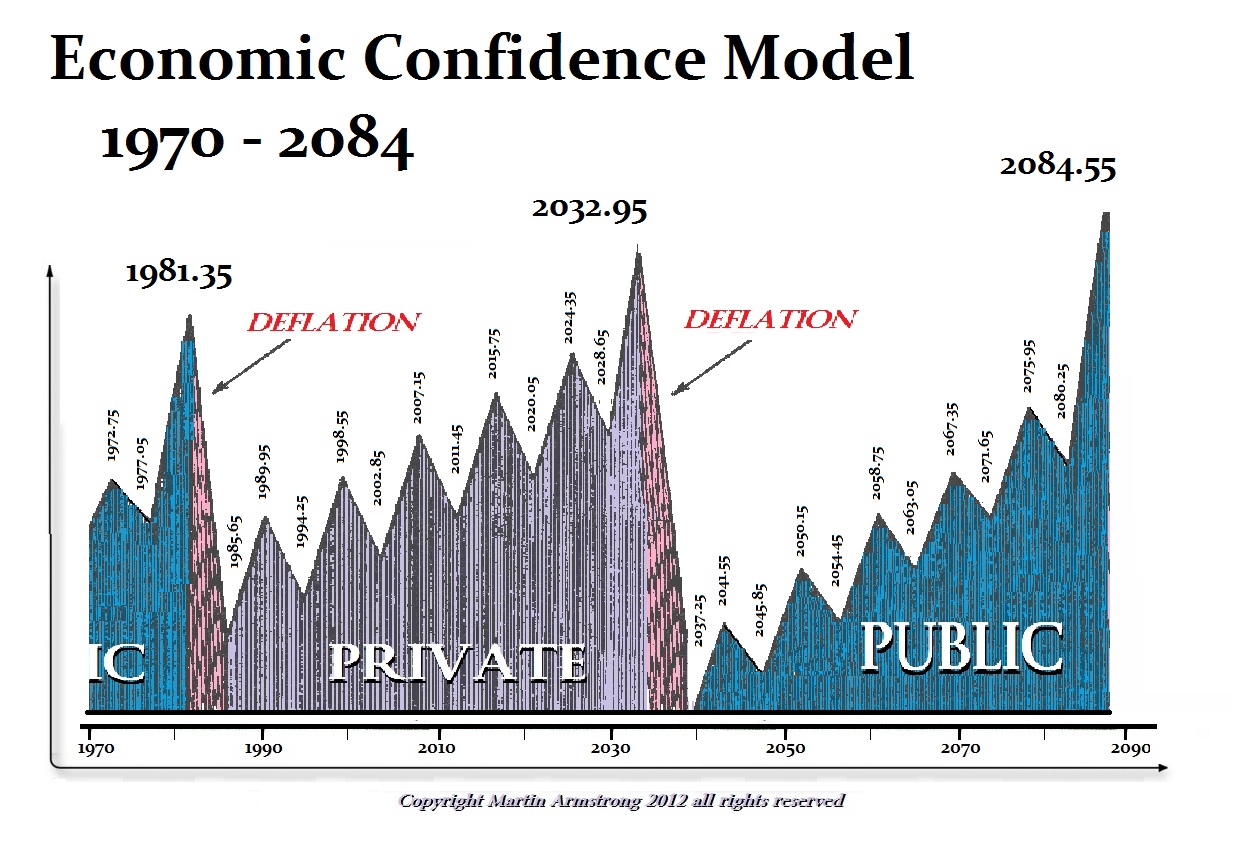
Why the Crash & Burn is Public not Private


ECM-1970-2084

QUESTION: Hi Mr. Armstrong,
You mentioned the crash and burn applies to government assets, not private sector assets. Can the private sector stand on it’s own two feet?
Thanks again,
MB

Continental Currency-6th-$8-2-26-1777

ANSWER: There are times when the private sector cannot stand and everyone runs to bonds/cash. Likewise, there are times when government can no longer stand and the only thing that survives is private assets. This took place during the collapse of the Weimar Republic (German Hyperinflation) and it has been the case throughout history even at the birth of the USA and the collapse of the Continental Currency.

Sectors Capital Movement

Whenever something happens in one sector, people turn to the next one. Capital will move from region to region and within each region there is still a domestic cycle. The 1987 Crash send capital fleeing from the USA to Japan. Then there was the Japanese Bubble 1989 and capital fled to South East Asia. That then peaked and capital began to rush to Europe for the birth of the Euro. That then peaked and it began to flow back to the USA.

People get burned on real estate, they then move to stocks. The get burned in stocks, then run to bonds/cash. Then they run to commodities. The key remains when there is a great alignment, which we are headed into. That warns the big Crash & Burn lies in government not private for this one