91 Year Old Woman Denied her Savings was in Sweden


swedish-parliament

COMMENT: The 91 year old woman who had her $12,000 deposit declined in Kristanstad, Sweden, and the money confiscated by the State is a sad tale. Perhaps you might want to identify Kristanstad, as a town in Sweden, for those of us who do not readily identify Kristanstad, a town of 35,000 souls with Sweden.

BTW I love your blog.

REPLY: Sorry – my bad as they say. This is Sweden. The notes were the old obsolete notes that she had saved over the years. If she could not prove she saved these notes, the government refuses to accept them. Just more confiscation because ALL governments now PRESUME we are all guilty and it is our BURDEN to prove we are innocent. This is the peak in socialism. It has nothing to do with helping people, it is all about helping government.

The “obsolete” is not the issue. Even obsolete notes are redeemable. This is standard in Europe. One pound notes in Britain from 1970 have been cancelled. Only the US does not cancel old currency. They are still redeemable. Even Australia redeems old cancelled banknotes. The Swedish Riksbank states on their site:

The Riksbank redeems all Swedish banknotes that are invalid, as long as there is no suspicion that they may be linked to a crime, for instance a cash-in-transit robbery.

The New 2017 Banking System


euro-digital-electric

The year 2017 will bring us a step closer to eliminating physical money through governments assault on the underground economy. I previously reported that Europe had moved forward to make payments electronically on an instant basis. The same system is being turned on next year in Australia. The entire reason the Founding Fathers of the United States prohibited direct taxation was to protect our liberty. Today, governments need to know absolutely everything, and once they eliminate physical cash they will have the their dream — the quest for the secret of the philosopher’s stone. They naturally take no responsibility and instead successfully shift the blame for their mismanagement to the rich. They claim they would have no problem if everyone paid every penny on taxes. Of course, it does not matter how much tax they collect — it will never be enough.

Eliminating physical money will lead, they believe, to the philosopher’s stone. By changing the banking system to instantaneous transfer, they can eliminate physical money and track everything we do all the time. There will be the surrender of all liberty and the termination of our civil liberties. This is how empires collapse.

Republican Tax Reform – What About the Deficit?


irs-building

The Associated Press ran a story reporting: “Congressional Republicans are planning a massive overhaul of the nation’s tax system, a heavy political lift that could ultimately affect families at every income level and businesses of every size.” The interesting aspect is that the headline reads:

GOP: Cut taxes, change brackets; but what about deficits

There is zero discussion about constantly borrowing year after year. The presumption here is that governments can borrow all the time and someone will buy, even if negative, and the world will keep on going. They assume that this is OK and that deficits are all right as long as we fund them.

Absent from all of this basic assumption is the reality of history — whenever a government borrows, they ALWAYS default.

Most people are living in the past. Prior to 1971, the US government borrowed money but it did not create new money, as it could not be used for collateral to borrow against. In the 1960s, if you bought an E-bond, you could not go to the bank to borrow against it. You had to cash it out. Post-1971, you could buy T-Bills and use them as collateral to fund your trading. Debt has become money that pays interest.

The bulk of the “real” money supply is created through the velocity of money and borrowing. When a bank lends money, it is creating electronic money without printing. If you borrow $1,000 and they lend it to you by using $1,000 from someone else, then two people have accounts that say they each have $1,000 but the actual money created by government was still just $1,000.

Consequently, during the early days of the Roman Republic, public taxes consisted of modest assessments on property, which were primarily tangible assets that included slaves, land, homes, animals, personal items, and monetary wealth. The tax rate under normal circumstances was 1% and sometimes would rise as high as 3% during periods of war. Taxes could not be collected on personal income for there was a lack of a valid census.

Julius Caesar ordered the first real census that was conducted street by street. He knew there was much corruption with people on the welfare rolls who did not exist. Caesar ordered a census whereby the check each property and who was living where. The rolls were greatly reduced after knocking on every door to collect a census. About 80% of Rome was funded by taxes, and 20% of the annual budget, on average, was covered by new coinage. This did not produce 20% inflation.

Roman citizens were free from any direct taxation. Rome’s income came primarily from war indemnity, booty, mines, port duties, and rental of public lands. The provinces were subjected to tithes, which was one tenth of annual produce or earnings. In 187 BC, the Roman treasury refunded the taxes imposed during the Punic wars. Women were then declared tax-exempt in Rome. However, in just two years, by 169 BC, people had been avoiding taxes by putting property in their wife’s name. This led to legal reform when a man was not allowed to pass his property to a woman beyond 50% of his worth. After 167 BC, taxes were exempt if you lived in Rome itself. This contributed to Rome becoming the largest city in the world, which was not matched until London during the 19th century Victorian Era.

syracuse-30

After the capture of Syracuse in 211 BC in Sicily during the Second Punic War, Rome adapted the tax system created by King Hiero that imposed a tithe on the agricultural produce of most Greek cities on the island. The reforms of Diocletian had eliminated the special tax-free status enjoyed by Rome.

There is little doubt that Rome funded its deficits by owning the mining resources, thereby enabling the creation of money to cover its expenses on about 20% of the budget on average. As resource dwindled, debasement began, but not aggressively until the Emperor Valerian was captured and enslaved by the Persians. That was a fundamental shock to the confidence of Rome and the people began to hoard significantly. This is also when Christianity took off for as people prayed to their gods. When no relief from barbarians took place, they turned in greater numbers to Christianity. The greatest period of Christian persecutions was during the 3rd century AD. It was the collapse in confidence that created the collapse in the monetary system.

USIntAs%Total

We are playing with fire if we think the deficits must be covered by borrowing more and more money that pays interest. It is time we review history closely. Stop the borrowing and monetize the deficit rather than pay interest and engage in quantitative easing that never makes it down to the people anyway. Up to 70% of the national debt has been accumulative interest which NEVER helped anyone but bondholders of which 50% have been non-Americans.

Government forces Social Security to be invested only in government debt, despite the acknowledgement that the rich get richer ONLY by investing, which government prohibits the average person from doing. Then we borrow their money and pay no interest, yet pretend to be magnanimous by handing them a refund check as if we were Santa Claus.


91 Year Old Woman Court Sides With Bank – Her Cash Saving Illegal


array-money

A 91 year old woman in Kristianstad tried to simply deposit her 108,000  SEK (approx. 12000 USD), which was her life savings. The bank refused to accept the notes, because the woman could not explain where they came from. The woman saved the first money in the drawer, because she did not trust banks. Then in a safety deposit box. Saving money and then trying to deposit it in a bank is rapidly becoming a crime as we move deeper into the age of authoritarian government because socialism is collapsing and government are desperate for money.

Because the woman had no proof of where they came from, the bank refused to receive notes with reference to the Riksbank’s regulations. The woman appealed to the Administrative Court explaining that she was not a criminal and not present a criminal record. She has lived efficient and economical, and now wanted to splurge a little during his last years of life. The regulations that are depriving this woman of her life savings according to the Riksbank requires a person not to have been convicted of a crime for redemption of banknotes previously. The Administrative Court allowed no other conclusion than the Riksbank and reject the appeal.

The government stole the life savings of a 91 year-old woman who wanted to splurge before she died. Welcome to the reality of socialism. If you really think socialist care about people, go to Venezuela.

The Share Market & the Future


Curiousity-Question

QUESTION: As a small retail investor, what would Marty suggest to invest in if in fact we break the 23000 level on the DOW and we do in fact get the phase transition that he is talking about?  Furthermore, what would he use to profit from it?  Shares in particular stocks, futures contracts or options in the DOW index?  Lastly, if this phase transition does happen, what is the longest time frame that it would last, 12 to 18 months?

Thank Marty for all that he has done for us little guys.  He has really opened my eyes to what is going on in this world.

J

ANSWER: In 2017, I will publish a breakdown of sectors and the differences between them. Keep in mind that the bulk of the retail public are not yet back in the market. The majority keeps saying how overvalued the market is, yet a substantial amount of people are all looking to buy the dip. Trump will be very good for the US markets and economy. Reducing taxes will bring capital home and it has already resulted in a new 13-year high in consumer confidence. That is the key to the market going into 2018.

The reflection point that will tip the scales to extremely bullish will turn on confidence. What MUST BE UNDERSTOOD here is we have two possible patterns: (1) We leave 2016 as the intraday high temporarily and back off, moving to retest support into 2018, and then rally in a major breakout into 2020, or (2) we press immediately higher and complete the rally by 2018 followed by a harder crash and burn.

These are the two possible paths that are coming up and it will all depend upon the actions and tone we set in January. We will prepare a very important special report on this topic.

The Real Crisis Trump Will Face With Trade


world-trade

The entire problem with trade and jobs has been its focus on only the job and not the consumer. David Ricardo developed his principle that nations should pursue their own competitive advantages. In other words, just because I might want to be a brain surgeon does not mean that (1) I might be very good at it, and (2) that I am entitled to state protectionism to prevent others coming into the field who could expose me as second-rate.

When the collapse of socialism is in motion, people demand state benefits and assume they can just legally take. Governments have been in serious trouble and are raising taxes to try to make ends meet, but at the same time, their economies are moving into sharp declines. The greater the instability in Europe and Asia, not to mention emerging markets, the stronger the dollar becomes.

282-total-us-bal-of-trade

348-b-us-bal-trade-usTrade has always been misunderstood for the two primary elements are jobs and currency. If you do not comprehend both elements, then you cannot properly manage trade. It is always a great topic to expose for votes during elections, but quite honestly, there is nothing any politician has ever been able to accomplish but confusion and chaos. The entire protectionism of the Great Depression was set off by (1) economic implosion in Europe reduced sales to Europe, and (2) the rise in the dollar reduced the competitiveness of US goods and lessened the cost of imports. The US entered a trade deficit with the rest of America because of the strong dollar.

$19002140

The dollar soared in value as European countries began to default on their sovereign debts. Trump will face the same crisis once again. One solution will be to index tariffs to the dollar. Thus, a 10% tariff across the board would be plausible on the trade issue. However, the danger of protectionism will emerge if you pick and choose between products and fail to understand the link to the currency.

The left socialists are out in force to say Trump’s 10% on time tax on foreign held money by U.S. corporations will do nothing for the economy. EBay was looking to take over two companies to expand domestically. They had to decline because the expansion meant they would have to bring cash in from overseas and the added tax would make the deal unattractive. Yes, some companies will bring back cash and pay out dividends and buy back their own shares. Trump should also eliminate the dividend tax; thus the money would go to shareholders who would pay their one-time tax on income. This will be a far better stimulus plan than the Fed handing money to bankers in hopes that they will lend it out, which never happens. Small businesses are turned down by the bankers for more than 80% of all loans. The banks do not invest in innovation that is the mother of jobs.

think-out-of-boxTrump should impose a 10% tariff on everything, and then index it to the US dollar index. That will avoid a protectionism crisis and deal with the largest influence being the currency. The entire reason why Germany wanted the euro was to eliminate currency risk for German companies so they would not need to worry about currency swings.

We have to start thinking out of the box. What politicians have been doing for decades is always listen to only academics who never think out the box as a rule.

Confiscating Gold


gold-2017-report

The assault on gold is by no means casual. The hunt for money and the global effort to eliminate cash to be able to increase taxation is also targeting gold. All the sales pitches that gold will survive have ignored the fact that government is well aware of gold and people using it to store wealth. China has imposed gold import restrictions, and India’s demonetization and gold confiscations have provided a blueprint for other government to follow, and the success to them is that there have not been riots and bloodshed in the streets of India like has unfolded in Venezuela. Now the European Commission has also proposed tightening controls on cash and have included precious metals transfers from outside the EU. They are using terrorism as the excuse that they need to shut down that route of funding of militant attacks on the continent. It was Winston Churchill who said – “Never let a good crisis go to waste.” Indeed, our politicians in Europe remember those words and they are indeed not allowing any terrorist attack in Europe go to waste. The USA followed this advice with 911, which they took part in, creating TSA, Homeland Security, and began seizing everyone’s phone calls as in the book 1984. The EU politicians are not letting any terrorist attack go to waste and see each event as an opportunity to do things they could not do before. Gold is rapidly becoming the target of confiscation in Europe following the Berlin Christmas attack.

Reuters reported that after the attack on a Christmas market in Berlin, where 12 people were killed as a truck plunged into a crowd, was such an opportunity that could not go to waste so the European Commission proposed to tighten capital controls – specifically cash and precious metals – into and out of Europe.

Under the new European proposals, customs officials in European Union will now expand checks on cash, precious metals, and even prepaid payment cards sent by mail or in freight shipments. The hut for money is rapidly expanding. Agents will now be able to seize cash or precious metals carried by individuals entering the EU even below the €10,000 euros threshold. Cash has already been required to be declared at customs when entering the EU and in the USA it is $10,000. The new European rules would allow authorities to seize money below that threshold “where there are suspicions of criminal activity.”

A friend in Germany tried to send €200 as a gift to their father and the government demanded they prove where the money came from. EU officials are claiming recent attacks in Europe were carried out with limited funds. Indeed, are we talking about buying food while hijacking a truck, which cost nothing?

The plan included virtual currencies such as bitcoin, and prepaid cards, which French authorities said were used to fund the bombings. Under this new proposal, even holders of prepaid cards would have to show some form of identity when they make payments of €150 euros or more. The question becomes why include precious metals? You cannot pay for a room with gold coins or but food. You have to convert that to cash and when you do all sales or purchases are already reported.

This is the covert hunt for money. We will be providing a detailed report on additional issues that are arising which will significantly impact your investment strategy moving forward. Will all these restrictions send even more money fleeing to the United States

U.S. Prepares To Sell Off Its Oil Reserves


Tyler Durden's picture

Submitted by Nick Cunningham via OilPrice.com,

The U.S. is beginning to wind down one of the core energy security policies of the past half century as the boom in domestic drilling eases concerns about supply.

The U.S. Department of Energy could begin to sell off some of its strategic petroleum reserve (SPR) as soon as January, the beginning of a multi-year process to shrink the nation’s stockpile of oil. Congress has authorized DOE to sell off $375.4 million worth of oil in its recent budget resolution. The DOE said that such a sale could be held in January 2017.To be sure, part of the motivation to sell crude is to finance upkeep for the SPR itself. The reserves are held in salt caverns in Louisiana and Texas, setup decades ago in the aftermath of the Arab Oil Embargo in 1973. The SPR system can hold more than 700 million barrels of oil, the largest strategic stockpile in the world. The idea is that the SPR holds 90 days’ worth of oil supplies, which could be released in the event of a global outage. A release has only occurred a handful of times, such as the Persian Gulf War, Hurricane Katrina and the Arab Spring.

Some of the storage systems are rusting and corroding after decades of use. In September, the DOE issued a report to Congress, which came to a dire conclusion about the condition of the reserve. “This equipment today is near, at, or beyond the end of its design life,” the report said. The sale “will allow the Department to take necessary steps to increase the integrity and extend the life” of the reserve, a DOE spokesperson said in December after the budget resolution was passed.

It is hard to overstate the significance of the SPR to U.S. energy policy. In fact, some analysts would argue the U.S. does not really have a comprehensive energy security policy. There is no coherent theory, policy or philosophy driving U.S. energy security concerns, other than the U.S. military policing the world to ensure the security of supply, a mission that has governed American actions abroad since the Carter administration at least.

The one cornerstone of energy security policy has been the SPR. As long as the U.S. had 3 months’ worth of supply, it could weather unexpected disruptions. The International Energy Agency was setup in the 1970s as well, and participating members – in addition to the U.S., the group includes Europe, Japan, Korea, Australia and New Zealand – also have pledged to hold a 90-day supply.

But U.S. policymakers no longer view the SPR is all that important. Even the more hawkish members of Congress have been lulled into a sense of security from the surge in U.S. oil production and the resulting crash in oil prices. The world is awash in oil, so why does the U.S. need to stockpile such a massive volume of oil at great expense? The ostensible reason of selling off oil from the SPR is to finance its maintenance to ensure its existence over the long-term, but if the Congress still truly believed in the importance of the SPR, they would have found funding elsewhere instead of reducing the stockpile.

Indeed, some of the proceeds from the sale of oil will go towards other uses beyond paying for repairs, namely, the U.S. treasury, which belies the notion that the sales are simply for upkeep. The sales are only occurring because U.S. policymakers are no longer concerned about the security of oil supply for the U.S. economy.

Various pieces of legislation have put the U.S. on a path to sell off 190 million barrels of oil from the stockpile gradually over the next decade. The sales are slated to take in $2 billion by 2020 to finance maintenance.

Beyond the question about the SPR’s relevance to U.S. energy security, a few other issues come to mind. First, the sale of oil from the SPR will occur at a moment of unusually low oil prices. The government could have taken twice as much revenue if it had sold the oil a few years ago instead of today when WTI trades for $50 per barrel. In the event that the U.S. decides to replenish the stockpile at some future moment, it will probably do so in a higher price environment. Selling low and buying high, any investor will tell you, is not a wise strategy.

A more immediate question is how the SPR sales will affect global supplies today. The release of oil will occur in already oversupplied market, and while the volumes are not huge, they will add pressure to prices. “Given stretched bullish positioning and the toppy state of inventories at Cushing, the sales of SPR oil could temporarily curb incentives for barrels in Cushing to flow to the U.S. Gulf Coast,” Barclays analysts recently said. The oil could reach the market in March or April, just “as refineries exit their turnabouts, but that could still steepen the WTI contango,” the Barclays analysts added.

“The DOE could not have picked a worse time to test the market,” said Bob van der Valk, senior editor at The Bakken Oil Business Journal, according to MarketWatch.com

Can Rates Rise with Deflation?


CALLMONY-MA

QUESTION: Hi Marty, How does the model’s call for deflation (earlier blog posts) fit in with the likely major cycle low in interest rates (per your recent posts)? Can there be general price deflation and yet interest rates increase significantly?

dow-1870-1940-int

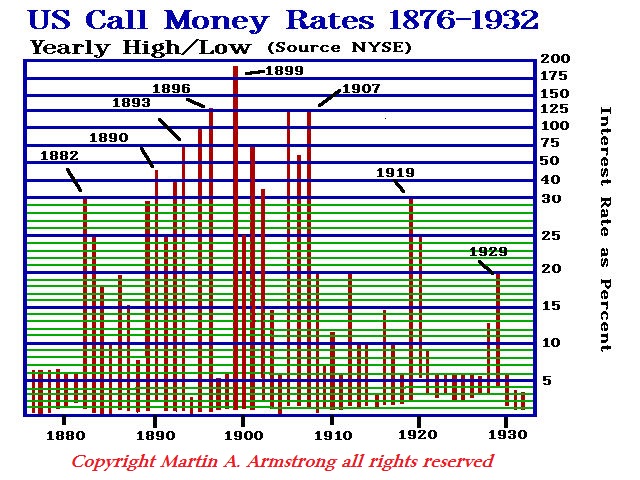
ANSWER: Yes. Rates can soar to outrageous levels during the collapse of a system, which reflects a collapse in confidence that causes a simultaneous deflation in assets. Look at the highest levels of interest rates that reached nearly 200% in 1899. That was not a reflection of speculation in the markets. This was when J.P. Morgan had to arrange a gold loan to bail out the government.

Normally, interest rates are the price of inflation in a normal growth environment where confidence exists within the system as a whole. You can get hyperinflation if confidence in government collapses, but when you are on a gold standard, you end up with hoarding and the velocity of money collapses and causes the interest rate to soar like with a loan shark.

You can see we had the biggest asset rally into 1929, but this was the lowest spike in interest rates because the confidence was with the dollar as Europe, Asia, and South America defaulted. The key is where the confidence resides. That’s why I called it the Economic Confidence Model.

The ECB is Insolvent Based on Their Standards


Draghai Euro Crisis

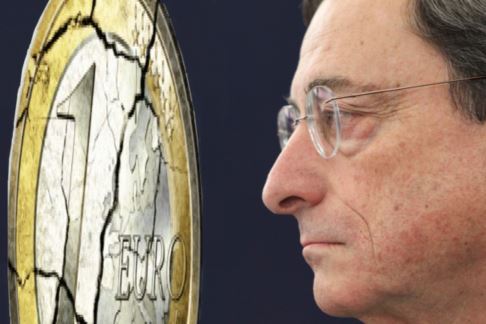
As we approach 2017, the euro appears far worse than anyone could imagine. The biggest hypocrite is actually Mario Draghi who is outrageously managing the European Central Bank (ECB). To make this as plain as possible, the ECB is the largest individual creditor of the euro countries, and is thus a bank that is undermined completely by the poor creditworthiness of the debtors. If the ECB were to apply its own rules to the banks in Europe that say bail-in, not bail-out, then by its own supervision rules, the ECB is insolvent and should be shut down.

Just look at the data. The ECB has been buying government bonds through its Quantitative Easing (QE) program and the failure of that expanded into other securities that now include corporate junk bonds. Looking at the balance sheet, the central bank currently has receivables amounting to €1,627 billion, of which €1,220 billion are directly attributable to government bonds.

Let’s begin to dive deeper. Of the 19 countries of the Eurozone, the total debt is €9.816 billion. Together, all the Eurozone banks hold €1,695 billion in government bonds. Additionally, there are €1,100 billion in outstanding bank loans. The ECB is already the largest individual holder of government debt as is the Bank of Japan. Neither have anything to show for their QE efforts but failure. Draghi is continuing to buy even more questionable debt to the tune of €80 billion a month, dropping down to €60 billion.

risk

The presumptions that government debt is RISK-FREE is built entirely upon this idea that they can tax. But taxes are at their highs and history warns we have a tax revolution on the horizon. Government debt cannot be looked upon as free of risk when there is no further room to raise taxes. Draghi has placed all his eggs in one basket. Governments NEVER pay off their debts, they only spend more and more. This is a major crisis that seems to be out of focus for the majority of the world and certainly the press who are bought and paid for.

The bottom line: this is not going to end nicely. Draghi has no way out and there is only one end result. As the Eurozone breaks apart, so will the assets of the ECB. Under their own rules, the ECB should now be declared INSOLVENT. The Federal Reserve is not in the same position as the ECB or Japan. Nevertheless, it too will be insolvent if it attempts to follow this path. The Fed only has Federal debt, not state debt which would be more like the ECB.