Why Science Fails to Understand Cycles – They Lack the Connections


Ring of fire - 1

QUESTION: Hi Marty,

Interesting attempt at the cycle analysis for a MAJOR earthquake. Why do you think they make these predictions, when they don’t properly understand the cycles?
PF
Last week, research based on a more complete earthquake record revised the return period of a quake to 291 years. The last was in 1717, exactly 300 years ago. Every year that passes pushes us further into the wrong end of that equation.
ANSWER: In every field of science outside of Physics, there has been a brain-freeze when it comes to understanding the cyclical nature of everything around us. I was on one of my Institutional World Tours in the second half of the 1980s. I first flew to Toronto, and there was a small earthquake. I then flew to Vancouver, and then there was another small earthquake. Then, I flew to Tokyo and was hit by yet another small quake. I then flew to Australia and joked about how this quake was following me. They said no worries, quakes don’t happen there. That night we were hit by a big quake and all power went out for a day. After that, I flew to New Zealand and sure enough, I was in the middle of another quake.
I met with the earthquake research center there in Auckland. When I described that this quake was following me around the Ring of Fire, I was told no, that was impossible. They were not connected. I argued if you move the plate on one side, it seemed logical that it must move on the other side eventually. About a year later, the research person I had met with called me. He remarked, you know I think you may be right.
1906-sanfrancisoquake
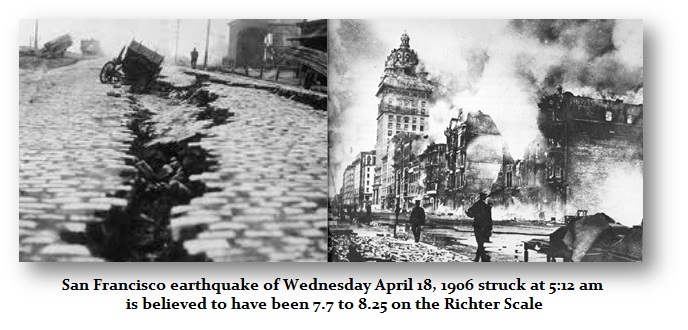
I ran correlations of all quakes since the 1906 San Francisco quakes that was ultimately responsible for creating the Federal Reserve and the 1923 quake in Japan was just absolutely devastating. Such an event today would be profound to the world economy.
ECM-Dynamic
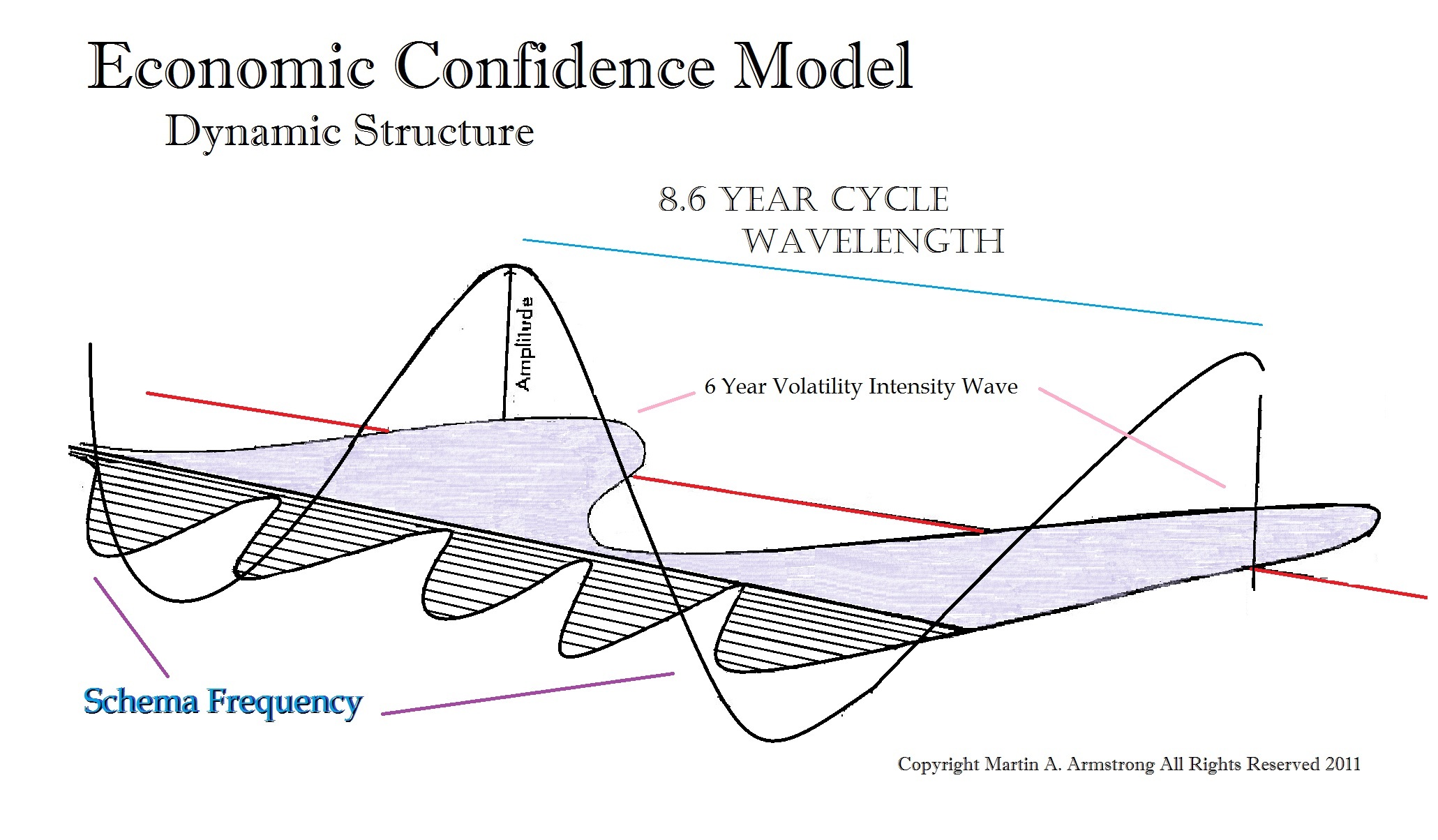
The entire problem center upon the lack of understanding is that everything is connected and this is the key to comprehending volatility in markets or major quakes in the landscape. It is the combination of force that makes one event more powerful than another. This field of research is just not comprehended in many fields.

How Capital Moves – Outward then Inward


USA Net Cap 1960-1990 Annotated

QUESTION: Hello Martin, In your ‘Why the Crash & Burn is Public not Private’ post of 18 March, you have an image showing World Capital Investment. Is that the sequence money usually follows at this time? And, what exactly is the ‘alignment’ you mention towards the end of the post as well as elsewhere? Best Regards and my condolences on the loss of your friend, Mr. Edelson.

BH

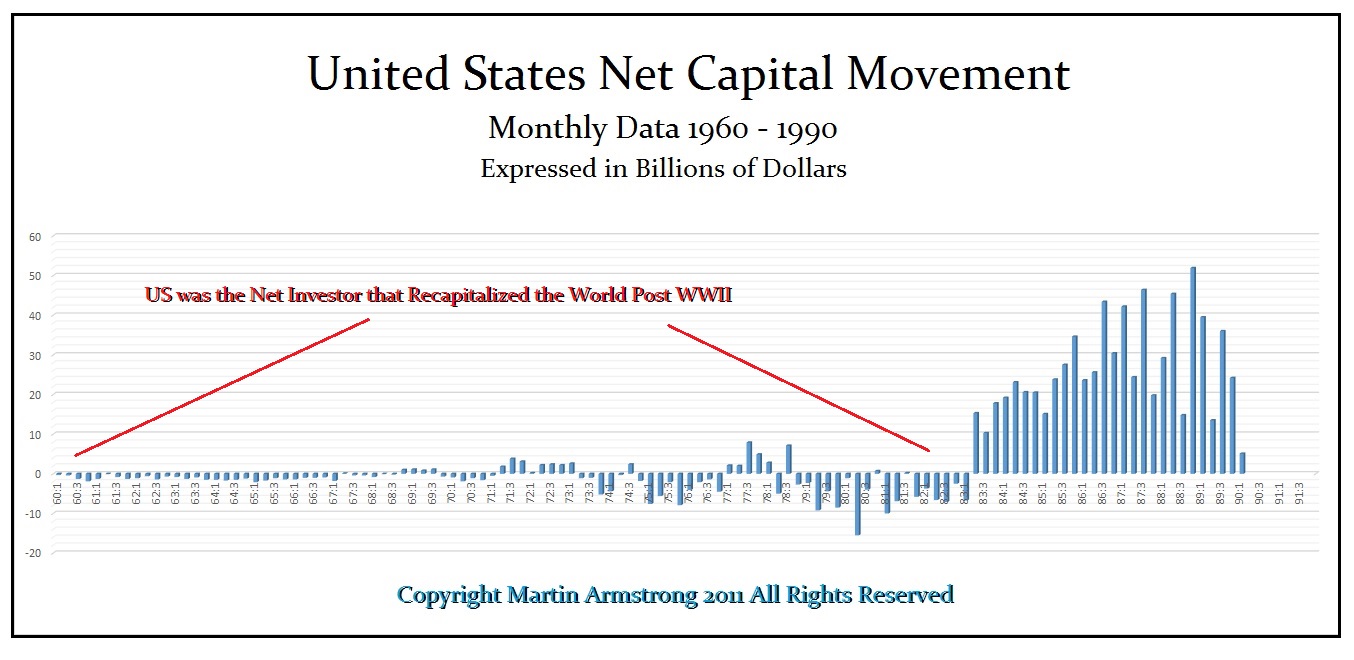
ANSWER: Historically, capital tends to flow first from the financial capital of the world to the outer provinces or state. This was how it functioned in the Roman times as was the case for postwar when US capital flowed outward to rebuild the rest of the world. Then what happens is as an empire begins to die (in this case Western Culture), the capital flow reverses and then moves back toward the core economy which is the financial capital of the world.

UBLST-25 MAHere is a chart of all the bonds listed on the New York Stock Exchange. When the Sovereign Debt Crisis hit in 1931, government simply defaulted. The bonds were then delisted never to come back again.

What transpires at that moment when government moves into a Crash & Burn, is that all tangible assets rise together, albeit at different rates of advance. This is what I call the Great Alignment. Therefore, we will see gold rise WITH the stock market – not counter-trend. Likewise, real estate survives provided you do not enter into a Dark Age when not even gold survives – only food.

German-1925-Rentenmark

If we look at the German Hyperinflation caused by the Communist Revolution in Germany in 1918 inviting the Communists of Russia to take Germany and the formation of the Weimar Republic, all of this political-economic chaos ended with a new currency being issued following the fall of the Weimar Republic. That currency was not backed by gold, but instead real estate.

Confidence in Real Estate Crashes in Australia


Australia-Behind Curtain

The rush of foreign capital that has caused real estate in major cities to soar coming out of China has hit Australia, Canada, and the USA. The laws against foreign ownership in Australia have been the harshest in the world. They have confiscated property owned by foreigners and are forcing it to be sold at losses. All of this craziness has resulted in public confidence in the housing market in Australia to collapse. The number of Australians describing property as the wisest place to put their savings has fallen to its lowest level in more than 40 years. This is the report of the Melbourne Institute of Applied Economic and Social Research which has been asking about the wisest place to store savings since it began its consumer confidence survey in 1974. With cutting off foreign investment, the “speculative boom” is being taken out of prices.

How OPEC Lost The War Against Shale, In One Chart


Tyler Durden's picture

At the start of March we showed a fascinating chart from Rystad Energy, demonstrating how dramatic the impact of technological efficiency on collapsing US shale production costs has been: in just the past 3 years, the wellhead breakeven price for key shale plays has collapsed from an average of $80 to the mid-$30s…

… resulting in drastically lower all-in breakevens for most US shale regions.

Today, in a note released by Goldman titled “OPEC: To cut or not to cut, that is the question”, the firm presents a chart which shows just as graphically how exactly OPEC lost the war against US shale: in one word: the cost curve has massively flattened and extended as a result of “shale productivity” driving oil breakeven in the US from $80 to $50-$55, in the process sweeping Saudi Arabia away from the post of global oil price setter to merely inventory manager.

This is how Goldman explains it:

Shale’s short time to market and ongoing productivity improvements have provided an efficient answer to the industry’s decade-long search for incremental hydrocarbon resources in technically challenging, high cost areas and has kicked off a competition amongst oil producing countries to offer attractive enough contracts and tax terms to attract incremental capital. This is instigating a structural deflationary change in the oil cost curve, as shown in Exhibit 2. This shift has driven low cost OPEC producers to respond by focusing on market share, ramping up production where possible, using their own domestic resources or incentivizing higher activity from the international oil companies through more attractive contract structures and tax regimes. In the rest of the world, projects and countries have to compete for capital, trying to drive costs down to become competitive through deflation, FX and potentially lower tax rates.

The implications of this curve shift are major, all of which are very adverse to the Saudis, who have been relegated from the post of long-term price setter to inventory manager, and thus the loss of leverage. Here are some further thoughts from Goldman:

  • OPEC role: from price setter to inventory manager In the New Oil Order, we believe OPEC’s role has structurally changed from long-term price setter to inventory manager. In the past, large-scale developments required seven years+ from FID to peak production, giving OPEC long-term control over oil prices. US shale oil currently offers large-scale development opportunities with 6-9 months to peak production. This short-cycle opportunity has structurally changed the cost dynamics, eliminating the need for high cost frontier developments and instigating a competition for capital amongst oil producing countries that is lowering and flattening the cost curve through improved contract terms and taxes.
  • OPEC’s November decision had unintended consequences: OPEC’s decision to cut production was rational and fit into the inventory management role. Inventory builds led to an extreme contango in the Brent forward curve, with 2-year fwd Brent trading at a US$5.5/bl (11%) premium to spot. As OPEC countries sell spot, but US E&Ps sell 30%+ of their production forward, this was giving the E&Ps a competitive advantage. Within one month of the OPEC announcement, the contango declined to US$1.1/bl (2%), achieving the cartel’s purpose. However, the unintended consequence was to underwrite shale activity through the credit market.
  • Stability and credit fuel overconfidence and strong activity: A period of stability (1% Brent Coefficient of Variation ytd vs. 6% 3-year average) has allowed E&Ps to hedge (35% of 2017 oil production vs. 21% in November) and access the credit market, with high yield reopen after a 10- month closure (largest issuance in 4Q16 since 3Q14). Successful cost repositioning and abundant funding are boosting a short-cycle revival, with c.85% of oil companies under our coverage increasing capex in 2017.

That said, the new equilibrium only works as long as credit is cheap and plentiful. If and when the Fed’s inevitable rate hikes tighten credit access for shale firms, prompting the need for higher margins and profits, the old status quo will revert. As a reminder, this is how over a year ago Citi explained the dynamic of cheap credit leading to deflation and lower prices:

Easy access to capital was the essential “fuel” of the shale revolution. But too much capital led to too much oil production, and prices crashed.  The shale sector is now being financially stress-tested, exposing shale’s dirty secret: many shale producers depend on capital market injections to fund ongoing activity because they have thus far greatly outspent cash flow.

This is the key ingredient of what Goldman calls the shift to a new “structural deflationary change in the oil cost curve” as shown in chart above. As such, there is the danger that tighter conditions will finally remove the structural pressure for lower prices. However, judging by recent rhetoric by FOMC members, this is hardly an imminent issue, which means Saudi Arabia has only bad options: either cut production, prompting higher prices and even greater shale incursion and market share loss for the Kingdom, or restore the old status quo, sending prices far lower, and in the process collapsing Saudi government revenues potentially unleashing another budget c

Liquidity Suddenly Collapses As Stocks Tumble


Tyler Durden's picture

This is the biggest drop for Bank stocks since Brexit, as investor concerns over Trump’s reform agenda grow…


And, as Nanex points out, S&P 500 futures liquidity is collapsing today.


Why? Because whereas the BTFDers have been willing to jump in and, well, BTFD, on days where there is a sharp move lower, both the HFTs and the carbon-based traders step aside and pull their bids, unsure if this is “the start” of the selloff.  Maybe this time they are right, as the bank bloodbath continues:

Why The 2017 French Election Could Trigger A Major Market Drop


Tyler Durden's picture

In 1981, the French stock market dipped in fears over François Mitterrand’s presidency win and the same could happen again, says Saxo Bank’s head of macro analysis Christopher Dembik.


In the 30 days following the first round in the 1981 election, the French stock market dropped by over 20% as a result of concerns about the economic policies of Mitterrand, who eventually became president from 1981 to 1995.

Dembik says that if Marie Le Pen – who has an anti-Eurozone stance – wins, the same steep dive could happen to the CAC 40 by 20% after the election. The first round of voting is on April 23 and the second round is on May 7.

Bank Bloodbath Batters Stocks; Bonds, Bullion Bounce As Trumpcare Vote Doubts Rise


Tyler Durden's picture

Does this look like policy ‘success’ or ‘failure‘?


VIX is jumping as stocks sink…


And Bank stocks are collapsing…


With the Financials ETF breaking below a key technical level…Bank stocks have now gone nowhere since Dec 8th.


Lots of chatter about selling due to doubts on TrumpCare passing on Thursday – which will delay the tax reform foundation that the market is settled on (and any banking system reform).

The Exchange Stabilization Fund – What Is It?


US Treasury Bldg

Apparently, some people have discovered the Exchange Stabilization Fund and are now touting this as some major power in manipulating the world economy. This is simply an emergency reserve fund of the US Treasury Department, which is typically used for foreign exchange intervention. This arrangement really goes back to the birth of the G5 and is the alternative to having the central bank intervene directly in foreign exchange. This is a Treasury function, which allows the US government to try to influence currency exchange rates without affecting domestic money supply created by the Federal Reserve.

Unlike those who are trying to sell newletters touting this as the new great manipulator, it holds less than $125 billion in funds which includes special drawing rights (SDR) from the International Monetary Fund. Trust me, there is no such great power that can manipulate the world economy. They have done their best to try to prevent the dollar from rising. They will fail as they did in 1987 and every other attempt to peg currencies. They are INCAPABLE of altering the capital flows.

Are Cycles Universal or Regional?


PopulationOfRome

QUESTION:  I have a question regarding cycles. You provide some very detailed, historic references showing why certain events are occurring now (again). Is there a disposition for something that occurred in the past to be destined re-occur for a particular region/country (i.e. Greeks abandoning property due to excessive taxation) because it happened once and now the propensity to repeat that causal action again is “in their DNA”. Is that something we as Americans do not yet possess because we have not been around long enough to experience a “fall of Rome” type event?

SM

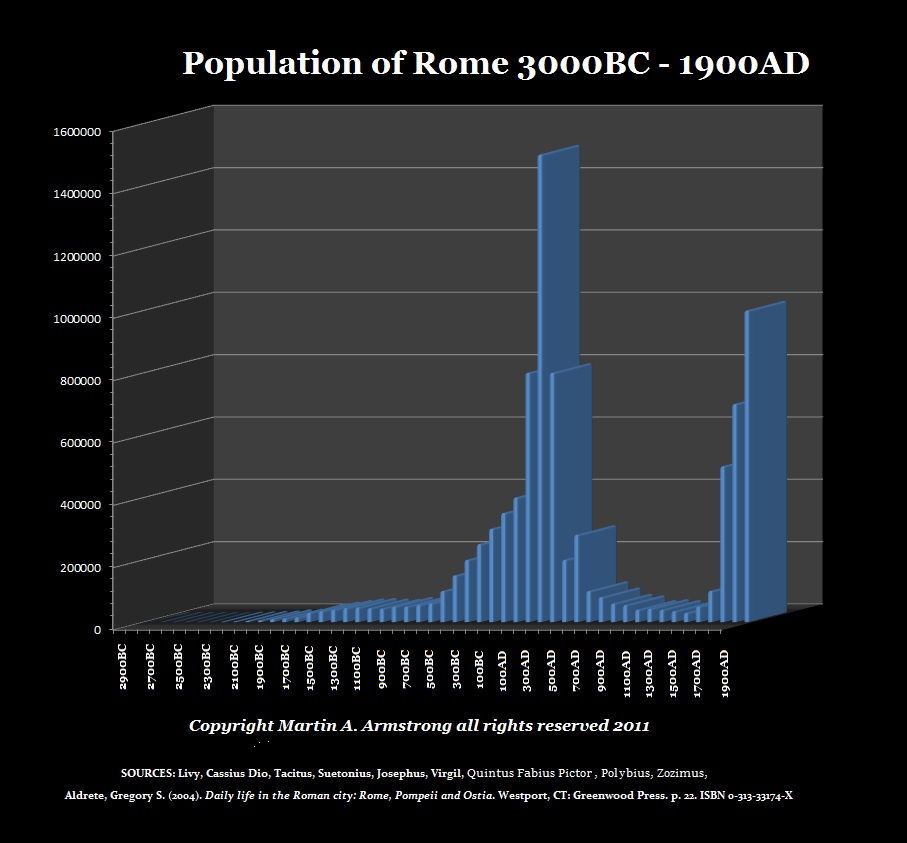
ANSWER: Cycles are based upon two element – (1) nature and (2) human nature. Some regions will be prone to natural disasters while others are not. Ironically, many of the best ports where cities grew such as Tokyo and San Francisco just as examples, were great harbors because of earthquakes. The landscape in California is strikingly beautiful compared ot the flat plain in Oklahoma, again because of earthquakes. The rocks that appear in Central Park in New York City are there because an earthquake fault runs through New York City making the harbor what it was. Hence, there are cycles that impact only on a regional basis due to nature.

With regard to Greeks walking away from inheritance because they cannot pay the tax, this is inherent to all societies when government goes too far. They imposed harsh laws in Vancouver against foreign real estate buyers and the market crashed. Because it was a local law, they moved to Victoria and Toronto. In Australia, they are seizing properties own by foreigners and selling them off. All of these types of interventions are reactions to events set in motion externally.

realestate

That said, this is the US cycle for real estate as a national whole. I just bought a house in Florida at about 50% of its 2007 high value. Trophy spots for the high end where people are just parking money we warned would make new highs going into 2015.75 – but that is not the bulk of the market. Why is the US market (minus trophies) down hard when that is not the case in other countries? The difference is the regional issue. In the USA, many people have 30 year mortgages. In Canada, the best you can get is a 10-year fixed mortgage. In Germany, you can get up to a 15-year fixed mortgage.

We must understand that property values are LEVERAGED, so if the money for fixed rate loans dries up because of interest rate hikes and political uncertainty, then real estate prices MUST fall. This is all because of the leverage that was deliberately injected into the real estate market during the Great Depression for property fell  in value so far, only cash buyers could buy anything. Farm land fell in value to below what it was sold for by the government more than 80 years before.

Real estate is different from stocks and gold. Yes it is a place to park money. However, be careful because without mortgages available, it falls further than other tangible assets because it has been LEVERAGED! Moreover, it is a fixed asset meaning you cannot leave with it. Therefore, people are forced to simply walk away when (1) the tax burden is too high and (2) there is war and the region is being invaded.

Deutsche Bank: “The Probability Of A Negative Shock Is High”


Tyler Durden's picture

For the second week in a row, Deutsche Bank’s strategist Parag Thatte has a somewhat conflicted message for the bank’s clients: on one hand, he writes that positive economic surprises continue “but are getting less so”, and although the divergence between har data surprises and sentiment is diminishing the bank is somewhat confident that a “pullback in the very near term is unlikely” (here DB disagrees with Goldman Sachs). However, Thatte is increasingly hedging, and notes that because a “rally without a 3-5% sell-off that is typical every 2-3 months is now running over 4 months and is in the top 10% of such rallies by duration”, he cautions that “the probability of seeing a negative shock is high” especially since Q1 buyback blackout period has begun.

Here are the key observations from the Deutsche Bank strategist:

  • The equity market rally has been going uninterrupted for a long time, driven by the unusual resurgence of positive data surprises. Strong data surprises drove equity inflows and fund positioning, adding to the steady support from buybacks. An expectation that positive data surprises were likely to persist underpinned DB’s call 2 weeks ago that a pullback was unlikely in the very near term. The bank takes stock of the current situation below:
  • Duration of rally now in top 10%. The rally without a 3-5% sell-off that is typical every 2-3 months is now running over 4 months and is in the top 10% of such rallies by duration.

  • Data surprises positive but getting less so. While incoming data in the last week has continued to surprise to the upside relative to consensus, it has done so at a more modest rate and DB’s data surprises index, the MAPI, is now declining off its highs.

  • Divergence between sentiment and hard data surprises diminishing. Attention has focused on the divergence between sentiment data which has run up strongly and hard data which has so far lagged. In terms of surprises, i.e., relative to what’s priced into consensus forecasts, hard data surprises have fallen back to neutral over the last two weeks, while sentiment surprises have declined this week but remain elevated. The surge in sentiment data is getting built into consensus forecasts and sentiment surprises also moving down to neutral over the next 3-4 weeks.

  • Fund positioning already trimmed in line with neutral hard data surprises. US funds have already been trimming equity exposure for the last three weeks in line with the decline in hard data surprises suggesting funds may already be anticipating a modest slowdown in overall data. Real money equity mutual funds are already close to neutral but asset allocation funds and long-short equity hedge funds are still overweight. Macro hedge funds are exposed to short rates positions in our view, not long equities.

  • Inflows accelerate. The pace of US equity fund inflows has accelerated over the last 4 weeks ($36bn). However flows have been closely tied to overall data surprises and could start to moderate in turn.

  • Buyback blackout period has begun. Heading into the Q1 earnings season, the pace of buybacks will slow as an increasing number of companies enter earnings blackout periods starting this week.

* * *

DB’s summary take on near-term equity moves:

Continued muddle through most likely in the near term. The fundamental drivers as well as demand-supply considerations for equities point to a continued muddle through in the near term. However history suggests that with the duration of the rally already in the top 10% by duration, the probability of seeing a negative shock is high. But the medium term outlook remains robust with the unfolding growth rebound having plenty of legs while from a demand-supply point of view flow under-allocations to US equities and robust buybacks remain very supportive.

* * *

Away from equities, the picture in rates, commodities and currencies based on trader flows is as follows:

  • Oil falls but still expensive and long positioning still elevated. Following the November OPEC supply-cut announcement oil prices became very expensive on our medium term valuation framework for oil and commodities based on the trade-weighted dollar and global growth (Trading The Commodity Underperformance Cycle, Apr 2013). The decline in oil prices over the last two weeks has trimmed the extent of overvaluation but leaves oil prices slightly above the upper-end of the historical 30% overvaluation band which has marked extremes (currently $48). Net long positions are off of recent record highs but remain quite elevated.
  • Extreme short positions remain an overhang for rates moving up. Bond yields fell sharply after the rate hike this week much like they did after the December one. While real money bond funds remained close to neutral going into the FOMC this week, leveraged funds shorts in bond futures remained near extreme highs. Outside of HY funds which saw a large outflow as oil prices fell this week, bond funds have continued to receive robust inflows. Indeed duration sensitive funds have this year completely recouped all of the outflows seen in the aftermath of the elections.
  • Gold valuations stretched again. Gold prices have rallied on the back of a return of inflows into gold funds this year reversing the modest outflows in Q4. Massive cumulative inflows since early 2016 ($40bn) remain an overhang. Gold longs had been declining heading into the FOMC meeting. Gold prices have again disconnected sharply to the upside from the historical drivers of the dollar and the 10y yield as well as global growth. Copper long positions continued to slide for a 6th straight week.

  • Shorts in the Mexican peso, the best performing currency this year, have collapsed to neutral. Mexican peso shorts fell sharply last week to the lowest levels in over 15 months as gross shorts fell sharply while longs also rose. Aggregate long dollar positions had been rising going into the FOMC meeting reflecting rising shorts in the yen and sterling even as euro shorts were pared.