Mutual Funds versus ETF’S


People are waking-up to the fact that they can substitute the expensive Asset Manager fees by doing it themselves. There are many ways but here we distinguish between Mutual Funds (MT) and ETF’s (Exchange Traded Funds). When buying into a MF it is via a company such as Blackrock, Vanguard, State Street etc. and they either execute the trade themselves or via a brokerage company. You are then part of a pool of money that tracks the underlying performance of the asset class. You are priced at the net asset value of the fund at the close of business that day. There is a bid/offer spread to the fund and typically a holding period with penalty for early redemption. ETF’s on the other hand are similar to a single name stock/Index/Municipal Bond etc. are traded directly on the exchange but bears no holding period. ETF’s attempt to track the net asset value of the underlying and are typically following an index; such at the S+P. One key difference is the cost – ETF’s are usually a lot cheaper to trade but on the other hand can be considerably riskier.

The growth of this type of self-investing has been huge. At the end of 2016 it is estimated the global ETF market was around $2,775bn (ICI data) with over 1,700 ETF listed. There are also rumoured to be around 79,000 Mutual Funds in the world, with just 7,900 in the Sates. However, much of the market size is dominated with in the US accounting for over 60% of the entire market value.

Growth rate into MF and ETF’s has only just stalled (in the US) but that could be because the US has such a dominant role and if considering the level of the overall stock market. Assets roughly stand around $16trn having been rising by over 12% pa since 1965 (according to Investment Company Institute). Although we are seeing a levelling-off in the US market we continue to see growth for less developed market and especially in Asia. The growth in India, for example, it is reported that Asset Management Companies grew AUM by 30% (reported by Value Research) over the past 18 months.

There could be several factors influencing recent trends. The mainstream players are facing a contracting market. This could be due to the absolute level (contract highs) and competition on fees. Clients are also becoming more financially aware, millennials are more socially astute with technology playing a huge role but also local emerging market players have started to reclaim their markets. This could be one of the reasons why GIC (Singapore sovereign wealth fund) is offering 2.4% stake in UBS; because of the increased competition from local funds in their own domestic market. UBS currently plays a dominant role within Asia for wealth management so it should not be a surprise that local companies are making a play to regain lost territory.
Stock Market Crash?


The correction has begun with the uneasiness of the two political scandals surrounding Trump – Russian meeting and now a Comey memo saying Trump asked him to kill the investigation into Flyn. The first is not really an issue legally, but the second could fuel the quest to impeach Trump which is really led by McCain and Graham behind the curtain in league with Schumer. McCain is already calling this a Watergate demonstrating he is out to get rid of Trump and protect the establishment.

The impeachment of Trump is being talked about behind the curtain as a positive move for then Pence would take up the Presidency and then the tax reforms would become possible. That is an interesting twist on things.

We are showing choppiness for three months and big volatility its in August. The likelihood of getting any tax reform now before the August Congress holiday is fading very fast. This is taking the icing off of the Trump rally. Forget the infrastructure expenditures for that is matching funds and states will just raise taxes for that one which is detrimental not bullish other than from the companies who will overcharge government fix stuff.

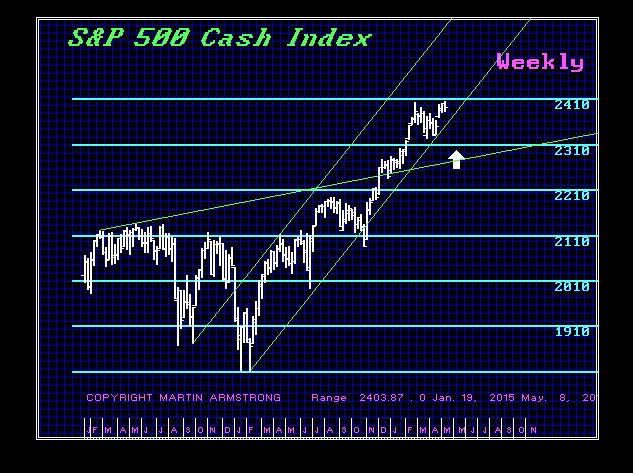
The Daily Bearish Reversals in the Cash S&P500 lie at 237900 and 234450. A Weekly closing below 233500 will tend to warn a serious correction becomes possible.

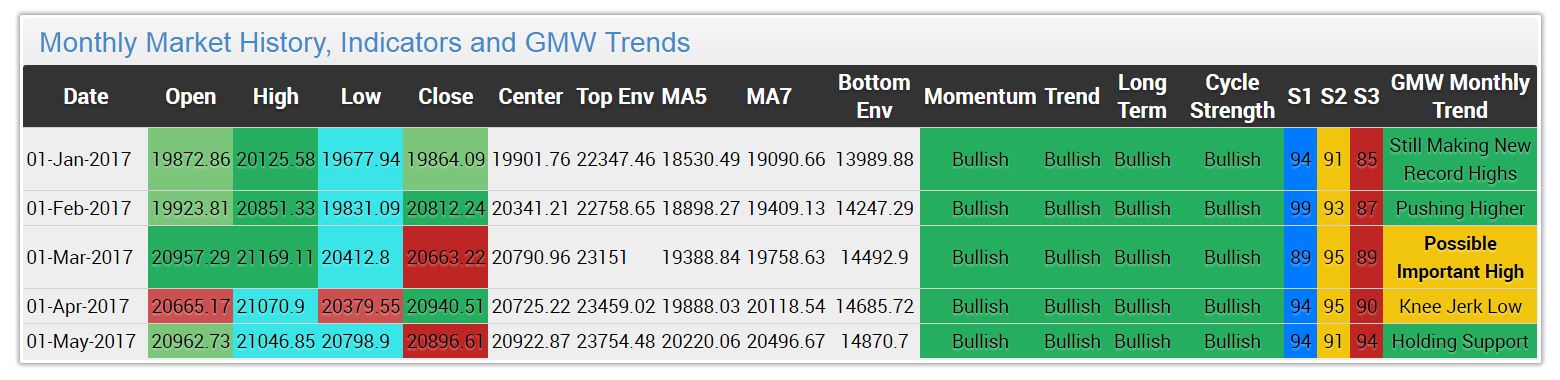
The fact that the Dow has been unable to make new highs and the Global Market Watched on the monthly level labeled April when it closed for the month as IMPORTANT HIGH. Our Capital Flow Models models are showing that there has been some European selling of equities, which is the reason the Dow has not followed the S&P500 or the NASDAQ. There has been a flight to quality moving into the US Treasuries, but also the hot money has been selling the dollar after the French election. Here we still see a Weekly closing below 20000 will confirm a more serious correction. The Daily number remains at 20204.

The NASDAQ shows a daily closing below 610750 will signal that a temporary correction is possible.A Weekly closing below 580500 will confirm a serious correction is possible.

The Global Market Watch classified the April high in the Dow as a Possible Important High. That should not be ignored. If May closes lower than April at month-end on these three indexes, that will confirm the correction. We do see the possibility for the correction to extend into 2018 from which a slingshot to the upside remains probably.

US Share Market – Still Up or Correction?


QUESTION: Marty you warned previously that an April high would have the potential to create an important temporary high with a decline into 2018 and then a slingshot up. Is that still a possibility?

ANSWER: Yes. We have the S&P500 and the NASDAQ Composite making new highs but NOT the Dow. This raises some concern that a correction is still possible. The Dow needs to make new highs above April intraday and on a monthly closing basis. This is a tall order right now. This will warn we are consolidating sideways and preparing for the breakout. The support on the Dow remains at 20,000 on a Weekly Closing basis. The majority has to be wrong for they are the fuel that drives the market. We have had nothing but bearishness in the bull market which has exceeded the 2007 high by nearly 50% yet throughout the rally everyone is bearish. This has been the fuel that made it rally. You even have people touting short the S&P500 and buy Emerging Markets. That has to be a suicide mission. Then you have people touting Europe is a wonderland and the Euro will be fine because Macron won. Of course these are Americans who obviously do not have clients in Europe nor do they visit often. Sure the Euro will rally for the key resistance is still in the 113-114 level.

We will be releasing a special report after the HK World Economic Conference just on the Dow, S&P500 and NASDAQ with timing. The broader market is rising and the Dow has flattened out. This is in part due to people assuming the Macron victory relieves the bearishness for Europe.

On the other hand, our risk is Trump. If Trump ever gets his act together and stops making stupid decisions that hand controversy to Democrats and ruthless pretend Republicans like Lindsey Graham, who backed the bill to allow the government to imprison people without a trial indefinitely for life and denied lawyers, then maybe we can get the tax cuts. Without the tax cut boom, we still have the chaos of Europe, and rising geopolitical tensions outside the USA. Those issues alone are capable of sending the dollar to the moon – but not yet. That’s still what we need to break the back of this monetary system and those cracks appear likely starting next year.

Lindsey Graham is a disgrace to our government and he is not qualified to dare criticize Trump for anything no matter how stupid Trump is. Graham is just an unconstitutional embarrassment. Graham and McCain are the biggest threats to our political-economy moving forward. They are protecting the establishment and are two people who I do not believe should be in Washington, and certainly do not trust them for a second. McCain would invade Canada to get even for his capture and betrayal of reading propaganda messages for the Vietnamese.

Is Germany Putting Pressure on Draghi? Absolutely!


QUESTION: Hi Martin,

It cannot be said enough: thank you for everything that you do.

While I would love the opportunity to sit down with you as I have a million questions concerning your excellent posts of today, let me focus in on The Coming Central Bank Crisis.

As the Fed begins to unwind its balance sheet this year, will that spur the Germans to demand Draghi stop with his program and unwind the ECB balance sheet in 2018, since the Fed will be successful?  Also, how can that occur if we are in a recession?  (Correct me if I’m wrong, but you are indeed calling for a recession by 2018?)

Thank You,
D

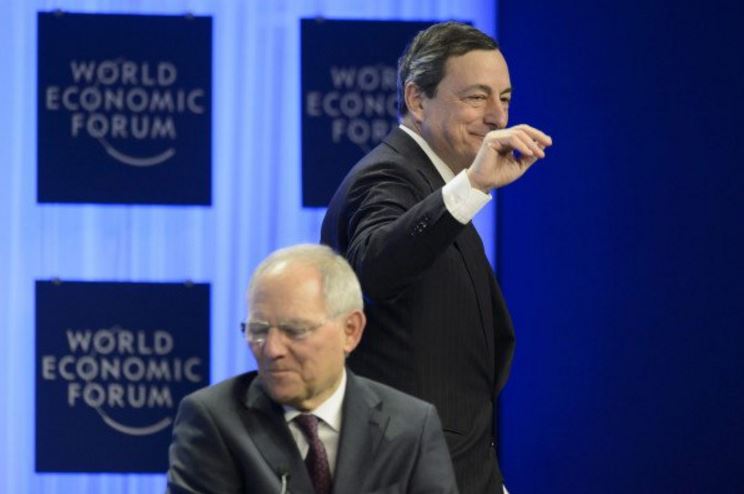
ANSWER: Wolfgang Schäuble has already been jawboning Draghi to reverse course. Draghi knows he has 40% of all Eurozone public debt. He has lost total control of the crisis and has become the crisis. He is frozen like a deer in headlights. Schäuble wants Draghi to leave, but he has a 10 year term. This will not end nicely. We may see the crisis be the reason the Euro turns back down after testing the overhead Reversals in the 113-114 zone.

We have been in a major economic declining trend ever since the 1950s. Yes there are bouts with booming economic periods, but the growth during such rallies is progressively making lower highs. Once upon a time, we had growth of 8-10%. Volcker raised interest rates to 14% to stop inflation. Today, we celebrate 2% growth. This is a worldwide consequence of socialism. Government have doubled in size since 1950 and people wonder why Trump, BREXIT or even Le Pen won nearly 35% of the vote compare to 5% 20 years ago in France.

So are we in a recession? Economists would say no unless there are two-consecutive quarterly declines in GDP growth. As a trade, you have to say we are on a very long protracted Bear Market in economic growth and the future, for us and our children, rests solely in the hands of this “populist” movement to replace socialism.