Posted originally on Feb 11, 2026 by Martin Armstrong |
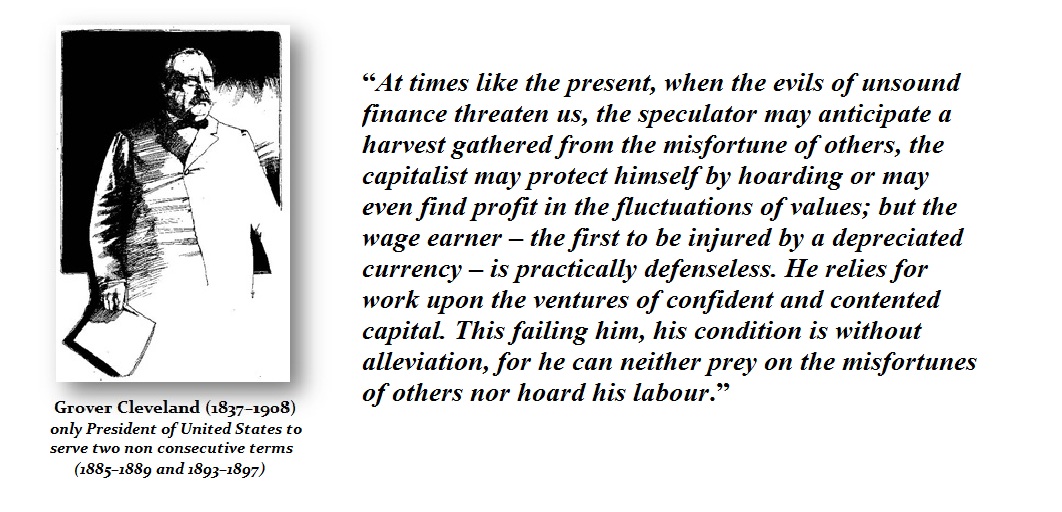
The reality one would think that most governments are acutely aware of the risk of capital and talent will flee when designing regulatory policies and targeting the rich and corporations for excessive taxation. The dynamic seems to be one of ignorance, or denial that their marxist goals are simply against human nature. The only politicians to have publicly admitted this was Democratic President Grover Cleveland who was chastising his own party for the unsound finance of the 1890s that led to the Panic of 1893. He understood that capital can flee to other jurisdictions, and what is left is a poorer state for the average worker cannot put their labor offshore.
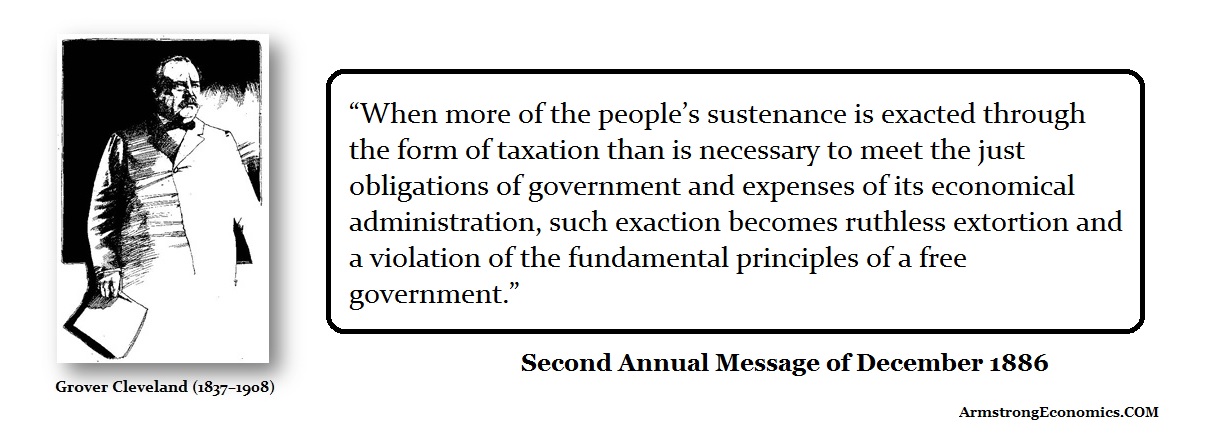
Cleveland also saw reality that when a state demand taxes more than what is necessary, it become “ruthless extortion.” Indeed, this undermines representative government and kills the very think of equal justice for all and the basic principles of a “free government.”
As they say, you can lead a horse to water, but you cannot make him drink. The same is sadly true about politicians. Gavin Newsom and the Democrats are completely destroying California all for their Marxist beliefs and sheer stupidity. Now Zuckerberg is moving to Florida. California’s total taxable wealth from billionaires has now plummeted to well under $1T from over $2T just a few weeks ago. No matter how many times you can show them what happens, they refuse to listen. We are watching the same stupidity taking over NYC. They are always in denial and want to believe in their Marxist dreams of Utopia. The refuse to comprehend that this is why China and Russia discovered the hard way that these philosophies do not work.
These were all people that were paying 13%+ in state income tax every year WITH NO COMPLAINTS UNTIL A FEW WEEKS AGO. Imposing a one-time 5% wealth tax would force then to liquidate assets for their wealth is not cash. Having to sell stock of that magnitude could even cause them to lose control of their companies. Here are just some major companies that have left California and where they went:
McKesson (Texas), Chevron (Texas), Oracle (Texas), Tesla (Texas), Playboy (Florida) In-N-Out Burger (Tennessee) John Paul Mitchell (Texas) Realtor.com (Texas)
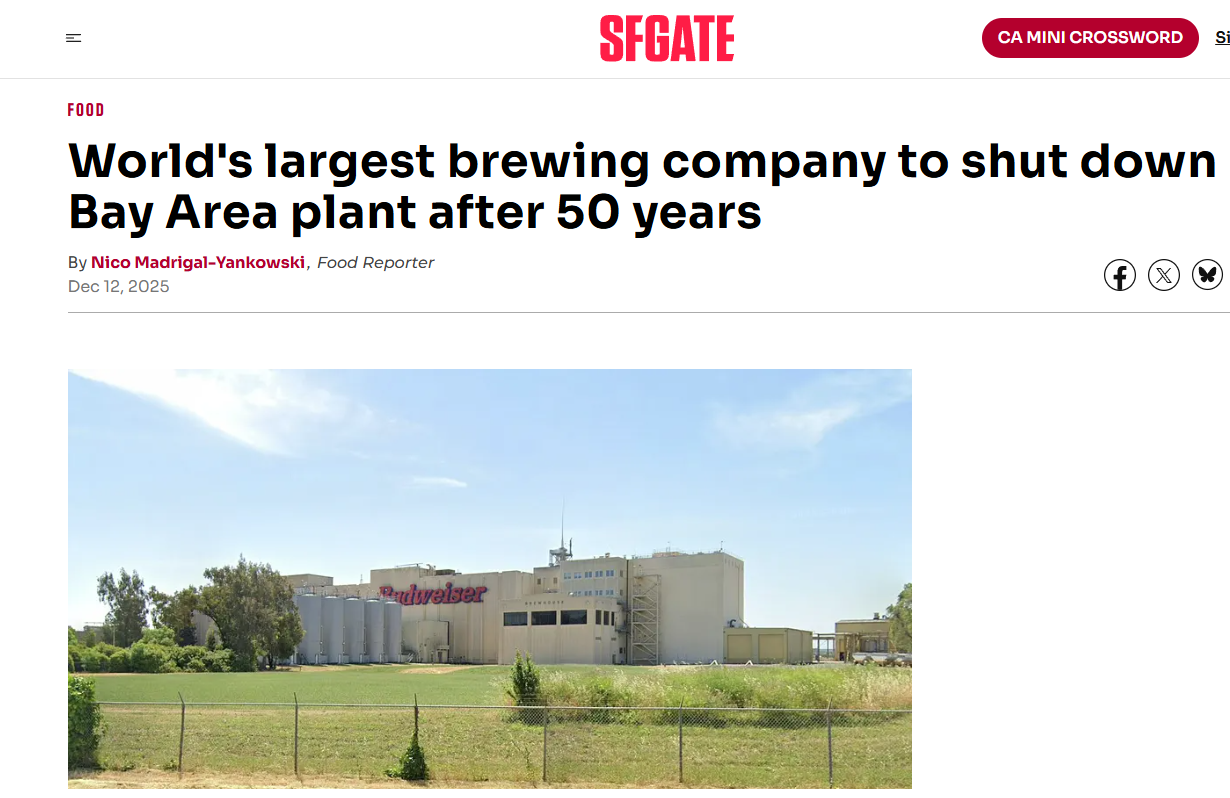
After 50 years, the Anheuser-Busch, the world’s largest brewery, is also closing its facility ending production in California. That will layoff nearly 240 employees.
California’s debt position has deteriorated from concerning to genuinely dangerous, representing one of the most significant sub-sovereign credit risks in the developed world. The state’s total debt obligations—when properly accounting for unfunded pension and healthcare liabilities—now exceed $1.5 trillion against a state economy of approximately $3.9 trillion. This debt-to-GDP ratio of nearly 40% would be alarming for a national government; for a state without monetary sovereignty, meaning it cannot print its way out of debt, it is approaching crisis territory.
The Official Debt Understates Reality
California’s official general obligation bond debt stands at roughly $80-85 billion, which appears manageable against the state’s $300+ billion annual budget. However, this figure is deliberately misleading, representing only the tip of a massive fiscal iceberg. Chasing out companies and now billionaires, it is becoming only a question when will the debt crisis hit not if.
You certainly do not want to own California debt. Face reality, and move on. And Gavin Newsom want to leave the country?
Posted originally on Feb 10, 2026 by Martin Armstrong |
Donald Trump recently stated that the Dow could reach 100,000 by the end of his presidency, and the usual crowd immediately rushed to either cheer or ridicule the statement without understanding why such a number is even possible. The problem with modern analysis is that it assumes markets rise because governments are doing something right. History shows the exact opposite. Markets rise to extreme nominal levels when confidence in government is collapsing worldwide, and the US has become the last safe haven for capital.
The United States remains the last functioning safe haven for global capital because every alternative is worse. Europe is imploding under regulation, war risk, and Marxist ideology. Asia is fragmented by capital controls and demographic collapse. Emerging markets remain structurally unstable. That leaves the United States by default.
Capital is fleeing government debt globally. Sovereign bonds are no longer risk-free assets; they are political instruments backed by insolvent balance sheets. As confidence erodes, capital migrates into private assets like equities, real estate, commodities, and anything that is not a government promise.
A rising Dow in this environment is not a celebration of prosperity. It is a warning signal. We have seen this repeatedly throughout history. Stock markets rise sharply during periods of monetary debasement and political instability because money is being repriced downward. The index rises because the currency falls, not because real wealth is expanding.
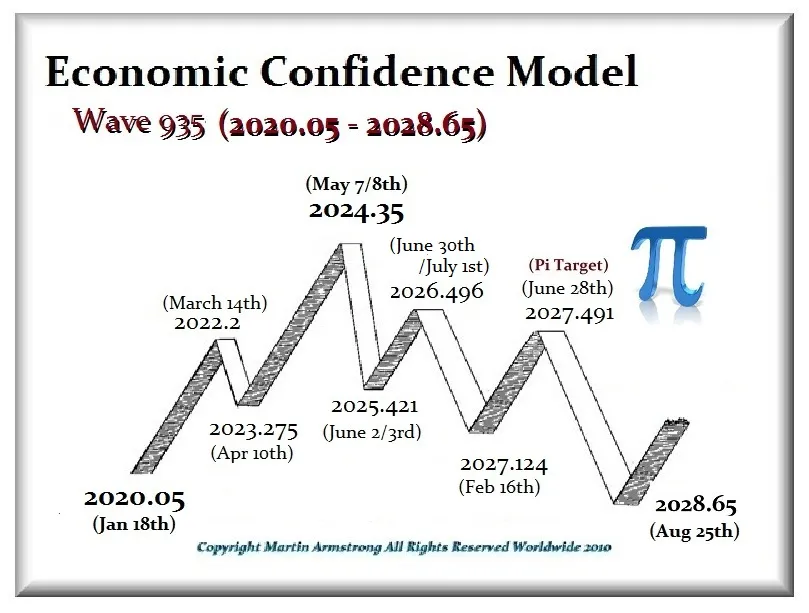
The Economic Confidence Model has never shown a clean boom cycle into the late 2020s. What it shows instead is rising volatility, sovereign stress, and geopolitical fracture. That does not stop markets from rising, but it changes why they rise. Capital concentrates, participation slims, and volatility expands. Governments respond with bad policies, such as taxes, controls, and regulations, which only accelerate capital flight.
Dow 100,000 in a collapsing confidence environment does not mean the average person is better off. It means money has nowhere else to go. The United States is the best of a bad bunch of nations ,slowly dropping off due to the sovereign debt crisis. We can look to the Dow as the true indicator of global capital on an institutional basis, whereas Nasdaq is more retail, and the S&P incorporates a bit of both.
Markets do not move in straight lines. Even if capital continues flowing into the U.S., there will be sharp corrections, political shocks, and policy mistakes along the way. So the real issue is not whether the Dow can mathematically reach 100,000. The question is what conditions would produce that outcome. Based on the computer, the culprit will be global confidence collapsing to the point where capital is forced into the last remaining open market.
Posted originally on Feb 6, 2026 by Martin Armstrong
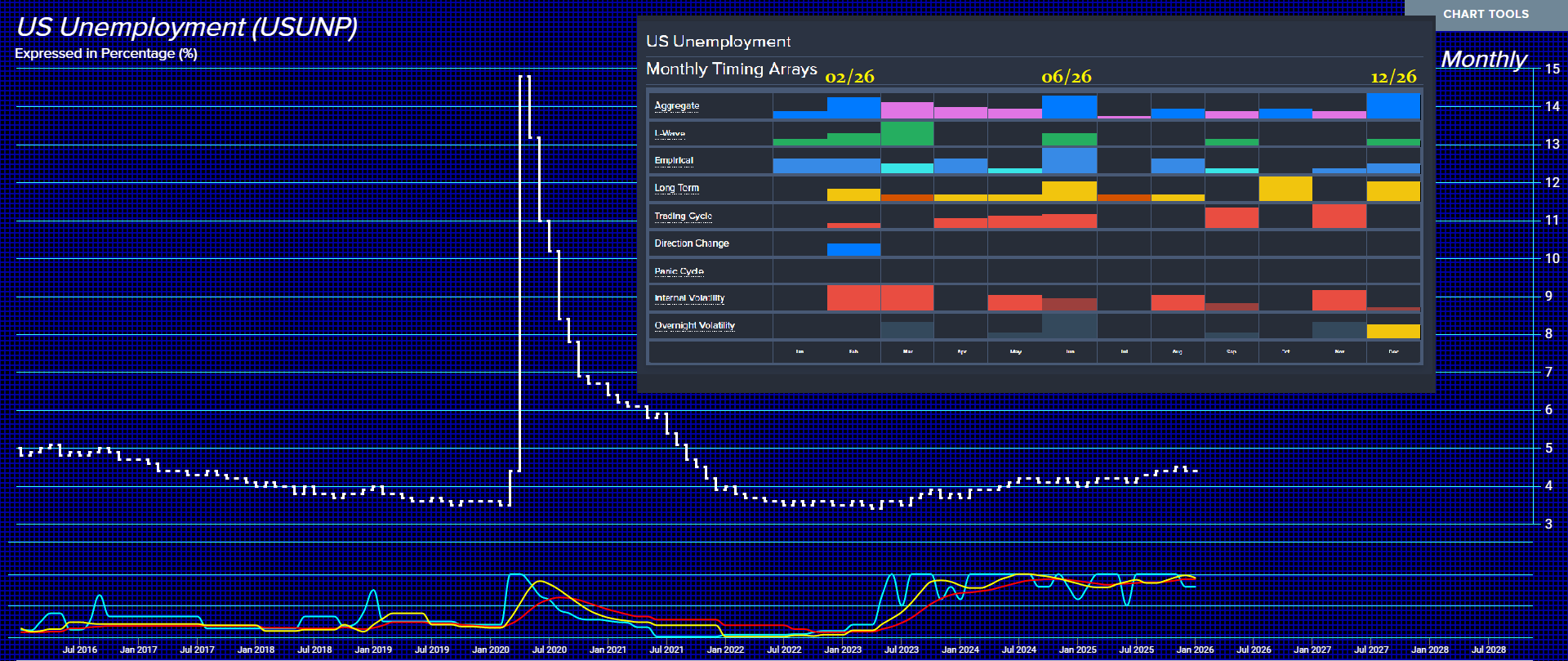
QUESTION: Marty, January posted the largest January job loss numbers since the Great Recession of 108,435, which was a 118% increase from a year earlier. This seems to be in line with Socrates’ going into February where it projected a rise in volatility there as well and a Directional Change. Plus, consumer confidence started declining during 2025. The decline has been ongoing for most of 2025, with January 2026 representing a particularly sharp drop that continued an existing downward trend. Your model forecast a recessionary trend into 2028 years in advance. Will society every look are your work and cycles?
GD
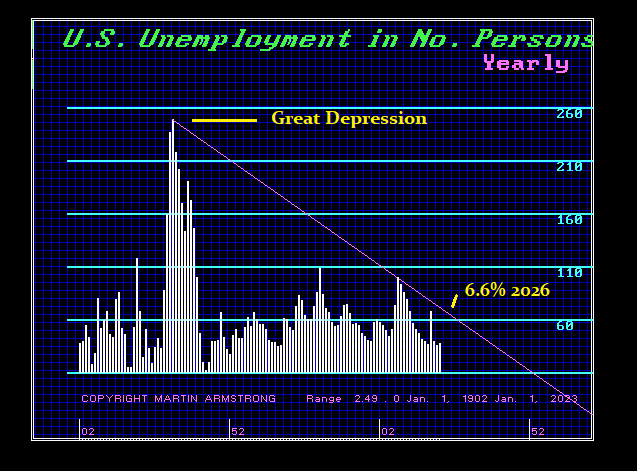
ANSWER: I don’t think the West will wake up until after 2032. Then, hopefully, they will review all the forecasts for there are so many and see that there is something to this. The critical resistance remains at 6.6% Exceed that on an annual closing, and you will see a very serious rise.
Amazon is showing weakness on both on the macro and business-cycle perspectives. The combination of weakening consumer demand, mainly in the lower- to mid-income tiers, and pricing pressures from shortages and to some extent from tariffs, are key factors to keep in mind. We are also in the middle of a Schumpeter Wave of Creative-Destruction into August 2028. This is confusing and will have impacts on the market to create false moves with high validity.
Posted originally on Jan 6, 2026 by Martin Armstrong |
The minimum wage increased significantly in 19 U.S. states on New Year’s Day. Minimum wages are often portrayed in the mainstream press as a straightforward way to raise incomes for the lowest-paid workers, but this portrayal ignores the underlying economic mechanisms.
When the cost of labor exceeds the value the labor actually produces, companies begin to reduce labor costs. This has led to a massive shift to automation and outsourcing. Employers are often forced to reduce their workforce, and those who remain face reduced hours or increased responsibilities without commensurate pay increases.
Wages rise with productivity in a healthy economy. Currently, employers’ costs are growing faster than the value added by workers in numerous instances. Yes, the federal minimum wage has been stuck at $7.25 per hour for nearly a decade, and nowhere in the US is that salary sustainable. Washington state now mandates roughly $17.13 per hour; California’s state minimum is nearly $17; New York’s major cities approach $17; and other states set their minimums above $15. The market or demand does not determine these set wages.
California routinely selects groups of minimum-wage workers and determines that their skill set is now worth 10 times as much. The state in general increased the minimum wage to $16.50 per hour on January 1, 2026, while certain cities have raised the minimum to $19 per hour. Yet, hotel and airline workers in Los Angeles are to receive a minimum wage of $38 per hour within the next two years. Hotels are already struggling, with only 79% of the traffic they once experienced prior to the pandemic. The city shed 11,000 hotel jobs last year, and this proposal nearly ensures more jobs will be cut. The state saw the same phenomenon when minimum wage was raised for fast food workers—employers reduced staff and raised prices for consumers.
Should a hotel maid earn more than a teacher in Los Angeles? Do the people constructing the hotel deserve less than those paid to book rooms? Does replacing towels and bed sheets, or checking a boarding pass, warrant an $80K salary? Pay grades are no longer based on skill and experience but on industry pandering. Yet another reason for companies to relocate when possible, as we saw throughout 2025 and will continue to see in 2026.
Rest assured that the government will continue to raise taxes on the lowest-paid workers. Wages rise naturally in a real economic expansion when businesses compete for workers. That is how a free market functions. But when governments artificially raise wages, businesses respond logically—by cutting jobs, reducing hours, or passing the costs onto consumers through inflation. The very people politicians claim to be helping end up worse off, as their cost of living rises and entry-level jobs disappear.
Posted originally on Dec 29, 2025 by Martin Armstrong |
The year 2025 was not defined by a single shock, but by a decisive break in confidence. Governments repositioned, as did central banks, but both have realized they are unable to stop the cycle in motion. The public no longer trusts those in charge of monetary or fiscal policy and confidence was the dominant theme of the year.
The drums of war loudly rang throughout the world. The Middle East saw intense conflict between Israel and Palestine. The West gained strategic partnerships with formerly ousted partners and created new enemies. Europe continued to build its defenses as it braces for World War III, promoted by its own neocons who have refused to accept peace. Nations drifted deeper into debt as they prepared for the inevitable, propelling the sovereign debt crisis. Russia acknowledged that it is at war with NATO and has increased its nuclear power. There were over 110 ongoing wars across the globe in 2025, and tensions are intensifying.
Economic warfare persisted. April’s tariffs and market correction sent shockwaves through the economy. Nations were forced to rethink trade and restrategize all imports/exports. War tensions rose in the East as all eyes are on Taiwan. China and the US remain at odds and are fighting for the title of “financial capital of the world.” China’s growing middle class and technological advancements rapidly accelerated.
Donald Trump taking office marked a global shift away from the globalist agenda–for now. Trump steered the US in a 180-degree direction from Joe Biden’s policies on energy, immigration, trade, and most importantly, war. I warned that Donald Trump’s election could delay the inevitable but not prevent it. As expected, the opposition has opposed the president every step of the way, which led to the longest government shutdown in US history. Confidence cracked once more when it was revealed that Joe Biden did not assume authorshipof his presidency, leaving the public to wonder who was in charge of leading the world’s top economy for the past four years.
The push toward the Build Back Better agenda collapsed after Trump, and we witnessed countless nations vote for candidates with nationalistideologies. Klaus Schwab’s exit from the World Economic Forum was unexpected and marked a change in vision from the bureaucratic elites who can no longer rely on the lies of climate change to control the masses. The new leadership of the WEF signaled a new direction for the globalists. They have not relented on their mission but altered it to adjust to the changing tides.
The dawn of the AIage has led to a new rise of institutions and reframed the future. Semiconductor chips are of utmost priority, as well as rare earth minerals, both of which are in tight supply. Automationhas begun to replace workers. Jobsare in tight supply as businesses no longer trust in tomorrow and will not expand even if there is an opportunity to borrow at lower rates.
The most widely read content reflected that reality. When Vietnam erased and froze 86 million bank accounts tied to digital ID compliance, the response was immediate and global. Readers understood this was not about Vietnam, but about the future of money itself. That concern deepened as similar systems expanded elsewhere. Thailand’s biometric control model illustrated how surveillance, banking, and identity are converging into a single permission-based framework. Digital IDs and CBDC are not only valid concerns but concrete plans. Governmentsare increasing surveillance, tightening their grip on the masses who no longer trust them. Capital has poured into equities and tangibles as a hedge against governments.
The most engaged blog posts of 2025 shared a common thread: capital controls, digital identity, surveillance, war risk, sovereign debt, and the loss of credibility in government data. It is clear that the public has lost all hope in a reliable government. Trust has been lost, and people are seeking ways to protect themselves from increasingly authoritarian regimes.
2025 was the confirmation year. As we move into 2026, volatility will not come as a surprise. The Economic Confidence Model points to a heightened risk of financial stress, political instability, and sudden shifts in capital flows as confidence in institutions continues to erode. This is the phase in the cycle when governments are forced to react, often resorting to control measures as volatility rises. Although 2026 will be far from a calm year, the computer will continue to guide the way and provide a bit of predictability amid an unstable world.
Posted originally on Dec 26, 2025 by Martin Armstrong |
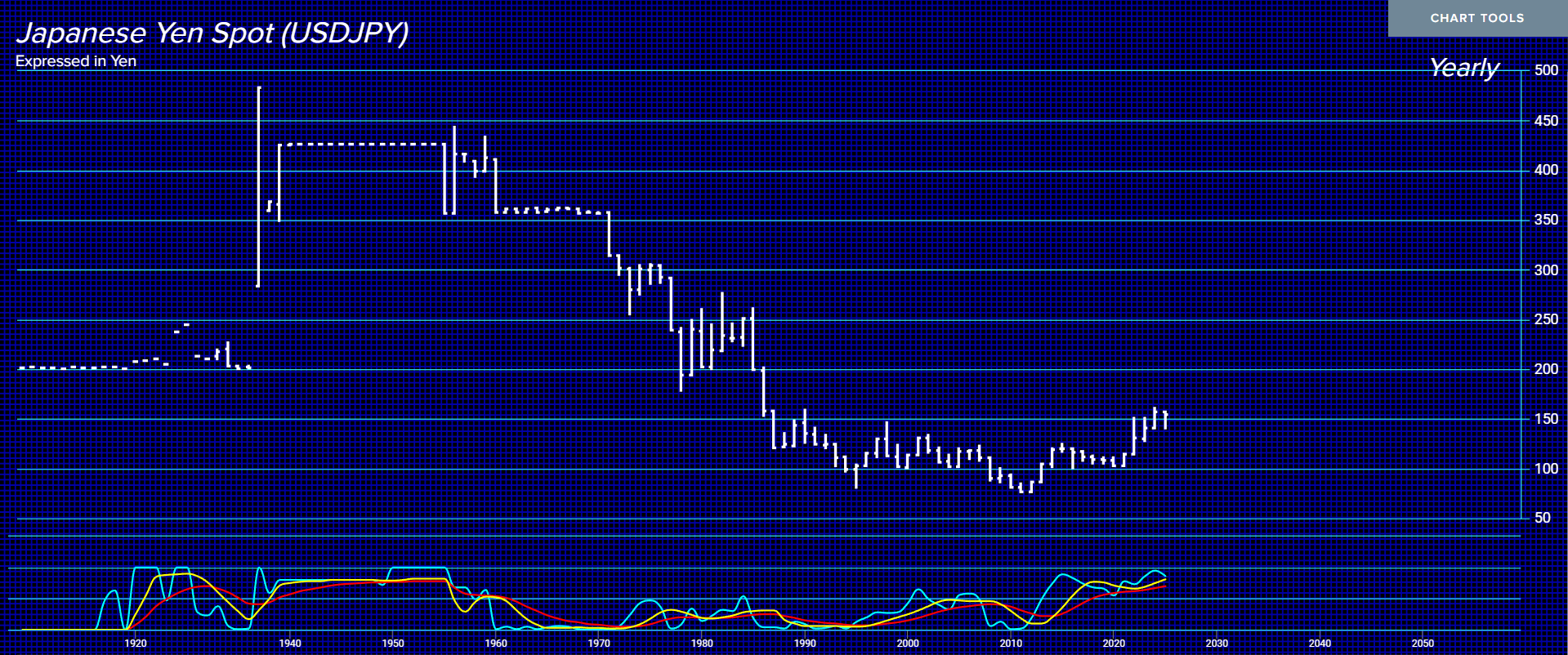
QUESTION: Mr. Armstrong, I understand the previous Japanese government did to you with the letter asking to confirm $10 billion when it was $1 billion and they never explained how they could make such a mistake. Here in Japan, we are still struggling as you had warned would be the case with the collapse of the bubble economy 36 years ago. The recently elected Japanese Prime Minister Sanae Takaichi has proposed an ambitious 21 trillion yen ($135 billion) spending program that puts new stresses on already heavily overdrawn government coffers. Would you ever consider coming to Japan to advise the new government?
TK
ANSWER: Thank you for the offer, but I do not believe that the new government would want to hear anything I had to say. The plan fulfills Takaichi’s campaign promise to bring yet another “proactive fiscal policy” that she thinks would bring Japan out of its long economic decline since the collapse of the bubble economy back in 1989. She is tackling a new approach to spend with the intention to help people cope with higher prices through various subsidies rather than taking more painful steps to control inflation itself, which has failed. When inflation is caused globally that began with the lockdowns of COVID instigating shortages, no single country can defeat inflation that is not caused domestically alone.
Next year will be critical for Japan. This will be our long-term target object – 43 years from the 1989 peak. Japan is the textbook case of how aggressively targeting inflation can fail when CONFIDENCE, demographics, and debt dynamics overwhelm monetary tools. Those who create these theoretical economic solutions assume they can manipulate people and never grasp that the core issue remains CONFIDENCE. People must believe that there is a future. Until the government understands that, it will fail continually. This is why some academics hate my guts because the reality is that their schemes to manipulate society fail and they prefer to blame others for their failed theories.
In 2013, under Abenomics, the Bank of Japan (BoJ) formally adopted a 2% inflation target. Inflation never reached that level because there was no CONFIDENCE in the future. People hoarded their cash and did not spend. Households and firms did not believe inflation would last.
Massive QE beginning in the early 2000s, expanded after 2013. The BoJ balance sheet grew to over 130% of GDP (largest in the world). Money did not circulate. Banks parked liquidity back at the BoJ or bought JGBs. Corporations hoarded cash instead of investing except for US Treasuries and the hoard resulted in the collapse of the Velocity of money.
You can print money, but you cannot force CONFIDENCE or risk-taking when the people are uncertain about the future. People MUST have CONFIDENCE in the future. Failing that, they will hoard money and refuse to invest. This is well established even with all the hoards of Roman coins from the 3rd Century AD. This is why there are many Roman coins that have survived because people burred their cash during the 3rd century when the CONFIDENCE in Rome surviving collapsed especially after Emperor Valerian Iwas captured in battle by the Persians exposing the weakness of Rome.
From 2016 onward, the BoJ capped the 10-year JGB yield near zero. Bond market liquidity evaporated. Investors exited the market entirely. Because of the rising debt, stimulus spending was offset by future tax fears. The people did not trust the FUTURE!
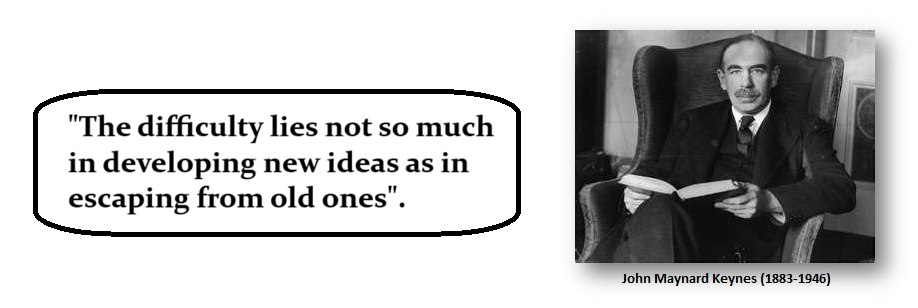
Japan is a mess. The academics have been totally wrong and Japan is on the edge of default. I do not think I can solve the problems of Japan with just one meeting. This is a very complex crisis compounded by so many mistakes it will take a serious reset. I do not believe that it can be turned until they come to realize that their theories are just wrong and that typically necessitates the crash. The academics rejected Keynes until after the Great Depression when all their previous theories failed. Unfortunately, the same will be true with the ECM. They will cling to Keynesianism until it all comes crashing down.
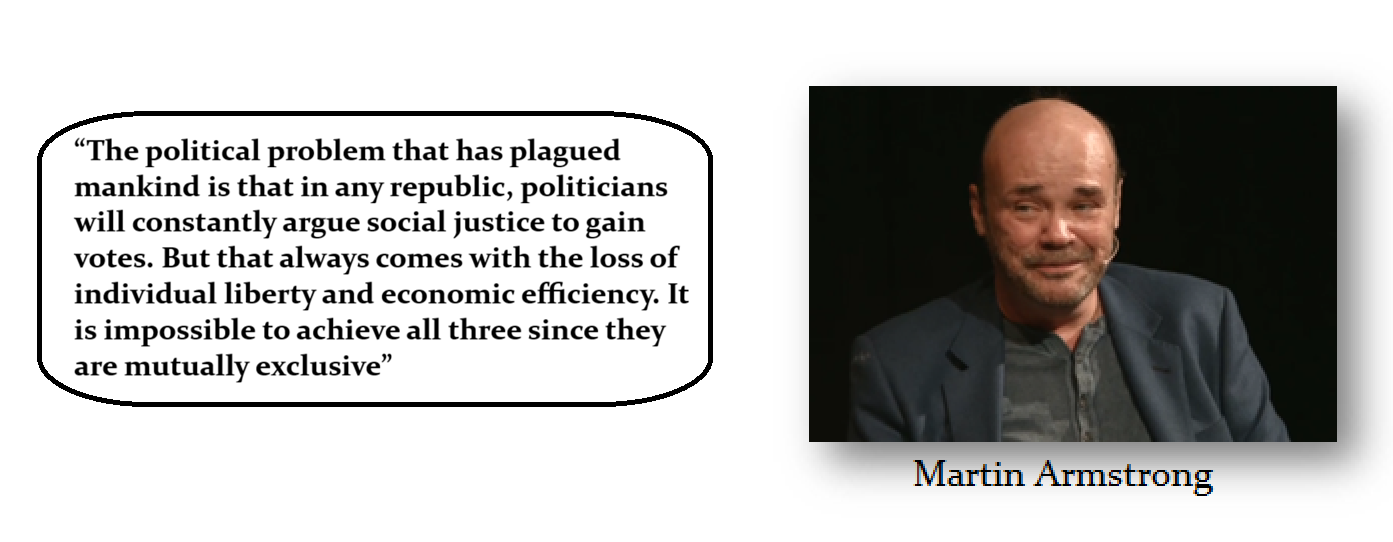
What politicians and academic economists refuse to look at, is that it is impossible to create social justice without the loss of individual liberty and economic efficiency. Just look at communism and the slow decay of Europe as the EU tries to create social justice at the expense of everything else. They confound civil rights and equality with material equality and that has failed every single time.
Posted originally on Dec 23, 2025 by Martin Armstrong |
While all we have heard from the biased goldbugs who insist that the US will go broke and the dollar will crumble to dust, that is the oldest theory from the 1970s that has NEVER been correct for it is rooted in the 17th century idea of money must be backed by a commodity. That has been behind so many analytical theories that are just without any credibility. That is repeated continually with no empirical evidence historically to prove that is remotely true.
The coinage throughout the centuries tells a completely different story proving even the Austrian School dead wrong, which they misunderstood the debasement of Henry VIII of which Sir Thomas Gresham commented that bad money drives out good. That comment came during a period when there was no obvious superpower and all the currencies of the European states traded solely on their metal content. They NEVER looked beyond that period for if they did, they would have discovered that there was ALWAYS a premium to the the coinage of the superpower that was the financial capital of the world.
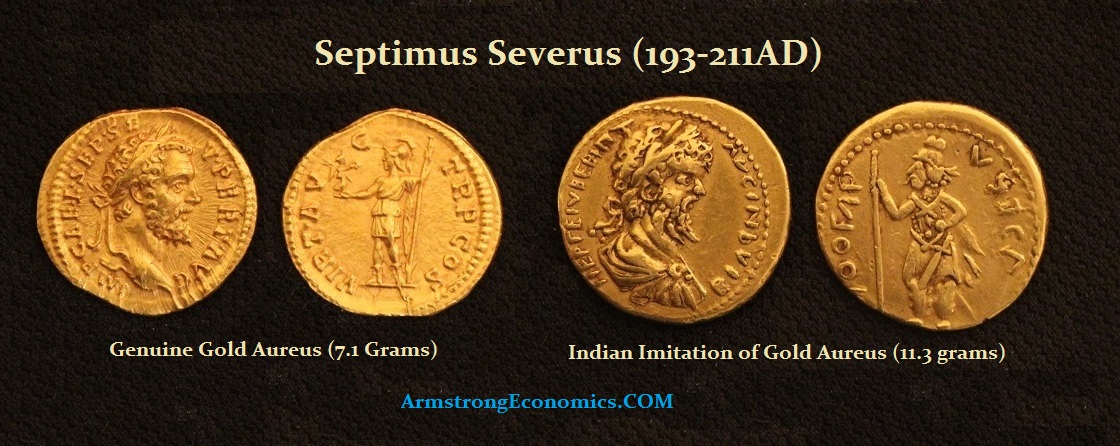
India was the source of spices and was rich in trade from the days of Greece which is why Alexander the Great attempted to invade India and failed. Here is a gold aureus imitation of a Roman coin of Septimius Severus where the gold content was greater than the actual Roman coin. India had the gold but they imitated Roman coinage because that was like the dollar today, seen as the superpower of the world. There was a premium to the gold because it was struck by Rome.
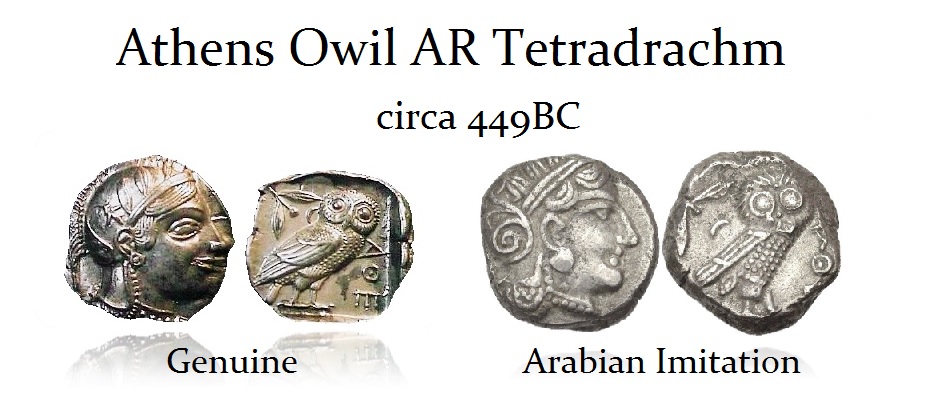
When Athens rose as the financial capital of the world after defeating the Persians, here too we see imitations of the Athenian Owls throughout the Mediterranean region. Even Egypt, which never issue coinage of their own like India, they too imitated Athenian Owls for the purpose of international trade.
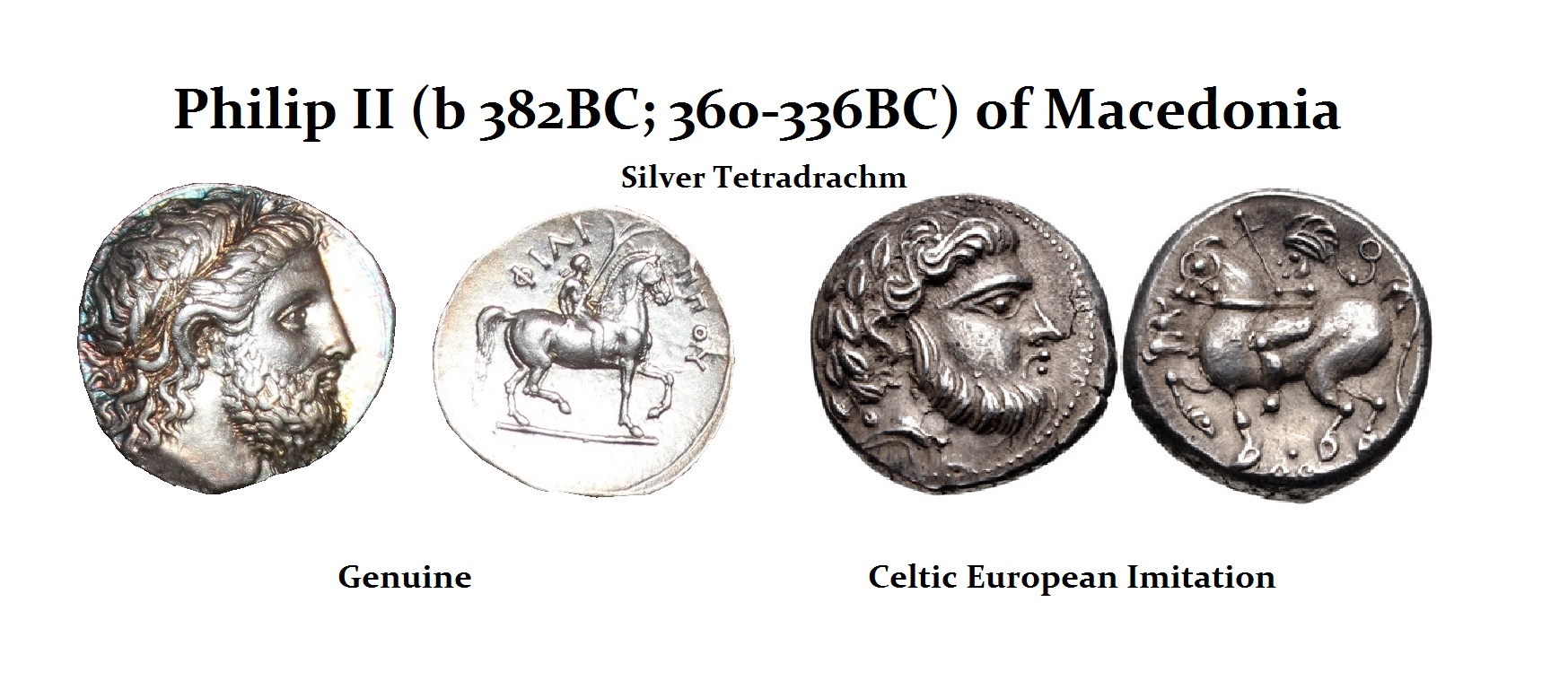
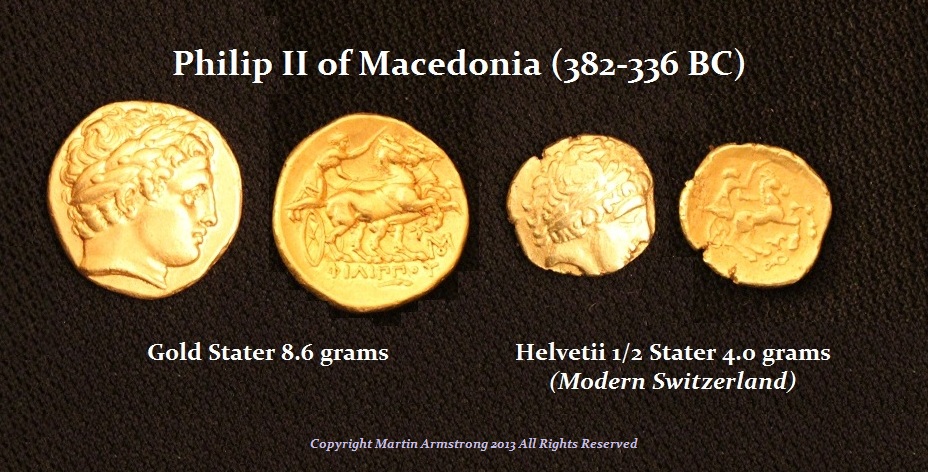
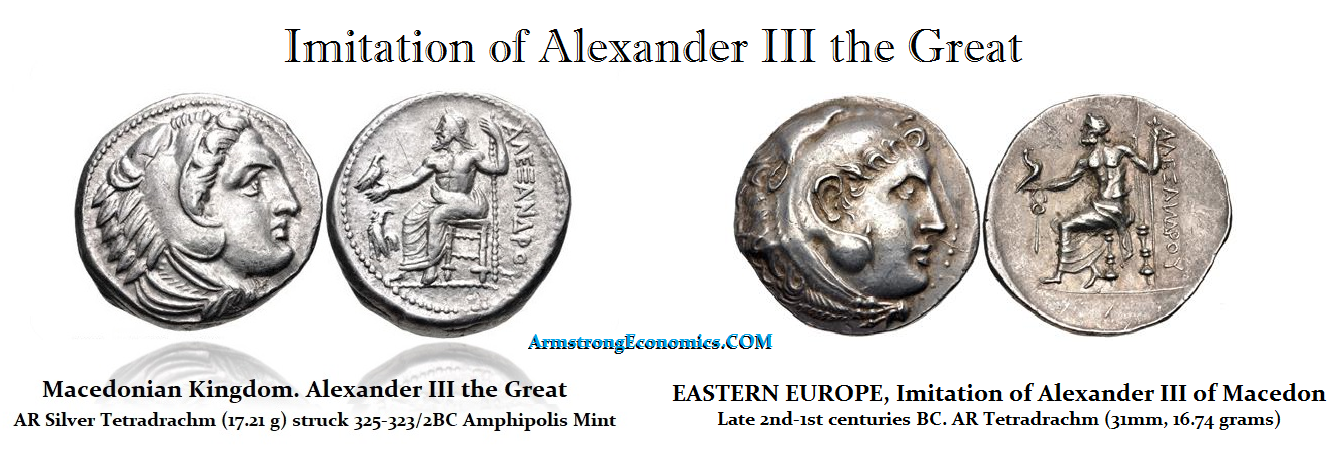
Even going back to Macedonia, the coinage of Alexander the Great’s father Philip II was imitated throughout Europe. It was of the same weight and again it carried a premium to the metal content.
Here is a half stater struck in Switzerland by the Helvetii at the proper weight again imitating the gold coinage of Philip II of Macedonia.
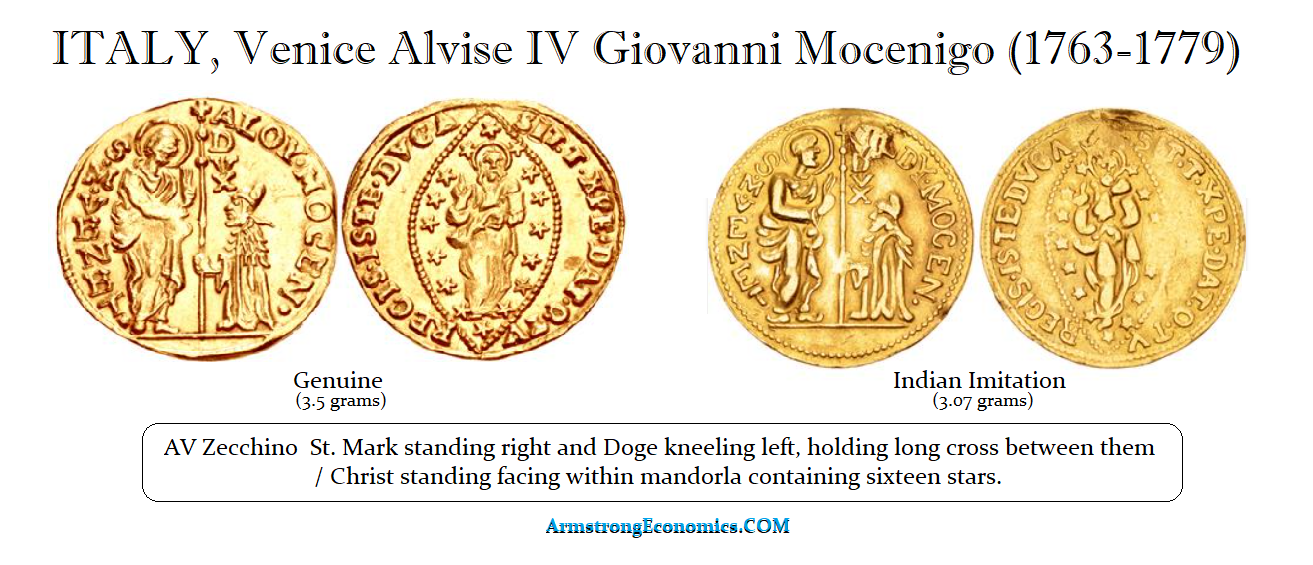
Indian imitations continued right up into 18th century when Venice was the financial capital of the world until Napoleon conquered it.
This constant nonsense that the dollar will crumble and that even entering World War III would bankrupt the United States, is all based on this unsupported sophistry that money must be backed by some commodity. The WEALTH OF A NATION is its people, and its productive capacity. Russia is the richest country in the world from a natural resource perspective, but it is not the financial capital of the world. Japan and Germany were destroyed after WWII yet they both rose from the ashes on the productivity of their people – NOT GOLD!!!!
A loaf of bread in 1929 was about 10 cents. Today, that is just under $2. So, obviously, a loaf of bread would be a great hedge against inflation. The entire reason silver and gold became money was because it was durable and that aspect enabled capitalism because suddenly with silver as money, it allowed the accumulation of wealth and thus capitalism unlike barley or cattle, which ultimately spoiled or died. All tangible assets are a hedge.
However, the third question comes into focus. Why did BITCOIN become popular? It is not a store of wealth since it fluctuates in value the same as everything else. Thus, I warned that it would never replace the dollar. It was the best money laundering instrument BECAUSE it was like gold insofar as it was durable unlike wheat or barley, but it was the same instrument if sold in Beijing as it was in New York. That is the character of both silver and gold. Even oil is a different grade depending on where it comes from.
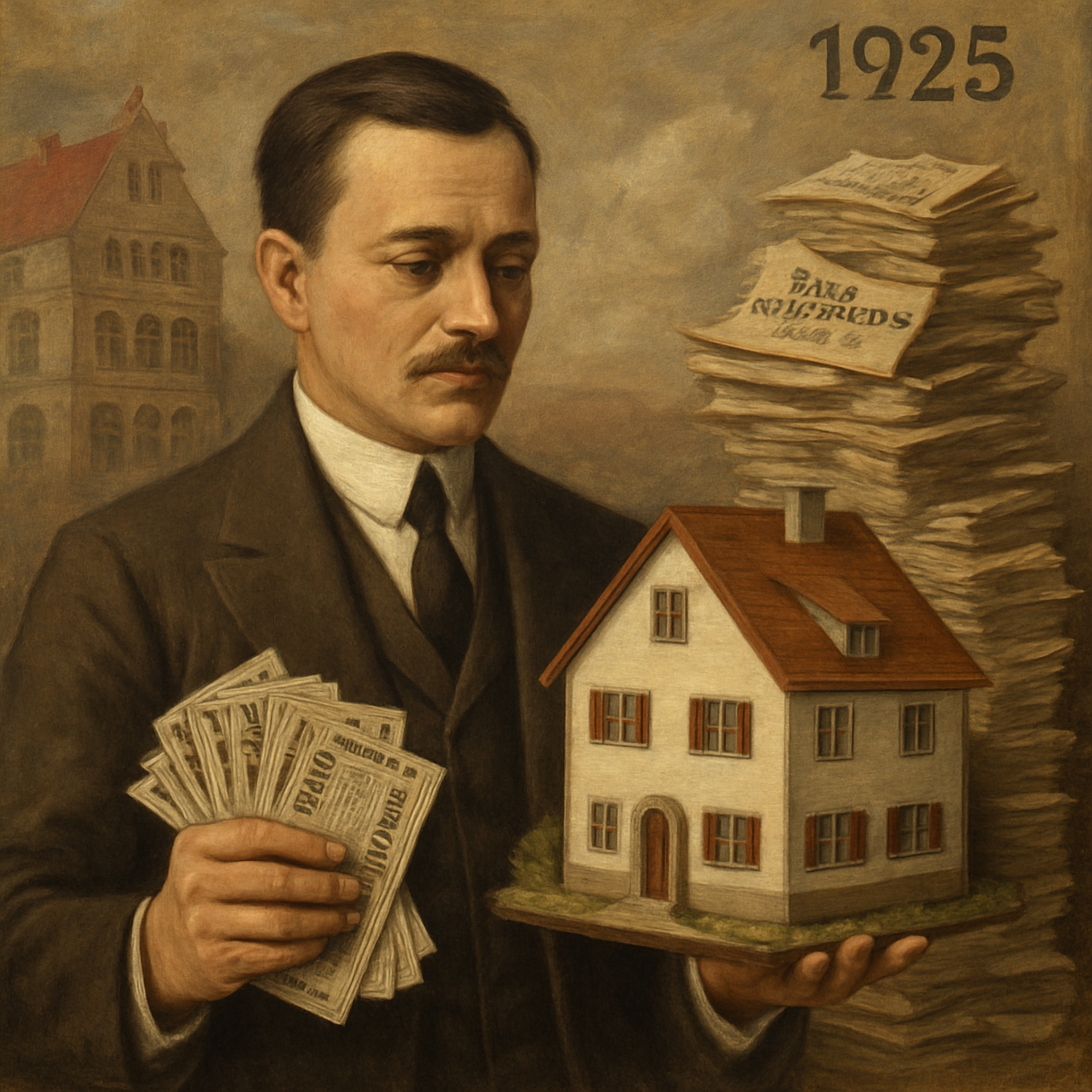
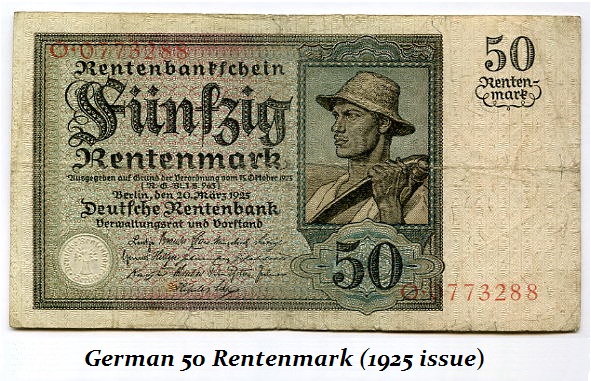
Do not confuse the hedge against inflation vs the hedge against government. During the Germany Hyperinflation, everything tangible rose in value. When the new currency was introduced in 1925, it was backed by real estate.
The hedge against government is distinctly different from inflation. When there is war involved, capital flees from the region where there is war and under this condition the capital will convert to another currency and flee. That is when immovable assets like real estate are not the hedge for they may be destroyed and at best you are left with title to the raw land if your country wins. If your nation-state loses, those assets are gone to the victor.
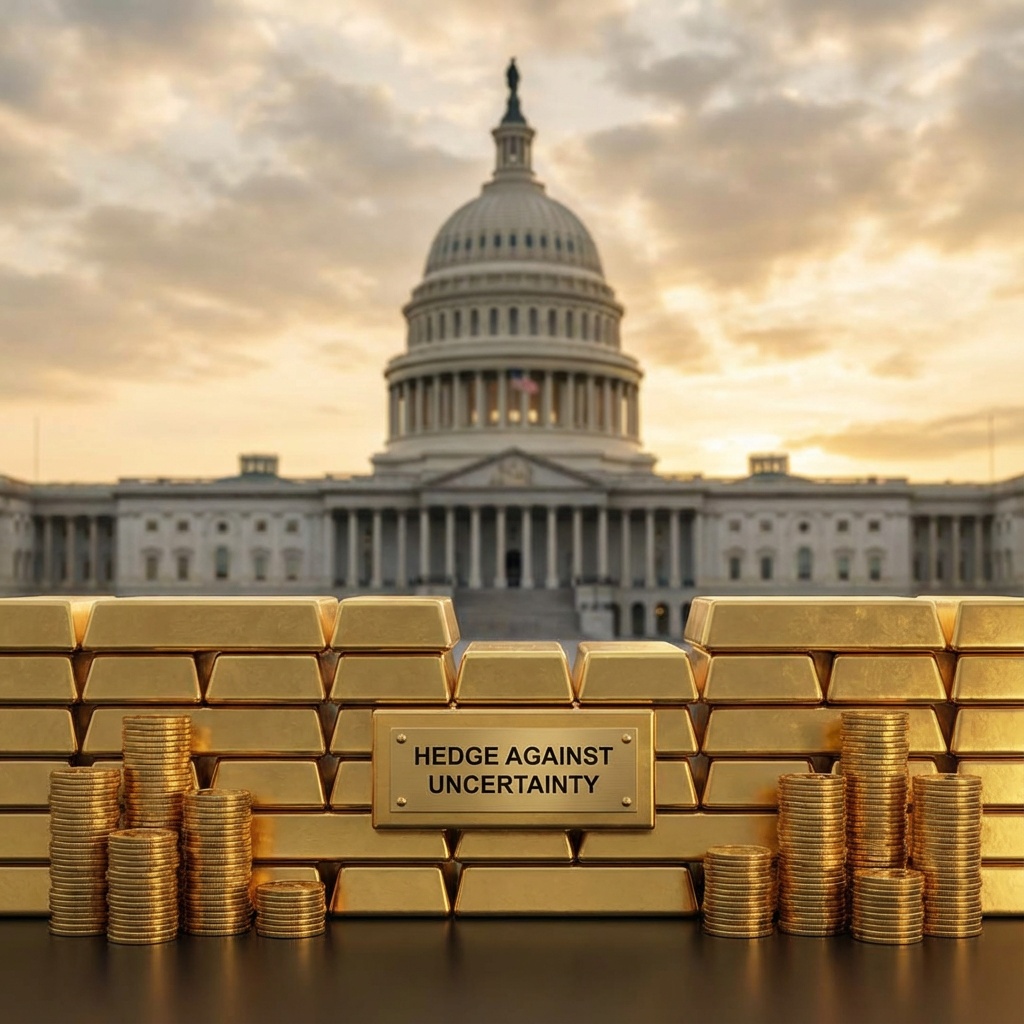
Gold is movable and therein lies its value. The greatest risk is capital controls. When I was in the gold business, I had the incredible opportunity to handle a rare Russian money skirt. It was entirely woven from gold wire and painted black. This was how gold was being used to flee the communists.
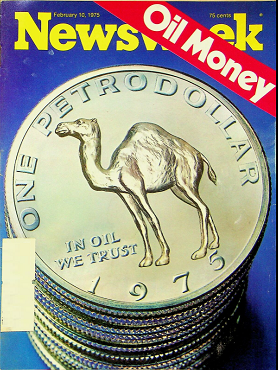
When their theory that the dollar would crumble after the fall of the gold standard in 1971, they came up with the excuse that the reason they were wrong was that the dollar was then the petrodollar because oil was being priced in dollars. Crude oil is less than 6% of world trade. The US trade of goods stands at 13% nearly double that of crude oil. But, it sounded good. It covered by their claims that the dollar would crumble to dust without gold. Then the Euro was going to displace the dollar. That has yet to ever materialize.
The capitalization of NYSE is greater than all the stock exchanges of Europe combined. The market capitalization of just the New York Stock Exchange (NYSE), at approximately $31.7 trillion in May 2025, is significantly larger than the combined capitalization of all European stock exchanges, which is estimated to be less than half the size of the total U.S. market coming in about $25.53 trillion in 2025. The entire U.S. stock market (including the Nasdaq) represents over 60% of the total world market capitalization. Yet the dollar is going to crumble because it is not backed by gold?
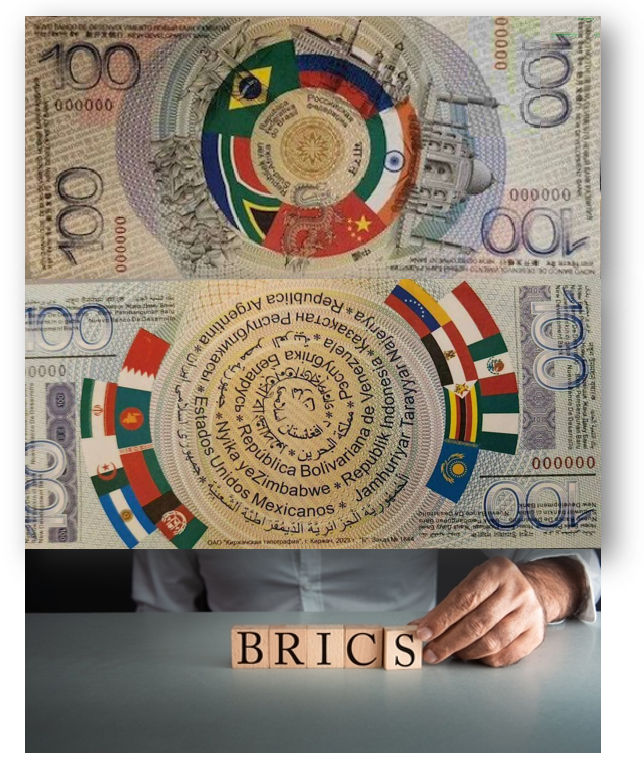
Now they are at it again with BRICS. Oh, BRICS will be backed by gold so the dollar will crumble to dust. Yet, not a single BRICS nation offers a market where I could pick up the phone and invest $10 billion. This sophistry is just amazing. Even Chinese provinces borrowed in dollars. The third world countries go to NYC to borrow in dollars because that is where the capital markets are today just as it was London before WWI. They refuse to examine why their theory has been wrong each and every time. They refuse to understand what is the true wealth of any nation – its people and productivity enhanced with the freedom of capital to invest.
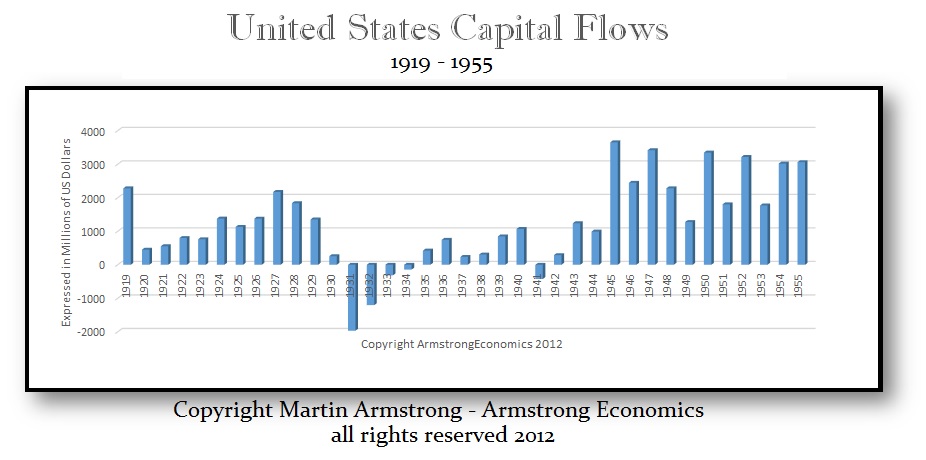
I have warned that war in Europe is inevitable. Those to think it will not happen because it would be suicide and the EU with the UK is broke mis the entire point. Europe is collapsing because of his highly Marxist control. This is why they are shutting down freedom of speech and you are about to witness capital controls. When WWI and WWII took place, the capital fled to the United States. That is what made the USA the financial capital of the world.
I get called in behind the curtain because they know this is NOT my OPINION. Every time I have tried to beat my own computer, I have lost. They can try to prevent mainstream media from interviewing me because I refused to cooperate. When the CIA wanted my model after it correctly forecast the collapse of Russia in 1998, I offered to run any study they wanted. But I was told that they had to own it. I refused to turn over the code or build it for them. So they do their best to try to prevent these forecasts from becoming mainstream. All they have succeeded in doing is making them more desirable behind the curtain than perhaps they would have been concerning geopolitics.
Russia has no interest in the conquest of Europe. But Europe needs the conquest of Russia to survive. They will use any peace deal to stage NATO troops in the Ukraine and then claim that Russia violated the peace deal to justify war. If we get a peace deal, it should be in January to the first week of February 2026. I would not count on it lasting.
Posted originally on Nov 20, 2025 by Martin Armstrong |
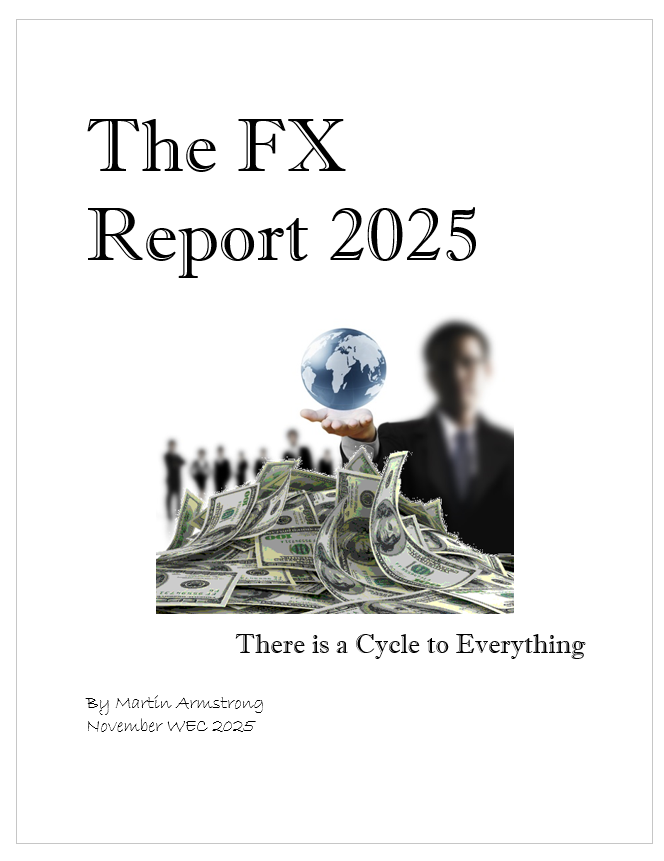
This is the 2025 FX Report covering the dollar reaction in the face of PEACE when the flight to safety may reverse near-term. The world is complex and we have to sort out the reactions from the major trend.
This Report will be available after the Conference $500
Posted originally on Nov 11, 2025 by Martin Armstrong |
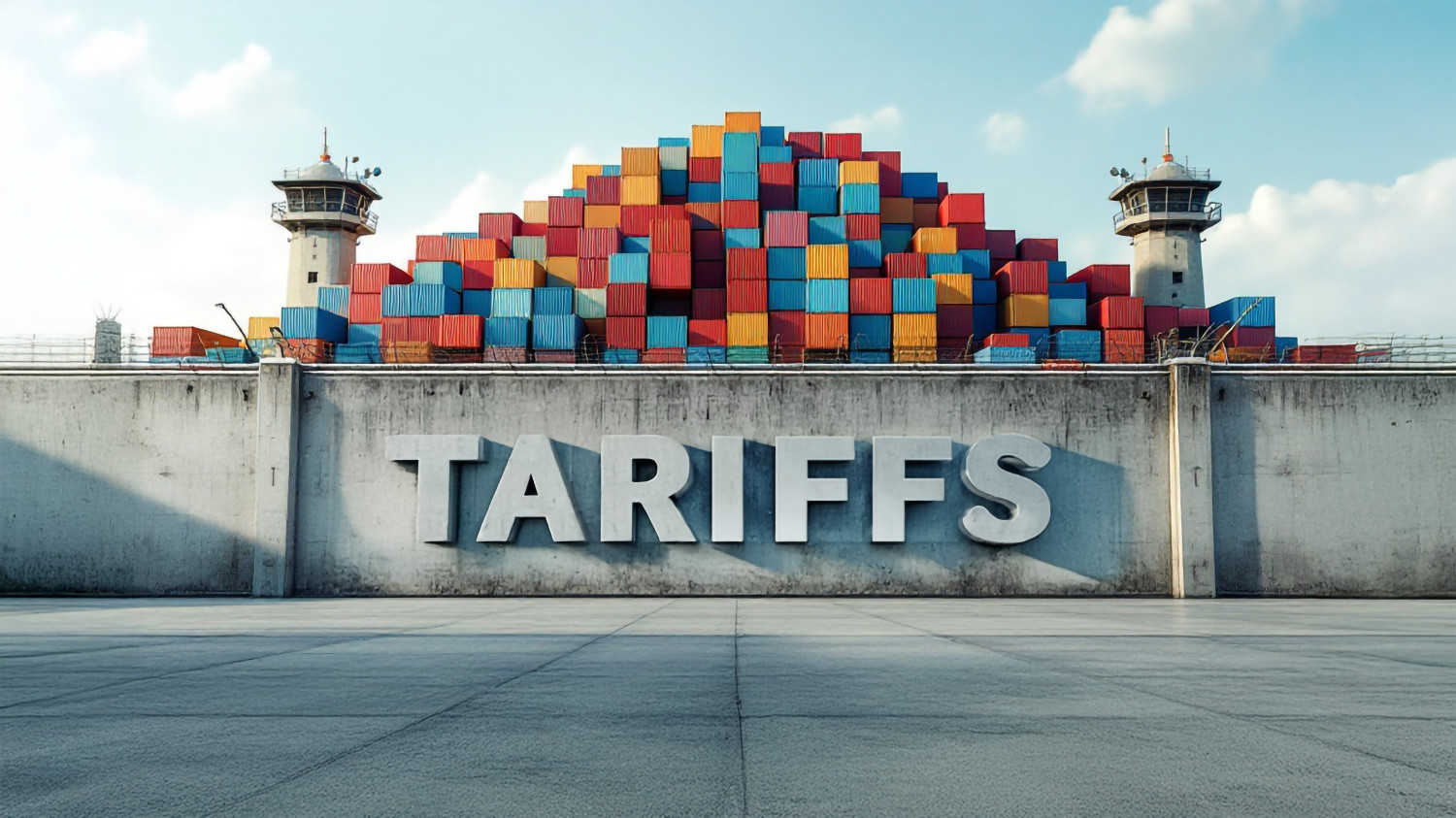
President Donald Trump has proposed a $2,000 tariff “dividend” to every American. Reminiscent of the stimulus checks provided during COVID-19, the payment comes at a time of low public confidence in government and government policy.
Tariffs generated $151 billion between April and October, according to the Committee for a Responsible Federal Budget. Treasury Secretary Scott Bessent believes duty collections will reach half a trillion per year.
This does not simply mean that the US federal government has a few extra billion lying around to disperse to the public. America has over $37 trillion in debt that is expanding by the second. Tariffs are an indirect tax paid by consumers through higher prices, not a penalty absorbed solely by foreign producers. A “dividend” payment to Americans would offset that indirect tax. This is not inflationary in itself, rather, it is merely shifting money from importers and consumers back to individuals. It’s a redistribution, not a monetary expansion.
“The $2,000 divided could come in lots of forms,” Treasury Secretary Scott Bessent said. “It could be just the tax decreases that we are seeing.” Also reminiscent of the COVID stimulus checks, these payments likely would not go to Americans earning over a certain threshold. The US does not need to stimulate spending at this time. Consumer spending remains high amid inflation. Consumer sentiment is low, but that does not correlate with spending; however, it does correlate with confidence.
The nation recently witnessed the celebration of a socialist politician, Zohran Mamdani, who became the mayor of NYC through free offerings. The public has its hand out and is waiting for the government to fix the cost-of-living crisis. The premise is more of a political stimulus rather than a monetary one.
The public always demands government do something, and politicians respond with short-term gimmicks to preserve power. But the underlying problem is systemic. We’re witnessing the end of Keynesian economics. The idea that government can endlessly manage the economy through fiscal manipulation is dying.
Posted originally on Sep 29, 2025 by Martin Armstrong |
Seasonal retail hiring may plummet to the lowest level since 2009. Job placement firm Challenger, Gray & Christmas expects retailers to add under 500,000 temporary positions in the final three months of the year, an 8% annual decline, and the smallest gain in 16 years. Retail depends on holiday Q4 sales for a bulk of annual revenue and the hiring trend is a glaring sign of a declining economy.
Certain retailers, like Target, stated that they plan to offer overtime hours to existing employees. Yet another sign of the times as people are eager for additional income and companies are not keen to take on additional employees.
A PwC survey from September 2025 indicates that the average person plans to spend 5% less this holiday season, down from $1,638 in 2024 to $1,552 per person. The survey has not indicated a drop in holiday sales since 2020. PwC’s figure translates to ~$413B–$460B total if scaled to ~266M adult consumers. Gen Z notably plans to spend 23% less this year as the cost of living has caused most young adults to live paycheck to paycheck, whereas boomers with sufficient savings plan to spend 5% more.
The National Retail Federation (NRF), however, predicts US retail sales will rise between 2.7% and 3.7% over 2024, reaching between $5.42 trillion and $5.48 trillion for the year. As for holiday spending, the NRF predicts a rise between 2.5% and 3.5% reaching a total between $979.5 billion and $989 billion.
Hiring trends in retail indicate that companies are less than optimistic about overall foot traffic this holiday season. Americans are spending more on less. Discretionary spending has been on the decline as inflation never meaningly waned.
I have created this site to help people have fun in the kitchen. I write about enjoying life both in and out of my kitchen. Life is short! Make the most of it and enjoy!
This is a library of News Events not reported by the Main Stream Media documenting & connecting the dots on How the Obama Marxist Liberal agenda is destroying America



![Minimum Wage Rate by State in the U.S. [2026]](https://www.paycor.com/wp-content/uploads/2023/12/MinimumWage_StateMap_740x560-768x582.png "MinimumWage_StateMap_740x560 768x582")






 Centinel2012