When This All Blows Up…


Tyler Durden's picture

Authored by Chris Martenson via PeakProsperity.com,

This report marks the end of a series of three big trains of thought. The first explained how we’re living through the Mother Of All Financial Bubbles. The next detailed the Great Wealth Transfer that is now underway, siphoning our wealth into the pockets of an elite few.

This concluding report predicts how these deleterious and unsustainable trends will inevitably ‘resolve’ (which is a pleasant way of saying ‘blow up’.)

The Ka-POOM Theory

In terms how this will all end, we favor the scenario put forth by Eric Janszen in 1998 called the Ka-POOM theory.

This theory rests on the belief that the Federal Reserve along with the other world central banks looked at Japan’s several decades of economic stagnation and decided that deflationary recessions are to be avoided at all costs — even if that means blowing asset bubbles and then cleaning up the destruction left behind in their aftermath.

Because the Fed, et al. have a limited playbook (which is: print, and then print some more), the Ka-POOM model calls for limited periods of disinflation, followed by massive money printing sprees that then produce high inflation.

Despite the trillions and trillions in thin-air money printed by the world’s central banks over the past 8 years, a common rebuttal we hear is “But there’s been no inflation so far!”  To which I reply, “Yes, that’s what we’re being told. But that’s not actually true.”

Remember: inflation is simply “too much money chasing too few goods.”  We can detect today’s excess of money in the rising prices in our cost of living — but those higher prices are symptoms, not causes. Inflation is not “higher prices”. Inflation is “too much money”.

Next, inflation is not an evenly-distributed event. It’s not like the price of everything rises 10% at the same time. The inflation rate is an average, which contains some prices going up, while others stay flat or even go down going down. It’s always a lumpy experience.  The reason why is that money is not evenly distributed across the economy, and it doesn’t always chase (or desire) the same things.

So the Fed and other central banks have printed up trillions and trillions of dollars, euros and yen, which they then essentially handed over to the financial markets and the very few people who work within them (as well as their biggest clients).  As a direct consequence, we’ve seen enormous inflation in the prices of things that relate to that tiny universe of people – stocks, bonds, trophy city apartments, Gulfstream 5 jets, fine art, and rare gems.

These items have all gotten massively more expensive over the past decade. Just as would have happened if the Fed had printed up a trillion dollars and given them everyone living in a trailer park in the American South, with the restriction that the money could only be used to buy other trailers in the region. Do you have any doubt that the price of trailers in the South wouldn’t explode upwards?

Well, that’s exactly analogous to what has happened to financial and trophy assets. The amount of money created and poured into the financial markets by that central banks has been incredibly enormous. As a first-order event, it raised the prices of nearly all financial assets. And then, as a second-order derivative, it then flowed into the properties and cherished possessions of the financial industry insiders.

The summary is that we’ve already had lots of inflation – but it has (so far) been mostly contained to the areas where the freshly-printed money was first directed. No surprise there.

But it’s certainly not only been limited to the rarified items the rich enjoy. Anyone who is currently looking to purchase a home, car or college education has a pretty good idea how prices have jumped substantially over the past decade.

Here’s the thing about the attempts by central banks to circumvent the workings of the actual economy by simply printing up money: It is doomed to fail. It always does; one cannot simply ‘print up’ prosperity.  Printing up money merely creates the illusion of free wealth for those with first access to it. In reality, what happens is that it secretly transfers the wealth from everyone else to those lucky few.

The Fed and the rest of the central banking cartel are consciously and very pointedly picking winners and losers.

It’s not in their power to make everyone a winner.  So they have decided to throwing granny (and savers and pensions) under the bus while financial elites and well-connected speculators (e.g. JP Morgan and other large banks) extremely wealthy in the process.  Wealth is being transferred from Parties B-Z to Party A – from the many to the few.

What the Fed promised would happen along with all of this money printing has not materialized. There has been no return to rapid economic growth. And there won’t be, because we have massive structural problems in our economy that can’t be papered over forever.

This stark fact makes the Fed’s entire money printing misadventure not just pointless, but dangerously destabilizing from a social and political perspective. The world’s central banks, especially the Fed, have done an enormous amount of damage. These institutions, as well as the decision-makers within them, are going to have a heck of lot to answer for when the inevitable crack-up comes.

A Quick Re-Cap

And so here we find ourselves, at the final torturous, grinding part where the final bubble top is formed. The über-bubble. The Greatest Of Them All.

A bubble this spectacular requires a top worthy of its size. A long, massive top, full of increasing exuberance — until the very last investor is sucked in.

Where I’ve noted humans’ remarkably silly behavior during bubble episodes in the past – tulip bulbs, railroads, swampland  – I still struggle to understand or even explain this one.

It’s so obvious at this point. And yet, like its brethren bubbles of the past, a lot of otherwise thoughtful and careful people are getting sucked in by its siren song.

I guess the best economic description of it might be “a credit bubble” with sub-components like sovereign and household debt, and sub-sub-components like Toronto real estate and the IPO price for SNAP shares (that’s Snapchat, which soon after its launch, had a valuation of $40 billion. This mind you, is a company that has no identifiable revenue model).

A credit bubble occurs when the issuance of credit grows faster than income supporting it. Here’s what that looks like on a national scale for the US. The bottom red line is income (GDP) and the top blue line is Total Debt. We can see that debt has been growing at twice the rate of GDP since 1970:

Debt to GDP

You have to be quite delusional to think that debt can be compound at twice the rate of income forever. Unfortunately, there are more than a few of those ungrounded optimists working in central banks and governments the world over. Their thinking is simply, The sky’s the limit! 

Those of us living in reality find this mindset puerile and insulting. And, of course, dangerously reckless. And it’s also maddening to hear the media cheerleaders for Wall Street selling us this bunk as if it were somehow sensible.  It is not.

Look, millions — likely billions — of people are at risk of getting badly hurt. When this bubble blows, it’s going to be enormously destructive and take out a lot of wealth along the way.  Millions of jobs will be destroyed. What people think of as wealth will evaporate as though it never existed in the first place (it didn’t). Political dynasties and major financial institutions will be ruined.

As I wrote recently, this will be widely and popularly referred to a period of wealth destruction. It will feel that way to must, but it will be actually be a period of wealth transfer:

The summary here is this: We are still printing and borrowing enormous amounts of money and credit, but the world is not growing any larger in response.  The pressure is building.  Nobody knows when all of that money and credit will have to be ‘trued up’ against the amount of real stuff out there. But it will. History shows us that it always does.

And that moment will be referred to by most as a period of wealth destruction. 401ks will be shredded, bonds will become worthless, defaults will spike, institutions and entire countries will fail – but the truth is that all of that paper ‘wealth’ was an illusion. People’s faith in it had been betrayed long before, when those in power started abusing the system by creating too many tertiary claims.

After the dust settles, there will be winners and losers, and those with the proper framework will understand that what actually happened was that all of the wealth was transferred from those who thought they owned it, to those who actually did.

The biggest remaining question is whether the wealth transfer comes about in the form of an inflationary destruction, like in Venezuela today, or as a deflationary bust more in the fashion of Greece.

(Source)

The only thing that capable of preventing this coming carnage would a resumption of rapid economic growth. And I mean growth that exceeds the rate of debt creation.

But that’s simply not going to happen.

The Problem With Growth

We can dispense with the idea of “solving” our too-much-debt problem by a resumption of rapid economic growth either by deduction or observation.  Both work just as well on their own, but each tells a similar story in this case.

The deductive route notes that economic growth stimulated by ever-higher amounts of borrowing simply requires greater and greater debt loads to accomplish.  Eventually debt levels simply become too high, and pinch off growth.

We can also deduce that because economic growth is tightly linked to energy consumption, lower amounts of usable energy flowing through an economy will cause that economy to stall out as well. Because we know that both the quantity as well as the net yield we get from our energy-producing activities are flattening, this explains why GDP growth is flattening too.

Thus, from a deductive standpoint, combining what we know about high levels of debt and flattening energy returns energy there’s really no more room for confusion about why GDP growth is, and will remain, anemic (at best).

Observationally, we now have more than a full decade of sub-par (i.e., ‘too low’) world GDP growth:

Debt to GDP

(Source)

Notice that the last year of data, 2016, is coming in at the lowest reading since the Great Recession, while the next two years are estimated to also come in at less than 3%.  The world hasn’t averaged 3% GDP growth in a decade. Even the mighty US has gone more than ten straight years without breaking into the 3% range.

We have to ask: How many years does it take to finally admit that there’s something seriously wrong with our hopeful story line that robust growth is going to save our debt-ridden bacon?

Just for the record, things are not shaping up any better here in 2017 either…

Atlanta Fed GDPNow model predicts 1.2% 1Q17 growth

And, just for kicks, we might also note that the GDP forecasting agencies of the world have consistent in over-estimating future growth.  Of course, this doesn’t deter them from continuing to predicting higher future growth each year. As a case in point, here are the IMF’s predictions for world growth over the past 6 years:

Debt to GDP

(Source)

Each of those colored lines is a forecast.  Each of them foresaw growth going notably higher in the near future.  Not only was every one of them utterly wrong in direction, each failed at getting even the next quarter anywhere close to right.  See how none of those lines ever dips below 3%?  See in the prior chart how global growth never breached 3% in any of these same plotted years?

For a variety of reasons, with aging demographics being a huge factor, future growth in the OECD countries must slow:

Debt to GDP

(Source)

My ‘prediction’ is that these projections will turn out to be far too high. Mainly because I include declining net energy in my views and no mainstream economist ever does.  But the track records of these outfits shows that taking the ‘under’ side of the over/under bet offers incredibly safe odds.

At any rate, the main story here is that the only way we can begin to justify the astronomical levels of debt currently on the books, let alone slathering on new tranches just to keep the whole thing form imploding, is to have a story of endless, rapid future economic growth. Which is, we’ve already shown, a delusional fantasy.

Stagnating growth, ever more trillions of debt, and a finite amount of depleting net energy all adds up to an unsustainable mess.  With asset price bubbles everywhere and wealth transfer mechanisms already in place, the end-game involves a very few winners and a lot of losers.

Anything that is this unsustainable will someday end. But how? And how should we position ourselves for it? 

In Part 2: The Ka-POOM! Survival Guide, we detail in depth the most likely progression predicted by the Ka-POOM! model. First, a punishing crash in prices as natural market forces eventually overwhelm the Fed’s doomed efforts to print the world to prosperity. Think of the 2008 crash, but on steroids.

Then will come the inevitable response from the central banking cartel: Set the printing machines on maximum speed! While this may seem to work for a brief while, it will soon collapse the world’s currencies in a hyperinflationary deluge.

This will be a very tricky time for preserving wealth as things swing violently from disinflation to inflation. Understanding the mechanics and knowing what to expect will be critical — not just for safeguarding your money, but for taking advantage of what will surely be some of the best bargains of our lifetime.
Click here to read the report

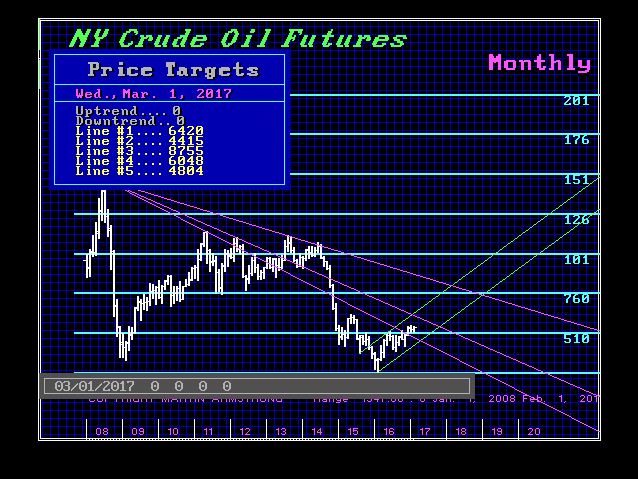
Crude & the Waterfall


Crude-M GMW 3-9-2017

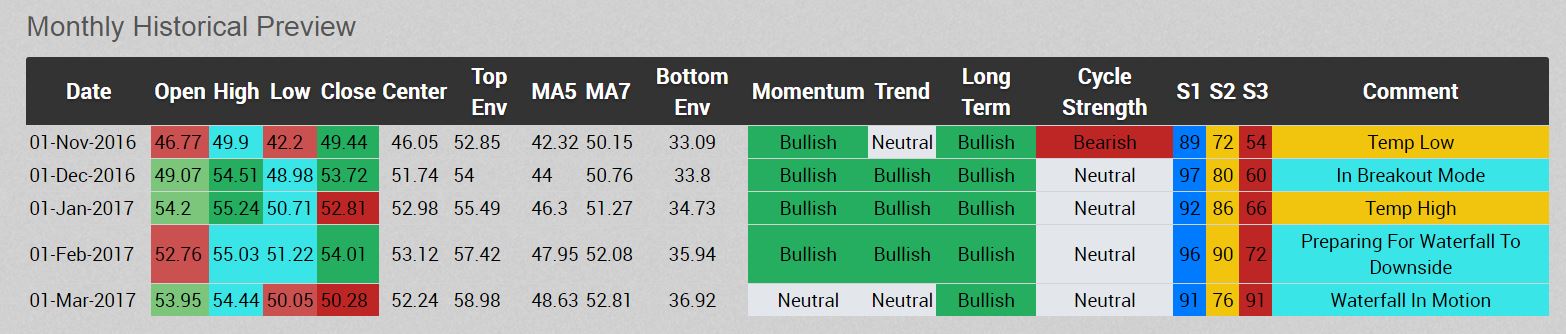
COMMENT: Marty; I have to say, the forecasting on Socrates in Oil is very impressive. It picked the high and then forecast a water fall in February even though February closed higher. From even a technical perspective, it did not appear that such a sharp collapse would unfold.

Absolutely amazing

KW

CRUDE-M 3-9-2017

REPLY: This is completely a pattern recognition system which is machine learning based so it constantly improves with time. It is writing its own code. Every pattern it discovers across all markets it records and assigns it a specific number. A monthly closing below 5240 will keep oil in a bearish position, but the technical support lies at the 4415 level. A monthly closing below 4200 will signal the reversal of fortune. Otherwise, welcome to the choppy world of market chaos.

This collapse in oil prices is based upon the amount of crude oil in U.S. storage facilities rose to another record high reaching 8.2 million barrels from the previous week, according to the Energy Information Administration. The increase was more than four times what analysts expected.The fact that the computer can pickup these patterns demonstrates that those who have such information begin to trade in anticipation. Picking-up these patterns may be extremely subtle. Nevertheless, the flow of capital is the key to everything


Standard Poors

Standard & Poor’s (S & P) is being touted as once again trying to influence political elections as they did in Britain without success. While the US Congress wants to investigate Russia trying to influence US elections, they should look at the US track record of influencing foreign elections by the CIA and also the private credit rating agencies. S&P said Britain would be downgraded it if voted for BREXIT.

S&P’s economist, Moritz Krämer, claims that a victory for the Front National with its top candidate, Marine Le Pen, in the French presidential elections would probably have far-reaching implications for the country’s financiers. This bogus analysis is targeted at the intention of Le Pen to get France out of the euro and reinstate the franc.

Krämer, head of the Standard & Poor’s government bonds section, claims rather absurdly that in such a case France’s insolvency must be declared. He reportedly told the press: “That is clear. If a debtor does not comply with the contractual obligations against the creditors – which is also the currency of the payments – we would declare a payment failure. He added: “Our current AA rating for France, however, means that this is unlikely at the moment.”

France 50-francs-1986

The nonsense of this statement demonstrates the total lack of credibility. If France pulled out of the Euro, nearly 40% of its debt is held by the ECB. It would seem that any risk of a French default would send the Eurozone into crisis – not France. The French franc would be an excellent way to reduce the debt and revitalize the French economy away from the deflation imposed by Germany.

Draghi & ECB Want to Regulate British Banks doing biz in the Eurozone


Mario Draghi

The ECB is living itself in La La Land. It is demanding that British Banks wishing to do business inside the Eurozone after BREXIT must obtain a license. While this is the same type of requirement for any foreign bank seeking to do business in the USA, the idea that the ECB wants to make sure that British banks are solvent is rather absurd. The reason Euro based banks are in danger of insolvency is because they are euro based bonds of all members as reserves. The British banks remained in British pounds and are head & shoulders above their Eurozone counterparts.

*(MORE FROM THE RELIGION OF PEACE) – ‘No go zones’ Swedish EMTs fear to enter ‘high risk’ areas without police and armour


We are watching the self destruction of a country, so sad.

Why the Fed Needs to Raise Rates


yellen Janet

I have warned that rates will rise BECAUSE the Federal Reserve will be criticized if they fail to do so when they are faced with a stock market that is rising. However, while one by one, several Fed officials have all signaled in recent days that the Fed is ready to resume raising interest rates as soon as this month, the real crisis for the Fed will be raising rates will strength the dollar and put even more pressure on Europe and emerging markets. Hence, the 64 billion dollar question is will the Fed abandon international policy objectives for domestic?

Janet Yellen speaks today in Chicago on the topic of the Fed’s economic outlook. The pundits will scan ever possible word for any hint whatsoever of how likely the central bank is to raise its key short-term rate after it next meets March 14-15, 2017. Traders in futures markets have put the probability of a rate hike at 75%, according to data tracked by the CME Group. Last week the odds were just 50/50. With the rally in the share market this week, many are now fearing a rate hike.

Many Fed officials are suggesting that the strengthening U.S. economy warns of higher inflation and a surging stock market has confirmed a potential rate hike. On Tuesday, William Dudley, president of the New York Fed, said the case for raising rates had “become a lot more compelling”. Robert Kaplan, of the Dallas Fed, said he thought the Fed would likely raise rates “in the near future.” Then Lael Brainard, a Fed board member, also said she thought the case for another hike was strengthening: “Assuming continued progress, it will likely be appropriate soon to remove additional accommodation.” Jerome Powell, who is another board member, said on CNBC: “I think the case for a rate increase in March has come together, and I do think it is on the table for discussion.”

Back in the 1980s, we would get a phone call that the Fed will raise the rates that day. Banks were not proprietary traders as they are today back then so the calls were really to make sure people did not get hurt. That has become insider trading these days so what we get is Fed officially attempting to choreograph their intention for the very same purpose that the marketplace is not hurt by their actions.

Last December, the Fed raised its benchmark rate by a quarter-point to a range of 0.5 percent to 0.75 percent. It was its first increase since December 2015 following our turning point on the Economic Confidence Model 2015.75 which was October 1st, 2015. When the Fed raised its key rate from a record low back in December 2015, it did so right on target for the change in trend.

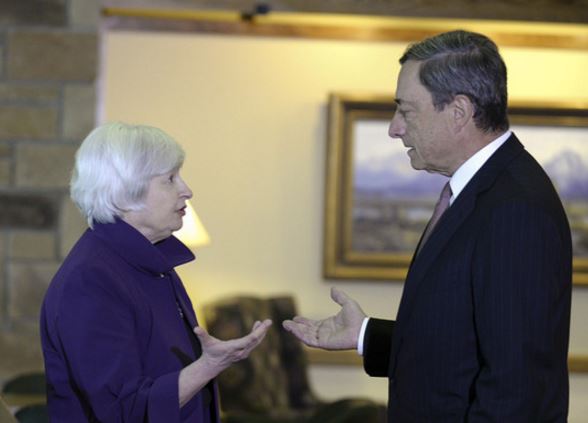
yellen-draghiDomestic Policy Objectives will win out over International. This will only have the same impact of causing capital inflows for the dollar will rise. Yet the Fed has no choice. To do nothing will invite attacks by the Democrats who will say they are only helping the rich get richer watching the stock market rise irrespective of the economy. What we are facing is asset inflation FIRST. That means Draghi and the ECB will be in even a more difficult position trying to maintain negative interest rates that have completely FAILED to revitalize the European economy. It has been 8 years of a complete brain-dead economic policy by the ECB. The question is will the ECB be compelled to end its failed policy and raise rates itself? Talk from behind the curtain is that Yellen keeps telling Draghi is is wrong.

Vertigo & Trading


Traders

There are at lot of professional traders who really lack the in-depth knowledge of the historical track record of how markets really trade because they have not traded something like this which is similar to 195 blast-off or the bull market into 1929. This is a special type of market and it requires real research to survive plus skills along with nerves of tungsten.

You have bond traders talking  their own books. Bond Traders aren’t pricing in more rate increases but rather moving forward the timing of the next move. The Bond Traders don’t believe the stock market hype about the sudden prospect for a burst of economic growth. Consequently, they remain bearish on stocks expecting a meltdown and bonds to soar. The Bond Traders say that any policy action is not warranted on the mere hint of a possibility of economic gains. They add that even the potential for higher rates from an increasingly worried Fed could create financial instability and would certainly ratchet up the cost of any new federal spending. They remain oblivious to the capital inflows into the blue-chips because of political uncertainty looking in Europe.

Vertigo-1While Buffet says we are not in a bubble, there are people like Jeffrey Saut at Raymond James who says he will be on the sidelines, choosing not to participate in something he does not understand. Saut said: “Folks, I have been in this business for over 46 years, and observing markets with my father for 54 years, and I have never experienced anything like what is currently happening.”

This is how REAL bull markets run. They run up because people are not in and they want to buy dips while short players keep getting stopped out.

This is the most difficult type of market to trade because it requires CONFIDENCE and CONVICTION. We will be devoting time to how to understand this type of market at the Hong Kong WEC. Given the possibility of a visa war between the USA and EU, some Europeans may want to consider the Hong Kong session.

Unless Healthcare is Revamped – Unemployment Will Rise


healthcare-1

Healthcare costs have continued to outpace inflation and just about everything else within the economy. Generally speaking, prices rise when demand increases relative to supply. The scheme of Obamacare was to force the youth to buy healthcare they did not need to pay for everyone else. The fines have been less than the costs so many of the youth just pay the fine. Forcing people to buy insurance to artificially lower the costs failed because healthcare is no different and has risen, not declined, with the false rise in demand.

Additional forces have also been contributing namely political decisions from Obamacare, additional taxes, and increased regulations have combined to impact healthcare costs. There has also been the notorious increase in lawsuits which influence the cost of malpractice insurance for medical practitioners forcing costs to also rise. Congress would never introduce Tort Reform because there are too many lawyers who would see their big paydays vanish.

McDonald’s is starting to replace people with auto-self-serving. Now Wendy’s is doing the same thing. Wendy’s plans to install self-ordering kiosks at 1,000 stores by the end of 2017. McDonald’s already beat them to the punch but we are witnessing this trend in many other businesses as well, such as movie theaters and airports. Corporate costs will decline with robots and automated order machines contributing to increasing corporate profits since they are not lowering prices. American Airlines is really anti-consumer. They charge $200 to speak someone to change your ticket when the ticket cost is even just $174. Healthcare costs rising faster than everything else will force companies to abandon workers whenever possible and this is impacting both manufacture as well as services.

So, what is the issue? Is it really just hourly wages? No! Any business with more than 25 employees are being hit with rising healthcare costs that amount to a monopoly from which the only possible relief is to eliminate people. Many small companies have tried to pay healthcare and have been forced to keep raising the deductible. Effectively, healthcare is devolving into catastrophic coverage. Many doctors are refusing to take people on government programs including Medicare because the government cheats them and is slow to pay.

Bill Gates may have been great at creating Microsoft, but when it comes to economics and law, he is off in the Cloud lost in his mind. What he has come out as a solution is to tax machines as if they are people? Gates said, “You’d think we’d tax the robot at a similar level” as humans and then the taxes a company pays would support society? So we become a world of couch potatoes?

Just maybe, we stop the subsidizing of healthcare, introduce Tort Reform, and replace government workers with robots to eliminate taxation on the people. That would be one alternative if we are looking at this new future world. In places like Greece, it is the government that accounts for 40% of GDP. In the USA, Fiscal Year 2017 is estimated at a total of all US government spending, federal, state, and local, to be $7.04 trillion. This will be 36% of GDP.

The US National Defense will be 4% of GDP while government pensions will be 7% plus government healthcare will be 8% compared to welfare is only 2%. Even education is 6% and that is highly questionable for it is really subsidizing the socialist philosophy. Our problem is government workers – not welfare or even military.

We need robots to replace government.

Market Talk- March 1, 2017


market-talk-2017

It was the speech that most claimed lacked substance that just did exactly what most thought it couldn’t – rally global stock markets. Yes, Japan’s Biz Cap-Ex released at 3.8% compared to the previous 1.3%; that woke markets, then Manufacturing PMI released a smidgen worse but when the JPY started to fall, everyone blamed Trump. The fact that the market has re-priced a March hike from 50% to 80% hardly made the pages. The Nikkei loved  the weaker Yen especially moved were key exporters all adding to the strong 1.5% rally. Shanghai and Hang Seng were small better bid (bit disappointing as China PMI better than expected) but in late US trading the futures market have added an additional 1% across the board.

I find it quite amusing that the pages announcing in Asian time zone “no substance”, lacked detail and disappointing – suddenly claim that $1tln will help infrastructure and defence stocks. Europe benefitted both on data and action as fresh money finally found its way into the market. All core indices saw gains of around 2% whilst both the Euro and GBP traded weaker. Mixed bag of tricks on the data front but probably a tad better for Germany which did see a small sell-off in bunds but then treasuries were down nearly 2pts so probably not that exciting really!

The US market could not wait to open with a 100 point gain seen in the opening minutes. By lunchtime time we were over 300 points higher, breaking both the psychological 21k for the DOW and the 2400 level for the S+P. Data was mixed initially but finished better (ISM 56 forecast was released at 57.7) with most talking FED. Towards the close we are pricing in a 80% chance of a move in March but many may wish to wait Janet Yellen when she speaks Friday. Given the DXY recent performance (now around 101.75), the rise of the S+P (+7% YTD) and 2yr yields their highest in nearly 8yrs the chances are this could be the start of the FED back in play.

2’s closed 1.28% (+5bp), 10’s at 2.46% (+10bp), Bunds 0.0.28% (+8bp) closes US/Germany spread at +218bp. France 0.91% (+3bp), Italy 2.11% (+4bp; can you really believe Italy trades 35bp through the USA!!!), Greece 6.75% (-22bp), Turkey 10.66% (+7bp), Portugal 3.89% (+6bp) and finally Gilts 1.19% (+4bp).

Key Interview – Treasury Secretary Steven Mnuchin Talks To Neil Cavuto…


Treasury Secretary Steven Mnuchin gives Fox Business News’ Neil Cavuto an interview to discuss President Trump’s timeline for the ObamaCare repeal, budget and tax reform. The interview is int…

Source: Key Interview – Treasury Secretary Steven Mnuchin Talks To Neil Cavuto…

trump-02