Special Report (June/11/2018)Martin Armstrong–System Breaking Down,Can We Avoid Chaos?


Published on Jun 11, 2018

#Ethereum ETH #Bitcoin Cash BCH #Ripple XRP #Litecoin LTC #Dash DASH #NEO NEO #IOTA MIOTA #Monero XMR #NEM XEM #Ethereum Classic ETC #Lisk LSK #Qtum QTUM #EOS EOS #Hshare HSR #Cardano ADA #OmiseGO OMG #Zcash ZEC #Martin Armstrong

Welcome to Dollar Vertigo – China to Ban Dollar Borrowing?


COMMENT: Mr. Armstrong, it seems that whatever you say our government follows. You said China should buy directly from the Treasury and not the New York bank and they did that right away. Now they are considering stopping dollar borrowing here in China as well. You should be holding a WEC here in Shanghai next.

QLJ

ANSWER: Yes, Bloomberg has reported that here in the West as well. People do not understand that the more the dollar rises, the greater the risk of defaults around the world. US rates fell so low that it was cheap to borrow dollars. The borrowers are now starting to realize that they also had a foreign exchange risk. This is what I have been warning about. You even have the dollar bears here in the States who keep saying I am wrong and the dollar has to crash. Repeatedly, I have warned that a decline in the dollar will be celebrated by everyone including Trump because it would ease trade friction. A rise in the dollar means trade friction, protectionism, and emerging market crisis of debt defaults. As the defaults mount, the dollar will be sent even higher. Add a crisis in the Middle East and in the stability of the Eurozone, and you end up with dollar vertigo!!!!

Euro Interest Rates


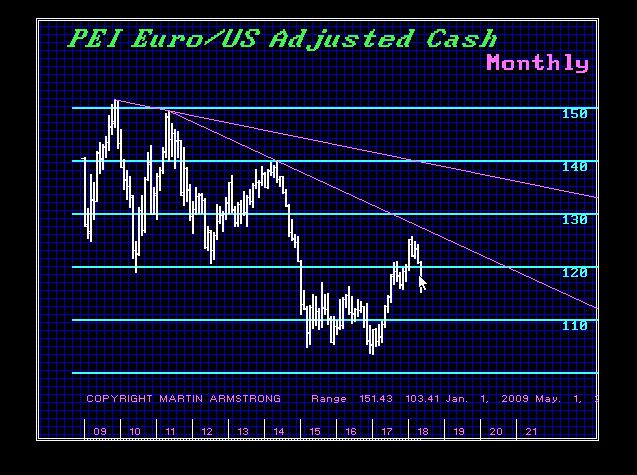
QUESTION: Mr. Armstrong; You have obviously been correct on the Euro. You even called the bounce but it stopped at 1.2550 and did not reach your ideal target of 1.28. You are saying that interest rates in Europe are more likely to rise faster than the ECB predicts. The French central banker Francois Villeroy de Galhau has also come out and said that a hike in interest rates from mid-2019 onwards will be possible. That contradicts Draghi. Running a small business here in Europe is difficult as you know. So we should look to try to lock in rates now before it is too late. Correct?

FK

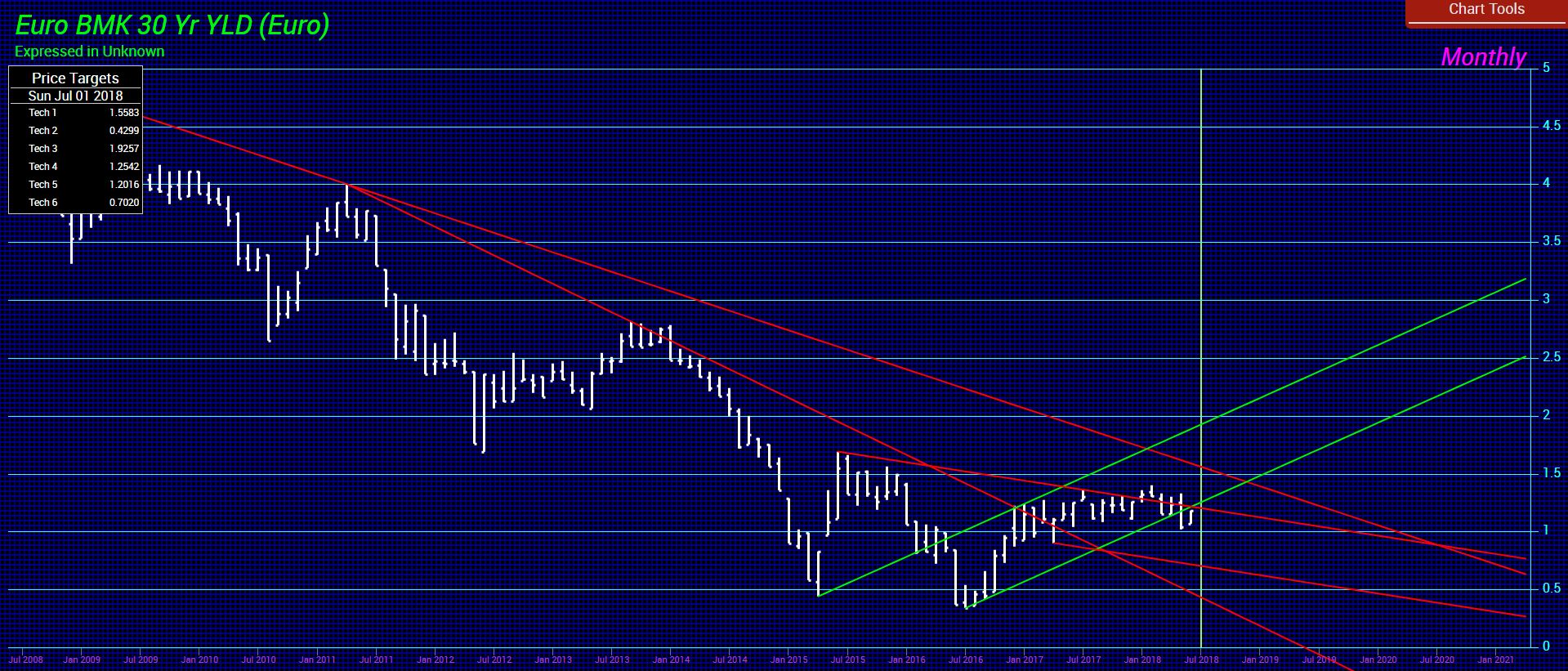
ANSWER: Absolutely. True, the technical resistance and the Monthly Bullish were in the 128 zone. However, the euro just did not have enough energy to reach that point which is in itself an indication of inherent weakness. If we look at the long-term 30-year rates on the euro, support lies at 0.93% and resistance at 1.7%. A monthly closing above 1.7% will signal a move up to 2.33% to 2.43%. After that, expect a rapid move to 5%. A closing at year-end above 1.42% will confirm a sharp rally is underway

Cryptocurrencies Vulnerable to Hackers?


QUESTION: It certainly seems that the cryptocurrency world has its flaws and may even be worse than traditional bank accounts and credit cards. They keep getting hacked. So they are trying to defeat central banks but may be running into the arms of scammers and thieves. I read one guy even claimed Bitcoin would be the new reserve currency. I really do not understand these fools. How can Bitcoin become the reserve currency? Where does this really end?

EP

ANSWER: I really do not know. The dollar is the reserve currency BECAUSE it has a $20 trillion debt that is used globally to park money. Europe never created a single debt market and that is why the euro never managed to compete with the dollar. There is just no way Bitcoin can become the reserve currency. That is really la-la-land. Where does this end? The technology may be absorbed by governments and perhaps you end up with a single electronic currency for each country. As far as circumventing central banks and governments, they can shut it down whenever they want by simply declaring cryptocurrency is for criminals as Australia is trying to do with cash.

With respect to the hacking, well easy come easy go. For the second time in just a few days, hackers launched a raid on a South Korean cryptocurrency exchange. The hackers had captured in one night about €27 million euros, the trading platform Bithumb had to admit. This is number six worldwide in terms of trading volume for cryptocurrencies. Bithumb announced that it would compensate its users.

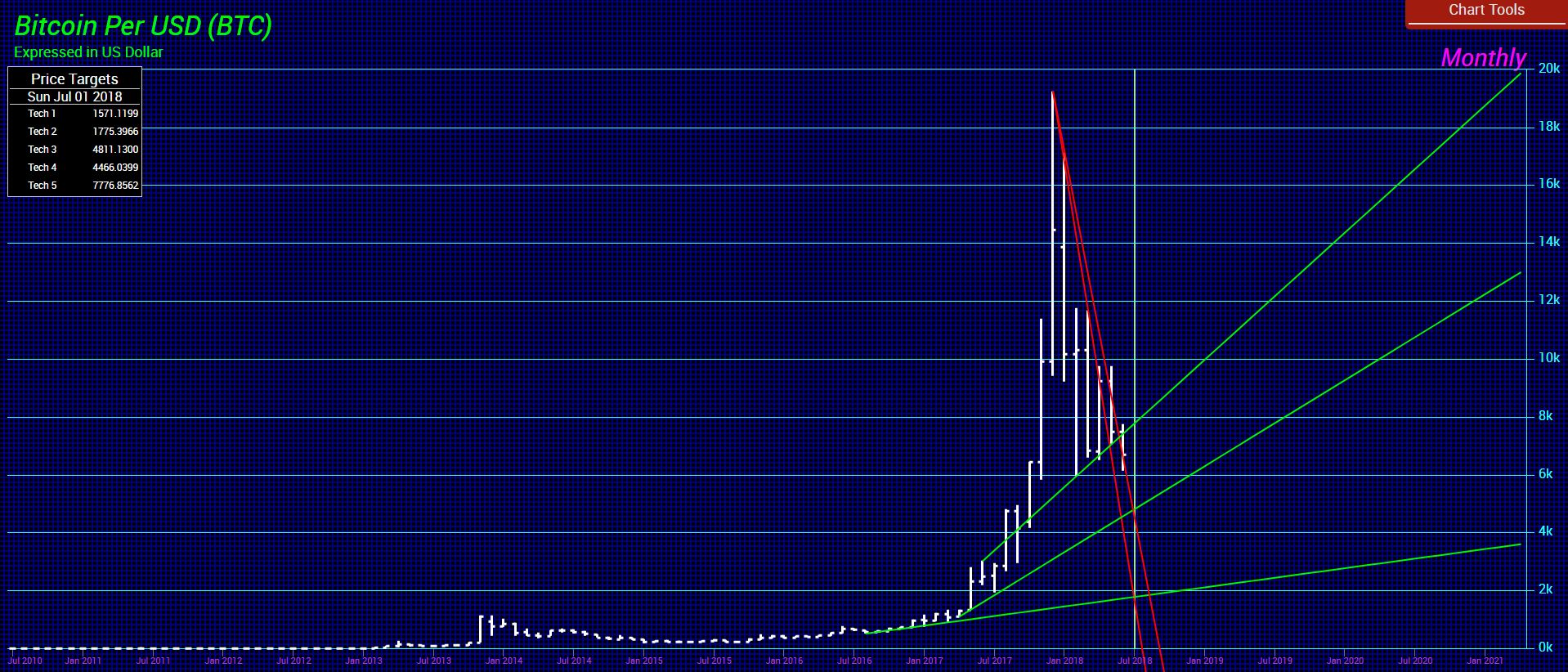
The prices of most cryptocurrencies fell after the second South Korean incident within a few weeks. Bitcoin, the largest cryptocurrency, fell 2% that day. These attacks are starting to wear down the cryptocurrency market, and we may yet see a decline further into July.

2032 – How Hard Do We Fall?


QUESTION: Hi Martin,

First, I’d like to offer my condolences on your mother’s passing. It feels to me that you must take great satisfaction in the fact that she must have been very proud of your accomplishments, and what you are trying to do for the average person. To me, that is the ultimate goal of a child; in thanking their parents for everything they have done.

Concerning the blog entry of “Crash & Burn & The Sixth Wave”, you write that it all depends upon if we begin the process in 2021. My interpretation – having followed you for years now – is that the people must rise up and push back against higher taxation, and demand reform and/or it could hinge on the Euro breaking apart, which provides the path to follow for the rest of us.

I believe you meant that if the people just acquiesce and do nothing – like in 2008, then those in power continue to run the economy for their benefit, causing the social fabric to continue to be torn apart between 2021-2032, (which means continued record low birth rates, low productivity, record low levels of capex, record suicide rates, etc) until it finally crumbles by 2032, leading to civil unrest. Have I got this right?

Thanks again for everything that you do.

Danny

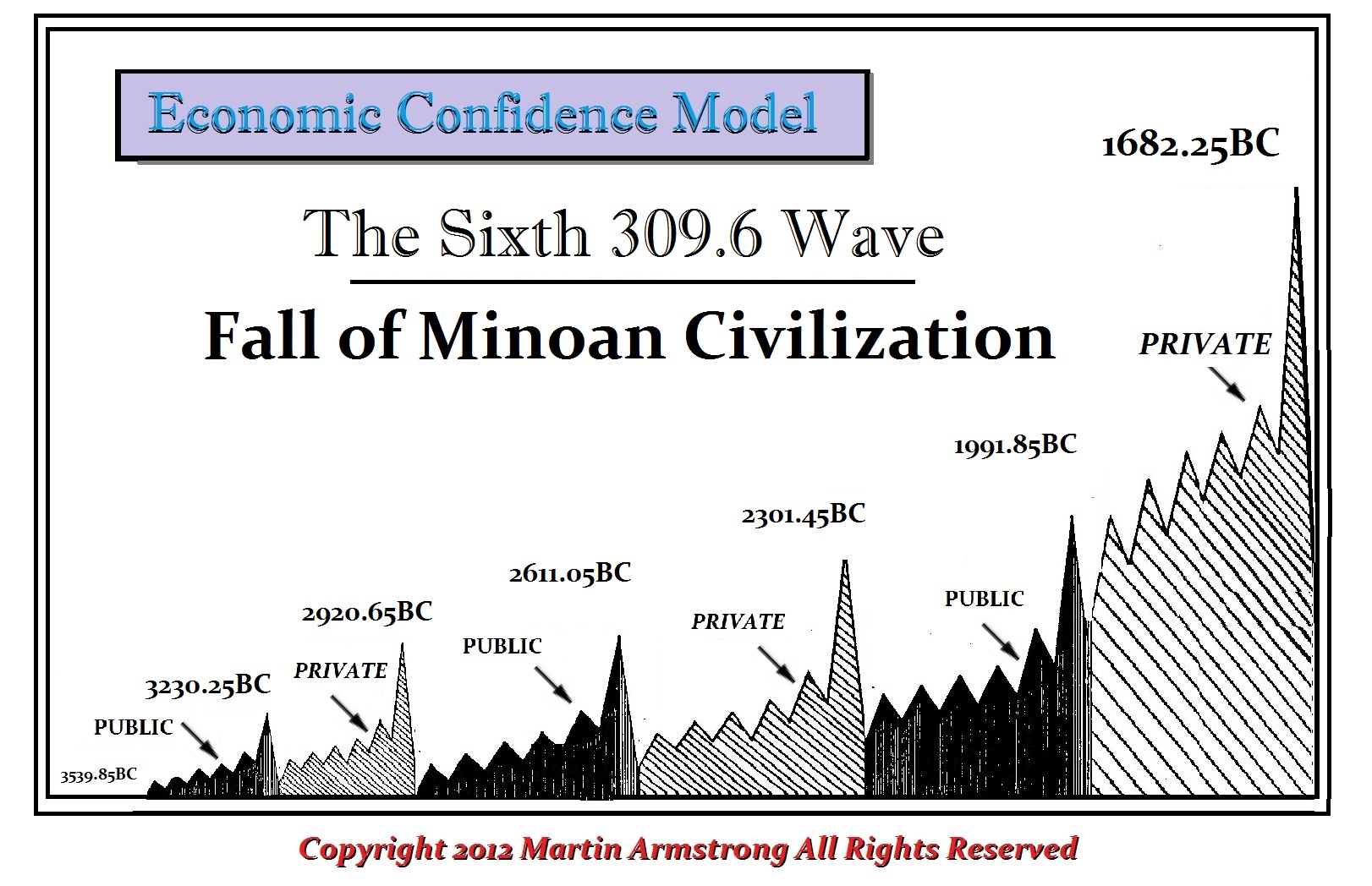
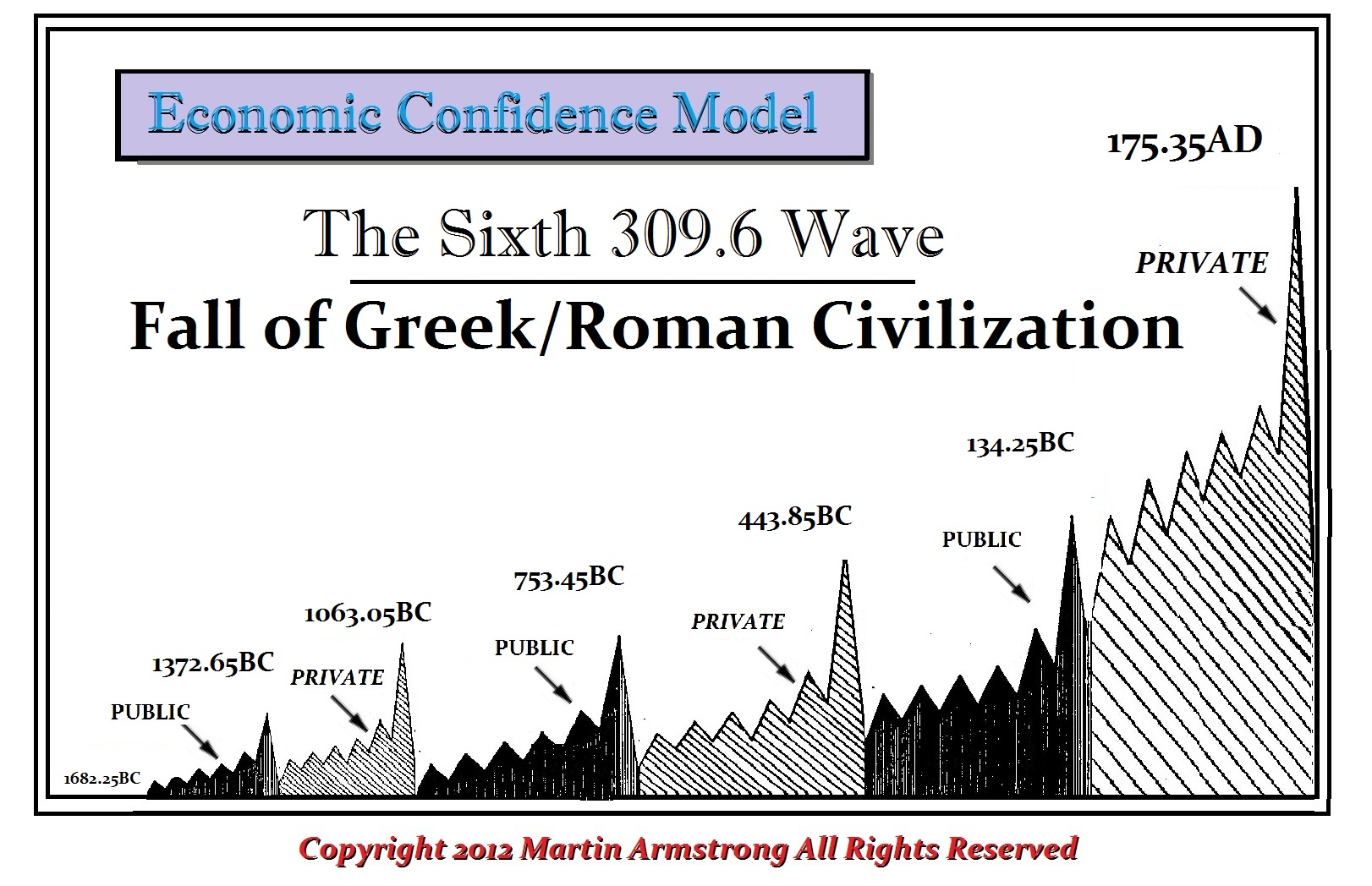
ANSWER: We have to understand that this will be the third such sequence of the Sixth Wave. At the end of the first sequence, we have civilization going into a Dark Age. That also coincided with the energy output of the sun declining and the massive volcanic eruption of Thera (Santorini), which ended the Minoan culture. That is when Mycenae invaded as well as the conquest of Troy. The last wave peaked in 175.35 AD, and after that we have the political unrest and collapse into 268 AD. I for one have a personal hope that we can avoid that outcome. In both cases, this is when the energy output of the sun dropped into a cold period where the Greeks became the sea people and migrated back to Africa. The second sequence saw the invasion of the barbarians as they moved south and overthrew the Roman Empire. The wall around Rome was not built until 270 AD. If we keep sticking our finger in a light socket and getting zapped, are we unable to learn from experience? The question in my mind is how hard will we land?

This is the cycle, it is NOT my “opinion” and I would prefer to point it out and say we can change the outcome if we understand the causes. There is no stopping the cycle. All I believe we are capable of doing is changing the degree of volatility. This is clearly the end of the West as a world economic power. The financial capital of the world will be shifting to China and Asia after 2032.

Even if we look at the hatred poured on Trump, this is indicative of how civilization collapses. It does not matter if you agree or disagree with Trump. This sort of hatred and the personal attacks, especially led by CNN, is so destructive I fear what comes AFTER Trump. There is absolutely NO POSSIBLE WAY that anyone who would really try to help the situation will come to power. CNN has guaranteed that nobody in the right mind would dare to be president. The only person will be a career politician who will NEVER look at the cycle. Instead, they will fill their pockets before they leave office. CNN loved Hillary. The Clintons stole a couch when they left the White House and had to return it. When you go to a hotel you might take all the soaps, but you do not leave with the bed.

If we do not realize what is happening, then yes, our own complacency will be our doom

Coming Crisis: Emerging Market Debt


QUESTION: Mr. Armstrong; Just to clarify, a continued rate hike in dollars will send Emerging Market debt into chaos and possibly default. Is this both public and private?

Thank you.

You are a voice in the wilderness

PK

ANSWER: Oh yes. Both public and private emerging market debt raised money in dollars. A 2% increase in interest rates could spark a sharp rise in the proportion of emerging market corporate debt issues at risk of default. This is true especially in Brazil, Turkey, and Indi

Merkel Extracted €2.9 billion in Interest from Greece


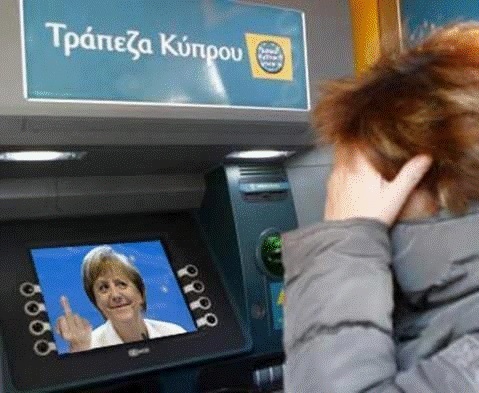
Angela Merkel promised the German people that she would not just hand Greeks money as she does with the refugee, no, she would make them pay dearly for allowing Goldman Sachs to structure deals to get them in the Eurozone. Indeed, she has kept her word. In response to a parliamentary question from the Green Party, the German government had to release figures which revealed that Merkel has acted more like a loan shark making €2.9 billion in interest payments on Greek bonds since 2010 despite the ECB moving rates negative. Merkel bought Greek government bonds as part of an EU deal to prop up the struggling Greek economy since 2010. The bonds were bought by the Bundesbank and then transferred to the federal treasury.

This certainly gives new meaning to the pictures of Greek citizens paying dearly for the shenanigans of politicians. The Protestant Reformation is where we draw the line with the birth of Capitalism. The reason we draw the line there is because previously, the Catholic Church had forbidden what Merkel has just done – exploit someone when they are down and out. It was called the Sin of Usury. You were supposed to “help” a fellow in his time of need. The Catholics would have been excommunicated if they engaged in banking. The Protestant Reformation was funded by wealthy Catholic merchants who wanted to compete with the Jews and enter the banking field. The Protestant Reformation thus did not adopt the Sin of Usury so Christians became bankers and could borrow as well as lend. That is where the economy began to be leveraged and this Capitalism was born.

Cryptocurrencies Down into July?


COMMENT: I found it very interesting when my bank would not allow using a credit card to buy cryptocurrencies. A friend of mine in Singapore said the government there has also instructed banks not to honor cryptocurrencies. It appears that government is starting to retaliate against the cryptocurrency world and I must question its viability long-term.

DP

REPLY: Yes. This is happening around the world. The US banks of Bank Of America, Citigroup, JP Morgan, Capital One, and the Discover card, have all banned their customers from purchasing cryptocurrencies. In the UK, Lloyds banking group was the first to ban cryptocurrencies and then MBNA, Halifax, and Bank of Scotland quickly followed. According to the blockchain research firm Chainalysis,  the long-term Bitcoin holders sold at least $ 30 billion worth of Bitcoin to new speculators between December 2017 and April 2018, half of which was in December 2017 alone making this very taxable in 2018. Many cryptocurrency investors have been lulled by the claim this is outside the central banks and off the grid. There are hundreds of data sources available to governments to track payments after conversion to a hard cash they call “Fiat” currency. Anyone who had purchased cryptocurrencies using their credit cards before the banks started to ban those transactions has a clear paper record for government to track.

Downunder, the Australian Tax Office (ATO) warned crypto traders/investors that their profits from trading in the years 2017 to 2018 “will not go unnoticed” and they have come straight out and warned on their website: “Anyone involved in acquiring or selling cryptocurrency must keep records of their cryptocurrency transactions.” Virtually every government classifies cryptocurrencies as assets. Therefore, any gain relative to the hard cash or “Fiat” currency is then taxable.

I have stated before, the governments want to move to an electronic currency so everything is taxable. They have been watching the cryptocurrency world and are coming down on banks demanding information. This is what the banks are simply banning the use of their credit cards to buy cryptocurrencies. The legal costs of gathering data to prosecute people the governments will demand are causing them to simply refuse to allow customers to use their facilities. The same result took place when the US government imposed FACTA requiring foreign banks to report whatever an American does outside the country. The way to avoid any problems was simply to ban Americans from having an account overseas.

At this point in time, we do have a Directional Change in July. So we may yet see a temporary low form at that time.

Switzerland Reject “Real Money” Proposal to Eliminate Banks from Creating Electronic Money by Lending


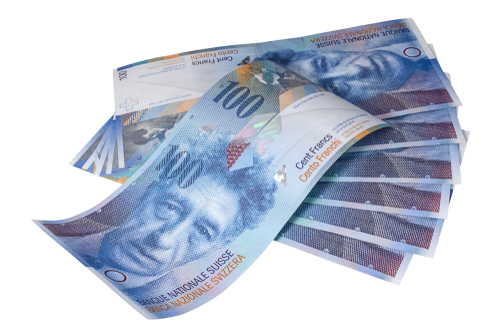
In Switzerland, we get to see how people who are really clueless about how the economy works still manage to get outrageous referendums on the ballot. A radical plan to transform Switzerland’s financial landscape was rejected, thank God, which would have barred commercial banks from electronically creating money when they lend. These people have no idea what such a proposal would have done. Their homes would have collapsed in value for there would be no mortgages. If banks could lend only the money on deposit and you withdrew your account, then does that mean a bank would have to shut down a mortgage and throw you out of your house?

All 26 of the country’s self-governing cantons also voted against it. The supporters needed a majority from all of Switzerland’s cantons as well as a simple majority of voters to succeed in such a proposal. The very idea of introducing a “vollgeld” or “real money” system convinced voters to reject the proposals. The outcome would have created such an economic disaster Switzerland would have committed suicide and entered a complete Dark Age unto itself

Portugal


QUESTION: Can you shed any light on the history of money in Portugal. There seems to be scan discussion of this subject.

Thank you

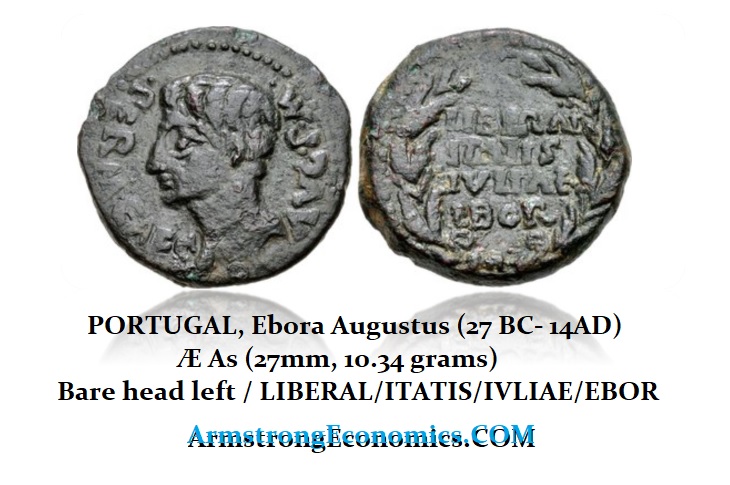
ANSWER: The first coinage of Portugal really is Roman and it appears to be struck by the first Roman Emperor Augustus (27BC-14AD). The location of the mint was the city of Évora. Interestingly enough, the name in ancient times was Ebora, which is really Celtic which is the name of a species of tree and thus the name means “of the yew trees.” However, there is a lack of any evidence of ancient settlements prior to that of the Roman. Perhaps because any Celtic evidence lies under the city which is not accessible to archeologists.

It is generally assumed that Évora only came into being as a municipium after the Pax Romana under Octavian in 30 BC which are really the first coin evidence in the region. Yet the name implies there was Celtic activity previously. The first reference to Évora as a municipium is found in a list of cities in Hispania in the Historia Naturalis of Pliny the Elder to the year 77AD.

During the 4th and 5th centuries, the Roman mint for coinage in the Spanish/Portugees region was actually Barcino, or Barcelona. So the early coinage of Portugal appears first under Augustus and then later the coinage is all struck in Barcelonia.

In more modern times, you might be wondering where are there different references to money. There was reis and reals and gold ducketsrelate. From the 12th century, Portugal had a currency called the dinheiro (dinero). The word today means money and is taken from the Roman denariusReal meant royal, as in a royal coin, and reis was the plural of real.
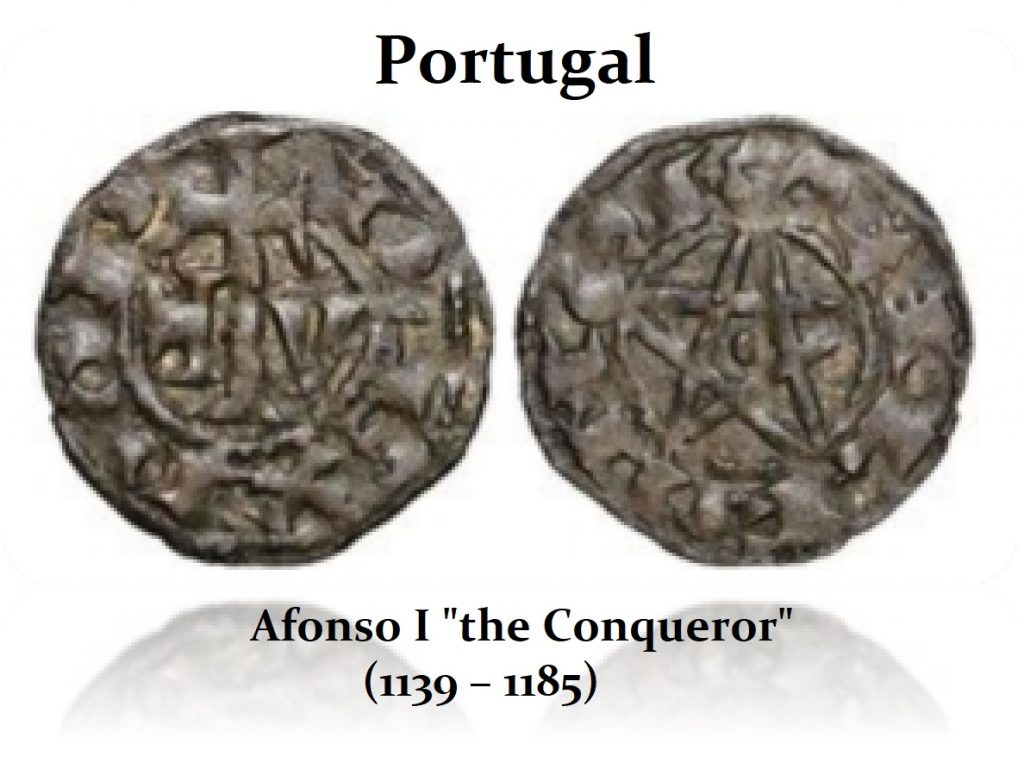
Portugal’s capital is Lisbon but it did not emerge as a nation until 1143, as a result of a rebellion by Dom Afonso Henriques (Afonso I) against his own mother Teresa of León. Portugal won its independence at the Battle of São Mamede near the town of Guimarães, in June of 1128. The first coinage was that of Alfonso I (1139-1185) and it was a dinero.

Europe had silver mines, but not gold. Gold was found in Northern Africa and in Anatolia (modern Turkey). Portugal became prominent because it had trade links with the Arabs and imported gold for Europe. Therefore, during 15th and 16th centuries, Portugal emerged as a powerful nation and naval power. Famous explorers are Fernando Magellan (circumnavigated the world), Vasco da Gama (discovered the route to India) and Bartolomeu Dias (sailed around Africa). Portugal made many discoveries and established colonies all over the world. The most famous one is Brazil, but it also established colonies in Africa, such as Mozambique and Angola, and on other continents.

Portugal was actually the first global power and one of the biggest empires at that time and was, therefore, the Financial Capital of Europe. During a 1910 revolution, the rebellion against government erupted once again and overthrew the monarchy. For most of the next six decades, repressive governments ran the country. This led once again to civil unrest and a 1974 military coup installed broad democratic reforms. Finally, on January 1, 1986, Portugal became the eleventh member of the European Economic Community.