ECB v the Federal Reserve – Different Animals Altogether


QUESTION: Do you you really think Trump would let the Central Banks Default? He said we would write off PoteRicos debt maybe he plans to write everything off can he do that? If this really did happen wouldn’t the dollar be worthless?

S

ANSWER: It seems as though far too many people ASSUME that all central banks were created EQUAL. Sorry – that is just not the case. These people who do not really know what they are talking about assume that just because the Fed has the power to create elastic money, that therefore the ECB can do the same thing. SORRY – WRONG!!!!
There is a substantial difference between the Federal Reserve and the European Central Bank (ECB).
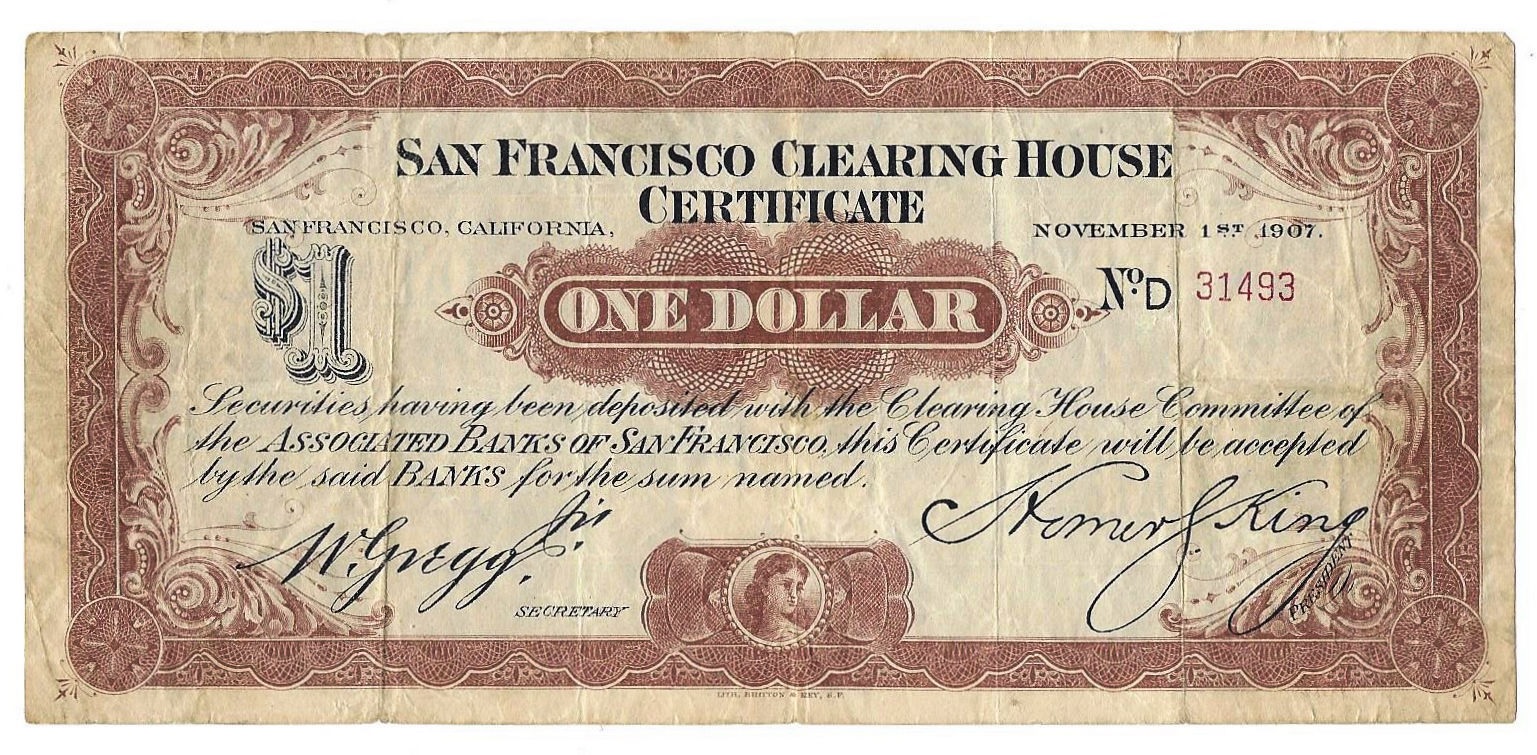
The accounting at the Fed allows for it to CREATE money as needed. Now the fiat crowd will argue that the Fed can just create money in a very ELASTIC money supply. This is true and it was intended from the very outset that when economic declines appeared, the leverage within the system would implode and thus to ease that contraction in the supply of money. Hence, the shortage of money resulted in defaults and assets decline in value relative to the contraction in money supply. Therefore, the Fed was created with the power to create ELASTIC money based upon the system of Clearing House Certificates that had pre-existed during the 19th century. The Clearing House  would issue its own money and then after the crisis, that money was retired – hence the term ELASTIC.

So how does this contrast with the ECB? Here in lies the problem. The ECB is NOT authorized to create
an ELASTIC MONEY SUPPLY. Germany would never allow that. Consequently, the ECB cannot continue to just buy-in sovereign debt of member states as the market forces come down upon them. The ECB, unlike the Fed, will run out of money and then there will be a very public crisis whereby the ECB will have to be recapitalized. I wrote about this before in Federal Reserve v ECB.

I warned back then that “Something will have to give in Europe.” The ECB was granted a ceiling to buy in government bonds. It cannot just print money with no end in sight. It must get approval, which the Fed does not require from Congress. The two are completely different animals.


On top of this, each member state retained its own central bank. Each member bank issues euros in their domestic economies. You can collect euro coins from each central bank – the ECB does not issue them.

Then the reserves of the European banking system had to be politically correct and the reserves were composed of all member bonds. Why? Germany opposed a single European debt issue.


Now, the Fed bought in $4 trillion against $20 trillion and the debt was only federal. The ECB bought the worst debt and now owns 40% of the total debt of the Eurozone members. Why is the ECB in danger of a default?

If there is a disagreement in Brussels, then the ECB runs out of cash. As interest rates rise, the value of its balance sheet will collapse. The ECB cannot sell the debt back to the market for there is no bid. To try to support the debt market, Brussels made it illegal to short government debt. Hence, there is no free market in European sovereign debt. If the ECB bought 40% of all debt, who is going to buy it when they stop?

This is a completely different perspective v the Federal Reserve which will just let its US federal debt holdings mature and expire. They too cannot sell the debt or interest rates would explode.

Welcome to the reality of the crisis. NOT all central banks were created equal. Those who paint them all with the same brush know nothing about what they are talking about. The ECB claims it cannot go bankrupt because it will just issue more money. The fact that they have even stated that demonstrates there is a huge problem. That depends upon one thing – approval from the politicians to issue more money.

I meet with central banks directly! This is comments about a field I only read about in the newspapers. I am not even sure the newspapers ever reported the actual differences between the central banks.

Governments are NOT a single entity. Central Banks are far too often on the opposite side of the table with the Political side of government. It is far more complicated than most people would ever guess


Saudi Arabia threatens to Privatize its Oil and Exit OPEC?


Saudi Arabia may actually be exiting OPEC. There are serious discussions about floating the state owned oil producer Aramco. Saudi Arabia attempted to get other oil producers around the world to agree to reduce production. Saudi Arabia is looking to float Aramco if the other producers fail to agree to cut production. The problem is that OPEC cannot reverse the trend in motion.

The BREXIT Bill to Leaves is All About Pensions for EU Politicians


Why is the bill so high from the EU to Britain to exit the EU?  It’s the Pensions. The EU pensions for government employees is rising dramatically. This is why the exit bill is climbing so high. They expect Britain to pay up for pensions of other EU politicians. Hm. It’s always about them! Curious!

Central Banks at Risk of Default?


Central banks do not play games with the markets but it sure feels like we are being played by someone! Earlier this year the Bank of Japan, Federal Reserve and the European Central Bank all had similar balance sheets at around $4.5 trillion.  As we know, over the past ten years all three have risen from lower levels but have seen faster expansion by the BOJ and the FED gaining pace to now catch the ECB. Foreign exchange rates are always subjected to inherent volatility that is thrown into the mix. However, given the recent extremes on all fronts, there has been uncanny similarity around end of Q1’ 2017.

Typically, a central bank balance sheet would off-set Assets against Liabilities and capital.

On the assets side would sit: –

(i) Net domestic assets, and
(ii) Foreign assets.

Liabilities would list: –

(ii) Non-monetary liabilities (Central bank securities and other), and finally

(iii) Equity Capital

(iv) Reserve money (currency in circulation and those of commercial banks)

In times of crisis it is common the central bank assumes the role of lender of last resort. Assuming the crisis was 2007/8, then it should be normal to expect the balance sheet to now shrink back to the levels of the pre-crisis era. However, we have heard many comments recently from the FED about re-normalizing their balance sheet but the BOJ and ECB are set to carrying-on for the foreseeable future.

Focusing now on the first two, BOJ and FED, the process is so much simpler because much of the debt is consolidated and displays a meaningful explanation of their economies. The heavyweight here is the BOJ with assets held close to 100% of GDP but the risk here could be off-set by the currency. Japanese debt is held domestically because of the currency controls. Hence, the yen could collapse to devalue the debt fairly easily once the markets wake up and smell the roses. The FED never came close to absorbing the full national debt or a percentage of GDP as has taken place in Japan or Europe.

Turning to Europe, the equation becomes far more complex when you consider the case for the European Central Bank. Since they initiated the APP (Asset Purchasing Programme) we have seen a need to follow cash within the components of the ECB itself. Within the European structure each central bank buys their own debt in relation to the size of their economy. The guidelines covering this activity are entitled Target2 and are easily found on the ECB website. What should be monitored closely is the trading between sovereigns, the rates at which all are traded, who the counterparties are (where they are located both domestic and international), and FX forwards’ trades that match the transaction dates. In many cases the NIM (Net Interest Margin) for many banks looks terrible but that is because the profit will appear in the FX books (which is the other side of the trade). Many reasons for the discrepancies’ from following the cash to liabilities, but Target2 and the concerns surrounding this are only recently starting to make some take a closer look.

Much has been published about Target2; so, let us concentrate on the fact that both Spain and Italy owe Germany around $400bn each. Neither the BOJ nor the Federal Reserve have this problem (internal macro issues) so from this angle alone there should counterparty risk that must be factored in. However, as we know the 10yr Bund (0.45%) trades around 185bp through treasuries (2.30%) and even Spain and Italy are negative 70bp (1.6%) and negative 20bp (2.10%) respectively. In short, we are seeing Spanish and Italian domestic investors moving away from government bonds thereby aiding capital outflow. This is fine for individuals and Spain/Italy but is just moving the risk up the food chain.

As we know the ECB owns around 40% of the European government bond market as we currently stand. Obviously, at these spreads the market is hardly reflecting appropriate risk and questions the likelihood of any easing without having a huge implication on both spreads and risk. The question should also move to counterparty risk for not just Germany but ultimately the ECB!  Maybe they should read their own recently published report (ECB guide on materiality assessment – 25th September 2017) as they increase the awareness of counterparty risk and the Credit Valuations Adjustment, they are not applying that to themselves.

QE has broken the capital markets, distorted risk and has sheltered geographies from the true effects of capitalism. If the central banks were playing poker you could say the ECB has just gone “All In” – its just a question now whether the markets call their bluff or fold.

What we are looking at is the risk of actually central bank defaults. This has not taken place since the defaults of government central banks in Amsterdam and Sweden.

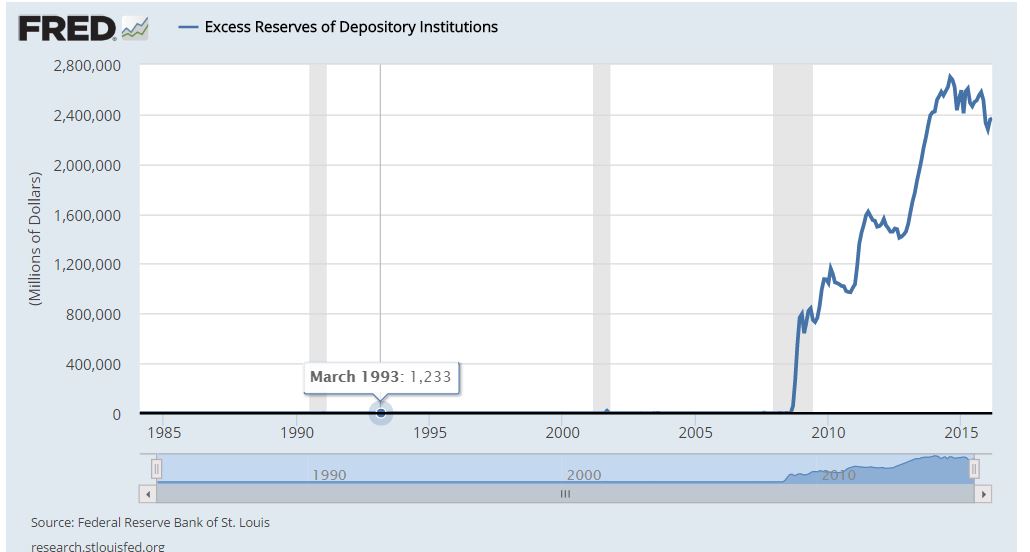
Will the Fed Keep Excess Reserves?


QUESTION: Hi Martin, I recently asked an Economist for a major Financial Institute the following question. Will the Fed continue to pay interest on “excess reserves” after they start to reduce their balance sheet? Their answer was yes, as it is a way to control short-term rates for private sector borrowers. I am not able to reconcile that answer with my understanding (maybe limited) of “excess reserves”. As always thanks for your continued input into my real life education.
Looking forward to another informative November Conference.

GH

ANSWER: I really do not understand that reasoning. It reflects a complete and utter failure to comprehend the system. Any pretend control over short-term rates seems to be absurd and would be opposite of the stated objectives of the Fed to return the bond market to the private sector. The Fed created excess reserves because they were buying the long-term debt and banks had no place to park money if the Fed bought the debt. So if the Fed allows its holding to expire and is no longer buying debt, then who would buy the debt if the banks still park the money at the Fed?

All our major banking clients in Europe are sending cash to their US branch and they in turn park it at the Fed so they are avoiding the negative rates if they park the cash at the ECB. This response illustrates that the establishment has still not figured out we are in a global economy.

It is IMPOSSIBLE for the Fed to “manage” the domestic economy because of the deflation spiral outside the USA. The Fed has become the world central bank as the IMF and everyone else lobbies the Fed not to raise rates because it will adversely impact other nations.

How can we even cope with the events to come when those in the establishment have no trading experience and only read books subscribing to old theories designed under a fixed exchange rate system? There is just not much hope that government will ever do the right thing. They have become the source of our nightmare.

The Fed will not end the Excessive Reserves instantly because they do not even fully comprehend what they have become. We will see a natural decline as rates rise in the marketplace. This could become the alternative to bonds during a crash and the Fed would have to recognize that they are now competing against the Treasury by keeping this facility open. Eventually, they will be forced to close it down once they understand how it is being used internationally.

The Theory of Non-Linear Intervention


Economics is well known for rather unrealistic theories based upon fundamentally unsound principles, such as the assumption that all things remain equal. Reality parts with academics whenever such assumptions are drawn to a foregone conclusion. However, greater false assumptions, which go unnoticed, lie at the foundation of so many theories in economics – primarily the assumption of linearity.

In our thinking process, we all are trapped by the Aristotelian sequence of logic – if X takes place then Y must follow. Unfortunately, we think in a linear fashion and, as such, most theories seek to embellish this very basic assumption. The financial world honestly wants to believe in simplistic notions. Raise interest rates and demand will subside along with inflation is but one false linear assumption. Man prefers to believe in linear relationships and systems, because anything beyond two variables becomes far too complex for rational thought processes.

Man’s natural tendency toward linear thinking has indeed created many heated battles. The arguments between supply and demand-side economics is one such example. Given the assumption of a linear economy, demand-side economists argue that the economy can be controlled through the manipulation of government spending and interest rates. In effect, demand-side economics seeks to use the consumer (demand) as a club to beat capital over the head. Yet these same demand-side economists claim that supply-side economics benefits the rich at the expense of the poor. Strangely enough, throwing the consumer out of work and causing higher unemployment to affect lower demand is the core of demand-side economics. It is hard to see how demand-side benefits the poor at the expense of the rich. The supply-side economist argues that there should be less government intervention in demand. Instead, government should stimulate the economy through encouraging greater output through supply stimulation.

Both sides have identified two extremes within a non-linear system, even though, based upon a linear assumption, their arguments assume that the other is totally wrong. If we look at just the last 10 years of economic activity one can clearly see changes within the infrastructure which provide a period where each form of economic management would indeed be appropriate.

Looking at the period of 1976–1980, it would be difficult to label this period as anything other than an inflationary spiral led by demand. Raising interest rates would be appropriate under such conditions when it is demand which flourishes wildly beyond its normal capacity. Hoarding and speculation was in full bloom. Therefore, one should employ “demand-side” economics when it is, in fact, demand which is out of control.

Nevertheless, in the post-1986 era and particularly since the ’87 crash, speculation is hardly the issue. We do not find excessive demand leading to the hoarding of commodities, as was the case leading into 1980. Yet, governments around the world are still employing demand-side economics to curb inflation, which is being caused by real shortages in labour and commodities. Clearly, in this case at least, supply-side economics makes much more sense. If interest rates continue to rise, the world economy will be threatened by a sharp and severe recession. However, the shortages on the supply side in energy, agricultural and base metals will not be corrected by raising interest rates. Higher interest rates will not cause the weather to return to normal. Higher interest rates will certainly not encourage miners to open new mines. Higher interest rates will also not cause a reversal in trend within the energy sector where exploration has been cut by more than 50% in the last two years.

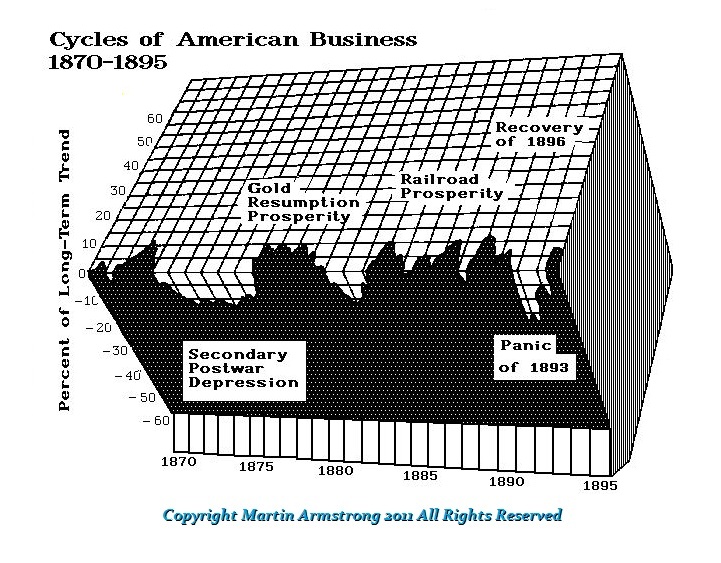
Supply-side economics is as valid as demand-side. There is a time and place for everything within the system because the system itself is non-linear. The chart provided illustrates our Theory of Non-Linear Intervention. This theory is essentially very simple and is based upon actual observation.

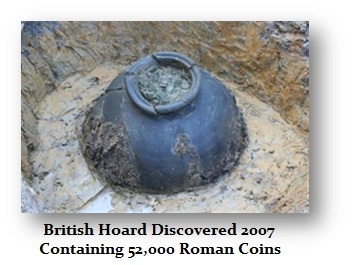
The standard economic assumption under demand-side economics is that raising interest rates will lower demand and inflation. If, in reality, this were the case, then Argentina with 300% interest rates per month would not be possible. However, continually raising interest rates does not prevent inflation. At some point in the system, confidence breaks down and higher costs in interest rates only add to costs of production and doing business. Eventually, this spurs on inflation instead of reducing it. Today we have gone to negative interest rates trying to stimulate inflation by punishing people if they fail to spend their money. What is constantly overlooked is the mere fact that if people worry about surviving the future, they will hoard money and save for the rainy day. The evidence of this are all the hoards of ancient Roman and Greek coins that reveal in times of uncertainty, people simply buried their money for a rainy day.

The very basic assumption that the system is linear is obviously incorrect. The business cycle exists throughout all times and portrays that the system is very much non-linear. If any effect is taken to extremes, the exact opposite effect emerges. This is the result of Non-Linear Intervention. Each economy possesses a different infrastructure. Consequently, the threshold where interest rates will cease being anti-inflationary and transform itself into the catalyst of inflation resides at different levels in each economic system. Differences in the value of labour, taxation, political systems and market mechanisms must be taken into account.

In conclusion, government intervention, which seeks to manage the economy in an efficient manner, always fails because they are conflicted with self-interest. They are the biggest debtor within society. Attempts to only manage the economy by  demand-side economics ignores the free market entirely. Intervention cannot possibly work when government remains in the dark about how the economy even functions. They fail to comprehend the direction and cause of inflation or deflation. The first step is recognizing that there is a business cycle, the second is to accept that a cycle exists, and third, we merely try to prepare for the downturns exactly as David advised the Pharaoh – 7 years of plenty v 7 years of drought.

The 2017 Year End Report Coming December 1st


The 2017 Year End Report is going to really be important as we enter the beginning phase of the Monetary Crisis Cycle in 2018 combined with the Pension Crisis, which is the next domino to start the process of the Sovereign Debt Defaults to come. Keep in mind that a system collapses from from the core, but from the peripheral economies inward.

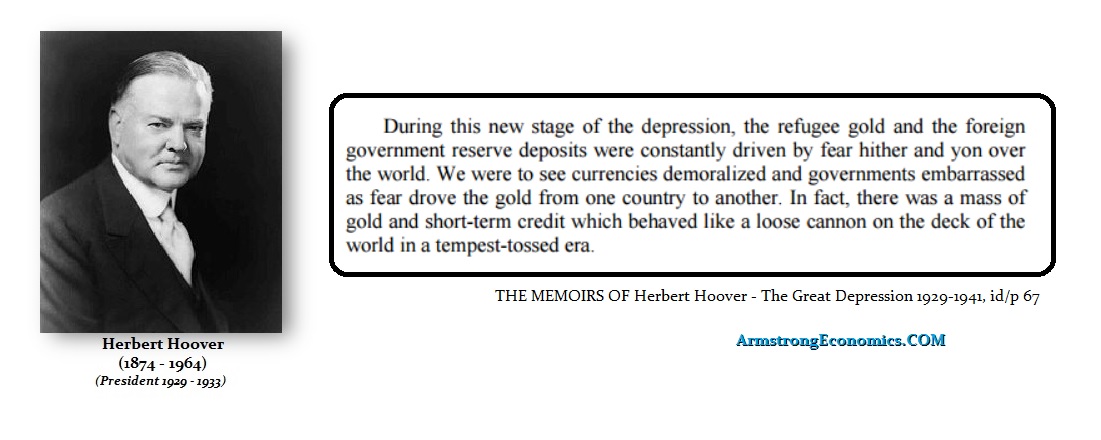
If you simply read Herbert Hoover’s memoirs for 1931, you will see how the Great Depression began as a contagion in Austria and the spread like the flu infecting all the economies until it led to a worldwide Great Depression. It was just two years later in 1933 that the economic contagion produce widespread political change. It was 1933 when Adolf Hitler came to power, Mao in China, and Roosevelt in the USA. It is never a particular political philosophy that wins, it has historically been a shift to whatever is the opposite of the current system.

This year’s 2017 Report will be very important. This will provide the signals on a global scale that will allow us to see the trend globally and the contagion that is preparing to infect the world economy unbeknownst to the political elite.

This Year’s Report will be included for the Orlando attendees of the WEC.

This Year’s Report will be $300

It will be Available December 1st, 2017

Will China take over US as the top Superpower


QUESTION: I read a credible theory recently about China taking over US as the top superpower via economic pressures. Namely by replacing the US dollar with the Yuan as the standard currency for international trade. This shift is (supposedly) being enacted through 1) increased control over Developing countries through international lending from the New Development Bank, 2) increasing control over global oil via financial ties to Saudi Aramco and Russia’s Rosneft, 3) trying to denominate global oil transactions in Yuan through the Shanghai oil futures market & backing up the Yuan value with the massive gold reserves China has been accumulating.

My question is whether you see this strategy unfolding as a credible threat to usurping United States’ global domination by China and if so – what might the investment world look like during such a massive upheaval?
Thanks – love your blogs & insights!!

WM

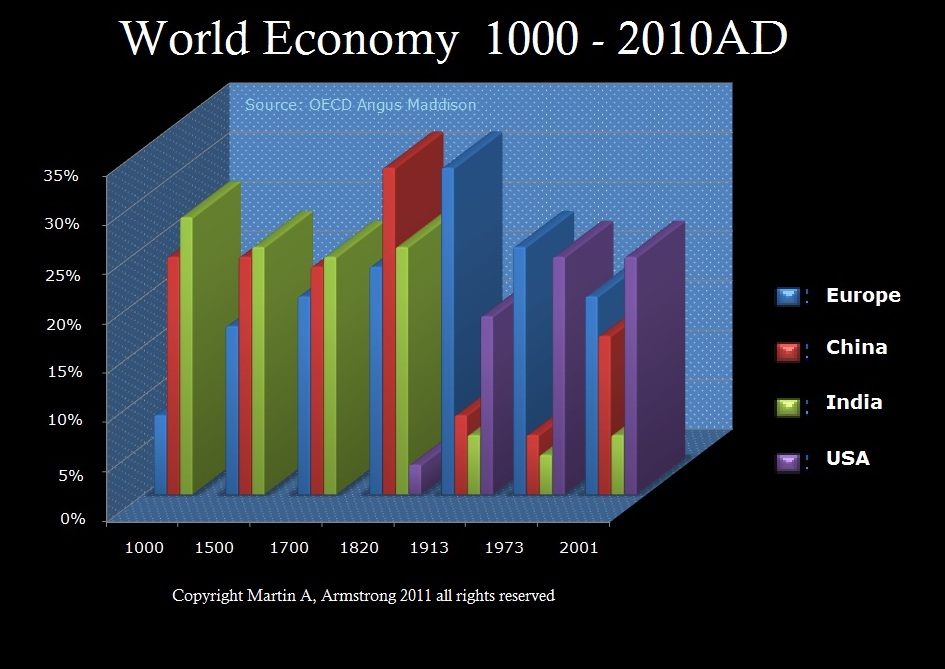
ANSWER: China is on the rise and it will become the financial capital of the world after 2032. However, it has a long way to go. China can price every commodity in yuan and demand all trade deals are in yuan. That still will not displace the dollar. The center core issue behind the dollar ironically in the US National Debt. For now, this is the place institutions can park their money. You can trade in any currency, but where do you park you profits?

China will displace the USA as the financial capital of the world when (1) people begin to trust China as a place to park money. Bitcoin exploded because the Chinese were using it to get money out of China, which had reach 98% of trading. China has been steeping in against BitCoin to stop the capital outflow.

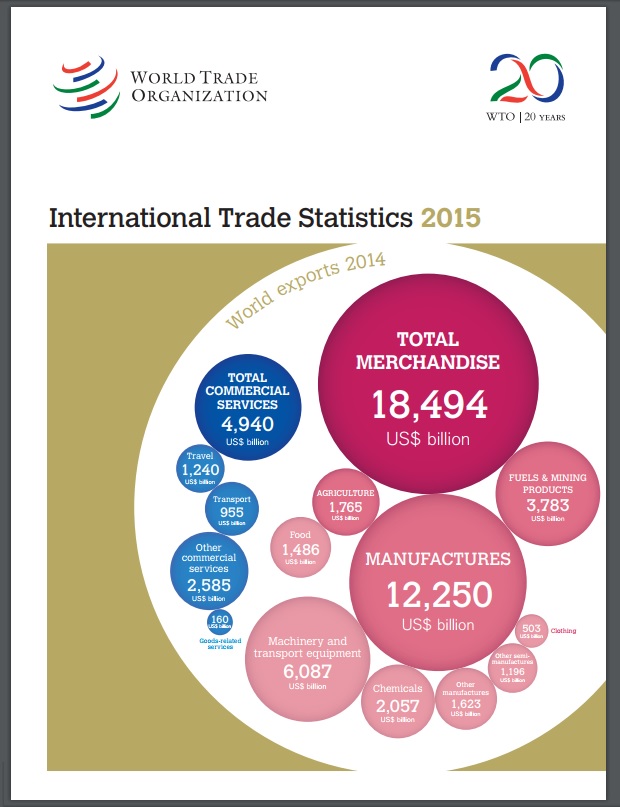
It’s the capital flows that are the key – not trade. The daily trading volume in FOREX alone has exceeded $5 trillion. Most investors are familiar with the stock market, yet they are unaware how small in volume share trading is compared to foreign exchange. The Forex market dwarfs the trading in equities and futures markets.

FOREX trade and investment capital flows DWARF trade flows. Absolutely nothing compares to the Foreign Exchange Markets.

Anyone can write a contract in dollars. You cannot do that in Japanese yen. If you issue a bond in yen you have to apply for permission back in Tokyo. All these argument are made up by the dollar-haters who are so desperate to find an excuse that the dollar will crash. It’s time will come. Just not yet.

Italy’s Experience With Pre-Pay VAT Was Devastating


COMMENT: Re:  Germany To Tax VAT Just Billing People Before they Pay

Please note in Italy we had the same = pay VAT to the government before collecting it from client for decades, until a couple of years ago (approx), when Italian government changed the rules (first you collect VAT from clients, then you send VAT to the Government).
They changed rules because Italian companies had a collapse (in sales, payments, orders,… nearly almost 50% were bankrupt) and nonetheless they have to pay the VAT to the Government  before to collect it from customers, and they were using cash or credit resources or even open bank loans to pay VAT (not yet cashed from customers). The largest and the smallest companies were in serious trouble; a lot of them forced to close or to go bankrupt.
Then this change in law just to give some …relief …to the remaining economic structure…
Thanks for your attention and for sharing with us your knowledge.
All the best
D

REPLY: Yes I am aware of the change in Italy. You are correct. This will stop companies from contracting installment payments and it will complete alter how you enter into employment contracts. Politicians are just incapable of understanding how the real world works which is self-evident from how they pass laws like this.

This will seriously hurt the German economy and further add to the deflation and economic decline ahead.

Diversification – Smart or Dumb?


WorldIntRates-2012

QUESTION: Mr. Armstrong; Do you believe in portfolio diversification?

ANSWER: No not really. I see no point in putting money in something you know will be a loss. Diversification within a sector is one thing. But buying government bonds when rates are at a 5,000 year low and governments are in trouble around the world, I just see as really stupid.

Once you understand how our global model works, you can see the trend unfolding in a numerous instruments that therefore confirms the trading direction. For example, we warned that gold had made an important high and would crash from 2011 for at least 3 years minimum. At the same time, we warned that the Dow would breakout to new highs. Barrons reported that forecast and did not believe that we would be correct. Both the high in gold and the breakout in the Dow were connected. Each confirmed the other among a host of other relationships.

What is impossible is trying to forecast just gold or the Dow in isolation relying upon fundamentals, which always prove to be worthless. Take the Long-Term Capital Management Crisis of 1998. The problem began in Russia and investments there collapsed but you could not get out at any price. They began selling assets everywhere else in the USA to Japan. This became a liquidity crisis that spread into a contagion. You could look at all of the fundamentals that said nothing should be happening in Japan. That led to massive losses in Japan that were contrary to fundamental analysis.

Everything is interconnected. Diversification is for people who cannot forecast so they just hope to stay ahead of the game. Asset Allocation has to be done smartly. You need some cash and those who will want some bonds v equities simply need to stay short-term and away from issues that will be a problem.