Oil & Pegs


QUESTION: First question: Disappointed I have not heard an opinion concerning OPEC’s continuation of reducing oil out put. Can the US shale drillers fill the void and or can the Canadian and Mexican producers ramp up any shortfall into the US

Second Question: What is your opinion on the Chinese Yuan being pegged to the US dollar. In the past you have always stated that “pegs can’t survive” i.e Swiss Franc to the Euro.

ANSWER: Supply really has little to do with the price. The real issue is demand. Electric cars are coming rapidly. I have a BMW hybrid I8 sports car and it is fantastic. It is the fastest sports car I have ever owned off the line. It has two engines a gas and electric and this technology is being expanded to all models. My neighbor has a Tesla and that is fine for local use. Tesla vehicles are currently the only battery electric cars you can buy in the that have an official range of more than 200 miles per charge. When I went to Amsterdam, the taxis are Teslas. Europe is moving toward electric cars faster than the States.

Most major automakers, including GM and Volkswagen, have vowed to roll out more than one fully electric car by 2020. In Europe, the average emissions level of a new car  2015 was 130 g of CO2 per kilometre (g CO2/km) and those sold in 2016 was down to 118.1 grams. By 2021, this has to be down to 95 grams of CO2 per kilometre.

Sales of electric cars totaled over 315,000 units in 2014, up 48% from 2013 reaching 565,00 units in 2015. In the U.S. alone, 542,000 electric cars have been sold to date. Granted, that is still small in comparison to the overall number estimated to be 263.6 million cars registered in the United States in 2015. Nevertheless, the trend is in motion. Does it by itself kill oil? Not yet! This is why oil did not elect any yearly long-term bearish signals on our model.

Keep in mind there are a lot of new discoveries also in gas. Cars make up 51.4% of oil consumption and jet fuel is 12.3%. Historically, demand drops with the economy as people drive and travel less. That is clearly the trend we see ahead.

With regard to pegs, none will stand and that includes China, Hong Kong and Middle East. What will break the peg is the dollar rally for that will import deflation to those nations with dollar pegs.
 

Shari’ah Standard on Gold to Replace the Dollar? Really?


QUESTION: Mr. Armstrong; I have read where some people are claiming this “Shari’ah Standard on Gold” will become the new “reserve currency” and this seems really just nuts. I understand there are 2 billion Muslims in the world, but they seem to forget that this is once again wild speculation. Any thoughts?

OP

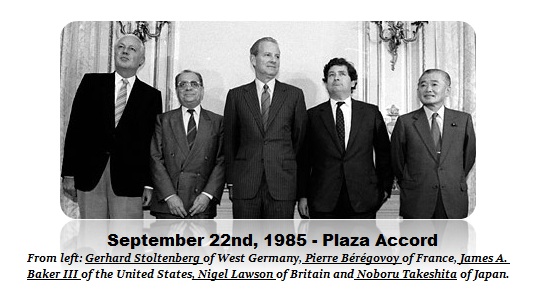
ANSWER: No. This is really rather absurd. First of all, not even the Euro could displace the dollar nor the Japanese yen, Chinese yuan and yet some meager 2 million average citizens will do so? I really hate to burst these people’s bubble in La-La-Land, but I have been in meeting and there are people in Washington who are trying to figure out how to get the dollar to be replaced somehow. The last failed attempt was the Plaza Accord in 1985 intended to push the dollar down and the Euro was born there and then. This is when James Baker encouraged Europe to create a single currency to “PLEASE” compete with the dollar. Every Administration has wanted a lower dollar to increase exports. Trump is no different. Sorry – they ALL HAVE FAILED!!!!!!!!!!!!!!!!!!!

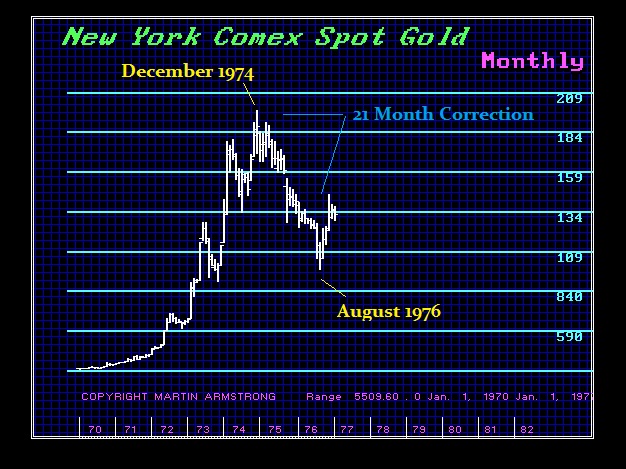
Secondly, this is really nuts and the very same hype I recall from 1975 when Americans were for the first time legally going to be able to buy gold starting January 1st and that is when gold futures began as well in New York. What happened? The hype drove the price of gold up to nearly $200 and on January 1st, 1975, it began a crash by almost 50% into 1976 for 21 months. They said the same thing about China and how the Chinese demand would make gold soar. Then they said the same thing about India and now its the Muslims. They keep switching groups to sell people gold like some used car salesman. In any other field it’s called consumer fraud.

Gold will rally ONLY when people begin to see that governments are failing. I am not talking about my readers. We all see what is coming. I am talking about the AVERAGE person on the street. Then you will see the gold breakout. We are getting closing. Patience is required when it comes to gold

US to Sell Off its Strategic Emergency Oil Reserves


The US government plans to sell half of the Strategic Emergency Oil Reserves and gasoline. The days of OPEC embargoes of the 1970s are now long past. The government plans to increase its budget for the financial year by $500 million. Therefore, over the next decade, the government wants to increase financial leeway by as much as $16.6 billion. With the US at a net exporter level and the shift toward electric cars, it becomes questionable if we need the Strategic Emergency Oil Reserves any more.

We still see support at the $32 level on a yearly closing basis. To stabilize, we need Crude to close above the 2016 high of $54.51. Both the oscillators as well as our Energy models imply that the high is in place for the near-term in real value. As long as Crude hold above the $32 level on an annual closing basis, then moving forward in time, new highs in nominal terms becomes possible but not in real value terms.

Schiller Cyclically Adjusted PE Ratio (CAPE) – Real or Mislead?


QUESTION: Hi Martin,

Long time… perhaps you can reflect on the indicator of the Shiller CAPE ratio?
Not that it is a predictive sell/buy signal in itself, but it is an indicator showing history
R

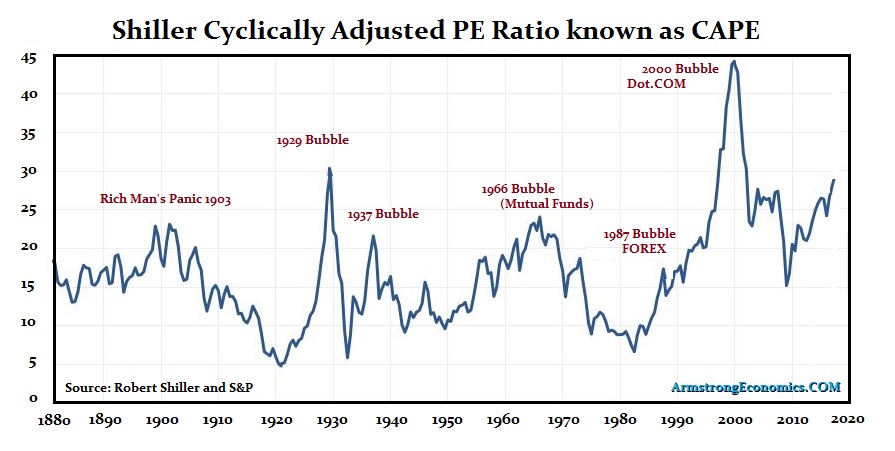
ANSWER: The Shiller Cyclically Adjusted PE Ratio known as CAPE,  is a particular PE ratio invented by Robert Shiller of Yale University. Unlike his index on real estate, this one tracking the period of 1870 to date is not very good. True, on will arrive at one of two conclusions that either the CAPE today is near the same level as in 1929, or it is higher today than it was just before the Panic of 2008. Does this really mean anything? Absolutely not!

When we filter this purely domestic view through the currency and capital flows, these two events are exactly opposite of each other. In 1929, the capital inflows were pouring into the USA whereas in 2008 then were exiting. The 2000 Dot.COM Bubble took place with a capital inflow.

The important difference is always the currency. Great bubbles unfold only when foreign capital is pouring into a domestic market. This is when the Japanese Nikkei Bubble took place in 1989. The capital left the USA as the Plaza Accord was pronouncing they wanted the dollar down by 40% to help trade. The swing in capital back to Japan looks like the brain wave of a real crazy person.

There is a risk of correction in the US Share Market after May. But this has nothing to do with the PE Ratio. We are looking at capital flows and that is the real key. The attempt by the Washington Post and New York Times to stir up a coup to oust Donald Trump will have far greater impact on the dollar and US assets than the PE Ratio, which is a very myopic domestic view.

Research – Where to find it


QUESTION: Mr, Armstrong; I read the research you provided for the Hong Kong WEC. I tried to see if I could find some of the Harper’s Weekly articles you photographed and perhaps others. They are not on line. May I ask, where do you get access to such material?

ANSWER: I have a very extensive library of bound volumes of newspapers from the USA as well as Britain. This has enabled me to conduct real research and see the thinking process and how it has evolved with the markets. First of all, I have to use the original source. Far too often when you dive into it, you find that people have made up quotes to support a predetermined agenda. This way, I can quote directly and not rely upon others.

Interest Rates Up & Bonds Up?


While the Fed may be raising rates, there is still a flight to quality underway that is giving a bid to US Treasury issues. Low Treasury yields may remain the norm even if the Federal Reserve raises rates again. At about 2.25%, 10-year yields have dropped to 2017 lows, even with the central bank signaling an imminent rate hike. Many still see the stock market crash and that also supplies a bit of an underlying bid right now. However, The Fed has also made it clear it will maintain a gradual approach to shrinking its massive bond portfolio thereby reversing the Quantitative Easing. We are in never-never-land where the Fed tightening will not yet have a direct impact upon the bonds on a one-for-one relationship.

When we compare the 10-year to the 30-year, we see strikingly different patterns. The high on the 30 year is 2016 in price (low in yield), whereas the high on the 10-year in price (low in yield) remains 2012.

Now look at the 2-year rate bottomed in September 2011 (high in price). Clearly, 2-year rates have been rising gradually for 6 years already.

Now when we look at the 30-year on our Proprietary Perpetual 30 Year Contract back to 1798, we gain true perspective in how rates have performed in the long-term. We are clearly looking at a bond bubble, but the breaking point appears to be 2018. Because of the extreme flight to quality, we can still see a pop up in the 10-year before this is all over. This depends entirely upon the capital flows.

US Pension Crisis Picking Up Full Speed


The Pension Crisis is serious and is the catalyst that will bring everything down. Nearly 600 State & Local governments are now in the hole and has reached nearly $1.2 trillion of unfunded pension liabilities in FY 2014. This reflects total pension liabilities of $4.798 trillion and total pension assets (or fiduciary net position) of $3.607 trillion. This staggering number is nearly 25% of the annual GDP and accounts for roughly 97% of all public pension funds in the United States. California is raising taxes to cover the short-fall for now, but this is going nowhere fast. Government pensions are what destroyed the Roman Empire and history is going to repeat.

I have stated before that there are people on Capitol Hill who support confiscating all private 401K plans in the country and replacing them with an allotment monthly. We know what will happen to that one, so you better have something else besides cash. The government cannot meet the promises for its own employees and they will turn to increasing taxes and confiscating private property.

Fed Rates & Minutes


Minutes from the Fed’s May policy meeting showed board members thought that if jobs growth remains healthy with a rebound in investment and consumer spending then rates could rise “soon”, which many took to mean June. The economy has shown some signs of weakness, the Fed still thinks its broad strength would justify winding down its balance sheet, essentially sucking cash out of the system and putting upward pressure on borrowing costs. As long as rates rise, it shows the economy is still holding.

The Fed is more concerned about the stock market. A correction would help ease the upward pressure, but the Fed also realizes that it has to get rates back up because of the looming crisis in State *& Local pension funds.

Keep in mind that as rates rise, so will the problems with fiscal budgets both on the Federal and States levels within the United States and externally it will hurt emerging markets and Europ

New Argument to Raise Rates – Rent Inflation!


There are those in the Fed who are desperate to find an excuse to raise interest rates. The one being bantered about is the Fed needs to raise rates to help the poor. Yes – you heard correctly. To protect the poorest Americans, the argument is that the Fed needs to raise interest rates faster according to Federal Reserve Bank of Kansas City President, Esther George. She said “inflation is a tax and those least able to afford it generally suffer the most.” Her twist is focused narrowly on just rental inflation, which she said will continue to rise if the Fed doesn’t take steps to tighten monetary conditions.

The idea of inflation as a tax that hits the poor the hardest is by no means a new theory. Of course you must ignore the fact that interest the poor pay on just about everything is far higher because the Fed wanted to fight inflation back in 1980 and had to abandon the usury laws in order to raise rate to 14%. As always, they never put back whatever it is they suspect for some solution. The Fed is responsible for the poor paying interest rates at over 20% to live on credit cards.

If the Fed really cares about the poor, knock off the BS and restore the usury laws. Oops! The banks would like that now would they!

Fines – Civil Asset Forfeitures – Taxes


When I was a kid, most police were kind, respectful, and actually there to protect society. Sure, there was some towns that were just greedy. My father took a local post as a judge in Cinnaminson, New Jersey. It was the politicians who told him they want the maximum fine for everything. My father refused and quit. It is not even the police who are ticketing people just for fun. There are quotas and pressure to raise money for the politicians. Governments are just going broke. Many of the police they bring in today are not like they use to be. They are much more nasty and aggressive.

All of these trends are alarming from civil asset forfeitures and tickets for everything in Europe where speeding tickets are fined a proportion of your net worth. All of this is seriously wrong and when government turned against the people, this identifies the trend at hand. This is part of the shift from Public to Private and with only 52% of Americans who now trust the police, this reflects how serious this shift on confidence has become. Gallup Polls have been asking this confidence question about trusting the police and the response has ranged fairly narrowly between 52% and 64% since 1993. Now, it is at historic lows of 1993.

red-light-cameraThe attempt to raise revenue with red light cameras has exposed unbelievable corruption. Private companies pay to install the cameras for a cut of the fines. Florida Supreme Court ruled that it is NOT legal for the cities to continue to issue Red Light Camera Tickets in the manner in which they have been issuing them. In the Ohio hamlet of New Miami, the town was ordered to pay back $3 million in automated traffic fines levied against drivers along the stretch of highway the town straddles.

The former chief executive of Chicago’s first red-light camera vendor was sentenced to 30 months in federal prison and over $2 million in restitution for paying bribes to a city official to help procure the contracts.

New Jersey has the strictest yellow timing provisions in the country as a result of concerns that cameras would be used to generate revenue; they have a statute specifying that the yellow time for an intersection that has a red light camera must be based on the speed at which 85% of the road’s traffic moves rather than be based on the road’s actual speed limit.

Fremont, California is proposing to reimburse drivers who collectively received more than 1,000 red-light camera tickets during a period when it inadvertently shortened the time they could cross on yellow signal lights through a couple of  intersections.

The list of states going after red-light cameras is indicative of the entire problem that as government go broke, they fine people, raise taxes, and confiscate property. This is all part of the shift from Public to Private Confidence