Why would anyone buy European bank stocks?


The European banking crisis is still brewing. The biggest problem rises from the rules that if a bank is in trouble, they just seize the bank and sell it for €1 and all the shareholders lose everything. This is having serious impact upon the European Banking System as a whole as I previously warned. The Italian bank Carige has had difficulty in trying to raise capital to meet requirements. If any bank cannot raise enough capital to meet the requirements, the European supervisory authorities can seize the bank in accordance with the new rules.

Once again, the government solution is to make up rules that totally disregard the private reality. Why would anyone buy bank stocks in Europe today if the government can seize everything and shareholders get zero? Spain’s Banco Santander bought rival Banco Popular for €1. This is Brussels’s new system to rescue failing banks without burdening taxpayers or stressing markets. This was cheered around the world because the shareholders lost absolutely everything. The bank which was valued in the collapse at €1.6 billion was bought for €1.

Hello! Why would anyone buy European bank stocks? I cannot recommend buying any in Europe. It’s just too risky. An Industrial corporation goes into bankruptcy and its assets are sold. The shareholders get something back. Banks are becoming more like government bonds. The normal rules just do not apply.

The Epidemic of Fake Analysis


COMMENT: Mr. Armstrong; I want to thank you for your work on Europe. We hear nothing from European analysts but up-up-and away and it makes one wonder if that is not fake analysis just like the news. Nobody seems to be talking about how retail sales are declining in Europe and even my mother, who is 90, said it is because they tax us too much.

Keep up the analysis. We need someone to tell the truth who is not told what to report here in Europe.

PF

REPLY: Yes, that has always been the NUMBER ONE problem in analysis. A famous bank has analysts but they cannot speak truthfully for the ECB will pick up the phone and they are silenced or fired. BTW, your mother is spot on. They keep raising taxes and hunting money and then wonder why there is deflation. Ah! The illogical thoughts of those in power.

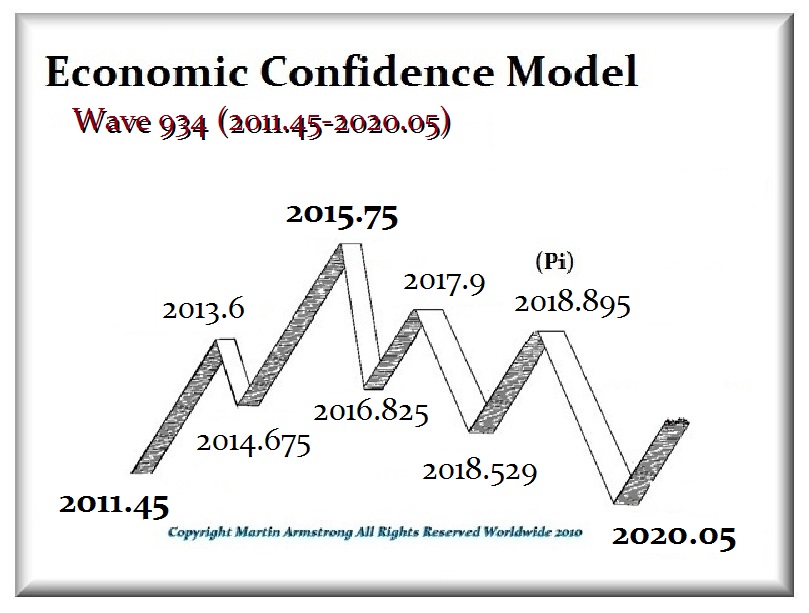
The retailers in the Eurozone had posted the second monthly decline in sales falling 5% in August. This was the sharpest drop in one month since October 2015 when the ECM turned. It does not speak well as we head into 2020. The official news reported was that European Economists came out and forecast in response that sales will increase of 3% next year.

During the holiday season in August, which is traditionally the best month of gasoline sales, reported a stunning fuel sales decline by 9%. This is reflecting the growing concern about terrorism as people are showing a distinct decline in travel.

Our problem is that we have career politicians. This infects everything. They are only concerned about their reelection so they manipulate the analysis to deny that there are problems. All we hear is constant complaints about the quality of analysis. The shocking trend is now central banks want to just subscribe to Socrates because even they are fed up with what you call “fake analysis” that is getting really bad.

Global Warming Taxes – Or Just Another Excuse?


Now that the German elections are finished, Merkel now comes with the tax hikes. This shows the contempt for the people assume that they are just stupid so do nothing before and election, then raise the taxes after. According to a report, Germans should not expect about a 50% tax increase on electricity. As the Bild newspaper reported on that the Federal Association of Energy Consumers will raise the taxes significantly all in the name of causing people to save the planet while government lines its pockets.

The Bull Market – This time It Really Is Different


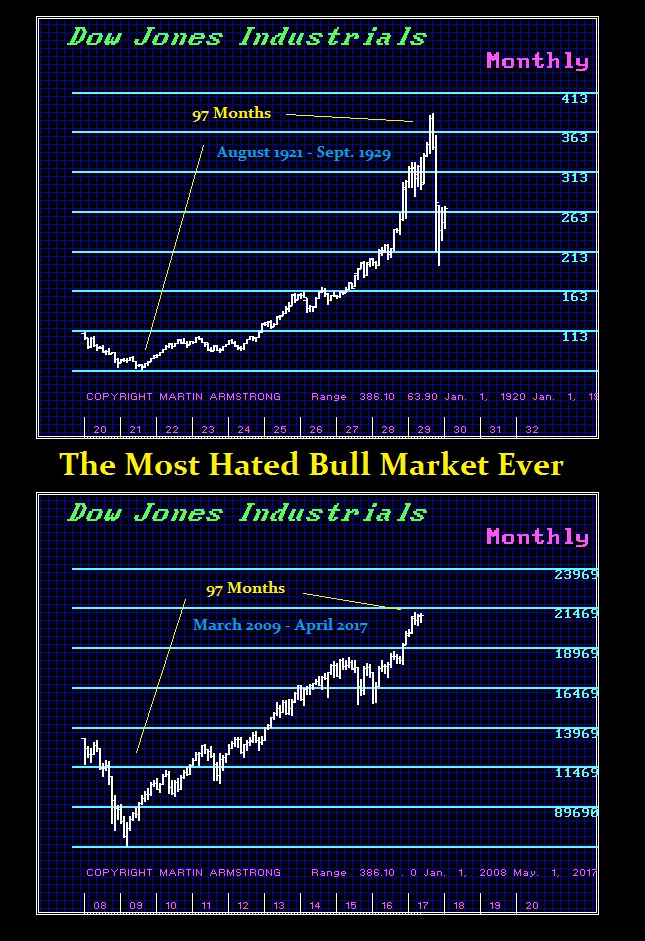
This current Bull Market has indeed been the most hated in history. Typically one expects complete euphoria as new highs are made. However, this bull market is really different this time. This rally is by no means the product of euphoria. While the majority of analysts have been calling for a crash since 2010 and every new high was supposed to be the last, this cannot be compared to the Roaring 20s.

If we lift the rug and look closer, you will start to put the pieces together. There has been a bond and property rally over the past seven years whereas rates were rising into the 1929 high and property burst in 1927 with the Florida Land Bubble. This is not even similar to the roaring Dotcom Mania of 2000. The PE Ratio was significantly higher in both instances.

Government bonds have moved even to negative yields at times in Germany and creditors have demanded insane levels of credit to buy housing in the States opposite of the free lending going on in Europe as banks are desperate for yield.

Rarely has high-end property prices around the world soared so high. We have seen this is London, Toronto, New York, Miami, Vancouver, Hong Kong and Sydney to mention just a few. The price of the average American house remains still 20-50% off from 2007 levels depending on where you look.

Rare coins, art, and antiques have soared around the globe. Add to all this the craze, we have  cryptocurrencies and BitCoin going nuts. Yet the entire bull market of the Roaring ’20s was 97 months. We passed that mark in April 2017. This is also the longest bullish trend suggesting there is something else afoot.

So exactly what is going on? Do we really have a bull market in EVERYTHING? Well the answer is yes and no. If we look closely at the high-end property market, much of the sales are for CASH – not leveraged. This too is highly unusual. Historically, such asset bubbles have been funded by banks. Yet the bitter experience has shown that debt-funded asset bubble implode taking the banks with them. The assets collapse in value because the banks need cash with withdrawals. The leverage magnifies the cash on the way up, and on the way down, assets crash to rebalance against the actual supply of cash.

For this reason, banks must be able to withstand such a contraction and the theory is to raise bank capital. That means raising bank capital to meet “stress tests” imposed by the various government authorities. The European Banking Authority (EBA) published the list of public sector entities (PSEs) that may be treated as regional governments, local authorities or central governments in the area of credit risk, in accordance with the Capital Requirements Regulation (CRR). This list will assist EU institutions in determining their capital requirements for credit risk. The problem with all of this “stress test” criteria is the fundamental assumption that government debt is risk free. In particular, the EBA includes those PSEs that are treated as regional governments, local authorities or central governments due to their reduced risk level. As a result of this treatment, exposures to the PSEs included in the list will qualify for the same risk weight as for the respective regional government, local authority or central government. The assumption that government debt is superior to private debt backed by assets underscores the real risk on the horizon.

The bull market in everything is really a global realization that government is in trouble. We are looking at money getting out of banks and government to REDUCE the risk of government as we move forward.  So this time it is different. Normally, we have one sector at a time in a bubble, commodities, stocks, real estate, tangible assets. We normally do not see a bull market in everything unless there is a wave of movement away from government.


EU is becoming a No-Go-Zone for Business


The European Union has ordered AMAZON to pay about 250 million euros ($294 million) in taxes to Luxembourg, saying it was given an unfair tax advantage from 2003 because it paid less than they would have paid in France or Germany. The EU is retroactively changing taxes. This is a sure fire way of telling companies to get out of Europe. If no matter where you build your plant, if you would have been paying a higher tax in France or Germany, the EU says that is not fair and you have to pay more in BACK TAXES.

In restructuring companies, taxes were always NUMBER ONE after Country Risk. The EU has just made Country Risk paramount. Honestly, I would have to advise companies NOT to set up shop inside the EU. Best to go to the UK and pay any tariff than to be retroactively taxes because the EU is broke. This is introducing a whole new risk into the mix. The EU is becoming a no-go-zone for business.

It is now too risky to business in Europe for they are changing the rules retroactively.

Gold – Dollar -Trade Deficits All Mixed Up


COMMENT: Marty; I get these emails about gold and have to wonder how people can keep preaching the same thing for decades and never be correct once. Not they say in a very simplistic manner that  Politicians argued that endless trade deficits were immaterial because U.S. exceptionalism allowed America to do what it wanted. If foreign leaders refused to accept dollars for commerce as Saddam and Gaddafi did, the U.S. used its military might and CIA for regime changes. Even the strongest adversaries like China and Russia cannot compete against U.S. weapons of mass destruction, so they are increasingly engaging in currency wars of their own to protect their national sovereignty. Is the dollar in trouble as a result?

They seem to advocate the collapse of the USA is necessary so they can make money on gold. Like you said on Global Warming, they want to reduce the population so a good thing would be to stop having children without thinking the birth rate is down so pension are collapsing.

What you have shown is none of this nonsense is necessary for gold to rise and that trade is a tiny fraction of capital flows. Are these people just mindless? The dollar is the lynch pin holding everything together. Here in Europe we have a lot more problems than the USA. BitCoin crashed because the Chinese were fleeing to dollars trying to get their money out of China.

REPLY: This is the classic problem in analysis. You fit the fact to your predetermined conclusion. They keep praying for the collapse of the dollar to make gold go up. The problem is then, if everything collapses, what good is gold if you cannot spend it because nothing has survived?

Very strange theory. BTW, Saddam and Gaddafi did not reject dollars. I even managed money for Muammar Gaddafi TWICE. He had no problem pouring millions of dollars into accounts to trade. I also knew Milton Friedman who advised that a floating exchange rate would provide a check and balance on the system where fixed exchange rates . The trade deficit is offset by the capital account reflecting investment. In fact, if a foreign entity BUYS American debt, that inflow goes into the capital account – not trade account. However, the interest payments go out in the Current Account commonly called the Trade Account. There do not even understand the accounting.

The more foreign investors come into America and the repatriate their profits, the “trade deficit” will appear to get worse and it has NOTHING to do with trade.

ECB v the Federal Reserve – Different Animals Altogether


QUESTION: Do you you really think Trump would let the Central Banks Default? He said we would write off PoteRicos debt maybe he plans to write everything off can he do that? If this really did happen wouldn’t the dollar be worthless?

S

ANSWER: It seems as though far too many people ASSUME that all central banks were created EQUAL. Sorry – that is just not the case. These people who do not really know what they are talking about assume that just because the Fed has the power to create elastic money, that therefore the ECB can do the same thing. SORRY – WRONG!!!!

There is a substantial difference between the Federal Reserve and the European Central Bank (ECB).
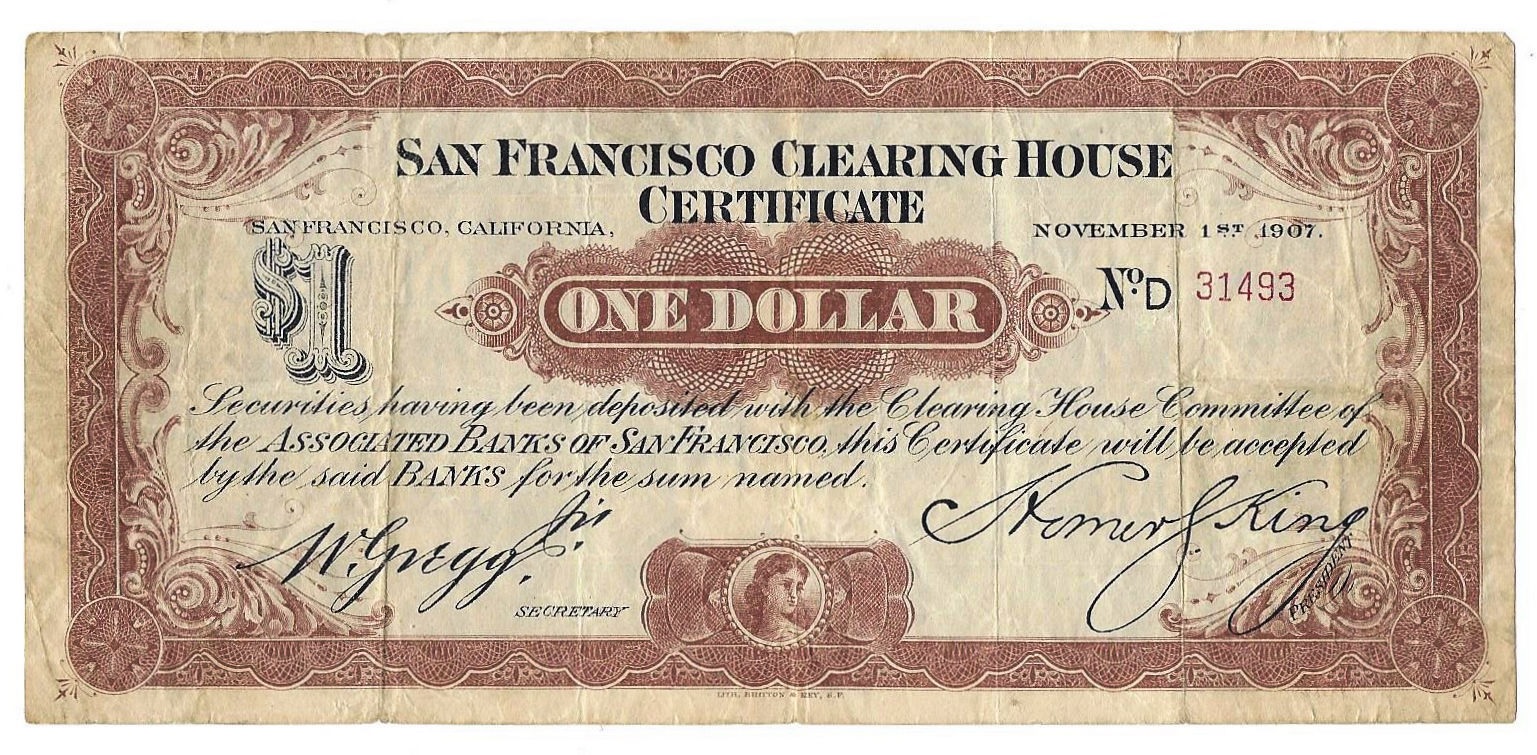
The accounting at the Fed allows for it to CREATE money as needed. Now the fiat crowd will argue that the Fed can just create money in a very ELASTIC money supply. This is true and it was intended from the very outset that when economic declines appeared, the leverage within the system would implode and thus to ease that contraction in the supply of money. Hence, the shortage of money resulted in defaults and assets decline in value relative to the contraction in money supply. Therefore, the Fed was created with the power to create ELASTIC money based upon the system of Clearing House Certificates that had pre-existed during the 19th century. The Clearing House  would issue its own money and then after the crisis, that money was retired – hence the term ELASTIC.

So how does this contrast with the ECB? Here in lies the problem. The ECB is NOT authorized to create
an ELASTIC MONEY SUPPLY. Germany would never allow that. Consequently, the ECB cannot continue to just buy-in sovereign debt of member states as the market forces come down upon them. The ECB, unlike the Fed, will run out of money and then there will be a very public crisis whereby the ECB will have to be recapitalized. I wrote about this before in Federal Reserve v ECB.

I warned back then that “Something will have to give in Europe.” The ECB was granted a ceiling to buy in government bonds. It cannot just print money with no end in sight. It must get approval, which the Fed does not require from Congress. The two are completely different animals.

On top of this, each member state retained its own central bank. Each member bank issues euros in their domestic economies. You can collect euro coins from each central bank – the ECB does not issue them.

Then the reserves of the European banking system had to be politically correct and the reserves were composed of all member bonds. Why? Germany opposed a single European debt issue.


Now, the Fed bought in $4 trillion against $20 trillion and the debt was only federal. The ECB bought the worst debt and now owns 40% of the total debt of the Eurozone members. Why is the ECB in danger of a default?

If there is a disagreement in Brussels, then the ECB runs out of cash. As interest rates rise, the value of its balance sheet will collapse. The ECB cannot sell the debt back to the market for there is no bid. To try to support the debt market, Brussels made it illegal to short government debt. Hence, there is no free market in European sovereign debt. If the ECB bought 40% of all debt, who is going to buy it when they stop?

This is a completely different perspective v the Federal Reserve which will just let its US federal debt holdings mature and expire. They too cannot sell the debt or interest rates would explode.

Welcome to the reality of the crisis. NOT all central banks were created equal. Those who paint them all with the same brush know nothing about what they are talking about. The ECB claims it cannot go bankrupt because it will just issue more money. The fact that they have even stated that demonstrates there is a huge problem. That depends upon one thing – approval from the politicians to issue more money.

I meet with central banks directly! This is comments about a field I only read about in the newspapers. I am not even sure the newspapers ever reported the actual differences between the central banks.

Governments are NOT a single entity. Central Banks are far too often on the opposite side of the table with the Political side of government. It is far more complicated than most people would ever guess

Saudi Arabia threatens to Privatize its Oil and Exit OPEC?


Saudi Arabia may actually be exiting OPEC. There are serious discussions about floating the state owned oil producer Aramco. Saudi Arabia attempted to get other oil producers around the world to agree to reduce production. Saudi Arabia is looking to float Aramco if the other producers fail to agree to cut production. The problem is that OPEC cannot reverse the trend in motion.

The BREXIT Bill to Leaves is All About Pensions for EU Politicians


Why is the bill so high from the EU to Britain to exit the EU?  It’s the Pensions. The EU pensions for government employees is rising dramatically. This is why the exit bill is climbing so high. They expect Britain to pay up for pensions of other EU politicians. Hm. It’s always about them! Curious!

Central Banks at Risk of Default?


Central banks do not play games with the markets but it sure feels like we are being played by someone! Earlier this year the Bank of Japan, Federal Reserve and the European Central Bank all had similar balance sheets at around $4.5 trillion.  As we know, over the past ten years all three have risen from lower levels but have seen faster expansion by the BOJ and the FED gaining pace to now catch the ECB. Foreign exchange rates are always subjected to inherent volatility that is thrown into the mix. However, given the recent extremes on all fronts, there has been uncanny similarity around end of Q1’ 2017.

Typically, a central bank balance sheet would off-set Assets against Liabilities and capital.

On the assets side would sit: –

(i) Net domestic assets, and
(ii) Foreign assets.

Liabilities would list: –

(ii) Non-monetary liabilities (Central bank securities and other), and finally

(iii) Equity Capital

(iv) Reserve money (currency in circulation and those of commercial banks)

In times of crisis it is common the central bank assumes the role of lender of last resort. Assuming the crisis was 2007/8, then it should be normal to expect the balance sheet to now shrink back to the levels of the pre-crisis era. However, we have heard many comments recently from the FED about re-normalizing their balance sheet but the BOJ and ECB are set to carrying-on for the foreseeable future.

Focusing now on the first two, BOJ and FED, the process is so much simpler because much of the debt is consolidated and displays a meaningful explanation of their economies. The heavyweight here is the BOJ with assets held close to 100% of GDP but the risk here could be off-set by the currency. Japanese debt is held domestically because of the currency controls. Hence, the yen could collapse to devalue the debt fairly easily once the markets wake up and smell the roses. The FED never came close to absorbing the full national debt or a percentage of GDP as has taken place in Japan or Europe.

Turning to Europe, the equation becomes far more complex when you consider the case for the European Central Bank. Since they initiated the APP (Asset Purchasing Programme) we have seen a need to follow cash within the components of the ECB itself. Within the European structure each central bank buys their own debt in relation to the size of their economy. The guidelines covering this activity are entitled Target2 and are easily found on the ECB website. What should be monitored closely is the trading between sovereigns, the rates at which all are traded, who the counterparties are (where they are located both domestic and international), and FX forwards’ trades that match the transaction dates. In many cases the NIM (Net Interest Margin) for many banks looks terrible but that is because the profit will appear in the FX books (which is the other side of the trade). Many reasons for the discrepancies’ from following the cash to liabilities, but Target2 and the concerns surrounding this are only recently starting to make some take a closer look.

Much has been published about Target2; so, let us concentrate on the fact that both Spain and Italy owe Germany around $400bn each. Neither the BOJ nor the Federal Reserve have this problem (internal macro issues) so from this angle alone there should counterparty risk that must be factored in. However, as we know the 10yr Bund (0.45%) trades around 185bp through treasuries (2.30%) and even Spain and Italy are negative 70bp (1.6%) and negative 20bp (2.10%) respectively. In short, we are seeing Spanish and Italian domestic investors moving away from government bonds thereby aiding capital outflow. This is fine for individuals and Spain/Italy but is just moving the risk up the food chain.

As we know the ECB owns around 40% of the European government bond market as we currently stand. Obviously, at these spreads the market is hardly reflecting appropriate risk and questions the likelihood of any easing without having a huge implication on both spreads and risk. The question should also move to counterparty risk for not just Germany but ultimately the ECB!  Maybe they should read their own recently published report (ECB guide on materiality assessment – 25th September 2017) as they increase the awareness of counterparty risk and the Credit Valuations Adjustment, they are not applying that to themselves.

QE has broken the capital markets, distorted risk and has sheltered geographies from the true effects of capitalism. If the central banks were playing poker you could say the ECB has just gone “All In” – its just a question now whether the markets call their bluff or fold.

What we are looking at is the risk of actually central bank defaults. This has not taken place since the defaults of government central banks in Amsterdam and Sweden.