Has 95 become the New 65 for Retirement?


One of the more interesting downsides of the collapse in socialism is the impact upon the elderly. The data now shows that since the 2007-2009 recession, about twice as many elderly are still working. When interest rates decline, income from savings collapsed. So while the theory was to lower interest rates to “stimulate” the economy, the central banks have discovered a dark hidden secret — demand-side economics has utterly failed. Saving for retirement has failed. Your house has failed to provide a savings account and states are broke so they keep raising property taxes. Government pensions keep demanding higher taxes to exploit the public so government unions survive. In many states, the promises handed to union workers are bankrupting everything as one of the main benefits was free healthcare for life for the members and their spouses.

Today, a record number of folks aged 85 and older are still working. Most are just trying to supplement losses from tax increases and decreased interest income. States make no accommodation for people when they retire. The property taxes keep rising and that is forcing many to sell their homes even in down markets to try to make ends meet. The youth are finding that their degrees are worthless. More than 60% cannot find employment in what they have worked to get a degree in these days. Even those with a law degree are often waiting on tables. When I was looking for office space in Florida, nearly 100% of the vacant spaces were former law firms. So 85 may be the new 65, but it appears that might be 95. Justice Kennedy is 81 so even he did not retire at 65. As the Washington Post reported, some 255,000 Americans who are 85 years old or older were working over the past 12 months.

Our Journey Through Life


QUESTION:  Hello Martin. Over the years I have read so much of your adventurers (if you could call them that =) and some of the great masters you
quote from time to time.

I know you have done a massive amount of research on your own. I was wondering about some of the unknown people in your early days. Like when you first started programming on wall street. People who shared things with you that gave incite… or steered you in the right directions knowledge wise. People who keyed you in on trading, markets and so forth.

It would be interesting to hear if you could share.

Alright, Nice evening to you sir.

N

ANSWER:  Life is a math equation. Life = Sum(x + y + z). Everything we do accumulates and the sum forges our character-defining who we are. Experience = knowledge. Nobody is ever born knowing everything. We learn ONLY from our mistakes so cherish them well for they are what make us who we are. When there is nothing left to learn about this world, then it is time to leave. Never be afraid to question for unless we have questions, we will never arrive at answers.

People often ask me why I am not bitter for the injustices I have fought against in New York. They have been absorbed and contribute to my understanding of life. In our natural habitat, we tend to judge others by ourselves. We need to be confronted by the opposite to understand its very nature. I have seen the corruption of the Judicial system from the inside out and am so glad I did not become a lawyer as my father wanted. You learn that there are truly evil people who know what they do is wrong, so they try to oppress and even kill those who would expose them. They deny all wrong-doing and pretend to be so upright, but someone who really is upright never pretends to be because they do not have to. The fact that they must act in this manner demonstrates that they themselves know they are evil or they would stand in the light of day. Just mind-blowing how people can act so corruptly and then sleep at night. There was one kid they were charging with conspiracy for murder because someone asked him where a person was he pointed to him and they killed him. The wanted the death penalty. The prosecutor refused because the kid had no priors and was 23. He quit and the next prosecutor had no problem trying to kill this kid for a conspiracy all because they wanted to win the first death penalty case in New York City regardless of who it was they would kill. Some of the evilest people in the world go to the Justice Department.

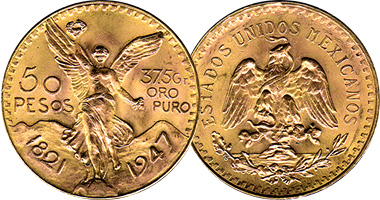
My father pushed me into computers because I was probably a natural trader which he disapproved of and I decided I did not want to become a lawyer. I was also not motivated by the education system. I suppose I began to see that those teaching did not have actual experience in what they taught. The ancient Romans had the best school system. You have the basic reading, writing, math, as well as history. However, you would decide what you wanted to do in life and left what would be called grade school to seek an apprenticeship. My father was going to take us to Europe for the summer, I believe, in 1964. I wanted to earn some money for myself and got a job in a coin/bullion store. Yes, you could buy gold before 1975 in coin form. There were countries who produced restrikes to be able to sell gold. Hungary issued coins data 1908 and Mexico kept the date 1947 on 50 pesos. Gold coins were legal for “collectors” as long as they were dated 1947 or earlier.

That was my apprenticeship for I began to see markets and observed the daily fluctuations. Silver was rising in price and President Kenney signed in 1963 the Executive Order 11110 on June 4th, 1963 to remove silver from the coins starting in 1965 before he was assassinated. Just about every country soon followed by 1965-1966. They two years later is when Bretton Woods began to crack in 1968 and a two-tier market in gold began – private and official. Gold begab to trade in London. It didn’t trade in the USA until 1975.

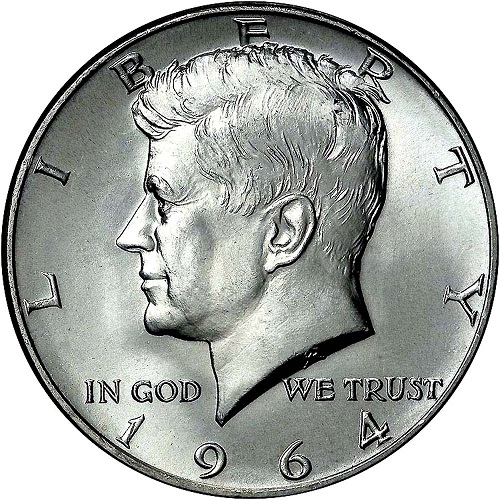
Going to Europe, we traveled the entire summer driving from Sweden down to Naples to visit Pompeii. I became the navigator but it also was a quick introduction to foreign exchange. We would have to exchange money at each border. I have a few 1964 Kennedy half-dollars. Whenever I would pull one out, whatever the bill was if $10 to $25, they just wanted that coin instead. It taught me early lessons about arbitrage. I remember telling my father we should have come to Europe with a bag of them and we would have paid for everything.

Every door we open in life leads to another. I have never been one to be afraid of trying something new. Failure is how we learn and success is our reward. Had I not gotten a job in that coin store where I bought my first Roman coin for $10, I would not be here today writing this. That is what I mean that we are the sum of our experiences. I was in history class and the high school professor brought in an old film The Toast of New York. It was a film about the Panic of 1869 and the attempt of Jim Fisk to corner the gold market. In this clip, you will see what sparked my imagination and sense of curiosity given my exposure to reality by working. Jim Fisk is at the ticker-tape, and he then turns to his girlfriend and quotes gold at $162. Now I knew from working that gold was $35. Suddenly, I was confronted with an anomaly. I was being taught that everything was linear. So how was it possible that gold could be $162 in 1869 and $35 today in the 1960s?

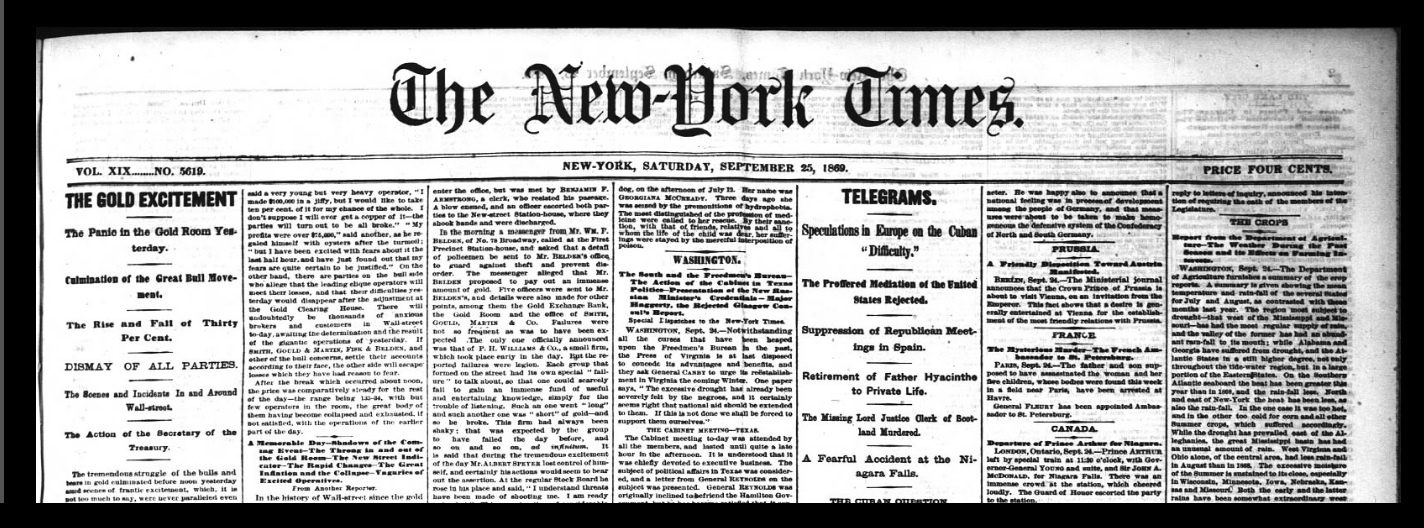
At first, I assumed it was just a movie. But it bothered me. There was a QUESTION in the back of my mind that would not be answered. I went to the library and looked up the price of gold in the microfilm copies of The New York Times. There it was, the quote, $162. It was real. It profoundly shook my belief system to the very foundation.

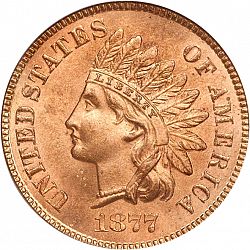
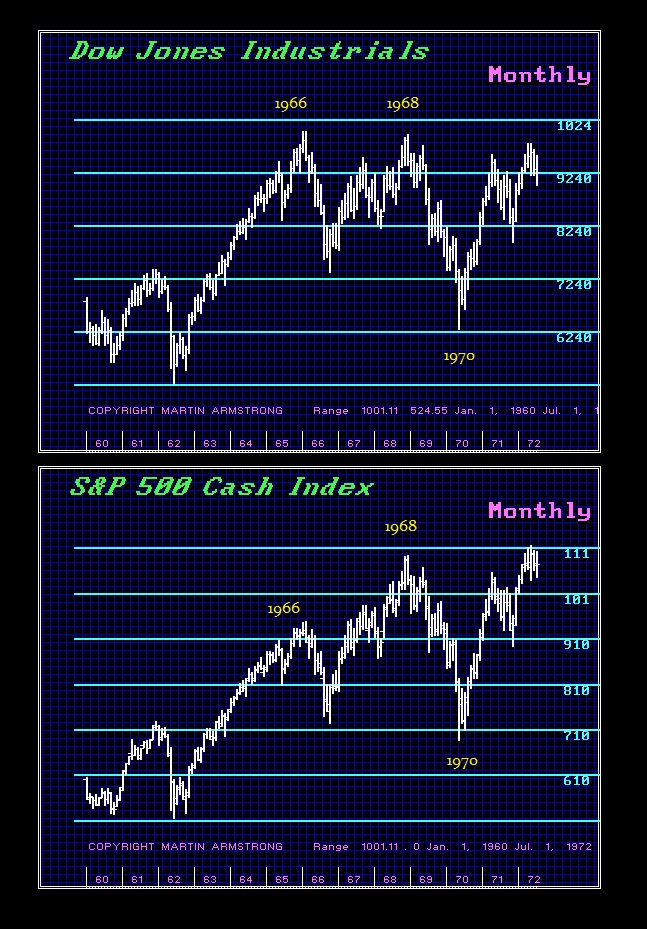
Countless questions were running around my mind like a pack of wild animals being chased. I began to ask questions in economics class. The answer was even more disturbing. Well, there was this thing that they once called the business cycle, but the government has eradicated that I was told.  It was a real bull market in everything going into 1966. Rare coins peaked. I remember an 1877 Indian Head Penny was sold for $700. It crashed by 50% in months and never saw that price again for at least a decade. Pennies were the hot thing back then. I was buying and selling and it taught me how to trade. I made so much money my father convinced me to invest in mutual funds. I did, and then the stock market collapsed and the mutual fund dropped from $54 to about $5. I asked my father if this was the way conservative people made money? My speculating in commodities was much more profitable than stocks I knew nothing about at that time.

I began to notice that there were certain things that were hot and others that were cold. The pennies were soaring but not ancient coins or many other denominations of American coins. Collectibles market crashed with the 1966 stock market crash as did mutual funds. The Crash of 1966 was followed by another in 1968 when the two-tier market in gold began with the crack in Britton Woods. The real estate crashed in 1970 as well. But even more confounding, gold actually fell BELOW $35 in 1970 – the old Bretton Woods fixed rate that everyone assume would hold.

There was no mentor back then. You had to learn from observation. Bretton Woods was collapsing and nobody knew what would even happen no less forecast what would come by 1971. I was finished with high school, but the nagging questions only multiplied. Clearly, there was some sort of a cycle. It did not matter if it was stocks, bonds, coins, collectibles, foreign exchange, or real estate. It was obvious that everything went through the same boom and bust cycle.

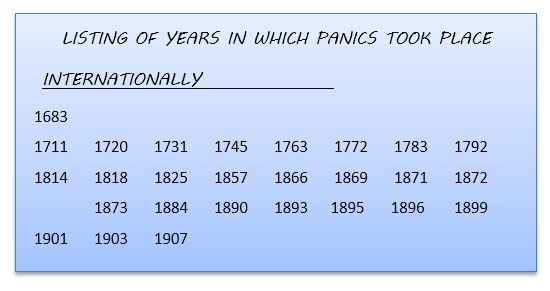
I was doing my own research now in the Firestone Library at Princeton University. I was searching old newspapers, looking for previous prices of booms and busts that I had been confronted with in gold. That’s when I stumbled upon an article that listed previous panics between 1683 and 1907. This was an old article published even before the 1929 Great Depression. That is why the list stopped with 1907. It was even pre-World War I.


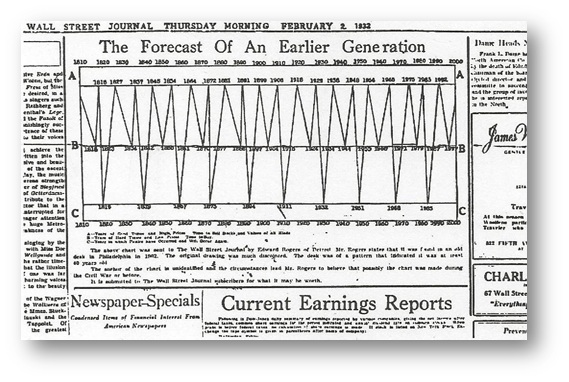
That’s when I also stumbled upon this illustration of a business cycle published on February 2nd, 1932 in The Wall Street Journal. I took the list I found that covered a span of 224 years and I divided it by the 26 events which yielded the 8.6-year average. I began to test through history which I knew well. The rest is history itself as they say (see wave structure). So no, there was nobody to talk to back then. You had to learn everything on your own. It was not until the Crash of 1974 that Paul Volcker was inspired to call it “The Rediscovery of the Business Cycle” because they did not even teach the existence of such a cycle. It was supposed to have been conquered by the government with Keynesianism. It was an age of rediscovery indeed. There was no place to go. Gold futures began in 1975, bonds 1977 and S&P 500 futures in 1985. There were no trading clubs. I was on my own.

China Venture Capital Raising now Exceed the USA


Believe it or not, Chinese start-ups have for the first time collected more venture capital than newly established US companies in the past quarter. This is reported by the South China Morning Post . Almost half (47%) of the venture capital used worldwide was spent on start-ups from the Middle Kingdom. The American start-ups were only just over a third (35%). This is part of the entire real reason why China will be surpassing the United States and take the title Financial Capital of the World. 

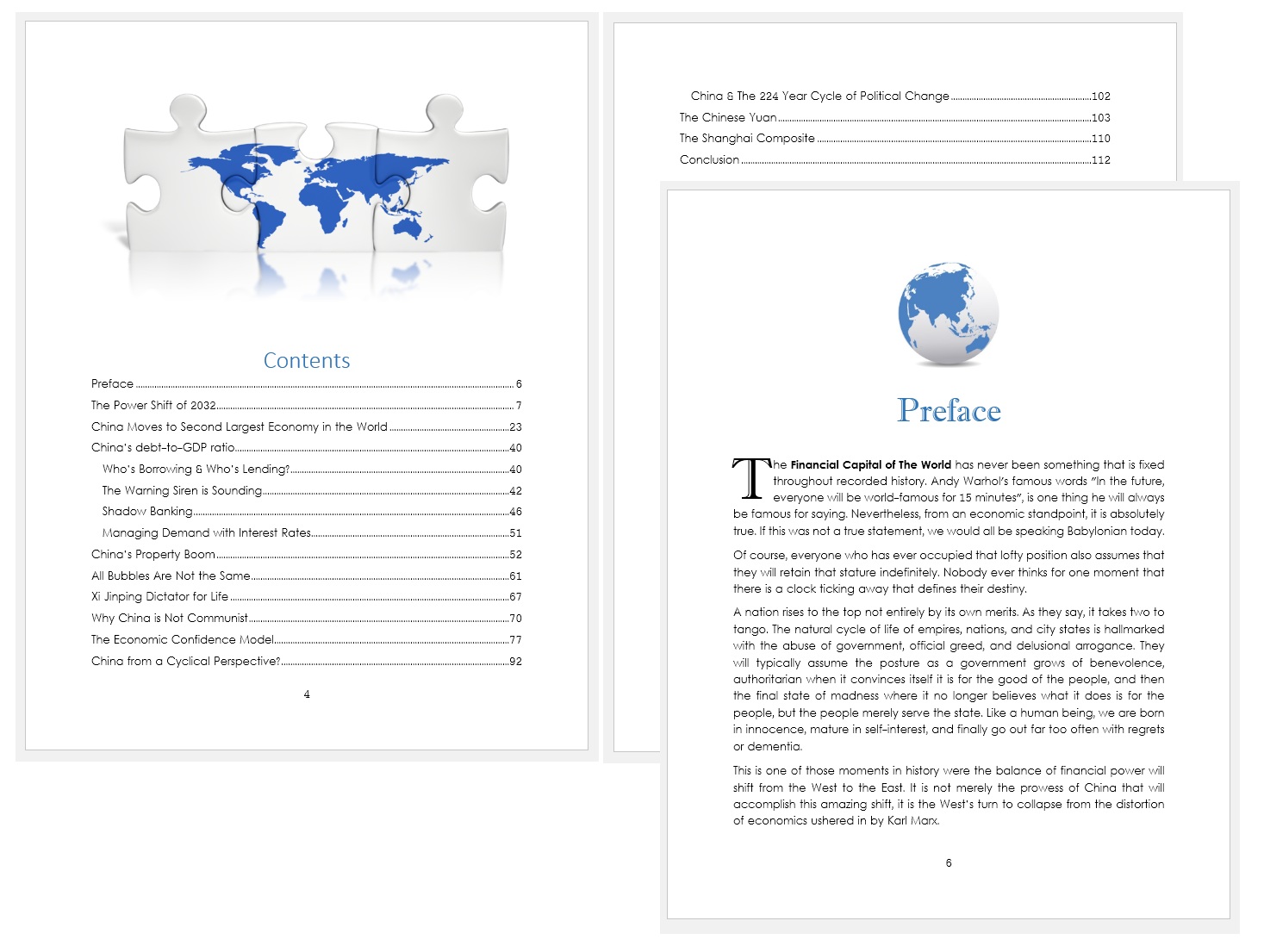
We will be releasing a printed report on this subject covering all the topics from politics to economic

Why CONFIDENCE is the Backbone of the New Monetary System


QUESTION: Mr. Armstrong; I found your recent article on inflation and contagions fascinating. Am I correct in summing it up that today because currencies are not commodity based, they rise and fall on anticipation of political events whereas under precious metals contagions took place by one country debasing compared to another?

Thank you for your reply;

EG

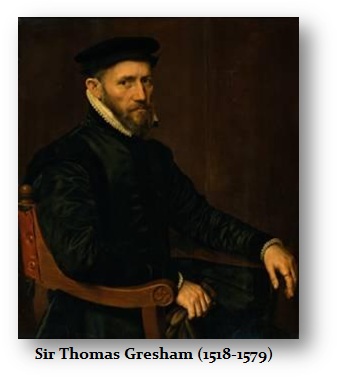
ANSWER: Correct. The monetary system has been altered far more than people understand. The question of money supply and inflation was philosophically established with Gresham’s Law. Gresham worked in Amsterdam and witnessed the response to the debasement of Henry VIII in England. His proposition that bad money drove out good money from circulation was one important observation. As countries would debase, people would hoard the old coinage, and actually, the money supply would shrink. It then requires a greater production of debased coinage to maintain an adequate money supply. This results in more debasement and unfolds in what people call hyperinflation. Yet, it is much more than simply just producing debased coinage or in modern time printing more money.

In addition to this observation, what is overlooked is frankly the driving forces behind the foreign exchange markets during the precious metal based monetary system and the modern paper monetary system (soon to be electronic based monetary system). Under a precious metal system, the coinage of one nation is compared and exchanged with others based entirely on its monetary value based on metal content. If England was at war with France, this had zero impact upon the value of their coinage as long as there was no debasement. Once debasement began, then the exchange rate between one currency and another changed.

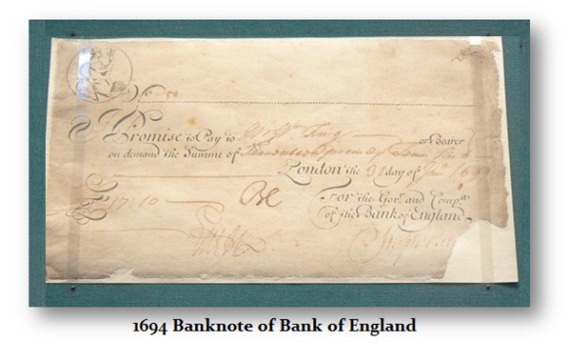
Consequently, this influence of anticipating future value based upon possible political decisions was not readily dominant and the coins of one nation were compared entirely on their metal content rather than political events. When money began to appear as paper currency, this altered the monetary system for then the value of that currency was dependent upon the “confidence” of the people in that currency. Bank runs would emerge when people lost confidence in that establishment surviving.

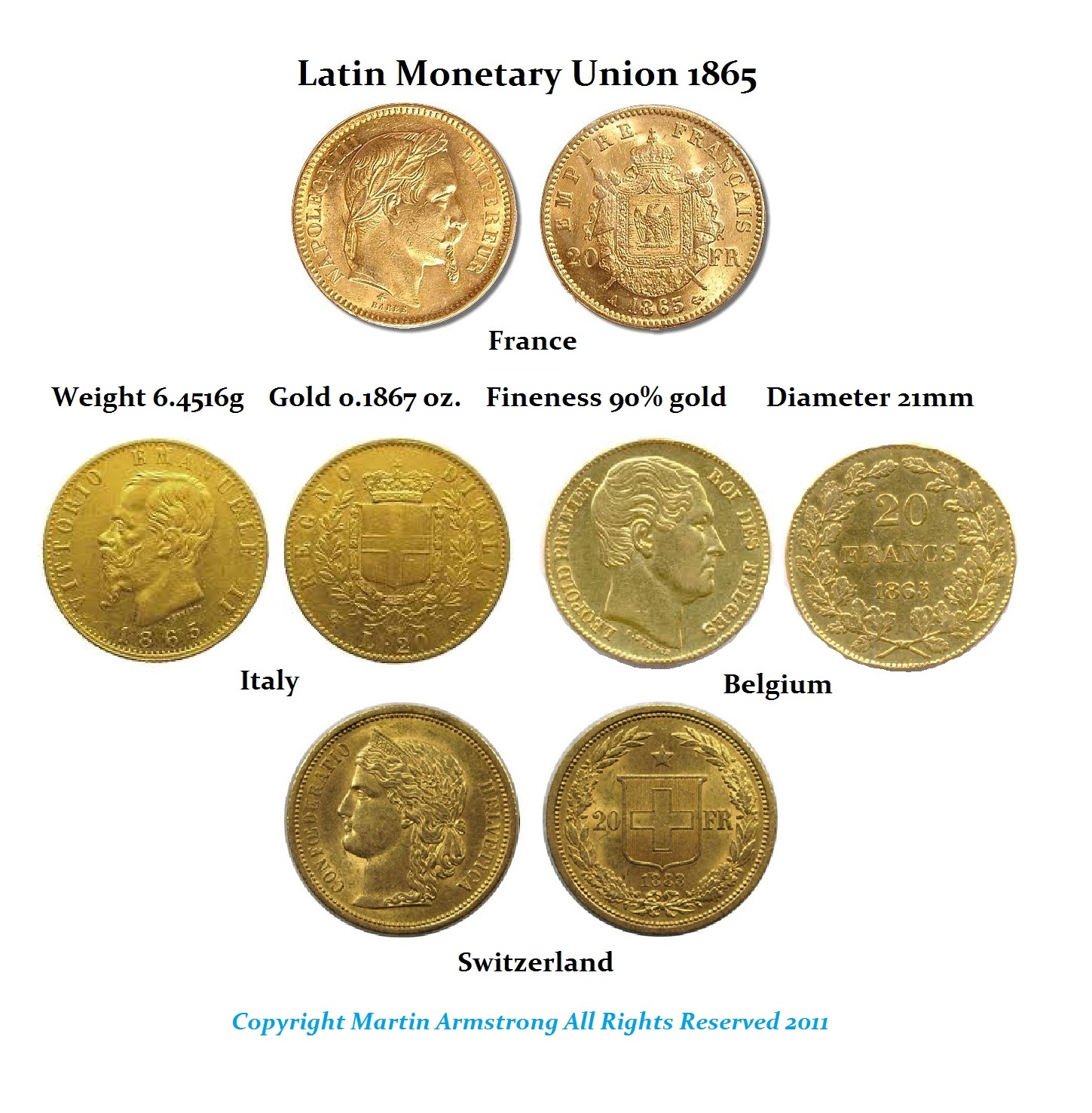
The Latin Monetary Union was an attempt to create a gold standard whereby member nations issued a standard coin of equal weight and metal content as to allow them to be interchangeable. Therefore, 20 French francs was equal to 20 Italian lire, 20 Belgian francs or 20 Swiss francs. The problem with commodity based monetary systems has always been that domestic economic trends in one country are exported as contagion to others. For example, the Spanish discovery of South American led to a massive influx of gold and silver coins which then created a contagion of inflation (lowering the purchasing value of coinage) throughout Europe.

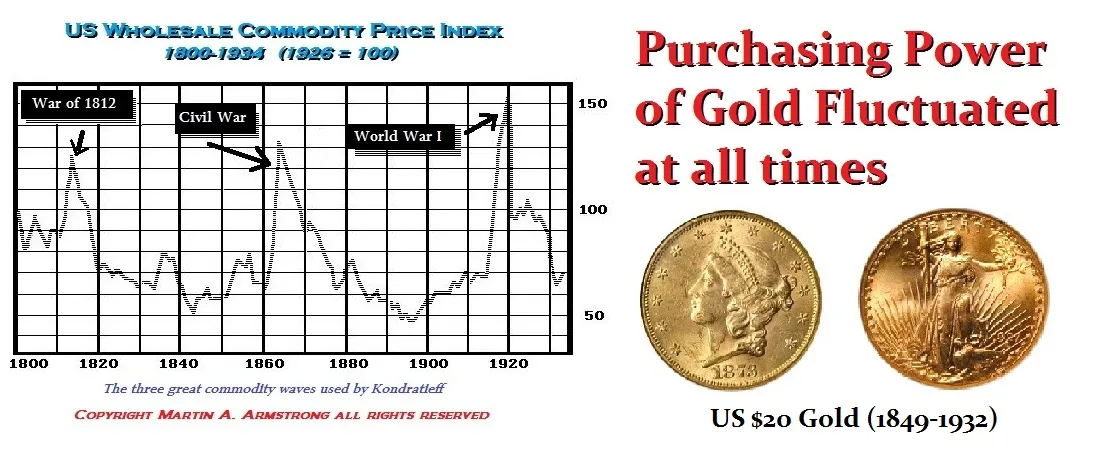
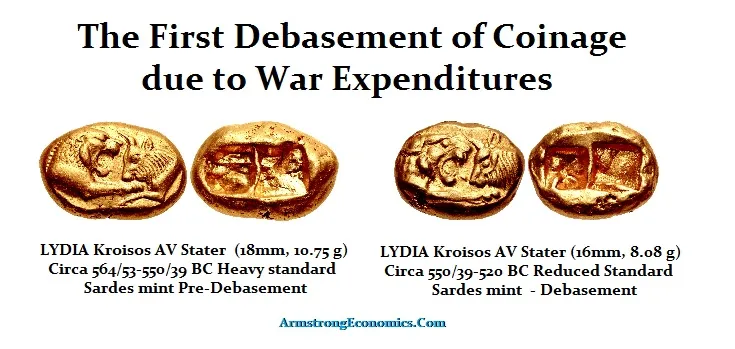
The waves of gold discoveries during the 19th century also created huge instabilities in the business cycle resulting also in waves of inflation. This is what Kondratieff studied to come up with his long wave theory. War has always resulted in waves of inflation as governments have had to increase the money supply to pay for these expenses. The US national debt exploded by $1 trillion for the Iraq war. We find from the very beginning of coinage in Lydia, its war against Cyrus the Great of Persia also resulted in a debasement of the very first coinage.

There are clearly established driving forces behind the monetary systems rise and fall. What we must come to understand is that a commodity based monetary system NEVER produced a perfect world where money was tangible and worth something. There were always waves of inflation based upon the discovery of new metal deposits. If we had a money supply that could NEVER change, then you would create deflation as the population grew. If there were only 10 gold coins and a population of 5 people, then everyone could have two coins, but one will inevitably have 4 because they invented something others wanted. Increase the population to 10, then the value of the 10 coins will rise in value meaning asset values will decline creating deflation.


Therefore, a tangible monetary system has never eliminated the business cycle and it will never bring “stability” as people preach. What has taken place is that by moving to a paper monetary system and a unit of account, which is increasingly more electronic (since paper money is less than 5% of commerce), the “confidence” factor that was once predicated upon the metal content has migrated to political events and thus we anticipate the future possibilities in the current value of any currency.


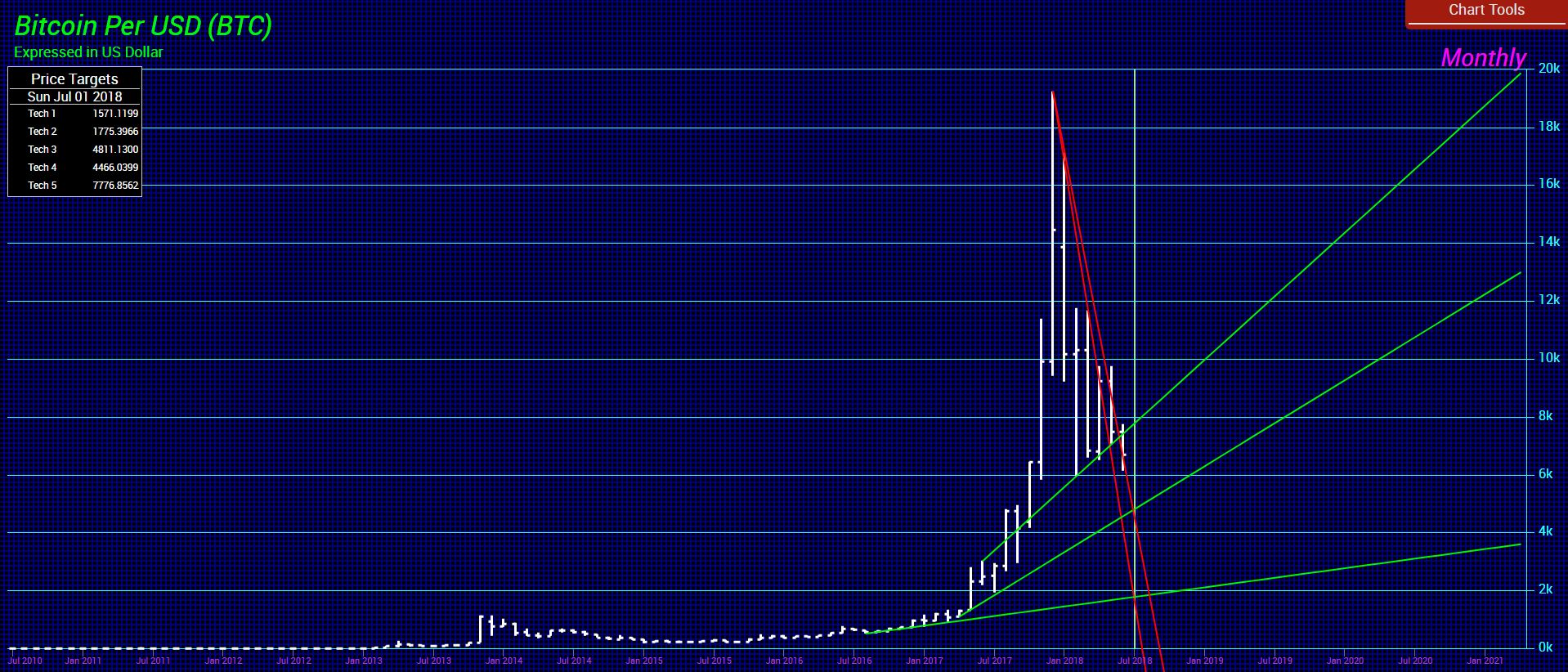
Here is a chart of Bitcoin. Once again, we do not see an instrument which is immune to the business cycle. It does not matter if we are dealing with coins, paper money, or electronic entries. Everything will still be subject to the business cycle. There will NEVER be any such exception. Moving forward, the only way to isolate contagions to some degree will be to create a basket of currencies as the international unit of account. It will still rise and fall in value. It cannot be permanently fixed.


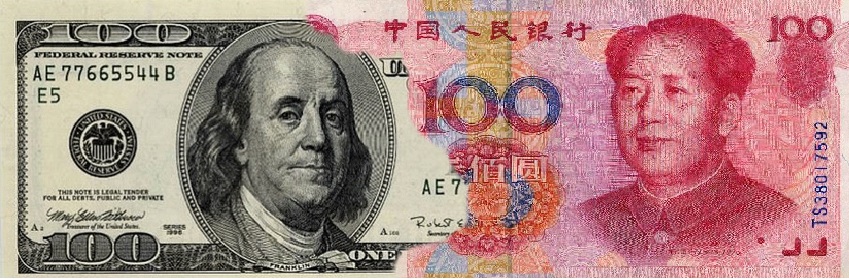
Therefore, while our computer forecasts that China will emerge as the Financial Capital of the World after 2032, those who hate the dollar and keep calling for its demise fail to understand that the more critical element that will make the China yuan a major global currency is when the “confidence” level rises among big capital and they feel “comfortable” parking their money in Chinese bonds, assets, etc. China is moving in that direction slowly. They will eventually allow their currency to be freely traded and currency controls will vanish. As that dawns, then we will see the yuan rise in global respect. They are moving to achieve that position. It just takes time.

We MUST comprehend that contagions have existed in ancient times to modern times regardless of the monetary system be it precious metals, paper, or electronic. We are all connected and the sooner we come to grips with that understanding, the sooner we can move forward in our evolution of money. Even the creation of money by banks through lending is driven by the business cycle

Boston University Graduate Alexandria Ocasio-Cortez Explains “Economics”…


According to DNC Chairman Tom Perez, Ms. Alexandria Ocasio-Cortez is “the future of the Democrat party.”  Ms. Ocasio-Cortez has a bachelors degree in “economics” and “international relations” from Boston University.

Born in 1989, Ms. Ocasio-Cortez is a millennial and a self-described democrat socialist.  In this interview segment she discusses a millennials’ view of economics:

On the dynamic current economy, 3.8% unemployment and capitalism providing expanded economic opportunity:

“unemployment is low because everyone has two jobs.”  “Unemployment is low because everyone is working 60, 70, 80, hours a week and can barely feed their kids”… “capitalism has not always existed in this world, and it will not always exist in this world.”

…Some people… and such, have jobs… it’s hyper-capitalism, that’s unemployment. Because it’s all like, you know, so unfair and stuff!

This is a millennial with a four-year degree in economics and international relations from Boston University; who won a primary race for congress and could very likely be heading to Washington DC as a political representative of New York.

Let that sink in.

Documenting History with Coins


QUESTION: Dear Martin,
I have been researching facts about history and there is strong evidence that what we were taught in school doesn’t fit with the reality. As you have a very vast coin collection, which is part of your research, how can you be sure of the timeline about those coins? I remember from your blog statements that many years are missing in the Japanese coinage and a very sudden drop in Roman silver minted coins. Greek, Roman and many other coins do not have any dates on them as we know it now. Is there any slight chance that years have been added to history by academia to fit their narrative?
Regards, Patrick.

ANSWER: Greek coins are not dated. Most have been determined based upon the archaeological discoveries. Therefore, Greek coins cannot be specifically dated to an individual year. What can be determined is the sequence of rulers and we can determine date approximations often from contemporary writers. The lack of coins in Japan for nearly 600 years simply means that there is no Japanese numismatic record. However, foreign coins are discovered in Japan. Chinese coins were used because they were not devalued with each new emperor as was the case in Japan. There have even been Roman coins discovered in Japan confirming there must have been some trade connection albeit indirect.
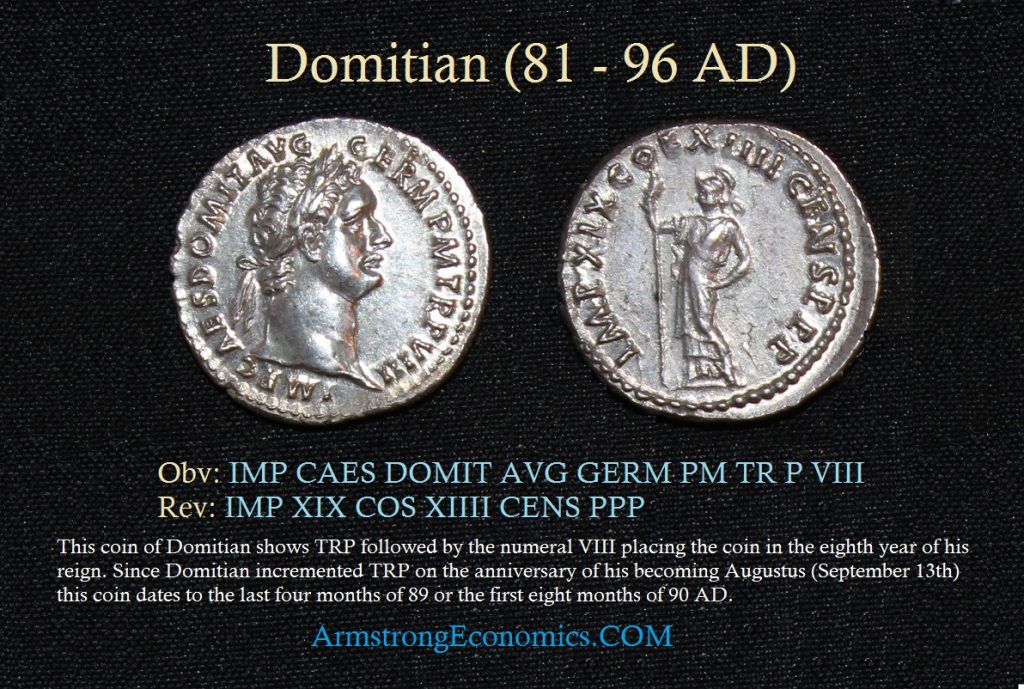
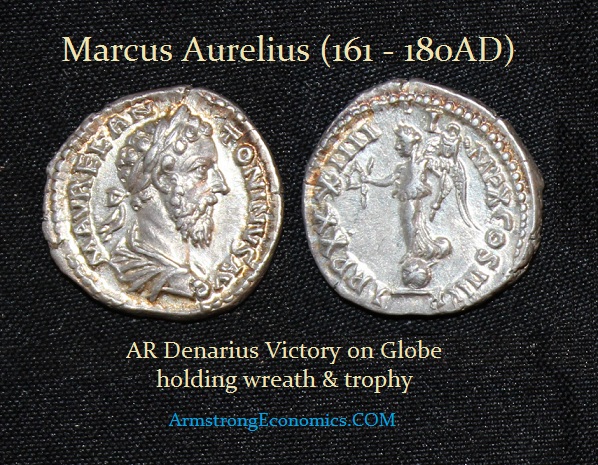
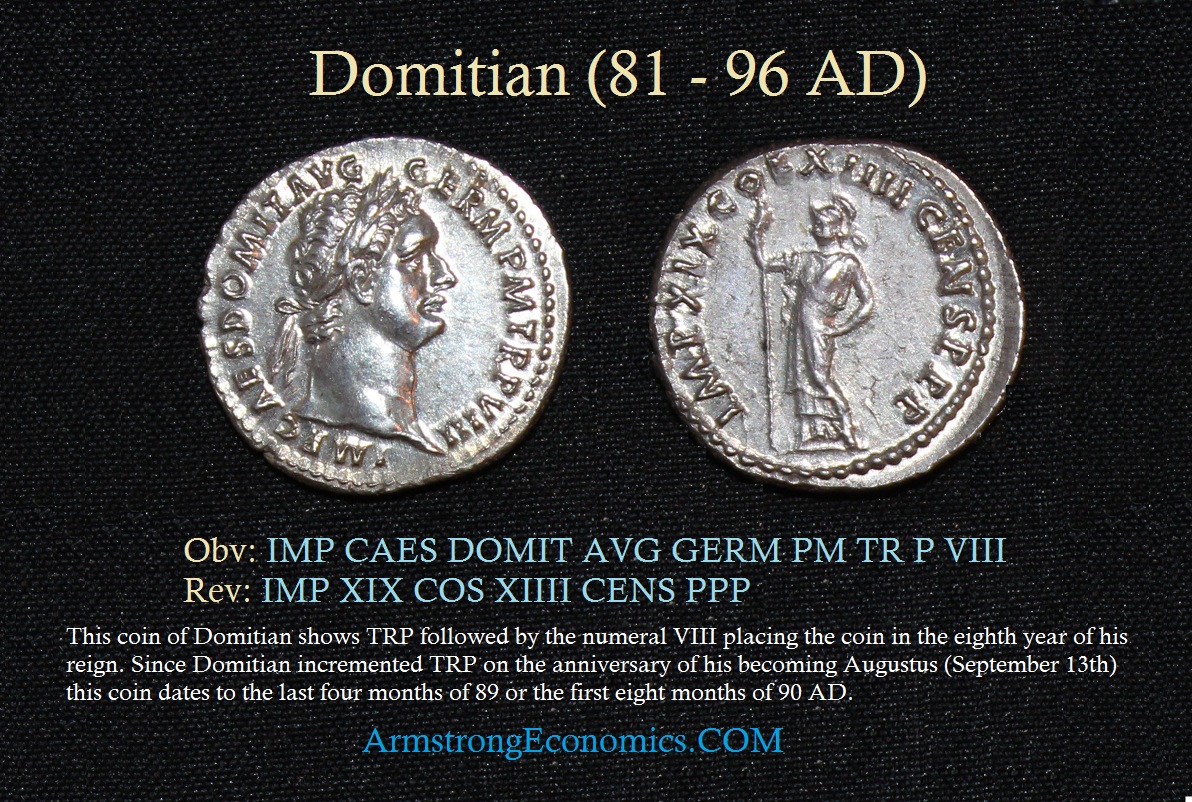
The Roman coinage is easy to date because Rome had overthrown the king and began the Republic during the 8th century BC. Therefore, an emperor was never portrayed as a “king” but maintained the pretense of being elected like our politicians today – the curse of a Republic. On the obverse of this Roman coin of Domitian (81-96AD), we see TR P VIII meaning this was the eight year of his reign since his Tribunicia Potestate – The Tribunician power, which had to be renewed each year as a pretence of being elected by the Senate, the same structure the EU today uses to appoint the head of the EU who never stands for public election either. Domitian had served as consul with his brother Titus before he succeeded him as emperor following his death. Therefore, the reserve of the coin shows he was also the Consul serving for the XIIII (14th) time. Again, these are one-year terms.
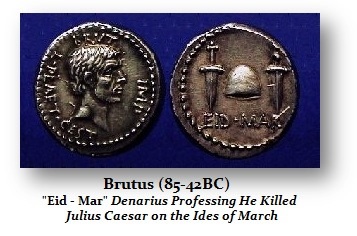
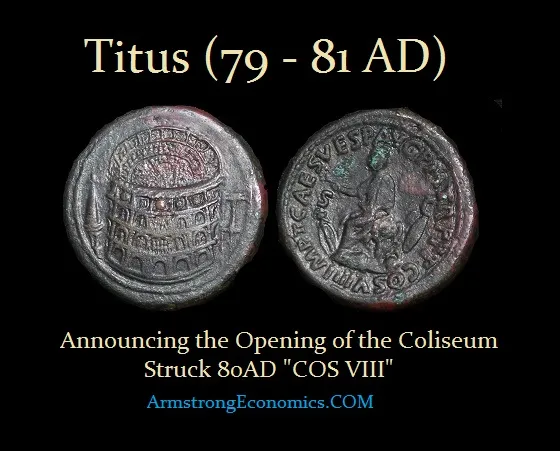
Here we have a coin of Brutus which boasts that he killed Julius Caesar on the Ides of March (15th) in 44 BC. We also have a coin of Titus announcing the opening of the Coliseum. The Romans used the reverse side of their coins often as a newspaper announcing events and victories. The Greeks were interested in art. They competed for design, but they did not use the coins as a means of propaganda.
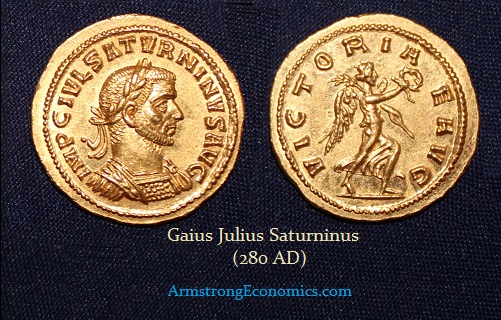
This coin of Saturninus is probably one of the most important Roman coins ever discovered. The Latin work Historia Augusta was written during the reigns of Diocletian and Constantine I in the late 3rd century AD. The work recorded the lives of emperors and usurpers in Rome before Diocletian. It was a collection of thirty biographies. Of course, some academics pronounced it was a fake as they did with Homer because it listed people they never heard of during the collapse of the Roman Empire during the Monetary Crisis of the 3rd century. They challenged both the authorship of the work as well as its date ever since Hermann Dessau (1856-1931) whose claim to fame as a historian came in 1889 when he rejected both the date and the authorship the manuscript. He argued there were major problems that include the nature of the sources and how much of the content he claimed was pure fiction. He was proven completely wrong when this coin and one other coin was discovered in Egypt. Saturninus was one of the names of a usurper he claimed never existed.
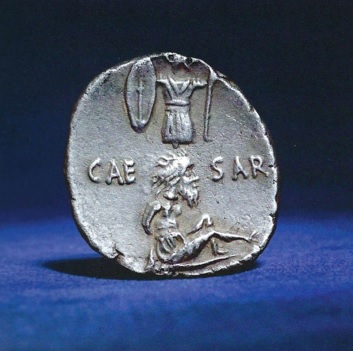
Here is a denarius of Julius Caesar showing a captive at the foot of a trophy. Note that the man has wild hair and a beard. It is believed that this coin represented the capture of Vercingetorix, the leader of the Gauls. Of course, the writings of Caesar and his conquest of Gaul have survived.

Coins have in fact called into question recorded history. But academics far too often defend old interpretations and refuse to revise previous assumptions. For example, the very date that Vesuvius erupted burying Pompeii is by no means definitive although you will find August 24th, 79 AD as the date carved in stone. This date has been interpreted from a letter to the historian Tacitus some 25 years following the event. This was his old friend Pliny the Younger who provided an eye-witness account of the eruption. He states that the eruption took place on Nonum Kal September (the ninth day before the Kalends of September), which has been calculated as August 24th. However, Tacitus was translated during the 16th Century which remains questionable on many points. The ancient historian Cassius Dio directly states that the disaster took place “towards the end of the harvesting season” which would be in October, not August.

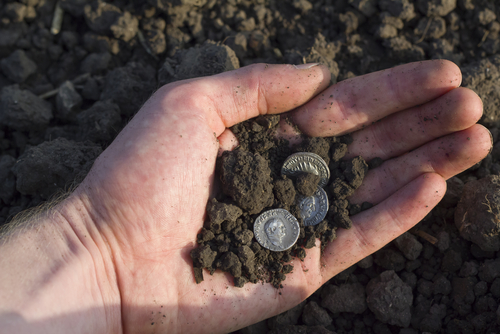
The excavation of Pompeii revealed that the stores were selling fruit that would not have been seasonal for August. There were amphoras filled with wine after the harvest which had been sealed and ready for transportation and sale. Many of the people discovered were wearing warm clothing. That has been dismissed as they just wanted to cover themselves. But during excavations of Pompeii’s “House of the Gold Bracelet” in 1974, 180 silver and 40 gold coins were discovered with the bodies of a group of victims. The coins were buried with the people attesting to their link with the eruption. The coins were never cataloged until 2006. There was one coin that confirmed that the date for the eruption of Pompeii was incorrect and that the account of Cassio Dio was closer to fact than Tacitus.

Titus was emperor at the time of the eruption and he was remembered for the relief efforts. Titus’ administration was marked not by military or political conflicts, but by disasters. His first disaster was the eruption of Vesuvius. The eruption destroyed the cities and resort communities around the Bay of Naples in addition to Pompeii and Herculaneum which were buried under many feet of stone, ash, and lava. Titus appointed two ex-consuls to organize and coordinate the relief effort. He personally donated large amounts of money for the relief effort and he even personally toured the region the following year like presidents do today after such disasters (human nature never changes).

A single silver denarius was discovered among the 180 silver coins in 1974. When it was cataloged, it overturned history and has ever since been buried again in the Naples Museum rather than rewrite the history books. Titus’ father Vespasian died on June 24th, 79 AD. Therefore, any coin of Titus as emperor would have to have the very first recording of his power “IMP VIIII” or 8th Imperator, which was a title that meant ‘leader of the army’ to the Romans. The award was generally given at this point in history for a particularly important victory that was celebrated. In some cases, these subsequent awards, denoted by a numeral following IMP, which also allows dating of coins to a very short period.

The coin discovered in Pompeii had the legend “IMP XV,” which was granted to Titus for the war in Britannia where he sent Gnaeus Julius Agricola who pushed further into Caledonia and managed to establish several forts there as recorded by Tacitus (Agricola 22). Therefore, Titus received this title of Imperator for the fifteenth time for this event, according to Cassius Dio (Roman History LXVI.20). This took place we know in September 79 AD about 3 months after becoming emperor following his father’s death. Obviously, if any coin was discovered in the ruins of Pompeii with “IMP XV” in its legend, then this provides absolute proof that the date for Vesuvius of August 24th, 79 AD cannot be correct.

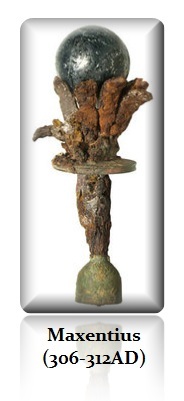
There are plenty of discoveries that have challenged the view of history. Roman swords have been discovered in Newfoundland for example. The Romans knew the world was round and NOT flat. They pictured a world that is round on countless coins. The one scepter that has survived from any Roman Emperor, Maxentius (306-312 AD), has a globe on it symbolizing that the Emperor ruled the entire world, which was a nice political boast.

Strangely enough, the coins have documented history even when academics choose to try to ignore them rather than admitting they are wrong. It just seems that people do not want to ever admit making a mistake. The academics are no different than politicians, and even the Catholic Church tried to pretend there were no allegations that were valid against some priests. The problem with this posture is that as this policy is supported, they undermine the credibility of everyone in that profession. Academics are no exception. Just revise history and get on with it.


Turkey the Poster Child of Emerging Market Crisis


During the 1980s, I was called in to create a hedge for a bank against the Turkish lira which nobody made a market on. I had to create a synthetic hedge for the currency was moving into what became hyperinflation.  The Turkish lira has begun to fall ever since Recep Tayyip Erdoğan became the 12th president of Turkey on August 28th, 2014. We can see from the chart that the last 4 years has produced nothing but a US dollar rally. The lira really began to break down in 2015 following his election. While his vision was to make Turkey a more important country with a vision of the former glory of the Ottoman Empire, we can see in this chart that 2016 the dollar broke out of the channel technically and has begun the steady rally that can make Turkey the poster-child of the emerging market crisis.

The Turkish financial market has come under heavy selling pressure last week. Turkey could be at the center of a new world financial crisis which is unfolding at first in the emerging markets followed by Europe.  The price of the lira fell sharply last Thursday making this the largest price decline for one week in the past 10 years. The Lira continues the immediate downward trend which has been ongoing since Erdoğan came to power.

Turning to the Istanbul Stock Exchange, here too we also saw falling prices. The price of the leading index ISE National 100 plummeted during the week from about 100,000 points to only 90,000 points. At the end of January, the price was around 120,000 points. The relationship between price and expected equity returns dropped to the lowest level in the past nine years.

Looking at the bond market, the 10-year government bond yields rose by about 100 basis points on Thursday in a single day reflecting the collapse in public confidence. The 10-year bond now stands at an almost 18% rate, which is up significantly from 10% a little more than one year ago. Inflation is now running at 15% level and during the hyperinflation period, it reach just about 15% per month.

Erdogan continues to try to consolidate power into a virtual dictatorship. He made his son-in-law Minister of Finance after the election and curtailed the independence of the central bank. He thinks he can simply manipulate the interest rates down, which is just going to blow up in his face.  Erdogan has simply increased global investors’ fears with his attempt to control the central bank and interest rates. Erdogan has circumvented all democratic procedures and can appoint the president and vice president of the central bank without any other approval. We are looking at a politician who has become a dictator and we must question even the validity of any election in Turkey. Of even more concern, however, is that history warns this type of behavior typically is characterized by someone who will begin wars to distract the people and retain power at all costs.

Currency Risk – The Great Unknown That Brings Down Governments


QUESTION: Hi,
I am not sure if I understand how it would work but obviously, this is highly hypothetical today.
If the reserve currency is SDR, we still need debt denominated in SDR and a very large and deep market accessible by investors to park money there.
If individual countries have their own currency and issue their debt in that currency, or SDR for that matter, is it not just the same as the EUR today! Credit risk has to match with the currency of the central bank if I understand the shortcoming of Europe today.

PH

ANSWER: You are correct. As soon as you borrow in another currency, you will then encounter FOREX risk. Third world countries have been borrowing in dollars extensively. As the dollar rises, we will see defaults BECAUSE of the currency risk.  It would not matter if countries borrowed in dollars or SDRs, they will encounter the same currency risk. At the very least, countries must be prohibited from borrowing in foreign currencies, or preferably, governments should be prohibited from borrowing PERIOD! The Roman Empire lasted for nearly 1,000 years. They neither had a central bank nor a national debt. There are other ways to restructure the global financial system. I am preparing the full solution that we need to examine based upon history and what has worked and what has failed

Herod Agrippa I (41-44AD)


Armstrong Economics Blog/Uncategorized

QUESTION: Was it Herod Agrippa who ruled Jerusalem when Jesus was Crucified? Someone said his coins are common.

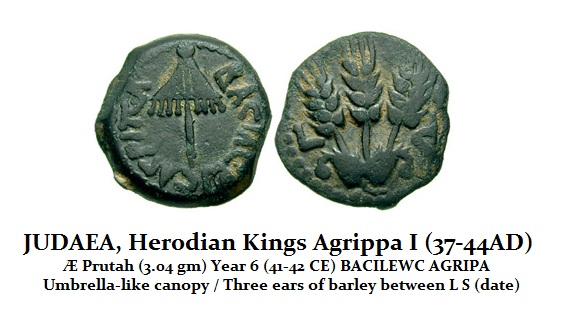
ANSWER: No. It does get confusing. Herod Agrippa I (born 11BC; ruled 41 – 44 AD) after Jesus was crucified. Agrippa I was the last King of Judea with the royal title reigning over Judea. He was also the father of Herod Agrippa II, who was the last King from the Herodian dynasty. Herod Agrippa I  was the grandson of Herod the Great and son of Aristobulus IV and Berenice. He was born Marcus Julius Agrippa being named in honor of Roman general and statesman Marcus Vipsanius Agrippa, who had been the right hand of Emperor Augustus. Herod Agrippa I is the king named Herod in the Acts of the Apostles 12:1 (Acts 12:1). The Jewish historian Josephus refers to him as “Agrippa the Great”.

Josephus tells us that, following the murder of his father, Herod Agrippa I was sent by Herod the Great to the imperial court in Rome. There, Tiberius became very fond of the boy and he was educated alongside his own son Drusus with whom he became good friends. He also became a close friend of the future Emperor Claudius. On the death of Drusus, Agrippa, who had been recklessly extravagant and was deeply in debt, was obliged to leave Rome.

All the Judean kings of the Herodian Dynasty issued small bronze coins. They did not put their portrait on these small bronze coins They are fairly common. The Herod you are thinking about was Herod III Antipas.

The Judaea Move for Independence 66-70AD


QUESTION: Was the first Jewish revolt about taxes? I think you said it was previously.

HJB

ANSWER: Correct. While there were tensions over religion, what really began the crisis was taxation. Later, the death of Nero and religion came into play about 2 years after it began. It is true that the rebellion of Judaea began in the year 66 AD, originating in ethnic and religious tensions but Rome had generally allowed every region to keep their own gods. In the case of Judaea, they were not fond of using coins with images of various gods. The crisis truly erupted due to anti-taxation protest that resulted in attacks upon Roman citizens.

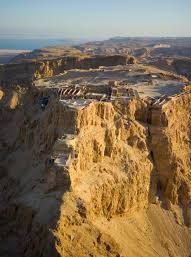
The Roman governor, at that time, was Gessius Florus. As the rebellion over taxes began, he responded by plundering the Jewish Temple seizing wealth to compensate for the decline in taxation. The following day he arrested numerous senior Jewish figures who were not directly connected to any violence. Meanwhile, on September 22nd, 66AD, Emperor Nero created the Legio Legio I Italica. He also appointed Titus Flavius Vespasian legate of the army of Judea and in command of three legions — V Macedonica, X Fretensis and XV Apollinaris. These actions resulted in justifying a large-scale rebellion which began in October 66AD. The rebels were able to annihilate the Roman garrison (a cohort of Legio III Cyrenaica) in Jerusalem resulting in King Herod Agrippa II and all Roman officials fleeing from Jerusalem for their lives. Meanwhile, Sicarii captured the fortress of Masada overlooking the Dead Sea.

With the fall of Jerusalem, Cestius Gallus, legate of Syria, marched into Judea and lead a Roman army of 30,000 men to put down the Jewish rebellion. At its core was Legio XII Fulminata, plus 2,000 picked men from the other three Syrian legions, six more cohorts of infantry, four alae of cavalry, and over 14,000 auxiliaries. The auxiliaries were furnished by Rome’s eastern allies, which included Herod Agrippa II and two other client kings, Antiochus IV of Commagene and Sohaemus of Emesa, who lead their forces (largely archers and cavalry) in person.

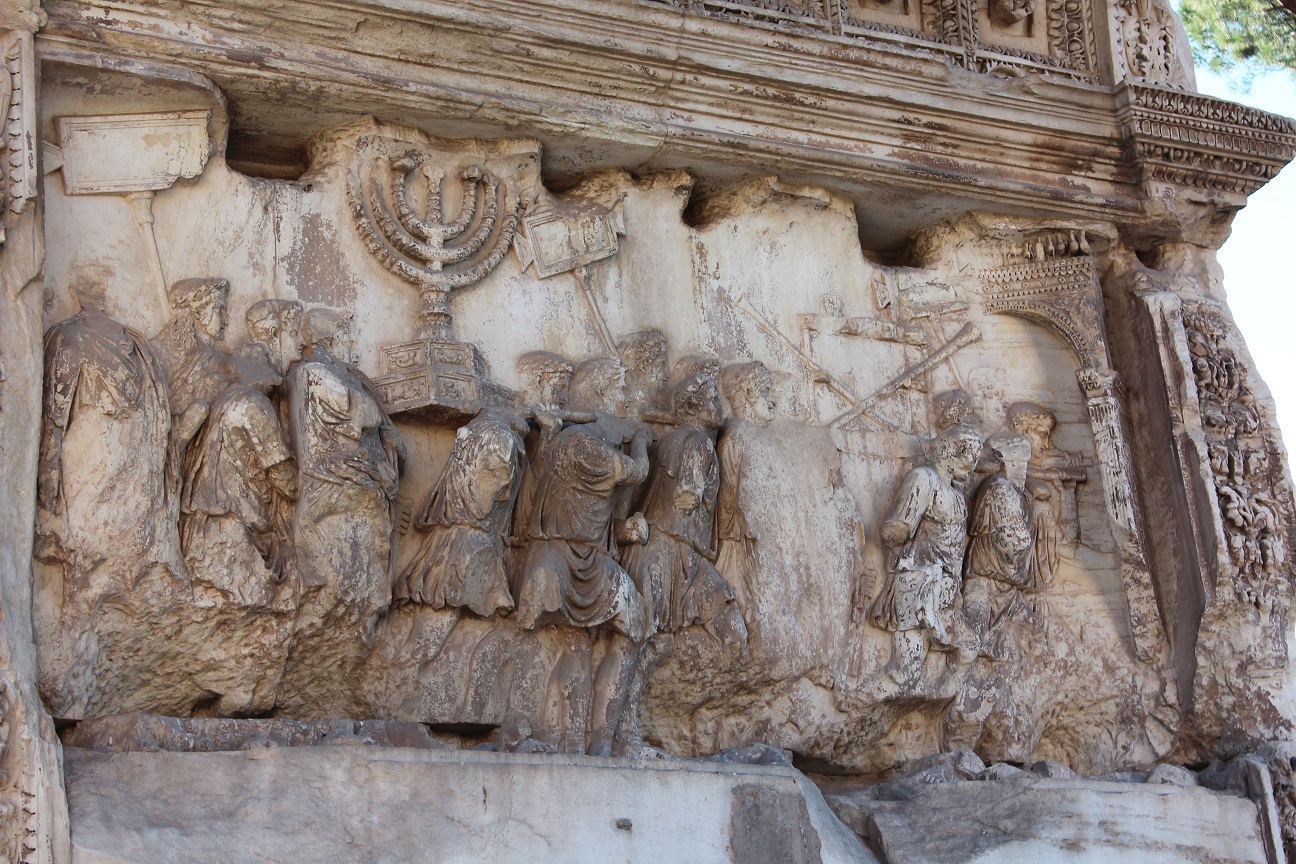
Gallus lead his main force down the coast from Caesarea via Antipatris to Lydda, detaching other units, by land and sea, to neutralize the rebel strongholds at Joppa, Narbata and the Tower of Aphek. With Galilee and the entire Judean coast in his hands, Gallus turned inland and marched on Jerusalem but broke-off the siege in November 66AD. As he withdrew his forces to retire to winter quarters, the Jewish rebels ambushed and defeated him. Some 5,300 Roman troops are killed in the battle. The Jewish rebels now captured his pack animals and his artillery which they used during the next siege by Titus four years later. This was a major victory for the Jewish rebels and it became a major disgrace of the Roman military. The Jewish rebels captured even the eagle standard of Legio XII Fulminata. Gallus abandoned his own troops in disarray and fled for his own life to Syria.

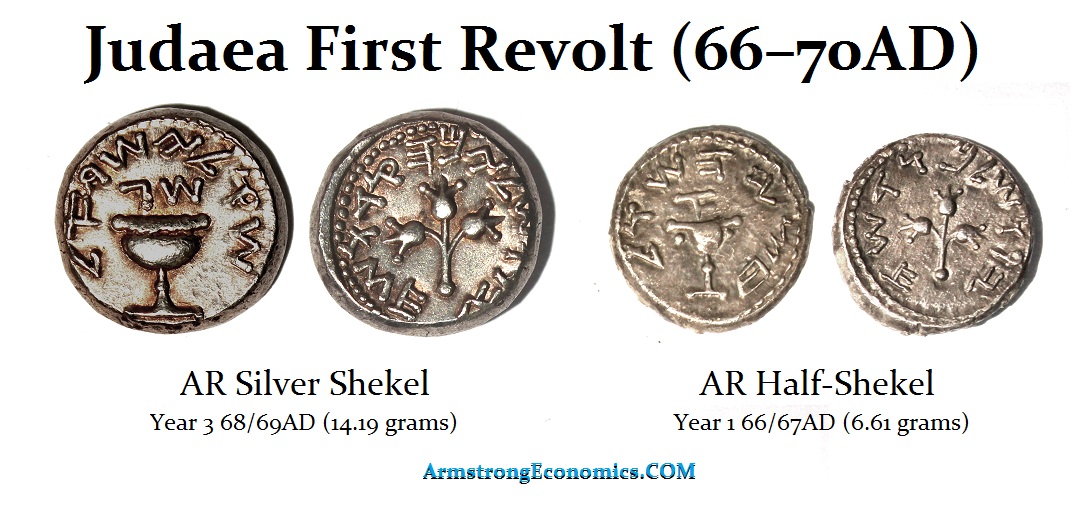
During 66AD, the Jews thus took control of Jerusalem and began to issue their own coins. The Judean Free Government was formed in Jerusalem including former High Priest Ananus ben Ananus, Joseph ben Gurion and Joshua ben Gamla elected as leaders. Yosef ben Matityahu was appointed the rebel commander in Galilee and Eleazar ben Hanania as the commander in Edom. Later, in Jerusalem, an attempt by Menahem ben Yehuda, leader of the Sicarii, to take control of the city failed. He was executed and the remaining Sicarii were ejected from the city. Simon bar Giora, a peasant leader, was also expelled by the new government.

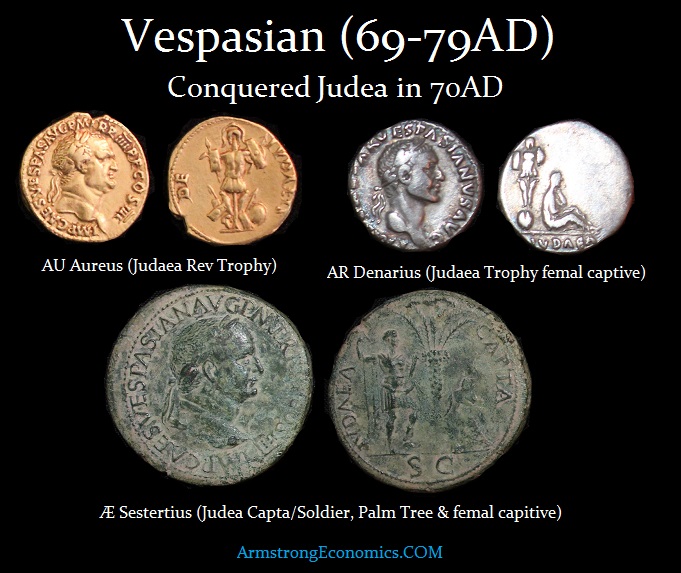
Vespasian was given the task by Nero of crushing the rebellion in Judaea province. His son Titus was appointed as second-in-command. Vespasian invaded Galilee in the fall of 67AD. He avoided a direct attack on the reinforced city of Jerusalem. Instead, Vespasian launched a directed campaign to crush rebel strongholds and punish the population. Within several months Vespasian and Titus took over the major Jewish strongholds of Galilee and finally overran Jodapatha, which was under the command of Yosef ben Matitiyahu, as well as subdued Tarichaea, which brought an end to the war in Galilee.

With the death of Nero in 68AD, Rome moved into a Civil War. Vespasian became the rival general to ain over Otho and Vitellius. Now the Judea situation was a matter of critical importance. Vespasian became emperor in 69AD and the defeat of the Jewish Revolt was critical for if they succeeded, then other provinces would rally against Rome as well.

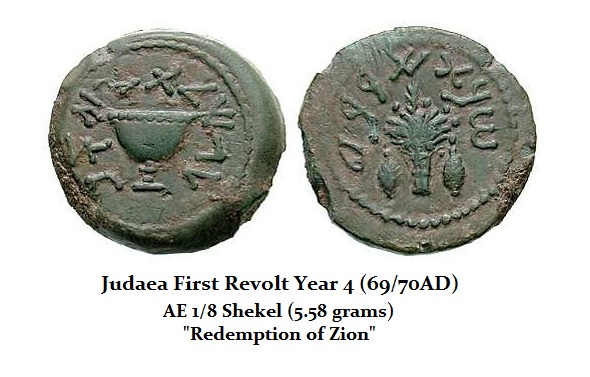
The first Jewish coins boasted the slogan: “For the Freedom of Zion.” The Jewish War for Independence last 4 years covering the period of 66-70AD until the conquest of Jerusalem. Recently, a bronze coin was discovered in Israel from the fourth year of the failed rebellion against Rome which reflected the change in attitudes. The coins of Year 4 saw a change in the slogan to “For the Redemption of Zion.” The Temple was sacked in 70AD and the clean-up skirmishes followed which took several years. The historian Josephus tells us of the last stand at Masada which took place around 73-74 AD.

Year 1 (66/67 CE) Jewish shekels and half shekels are scarce, year 2 (67/68 CE) shekels and half shekels and year 3 (68/69 CE) shekels and half shekels are relatively common, year 4 (69/70 CE) shekels and half shekels and year 5 (70 CE) shekels are extremely rare.

Virtually EVERY revolution throughout history appears to emerge from a tax rebellion. It will often expand into ethnic or religious slogans, but at the core, it is always taxation. The American revolution was the class – No Taxation Without Representation. Yet the greed of politicians inevitably leads to their own destruction for they cannot resist spending other people’s money.