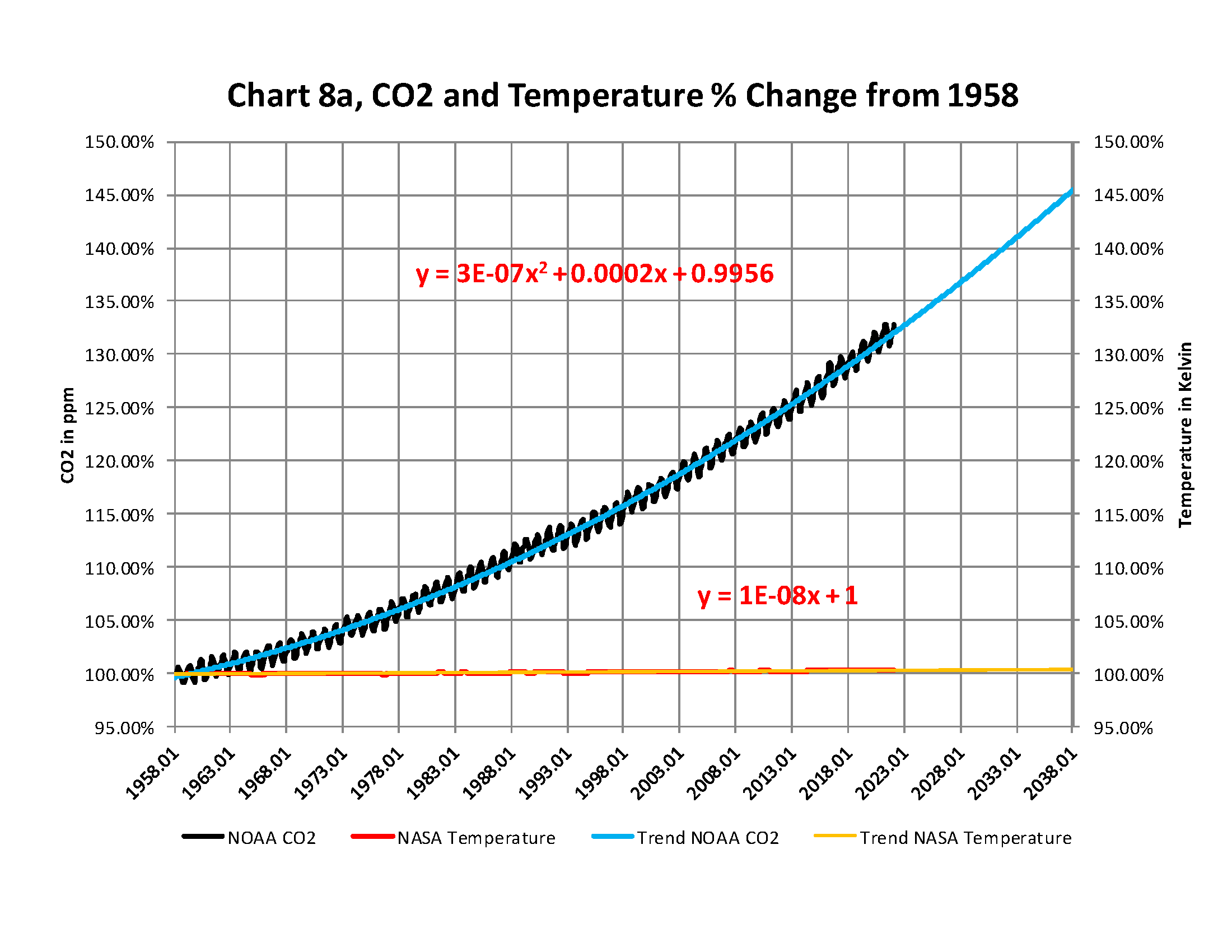
From the attached report on climate change for September 2022Data we have the two charts showing how much the global temperature has actually gone up since we started to measure CO2 in the atmosphere in 1958? To show this graphically Chart 8a was constructed by plotting CO2 as a percent increase from when it was first measured in 1958, the Black plot, the scale is on the left and it shows CO2 going up by about 32.4% from 1958 to September of 2022. That is a very large change as anyone would have to agree. Now how about temperature, well when we look at the percentage change in temperature also from 1958, using Kelvin (which does measure the change in heat), we find that the changes in global temperature (heat) is almost un-measurable at only .4%.
As you see the increase in energy, heat, is not visually observably in this chart hence the need for another Chart 8 to show the minuscule increase in thermal energy shown by NASA in relationship to the change in CO2 Shown in the next Chart using a different scale.
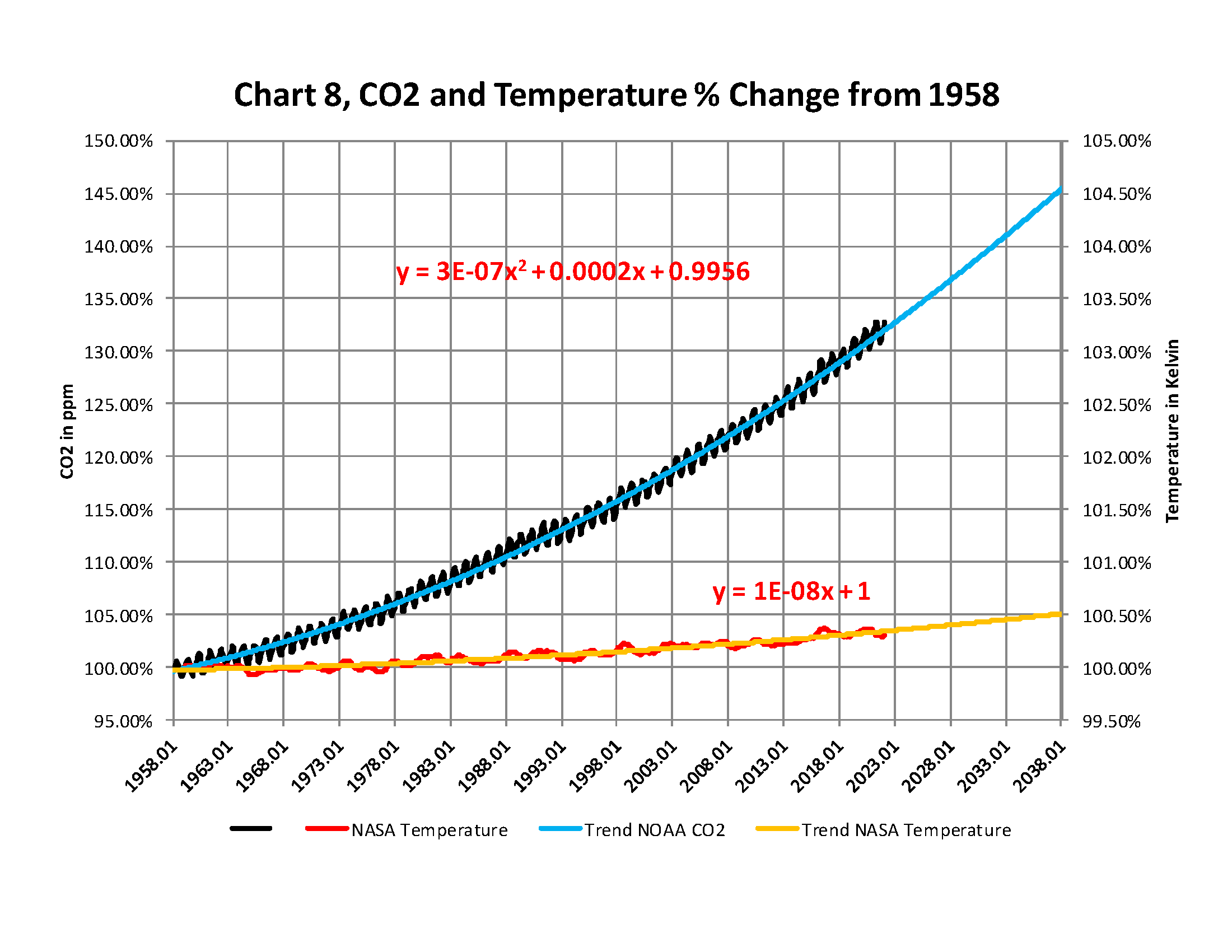
This is Chart 8 which is the same as Chart 8a except for the scales. The scale on the right side had to be expanded 10 times (the range is 50 % on the left and 5% on the right) to be able to see the plot in the same chart in any detail. The red plot, starting in 1958, shows that the thermal energy in the earth’s atmosphere increased by .40%; while CO2 has increased by 32.4% which is 80 times that of the increase in temperature. So is there really a meaningful link between them that would give as a major problem?
Based to these trends, determined by excel not me, in 2028 CO2 will be 428 ppm and temperatures will be a bit over 15.0o Celsius and in 2038 CO2 will be 458 ppm and temperatures will be 15.6O Celsius.
The NOAA and NASA numbers tell us the True story of the
Changes in the planets Atmosphere
The full 40 page report explains how these charts were developed .
New Prime Minister Ulf Kristersson is not heeding to the Green agenda. He promptly eliminated the entire Ministry of Climate and Environment, marking the first time in 35 years that Sweden does not have a specific climate ministry. People are crying that the world will crumble without funding bureaucrats who pretend they have the ability to alter the weather cycle with enough funding.
Klaus Schwab’s plans for Agenda 2030 are in jeopardy. “Environmental issues are going to be given a disadvantage at the same time when we have a huge challenge in Sweden when it comes to biodiversity and forestry,” stated Stockholm University professor Karin Bäckstrand. “We won’t meet the Agenda 2030 goals on biodiversity.”
Democratic leader Ebba Busch will serve as the new Minister for Energy, and 26-year-old Liberal Romina Pourmokhtari will serve as the Minister of Climate and Environment, The Nationalist Sweden Democrats do not support the goal of achieving net zero emissions.
Instead, the new government is prioritizing nuclear power initiatives that will make it increasingly difficult to shut down existing plants while using €36 billion to build new nuclear power stations. The new government is also considering reopening two nuclear power plants that discontinued operations in recent years. Yet another example of how Agenda 2030 and Schwab’s plan to alter the world will fail.
Posted originally on the conservative tree house on October 18, 2022 | Sundance
New England consists of six states in the US Northeast, Connecticut, Maine, Massachusetts, New Hampshire, Rhode Island, and Vermont. The states have been warned by regional ISO electricity providers for several years about their vulnerability if the winter weather is harsh and there is a significant increase in demand for home heating. Those warnings are now multiplied by the massive price increases for natural gas.
Keep in mind as all these natural gas and LNG issues surface, the U.S. has been exporting natural gas to Europe as part of the Biden effort to subsidize the NATO effort against Russia. Prices for natural gas have skyrocketed, and now shortages of the fuel source for energy production may create even bigger problems for New England.
[Via Zero Hedge] – […] The region’s power mix changes have left it increasingly reliant on international NatGas spot markets. State governors have asked US Energy Secretary Jennifer Graholm to waive the Jones Act and allow foreign-owned tankers to ship LNG from the US Gulf region.
All of this has led to New England residents facing some of the highest electricity bills in years. Heating season is already underway.
New England ISO expects the grid will be stable if there’s a mild-to-moderate winter. However, if there’s an extreme cold spell across the Northeast, then grid chaos could unfold: “The grid overall is in a much tighter position.
“If we get a sustained cold period in New England this winter, we’ll be in a very similar position as California was this summer,” Nathan Hanson, a senior vice president of energy and commercial management of LS Power Development LLC, which has two NatGas power plants in New England, warned. (more)
According to the U.S. Energy Information Association (IEA), U.S. storage of Liquified Natural Gas (LNG) is 12% below the five-year average (LINK). Additionally, the IEA is expecting the U.S. to export 11.7 billion cubic feet of LNG per day during the fourth quarter of 2022 — up 17% from the third quarter. The destination of that export is Europe.
Consider that 43% of U.S. households use natural gas for home heating, and power suppliers use natural gas to create electricity. With the massive 2022 exports of LNG to Europe (+17% in fourth quarter alone), that means lower domestic supplies and increased prices here in the United States for electricity and home heating. We are seeing and feeling these massive price increases right now.
Barrons – […] If you need more evidence of the impact of natural gas exports on prices, just compare supply and demand fundamentals for the year leading up to February 2020 (the last pre-pandemic month) versus the year leading up to this May (the most recent month with full federal data). Annualized production rose over the period, while domestic consumption remained roughly flat. Yet LNG exports almost doubled—a surge that tightened U.S. gas markets and doubled the price that U.S. consumers pay for the fuel.
The growth of global demand for U.S. LNG can be tied to many market forces, including the shortfalls in Europe due to Russia’s manipulation of European Union gas markets. Sustained high demand in wealthy Asian nations has contributed to export growth as well. And so has the U.S. gas industry’s dogged determination to ship its wares to the highest bidder, foreign or domestic.
Russia’s role has been particularly critical in the rise of global LNG demand. As Russia choked off gas shipments to Europe, EU buyers have turned to global LNG markets to make up the shortfall. Global LNG prices rose in response, and U.S. LNG companies ramped up output, shipping more cargoes to Europe. But Russia responded by further clamping down on gas supplies to the EU—a vicious circle that has hurt Europe’s economy even more severely than it has harmed America’s.
There’s little sign that U.S. gas prices will ease in the coming years. Freeport’s demand will be back online soon enough, and there are three other massive LNG export projects under construction, with more than a dozen of others waiting for financing.
[…] Curiously, federal regulators have consistently found that the gas export projects are in the public interest—meaning they were in the economic interest of LNG companies and gas drillers. But now, exports are creating sky-high costs for U.S. consumers, and drillers are reluctant to boost gas output lest prices fall back to earth. So, it’s high time to consider whether soaring U.S. LNG exports are actually in America’s interest—or if, instead, runaway LNG exports are fueling energy inflation and undermining the nation’s economic competitiveness. (read more)
Not only are U.S. taxpayers directly paying for the majority of costs in Ukraine, but we are also subsidizing the European Union by exporting LNG and driving up the price for energy here at home. Here’s the Wall Street Journal talking about the risks to New England:
[Via Wall Street Journal] – New England power producers are preparing for potential strain on the grid this winter as a surge in natural-gas demand abroad threatens to reduce supplies they need to generate electricity.
New England, which relies on natural-gas imports to bridge winter supply gaps, is now competing with European countries for shipments of liquefied natural gas, following Russia’s halt of most pipeline gas to the continent. Severe cold spells in the Northeast could reduce the amount of gas available to generate electricity as more of it is burned to heat homes.
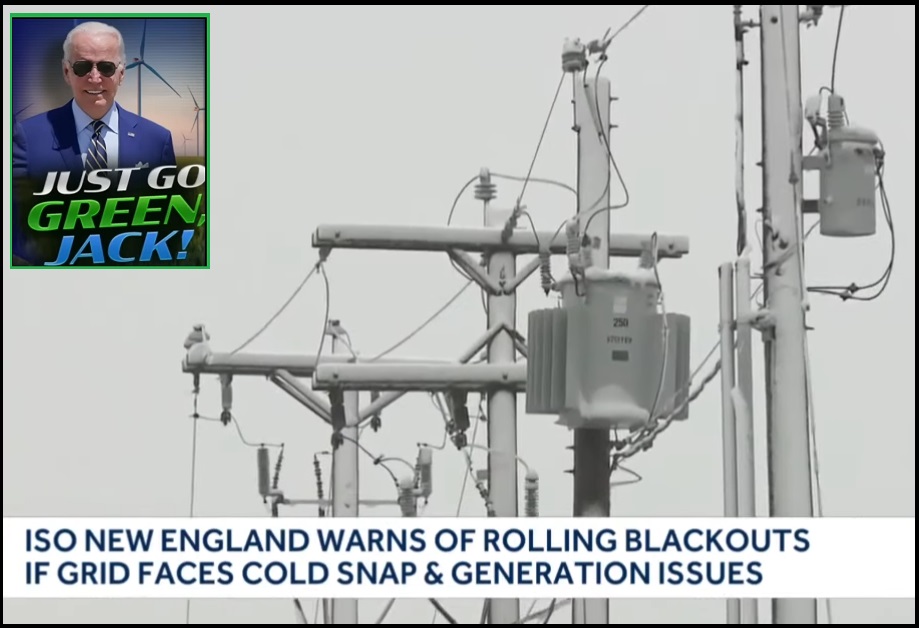
The region’s power-grid operator, ISO New England Inc., has warned that an extremely cold winter could strain the reliability of the grid and potentially result in the need for rolling blackouts to keep electricity supply and demand in balance. The warning comes as executives and analysts predict power producers could have to pay as much as several times more than last year for gas deliveries if severe weather creates urgent need for spot-market purchases.
“The most challenging aspect of this winter is what’s happening around the world and the extreme volatility in the markets,” said Vamsi Chadalavada, the grid operator’s chief operating officer. “If you are in the commercial sector, at what point do you buy fuel?”
Power producers in New England are limited in their ability to store fuel on site and face challenges in contracting for gas supplies, as most pipeline capacity is reserved by gas utilities serving homes and businesses. Most generators tend to procure only a portion of imports with fixed-price agreements and instead rely on the spot market, where gas prices have been volatile, to fill shortfalls. (more)
Thirty years later, the world continues to thrive. The climate zealots claimed we had about 10 years left on this Earth. Limbaugh calls out Gore for blaming global warming on capitalism and fear-mongering in this two-part debate. Also noteworthy is how two sides of the spectrum were able to hold a civil debate on a hot topic.
The French, especially in Paris, are starting to feel the effects of the gas shortage. There are reports of cars queued for miles outside gas stations. Some have reported waiting for over an hour, only to find that there was no petrol left to fuel their vehicle.
Workers at TotalEnergies and Esso-ExxonMobil in France are on strike at the moment as well. This has led to three out of six refineries shutting down as production has been cut by 60% to 740,000 bpd. Over a third of TotalEnergies’ 3,500 stations are low on petrol. Workers are seeking a 10% salary increase as they feel the oil companies are reaping in profits amid this crisis.
President Emmanuel Macron has urged the people to avoid panicking. Some believe that this situation is only a glimpse of what will come in the winter when reserves plummet and demand soars. There is currently enough fuel for about 90 days.
The climate zealots of the Yellow Vest movement are prominent in France. The group protested for 60 consecutive weeks in 2018 and is extremely anti-Macron. They even stormed the Arc de Triomphe in central Paris. With Macron reelected and fuel woes rising, expect this movement to gain some momentum – with more support than the last go-around.
Posted originally on the conservative tree house on September 26, 2022 | sundance
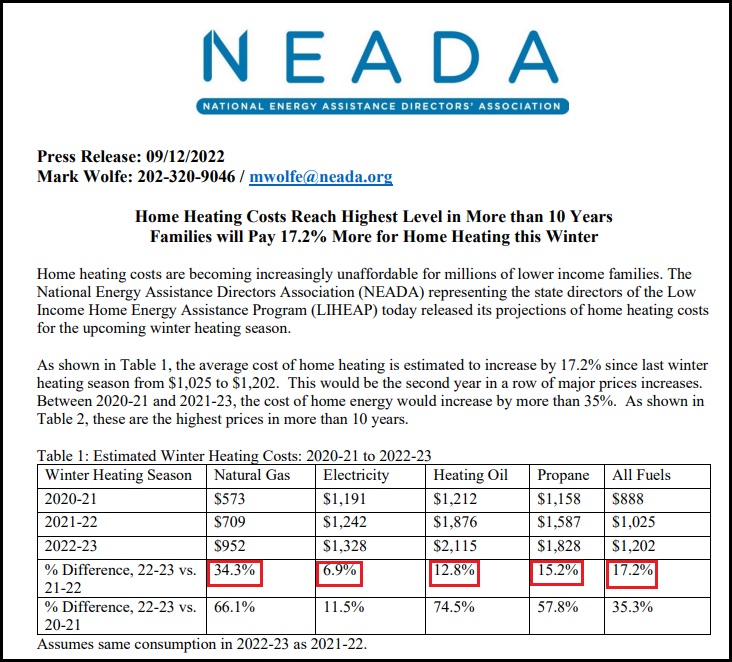
The National Energy Assistance Directors Association (NEADA) is estimating it will cost Wisconsin residents more than $1,200 to heat an average home this winter, an increase of more than 17% compared to last winter. [Data Link Here]
Roughly 50% of Wisconsin residents use natural gas for home heating. Natural Gas heating costs are increasing 34% this year (vs last winter, 2021). That’s also a 66.1% increase over the winter of 2020.
The Bank of England (BoE) all but admitted the UK is officially in a recession. Bank Governor Andrew Bailey stated weeks ago that there was nothing the central bank could do to prevent a recession at this stage. The Monetary Policy Committee (MPC) voted to raise rates by half a percentage point to 2.25%, marking the highest level since 2008. The markets were expecting a 75 bps hike, but the central bank is moving slowly and aiming to avoid panic.
The central bank foresees a 0.1% drop in GDP over the next three months after experiencing a 0.1% decline last quarter. The CPI report for August came in at 9.9%, which is only a slight drop from July’s 10.1% reading. Winter is coming, and that is when the full impact of the energy crisis will be felt. The BoE believes inflation will rise to 11% in October when energy caps are altered. Like the Federal Reserve, the BOE is a long way from its 2% inflation target and relied on QE for far too long.
The dollar’s strength continues to cause a devaluation in sterling as the USD is seen as the last safe haven.
Posted originally on the conservative tree house on September 23, 2022 | Sundance
The DeSantis Crew, formerly the 2016 Cruz Crew, is up in arms over a selectively edited soundbite from Jared Kusher, President Trump’s son-in-law. {Direct Rumble Link}
Florida Governor Ron DeSantis went shopping for South American aliens at an El Paso migrant processing facility in Texas. The DeSantis people took the aliens to a hotel with plans to fly them to Delaware, Joe Biden’s home state. However, facing backlash over the legality of spending Florida funds on a previous operation to move Texas migrants to Martha’s Vineyard, the DeSantis team abandoned the recruited Venezuelan aliens at the hotel, leaving them confused and stranded.
Jared Kushner noted in a Fox appearance that he did not like the approach of recruiting, manipulating and using arriving aliens as political pawns. Immediately the DeSantis supporters pulled an 8-second soundbite from a one-hour Fox News appearance and proclaimed Kusher was criticizing Ron DeSantis, which in the world view of Team DeSantis makes Kushner an enemy. However, the full statement with context is not controversial at all, and in my opinion Kusher is correct. WATCH:
.
The fact that Ron DeSantis sent people to Texas to recruit aliens from an El Paso processing facility with the promise of a flight to Delaware, then abandoned them when the political heat started, literally leaving them at the hotel confused and waiting for a bus that never arrived, shows the operation itself was using aliens as “political pawns,” and it is unseemly.
The DeSantis people can try to spin this against Kushner, but the outrage should really be toward the people working for DeSantis who pulled this stunt.
Posted originally on the conservative tree house on September 22, 2022 | Sundance
National Grid and Eversource are the two major electricity providers for Massachusetts. Both companies have notified the Department of Public Utilities (DPU) that rates for electricity are about to skyrocket.
National Grid has announced a 64% increase in electricity rates effective November 1st. While Eversource is on a different schedule, they too have announced an increase in natural gas rates of 38% on November 1st and the January 1, 2023, electricity rate will be announced in the next few weeks. Eversource is anticipated to announce a similar rate increase to National Grid. WATCH:
Both major power companies rely on natural gas to create electricity. Thanks to Joe Biden’s energy policies, which includes the massive export of natural gas in LNG form, domestic prices for natural gas have skyrocketed and will continue increasing as production is further shut down by regulation.
We are helping the EU survive their sanction driven energy crisis by sending them natural gas (LNG format), while simultaneously forcing Americans to pay more in order to maintain the EU export. Everything about the process is FUBAR.
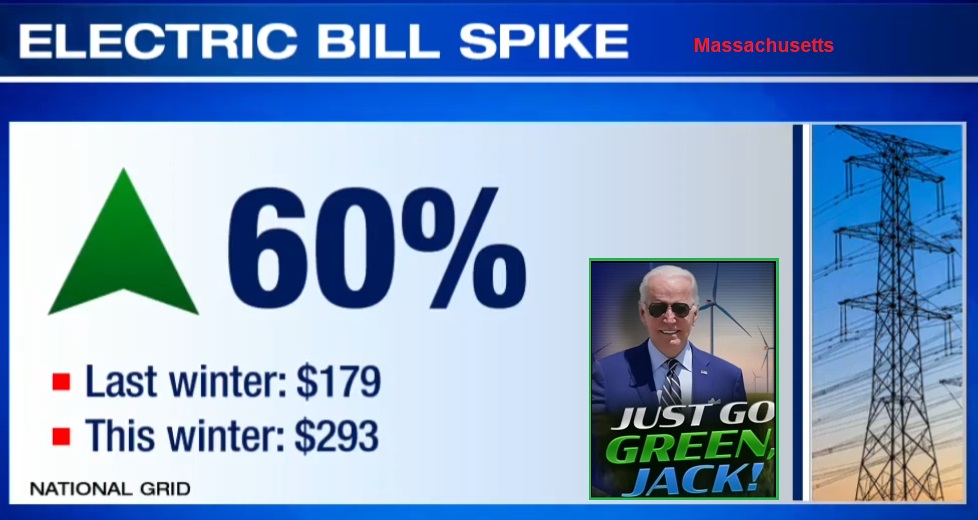
Massachusetts – […] National Grid said the monthly bill of a typical residential customer using 600 kilowatt-hours of electricity will increase from $179 last winter to about $293 this winter, an increase of about 64%. National Grid said the delivery portion of electric bills will basically remain flat.
“National Grid buys electricity on behalf of its customers from the wholesale power market through a regulatory approved process established 20 years ago. That process has served customers well over the years and provides flexibility for unforeseen events, like limited supplier response to solicitations. But things have fundamentally changed,” Helen Burt, the company’s chief customer officer, said in a statement. “Today, under a sustained, high market price environment, it is challenging to maintain affordable prices. Given that, we think it’s a good time to work with our regulators and other stakeholders to review the process and electricity supply dynamics in the region, with an eye toward reducing price volatility and maintaining a secure, reliable and resilient energy system for the future.”
The company also announced that its natural gas rates are expected to rise on Nov. 1. They said they have a pending proposal with the state Department of Public Utilities that would result in the monthly bill for an average Boston Gas residential heating customer using 115 therms per month of $278, an increase of $50, or 22%, compared to last winter’s rates.
Eversource, the state’s other major electric provider, said in an email that it is on a different schedule than National Grid for setting its electric rates so no increases are currently planned.
“We file electric base service rates twice per year with the DPU,” company spokesman Chris McKinnon said. “Our last change was on July 1, 2022 and our next change will be January 1, 2023, which we will be filing for in the coming months.”
Eversource did announce Wednesday that it has submitted a proposal to the Department of Public Utilities seeking to raise its natural gas rates. They said their average residential customer using 126 therms of gas a month would see an increase of about 38%, or $86 on their natural gas bill over last winter. Those rate increases would take effect Nov. 1. (read m0re)
I have created this site to help people have fun in the kitchen. I write about enjoying life both in and out of my kitchen. Life is short! Make the most of it and enjoy!
This is a library of News Events not reported by the Main Stream Media documenting & connecting the dots on How the Obama Marxist Liberal agenda is destroying America






 Centinel2012