Posted originally on the conservative tree house on July 4, 2022 | Sundance
John Kirby is the former Pentagon spokesperson who is now the National Security Council Coordinator for Strategic Communications. The people in/around the White House have shifted Kirby, a very good spinner of parseltongue, into a place where he can give the media an impression of White House competency.
The LGBTQ, racially inclusive and woke checkbox hires are not up to the task of their positions. Incompetence is running amok. As a result, it is somewhat ironic and representative the Biden hypocrisy, that Kirby is needed to take the pressure away from administration checkbox hires. In this interview Kirby defends the White House policy on the Russia-Ukraine war, interventionist and dependent foreign policy, and the energy policy that has resulted in high gas prices.
Video prompted to 04:05, where the topic of Biden’s upcoming visit to Saudi Arabia is discussed. WATCH:
Posted originally on the conservative tree house on July 2, 2022 | sundance
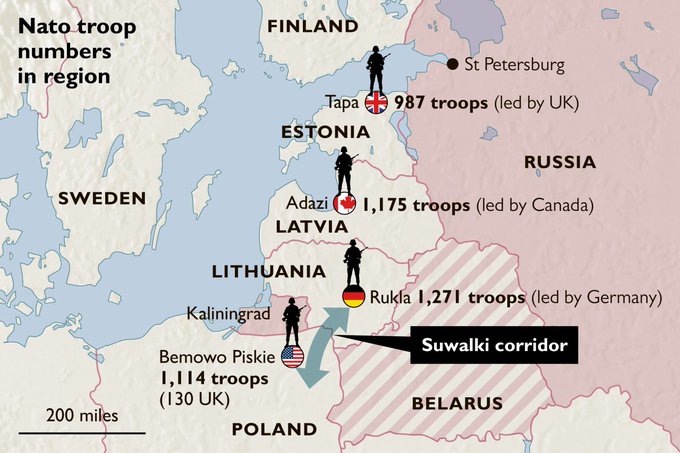
Two weeks ago, a NATO blockade of Kaliningrad, an outpost of Russia, was triggered when Lithuania blocked the transport of goods through Suwalki corridor. According to the Lithuanian justification they were following through on NATO sanctions against Russian goods. However, the escalation was very provocative toward Russia and discussions between Russia and NATO countries were tense.
Apparently, Germany was increasingly concerned the blockade was creating a scenario where Russian military were going to escort the transport of railroad goods to Kaliningrad, and that would lead to escalated military conflict with Russia. “German Chancellor Olaf Scholz is eager to avoid unnecessary provocations of Russia. He has repeatedly emphasized that he would do everything in his power to ensure that NATO does not become a party to the war between Russia and Ukraine. German soldiers are stationed in Lithuania and could become involved in a possible conflict.” {link}
The EU has now dropped the blockade and the transport of goods between Kaliningrad and Russia will resume. The EU decision was made before the NATO meeting in Madrid concluded; however, it looks like NATO postponed the announcement until after Biden left in order to save face on the reversal of position.
GERMANY – The European Commission plans to issue a clarification that will allow Russia to resume sending supplies to the exclave of Kaliningrad via Lithuania. Berlin supports the idea, but some in Vilnius are not pleased.
[…] The move will put an end to a disagreement that had not only been a significant source of tension between Russia and Brussels – but also exposed deep rifts within the EU regarding the correct approach to Moscow.
[…] The European Commission clarification expressly applies to all EU member states, but it mostly only affects the situation in Kaliningrad. According to the document, Russia will be allowed to transport sanctioned goods to Kaliningrad, but only in amounts comparable to pre-invasion deliveries.
The policy that has been adopted by the Commission largely reflects the position of the German government. Berlin had been critical of the approach taken by Lithuania.
German Chancellor Olaf Scholz is eager to avoid unnecessary provocations of Russia. He has repeatedly emphasized that he would do everything in his power to ensure that NATO does not become a party to the war between Russia and Ukraine. German soldiers are stationed in Lithuania and could become involved in a possible conflict.
The rules for the transit of goods, Scholz said at the conclusion of recent NATO summit in Madrid, “must of course be established in light of the fact that this is about shipments between two parts of Russia.” The comment made it clear that Berlin has a different interpretation of the legal situation than the government in Lithuania. (read more)
Posted originally on the conservative tree house on June 26, 2022 | Sundance
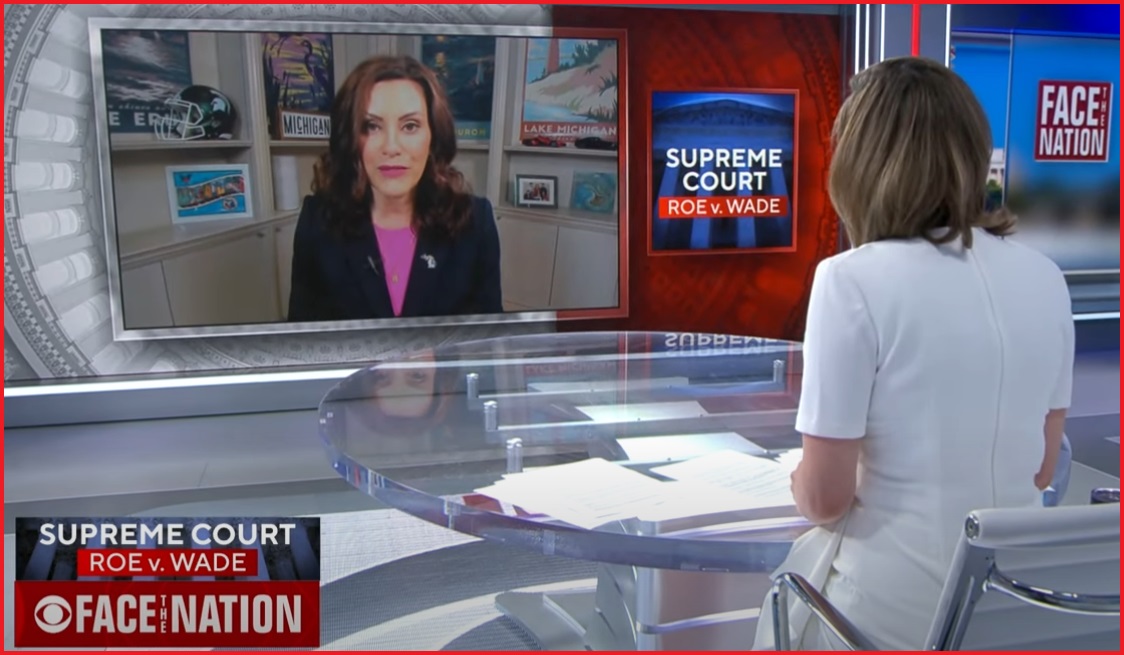
Comrades, this is quite a remarkable interview if you stand back away from the issue and just look at the context. Michigan Governor Gretchen Whitmer appears on CBS Face the Nation to discuss abortion in the aftermath of Supreme Court overturning Roe. The legal aspects for any abortion restriction now return to the state legislature and representatives closest to the people.
Comrade Whitmer is repeatedly asked what she can do to keep abortion available without limit. In her responses Whitmer notes that her opinion on the issue is not held by the state legislature and lawmakers, as a result there’s not much she can do. Gretchen Whitmer is admitting her view is not the view of the people in her state, yet she vows to continue fighting against the will of the people. WATCH:
[Transcript] – …”GOV. WHITMER: What I’m trying to fight for is the status quo in Michigan and there are reasonable restrictions on that. With the current legislature that I have, there is no common ground, which is the sad thing.” (read more)
Posted originally on the conservative tree house on June 26, 2022 | Sundance
Western leaders, specifically including the G7, have a serious problem. Their collective energy and economic policy, a chase for the climate change and corporate financial agenda, have created the downstream consequences of global food shortages and third-world instability. The non-industrial nations will now, once again, suffer as a direct result of Western ideology and arrogance.
To combat the pesky third-world pitch forks, today Joe Biden announced the U.S. will lead the G7 in a series of advanced spending measures intended to control how the pain inflicted by the industrialized nations will surface to the rest of the world. Western media must not let the suffering of the brown people become visible, lest people start to connect the dots and realize the G7 is an ideologically racist and exploitative enterprise.
To soften the reality of the brown people suffering, the leftist administration of Joe Biden will spend $200 billion to mitigate the damage. There are four aspects:
(1) To increase dependency and control the third-world population the G7 will finance a vaccine manufacturing facility in Senegal. The breeding of the brown people must be controlled – climate change policy demands it.
(2) To control the optics of the third-world complaining about it, the G7 will mobilize $335 million in private capital to control the communication systems in Africa, Asia, and Latin America. The brown people must not discover the nature of their exploitation; and the citizens within the G7 nations must not find out their government is exploiting the brown people. Wouldn’t look good.
(3) The United States will spend $50 million over five years to support gender equity in the developing world increasing the friction between brown women and brown men, while ignoring cultural differences and forcing the social ideology of the West upon them. And finally….
(4) The G7, fearing third-world instability and anger from the brown people that could disrupt their supply chains, the U.S. and Western nations will now seek to increase their control of mining for mineral deposits needed for G7 batteries – and will fund more railroads and ports to export the critical material to the West more quickly.
[Transcript] – THE PRESIDENT: Thank you very much. Well, good afternoon, folks.
Our nations and our world stand at a genuine inflection point in history. Technology has made our world smaller, more immediate, and more connected. It’s opened up incredible opportunities, but also accelerated challenges that impact on all of us: managing global energy needs, taking on the climate crisis, dealing with the spread of diseases.
And the choices we make now, in my view, are going to set a direction of our world for several generations to come.
These challenges are hard for all of us, even nations with resources of the G7. But developing countries often lack the essential infrastructure to help navigate global shocks, like a pandemic. So they feel the impacts more acutely, and they have a harder time recovering.
In our deeply connected world, that’s not just a humanitarian concern, it’s an economic and a security concern for all of us.
That’s why, one year ago, when this group of leaders met in Cornwall, we made a commitment: The democratic nations of the G7 would step up — step up and provide financing for quality, high-standard, sustainable infrastructure in developing and middle-income countries.
What we’re doing is fundamentally different because it’s grounded on our shared values of all those representing the countries and organizations behind me. It’s built using the global best practices: transparency, partnership, protections for labor and the environment.
We’re offering better options for countries and for people around the world to invest in critical infrastructure that improves the lives — their lives, all of our lives — and delivers real gains for all of our people, not just the G7 — all of our people.
Today, we officially launch the Partnership for Global Infrastructure and Investment. We collectively have dozens of projects already underway around the globe.
And I’m proud to announce the United States will mobilize $200 billion in public and private capital over the next five years for that Partnership.
We’re here today because we’re making this commitment together as a G7 in coordination with one another to maximize the impact of our work.
Collectively, we aim to mobilize nearly $600 billion from the G7 by 2027.
These strategic investments are areas of — critical to sustainable development and to our shared global stability: health and health security, digital connectivity, gender equality and equity, climate and energy security.
Let me give you some examples of the kinds of projects that are underway in each of these areas.
First, health. Two years ago, COVID-19 — didn’t need any reminders about how critical investments in healthcare systems were and health sec- — and health security is, both to fight the pandemic and to prepare for the next one, because it will not be the last pandemic we under- — we have to deal with.
That’s why the United States, together with the G7 partners and the World Bank, are investing in a new industrial-scale vaccine manufacturing facility in Senegal. When complete, it will have the potential to produce hundreds of millions of doses of vaccines annually for COVID-19 and other diseases.
It’s an investment that will enhance global vaccine supplies as well as improve access and equity for developing countries.
Second, in the digital area. Our economies’ future increasingly depends on people’s ability to connect to secure information and communications technologies. And we need to strengthen the use of trusted technologies so that our online information cannot be used by autocrats to consolidate their power or repress their people.
That’s why the Digital Invest Program is mobilizing $335 million in private capital to supply secure network equipment in Africa, Asia, and Latin America.
And the U.S. government also supported the successful bid by an American company, SubCom, for a $600 million contract to build a global subsea telecommunications cable. This cable will stretch from Southeast Asia, through the Middle East and the Horn of Africa, to Europe.
This will be essential to meeting the growing demand for reliable security, high-tech connectivity in three key regions of the world.
Third, gender. When women and girls have the ability and the opportunity to parcia- — to participate more fully in those societies and economies, we see positive impacts not only in their communities but around the board — across the board.
We have to increase those opportunities, though, for women and girls to thrive, including practical steps to make childcare more accessible and affordable as we continue the vital work to protect and advance women’s fundamental rights.
The United States is committing $50 million over five years to the World Bank’s global Childcare Incentive Fund. This public-private partnership supported by several G7 partners will help countries build infrastructure that makes it easier for women to participate equally — equally — in the labor force.
Fourth and very important, climate and energy. We’re seeing just how critical this is every day. The entire world is feeling the impact of Russia’s brutal war in Ukraine and on our energy markets.
We need worldwide effort to invest in transformative clean energy projects to ensure that critical infrastructure is resilient to changing climate.
Critical materials that are necessary for our clean energy transition, including the production of batteries, need to be developed with high standards for labor and the environment.
Fast and reliable transportation infrastructure, including railroads and ports, is essential to moving inputs for refining and processing and expanding access to clean energy technologies.
For example, the U.S. government just facilitated a new partnership between two American firms and the government of Angola to invest $2 billion in building new solar projects in Angola. It’s a partnership that will help Angola meet its climate goals and energy needs while creating new markets for American technologies and good jobs in Angola and, I suspect, throughout Africa.
And in Romania, the American company, NuScale Power, will build a first-of-its-kind small modular reactor plant. This will help bring online zero-emission nuclear energy to Europe faster, more cheaply, and more efficiently.
The U.S. government is helping to advance the development of this groundbreaking American technology, which will strengthen Europe’s energy security and create thousands of jobs in Romania and the United States.
These deals are just some of what’s in store. And we’re ready. We’re ready to get to work, together, all of us.
To lead efforts — to lead U.S. efforts, in my case — appointed — I appointed Amos Hochstein, my Special Presidential Coordinator, to deal with the rest of our colleagues. I’ll [He’ll] lead the U.S. whole-of-government approach to drive a coalition and a collaboration with the G7 and our partners around the world, including private sector and multilateral development banks.
I want to be clear: This isn’t aid or charity; it’s an investment that will deliver returns for everyone, including the American people and the people of all our nations. It’ll boost all of our economies, and it’s a chance for us to share our positive vision for the future and let communities around the world see themselves — and see for themselves the concrete benefits of partnering with democracies.
Because when democracies demonstrate what we can do, all that we have to offer, I have no doubt that we’ll win the competition every time.
Posted originally on the conservative tree house on June 26, 2022 | Sundance
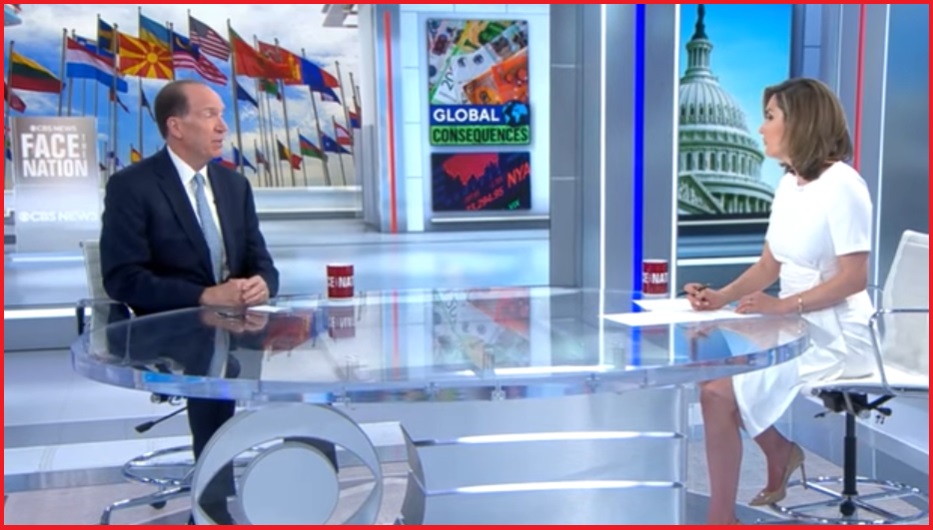
World Bank President David Malpass appears on CBS with media propagandist Margaret Brennan, a woman of exceptionally low intelligence, to discuss the current state of global economics and the likely consequences. I have been saying this for a year and I will repeat, the absence of food will change things.
Within the interview [Transcript Here] the status and solutions that Malpass outlines are accurate and factual, albeit couched in gentle terms acceptable to the globalists. As noted by Malpass, if a shift in messaging and actual policy for energy and finance does not take place, the outcome will be bad for food production and government stability.
The World Bank president accurately states increased production is urgently needed to avoid global shortages. However, that increase in production is only possible if the leaders of the largest economies reverse their positions on energy development and finance. The world needs oil and natural gas production to increase dramatically in order to stave off food shortages. Unfortunately, those pragmatic recommendations are falling on deaf political ears. WATCH:
[Transcript] – MARGARET BRENNAN: There are a lot of stressors on the global economic system right now, how do you describe where we are?
MALPASS: It’s a sharp slowdown, including even China. So we’ve seen the world growth fall by half since January in terms of GDP growth. But there’s also shortages, there’s inflation. And the food shortages for the poorer countries are becoming a significant concern, they already are.
MARGARET BRENNAN: I mean, global inflation, it’s not just the US it’s other wealthy countries around the world. But you’re also describing a recipe for global instability.
MALPASS: It feeds in when there’s not enough food that for- for weaker countries, poorer countries, that- that causes instability. And it’s a big factor in the turnover of governments that’s been occurring in quite a few of the countries. And then there also has to be much more discussion of what to do about the fiscal challenges that you know, running out of money for government as well as food. And so these all go together into fragility, very concerning.
MARGARET BRENNAN: COVID caused the deepest global recession since World War Two. Now, the world economy is in danger because of this Russian invasion in Ukraine. How do you avoid a global recession with all of these factors?
MALPASS: Some countries, it’s going to be very hard to do that. I think that leadership from the stronger countries is very important. There are a lot of possibilities, tools, for example, the- the central banks have many more tools than in 2008. You know, there were, there are regulatory tools that they have, they now hold huge bond portfolios, those could be- those are all funded by money from banks. So if there is reduction in the bond portfolios, that frees up capital that could be used for these supply chains that are so strained. The bottom line is there needs to be lots more production and that’s most available to the strongest countries. The U.S. is the world’s biggest economy and can increase production more than anybody else. And so that becomes one of the key variables in the outlook. What are you doing today, to increase production of everything, the world needs practically everything that the U.S. makes and there needs to be a process to really boost that production.
MARGARET BRENNAN: So if you were talking to Jerome Powell, that chair of the US Federal Reserve, you would say focus less on interest rates, focus more on what?
MALPASS: He’s got multiple tools. One is regulatory policy, the Fed is a sort of an important regulator of banks. So let the banks lend more. But then also on the bond side, reducing the bond portfolio would return more money to banks, all of the money being used to hold the bond portfolio comes from banks. And if they had more, they could lend and also the non-bank sector of the U.S. economy. That’s one of the most innovative, and it could put more money into the supply chain.
MARGARET BRENNAN: It’s interesting, you say that, the banks, I heard something from a U.S. official talking about that as an impediment to oil companies right now and President Biden’s calling on them to produce more energy. Is that a problem, that you see?
MALPASS: Big problem, and it’s really around the world markets look ahead, and they look at what the regulatory policy is going to be into the future. So if you’re an oil company, you hear the message from all around that, that the- the politicians don’t want your oil. And so- so then you- you drill less you put you make less of your R&D plans. You know, R&D is research and development is critical to the innovation in every sector. In developing countries, they aren’t producing energy either, because they’re constrained by bank regulations by the lack of financing.
MARGARET BRENNAN: But even at this meeting of the largest global, you know, Western economies at the G7, there’s going to be focus on sustainability, there’s going to be focus on climate change, the message there is switch away from fossil fuels. But then at the same time, you’re hearing Germany, build a coal burning once again, the United States urging oil and gas production once again, because of the crisis with Russia. So how do all these pieces fit together without impacting growth in a negative way?
MALPASS: There’s an inconsistency [in energy policy] and it’s a moment in time the world’s trying to reduce the dependence on Russia, and also on China. And it needs to keep markets open and not restrict exports and finance the new investments that’s needed, and there’s not clarity in Europe. You know, some of the countries want nuclear power, some want natural gas, and they’re talking about importing natural gas, but they’re doing it slowly. So that for the poorer countries in the world, this is also- it’s a conundrum, how are we going to get forward when Europe is drawing in so much of the world’s natural gas.
MARGARET BRENNAN: So a state department official said, a few days ago, food crisis will be at least a three-year problem. What time horizon do you put on the food crisis and the energy crisis?
MALPASS: I’ll say one thing, it’s possible to produce enough to soften that crisis. But at the rate that we’re going right now, the fertilizer isn’t being made, you know, fertilizer comes a giant source of fertilizer is from natural gas, through the ammonium channel into the most useful fertilizer. And it also is used to make the electricity that converts the minerals into fertilizer, and that’s just not happening. So a lot of the world is shutting down for lack of fertilizer, and then those shortages of crops will last for multiple years. We need to break that cycle, and do it pretty forcefully now, through announcements. The markets listen to what the governments are saying. And I think if the governments were saying, if the central banks were saying there’ll be currency stability, meaning years and years from now, the currencies won’t have devalued, they won’t be causing inflation, they’re going to be strong and stable for the long term, that would go a long way and the same thing on this production side of the economies, say that you want your strong economies to produce twice as much as they are right now. That’s within reach for many of these innovation techniques.
MARGARET BRENNAN: The Federal Reserve Chair said this week in this country, that recession is certainly a possibility, in part because of higher interest rates. Citigroup puts the odds of a recession at 50%. What’s your projection here for the world’s most important economy?
MALPASS: We put out a report three weeks ago that didn’t have the US in recession. But we said in downside scenarios there could be and so I don’t disagree with those estimates that you’re seeing there. And I would say the key variable is what do you do today to provide more production that addresses both the recession problem and also the inflation problem because you- you just push goods into the market and you make it clear to the world, we’re going to produce so much, you won’t be able to get that price.
MARGARET BRENNAN: So do you agree with Fed officials when they say it’s going to take at least two years, a couple of years before we get inflation back down to 2%?
MALPASS: It’s going to take time to come down, but again, that depends on what our- what’s your forecast for oil prices, for natural gas prices, for fertilizer? I guess it’s- it’s clearly- it’s going to take- months and months and maybe two years to bring inflation back down. It- markets respond, though, to signals. And so I think the important question is, can there be enough signals out of the U.S. but also the other advanced- the big economies, that they’re going to provide more production. And the reason I keep coming back to that central banks have a lot to do with whether businesses feel that they can borrow more money. It’s the regulatory policy, also this, this control of so many bonds, you know, in Japan, they’ve bought up a huge part of the national debt, so the central bank, but takes money from the banking system and buys government bonds. That’s not adding to supply in Japan.
MARGARET BRENNAN: So lastly, before I let you go, you have warned on this program before about a debt crisis in these developing countries, the emerging markets, with interest rates headed up is that now where we are, are we at crisis?
MALPASS: We’re at crisis, and we see more countries falling in one by one, we’ve seen that Sri Lanka in the very grave difficulties there. But it’s, it’s going to be many countries because of as you say, the interest rates going up and also their GDP going down in- in this slow growth environment of the world. The solution is a lot more production intent from the advanced economies.
MARGARET BRENNAN: A perilous moment for the global economy, David.
MALPASS: Dangerous, and I just hope we can push through strongly and with confidence.
MARGARET BRENNAN: Thank you very much for your time.
Posted originally on the conservative tree house on June 26, 2022 | Sundance
We must always keep focus on the context for information that comes from the U.S. State Dept and the Central Intelligence Agency to the media. Yesterday, as Joe Biden was en route to the G7 summit in the Bavarian Alps, the New York Times published an article saying the CIA and Pentagon special forces are organizing and conducting the NATO war effort from a secret operation center in Kyiv.
Some viewed the article as the NYT violating operational security for the U.S. led effort. However, that perspective belies the nature of how the media is used in war by Dept of State and intelligence officials. The details of the Times article are attributed to “three U.S. officials,” and should be looked upon as purposeful.
In addition to the timing of Biden headed to the G7, the admission of CIA officials conducting the war effort from inside Ukraine, comes as NATO partner country Lithuania informs Russia that prior transit treaties to the Russian enclave of Kaliningrad will not be honored. NATO is poking and provoking a response from Russia, the Times article is part of this effort.
New York Times – … [E]ven as the Biden administration has declared it will not deploy American troops to Ukraine, some C.I.A. personnel have continued to operate in the country secretly, mostly in the capital, Kyiv, directing much of the vast amounts of intelligence the United States is sharing with Ukrainian forces, according to current and former officials.
At the same time, a few dozen commandos from other NATO countries, including Britain, France, Canada and Lithuania, also have been working inside Ukraine. The United States withdrew its own 150 military instructors before the war began in February, but commandos from these allies either remained or have gone in and out of the country since then, training and advising Ukrainian troops and providing an on-the-ground conduit for weapons and other aid, three U.S. officials said.
Few other details have emerged about what the C.I.A. personnel or the commandos are doing, but their presence in the country — on top of the diplomatic staff members who returned after Russia gave up its siege of Kyiv — hints at the scale of the secretive effort to assist Ukraine that is underway and the risks that Washington and its allies are taking.
[…] The commandos are not on the front lines with Ukrainian troops and instead advise from headquarters in other parts of the country or remotely by encrypted communications, according to American and other Western officials, who spoke on the condition of anonymity to discuss operational matters. But the signs of their stealthy logistics, training and intelligence support are tangible on the battlefield.
Several lower-level Ukrainian commanders recently expressed appreciation to the United States for intelligence gleaned from satellite imagery, which they can call up on tablet computers provided by the allies. The tablets run a battlefield mapping app that the Ukrainians use to target and attack Russian troops. (read more)
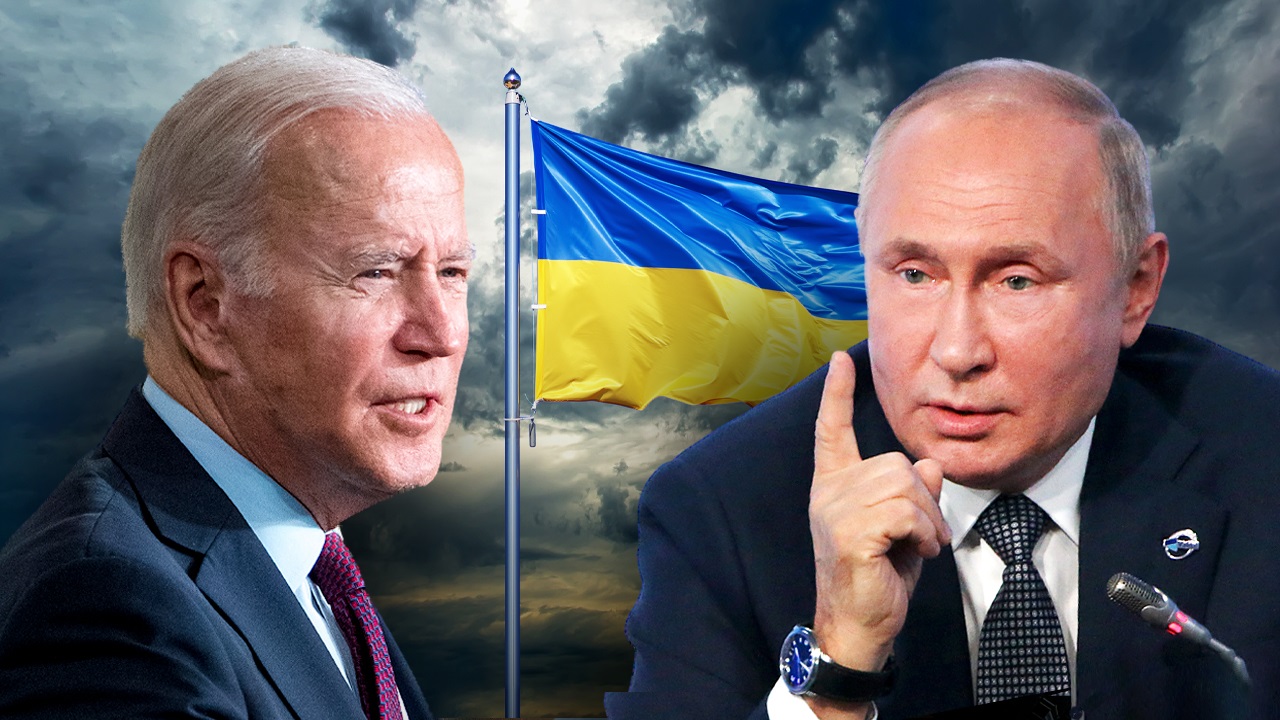
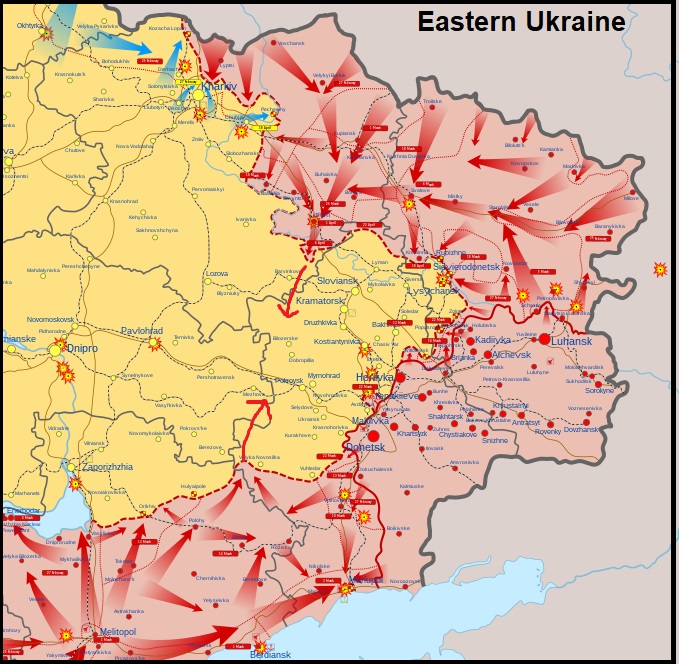
Regardless of debatable opinion on the Russian special military operation in eastern Ukraine, there are multiple motives for NATO and western government to escalate the proxy war against Vladimir Putin.
The proxy war in Ukraine provides a cover justification for the economic consequences driven by western government COVID-19 spending and policy. We are seeing Russia being blamed for oil shortages, an EU energy crisis, U.S. gasoline prices, global food and fertilizer shortages, as well as global inflation overall.
While there is some latter causation in EU energy disruption related to the Ukraine war, the blaming of Putin is wildly disproportionate to the actual impact from the Russian operation; not to mention disconnected from the reality of those economic consequences surfacing long before the February 24th Russian incursion began.
Factually, it is the NATO and Western sanctions against Russia that have contributed to the Ukraine impact on the global economy. Russia has no issue selling oil, gas and food related products to the global market. It is the sanctions that forbid the sales and created the fracture in global trade now impacting the EU and to a lesser extent the U.S.
All of that said, consider the position of Vladimir Putin now as the U.S. openly admits to conducting military operations against Russia from inside Ukraine while NATO allies like Lithuania announce blockades against products to and from Russian civilians in Kaliningrad.
Putin knows the U.S-led NATO alliance would like nothing more than to invoke article 5 of the NATO treaty if Russia takes any hostile action toward a NATO country. The Russian president is likely not going to fall for any bait that can be placed in front of him. However, that doesn’t mean Vladimir Putin does not have options to strike back against increased provocation.
Russia can strike any region inside Ukraine, including any area they previously did not have as a target, without changing the dynamic of current hostilities. This puts the capital city of Kyiv in a precarious place, especially given the pronouncements by U.S. officials that CIA and Pentagon operators are working to fight Putin’s forces from inside Kyiv. Again, a pronouncement that could be looked upon as intentionally publicized in order to provoke such a move.
Russia can also shut down the remaining pipelines out of Russia and sell oil and natural gas, albeit at higher prices, to non-western countries (India, China, etc).
As the ongoing successful effort in eastern continues, Russia has options to ignore NATO’s desire to expand the conflict or he could target very strategic operation centers in Western Ukraine that are being used as bait by U.S. officials promoting their antagonism through the New York Times.
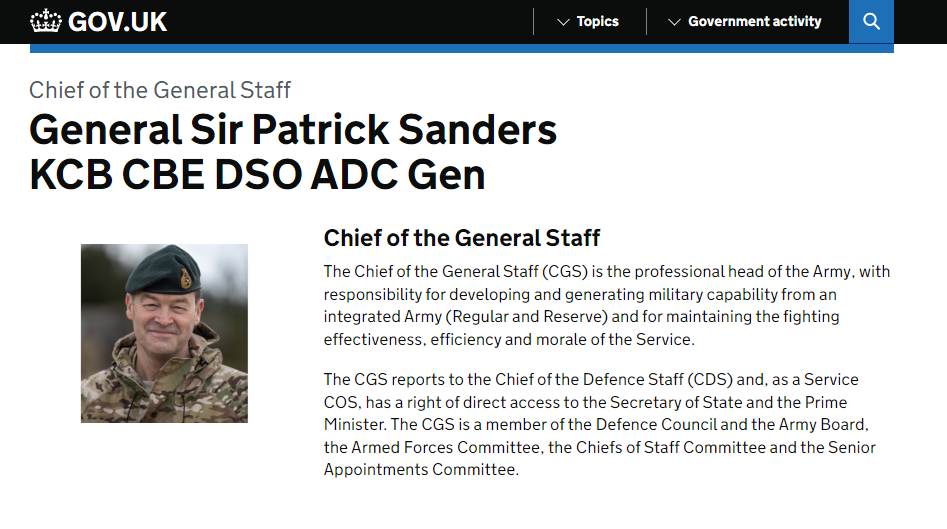
Britain’s Military Chief of the General Staff had just taken that position and he has already told the army they need to prepare for war against Russia in Europe. He has told every soldier to prepare to fight Russia in a potential World War III. He has pledged to forge an Army that can beat Russia in battle and said that we must now prepare “to fight in Europe once again.” He added on his fourth day on the job: “There is now a burning imperative to forge an Army capable of fighting alongside our allies and defeating Russia in battle.”
This is a video interview of Zelensky’s adviser years in advance. This entire Ukrainian War was deliberately instigated. The West NEEDS war because the entire financial system is collapsing. All the pensions promised have been wiped out in Europe thanks to NEGATIVE interest rates since 2014.
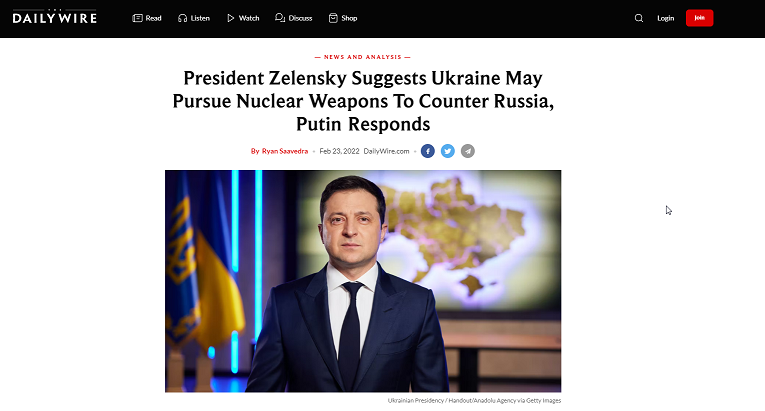
Zelensky is an actor. He is playing his role in this Great Reset which is to destroy Western civilization as we know it so they get to create their One-World Government and the United Nations will then appear to be the GREAT PEACEMAKER. On February 20th, 2022, VP Harris blurted out that Ukraine should join NATO which was a direct violation of the Belgrade Agreement where Ukraine, the 3rd largest nuclear power at the time, gave up its nuclear weapons and NATO promised not to invade as did Russia provided Ukraine was to remain NEUTRAL. Then 3 days later, Zelensky announced that he would pursue nuclear weapons to defend against Russia. The next day, Putin invaded to protect the Donbas on February 24th.
There are a number of world leaders who are starting to wake up and see that this entire Ukrainian War has been a hoax. This was intentionally created for the Great Reset because Europe NEEDS to default on all the debt they can no longer sustain. But that will wipe out all the pensions and millions of people will be storming the parliaments. The only escape for those in government is to create a war to hide the collapse. Now even Pope Francis is starting to see through this facade as he has told a group of European Jesuit news editors that “perhaps somehow either provoked or not prevented,” and he cautioned against oversimplifying the conflict.
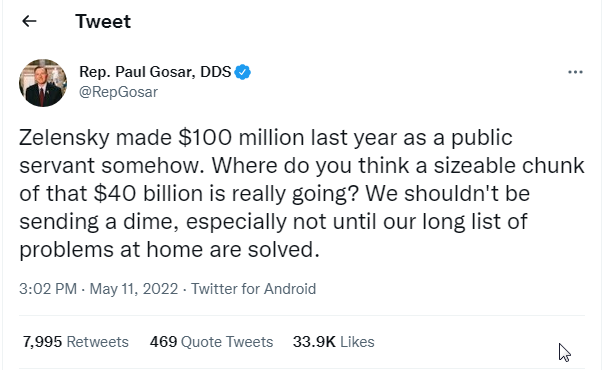
Zelensky is a hateful, vindictive, and pathological liar who demonizes Russians every chance he gets. The US has absolutely NO abilityto even verify where all the weapons go that they send to Ukraine. There are reports of foreign soldiers who had volunteered to fight for Ukraine and then left because the weapons were being stolen and sold on the black market and will always, end up on the streets in America.
Zelensky is evil, and corrupt, and ran for office promising peace with Russia and ending corruption. Some reports say he has already diverted up to $850 million to hidden offshore accounts. He will fight till the last Ukrainian dies and then fly off to live the billionaire’s life drinking port with Klaus Schwab, George Soros, and Bill Gates.
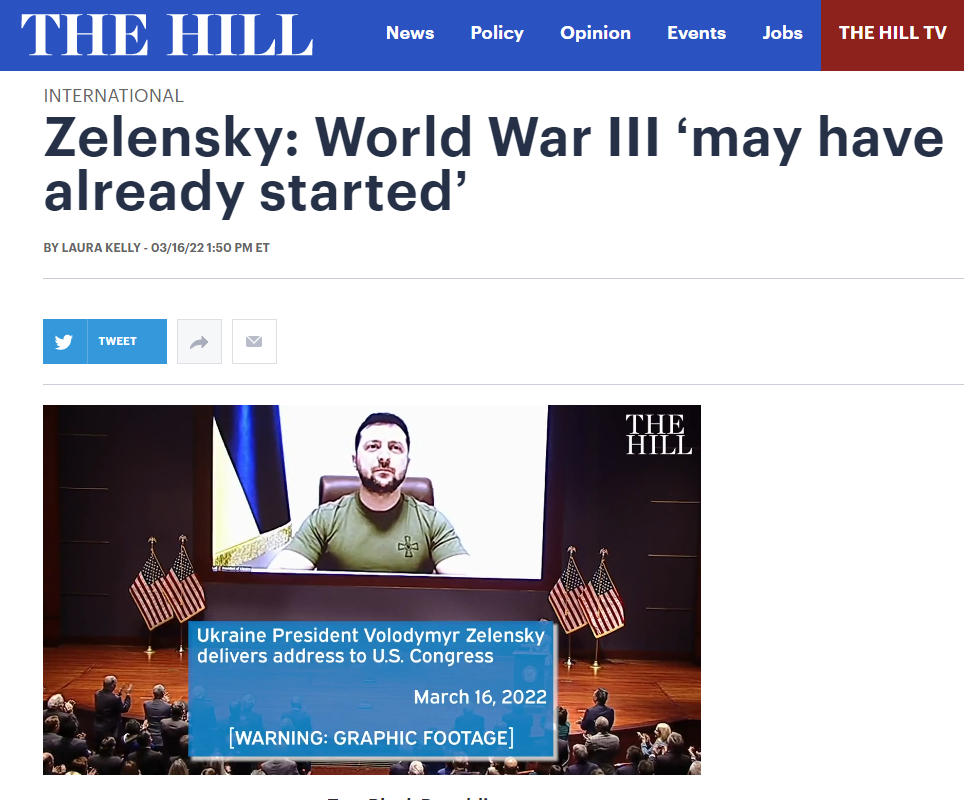
The very person who funded Zelensky is the same person who bought Hunter Biden and President Joe Biden demanded that Ukraine fire the prosecutor investigating this corruption. Zelensky pathologically urges World War III during every one of his public appearances. Zelensky is clearly waging an information war promoting pure propaganda.
Zelensky’s Davos Speech was unbelievable. He demanded that the US-led West implement a policy of maximum preemptive sanctions on the false pretext of averting future wars. According to Zelen sky, had the US-led West’s cut off Russia completely from the world economy IN ADVANCE, this would somehow prevented war. He claimed that the sanction was NOT ENOUGH and cane TOO LATE. He wants the US-led West to now completely cut off from the world economy not just Russia, but regional security demands that the US-led West should unilaterally threaten other nations and impose maximum sanctions on all Russian allies BEFORE they can react.
I have videos captured from Ukrainian soldiers showing what they are doing to captive Russian soldiers. I will not post them because they are too horrible. They are actually crucifying Russians driving nails through their limbs and then setting them on fire alive. This is the hatred of Ukrainian neo-Nazis toward Russians and why the CIA protected the Ukrainian neo-Nazis because they always hated Russians. They massacred Jews and Polish but NOT one Ukrainian was ever put on trial at Nuremberg. This is now what we get for the failure to prosecute Nazis. The 72-year revolutionary cycle from the end of the Nuremberg Trial was 2018. Even this hatred has risen all over again and this time the US-led West is supporting the Nazis.
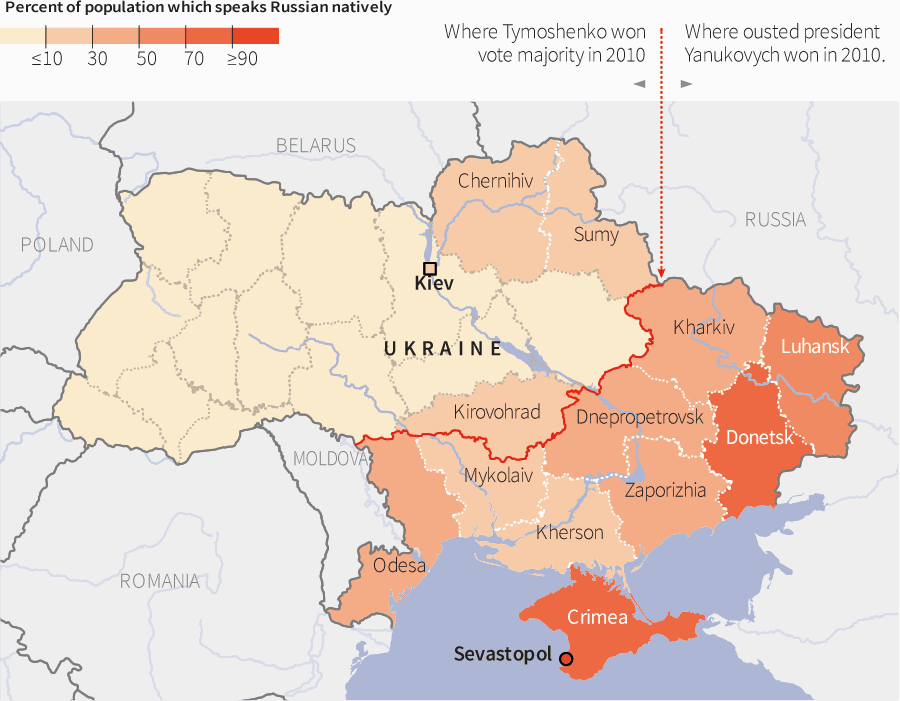
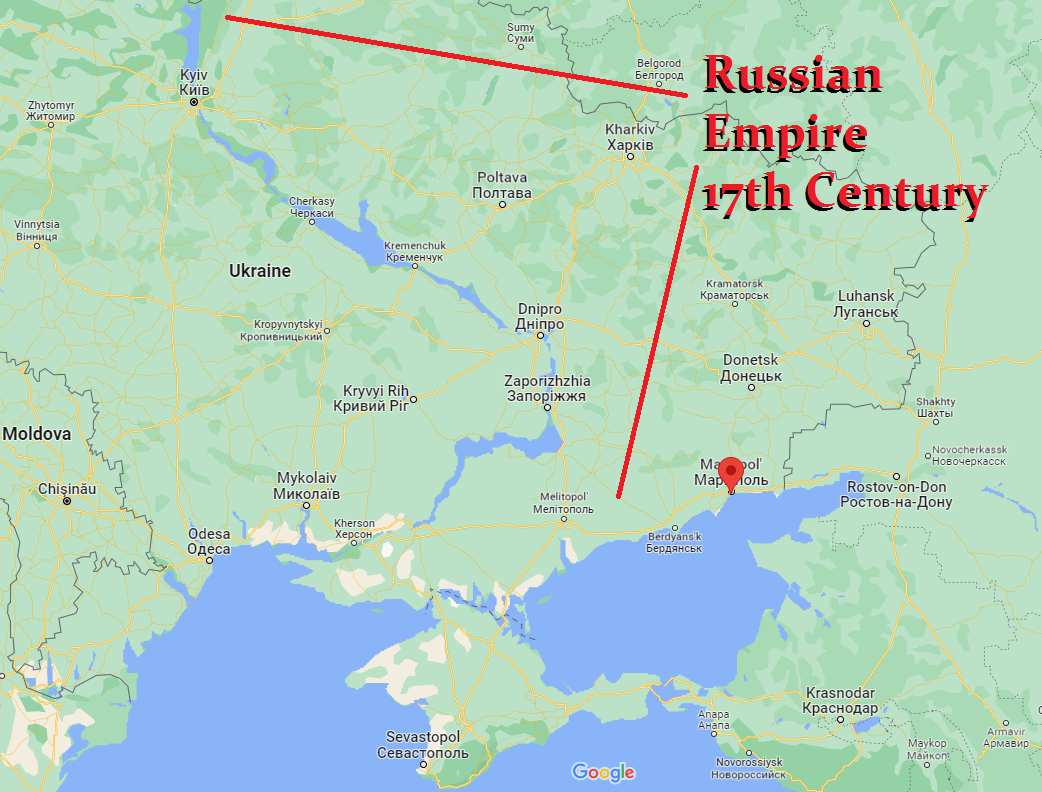
As I warned back in 2013, our computer had targeted Ukraine as the place where World War III would begin. I warned that Ukraine should have been split according to language. This area to the East was NEVER Ukrainian territory EVER in history. Khruschev grew up in the Donbas and he was in charge of rebuilding Kiev. When he became the head of Russia, in 1954 he assigned Crimea to Kiev for administrative purposes. The Duma later declared that illegal and reversed that decree.
Historically, the East was ALWAYS part of the Russian Empire BEFORE the USSR. This refusal to yield “one inch” to Russia which Zelensky has declared, is unsupported by history. That region is occupied by ethnic Russians who the Ukrainians will massacre. In Kyiv, they were saying in 2014 that Crimea is Ukrainian or it will be depopulated.
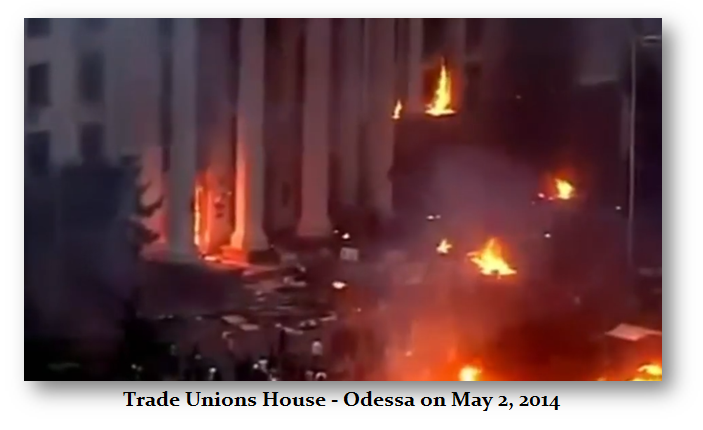
The hatred of Russians who have lived there for centuries is deeply rooted. The Ukrainians began their civil war against the Donbas and Russian-speaking Ukrainians immediately after overthrowing Yanukovich in 2014. They were beating Russian-speaking Ukrainian in Odesa and they fed to the Trade Union House. The Ukrainians then set the place on fire and killed them all burning them alive which the West turned a blind eye to because after all, they were evil Russians who obviously have no right to live on this earth.
Zelensky does his war propaganda always dressed in a military t-shirt. He has done nothing but promote world war III every chance he gets. His hatred of Russians knows no bounds and he will engulf the entire world in war all for what – territory? This man is so evil, that history will remember him along with those of the same mentality of sheer hatred and manipulations – Marx, Stalin, Hitler, and the list goes on.
As for those who see only one dimension, there was widespread support for animalwelfare in Nazi Germany (German: Tierschutz im nationalsozialistischen Deutschland). Believe it or not, AdolfHitler and his top officials took a variety of measures to ensure animalswere protected. That obviously stood in contrast with killing the Jews, and gypsies and the Ukrainian Nazis added Polish and Russians to the list that needed to be ethnically cleansed. But somehow, Hitler protected the animals.
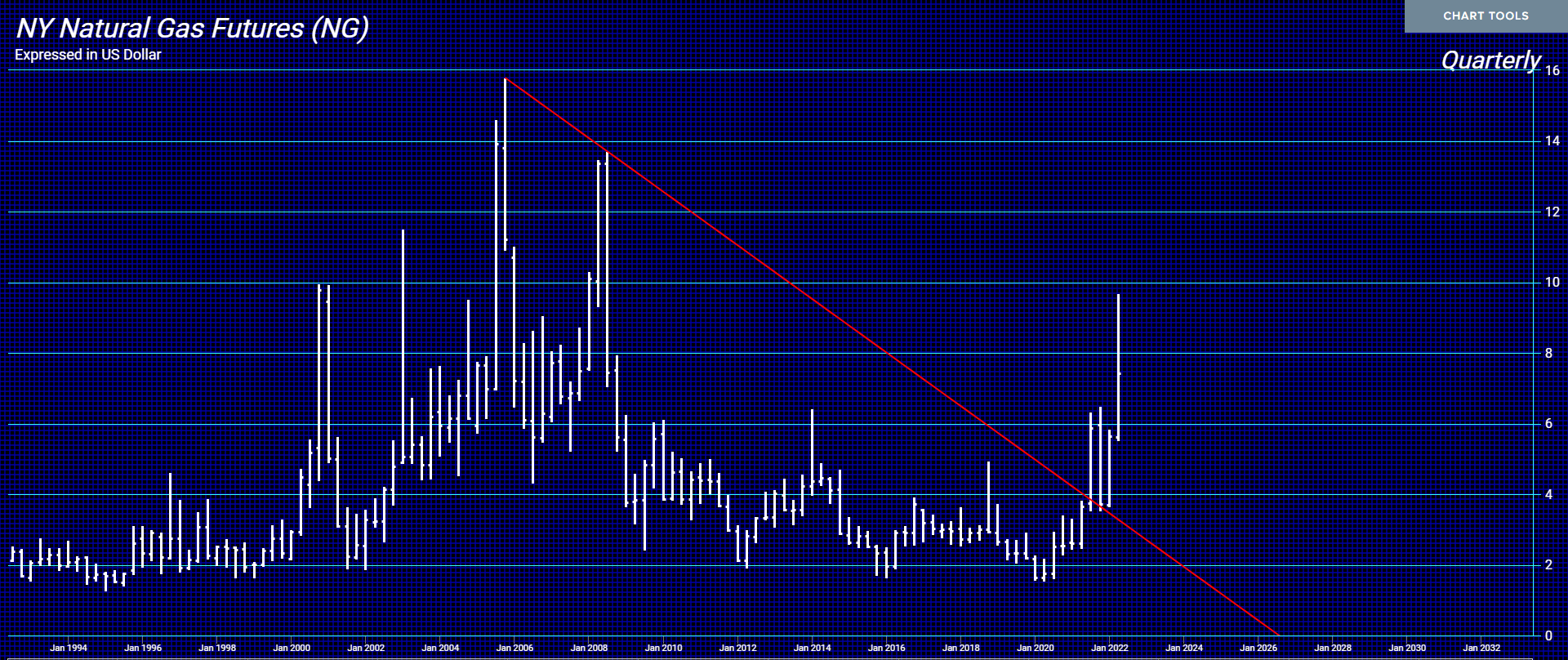
The Russian EU Ambassador has informed the EU that gas will stop through Nordstream because a turbine that was needed was stuck in Canada because of the sanctions. Then the biggest gas field in Siberia is now on fire. That can also provide an excuse to reduce gas delivery to Europe. This will also add to the reduction in gas supply to Europe This is making things very interesting. If Gas bottoms next week, we could be looking at much higher volatility thereafter. For now, a June closing above 625 will keep the market in a broader-term support position but a real breakout would require a close for June above 795.
Posted originally on the conservative tree house on June 15, 2022 | Sundance
A contracted mercenary has no legal recognition or protection as a prisoner of war. Two American mercenary soldiers have been captured by Russian forces and now present a rather unique issue for the Biden administration. The traditional end result for captured mercenaries is execution; however, Russian President Vladimir Putin may not want to hang these two State Dept. conscripts.
(Via Telegraph) – Two former US servicemen have been captured during fighting with Russian forces in Ukraine, The Telegraph has been told. The pair were taken prisoner during a fierce battle outside the north-east city of Kharkiv last week, according to comrades who were fighting alongside them.
Alexander Drueke, 39, and Andy Huynh, 27, had been serving as volunteers with a regular Ukrainian army unit. They are believed to be the first US servicemen to end up as Russian prisoners of war. They join a growing number of Western military volunteers captured by Russian forces, including at least two Britons.
Aiden Aslin and Shaun Pinner have already been told they face the death penalty as “mercenaries”. The capture of the two Americans will be diplomatically sensitive as the Kremlin may seek to use it as proof that America is becoming directly involved in the war. Vladimir Putin, the Russian president, is likely to demand significant concessions to release them. (read more)
Two Americans fighting alongside Ukrainian forces north of Kharkiv have been missing for nearly a week and there are fears that they may have been captured by Russian forces, according to their families and a fellow fighter https://t.co/eLbuXUr9pF
The West thought they’d cripple Russia’s economy when they stopped buying Russian oil. Gas prices in the West are on the rise and at unsustainable levels. Meanwhile, Putin is having the last laugh as he is now selling more oil at a higher price point.
In April, Russian oil exports rose by 620,000 b/d to 8.1 million b/d. India (+730,000 b/d) and Turkey (+180,000 b/d) helped to offset the international embargo, while the EU remained the largest importer despite a sharp reduction in shipments. The IEA reported that Russian oil exports rose over 50% YoY during the first four months of the year.
Oil jumped in price last week from $92 per barrel to $122. Gas in the US was $2.10 under Trump. Biden took office and prices rose to $2.37 within the first two months due to a series of decisions that prevented America from remaining energy independent. Before Russia even invaded, gas reached $3.51 per gallon, and now the national average is surpassing $5.00. The boycott has completely backfired on the West and has helped strengthen the Russian economy.
I have created this site to help people have fun in the kitchen. I write about enjoying life both in and out of my kitchen. Life is short! Make the most of it and enjoy!
This is a library of News Events not reported by the Main Stream Media documenting & connecting the dots on How the Obama Marxist Liberal agenda is destroying America






 Centinel2012