
Armstrong Economics Blog/Canada
Re-Posted Apr 4, 2019 by Martin Armstrong
In Canada, the left is urging lawsuits against oil companies to force them to pay for all the damage to the climate. Honestly, the oil companies should announce that they will layoff all Canadians and shut down all operations in Canada. Perhaps then these extremists will get what it means to go without oil: no more heating your home, no more driving to work, and no more food production for there will be no way to get the food to market. If you wanted to flee Canada, you would have to do so only with what you could carry in a backpack.
We are in Global Cooling!! not warming !!

Published on Mar 8, 2017
The following is a comment I have added.
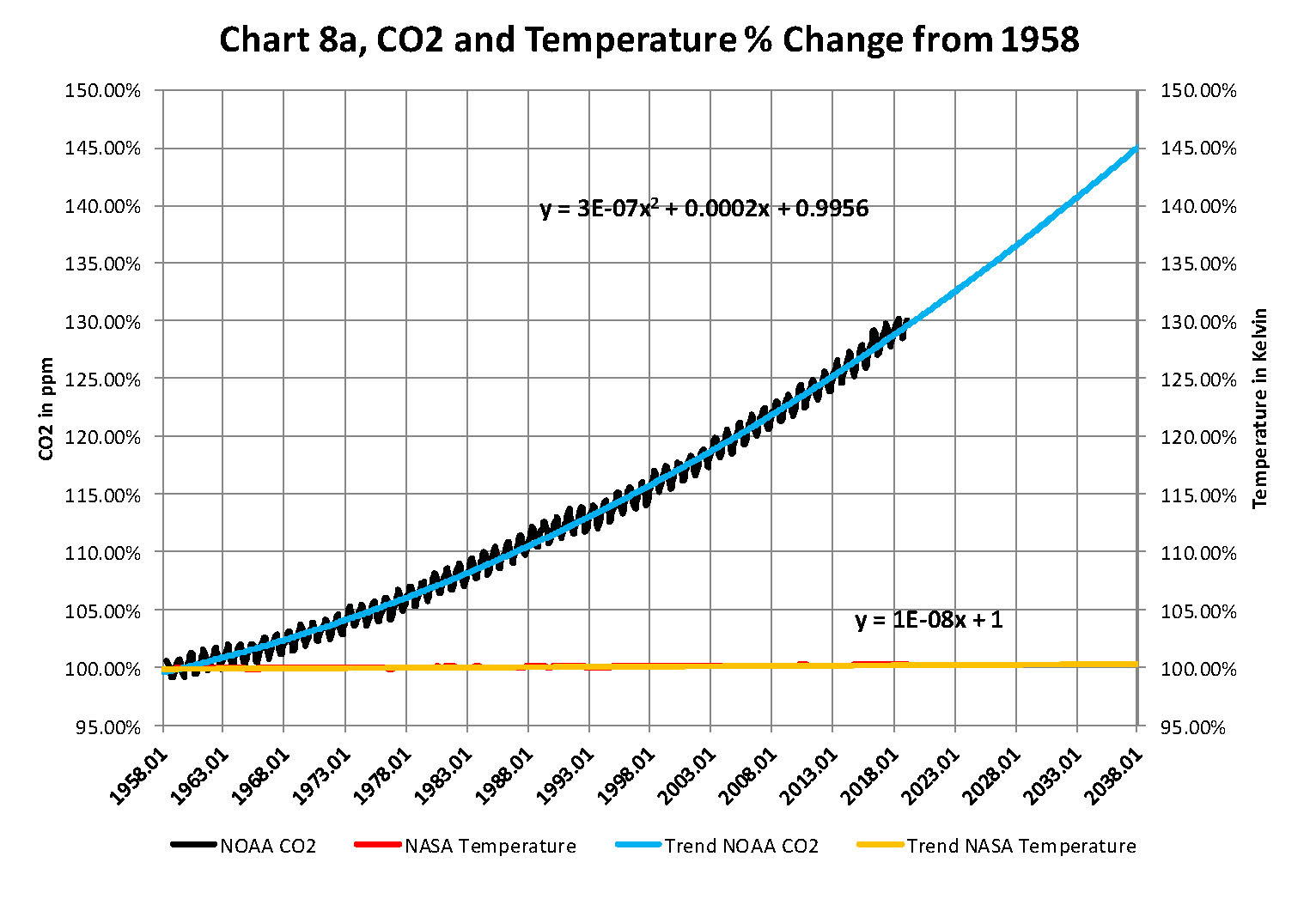
I agree with the basic premise of Murray; but I have one correction we are in a pause not a mini ice age. The long cycle is likely not to go down, easing all the previous increase for another ~100 years we are only ~900 years into the ~1000 year primary cycle. The base we are measuring from is 14.0 Degrees Celsius (an arbitrary number) and the 2.0 Degrees Celsius limit that is the point of no return according to AOC is from that point. We are now just under 15.0 Degrees Celsius so there is only 1.0 Degrees Celsius of their buffer left. The following charge shows a simple statistical projection based on current NOAA and NASA data. The chart is in percentages but it shows us that the amount of heat in the atmosphere is not likely to exceed 160 Degrees Celsius until after 2050 so all the projects are going to be 100% wrong!
The 8.6-Year Cycle in the Sun & Solar
Armstrong Economics Blog/Climate
Re-Posted Apr 2, 2019 by Martin Armstrong
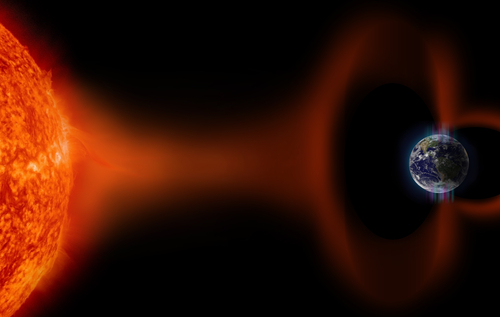
Solar storms are important events yet they come in different sizes and different types. They are caused by disturbances on the Sun, and are most often coronal clouds associated with coronal mass ejections (CMEs) that are produced by solar flares emanating from active sunspot regions. They can also erupt from rarer coronal holes. Solar filaments (solar prominences) may in fact also trigger CMEs. What is interesting is that putting the data into our computer produced an 8.6-year cycle that operated in intensity peaking every 224 years. Here is the list of the major solar storms:
2225 BC
1485 BC
≈660 BC
95 AD
265 AD
774–775 carbon-14 spike (“Red Crucifix” aurora event over British Isles)
993-994 carbon-14 spike (Intense auroras that migrated south during the 990s)
1460 AD
1505 AD
1707 AD
1709 AD
1719 AD
There was a very major storm in 660 BC as well as the Red Crucifix event of 774/775 AD. The event of 774 is the strongest spike over the last 11,000 years in the record of cosmogenic isotopes, but it is not unique by far. Nevertheless, the event of 774/775 AD appears to have been global, with the same carbon-14 signal found in tree rings from Japan, Germany, Russia, the United States, and New Zealand. A similar event occurred in 993 or 994, but it was only 0.6 times as strong and also in 660 BC.
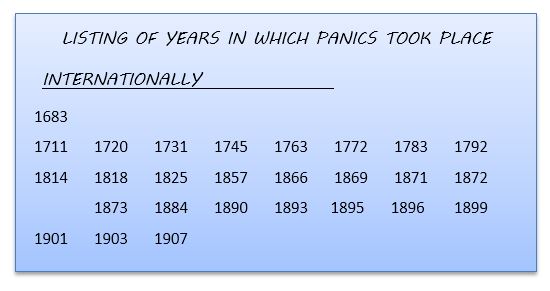
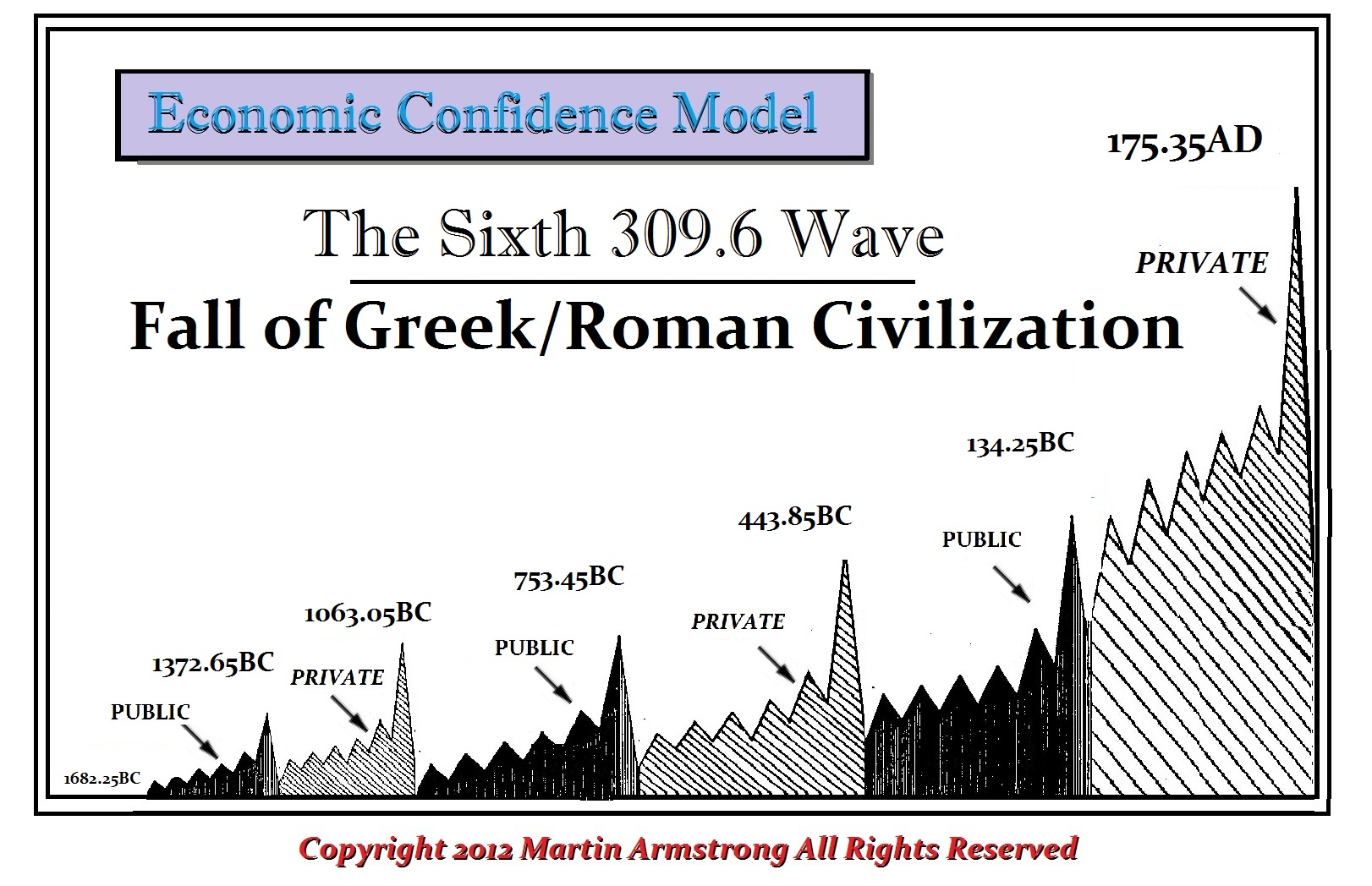
The intensity follows a cycle of 224 years in duration which comports to the same time frame that revealed the Economic Confidence Model. The period of 224 years divided by 26 financial waves of panic revealed the frequency of 8.6-years which was a derivative of Pi – 3,145 days. There are events which take place on the half and quarter cycle events as well, but of course, they differ in intensity. It appears to have also signaled the shift in the sun would have taken place about 2006. Indeed, Sunspot 905 during 2006 showed up warning that the field was reversing the magnetic polarity. With the aura once again moving south, it appears that we are headed into a phase where solar storms will increase. The sunspots have declined sharply 8.6 years later and this warns we may have strange weather into 2024.
The Sixth Wave & 2032
Armstrong Economics Blog/ECM
Re-Posted Apr 1, 2019 by Martin Armstrong
QUESTION: Dear Mr. Armstrong
It was my great honour to meet you in Orlando in November. I couldn’t help hugging you! Thank you so much for all you are doing.
Two questions:
1. In terms of societal collapse, I have been looking at 2032 as the date of armegeddon , or the next major asteroid impact when life as I know it will completely cease (needless to say, kind of a downer), but in a recent blog post you mentioned the collapse of the West might stretch out for another 600 years (OMG, thank you!). Which is it? 😰
2. When you hand over the reigns of Socrates, please let this naive, gentle soul know how you will ensure its (super-) power will be used for good. You are incorruptible, but sadly, most are not.
God bless you always,
M in Ottawa
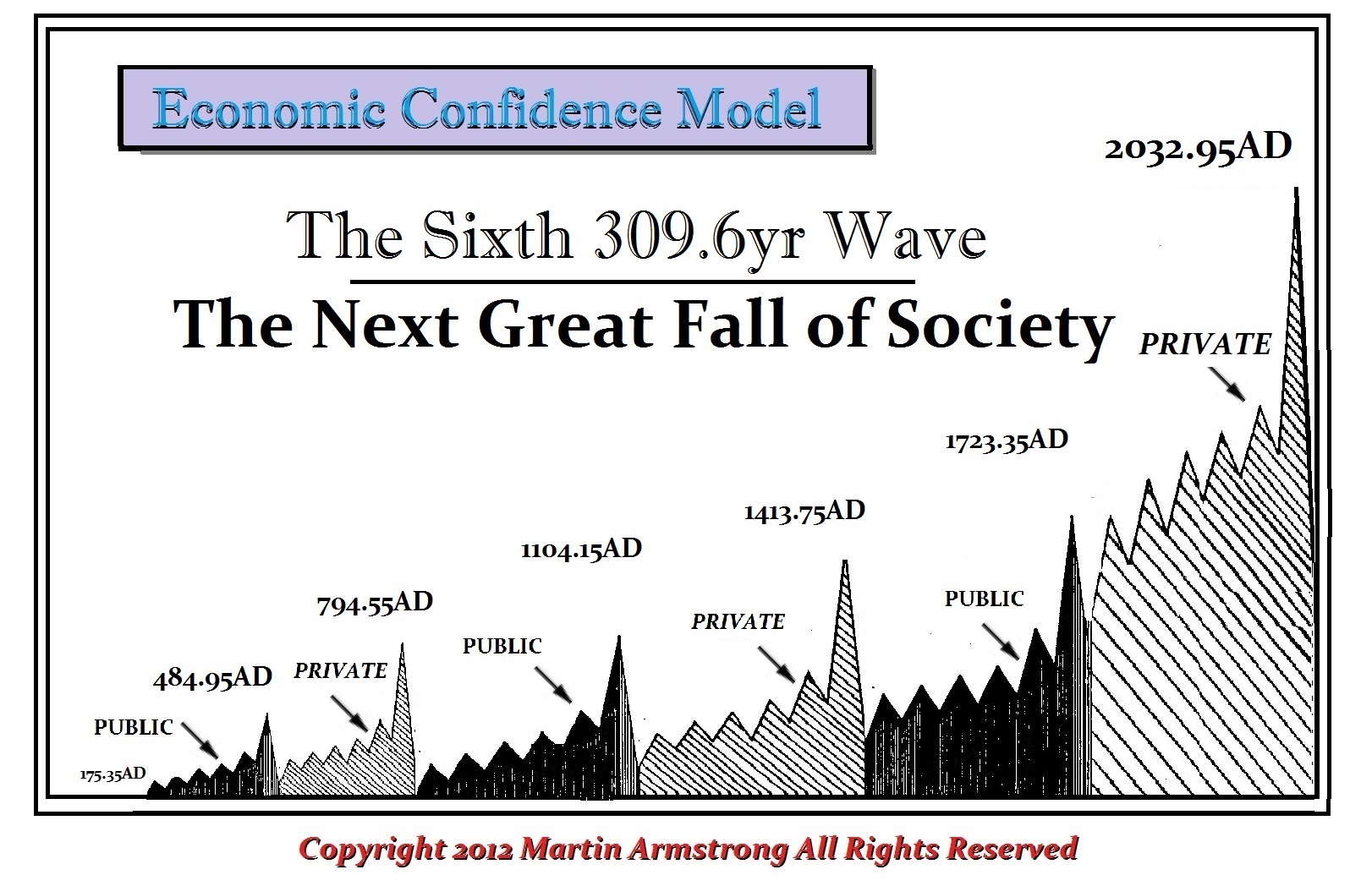
ANSWER: I do not believe that 2032 is the end of civilization. Even if we assume this Sixth Wave will be of equal importance as the one that picked the end of Rome in 175 AD. Roman society declined for the next 300 years, and then the Dark Age emerged for another 600 years. So from the actual peak in Roman society, the low was about 900 years later.
That time frame is probably correct for North America but it does not mean society comes to an end. The financial capital of the world will shift to China, which will be the dominant economy for the subsequent 309.6-year period. Then it will migrate to Russia and then to Europe. It will probably take 900 years before it reappears in North America.
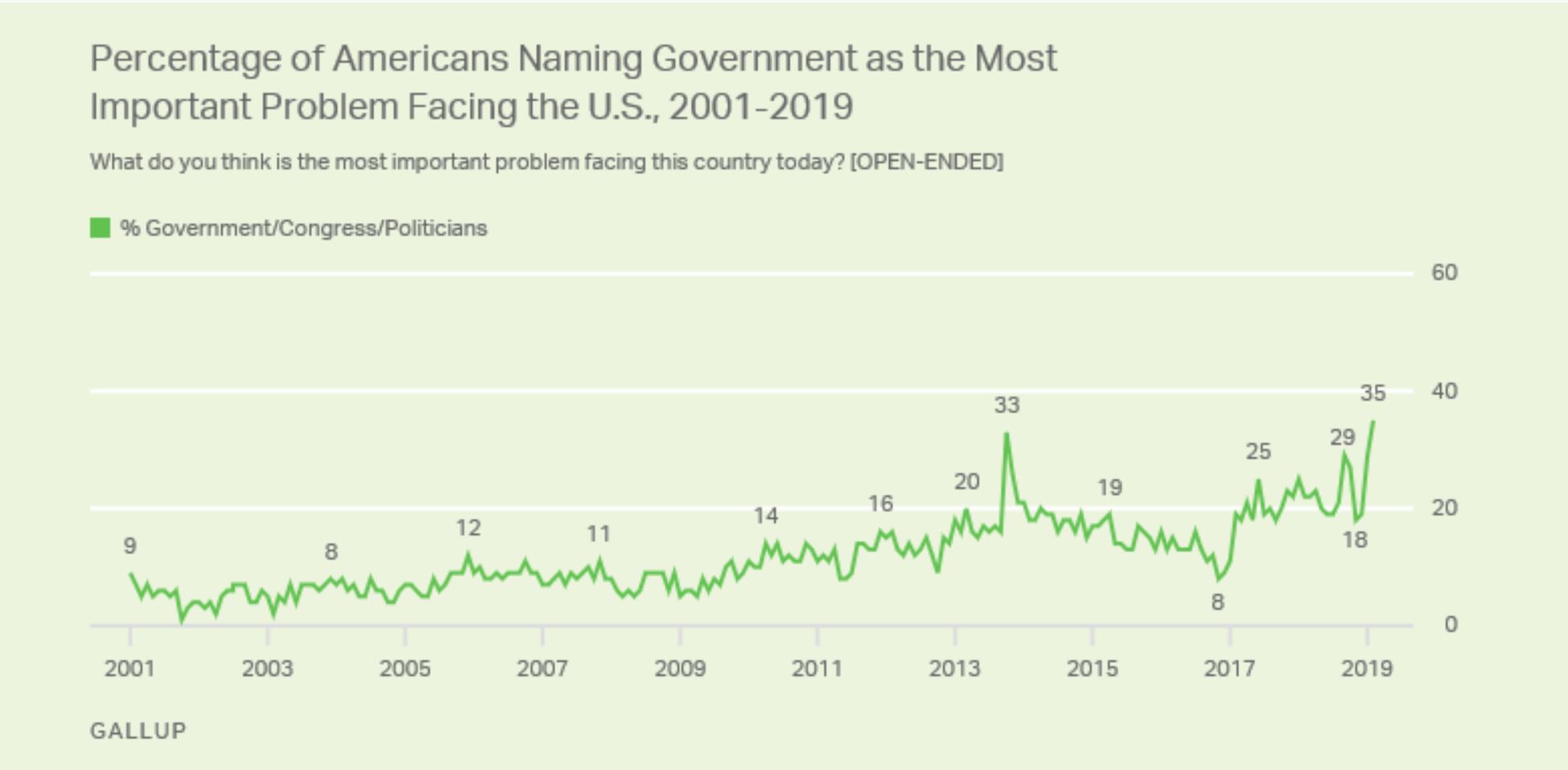
None of that says you should hide in a bunker or wait for an asteroid to crash. Just look at the politics and how there is no longer a possibility of actually managing the government. The political in-fighting will render it incapable of government as was the case in Rome following 180 AD. Life will continue. Governments will be recognized by the vast majority as the major problem. That is already at 35%.
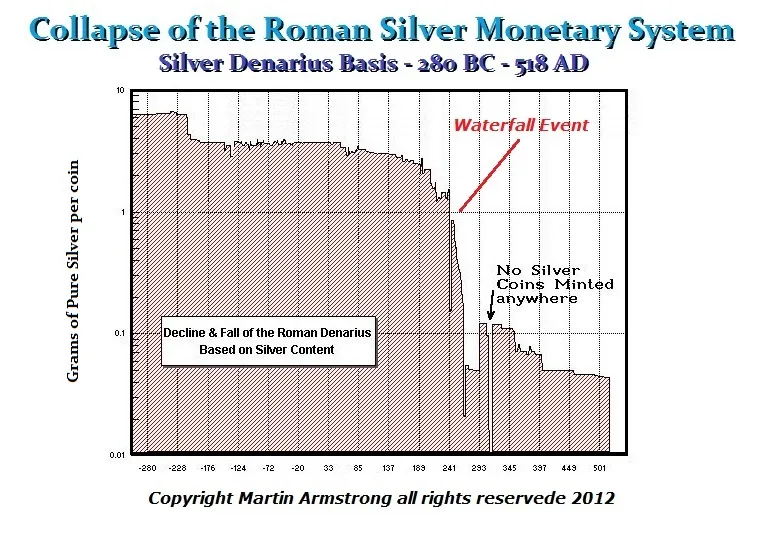
The question will turn on how rapidly the monetary system will collapse. In the case of Rome, there was no public debt. The debasement unfolded as people hoarded coinage which then forced the state to reduce the silver content in order to meet the demand to fund the government. In our modern sense, we are on a debt-based system. The crisis this time will not be due to people simply hoarding, but from governments being unable to sell their debt to keep the government funded. This time, it will be different. The modern economic system is LEVERAGED unlike that of Rome. Therefore, it will be prone to extreme sharp flash-crashes.
Climate Change & Democrats Refuse to Vote
Armstrong Economics Blog/Climate
Re-Posted Mar 31, 2019 by Martin Armstrong
Despite all the outrageous rhetoric from AOC and her New Green Deal, Majority Leader Mitch McConnell brought the Green New Deal resolution up for a vote without any hearings after a brief floor debate. He wanted the world to see that shutting down all air transportation and ending anything with fossil fuels would not go well with the American people. So McConnell gave the Democrats in the Senate their chance to show the world just how extreme they have become.
Yes, McConnell wanted to allow the Democrats to show everyone their agenda as environmental radicals. The Democrats blinked and voted “present,” so they refused to go on record for this New Green Deal that would have no doubt been used in 2020 against them. However, with this stunt, they are claiming that they can be for it or against it since they refused to vote. How will a voter even know what they stand for? Do you vote for a person who then wants to end all air travel? One would think that is a fairly radical proposal that warrants a clear response.
A Technical Study in the Relationships of Solar Flux, Water, Carbon Dioxide and Global Temperatures, February 2019
From the attached report on climate change for February 2019 we have the two charts showing how much has the global temperature actually gone up since we started to measure CO2 in the atmosphere? To show this graphically Chart 8 was constructed by plotting CO2 as a percent increase from when it was first measured in 1958, the Black plot, the scale is on the left and it shows CO2 going up about 30.0% from 1958 to February of 2019. That is a very large change as anyone would have to agree. Now how about temperature, well when we look at the percentage change in temperature from 1958, using Kelvin (which does measure the change in heat), we find that the changes in global temperature (heat) are almost un-measurable. The scale on the right side had to be expanded 10 times (the range is 40 % on the left and 4% on the right) to be able to see the plot in the same chart in any detail. The red plot, starting in 1958, shows that the thermal energy in the earth’s atmosphere increased by .30%; while CO2 has increased by 30.0% which is 100 times that of the increase in temperature. So is there really a meaningful link between them that would give as a major problem? The numbers tell us no there isn’t.
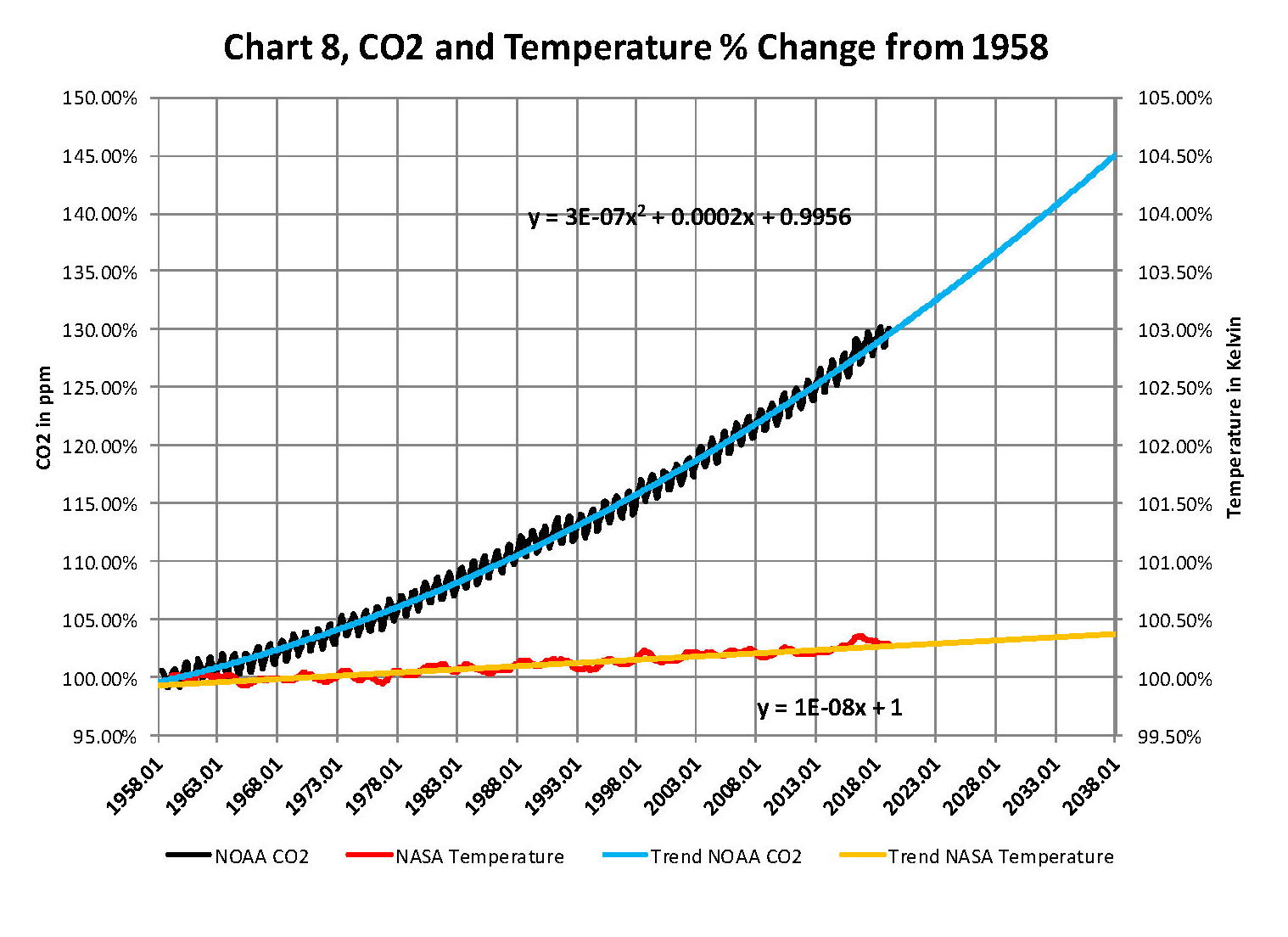
The next chart is Chart 8a which is the same as Chart 8 except for the scales which are the same for both CO2 and Temperature. As you see the increase in energy, heat, is not visually observably in this chart hence the need for the previous chart 8 to show the minuscule increase in thermal energy shown by NASA in relationship to the change in CO2. Based to these trends, determined by excel not me, in 2028 CO2 will be 428 ppm and temperatures will be 15.0o Celsius and in 2038 CO2 will be 458 ppm and temperatures will be 15.6O Celsius. This is what the data shows no matter what the reasons are, so I have no idea how the IPCC gets to predict that the world will end in ten or twenty years.
The full 37 page report explains how these charts were developed and why using NASA and NOAA data are used with out change to prove that The New Green Deal is not required and any attempt to compliment that plan will be a world wide disaster.
Click on the link below for the full report that you can download.
Greenland Glacier has been Growing for the past 2 years & it will Probably end up 3 for 3 when this season ends
Armstrong Economics Blog/Climate
Re-Posted Mar 28, 2019 by Martin Armstrong
COMMENT: Mr. Armstrong; It is clear that your computer is really amazing. I was just ready how the Greenland Glacier is expanding, not melting. What you have accomplished by seeking to eliminate yourself is really a major contribution to society.
Job well done, sir.
PH
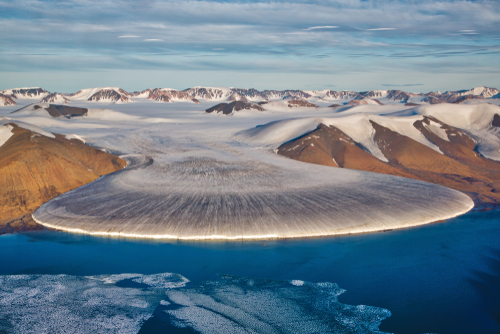
 REPLY: Thank you. A number of people have read the same article and have been sending it in. I would like to also thank all the people who have dome sone and your comments. It is so important to eliminate bias. I moved to Florida trying to find Global Warming. To me, it is just stunning how people do not understand that everything has a cycle from weather to why we must eventually die. The Greenland glacier 2012 was retreating about 1.8 miles back in 2012 annually. However, as the climate has been getting colder nor for the third year, interestingly enough, the Greenland Glacier has begun to grow in mass once again.
This is NOT a forecast I want to see happen. I hate cold. So I do not enjoy even having to say see I told you so. Wish I was wrong on this one.
World In Midst of Carbon Drought (w/ Prof. William Happer, Princeton University)

Published on Jun 22, 2015
Princeton physicist: There’s a ‘cult’ building around climate scientists

Keeping it Simple Keeps you Stupid
Armstrong Economics Blog/Understanding Cycles
Re-Posted Mar 27, 2019 by Martin Armstrong
There was a 14th-century Franciscan friar by the name of William of Ockham who is credited with having formalized the principle that “simpler solutions are likely to be more correct than complex ones.” Hence, we seem to always try to reduce everything to a single cause and effect. Some have rephrased this as “keep it simple, stupid,” and it has emerged with the label “Ockham’s razor,” which is supposed to be a tool that cuts through complexity to get from point A to point B. However, is this the very problem that prevents us from seeing reality? It was, after all, this very principle that supported the flat earth theory. It prevailed and even led to the execution of people such as Giordano Bruno (1548–1600) for daring to propose that the universe was not revolving around a flat Earth. Even Galileo Galilei (1564-1642) was charged in 1633 by the Roman Inquisition and forced to sign the confession or suffer the same fate of Bruno that the Earth was flat.
 In funds management, the statement that proves there is complexity is a legal requirement: Past performance is not a predictor of future success. All investing involves the risk of loss.While there is a desire to make complexity simple and understandable, this is really completely misguided. Clearly, simplicity rather than complexity is by no means the proper course of action for we then cannot see the interconnections of how everything truly functions. The greatest mistake in the analysis is always trying to reduce any effect down to a single cause. The world is a complex mechanism. It is indeed like a rainforest. There are countless species and each is interconnected. Exterminate one and you will find that it was the food source for another. That species, in turn, was the food source for yet another and so on. The world economy is equally complex. This is why I say we are ALL CONNECTED. Create a war in one region, we may not be involved with troops, but the capital flows shift. How can we forecast anything by ignoring all the interrelated influences?
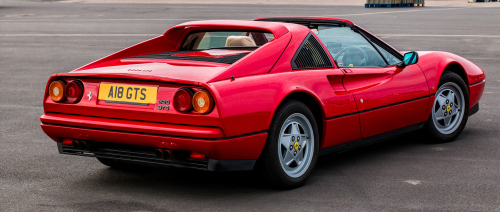 There are those who advocate that the best way to achieve your long-term investment objectives is to keep in simple. Yet they are looking at history and banking everything on a continuation of inflation. I have told the story at conferences how I bought a 328 Ferrari when I lived in London in 1985 when the British pound fell to $1.03. The Italians were getting $60,000 for the car in the states. It was still priced in pounds when it was $2. I bought the car for about $35,000. The Italians could no longer sell cars at that price so they doubled the price in pounds. Then the pound rallied and went to almost $2. I drove the car for 2 years, sold it used, and nearly doubled my money. Then people were buying Ferraris as an investment, thinking it was the car that appreciated when in fact it was just a currency play. If you did not look at the currency, you missed the whole point, so keeping it simple indeed made you stupid.
Rapid technological development in recent years across industries has helped to expose the fact that we live in a global economy and are all interconnected. Fund managers, because of regulation, are blinded by this interconnected world for they are not allowed to invest globally in a diversified portfolio. This is why we have so many specified funds and people claiming to “just keep it simple” with a hold policy because it always comes back.
Markets, on the one hand, appear deep and complex, rendering them impossible to understand fully when limited even by law to a purely domestic view. This has resulted in the advice of buy and hold as a strategy to fight against complexity with simplicity. Then there are investors who believe they need investment solutions that are nimble and flip positions based upon the talking heads on TV. They are brainwashed by their market myths. This has merely become grand sophistry trying to fight complexity with a simplicity that sounds logical by reducing all activity to a single cause and effect.
Asset allocation philosophies have emerged which invest other diverse market sectors knowing that they are polar opposites. They assume that the world is too complex beyond their comprehension so spread the wealth and hope for the best. These strategies have expanded as of late beyond the traditional stock/bond mix that was really exclusively domestic-oriented. In modern times post-1985, alternative strategies emerged introducing hedge funds that also incorporated foreign exchange, commodities, options, private debt, venture capital, and even real estate.
As hedge funds began to report their 2018 performance, an abyss quickly emerged between managers who outperformed the index and those who saw staggering losses with a third group landing somewhere in between. Overall, the industry saw its biggest annual loss since 2011, declining 4.1% on a fund-weighted basis, according to Hedge Fund Research Inc. Mostly, the smaller funds were able to flip portfolios quickly and that allowed them to trade around the big funds that can no longer maneuver. Most were unable to navigate the market turbulence in what became the worst year for the S&P 500 Index since the financial crisis. Most took “views” of what they thought would unfold and it cost them dearly. The funds that relied upon a personal opinion proved to be the worst for the vast majority kept viewing the stock market would crash any day, which never happened.
The illusion that simplicity provides the best long-term investment return is really predicated upon an assumption since the Great Depression that if you just held through all the 50-70% corrections you would be OK at the end of the day. The problem with this argument is that we are all human. I have never met someone who can actually do that. Then there is the problem of surviving the long-term. The city of Detroit suspended its debt payments in 1937 and resumed in 1963. If you owned such bonds for retirement, perhaps your heirs benefited, but you would have died broke and starving. It all depends where you are in the business cycle.

