Princeton physicist: There’s a ‘cult’ building around climate scientists


Published on Feb 17, 2017

SUBSCRIBE 506K
Princeton physics professor William Happer explains why he describes some climate change scientists as a ‘cult.’


Keeping it Simple Keeps you Stupid


There was a 14th-century Franciscan friar by the name of William of Ockham who is credited with having formalized the principle that “simpler solutions are likely to be more correct than complex ones.” Hence, we seem to always try to reduce everything to a single cause and effect. Some have rephrased this as “keep it simple, stupid,” and it has emerged with the label “Ockham’s razor,” which is supposed to be a tool that cuts through complexity to get from point A to point B. However, is this the very problem that prevents us from seeing reality? It was, after all, this very principle that supported the flat earth theory. It prevailed and even led to the execution of people such as Giordano Bruno (1548–1600)  for daring to propose that the universe was not revolving around a flat Earth. Even Galileo Galilei (1564-1642) was charged in 1633 by the Roman Inquisition and forced to sign the confession or suffer the same fate of Bruno that the Earth was flat.

In funds management, the statement that proves there is complexity is a legal requirement: Past performance is not a predictor of future success. All investing involves the risk of loss.While there is a desire to make complexity simple and understandable, this is really completely misguided. Clearly, simplicity rather than complexity is by no means the proper course of action for we then cannot see the interconnections of how everything truly functions. The greatest mistake in the analysis is always trying to reduce any effect down to a single cause. The world is a complex mechanism. It is indeed like a rainforest. There are countless species and each is interconnected. Exterminate one and you will find that it was the food source for another. That species, in turn, was the food source for yet another and so on. The world economy is equally complex. This is why I say we are ALL CONNECTED. Create a war in one region, we may not be involved with troops, but the capital flows shift. How can we forecast anything by ignoring all the interrelated influences?
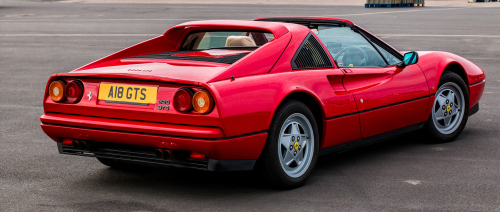
There are those who advocate that the best way to achieve your long-term investment objectives is to keep in simple. Yet they are looking at history and banking everything on a continuation of inflation. I have told the story at conferences how I bought a 328 Ferrari when I lived in London in 1985 when the British pound fell to $1.03. The Italians were getting $60,000 for the car in the states. It was still priced in pounds when it was $2. I bought the car for about $35,000. The Italians could no longer sell cars at that price so they doubled the price in pounds. Then the pound rallied and went to almost $2. I drove the car for 2 years, sold it used, and nearly doubled my money. Then people were buying Ferraris as an investment, thinking it was the car that appreciated when in fact it was just a currency play. If you did not look at the currency, you missed the whole point, so keeping it simple indeed made you stupid.

Rapid technological development in recent years across industries has helped to expose the fact that we live in a global economy and are all interconnected. Fund managers, because of regulation, are blinded by this interconnected world for they are not allowed to invest globally in a diversified portfolio. This is why we have so many specified funds and people claiming to “just keep it simple” with a hold policy because it always comes back.

Markets, on the one hand, appear deep and complex, rendering them impossible to understand fully when limited even by law to a purely domestic view. This has resulted in the advice of buy and hold as a strategy to fight against complexity with simplicity. Then there are investors who believe they need investment solutions that are nimble and flip positions based upon the talking heads on TV. They are brainwashed by their market myths. This has merely become grand sophistry trying to fight complexity with a simplicity that sounds logical by reducing all activity to a single cause and effect.

Asset allocation philosophies have emerged which invest other diverse market sectors knowing that they are polar opposites. They assume that the world is too complex beyond their comprehension so spread the wealth and hope for the best. These strategies have expanded as of late beyond the traditional stock/bond mix that was really exclusively domestic-oriented. In modern times post-1985, alternative strategies emerged introducing hedge funds that also incorporated foreign exchange, commodities, options, private debt, venture capital, and even real estate.

As hedge funds began to report their 2018 performance, an abyss quickly emerged between managers who outperformed the index and those who saw staggering losses with a third group landing somewhere in between. Overall, the industry saw its biggest annual loss since 2011, declining 4.1% on a fund-weighted basis, according to Hedge Fund Research Inc. Mostly, the smaller funds were able to flip portfolios quickly and that allowed them to trade around the big funds that can no longer maneuver. Most were unable to navigate the market turbulence in what became the worst year for the S&P 500 Index since the financial crisis. Most took “views” of what they thought would unfold and it cost them dearly. The funds that relied upon a personal opinion proved to be the worst for the vast majority kept viewing the stock market would crash any day, which never happened.

The illusion that simplicity provides the best long-term investment return is really predicated upon an assumption since the Great Depression that if you just held through all the 50-70% corrections you would be OK at the end of the day. The problem with this argument is that we are all human. I have never met someone who can actually do that. Then there is the problem of surviving the long-term. The city of Detroit suspended its debt payments in 1937 and resumed in 1963. If you owned such bonds for retirement, perhaps your heirs benefited, but you would have died broke and starving. It all depends where you are in the business cycle.

Understanding Rogue Waves


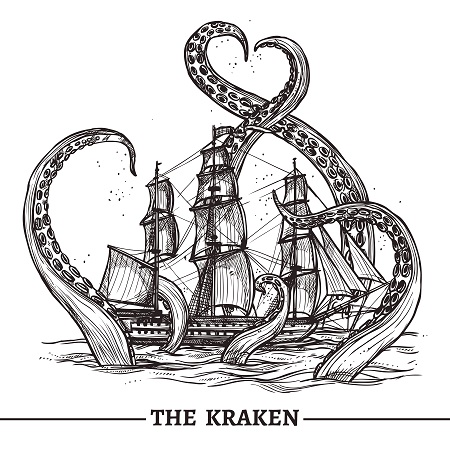
Over the centuries, sailors have told legends of monster waves that would appear out of nowhere in the middle of the open sea. Most scientists dismissed the stories as fabrications and legends. These stories were reported over the centuries by sailors who repeatedly saw these rogue waves of gigantic proportions rise up from nothing far above the surrounding waves in the middle of nowhere. In the 16th century when sailors began to venture past the Pillars of Hercules after Columbus, these stories began to commonly emerge. Many attributed them to the wake of some hidden sea monster. The ships that vanished were said to have been swallowed by these sea monsters they called the Kraken from Greek mythology.

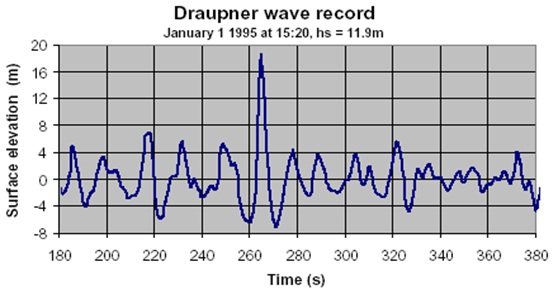
What was missing were any reliable measurements until New Year’s afternoon in 1995. On that day,  there were between ten to twelve-meter high storm waves and a wave of almost 83 feet (26 meters) high under the oil drilling platform named Draupner. This was the very first time one of these rogue waves was actually measured by the sensors on the platform. Since then, what was once dismissed as legend has entered the field of reality.

Hundreds of such monster waves have since been documented and they occur in different forms. For example, the convergence of waves in a nonlinear process can cause single superwaves to result from otherwise ordinary waves. I have found this stunning for scientists have been baffled by these rogue waves when in fact the same exact thing takes place is wave analysis of even the economy.

The Draupner wave was one of those mysterious lone superwaves that appeared to tower over all other waves. They are strikingly different from a tidal wave, which is when energy is passing through the wave until it hits shore. One of these superwaves appear out of nowhere, but they also vanish and disappear without a trace. This is what the scientists have failed to comprehend.


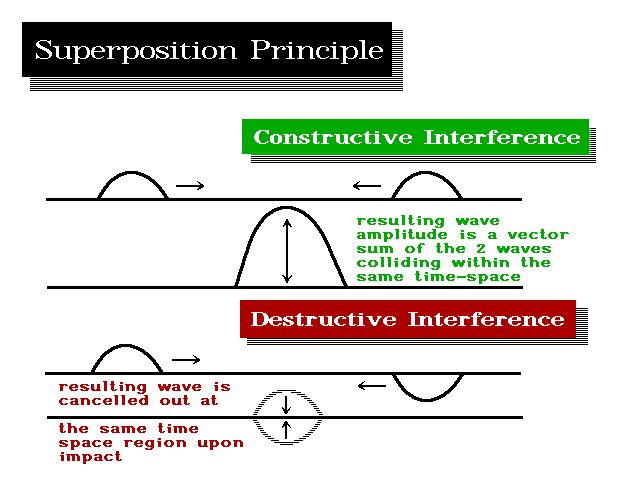
Since the Draupner wave discovery, finally, research has been taking place to try to understand these interesting wave formations. Essentially, a normal wave that hits the shoreline is produced by a wave of energy that flows through the water which is the medium. Those are quite distinct whereas a rogue wave is produced by the cycle of several waves that suddenly sync and produce a combined wave which is a singularity. If you look at something floating just off the beach, you will notice it rises and falls with the waves for it is not actually the water which is moving, rather it is the energy passing through the water. It is similar to what would occur if you received an electric shock; your flesh is not moving, it is the electricity passing through your flesh.

Essentially, everything in the universe is subject to cyclical theory. These rogue waves are no different from a market that suddenly erupts, crashes, and in the end, wipes out economies and investors. Politicians then respond with laws and investigations to try to blame the event on some human cause and effect.

Now, look at Bitcoin. The computer pinpointed the high in Bitcoin to the day. It understands these rogue waves, how they form, and how they will quickly vanish. We heard nothing but scenarios of the new age of knowledge and how Bitcoin would become the new reserve currency. So many people lost their shirt because they wanted to believe the hype and they ignored the reality of what takes place in a rogue wave.

Climate Change, Midwest Floods & Food Shortages


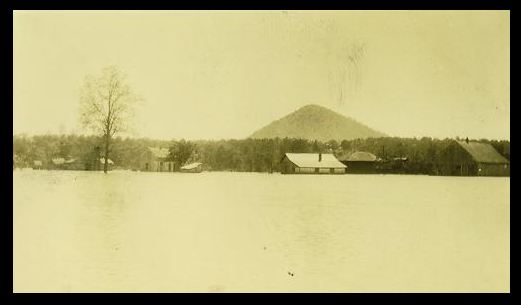
The Great Flood of 1927, flooded the lower Mississippi River valley in April 1927.  It was one of the worst natural disasters in American history. More than 23,000 square miles of land was submerged, hundreds of thousands of people were displaced, and around 250 people died. The flooding impacted areas in Arkansas, Illinois, Kentucky, Louisiana, Mississippi, Missouri, Tennessee, Texas, Oklahoma, and Kansas.

Following that Great Flood of 1927, we then see the climate swing dramatically in the opposite direction into the extreme drought that led to the Dust Bowl of the 1930s. The Dust Bowl was a period of severe dust storms that greatly damaged agriculture in the Midwest prairies during the 1930s. The Dust Bowl was a severe drought that came in three primary waves, 1934, 1936, and 1939–1940. The entire event actually complied with our Economic Confidence Model when many regions of the high plains experienced drought conditions for eight years.

Unfortunately, the global warming people are already out in force and blaming this on moms driving the kids to soccer matches. They always pretend these are catastrophic events never before seen. Cars were not really in wide use until post-1940s. They could care less about history or truth. The cycle is very clear. This major flooding which may destroy at least 6 billion bushels of wheat is a prelude to what is coming.

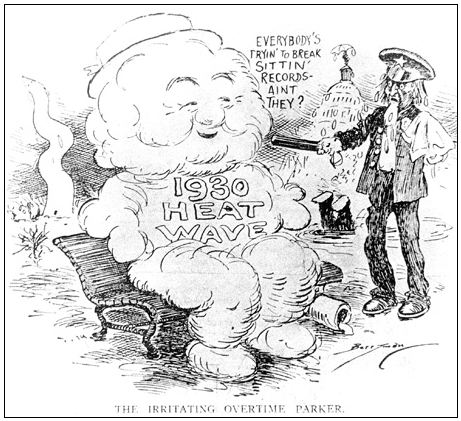
Long before there was the Global Warming crowd, there were the record-setting heat waves and drought of the 1930s that contributed to the Great Depression and wiping out agriculture that was employing 40% of the civil workforce at the start of the century. There were runs of extreme temperatures which broke all records. There was a stretch of 11 days straight in July with temperatures over 100. The two worst years were 1930 and 1936.

Today, they would be demanding action and 11 days over 100 degrees Al Gore would be yelling this proves he is right. Of course, back then, there were no fleets of cars to blame no less soccer moms.

This is all part of the cycle. We have extreme floods now, then swings of heat during the summer to create droughts, then the climate turns down and progressively moves into a colder pattern.


Aurora Borealis Warning the Climate May Turn Sharply Colder into 2032


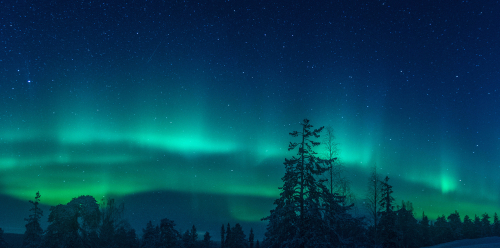
There may actually be a confirmation that we are heading into a much colder climate. The Aurora Borealis, also known as the Northern Lights, can now be seen in the UK. Normally, the Northern Lights can be seen only extremely north as in Alaska. Sir Edmund Halley (1656 – 1742), the man who discovered Halley’s Comet, was a friend of Isaac Newton. He was asked to speak about the unusual events that were taking place in the sky. He addressed the British Royal Society, stating:

The Royal Society, having received accounts from very many parts of Great Britain, of the unusual lights which have of late appeared in the heavens ; were pleased to signify their desires to me, that I should draw up a general resation (sic) of the fact, and explain more at large some conceptions of mine I had proposed to them about it, as seeming to some of them to render a tollerable [sic] solution of the very strange and surprizing [sic] phænomena thereof.

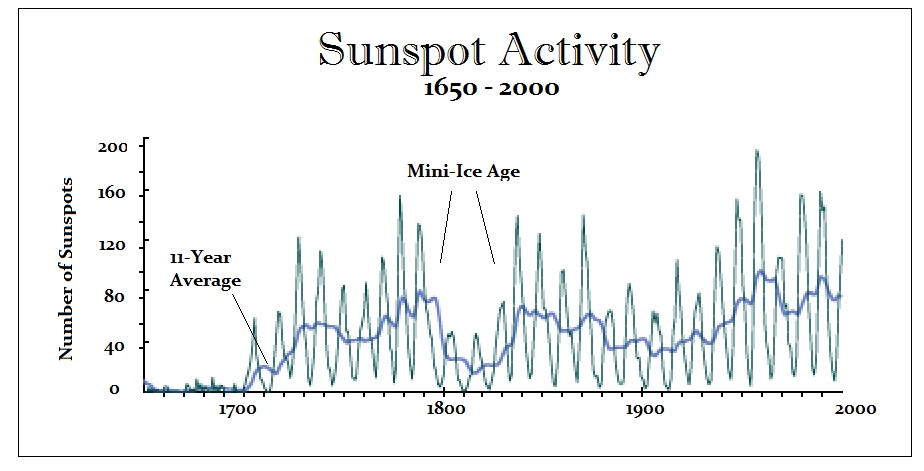
During the period of Halley’s investigation, the Little Ice Age dominated the decades and it bottomed around 1680. The Aurora Borealis actually expands and moves further south during periods of a colder climate. The Northern Lights being visible in the UK is not a good sign for climate change. This may be warning that we are headed back to a prolonged colder climate. Solar cycle 14 had the record high for sunspots during February in 1906. The annual peak took place in 1957 with 190 sunspots taking place that year. Based upon our models, the ideal low was most likely 1686/1687. From the 1957 high, the collapse to just 10 sunspots per year took place in 1964 — 7 years later.

Just before the Mini Ice Age, sunspot activity peaked during 1787 at 132 (mean) and crashed for 11 years into 1798, dropping to just 4 sunspots. If we continue to witness this declining trend from the 2000 high where there are virtually no sunspots, we appear to be vulnerable to a significant decline at least into 2032.

Climate Change: Real – Fake – Exaggerated?


QUESTION: I find it interesting that you are against human-induced global warming yet you confirm that climate change is natural. You seem to be in the middle of these arguments. You warned that solar activity was declining and there was a risk of going into a mini ice-age, but you did not seem to place high odds on that one. So can you elaborate on this since you seem to be the voice of reason?

GR

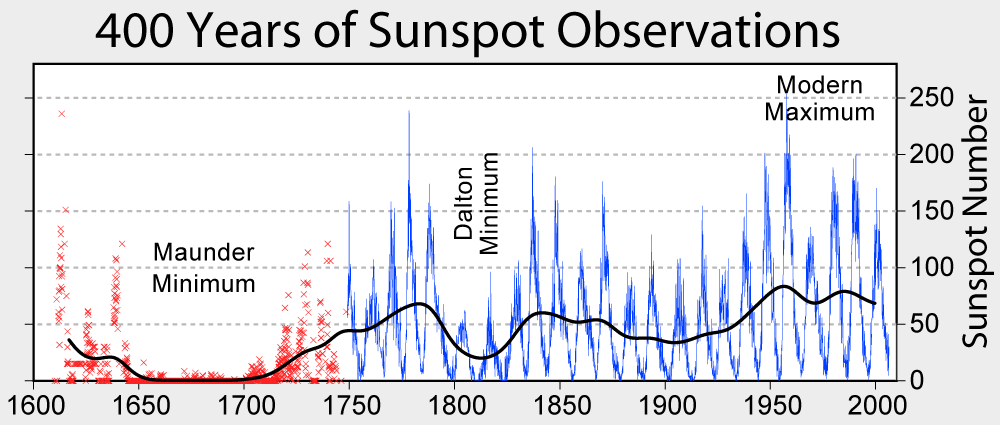
ANSWER: Sunspot activity has declined on schedule. February was an incredible month void of sunspots. This is clearly contributing to the extremely cold weather we are having. Cyclically, between 1645 and 1715, there was a prolonged collapse in sunspot activity known as the Maunder Minimum. Indeed, that was a period where sunspots all but disappeared. This coincided with the “Little Ice Age,” which was a period from 1500 to 1850 in the northern hemisphere. It was so cold, Viking settlers even abandoned Greenland.

I have stated many times that a major error in analysis is the attempt to reduce a problem to a single cause and effect. This topic of climate change is no different. Many scientists have strongly suggested that the Maunder Minimum caused the Little Ice Age. As I have shown, correlating everything that took place revealed that during solar minimum there is also an increase in volcanic activity and earthquakes.

You will read that scientists seem to be debating between the two rather than comprehending that EVERYTHING is absolutely connected. We cannot reduce everything to a single cause and effect. Therefore, in order for me to confirm that we are heading into a new ice age requires more volcanic activity in addition to a prolonged solar minimum.

The sunspot cycle is also called the Schwabe cycle, and currently we are moving toward the end of cycle 24. It does appear using long-term cycle analysis that cycle 25 will probably be at the very least a quieter cycle than we are concluding here with cycle 24. There’s been this steady decline, so we are indeed heading into what could be a prolonged solar minimum.

There have been several protracted solar minimums since 1000 AD:

  1. Oort minimum (1040–1080 AD)
  2. Medieval Minor minimum (1150–1200 AD)
  3. Wolf minimum (1270–1350 AD)
  4. Spörer minimum (1430–1520 AD)
  5. Maunder minimum (1620–1710 AD)
  6.  Dalton minimum (1787–1843)

This post-Dalton minimum peaked strangely with the Economic Confidence Model on 1989.95. The peaks in solar activity have been declining with each wave subsequent to that turning point. It is now declining faster than ever previously know for nearly the last 10,000 years. Pretend scientists claim climate change it due to human activity. They were predisposed to arrive at that conclusion and not offer legitimate analysis whatsoever. Society expands during warming cycles and contracts during periods of global cooling.

I have also warned that if next year is colder than the 2018/2019 winter, and if this summer ends up with an expansion of drought, then besides keeping an extra supply of canned goods, the short-term cycle would warn of a further cold period into 2024/2025. The problem here is that if governments can blame humans, then they can tax us. When something is natural, there is no one to tax or blame except Acts of God. So YES, there is always climate change, but humans do not create it. There is far more complexity to this than a single cause and effect. REAL analysis cannot take place when the objective is always to reduce it to a single cause and effect.

India v Pakistan & the 2019/2020 Turning Point


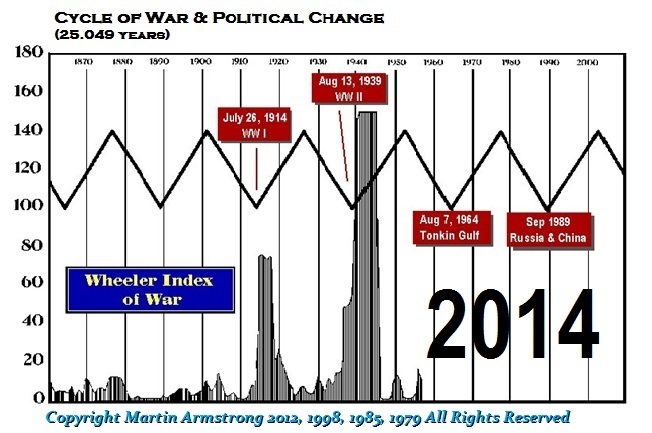
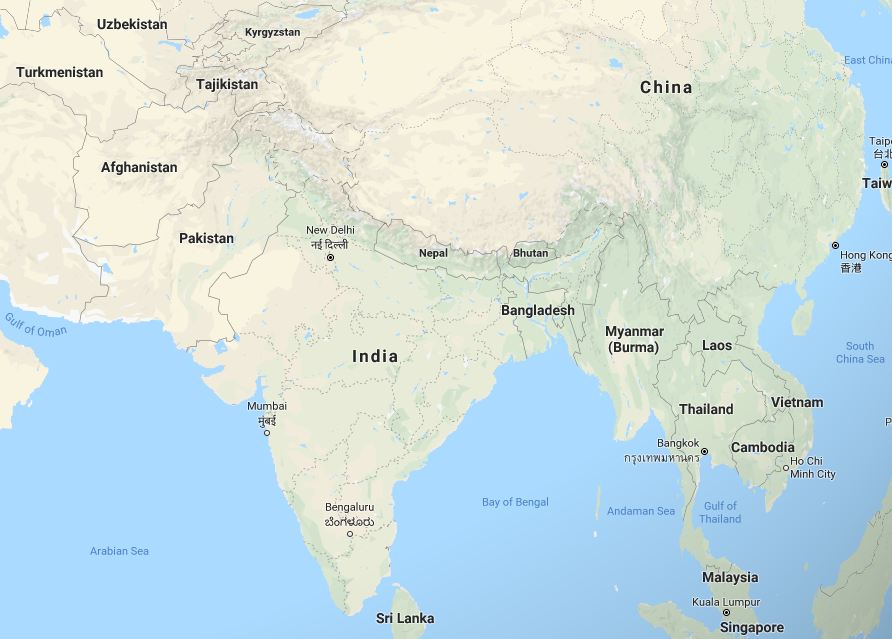
The last time that Indian and Pakistan were at war was back in 1971. Our War Model turned up in 1964 and indeed it marked the beginning of the US Vietnam War. In reality, the separation or the partition of India took place in 1947 based upon religion. The British created two independent dominions, India and Pakistan. India became the Republic of India in 1950, and in 1957 the Dominion of Pakistan became the Islamic Republic of Pakistan. In 1971, the People’s Republic of Bangladesh came into being. On March 25, 1971, there was also the Bangladesh War of Independence against Pakistan. Bangladesh was a Sunni Muslim state as was the case with Pakistan.  The partition involved the division of three provinces — Assam, Bengal, and Punjab — based on separating Hindus from Muslim majorities.

Ironically, here we are at the 72-year mark from 1947 which equals 2019. This is PRECISELY on target for a confrontation. Back in 1971, neither side possessed nuclear weapons as both do today. Indian warplanes began bombing inside Pakistan’s on February 26, which was really the culmination of the most serious confrontation South Asia has seen in a long time.

The origins of India’s air raid can be traced to a suicide bombing on February 14th in the Pulwama district of the state of Jammu & Kashmir that killed 40 Indian policemen. That was by far the deadliest attack and the worst jihadist assault to date. Prime Minister Narendra Modi faces reelection. The Hindu hardliners argue he has been weak and thus the attacks are clearly because of the upcoming elections. Then there are those who believe his attempt to modernize India to bring jobs to his countrymen has also failed. Modi is in a place where personal power depends upon him appearing strong. Unfortunately, this is precisely on target for 2019 after 72 years.

Even the volatility model of the Economic Confidence Model component is 6 years. Where the 8.6-year wave builds into waves of 51.6 years, due to turn in January 2020, the major volatility wave coincides here as well — 72 years from 1947. It was also 1947 when the International Monetary Fund began. It was also 1947 when the Marshall Plan came into force.

Ironically, 2019-2020 is a very formidable turning point both in conflicts and war/civil unre

When is Forecasting Not Forecasting?


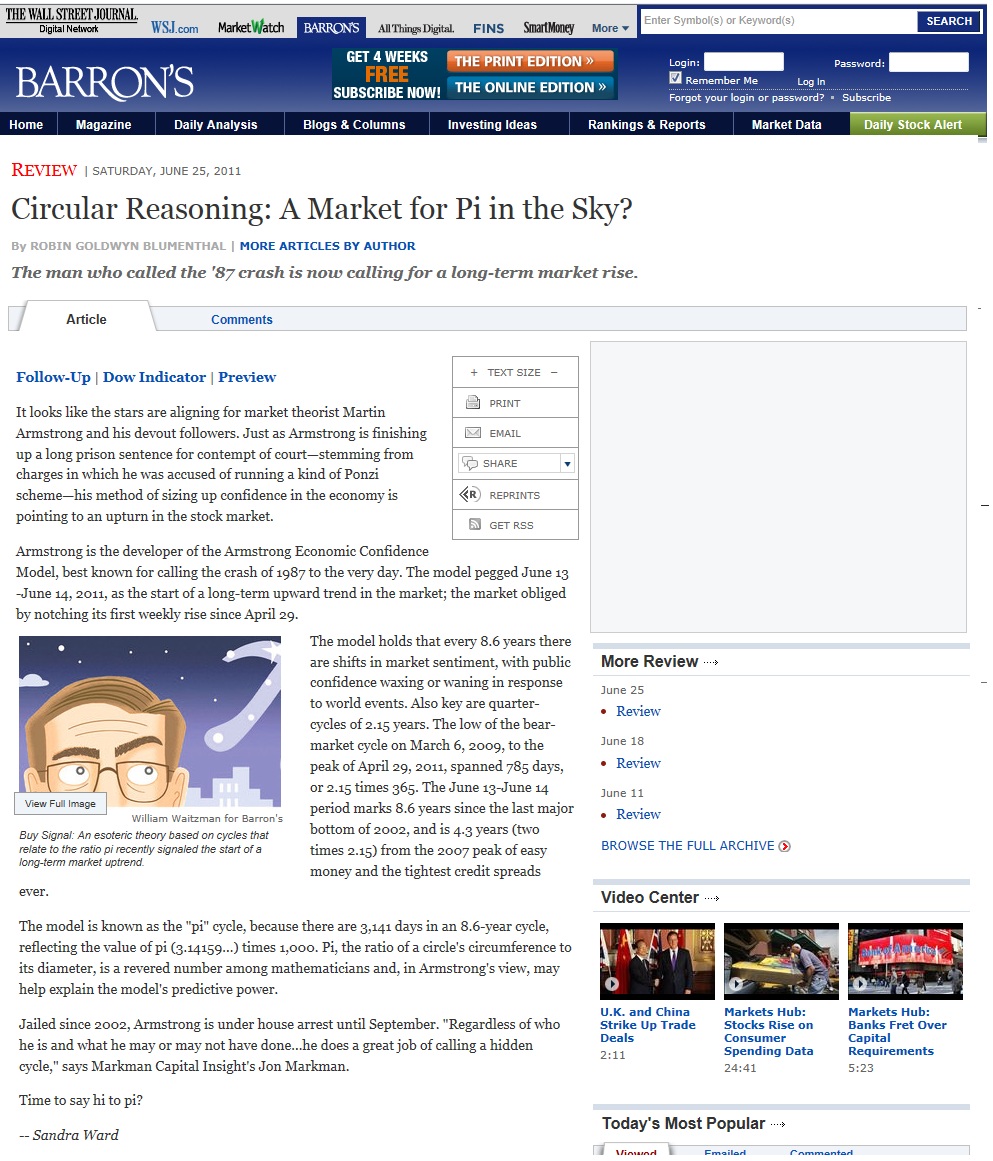
QUESTION: There are a number of people who claim to have called the 2008 crash. What I find absent is that there is no one who brags on calling the rallies and crashes as you have and I have witnessed from going to your WECs since 1985. I still remember you in 1985 standing up and showing us all the projections of so many economic indicators all point to the moon for the next 51.6 years. Your call on the Dow going from 1,000 to 6,000 was an eye-opener back then and to watch it unfold was unbelievable. Then at the bottom in 2009 you called for new record highs. I read Barrons even wrote on that as if it was just a foolish comment. That happened exactly the same way when you stood up at the 1987 WEC and said the same thing.

My question is this. I recently read where a value investor from Boston claimed that the stock market would produce 2% to 3% for the next 20 years not 6% to 8%. He claimed to have called the 2000 and 2008 crash. Why do these people only claim to forecast the crash and not the rally?

Your life long subscriber who has grown old with you in this journey for knowledge as you put it.

PG

ANSWER: Good to hear from you. Yes, it has been a long time. I believe your answer lies in the fact that so many analysts are focused on 1929 and constantly view the market in that light. Even Germany and its austerity policy that has devastated Europe is fixed on the hyperinflation of the 1920s. In both cases, they failed to ever do the research to comprehend the real reasons behind the events of the 1920s and 1930s. So you will always find people claiming to predict every crash. There is an absence of those who forecast rallies. This is the result of the very same reason. They are all focused only on the events of 1929. You even have the Goldbugs constantly telling people everything will collapse and only gold will rally based upon their understanding of the 1930s which again is completely wrong.

If you are going to forecast any market, you have to be UNBIASED and willing to forecast the rally and the decline or else it is not forecasting. All the pretend gold analysts who only constantly forecast rising prices are really preaching, not forecasting, and they typically have skin in the game and will never say down when they own gold or mining stakes. When I was called by the Brady Commission for the Crash of 1987, the investigation showed that the theory that computer trading caused the crash was proven wrong because most people did not follow the computers and unplugged them because they did not believe in them.


All you have to do is look at our Energy Models. They track the strength and weakness of a market and show you when the energy in a market is declining even though you may not see that in a chart pattern. Likewise, the energy was immediately making new record highs coming out of the major low.

You must also understand that the press needs content. They have their stable of people to put on and they prefer to show a consistent prediction. They do not want to put me on the air as I contradict everything they are putting out there. This immediate rally has been the most hated bull market in history. Every high there was someone forecasting the crash of all time. Even Goldman Sachs told everyone to sell 2019. Granted, at the Orlando WEC I stood up and said the market would make a correction and we should drop to retest the Monthly Bearish. We dropped to 21712 when the target was 21600.

But we have to look at this UNBIASED from every angle. You cannot forecast from a personal opinion perspective. I find it really funny when someone tries to argue against me and offers some logical fundamental, reducing everything to a single cause and effect. They fail to understand I am NOTmaking forecasts on what I “think” or my “opinion” personally I have been wrong and the model proves to always win if I dared to try to compete.

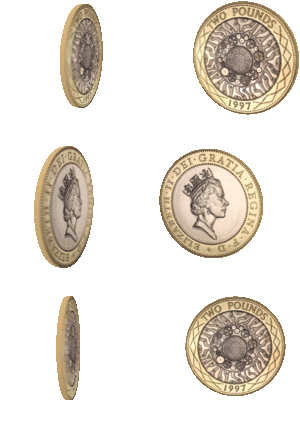
I suppose when you are always forecasting every high as the big one, then you can claim to call the crash. But nobody asks how many highs before then did they say the same thing. Markets are like the two sides to a coin. If you cannot forecast the rally and the decline, then you are not really forecasting

50 to 1 Project – Marc Morano Interview


Published on Aug 29, 2013

SUBSCRIBE 3.8K
http://www.50to1.net – Topher interviews Marc Morano, accused ‘criminal against humanity’ and alleged ‘central cell of the climate denial machine’ and gets an insiders look into the politics and collateral damage caused by clumsy political responses to fears about climate change.


Lord Christopher Monckton – The Economics Behind Windmills


Published on Feb 5, 2018

SUBSCRIBE 21K
Lord Christopher Monckton joins us on stage for a quick talk to discuss the economics behind windmills and the problems behind them.