Money Rushing in Emerging Markets & Europe – Really?


QUESTION: Martin; it seems the Emerging Markets are back in favor just as interest rates are on the rise and their dollar borrowings have exploded. Is this the final bubble that is unfolding? When the WSJ writes about a trend it is usually the end. They are noting that significant flows of funds are now going out of the US and into Europe. Is this time to sell the emerging markets and Europe? Picking up the rug here in Berlin, nothing seems to have really changed. Any comment?

ANSWER: Yes, the move back to Europe after the French election seems to be the relief rally that is always the case for hot money. The Emerging Market debt bubble is what I wrote about a few days ago that the rush to emerging markets has seen an explosion in new debt offerings. This is very alarming. People act like you should short the US stock market and buy Emerging Markets. You really have to wonder if they understand the global economy at all. The willingness of investors to buy debt securities is rooted in these bearish forecasts for U.S. equities. But the bulk of this is really desperate pensions funds who are in search of higher yields. This is by no means the start of some new Emerging Market boom of prosperity.  It reminds me of Andrew Melon’s comment when the stock market began to decline in 1929 before the bond meltdown in emerging markets back then: “Gentlemen buy bonds!”

The fool will jump in with both feet as always. You need people to buy the highs. The US equities have been in a sideways consolidation since February and their greatest vulnerability is Trump’s stupid firing of Comey that the Democrats are calling a Constitutional Crisis. Trump should have been wiser than this. The danger is this distraction holds off any tax reform for that has been the underpinning to the US equities.

A friend of mine was Chief of Staff in the White House years ago. We went to dinner after he won the position. He was so optimistic that he would be able to accomplish a lot. He knew my view he would never get to anything by the end of the day. After he left the White House we went to dinner. I said nothing. He burst out and said alright you SOB, I never got to a single thing I wanted to change. That is Washington for you. Trump’s greatest flaw is he fails to understand that. Stupid moves like firing Comey are costly. They will eat up time and delay everything if not block tax reform. Congress loves to investigate every leaf that falls to the ground and assign blame even in the middle of a wind storm. That’s just the way it goes in that city. Trump handed them a controversy on a gold platter.

As far as money rushing back to Europe, yes, there was the parking of money here for fear of the French election. But this is nothing more than a short-term knee-jerk reaction. European growth has nothing to offer long-term but higher taxes.

The US share market has been unable to make a significant correction and the numbers remains the same. The surge into emerging markets has been taking place over the past year and this has been the desperate search for higher yields. This is a bubble that is very dangerous and smells like the Russian one back in 1998.

The only way to bring about real economic change remains a rising dollar – not a lower one. That will kill the emerging markets. The US share market remains flat-to-lower and only a breakout to new highs will signal the next leg up. The main area to watch is the 20000 level in the Dow on a weekly closing basis.

Not a single European bank parking money at the Fed through their US branches have reversed that trade. Not a single major player among our clients has been a buyer of Emerging Market debt in this bubble. So the flows written about by the WSJ are indeed the tail-end and not some major brand new trend emerging
The Coming Central Bank Crisis


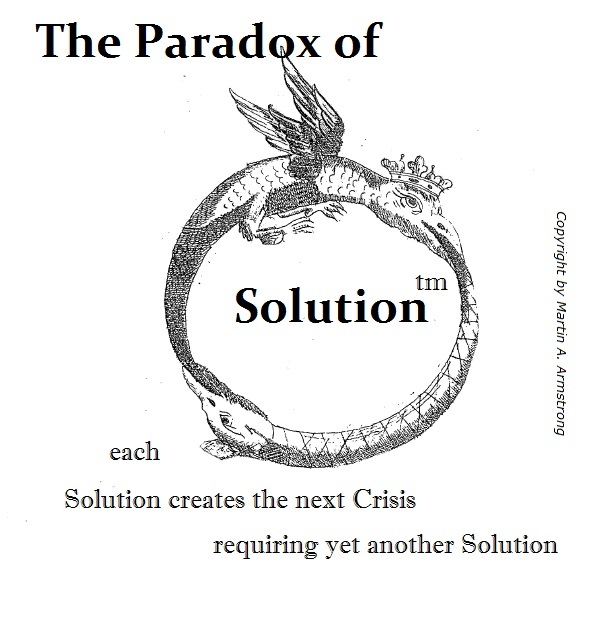
I have warned that whenever a government creates a solution to any crisis, that solution becomes the next crisis. This is what I have called the Paradox of Solution.The unfolding of the exit of the central banks from the Quantitative Easing monetary policy will become a much more serious threat to the financial markets than anyone suspects. The Federal Reserve has already exited and begun to raise rates while also announcing it will NOT be reinvesting the money when the government debt they bought expires. The Federal Reserve is already shortening their balance sheet. Bills of $426 billion will be due at the Fed in 2018, and again about $357 billion a year later. So the Fed will not repurchase that debt. The US economy is absorbing this because US dollars are effectively the only real reserve currency in the world right now.

The real problem lies with the European Central Bank (ECB) and the Japanese central bank and when they exit their Quantitative Easing programs, their economies are not the reserve currency and lack a solid bid from international capital. The end of QE will lead to a sharp increase in yields on the bond markets, and thus the financing costs for the states will explode far more rapidly today than at any time in past history. It is also possible that other sectors of the financial system, such as the stock markets and the foreign exchange markets in peripheral economies to the USA, will be cast into turmoil experiencing great difficulties without the financial support of the central banks.

Since 2008, the Bank of Japan recorded an increase of 107 trillion yen. The ECB has more than doubled its balance sheet from EUR 2 trillion to EUR 4.1 trillion and holds 40% of member state debt while tensions rise against the EU. The crisis emerges when governments, who are the ones who have been subsidized since 2008, find no bid for their paper. This will really send rates upward at a rapid pace.

As central banks appeared as omnipotent purchasers of government bonds to the un-savvy trader, the yields of the debt by no means reflect the risk of a default in the country’s payments. The decline in yields masked the rising risks from fiscal mismanagement that has been widespread.

While the Federal Reserve had recently announced that it would no longer reinvest its gains on government bonds that had matured into new US securities, the US bond market will need to find new buyers to absorb the additional supply. That may not be a problem right now, but as other government debt moves into crisis, we will see the capital flight from bonds to equities unfold.

The balance sheets of both the Japanese central bank and the ECB are unlikely to follow the Fed just yet. A withdrawal of the ECB’s purchases of securities could produced the most widespread damage in Europe since the Dark Ages.

BitCoin & Alternative Currencies


QUESTION: I very much look forward to reading your blog every day and feel that I am learning much. I don’t know much about BitCoin but I note that it has almost doubled since the beginning of the year. Does your model have any insight into the future of cryptocurrencies like BitCoin.

MR

ANSWER: The problem with BitCoin is precisely that. It is akin to the problem that existed when the bubble burst in 1966 with mutual funds because they were listed back then. People bid the funds up beyond net asset value so when the crash came, people lost everything when they though it was a secure investment. The net underlying assets may have dropped 20%, but they paid 20% over net asset value and then sold at 50% of net asset value. Ever since, mutual funds are no longer allowed to be listed. You go in and out at net asset value.

In this way, BitCoin is not ready for prime time. However, that is a separate and distinct problem from the technology. For now, BitCoin represents a threat to governments for it is used to get money out of places, avoid taxes, and is an alternative currency. Throughout history there have been alternative currencies and as long as people accept them, at times, they have become the major currency when government crash and burn. (see Two-Tier Monetary Systems & Local Alternative Currencies)

Longer-term, this technology may be the future after the crash and burn

California is Highest Taxes State in USA and should join the EU


Governor Jerry Brown never saw a problem that could not be solved by just raising more taxes. This time, the state pension fund is going broke as we have been warning with the building Pension Crisis thanks to mismanagement and low interest rates thanks to Larry Summers. California has already increased its gasoline tax by 50% in the past decade. Now to bailout the state employee Pension fund,  Gov. Brown has proposed a 42% increase in gasoline taxes and, get this, a 141% increase in vehicle registration fees. Nobody talks about cutting government employee pensions. NEVER! Why when you have a population to milk like the cow

Interrogation By Bankers to Do Anything With Your Money


QUESTION: A bank manager at a local bank called and began asking questions about a wire transfer to Panama that we had some difficulty sending. We are purchasing a small house and land in Panama and this was the earnest money of $16,000. She was asking why I was buying the land, when I planned to move there, where I got the money, (I have several business accounts at this bank with large sums of cash in some of them). Do I have an obligation to give her the info? What are the repercussions if I refuse to answer her questions. The interrogation lasted for 25 minutes.

HW

ANSWER: The hunt for money is getting really bad. Everyone is now simply guilty and you must prove you have nothing to hide. It is getting really insane. We have 3 accounts at a major bank. I went to open another for a local company. I was told I had to mail a letter addressed to myself to our legal headquarters in Delaware to prove I received it and then mail it back to myself. When I pointed out that was just the incorporation address and this was a registered Florida company, it made no difference. When I pointed out we already had three accounts with them, they said that did not matter and they could not look at that and must treat every account as if they did not know who the person was. I just walked out and went to a different bank.

Everything these people are doing is just nuts. We cannot sell 1 year subscriptions anymore despite the fact we have done so for 40 years. Some person in the back office is making up rules they think are to prevent the bank from any liability and are filling files on everyone as a cover-your-ass requirement. The rules differ from bank to bank,

The repercussion are not legal. They will just close your current accounts.

IMF Proposed a Capital Levy – Tax on Money in Bank Accounts & Raise Property Taxes


The International Monetary Fund (IMF) is always the cheerleader to raise taxes to support government. They are instructing Germany to raise taxes and also talking about just imposing a 10% tax on all money that deposits in banks throughout Europe. Yes – you read that one correctly.

The IMF has told Germany it should raise its property tax, cut social welfare contributions and invest more to reduce income inequality. The demands are contentious in an election year. Once again the IMF has demanded higher taxes on savings deposits in Germany. Germany must do more for to raise taxes to impose more socialistic idea to somehow tax the rich to create a broader participation of all citizens in the fruits of economic growth, if somehow raising taxes actually ever creates economic growth. The IMF warns that there is a relatively high tax burden on lower incomes with a comparatively low burden on assets.

The IMF argues for higher taxes on property  are in fact necessary and that the government should demand higher wages to also give impetus to the growth in Germany, yet this is magically creating no inflationary impact. Years ago, Italy simply imposed a tax on money in one’s account. This was called a “capital levy”. This was a one-time charge as an exceptional measure to restore the sustainability of the debt. The IMF is also suggesting that measure be invoked to help the coming Sovereign Debt Crisis. The attractiveness of such a measure is that such a one-time tax can be levied before a tax evasion can even occur, especially if cash is eliminated and money can only exist in bank accounts. This requires the belief that this measure is unique and never repeated.

The IMF has already calculated how much the measure would cost every Eurozone citizen:

“The amount of the tax would have to bring the European sovereign debt back to the pre-crisis level. In order to reduce the debt to the level of 2007 (for example in the euro area countries), a tax of about 10 percent is needed for households with a positive asset. “

As you can see, there is NEVER any discussion about reducing taxes or the size of government. The solution is always to raise taxes and to not even look at the old Italian trick of a 10% seizure of all cash in your account. We highly recommend to diversify to assets that are MOVABLE and not subject to taxation merely to possess.

If the Majority Must Always Be Wrong – Can that Ever Change?


QUESTION: I find it interesting that you say the majority must always be wrong. I read Kenneth Rogoff’s comment on Davos and how the predictions there are always wrong. Do you think this can ever change or is it just how it works?

ANSWER: Yes, I reported on that comment by Rogoff. The MAJORITY must always be wrong for they are the fuel that moves markets as well as politics. I have been stating persistently that the Dow cannot “C R A S H” when the majority are bearish and retail participation is at historic lows. The question you pose is a very interesting one indeed.

I would have  to say NO. I do not believe that can ever change. Human nature is such that it never changes throughout the centuries. The issues may change with technology, but human responses will always be the same. A mother still cries for her son lost in war today as she did in ancient times.

What I do believe is we each have our own cycle. We progress through this journey of life hopefully learning from our mistakes. We buy the high and sell the low when we begin following the crowd. As we learn and progress with age, we end up being the person who sells the high to the novice just entering the cycle.

The best we can do is learn and survive ourselves. I do not believe we can change human nature. That is the same reason why Communism failed. It is also why politicians become corrupt. It’s too tempting for them, which is why they cannot stand Trump. He cannot be bought. No amount of money will change his life style of that of his family. It’s now all about accomplishment and being remembered.


Vancouver Real Estate Forecast – Regulation & Currency


QUESTION: I am new to your services. I purchased the Canadian report on the property markets. I am fascinated by your ability to forecast so many events. I understand it is the computer for sure and no individual has the time to forecast so many markets all the time. It appears your forecast on the real estate in Vancouver was right on target. Am I correct in assuming this was caused by the regulation changes and the trend in the US dollar?

Thank you

DK

ANSWER: Yes to regulation and the dollar. The Savings & Loan (S&L) Crisis in the 1980s was caused by a change in tax code whereby the US Congress wanted to tax the rich so they changed the tax credits in real estate. They took a bull market and turned it into a one-way sellers’ market with no bid. They had to order S&Ls to lend into the real estate market. So when the real estate market collapsed, they then blamed the S&L and went to even criminally prosecute directors. I provided the warning to members of Congress what would happen if they changed the tax code. Of course, they ignored the warning and the crisis unfolded as any person with common sense would have expected.

Charles Humphrey Keating, Jr. (1923–2014) operated the Lincoln Savings and Loan Association in Irvine California. When Lincoln Savings & Loan failed in 1989, it cost the federal government over $3 billion and about 23,000 customers were left with worthless bonds. The government, which caused the fail, then criminally charged Keating and of course they convicted him. The argument was he KNEW he would fail 7 years in advance so the bonds he sold he KNEW he would default on making it a crime. He served four and a half years in prison before those convictions were overturned in 1996. The theory of that case was absurd. I have never encountered the head of any company that was major where the director knew the company would fail 7 years in advance. The government made Keating the scapegoat for whole S&L Crisis Congress created.

Today, just add to this the Vancouver real estate market the trend in China trying to stop the outflow of cash that has been pouring out of the country. If you change the capital flows, you change the markets.

It’s not hard to put this together as long as you keep a global view and an understanding of history and how it unfolds for government is typically the source of all economic crisis. Politicians are absolutely clueless. The regulation changes in the property market in London set in motion the collapse in values there as well and in Australia they even outlawed foreigners from buying real estate.

Bitcoin Soars Over $1700 – 2017’s Best-Performing Currency


Tyler Durden's picture

Bitcoin is now up for 16 of the last 18 days, soaring over 50% in the last month and up almost 90% in 2017 – making its the year’s best performing currency.

There appears to be no specitic catalyst for today’s move as the surge in Japanese interest (as we detailed here) and news that Russia is considering, like Japan just did, to allow cryptocurrencies as a legal payment method are outweighing fears over ‘hard forks’, SEC rejections, and Chinese crackdowns.


One wonders whether this ‘spurious’ correlation has anything to do with Bitcoin’s rise – as Venezuela’s black market Bolivar plunges into hyperinflationary collapse, non-fiat currencies are bid…

We summarized the ongoing bitcoin frenzy as follows last week: “just as the Chinese bubble frenzy in bitcoin is fading, it may be replaced with a new one, in which thousands of Mrs. Watanabe traders shift their attention away from the FX market and toward digital currencies” and added that “If the transition is seamless, there is no telling just how far this particular bubble can grow.”

Five days later and $250 dollar higher, we are observing first hand how accurate this prediction may have been, although like last week, we have no way of telling how long this particular mania phase will last

Emerging Market Debt Expanding Twice the Rate of 2016


The view that BREXIT is a passing phase and Europe will extinguish the swell of populism, has led to more debt in dollars being racked up at a faster pace than ever in US dollars among emerging markets, which stood at about 50% of the US National Debt. The debt in new offering has exploded as bears continue to say the Dow will crash and the dollar with it. This had led to an extraordinary offering of new dollar debt which is close to $160 billion by the 1st of May, 2017. This represents more than twice the dollar value reached by May 1st last year.

The willingness of investors to buy debt securities is rooted in these bearish forecasts. I was recently asked to do an interview because they said they were desperate to find someone who was bullish on the equities market long-term. The vast majority keep touting the dollar will crash with the share market and this is fueling the explosion in new debt along with the expectation that interest rates will rise – not fall.

Investment funds specializing in emerging market bonds reported inflows of $ 1.9 billion, according to data provider EPFR Global. Also, exchange-traded funds from this sector were able to show more than $200 million. Investors from the US and Europe are currently particularly interested in corporate bonds from countries such as Brazil, Indonesia or Argentina, since they yield comparatively high returns and have rather short maturities. This is similar to the Russian bond collapse back in 1998, which took down Long-Term Capital Management.

The bond debt from developing countries is growing exponentially with total commitments reaching around $425 billion+. This crop of bonds have an average maturity of 6.3 years as compared to 10 year maturities for investment grade rated as risk-free.

This is adding to the crisis we see on the horizon and a dollar rally will set off a debt crisis like nobody has ever seen in more than 100 years. Private debt among emerging markets is almost about $1.6 trillion with maturity due to foreign creditors over the next five years. It looks like about 90% of this debt is in US dollars.