Posted originally on the CTH on February 9, 2023 | Sundance
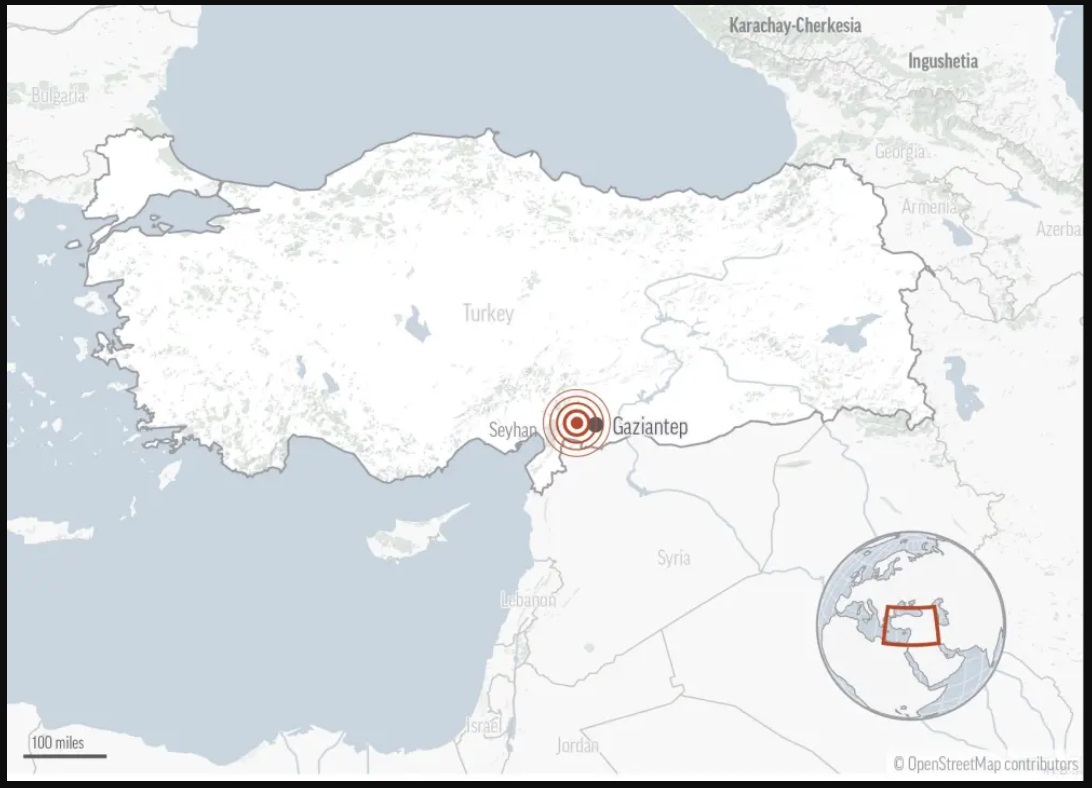
Hopes are fading amid the rescue and recovery workers in the aftermath of the horrific earthquake that hit southern Turkey and northern Syria. Reuters is providing an update on the devastation in the region. The scale of the impact is widespread and devastating as even more recovery workers continue arriving.
ANTAKYA, Turkey/JANDARIS, Syria, Feb 9, (Reuters) – Cold, hunger and despair gripped hundreds of thousands of people left homeless after the earthquakes that struck Turkey and Syria three days ago as the death toll passed 20,000 on Thursday.
The rescue of a 2-year-old boy after 79 hours trapped in the rubble of a collapsed building in Hatay, Turkey, and several other people raised spirits among weary search crews. But hopes were fading that many more would be found alive in the ruins of towns and cities.
[…] Hundreds of thousands of people in both countries have been left homeless in the middle of winter. Many have camped out in makeshift shelters in supermarket car parks, mosques, roadsides or amid the ruins, often desperate for food, water and heat.
[…] Authorities say some 6,500 buildings in Turkey collapsed and countless more were damaged.
The death toll in Turkey rose to 17,406, Health Minister Fahrettin Koca said. In Syria, already devastated by nearly 12 years of civil war, more than 3,300 people have died, according to the government and a rescue service in the rebel-held northwest.
In the devastated Syrian town of Jandaris, Ibrahim Khalil Menkaween walked in the rubble-strewn streets clutching a white body bag. He said he had lost seven members of his family, including his wife and two of his brothers.
“I’m holding this bag for when they bring out my brother, and my brother’s young son, and both of their wives, so we can pack them in bags,” he said. “The situation is very bad. And there is no aid.”
Turkish officials say some 13.5 million people were affected in an area spanning roughly 450 km (280 miles) from Adana in the west to Diyarbakir in the east. In Syria, people were killed as far south as Hama, 250 km from the epicentre.
Rescue crews looked for survivors at the site of a collapsed building in the dark in the city of Adiyaman with temperatures below freezing, Turkish broadcasters showed.
[…] There were still some signs of hope.
A 2-year-old boy was picked out of the rubble by a Romanian and Polish rescue team in Hatay 79 hours after the earthquake, video released by Turkey’s Humanitarian Relief Foundation (IHH) on Thursday showed.
The boy, wearing a blue, white and black striped sweater, cried as he was gently lifted from the hole where he had been trapped. He was carried away on a blanket. No other details were immediately available.
Another video from IHH showed a helmeted and dust-streaked rescuer weeping with emotion after successfully freeing a little girl from the rubble of a collapsed building in Kahramanmaras. (read more)
All-powerful Father, as we see all of the destruction caused by this natural disaster, we mourn for all that has been lost and the fragility of this life.
Lord God of mercy, please comfort those who have lost somebody they love, and those who are yet still searching. Give them comfort and peace.
Heavenly Father, be a protective wing for those who have survived, but lost their home. Grant the men, women and children the needed fortitude and assistance they need to recover and rebuild. Show me how best to pray for their needs and guide my prayer.
Lord God of all creation, be strong with directed purpose for those whose job it is to search through the rubble for those lost. Give them endurance and strength as they complete their responsibilities.
God of comfort and mercy, help us come together as one body in You during this time of tragedy.
You are the redeemer, the source of all strength and courage, please provide us with reassurance, humanity and faith.
In Your holy and merciful name, we humbly kneel and pray.
The Double Earthquake that hit Turkey & Syria has been extraordinary. The first quake was a 7.8 magnitude sticking in southeastern Turkey and northwestern Syria early Monday morning local time. Then 9 hours later, a second quake, which recorded a magnitude of 7.5, struck hard. Both countries have witnessed the devastating aftermath as rescue workers on the ground are reporting that nearly 12,000 people have been killed as a result of the quakes, and tens of thousands more have been injured. Thousands of buildings have also been reduced to rubble.
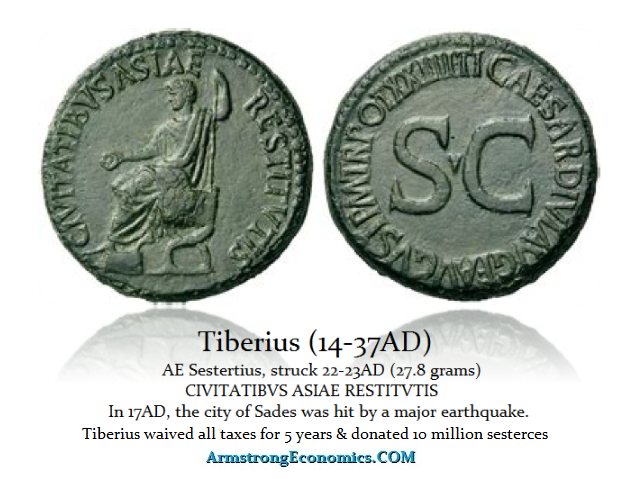
This region is prone to these major DOUBLE earthquakes. Overall, since the major earthquake of 17AD that was so created a financial panic in Rome and forced Emperor Tiberius to issue these coins noting that they were for the relief of that region, there have been 81 major earthquakes. There have been many double earthquakes and the previous was in 2017 June 12th and July 21st. Before that in 2011, there was a Double Earthquake on the 23rd of October and then on November 9th.
What is unusual this time is the time differential was only 9 hours rather than days. This raises the concern that this event may not be over just yet.
Posted originally on the CTH on February 6, 2023 | Sundance
I did not have internet access for most of today, another long-term recovery issue. However, now that I am seeing the footage of the earthquake in Southern Turkey and Northern Syria, my prayers are for all of those in the region. The devastation is just incredible.
According to the Associated Press, 5,600 buildings have collapsed and several of them came down today during aftershocks amid search and rescue operations. The current recorded death toll is over 4,300 people, with the World Health Organization (WHO) predicting the total loss of life could exceed 20,000. This is just horrific.
The estimated 7.8 magnitude earthquake hit over an area of several major population centers. The Guardian reports, “the population of the ten provinces in southern Turkey affected by the earthquakes are home to 13.5 million people. So far, according to the Andalou agency, more than 5,600 buildings have collapsed.
It is just after 6am in Turkey, and we’re seeing stories of people rescued after a very long day and night, which means they survived not only the rubble’s collapse but the cold. There are many, many more who have not yet been found, with the WHO predicting the death toll could reach 20,000 in the coming days. For now, here are videos of a three-year-old toddler and a woman who were freed from collapsed buildings by rescuers.” (link)
(Via Reuters) […] The magnitude 7.8 quake brought down whole apartment blocks in Turkish cities and piled more devastation on millions of Syrians displaced by years of war. It struck before sunrise in harsh weather and was followed in the early afternoon by another large quake.
In Diyarbakir in southeast Turkey, a woman speaking next to the wreckage of the seven-storey block where she lived said: “We were shaken like a cradle. There were nine of us at home. Two sons of mine are still in the rubble, I’m waiting for them.”
She was nursing a broken arm and had injuries to her face.
“It was like the apocalypse,” said Abdul Salam al-Mahmoud, a Syrian in the northern town of Atareb. “It’s bitterly cold and there’s heavy rain, and people need saving.” (more)
All-powerful Father, as we see all of the destruction caused by this natural disaster, we mourn for all that has been lost and the fragility of this life.
Lord God of mercy, please comfort those who have lost somebody they love, and those who are yet still searching. Give them comfort and peace.
Heavenly Father, be a protective wing for those who have survived, but lost their home. Grant the men, women and children the needed fortitude and assistance they need to recover and rebuild. Show me how best to pray for their needs and guide my prayer.
Lord God of all creation, be strong with directed purpose for those whose job it is to search through the rubble for those lost. Give them endurance and strength as they complete their responsibilities.
God of comfort and mercy, help us come together as one body in You during this time of tragedy.
You are the redeemer, the source of our strength and courage, please provide us with reassurance, humanity and faith.
In Your holy and merciful name, we humbly kneel and pray.
Food shortages have historically contributed to revolutions more so than just international war. Poor grain harvests led to riots as far back as 1529 in the French city of Lyon. During the French Petite Rebeyne of 1436. (Great Rebellion), sparked by the high price of wheat, thousands looted and destroyed the houses of rich citizens, eventually spilling the grain from the municipal granary onto the streets. Back then, it was to go get the rich.
There was a climate change cycle at work and today’s climate zealots ignore their history altogether for it did not involve fossil fuels. The climate got worse at the bottom of the Mini Ice Age which was about 1650. It really did not warm up substantially until the mid-1800s. During the 18th century, the climate resulted in very poor crops. Since the 1760s, the king had been counseled by Physiocrats, who were a group of economists that believed that the wealth of nations was derived solely from the value of land and thereby agricultural products should be highly priced. This is why Adam Smith wrote his Wealth of Nations as a retort to the Physiocrats. It was their theory that justified imperialism – the quest to conquer more land for wealth; the days of empire-building.
The King of France had listened to the Physiocrats who counseled him to intermittently deregulate the domestic grain trade and introduce a form of free trade. That did not go very well for there was a shortage of grain and this only led to a bidding war – hence the high price of wheat. We even see English political tokens of the era campaigning about the high price of grain and the shortage of food to where a man is gnawing on a bone.
Voltaire once remarked that Parisians required only “the comic opera and white bread.” Indeed, bread has also played a very critical role in French history that is overlooked. The French Revolution that began with the storming of the Bastille on July 14th, 1789 was not just looking for guns, but also grains to make bread.
The price of bread and the shortages played a very significant role during the revolution. We must understand Marie Antoinette’s supposed quote upon hearing that her subjects had no bread: “Let them eat cake!” which was just propaganda at the time. The “cake” was not the cake as we know it today, but the crust was still left in the pan after taking the bread out. This shows the magnitude that the shortage of bread played in the revolution.
In late April and May of 1775, the food shortages and high prices of grain ignited an explosion of such popular anger in the surrounding regions of Paris. There were more than 300 riots and looking for grain over just three weeks (3.14 weeks). The historians dubbed this the Flour War. The people even stormed the place at Versailles before the riots spread into Paris and outward into the countryside.
The food shortage became so acute during the 1780s that it was exacerbated by the influx of immigration to France during that period. It was a period of changing social values where we heard similar cries for equality. Eventually, this became one of the virtues on which the French Republic was founded. Most importantly, theFrench Constitution of 1791 explicitly stipulated a right to freedom of movement. It was mostly perceived to be a food shortage and the reason was the greedy rich. Thus, a huge rise in population was also contributed in part by immigration whereas it reached around 5-6 million more people in France in 1789 than in 1720.
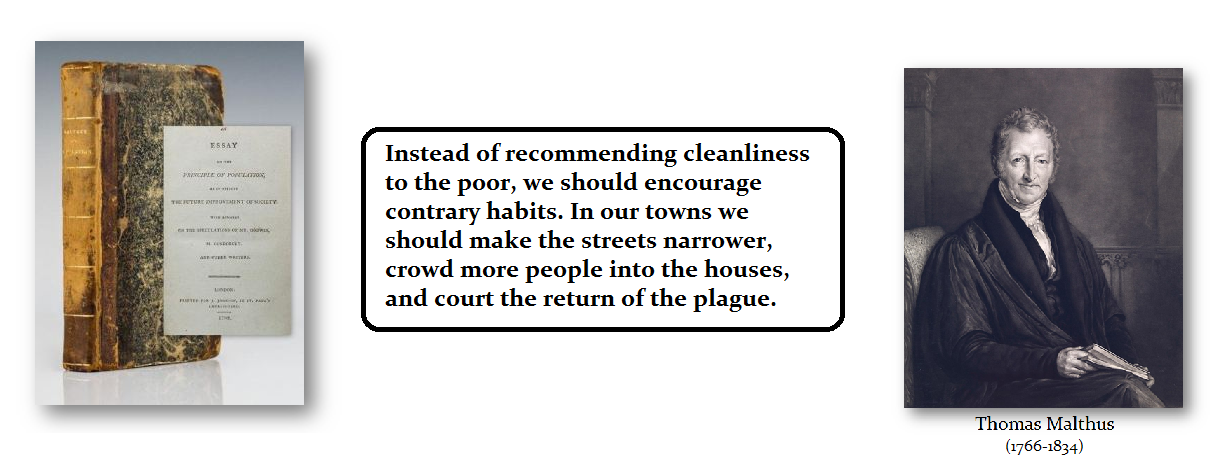
Against this backdrop, we have the publication by Thomas Malthus (1766-1834) An Essay on the Principle of Population was first published anonymously in 1798. He theorized that the population would outgrow the ability to produce food. We can see how his thinking formed because of the Mini Ice Age that bottomed in 1650. All of this was because of climate change which instigated food shortages. Therefore, it was commonly accepted that without a corresponding increase in native grain production, there would be a serious crisis.
The refusal on the part of most of the French to eat anything but a cereal-based diet was another major issue. Bread likely accounted for 60-80 percent of the budget of a wage-earner’s family at that point in time. Consequently, even a small rise in grain prices could spark political tensions. Because this was such an issue, and probably the major cause of the French Revolution among the majority, Finance Minister Jacques Necker (1732–1804) claimed that, to show solidarity with the people, King Louis XVI was eating the lower-class maslin bread. Maslin bread is from a mix of wheat and rye, rather than the elite manchet, white bread that is achieved by sifting wholemeal flour to remove the wheatgerm and bran.
That solidarity was seen as propaganda and the instigators made up the Marie Antoinette quote: Let them eat cake. . Then there was a plot drawn up at Passy in 1789 that fomented the rebellion against the crown shortly before the people stormed the Bastille. It declared “do everything in our power to ensure that the lack of bread is total, so that the bourgeoisie are forced to take up arms.”
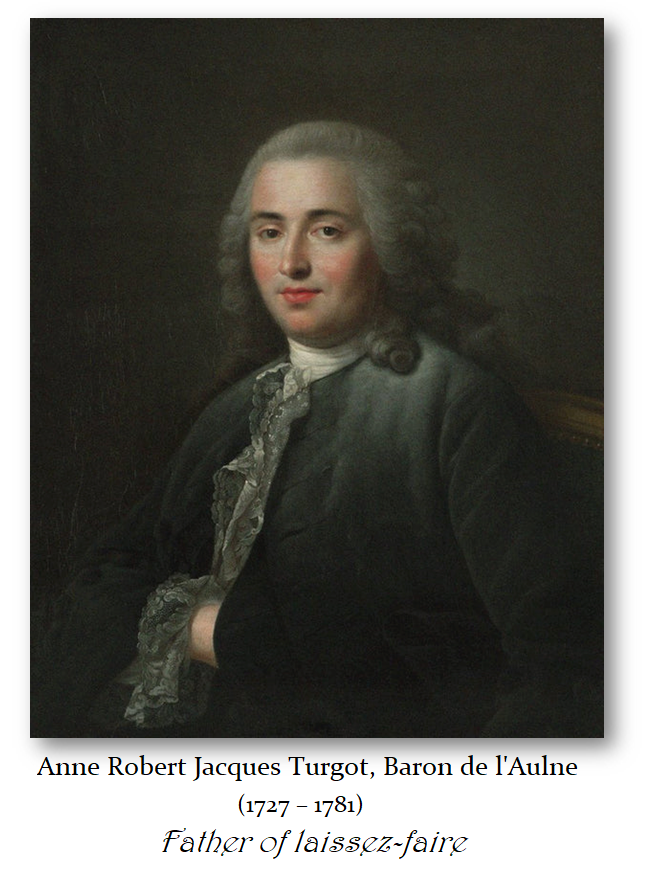
It was also at this time when Anne Robert Jacques Turgot (1727-1781), Baron de l’Aulne, was a French economist and statesman. He was originally considered a physiocrat, but he kept an open mind and became the first economist to have recognized the law of diminishing marginal returns in agriculture. He became the father of economic liberalism which we call today laissez-faire for he put it into action. He saw the overregulation of grain production was behind also contributing to the food shortages. He once said: “Ne vous mêlez pas du pain”—Do not meddle with bread.
The French Revolution overthrew the monarchy and they began beheading anyone who supported the Monarchy and confiscated their wealth as well as the land belonging to the Catholic Church. Nevertheless, the revolution did not end French anxiety over bread. On August 29th, 1789, only two days after completing the Declaration of the Rights of Man and of the Citizen, the Constituent Assembly completely deregulated domestic grain markets. The move raised fears about speculation, hoarding, and exportation.
Then on October 21st, 1789, a baker, Denis François, was accused of hiding loaves from sale as part of a conspiracy to deprive the people of bread. Despite a hearing which proved him innocent, the crowd dragged François to the Place de Grève, hanged and decapitated him, and made his pregnant wife kiss his bloodied lips. Immediately thereafter, the National Constituent Assembly instituted martial law. At first sight, this act appears as a callous lynching by the mob, yet it led to social sanctions against the general public. The deputies decided to meet popular violence with force.
So, food has often been a MAJOR factor in revolutions. We are entering a cold period. Ukraine has been the breadbasket for Europe. Escalating this war will also lead to accelerating the food shortages post-2024. It is interesting how we learn nothing from history. Wars are instigated by political leaders while revolutions are instigated by the people.
Do you feel helpless when trying to assess the veracity of “climate doom is looming” claims we are constantly bombarded with?
For ordinary citizens not having acquired at least a Ph.d. degree in atmospheric physics or comparable climate-relevant sciences, it seems nearly impossible to tell right from wrong when it comes to assess such claims. Do so-called greenhouse gases really reflect infrared energy back to earth in such quantities that this affects earth’s temperature?
Don’t give up trying to understand the relevant basics: there are rather simple ways to get an idea about what this is all about. Even without a scientific background, most people have at least a good common sense. And that’s all it takes to get a grasp of how vigorously and chaotically enormous energy fluxes slosh up and down, back and forth between earth’s surface and the skies.
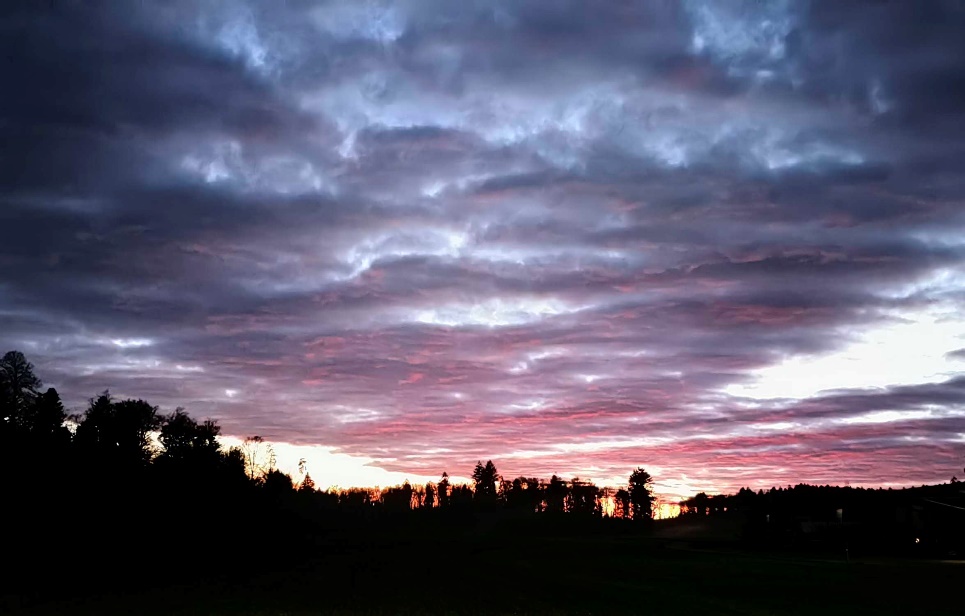
Fig. 1. The setting sun illuminating a fairly thin veil of clouds from below – thus injecting energy into the space between the earths’s surface and cloud cover.
Part 1 – some basics
Let’s first clarify where the heat that allows us to live rather comfortably in our habitats is coming from and where it goes to. Despite the enormous energy content of the molten core of our planet, the bulk of our energy comes from the sun, which sends us energy mainly using three forms of electromagnetic radiation: visible, ultraviolet and infrared light.
At the top of the atmosphere, every square meter oriented towards the sun thus receives a fairly constant power influx of 1361 to 1362 W/m2. Although not being a real constant, this value is often referred to as the solar constant.
The alleged greenhouse effect
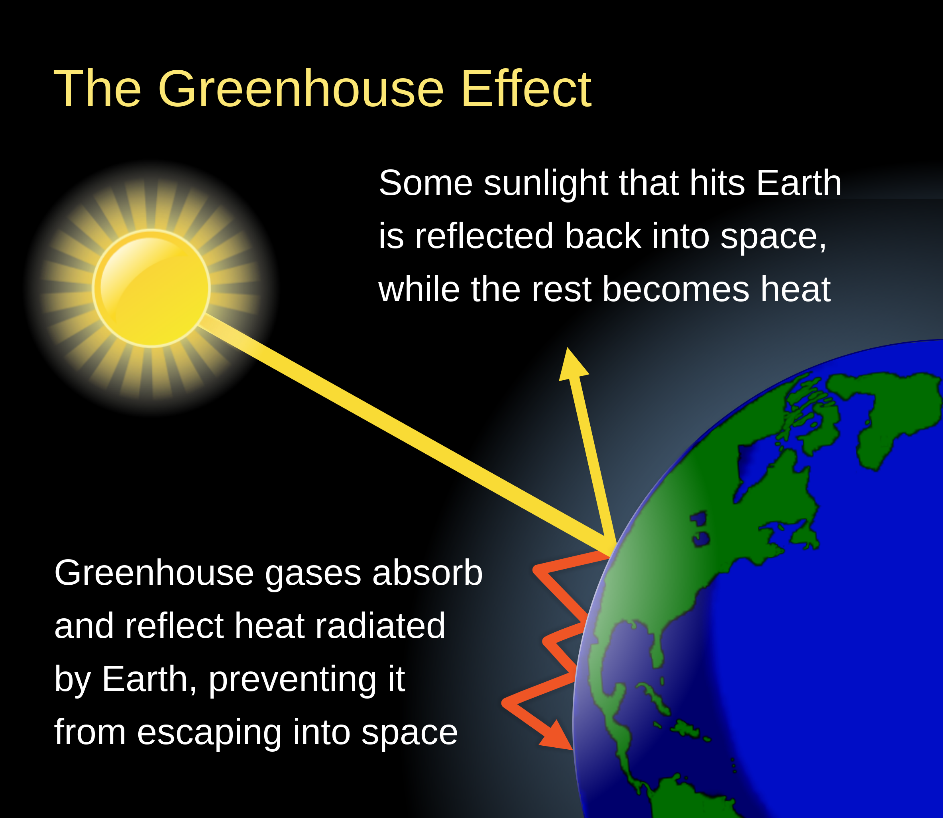
The notion of a “greenhouse effect” in our atmosphere has been used and misused incredibly often, resulting in an incredible mess of erroneous perceptions not only among the public, but even in the scientific world. A striking example for an obvious misrepresentation can be seen in the lead-in picture of the Wikipedia chapter on the topic, Fig. 2.
Fig. 2. The lead-in picture of the Wikipedia chapter about the “greenhouse effect” (Author: Efbrazil2), CC 4.0)
This graphic highlights the extent to which Wikipedia gives the impression of having fallen prey to climate activism. The complex reality of transfers and transformations of energy on our planet involving soils, waters, gases, clouds, aerosols, heat storage, conduction and convection, chemical reactions and phase transformations, as well as a host of additional factors are simply swept under the carpet, attributing all their combined effects solely to the odious “greenhouse gases”.
This Wikipedia chapter is a saddening example for the downfall of an allegedly scientific encyclopedia actually spreading rather crude ideology under the guise of educating the public. The related chapter comprises more than 7,000 words and tries to underscore its claim of being “scientific” by a list of 80 citations including papers about the atmospheric conditions on far-away cosmic bodies such as Titan and Venus. But this cannot excuse the use of such a grossly misleading graphic as the lead-in picture for the abstract. Such tricks commonly used in tabloids or yellow journals. Wikipedia touts itself to be an encyclopedia addressing not only scientists but also laymen and the general public and should therefore care all the more not to disseminate content that may be misunderstood by people lacking a scientific background.
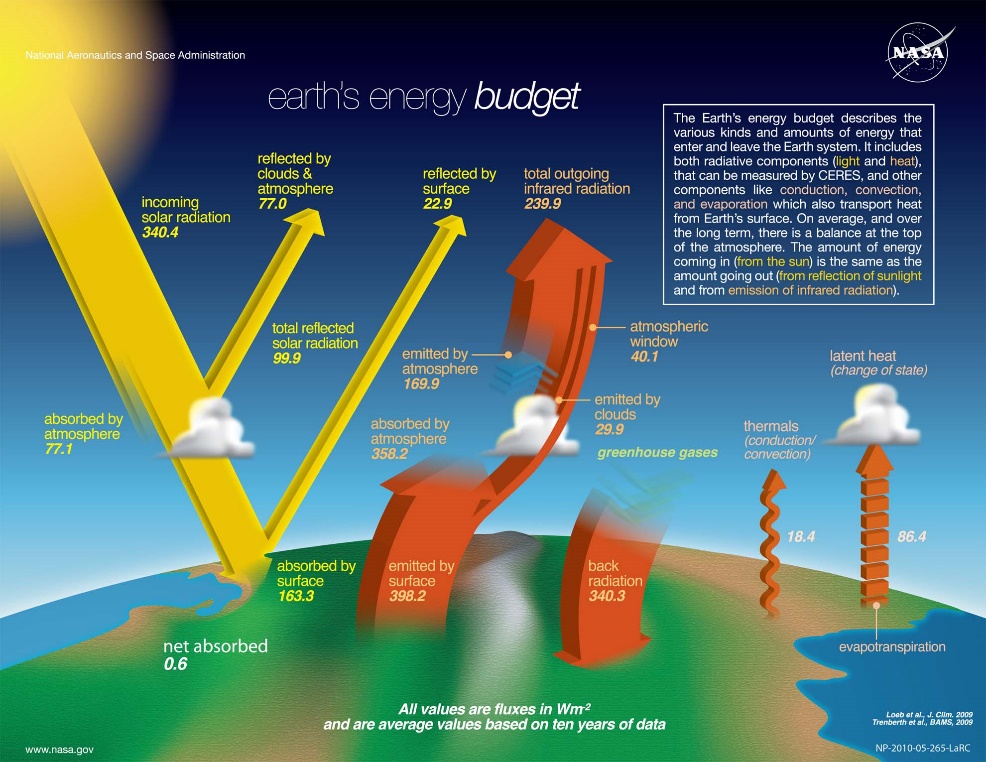
Fig. 3. This more detailed representation of the energy fluxes on earth elaborated by NASA is still misleading with respect to some decisive facts (Picture by NASA3), public domain) Note: This graphic and the corresponding link have been withdrawn after completion of the article. In a subsequent part, the replacement graphic and its amendments will be treated in detail. Nevertheless, this graphic and its errors have been displayed for a prolonged time, thus warranting a suited discussion.
Although the more detailed Fig. 3 elaborated by NASA gives a better impression of the many different factors influencing energy transfer fluxes between earth’s surface and space, it still misleads in a subtle way that makes it unfit to convey a correct understanding of the vital facts. Let’s look at the main inconsistencies.
Mean values intended to mask natural variations
One of the favourite tricks of climate prophets of doom is to suggest that all major factors influencing our climate are more or less constant, with the sole exception of “greenhouse gases”. They intend to exploit the fact that the CO2-level of the atmosphere is rising while at least for the past some 150 years, meteorologists have also seen a moderate rise of the temperature levels they monitor on their stations. Though both trends are far from being in lockstep, this coincidence of trends has been declared to be the proof for a causality, although no clear mechanism or quantitative deduction could hitherto be established. Despite many striking discrepancies e.g. with respect to the natural cycles of CO2 or the absorption and sequestration of CO2 in our oceans, the perceived rise in temperatures has been almost exclusively attributed to CO2.
Misusing water vapor
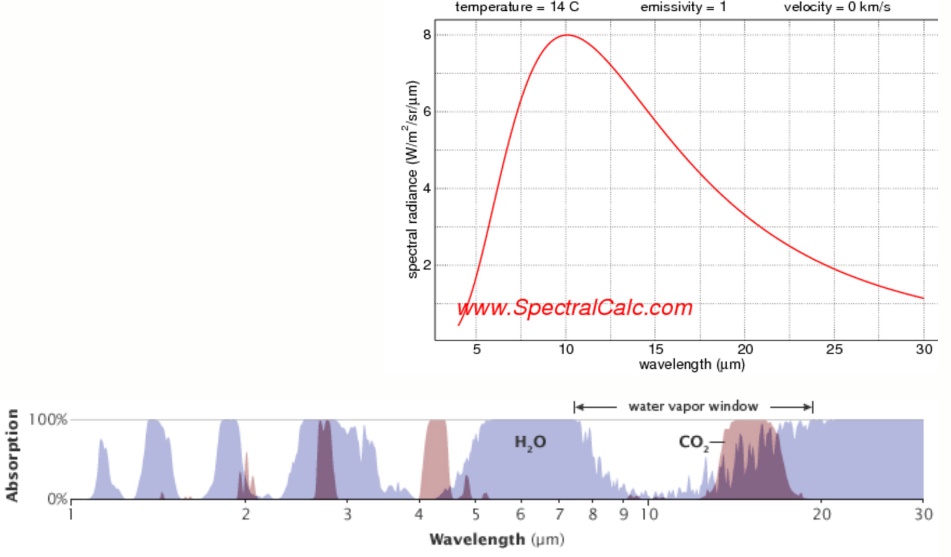
Another diversion has been to declare that water vapor is simply reinforcing the leading role of CO2. This might be viewed as a real masterpiece of twisting reality since water vapor has not only a much higher efficiency with respect to absorbing (and re-emitting) infrared radiation (see Fig.4.), but is also exceeds the content of CO2 in the atmosphere by factors between 25 (= median concentration value at sea level) and up to 100!
Fig. 4. Comparing the spectral IR radiance of a surface with 14 °C with the overlapped absorption bands of CO2 (brownish) and water vapor (bluish) shows the highly superior absorption capacity of water vapor for the IR emission of soil or water at 14 °C – (which is the “mean” temperature on earth’s surface). Please mind the different scales of the x axes: linear for the spectral radiance, logarithmic for the absorption. (Graphics: SpectralCalc4) (above), NASA, Robert Rohde5) Public domain (below)).
Notwithstanding these inconsistencies, the climate science community has in its vast majority adopted this approach. This might be attributable to the fact that the quantity of water vapor in the atmosphere is subjected to wild temporal and local variations between nearly zero – e.g. at high altitudes and very low temperatures – and sometimes up to 4% at sea level.
Cutting corners
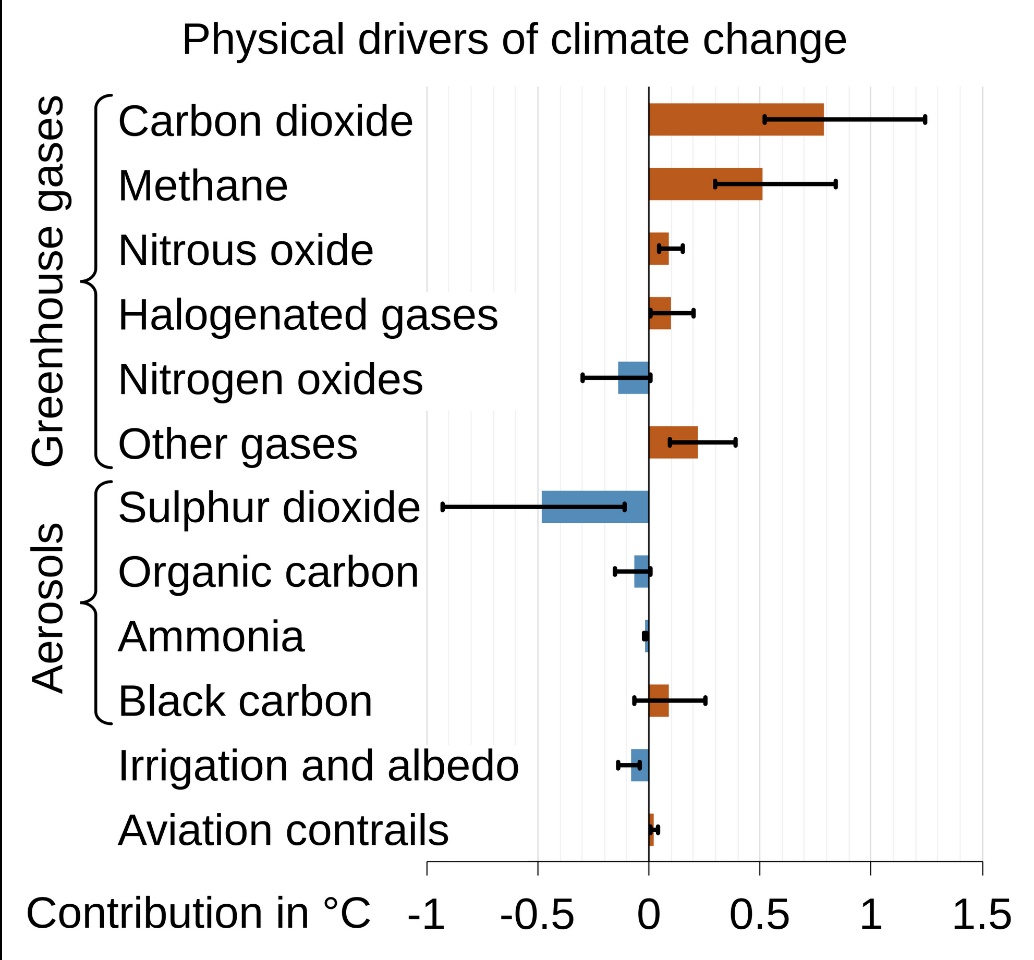
Additionally, especially when transforming to clouds, water vapor tends to condense or freeze out of the atmosphere in ways that have up to now resisted any realistic attempt to describe them mathematically. Trying to establish realistic three-dimensional models of water vapor distribution over a certain location at a given moment and to calculate the resulting effects on absorption and re-emission of IR radiation thus remain a much more arduous task than using a single value for all and every condition, as can conveniently be done when attributing the whole “greenhouse effect” solely to CO2. And voilà, truckloads of complicated research work may simply be skipped. This approach also greatly reduces the scale of expenditures in data acquisition, manpower, computer time – and in waiting time before reaping academic awards. After all, the beacon for all climate science, the IPCC, is doing it too, e.g. by simply omitting water vapor from its account of “greenhouse gases”, see Fig. 5.
Pic.5. Contribution to observed climate change from 12 different drivers, as taken from the Summary for Policymakers of the sixth IPCC assessment report, adapted from figure SPM.2c (Graphic: Erik Fisk, CC 4.06))
The numerous advantages of such a cutting of (scientific) corners might be one of the main driving forces for the deplorable tendency towards the “single number fallacy” explained by Kip Hansen7) as being “the belief that complex, complicated and even chaotic subjects and their data can be reduced to a significant and truthful single number.”
Unfortunately for us, that’s exactly what the official climate science is doing. Under the headline “One number to track human impact on climate”, NOAA scientists released the first AGGI8) (aggregated greenhouse gas index) in 2006 as “a way to help policymakers, educators, and the public understand the cumulative impact of greenhouse gases on climate over time”.
The minuscule driving forces of “greenhouse gases”
When trying to assess the real impact of “greenhouse gases” on earths energy balance, the first step should be to assess the driving force they are alleged to exert on the input and output of energy fluxes. Corresponding parameters can be found in a table within the Wikipedia chapter about Greenhouse gases 9). They reveal that in the view of the leading climate scientists, just four gases have a relevant influence on the budget of energy exchange between incoming and outgoing radiation energy since the alleged start of “human- induced climate change” in 1750. These are:
Carbon dioxide with + 2.05 W/m2 Methane with + 0.49 W/m2 Nitrous oxide with + 0.17 W/m2 Tropospheric ozone + 0.4 W/m2 =========== Total GHG contribution +3.11 W/m2
This figure is extraordinarily small when comparing it with the enormous temporal and local variability of energy fluxes within our planet’s ocean/atmosphere/soil system within short time periods, and amounts to just a low single digit percentage of the daily variations. This will be treated in more detail in the following chapter.
Peculiarly enormous greenhouse effect range
On a side note, it is interesting to see that the IPCC gives an enormous range for the greenhouse effect (TCR, Transient Climate Response or “climate sensitivity” 10)) of CO2, which is estimated to range “likely” between 1.5 and 4.5°C. The figure represents the alleged rise of earth’s mean temperature in °C for every doubling of the CO2 level of the atmosphere. Given this extraordinarily broad range of ± 50%, one might be surprised that IPCC, NOAA and Wikipedia authors advance temperature rise values for greenhouse gases calculated with up to three “significant” digits. This too might be attributable to the feeling of certainty about climate relevant figures instilled into the public by the “one number fits it all” mentality prevalent in our current climate science community.
Posted originally on the CTh on January 14, 2023 | Sundance
Their names will not make national headlines, and generally everyone has moved on, but to their families and friends Ilonka Knes and James Hurst mattered. As CTH readers may remember, in the aftermath of Hurricane Ian we shared that many missing people would be found in the months after the storm, and unfortunately many more will likely never be found.
The body of Mrs Ilonka Knes (82) was found in the mangroves and back bay salt marsh near Fort Myers Beach and has been positively identified. The body of her husband Robert was found in the days immediately following Hurricane Ian.
Additionally, the sailboat “Good Girl” was found submerged with human remains believed to be the body of James ‘Denny’ Hurst (73).
Mrs. Knes and Mr Hurst bring the total number of Hurricane Ian victims in Lee County, Florida, to seventy-five. Mr. Hurst was the final “official” missing person on the local list; however, there are many more yet unaccounted that were not from this immediate area. The physical devastation is widespread, but the emotional toll on the families and friends of the missing has been beyond imagining. Tonight, two more families have answers.
(FLORIDA) – During Thursday’s news conference, Lee County Sheriff Carmine Marceno released new information regarding the area’s recovery.
“Most of us have gotten back to a sense of the new normal. For some, still missing their loved ones, every day since the storm has been difficult,” said Marceno.
The sheriff said his agency originally attempted a well-being check at what was left at the home of Ilonka and Robert Knes in the aftermath of the storm.
The body of Robert Knes was found shortly after Ian struck, but there were no signs of his wife during the days and weeks following the disaster.
Marceno said it wasn’t until mid-January that a debris removal crew found remains in a dense patch of mangroves, that later tested positive, through the use of dental records, to be that of Ilonka. (more)
The power and duration of Hurricane Ian killed more people than Hurricane Andrew and the storm that hit Southwest Florida last September is now recorded as the deadliest storm in the past 87 years.
If you live anywhere along the coastline of the United States, inland to about 50 miles, please remember to always take these storms seriously.
After this storm, and having been through four previous direct impacts, including Homestead AFB (Andrew), I would say this…. If there is even a remote chance you would ever encounter this type of a hurricane event, EVACUATE. Do not try and hunker down if there is a looming possibility of having to rely on a structure to withstand 150+ mph wind for a full day. Just leave. With all of my preparations in place, and all of the knowledge I possess in storm survival, I would never attempt it again.
It is more than three months since Hurricane Ian hit Southwest Florida and beyond the chaos and debris that still remains visible almost everywhere, they are still recovering bodies. Please take hurricane preparations seriously.
Posted originally on the CTH on January 9, 2023 | sundance
The timing here is genuinely ridiculous. It’s as if the federal government, specifically the U.S. Consumer Product Safety Commission, led by… Richard Trumka Jr (yes, that guy’s son)… doesn’t think or care that we can see the real issue is to change energy uses.
Now that Russia has been isolated from natural gas sales, the European Union needs the supply of all other natural gas markets in order to keep itself from freezing to death. Simultaneously, natural gas as an energy resource is now bad, terrible like oil and coal, amid the climate change cult.
So, they need to change the narrative and stop people from using natural gas appliances.
Suddenly, after generations of natural gas appliances existing in almost half of the kitchens, suddenly the appliances are toxic, dangerous and likely to require a ban against use.
(Bloomberg) – A federal agency says a ban on gas stoves is on the table amid rising concern about harmful indoor air pollutants emitted by the appliances.
The US Consumer Product Safety Commission plans to take action to address the pollution, which can cause health and respiratory problems. “This is a hidden hazard,” Richard Trumka Jr., an agency commissioner, said in an interview. “Any option is on the table. Products that can’t be made safe can be banned.”
Natural gas stoves, which are used in about 40% of homes in the US, emit air pollutants such as nitrogen dioxide, carbon monoxide and fine particulate matter at levels the EPA and World Health Organization have said are unsafe and linked to respiratory illness, cardiovascular problems, cancer, and other health conditions, according to reports by groups such as the Institute for Policy Integrity and the American Chemical Society. Consumer Reports, in October, urged consumers planning to buy a new range to consider going electric after tests conducted by the group found high levels of nitrogen oxide gases from gas stoves.
New peer-reviewed research published last month in the International Journal of Environmental Research and Public Health found that more than 12% of current childhood asthma cases in the US can be attributed to gas stove use. (read more)
Its peer reviewed they say. Carved in stone tablets it must be… Just like the vaccine and other health papers and studies… Swear.
Comrade citizens, you must gather twigs, carry flint rocks, eat bugs and sustainable algae cakes, and adapt your parasitic lifestyle to become the best citizen that planet earth deserves. There can be no gas appliances in your tiny house.
All good comrade citizens who care about their carbon footprint are removing gas stoves and returning to heating water atop open fires in order to comply with the permitted bathing requirement each month, while staying safely your water distribution allotment.
Posted originally on the CTH on January 9, 2023 | sundance
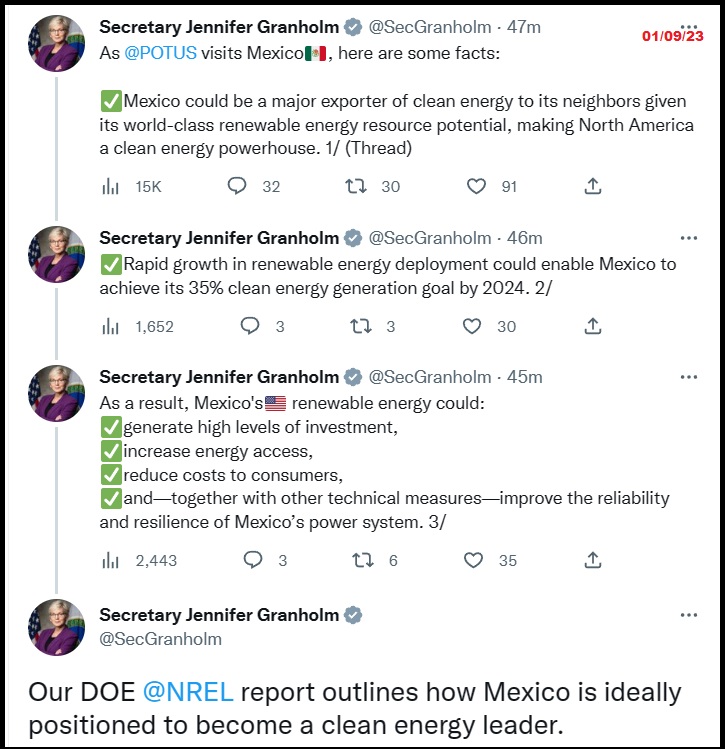
Joe Biden is in Mexico for the U.S-Mexico-Canada North American Summit, and as we have said the demands from the U.S and Canada to join the western climate change energy agenda immediately come to the forefront.
The overall effort is designed to force Mexico to join the western Build Back Better energy policy agenda, known domestically as the Green New Deal.
Previously Mexican President Andres Manuel Lopez-Obrador has pushed back against the pressure from the U.S. and told Joe Biden his nation would remain focused on economic gains, that includes the use of traditional Oil, Coal and Natural Gas resources. However, the corporations and multinational financial constructs who control the Biden and Trudeau administrations, WEF types, are not going to accept that.
It is within this very consequential economic dynamic that we begin to see a host of other ancillary geopolitical aspects start to build against the AMLO administration, to include cartel activity perhaps stimulated by covert U.S. intelligence activity. We have been outlining the importance of Mexico for several months, there are trillions at stake.
The first pressure point applied, was to demand AMLO join the Biden and Trudeau group by condemning the populist uprising in Brazil [Accomplished]. Among other geopolitical facets, this joint condemnation helps set distance between Mexico and the potential for any BRICS alliance.
With that secured, now the Biden team led by Jake Sullivan (Neocon wing of State Dept), start to apply pressure around social issues (immigration), cultural issues (fentanyl trade), humanitarian issues (human trafficking, border crisis, drugs and cartels); then building toward economic issues (worker conditions and trade) ultimately culminating with energy policy (Green New Deal).
(White House) – […] And President López Obrador and President Biden will have the opportunity to discuss questions related to supply chains, to clean energy cooperation, and to a larger economic vision of North America that involves high labor standards, high environmental standards, and as much positively reinforcing economic activity as possible that allows the United States to be the manufacturing powerhouse that President Biden has talked about but also is a win-win for Mexico and Canada, and reduces our dependencies on other countries and other parts of the world who don’t necessarily share the same values that we share with our partners here in North America.
There will be a lot of other issues on the agenda: broader law enforcement cooperation, questions related to how we move forward a common agenda to combat the climate crisis, health, people-to-people ties, and so much else.
But these areas in particular — migration, fentanyl, and integrated supply chains and the increased strength of North America’s manufacturing and innovation powerhouse in critical sectors, including in the clean energy sector — these are the areas, I think, where you will see the greatest amount of focus. The final point I would make: This trip is a good opportunity for President Biden to deepen his personal engagement with President López Obrador and Prime Minister Trudeau. Yesterday, he had the opportunity to ride with President López Obrador from the airport back into town, which gave them the chance to just have a one-on-one chat on kind of how they’re seeing the world right now, what’s on their minds. I think they both got a lot out of it.
And then, this evening, they will have the chance to all meet together with their spouses for a personal dinner. So that’s an important dimension to this as well.
[…] Q – And briefly, can you say whether the presidents discussed the dispute over Mexican energy policy, which has been a thorn in trade ties for some time, in either the limo ride — or does he plan to discuss it over the next couple of days? What is President Biden’s message to President López Obrador on that issue?
MR. SULLIVAN: I’m not going to read out the conversation in the limo because I think that was a personal conversation between the two of them. I’ll let each of them speak to it, to the extent they feel comfortable doing so.
What I will say is that the question of energy policy and the consultations over energy will be on the agenda, will come up between the two leaders on this trip. I want to leave it at that because those are sensitive conversations. They’re best done behind closed doors. But the President certainly comes with that as a key part of his economic agenda here.
Q Can I follow up? Can I follow on the — just the energy part? In talking to U.S. energy companies, they’re frustrated at the pace of these negotiations, consultations. The deadline — it expires, it’s been extended.
They are urging this White House to take the next step of calling a dispute panel, saying that there’s evidence that that is necessary. Is that something the U.S. is considering? And kind of what — what would need — what are the preconditions you would need to see in order to kind of call a dispute panel?
MR. SULLIVAN: So, I’m not going to negotiate in public or telegraph next steps in public. I’ll just say that we remain in close touch with all of those energy stakeholders. We remain in close touch with both Democrats and Republicans on the Hill. In fact, I’ve spoken with members just this morning on this issue, to keep them up to date on what we’re doing.
And as I said before, this will be a topic between the leaders here in Mexico, but I don’t want to get ahead of their opportunity to discuss this. I would just say that we think consultations have helped clarify both the nature of U.S. concerns, have identified some potential pathways forward, but we’re not there yet. And we’ll make determinations about next steps based how things unfold here in the coming days and weeks. (read more)
COMMENT: Mr. Armstrong, I just wanted to inform you as a loyal reader of your blog, it is snowing here in Kuwait for the first time in history. Your computer is the only non-passionate forecaster I have ever encountered. It relays just the facts without an agenda.
Thank you so much. You have a large group of supporters here in the Middle East.
SBB
REPLY: This entire climate change agenda is a hoax. They are not interested in the truth. This is about using climate to restructure society into the one-world order which is why they are supporting Ukrainian Nazis that follow the same beliefs as Adolf Hitler. We have turned 180 degrees from our basic fundamental values.
I am deeply concerned that by calling this global warming and now they are experimenting with shooting particlesinto the atmosphere to “cool” the planet, we may be pushing ourselves into an ice age much faster than anyone suspects. Napoleon was defeated by a Volcanic Winter. These people are risking the entire planet for several volcanoes erupting, and we may not survive by deliberately shooting particles into the atmosphere. All of this is because our current debt system cannot be sustained.
I have created this site to help people have fun in the kitchen. I write about enjoying life both in and out of my kitchen. Life is short! Make the most of it and enjoy!
This is a library of News Events not reported by the Main Stream Media documenting & connecting the dots on How the Obama Marxist Liberal agenda is destroying America











 Centinel2012

