Why have so few jobs been created especially since 2008?


Comparative Disadvantage

Over the past 30 years maybe even a bit longer there has been a steady and growing shift of manufacturing based jobs out of the country and into the Pacific Rim countries for example; Japan, Korea, Indonesia, India, Vietnam and China. We were told not to worry about this as those old obsolete factory jobs were being replaced by new service jobs in accounting, finance, health care, legal services and tech related development.  We were told that this was no different then when the United States shifted labor out of agriculture into manufacturing. Therefore don’t worry about it, things will work out and be even better.  We were told that this was called globalization and the free trade between nations was the way to prosperity for all.  And according to Adam Smith in his book The Wealth of Nations this was, in fact, true and was explained by the principle of comparative advantage which we must understand first before we can understand the opposite of disadvantage which is what we have.

Comparative advantage is a result of one group, or person, doing one thing very well and another group, or person, doing something else very well.  They then strike a bargain between them to trade some of each of their product or production to the other at some ratio that they both agree to.  The result of this is that both groups, and/or both people, have more then if they had tried to make or produce everything themselves, as in jack of all trades master of none. This is a key concept and for it to work properly there must be a “free” movement of goods and services between the two groups, or people, and no “interference” between the bargaining that sets the exchange ratio.  Meaning no outside influences like government and regulation which will always distort the process either some or a lot.

Today we find that the manufacturing jobs are gone but we also find that the service jobs are gone as well, in fact some of the service jobs left faster then the manufacturing jobs.  Try calling for any tech support or customer service and you will, in many cases, end up talking to someone in India.  Although it must be said that there has been some blowback on this as it was very hard to get someone to understand you. So what happened — what went wrong? Was it evil greedy business men looking to make a few cents more on a product because labor was cheaper someplace else?  Was it labor unions driving up the cost of labor?  Was in Health Care being to expense?  Was it Wall Street financiers finding ways to manipulate markets?  Was it the evil Oil companies ripping us off?

Actuality the answer is none of those! The question can be best answered by using a line from an old comic strip “Pogo” created by Walt Kelly from comments he first made in 1953 where he said, “We have met the Enemy and he is us!” So the answer is that we the citizens are the problem!

That is actually a parody of a message sent in 1813 from U.S. Navy Commodore Oliver Hazard Perry to General William Henry Harrison after the Battle of Lake Erie, stating, “We have met the enemy, and they are ours.” Kelly was a master of satire and parody and produced Pogo in syndicated form from 1949 to 1973 when he died from complications from diabetes. The strip was carried on by Kelly’s wife and son for two more years before it was stopped.

The reason that we the “Citizens” is the answer to why this happened is that we the “Citizens” let the politicians convince us that what was going on with globalization was OK and we should not worry.  We believed them even though it didn’t sound quite right to us. But they told us they were the “best and the brightest so we believed them. And there were some good times originally until the dot com bust and then 9/11 and Enron after that the cancer took hold with a vengeance and the jobs were soon almost all gone.  But there were signs early on like Billy Joel saw in his song Allen Town from a 1982 Album ‘The Nylon Curtain’.  Then there was the 1987 movie Wall Street Directed by Oliver Stone starting Michael Douglas, Charlie Sheen and Daryl Hannah, with its warnings about breaking up companies for profits.  And we can throw in Disclosure a 1994 movie also starting Michael Douglas which is about the games being played in Silicon Valley with all the production (a side issue) in Indonesia.

While the country was being dismembered one company and one job at a time we the Citizens were worried about all the really important things in life like; gay rights, abortion rights, civil rights, the environment, women’s rights, animal rights, handicapped peoples rights, emigration rights, affordable housing, breaking the glass ceiling, not offending anyone (Political Correctness), taking God out of everything, and not teaching anything of substance in our schools so that no one would feel bad because they couldn’t learn.  So today we have all those rights in spades but no jobs. Which was really more important?

Having lived through the 1980’s as a businessman in production related industries in a senior management position the effects of the political policies of the 1980’s were very apparent.  No one seemed to care about what was happening to business their focus was solely on all those issues listed in the previous paragraph which by the way is not a complete listing it’s just a sample.  But why would these social issues matter to businesses and job creation? And what does any of this have to do with comparative disadvantage?

First we need to discuss business and its purpose which is to make a profit so that the investors can be paid back for making their investment in time and/or money.  If a business can not make a profit that it can “keep” then the investors will either not invest or they will sell their position (at a loss) and the business will close. Therefore no business can stay in business without making a profit. So by simple extrapolation profits are good not bad.

They are the reward for doing a good job

The lack of them is the penalty for doing a bad job

So how does a business make a profit?  Well there is really only one way and that is to sell a product for more then what it costs to make the product and in addition cover all the costs of being in business.  A key point here that most people do not appreciate is that the only thing that matters to an investor is the net cash left after the deduction of all expenses; which includes production costs, operating costs and all business taxes.  So it’s easy to see that to have anything left over to pay the investors, the price of the product or service has to be greater then all the costs of providing that product or service, including taxes.

Anything that raises any part of the cost of doing business “must” be passed on to the consumer in the form of “higher” prices.  Even Adam Smith knew this, it’s in his book.

Therefore if society determines that businesses must include social costs as for example in complying with OSHA, EPA, NLRB rules and providing HEALTH CARE (a complete listing of rules and regulations would fill this entire paper) as well as property taxes and income taxes the costs of doing business are by definition driven up.  And therefore as the costs are driven up the businesses must raise their prices or go out of business. Their revenue must always be greater then their costs, to stay in business. Or one other is by government subsidies (additional revenue) but then the government needs higher taxes to do that. And the government also gets the right to participate in that business.

Now we get to comparative disadvantage for we in America do not have a closed society we allow others to sell goods and provide services in this country.  Discounting transportation cost which are minimized by huge cargo container ships we have goods coming into this country from countries that do not have the same social cost structure that companies here have.  American companies are therefore at a comparative disadvantage.  And to be honest the actual direct labor component, even with unions, maybe the smallest element in their high cost structure.

For example the hard push today to “Green Energy” which costs more to produce as any technical person will agree to.  According to the International Energy Agency (IEA) in 2005 the average cost of electricity in the United States was $.052 per kWh and in China it was $.032 per kWh. This is before the big push to renewable sources which will drive up the cost of electricity here even higher. For example, according to the U.S. Energy Information Administration (EIA) in their report of H.R. 2454 (the clean energy act) electric rates $ per kWh could easily double during the time frame of the report if that law was ever enacted.  If the business in China were paying on average only 55.2% of those of their U.S. competitors now, that is a major Comparative Advantage that they have.  Further it would seem that that advantage will get bigger as the EPA pushes to implement its clean energy agenda. This is being done through rules and regulation by the EPA even without the passage of any carbon reduction legislation being passed.

If we add to that all the other social costs of doing business here (we are not considering the social merit here only the costs) from say worker safety and pollution for example we quickly find that it would be almost impossible for any U.S. company to produce anything in our country that could not be produced and delivered here cheaper from a foreign source.  It does not require a degree in economics or finance to see that this is just not going to work. Common Sense alone tells us that the system our current leaders have put in, because we told them we wanted these social benefits, welfare programs and regulations, and this will continue to drive production related business out of this county.

Walt Kelly, “We have met the Enemy and he is us!”

However our politicians, although they gave us the rules and regulation we asked them for, didn’t explain to us the consequences of those rules and regulations as they became apparent. As we saw in the songs and movies of the 1980’s even the entertainment industry saw what was happening.  So why didn’t the politicians do something — well it was really very simple.  As the trade imbalance increased and cheap goods poured in, through Wall-Mart initially, the countries that were flooding the U.S. with cheap products elected to buy U.S. treasures bonds (T-Bills) rather then products and services that were too expense to buy from the U.S.

So what most of us would say?  Well as it turns out this is the most critical element of the predicament that we are now in.  Our elected officials being from the best schools and being very educated (that’s what they tell us and is the reason we are supposed to listen to them) knew what was happening but since the countries that were giving us the cheap goods were buying T-Bills the politicians had more money to play with and so to them having those extra funds meant they could pay for things that they otherwise could not provide (to us).  This made them look good and got them re-elected. And they could always blame the job losses on the evil businesses that just didn’t care.

There has been a lot of talk by economists that claim this is of no concern as eventually those countries will have to move out of T-Bills so it doesn’t matter.  Although technically that may be true in “economics,” in the real world its nothing but farm pollution.  For example we are told that foreign purchases of T-Bills hold down the rate of interest which is good.  True yes, but rather then use that low interest rate to build infrastructure and promote business investment we used it to finance our social programs. The problem with that was that the social transformations increased the cost of doing business which made the situation worse.

It was an absolutely perfect positive feed back situation working like this: as the foreign purchases increased the government had more funds to make social changes which then raised the cost of doing business, which drove more business out, which then resulted in more imports, which then result in more money for the government to play with. There was just no incentive to stop this from happening in the government; it would have stopped the money flow to them.

In addition as the businesses closed or moved operations out of the country there were both fewer businesses to pay taxes and fewer employees to pay them as a result.  So with fewer and fewer workers the tax burden per worker was forced higher and higher. Fewer workers meant the government needed to provide more services and therefore the government needed more funds and the resulting growing deficit was financed increasingly by foreigners.

In simple terms the foreign purchases of T-Bills represents the hidden social cost of U.S. policies compared to those in the rest of the world that is bringing us our products.

In the study of economics one quickly learns that in the “long run” most everything works out.  The artificially induced distortions by governments and rulers are never sustainable for very long.  Look what happened to the workers paradise the U.S.S.R. it only lasted 70 some years before collapsing. China lasted even a shorter time maybe only about 50 years before making a major change and letting a private sector develop there. Although to be fair they did see what happened to the Russians and so making a change was the only way to avoid a similar collapse for them. They did stay in power which was the really important part to them.

We can not by law or regulation overrule these three things: human nature, the laws of physics and engineering or the principles of economics.  An economics professor of mine one told us in class that the only thing any government can do is to create “shortages” or “surpluses” and he was 100% right.

We have the Department of Energy and a shortage of energy

We have the Department of Heath and Human Services and we have a surplus of poor

We have the Department of Labor and a shortage of jobs

We have the Federal Reserve and that has given us both a shortage of and a surplus of money.

Neither the shortage of energy nor the surplus of poor nor the shortage of jobs nor the swings in money existed as a major problem prior to the creation of these agencies.  Each of these government departments was created to fix a problem that at the time was a short term problem not a structural problem.  And each time this happened we lost a little bit of our Comparative Advantage for each of these changes added more rules and regulation that had to be followed.

So now these and many other government actions and social issues have eliminated most all of the Comparative Advantage that the U.S. once had.  The options for getting it back are slim to none unless we take drastic action — and very soon.

So where has this taken us then what have all these really smart and educated politicians given us with their politics?   Well it a very easy thing to answer — no jobs!  Americans want to work and take care of themselves and their families they don’t want some big government telling them what they can or can not do.  The Citizens can develop a feeling in them collectively when major shifts occur;.how this occurs is not the subject of this post but the facts are that the public, the Citizens, know that things are not right.  They may not know the details because they have been hidden but they do know that the country is in deep trouble.

One last comment in this post is that there is a fix for at least a part of this.  The process of other countries buying U.S. Treasurers in lieu of buy things here is the main reason we have lost so many jobs. In a free market this would not have happened but since there is no true free market we need some way to compensate for this.

There are two ways this could be done although neither would never be done, and it’s relatively simple.  The first method would be that Congress could pass a law that would state: Starting immediately U.S. Treasuries will no long be sold to anyone that is not a U.S. citizen or a U.S. corporation.  And if a Corporation then it must be at least three fourths’ owned by U.S. Citizens.  All Treasuries that are now held by non qualifying entities will be held to maturity but will not be refinanced.  This will force the money into product services or other non government equities of some kind.

This will raise the interest rate for government securities but that will only put the cost of this kind of borrowing in line with where it should be to begin with.   The effect of this will be to raise stock prices and force the government to be more realistic with its expenditures.  Obviously the change will be traumatic but it will be better then other alternatives as described elsewhere in the book.

The second method would be somewhat easier to implement but it would be just as confrontational.  This method is one of tariffs but not as we presently know or think of them; we add a different twist to them.  If we agree that the various social costs in the United States are in fact driving up business costs and if we agree that the corollary to that is many of the countries that import to us do not have those same costs then there is a way to fix this.

We would set up two tariffs the first being a Social tariff and the second an Environmental tariff.  A task force would be set up consisting of the countries Business and Unions but no politicians.  They would determine what those two non business (not related to producing the product or service) related costs are.  They would also look at the various countries that ship goods here and estimate what each of those counties costs are.  Once that has been accomplished a comparison can be developed between them and two tariffs established one for social costs and one for environmental costs.  A particular country could have none, one or both applied and they would be administered separately.

It would not be reasonable to implement something like this all at once and so it would be phased in over time, say ten years, at 10% of the total differential added each year.  Offsetting this would be an annual review of the tariffs such that if a country got worse of better vis-a-vis the United States the numbers would be adjusted up or down.  A system like this would force countries doing business with us to either clean up their countries or pay the penalty through the tariffs. Over time the comparative disadvantage would be reduced and that would allow some of the lost jobs to be brought back here. The offset to this is that the costs of goods would go up and that must be understood itf we are going to protect our jobs.

Neither of these solutions is desirable in themselves but the alternative of continuing the present system is much worse.  We must have jobs in this country commensurate with the abilities of the citizens and that means there must be a range of jobs available that encompass the full range from manual labor to university professors. Obviously those are the extremes and the bulk must fall in the middle such that the average person can hold a full time job that pays a decent rate.  If we as a society do not provide that then we have failed both as a society and as people.
A Constitutional Republic


Our Form of Government

When the American Revolution started there had been a 500 year debate going on within political theorists that was having the effect of undermining the prevailing validity of the heredity based monarchies’ that predominated Europe and most of the rest of the world at that time.  Therefore western civilization was ripe for a change and that change came from the British colonies in America. Residing there was a group of very special men: Washington, Jefferson, Franklin, Adams, Madison, and Hamilton to name but a few of those that created this new system.

An interesting fact is that if we look at science and engineering for the period 50 years before and 50 years after 1776 we find that is the heart of the industrial revolution.  Mostly in England but also in the Americans we have the perfection of the steam engine, the flying shuttle loom, the crucible process for making steel, the small pox vaccine, the first machine tools, interchangeable parts, the battery and photography all being invented. From there things moved faster and faster resulting in the standard of living that we have today.

Since this was also the period of political economic and legal writing that included the likes of Adam Smith, William Blackstone, John Locke, Jean-Jacques Rousseau and Thomas Paine it is safe to say that we are today the result of these men and what they did during that period.

But back to politics and government to find out what was created after the end of the American Revolution with the signing of the Treaty of Paris on September 3, 1783.  A few years before that on March 1, 1781 the newly freed colonies begin operating under a loose form of government called the Articles of Confederation described in the first section of this book.

But there were problems with that form of government and so a few years later in 1786 a conventional was called to make changes as was allowed by the Articles of Confederation.  That quickly lead to the writing of the United States Constitution that we now have and that was ratified and put into effect on September 13, 1788.  By April of 1789 the elections had been held the 1st congress convened and Washington sown in as the first President.  The rest is history in the making.

We know most of that and most of us know a little about the form of government that we have but few know why we have what we have.  That is sad for the why is the important part, especially today when some wish to make changes to the form of government that we have that will basically make the Constitution we have an obsolete document.

We know from historical records that there was a significant debate between those wanting a relatively strong central government (Federalist) and a weak central government (Anti-Federalist).  The compromise that allowed for the ratification was the Bill of Rights which was the name given to the first ten amendments to the United States Constitution.  The purpose of these amendments was to ensure that the power (for the serious readers the Sovereignty) stayed as much as possible with the people and the states.

Most of the first eight years of the new government were taken up in forming the government and forming the operating procedures for how it would actually function.  There was little historical help to those that wrote the constitution and those that were elected to run it.  And since the system was specifically set up to be cumbersome in operation with all kinds of checks and balances this was not an easy task.  So why was our government set up to be hard to get things done?

To get that answer we need to look at the forms of government and what you know about them is not necessarily what the first impression is.  If we go back to Locke and Rousseau we see that the power resides in the people and that they, through the ‘social’ contract give some of that power to the government.  The purpose of this ‘social’ contract is primarily for the protection of the people.  But it’s also to set up a system of governance that gives the people the rules (statutory and common laws) that determine the legal basis of how society operates day to day and year to year.

We can see that if there is no government and therefore no law that all the power resides in the people and they are free to do anything that they want.  This is called anarchy.  If we move to the other end as in a monarchy we have the opposite with all the power resting in the Monarch (king, emperor etc).  The people here are subjects with no rights except those that the Monarch grants them.  Today we hear about the right and the left or communism or fascism as forms of government but they are all really the same thing.  Oh there are differences but the important thing is that they all have as their base a strong central government. Which makes them little different than the heretical monarchies that ruled the world for so long.  Different titles and different procedures with or without voting but they all had at their core a ‘ruling class’ that governed the country some with almost absolute power.

Historically most countries ended up with a group that supported the monarch since it would be impractical for one person to run an entire country.  These people ended up being the royalty with a whole range of titles to establish a pecking order.  But even that wasn’t enough to affectively rule as the size of the countries increased and so councils were formed mostly of educated but not always aristocrats mostly with blood lines to the crown, so to speak.  There were various names for these councils such as the parliament in England generally the rule makers served at the Monarchs’ pleasure and were called magistrates.

When the United States Constitution was being written the founders did not want to establish a system like existed elsewhere for they had just finished fighting a long war to get rid of that kind of system.  But what else was there?  Well that is why the work of Locke and Rousseau were so important.  This is not to say that many others didn’t contribute to the thinking of that time but only that these two gave a theoretical basis for a different form of government.

So the task that those attending the constitutional convention in 1787 faced was to come up with something that was not a monarchy and not anarchy.  Something in-between the two that would give the people soon to be called citizens their freedom but yet allow for the protection of the people through a federal government. To get a better understanding of this process one of the best books written is The Five Thousand Year Leapwritten by W. Cleon Skousen.  First published in 1981 and then again in 2009 by American Documents Publishing.

The system that was set up here was deigned to fall between anarchy and a monarchy and be anchored there with strong controls and limits on what power the various governments’ power centers had.  There were Local, County, State and Federal systems each with a defined and limited ability to make laws.  Further, since their biggest concern was the Federal system it was broken up into many sections to defuse the power for they knew that the tendency would be for power to concentrate and once that accrued the form of government they had set up would be lost.

The purpose for all the checks and balances and splits in power and states rights and individual rights and the electoral system of determining the president was to prevent the concentration of power in the federal government which would inevitably lead to the Citizens be turned once more into subjects.

John Adams, “Liberty cannot be preserved without a general knowledge among the people, who have … a right, an indisputable, unalienable, indefeasible, divine right to that most dreaded and envied kind of knowledge, I mean the character and conduct of their rulers.”

Our Way of Life, Part I


Before we can start a discussion on civilization and society and our way of life we must briefly address the issue of how humans came to populate the earth, and this brings us to the issue of God, since all the major religions of the world teach that God created man.  Some believe that God created the earth some 5,000 odd years ago in a six-day period.  Others who are also religious are more flexible in this belief. Those that are of the first group of teachings are prescriptively rigid and therefore they cannot account for the abundance of observations and phenomena in our natural world, which point to a much greater age for the planet (ten to fifteen billion years).

Why the red shift in astronomy?  Why the many fossils that point to evolutionary development for all terrestrial life?  Why the existence of geological structures millions, even billions, of years old? Why human brains with the capacity to discover these things as we study ourselves and the universe?  Why would a God who had created the universe in six days go to such great efforts to make it appear otherwise?

We should bypass this issue by assuming that, given the existence of a God/Creator, the universe was created in a manner consistent with our scientific knowledge, but that man was an intentional result of the creation process, planned by the God/Creator from the beginning.  In other words, God created man via an indirect, evolutionary process, that many  today call “intelligent design.”   If we can agree to make this one simple assumption, then we can move on to the discussion and analysis of our humanity without getting into an argument about the existence of God and whether here is an afterlife. There will be more on this subject in future post.

Assuming that human life developed in an evolutionary process we can begin our discussion of civilization with the pre-human ancestors of modern man, who began to roam the planet coming out of Africa approximately two and a half million years ago.   By this stage of our development, pre-humans had developed a complex brain as a means of adapting to a hostile environment.   It is generally believed that at the time the earliest humans developed sentience they had banded together in small groups for protection.   The importance of this practice was three-fold:

First, living in groups provided general protection for all members of the band or tribe (in other words there was, “safety in numbers”).

Second, since the human female is particularly vulnerable during the later stages of pregnancy (pregnancy easily adds twenty-five to thirty percent to her body weight), group protection of gestating females was a very strong asset to the viability of the human species.  Whether it is politically correct or not — the primary purpose of a man is to protect and care for his mate and their children

Third, human babies are absolutely helpless (unlike most other mammals) for an extended period of time after birth, and children require many years of growing and learning before becoming independent individuals (14 to 16 years back then and much longer today), and thus group protection of infants and young children was absolutely imperative if the human species was to survive.

The females of almost all species with complex brains (and developmental patterns similar to ours) developed very strong protective instincts.  It follows logically that human males, unburdened with childbearing, became the aggressive gender of the species, whose core job was foremost to protect and provide for the females and young. In addition, males were much more expendable than females, since one male could impregnate many females.  Maybe this is one of the reasons that approximately 7% more males are born than females.  They were expected to die off and so more were needed.

These defined gender roles must have been beneficial to the development and propagation of the human species, or we would not have continued to evolve.  By the time humans had developed language and had begun to use tools and fire, the social roles of both males and females had been “programmed” into human DNA: Aggressive males protected the tribe (even at the cost of their lives), while the more passive females bore and cared for the young.  Probably as a direct result of the major physical demands of childbearing, females also became physiologically much stronger than males, thus increasing their longevity potential in comparison to males. This has major ramifications today as women live much long then men do and older people require more health care.

Based on observations of the social behaviors of other species with large, complex brains, we can assume that early humans developed specific social structures within their bands and small tribes.   Typically, a dominant male becomes the band or tribe leader; parallel to this, a dominant female also arises, thus providing the basis for a “pecking order,” or social structure, of both males and females within the group.

Probably about thirty thousand years ago basic, “civilization” was born when humans began to retain knowledge through speech, art, and writing, and the relatively simple social structure of early humans began to evolve into something more complex.  The evolutionary process became much more complicated as humans gained the knowledge that allowed them to exercise ever greater control over their environment.  Farming, mining, metal working, and the building of mechanical devices developed quickly and spread throughout the world in short very short order.

A critical mass of knowledge was reached about five thousand years ago, and the conquest of the planet then began in earnest.  It has continued in spurts ever since (periods of rapid gain of knowledge followed by periods of absorption of that knowledge) and is now progressing geometric rate. Given that most of the easy to get resources of the plant have been found and used it is critical that we continue to push the knowledge frontier so we can get to the point that we are not limited to ‘easy’ to get resources. Turing back now is not an option for if there is a second modern dark age it will not be easy to come back.

With the rapid expansion of civilization throughout the globe, the aggressive nature of the male began to constitute, at least somewhat, a liability to the development of the human race.   To some extent, war and the desire for conquest were simply an outgrowth of the male’s role as protector of the tribe.  As bigger and bigger territories were brought under the control of a single dominant, male, large areas assumed a certain stability, which, in turn, promoted the development of technology.  Since by this time no other thing on the planet could challenge the human race it began to dominate the planet.

As the number of humans grew and their knowledge base expanded, all areas or aspects did not develop equally.  Initially male-oriented skills predominated and resulted in the advancement of technology and the physical sciences.  The skills of warfare and conquest were perfected, driven by technological advances.  Human cultures that did not develop these skills were quickly swept aside by highly organized and increasingly mechanized armies.

Prior to the twentieth century, however, aggression and warfare did not impact the overall survival of the human race.  Today, unfortunately, with man’s ability to make nuclear bombs, lethal gases, and custom-designed killer viruses, warfare has the potential to threaten the survival of the human species and has become a very important issue.

“Civilization” has now reached a point at which mankind must rethink its purpose and, in fact, its very existence.  With billions of humans on the planet, and with the knowledge we now possess, it would be easy for mankind to destroy all life on the planet.  Some international tension has been displaced with the collapse of the USSR in the late ‘80s, but it must be kept in mind that, historically, a power always rises to fill a void. India, China, Japan (probably not now after the 2011 earthquake), or some other country will assert itself and replace the USSR in the pantheon of world powers. Disarmament is also not an issue as weakness breeds war, it always has and that cannot be allowed today.

Today with the apparent decline of the United States since 2008 this looks to be more and more like China will assume this role of the replacement country to the old USSR and in the process possibly even surpass the United States if the current direction is not reversed.  This is not a certainty as there are internal problems in China that are not obvious, but that is a subject for a different discussion.

The decline of the United States to a lesser status would be very bad for mankind for we can no longer allow these old aggressive power patterns of a strong leader as part of a closed political system trying to gain control of a region or significant portion of the world.  We must come to an understanding of who we are and why we do what we do; we must be able to address these issues realistically or our civilization will collapse under the onslaught of our increasing numbers our technology and our relentless impact on the ecostructure of the world.

The reason that our decline would be bad is that we are different. Because of this difference the U.S. rose to its present position as the world’s leading industrial and political power in less than 200 years. The industrial base, governmental structure and military might of our country are the culmination of five thousand years of western civilization.  The U.S. is presently unchallenged by any nation on the planet; simply said, we are the best (nation) and we got to where we are by being the best (individually) because there was no central control. However, since 2008 that is being changed and not for the good. This fact must be kept in mind or all discussion of change will lack a solid base, for if we already are the best than what are we going to change to that is better?

We got here by the intellect and hard work primarily by men of European ancestry.  This is not to imply that people with other cultural backgrounds did not contribute to America’s growth, but, prior to a very few years ago, the core leadership of this country came predominantly from western European stock (English, French, Italian, Spanish and German). This “melting pot” of people and ideas worked well as long as the melting was encouraged by the citizens.  The social structure that developed from this experiment in self rule became the “American” culture.  It makes no sense to postulate whether the contributions of eastern European or non-European cultures would have changed American culture in some substantial or “better” way, since the fact remains that the influence of these cultures was — nominal or minimal at best.

The American citizen was not ruled by the federal government and that was because of the U.S. Constitution and “Bill-of-Rights” which prevented an oppressive government from developing; that is until now.  We are being told that those documents are obsolete and must be changed or gotten rid of.  There is no logic to that thinking and it is only being promoted by those that want the power that those documents now deny. We should be very careful about making changes for another system other than what we have now for that is a return to past systems that do not and have never worked.

There are, of course, imperfections in our society we are after all human. But we should not abandon all the good we have accomplished within the parameters of American culture just because we have some negative aspects.  For sure we should not start over because of some perceived problems areas.  Make adjustments yes, but not start over.

Issues with the IPCC Methods, Part IV


As discussed, the PCM model of the world’s temperature is based on identifying patterns and then finding equations that could generate a curve(s) that would match the observed data.  This is neither non-linear least squares fitting nor is it Gauss-Newton curve fitting as there is just too much noise or variability to the temperature data especially with the method used by NASA to handle raw data and prior to ~1850 there is only proxy data.  The assumptions used here for predicting temperature are that there were two source curves that were independent of each other but when added together with a reasonable factor for Carbon Dioxide gave the observed results.  We also needed a model for the Carbon Dioxide level and that was modeled using the form of a Gaussian distribution after the seasonable variance was removed using a mean value.  Once that was accomplished an equation was developed that could generate a plot that fit the NOAA data very well and it would transition smoothly back to the 1650 value of ~270 ppm. This gives a base to work from that led to the following equations.

In the model the base Temperature in 1650 (we use 1650 since that is the approximate low point in the little ice age) is set at TB = 13.215 C.  The long cycle LC is 1,052.63 years with a 1.48 C swing. The short cycle SC is 66.67 years with a swing of .30 C.   The forcing for CO2 CL is calculated from 272 ppm for 1650 and taken to 800 ppm level by 2250 by a plot that matches NOAA data where available. The model starts in January 1650 and moves by an increments of 1 per month (M) from the starting point to the end of the simulation. Each increment of one adds one row to the spreadsheet.  So the following equations are what we use for the following example. If we wanted to calculate the value that NASA-GISS will give for November 2014 that would represent an M value of 4379 and that is all that is needed to solve for the temperature. This method appears to work well from 1000 AD through 2000 AD; so the prediction for November 2014 is calculated as follows:

1. The Long Cycle value is

LC = Sin (.00052359*M-1.57338795)*.74+.303784 = .791408 C

2. The Short Cycle value is

SC + Sin (.00785385 *M-19.2419325)*.15+.195341 = .274718 C

3. The CO2 value is

CL = 550/(1+EXP(1+8.94+.002*M)+272 = 401.081 ppm

4. The Adder for CO2 is

TC = -4.227 + (.75*LN(CL))) = .268623 C

5. The Temp. for 2014-11 will be:

Temp = 13.215 + LC + SC + TC = 14.550 C

The NASA-GISS temperature for June, July, and August 2013 is 14.58 C

The PCM model projection for the same period is 14.56 C

The concern over global warming as observed during the 70’s 80’s and 90’s was not unreasonable since Carbon Dioxide, a known “greenhouse” gas (we use this term even though it is wrong as explained in point six), levels were going up and global temperatures were also going up.  The politicians that wanted to act got involved and created a solution before the apparent problem was even understood.  The green energy, sustainability and save the planet slogans that were developed and even the greenhouse effect words were all designed to convince the citizens that things must be changed or there would be dire consequences. The IPCC climate models will eventually be fixed to work as they will eventually realize that something is not working the way they thought.  Unfortunately the political damage has already been done as we poor hundreds billions of dollars into changing how we produce energy to fix a non-existent problem.  The sooner we can get past this the less time, effort and resources will be wasted and we can use them for much better purposes.

Issues with the IPCC Methods, Part III


In Part I  the basics for a different kind of climate model which we call the Pattern Climate Model (PCM) were discussed and in this section we will present a method where the real reasons for global temperature movements can be demonstrated in a very simple model.  The reason or logic for developing this model is that based on geological evidence the link between Carbon Dioxide and global temperature appeared weak at best, especially at elevated levels meaning over 400/500 ppm.  More currently over the past 2000 years or so there appeared to be patterns to the climate that had better relationships to orbital changes, Milankovitch Cycles, and variations in the suns output.  As discussed in the seventh point over the past several thousand years the Milankovitch Cycles appear to give a global warming and cooling cycle of some 1,052 years with a swing in temperature of about 1.46 degrees Celsius.  This swing appears to match well with the timing of the Little Ice Age and the Medieval Warming as well as other warming and cooling cycles going back further than those two just mentioned. With a swing of almost 1.5 degrees Celsius this is has probably been the primary driver of global temperatures for the past 4000 years. Figure 3 follows.

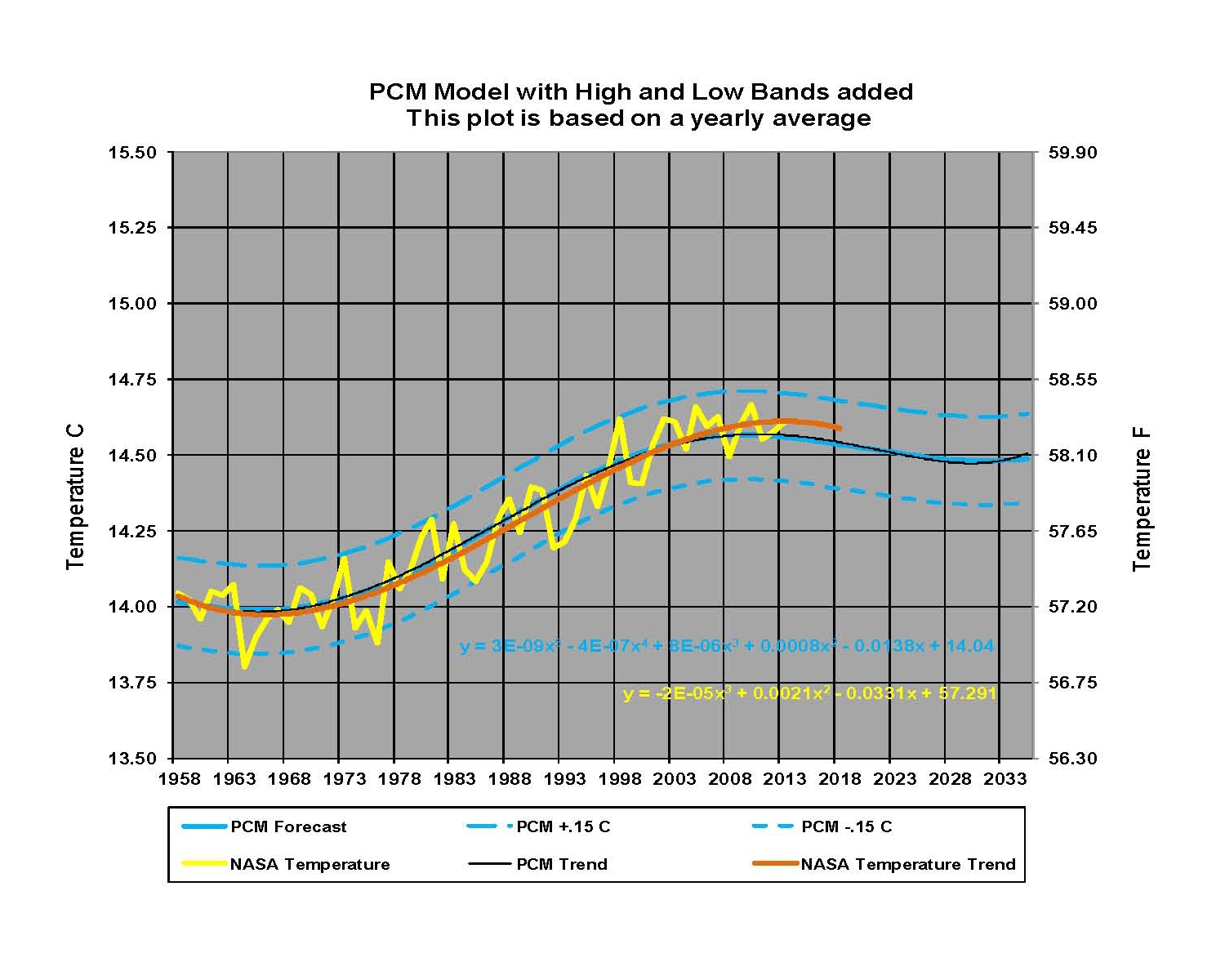
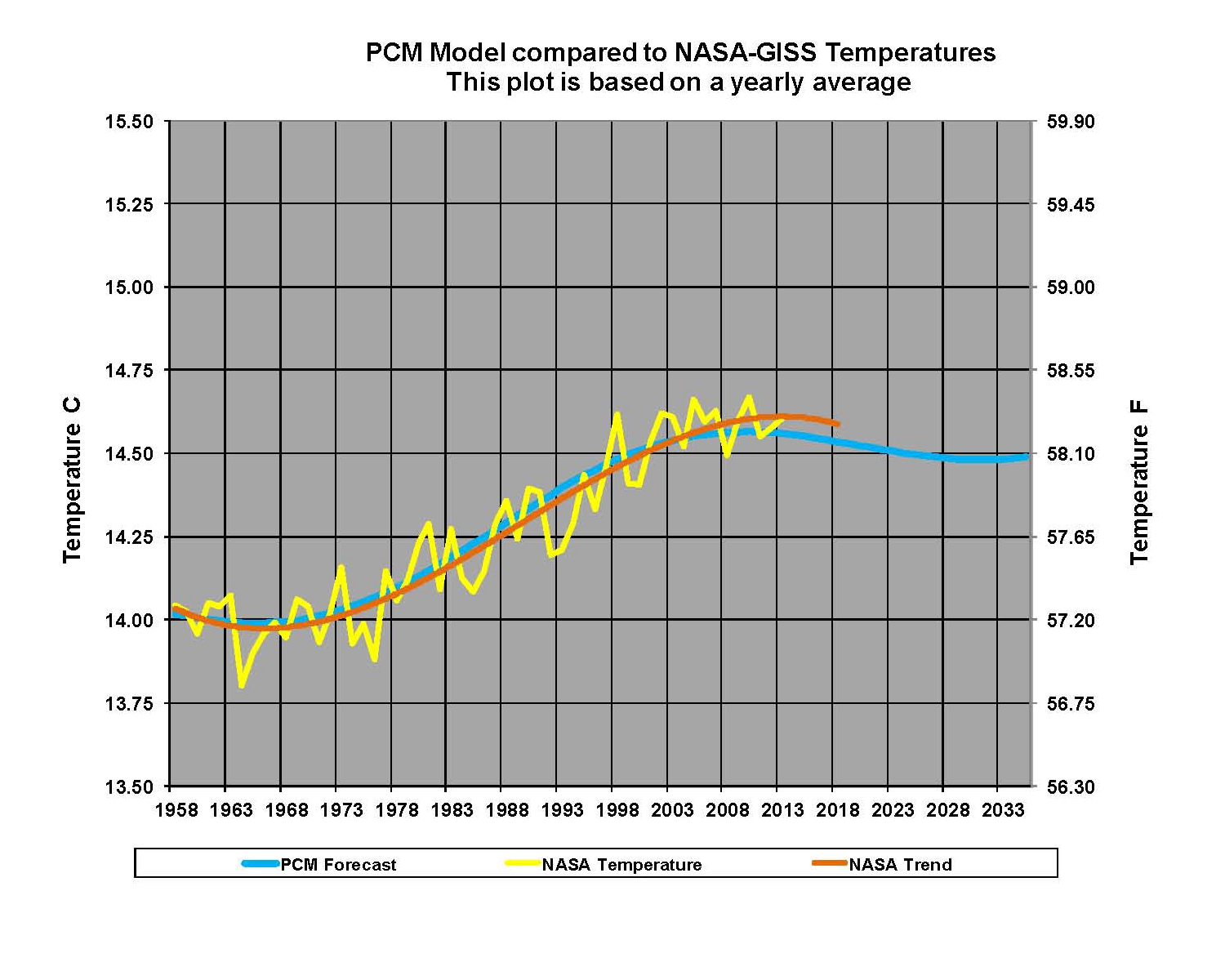
IPCC-03However the Milankovitch Cycles cannot explain all of the variations as there are clearly many ups and downs observed with shorter times and less magnitude. The solar variation from internal variation in the fusion process in the suns interior appears to be the primary reason we have the short cycle of almost 67 years and with a swing of about .32 degrees Celsius.  Putting these two cycles together get’s us very close to observed NASA-GISS temperatures but there does seem to be more needed and we find that if we use a sensitivity value for Carbon Dioxide of .64 degrees Celsius and then add that value to the long and short trend that we end up with a very good match to the NASA-GISS temperature plots.  Because of the way the sensitivity value works in the models the actual temperature affect on the Climate is the highest when there is very little of it and it gets proportionately less the more there is. That may seem to be counter to logic but what happens is basically a “saturation” beyond which the affects of the Carbon Dioxide becomes almost zero.  If this were not true then during those periods where Carbon Dioxide was 10 or 20 times what it is now would have produced temperatures that would have killed off much of the life on the planet. Figure 3 shows the mathematical result of properly adding all these factors together and they are shown as the blue plot ladled the PCM. In addition just as was shown in Figure 1, an orange trend line for the yellow NASA-GISS temperatures is shown and both match the blue PCM plot very closely from 1960 to the present unlike that of the IPCC plot. Figure 4 follows

IPCC-04

There is a very clear difference between the blue PCM plot verses the IPCC red plot compared to the NASA-GISS temperature plot. Now that the short trend is moving down global temperatures have stopped increasing (this is why the orange trend plot has turned down) and will now move down between .08 and .16 degrees Celsius by 2035 and this assumes that Carbon Dioxide reaches 450 ppm by the end of 2035 which is in line with the IPCC “ar4 forcings.” This effect, the reversal of the past increasing trend is clearly shown in the current NASA-GISS data as shown in Figure 3 and 4 of actual NASA-GISS temperature data as of July 2013.

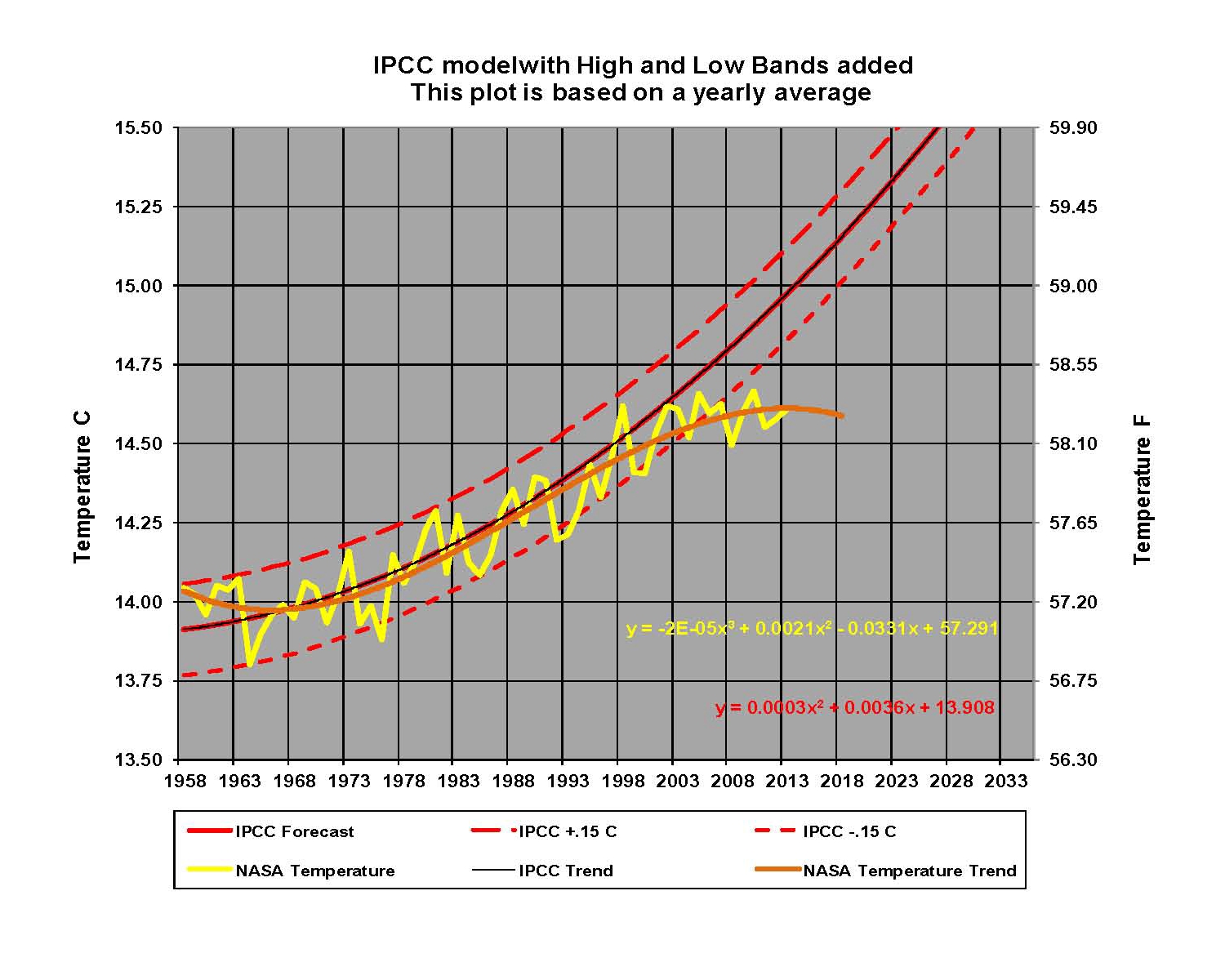
In Figure 4 we put some probability bands around the PCM model using the same values as used on the IPCC model a high (+.15 degree C) and a low (-.15 degree C) and they represent a deviation of +/- 1.0% from the mean. We can see that the PCM models bands contain most of the yellow NASS-GISS values from 1958 to 2013 with 51 of 56 points inside its bands for 91.1%. We also show the orange trend plot with its equation to the yellow NASA-GISS data which shows that their data plot is trending closer to the PCM plot than the IPCC plot and there have been no years outside the bands since 1998 which is 15 continuous years. If the NASA-GISS data plot continues following the current pattern for three more years then no more temperature plots can be expected to fall outside the dashed blue lines and the issue will be settled as it will get harder and harder for a temperature plot to fall into the red bands as that IPCC trend continues to more higher and higher.

For reference in Figure 1 all the values on the red plot to the left of 1988 are back calculated and all the values to the right of 1988 are forecasted values by the IPCC GCM system.  Then on Figure 3 we have the PCM system where all the values on the blue plot to the left of 2009 are back calculated and all the values to the right of 2009 are forecasted values by the equations in the PCM system.  Unlike NASA-GISS table LOTI temperature values the PCM Temperature values do not change as new temperatures are added to the data table. The model is what it is and lives or dies on the accuracy of its predictions.

The concern over global warming as observed during the 70’s 80’s and 90’s was not unreasonable since Carbon Dioxide, a known “greenhouse” gas (we use this term even though it is wrong as explained in point nine), levels were going up and global temperatures were also going up.  The politicians that wanted to act got involved and created a solution before the apparent problem was even understood.  The green energy, sustainability and save the planet slogans that were developed and even the greenhouse effect words were all designed to convince the citizens that things must be changed or there would be dire consequences. The IPCC climate models will eventually be fixed to work as they will eventually realize that something is not working the way they thought.  Unfortunately the political damage has already been done as we poor hundreds billions of dollars into changing how we produce energy to fix a non-existent problem.  The sooner we can get past this the less time, effort and resources will be wasted and we can use them for much better purposes.

Image

Issues with the IPCC Methods, Part II


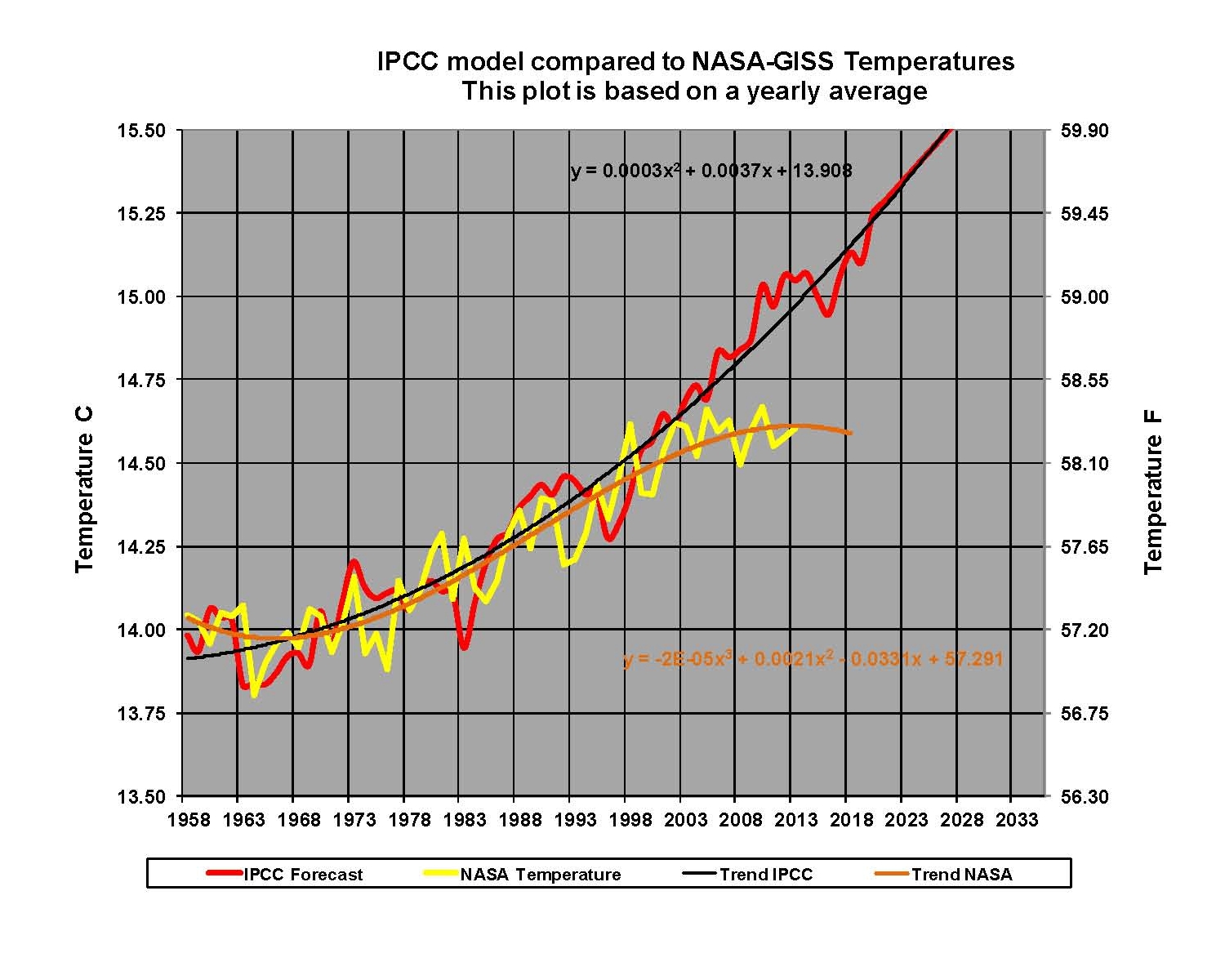
The IPCC climate models as discussed here have many issues most as a result of the method used to develop them e.g. showing that increased levels of Carbon Dioxide “would” increase the global temperatures to unacceptable levels. The models were started in earnest around 1988 when the IPCC was formed and much of this work was from James Hansen of NASA.  In 1988 he presented to the US Congress his estimate of what the increasing levels of Carbon Dioxide from the burning of carbon based fuels would do to the world’s climate; these were presented as Scenario A (worst case), B (expected case) and C (unlikely low estimate). Scenario B was the focus and its projections were shown from 1958 (when the first Carbon Dioxide levels were published by NOAA) to 2020 in the form as described in section four; after the formation of the IPCC and the global Climate models were developed they added to Hansen’s work and that plot (shown in red in Figures 1 and 3) is what is used here. It appears to be a form of a log function (black plot with the equation for it shown superimposed over the red plot) with a primary focus on the level of Carbon Dioxide (values listed in the IPCC table “ar4 forcings” also a form of a log function) which is assumed to be the proximate cause of global temperature changes.

IPCC-01

Although Carbon Dioxide did play a part, the real reason was that the long and short climate trends previously described in point seven were both moving up together; more on this in the next section.  This can be seen in the IPCC estimated global temperatures shown in Figure 1 as the red plot when it is compared from 1958 to 2000 with the yellow NASA-GISS temperature plot (orange trend line added with equation) where the red IPCC plot moves in synchronization with the yellow NASA-GISS plot of estimated global temperature. However, after 2000 things began to change as the yellow NASA-GISS plot, and the orange trend began to move down while the red IPCC plot and trend continued to move up.  Thirteen years have now passed and the IPCC still has no explanation for why global temperatures are trending down not up: so with no explanation we can say that the model is flawed and needs additional work before any estimates can be believed. This is clearly shown in Figure 2 where we added a high and low band of .15 degrees Celsius to the trend of the IPCC plot and they represent a deviation of +/- 1.0% from the mean. This shows where we can reasonably expect NASA-GISS temperatures to fall within; the IPCC has only 42 of 56 years between the high and the low bands for 75.0% inside the bands. The last time the NASA-GISS plot was inside the IPCC GCM bands was 2007 and the last time it was near the mean was 2002. There is no doubt that there is something seriously wrong here.

IPCC-02

Issues with the IPCC Methods, Part I


The following post is intended to show, to those with some technical background, that the major issues that surround the belief that anthropogenic Carbon Dioxide (CO2) is the proximate cause of the recent thirty year increase in global temperatures are not settled; as claimed.  To accomplish this we will go through ten issues associated with what passes for the Anthropogenic Climate Change Theory, although they do not call it a theory, and their projections which they do not call forecasts. In essence what they are telling us is that their (IPCC) climate models might show what might happen, if we have considered all the variables correctly; in order words they aren’t sure.

These ten issues are not full discussions only short statements showing where there are problems areas; and they are not presented in any particular order or ranking.  Although there is a lot of technical jargon used here (the actual science is complicated) it has been simplified as much as possible which has also meant some liberties were taken with the use of some words. To the best of my knowledge none of these simplifications make any material change to the implications presented here.

One, Carbon in the form of Carbon Dioxide (CO2) has been declared to be a pollutant and thereby must be controlled under the guidelines of the 1963 Clean Air Act by the Environmental Protection Agency (EPA).  Further this was ruled to be a valid interpretation of the law by the U.S. Supreme Court in 2007 and therefore Carbon Dioxide is now a “legal” pollutant and “must” therefore be regulated; meaning reduced to the lowest possible value.  However, this logic flies in the face of reality as Carbon Dioxide is a “requirement” of the process that plants use to grow, known as photosynthesis.  The lower the level of Carbon Dioxide in the atmosphere the harder it is for the plants to grow; and, in fact, the optimum level of Carbon Dioxide in the atmosphere would probably be three to four times what it is now; and that level would also be more consistent with the earth’s geological records. Because of this misconception that Carbon Dioxide is a “pollutant” there is even talk of setting up some form of Geo-Engineering to remove the Carbon Dioxide from the atmosphere. This is literally insane for if they were able to get the Carbon Dioxide down to below 100 ppm they would kill off all the plants and trees on the planet. Just to get back to 300 ppm we would need to stop using all Carbon based fuel and process 290.1 Tt of air to get to 1,560.2 Gt of CO2 to pull out 406.9 Gt of Carbon.

Two, Geologically there is a poor link between Carbon Dioxide and global temperatures with periods of high Carbon Dioxide and low temperatures and periods of low Carbon Dioxide and high temperatures. It also appears that global temperature increases generally precede Carbon Dioxide level increases thereby seeming to show a reverse cause and effect from what we are being told.  In addition it also appears that whatever the link between Carbon Dioxide and temperature, it is relevant only at very low levels i.e. less than 300 ppm since Carbon Dioxide has been as high as 7,000 ppm, which is a range of values from low to high of 0ver 2,000%. Generally Carbon Dioxide has been more in the range of 1000 ppm and has only been at the current very low levels of under 400 ppm twice before once at 300 million years ago and once about 450 million years ago.  Even with that wide range of Carbon Dioxide values the global temperature has been relatively stable geologically ranging between a high of ~22 degrees Celsius and a low of ~12 degrees Celsius which is only a difference of 3.5% in heat value.  This shows that the thermal processes on the planet do not have any positive feedback associated with them as the current Climate Model’s seem to be implying or the temperature swings would be much greater. Lastly, we are currently at 14.6 degrees Celsius which is 3 degrees Celsius below the historic global mean temperature since we have probably still not completely recovered from the last ice age 11,500 years ago.

Three, The Intergovernmental Panel on Climate Change (IPCC) was established by the United Nations (UN) in 1988 to “show” what the higher global temperatures caused by the observed increasing levels of Carbon Dioxide would do to the planet physically and economically. It was “assumed” that global temperatures would go up in a direct relationship to the higher levels of Carbon Dioxide caused by the burning of fossil fuels (which are primarily Carbon) for the creation of energy.  The charter of the IPCC was not to find the “cause” of global warming but to show how Carbon Dioxide “was” changing the climate. Showing what will happen with higher global temperatures is not the same as “proving” that Carbon Dioxide will cause global temperatures to increase to levels that will cause major problems. The true relationship of Carbon Dioxide and global temperatures has never been established.

Four, Determining the global temperature is a daunting task and the science and engineering behind it has not been established in a transparent mode. The core issue is how to put all the individual temperature records together into one master value.  This process is accomplished with software today that determines an anomaly (a difference) from some base.  NASA-GISS (Godard Institute for Space Studies) publishes this number monthly in their LOTI table (LOTI is the Land Ocean Temperature Index which is a composite of all the NASA temperature reading they have collected each month adjusted into one number) as a hundredth of a degree Celsius plus or minus from the base temperature which is currently set as 14.0 degrees Celsius.  NASA-GISS publishes global anomalies back to January 1880; unfortunately because of the process that they use this means that every month all the numbers in the index change.  So with no fixed base how do we even know what the temperature change is, i.e. in October 2009 the LOTI which is a derived number determined by software which purports to be the global mean temperature) value for January 1880 was 28 and on July 2013 the LOTI value for January 1880 was -34. Converting to degrees Celsius and comparing to the current temperature, that is a change of only .32 degrees Celsius using the 2009 figure but it’s a change of .94 degrees Celsius using the 2013 figure, so which is it?  This process has not been subject to independent peer review and it must be if the process and the numbers are to be believed.  Also it makes no sense to keep changing all the numbers back to 1880 every month and some of the changes are not small as just shown. There is agreement that temperatures have gone up but that’s about the extent of the process.

Five, In order to determine future global climate changes based on temperature changes Global Climate Models (GCM’s) of various kinds have been established by the IPCC. These are extremely complex constructs that to work must have equations to determine all the thermal flows of energy on the planet from the deepest ocean to the top of the earth’s atmosphere. There are two issues with this, one being we do not know all the processes and variables involved nor even what values to assign to many of them and two we do not have computers powerful enough to process the data at a resolution sufficient to determine global energy policy. The resolution is a major factor, since for these kinds of models to work the entire planet must be covered in a grid or mesh in all three dimensions, e.g. a box; the current state of the art means that these boxes are much larger than major cities and many of the key thermal flows are at much smaller sizes that cannot then be properly modeled. Then when the current GCM’s are run they never give the same result twice and so an average of a number of runs is used for each. In addition they change the population and economic circumstances such that it not even certain if they are projecting climate or economics for example in the current report, AR4, seven different economic scenarios are shown.  That range of outputs is way too broad to give any certainty to the output especially with the current downward global temperature trend which is not even possible, with the way the GCM models are currently programmed.

Six, A key number that is not known with sufficient certainty is the Radiative Forcing value of Carbon Dioxide which determines the Climate Sensitivity or the amount the global temperature will increase with a doubling of the level of Carbon Dioxide.  The IPCC uses 3.0 degrees Celsius in its models but they also admit in their Fourth Assessment Report (AR4) issued in 2007 that the range of values is from .4 to 4.5 degrees Celsius.   This wide range gives results ranging from no climate effect to global catastrophe and the use of 3.0 degrees Celsius puts the models into the range of catastrophe.  The apparent need for the value of 3.0 degrees Celsius is that is what was needed to make the models show a global temperature that matched that which was observed between about 1960 and 2000. The mistake in this was assuming that there were “no other significant factors” in play and that Carbon Dioxide was the primary cause if not the ultimate cause of the increase. It seems when properly used the Carbon Dioxide sensitivity value is closer to .64 degrees Celsius than the 3.0 degrees Celsius the IPCC uses.

Seven, The IPCC has mostly ignored orbital and solar variations and that is what has forced them to use the high climate sensitivity values for Carbon Dioxide.  The orbital changes as first defined by Milutin Milankovic and now known as the Milankovitch Cycles have three components: Precession, Axial tilt and Eccentricity all of which are well documented.  Over the past several thousand years they appear to give a global warming and cooling cycle of some 1,052 years with a swing in temperature of about 1.46 degrees Celsius.  The solar variation from internal variation in the fusion process in the suns interior are the primary reason we have the short cycle of almost 67 years with a swing of about .32 degrees Celsius.  In both cases these numbers do relate to the primary cause of the observed temperature increases but they are mitigated by all the thermal sinks on Earth and so they do not exactly correlate year for year.  These two patterns are the bases for an alternative climate model called a PCM here.

Eight, Reliable thermometers were not invented until 1724 by Daniel Fahrenheit so there was no  way to know what the global temperature really was although other cruder devices were in use prior to then; however by around 1850 there were enough weather stations recording temperatures to begin trying to determine what the average global temperature was.  It must also be understood that before 1850 everything regarding temperature is proxy data which means that it is derived from things like the ratio of the isotopes of Oxygen 18 to Oxygen 16 in wood, stalagmites, ice and sediments; the size of tree rings and coral growth.  That is not to say that there is no relationship to temperature but since other things also contribute to the items being measured its difficult if not impossible to know the true cause and therefore the global temperature. More importantly there is no “one” global temperature, whatever the number is said to be it is strictly an artificial number derived by some process e.g. software today.   The reason this is an artificial number is that the earth is a spinning global with one side facing the sun (being heated) and the other deep space (cooling down); this creates three climate bands on each side of the equator. First is the equatorial band from the equator to 30 degree north or south which receives the bulk of the available heat from the sun. Next are the bands north and south from 30 to 60 degree, where the continental United States is, that receives about 1/3 less. Lastly we have the Polar Regions from 60 to 90 degrees north and south which receives almost no heat from the sun. Considering the planet as a whole, front and back; only 5.6% is directly under the sun at any one time with another 16.7% getting a reasonable amount of solar heat, all the rest is, in effect, cooling down. The complex planetary air flows that create our climate are a direct result of the heating patterns from these bands and the spinning globe. The energy from the sun is also significantly reduced by clouds levels, and the temperature on the surface depends whether it‘s land or water and what the elevation is.  This is a very complex process that is not yet completely understood at the local level, yet we are shown a stated value, the anomaly, which are actually degrees Celsius shown to the second decimal place.  This indicates a relatively high degree of precision but since the values change every month we have low accuracy.

Nine, there is no “greenhouse” effect and there are no “greenhouse” gases!  The processes going on in the earth’s athomosephere “are not” the same processes as that occurring in a greenhouse used to grow food.  The heat in the greenhouse is trapped in there by the physical barrier of the glass or plastic panels.   There are no physical barriers in the atmosphere and so the process is very different.  Sunlight reaches the earth and as it enters the atmosphere 30% of it is reflected back into space, mostly by the white clouds.  The remaining radiation warms the air the land and the water but by doing so the energy must also “eventually” leave the planet to maintain a thermal balance and does so as radiation in the infrared (IR) bands. Some of that outgoing Infrared is absorbed by the Carbon Dioxide and then reradiated and either shifted to water vapor or sent out into space. There is a lot more water than Carbon Dioxide and, in fact, water is the primary “greenhouse” gas if we have to use that term.  The water in the atmosphere acts as a thermal buffer and that raises the global temperature from a negative 18.5 degrees Celsius to 14.5 degrees Celsius which is a positive swing of 33 degrees Celsius, and of that 33 degrees Celsius about 15% is from the affect of Carbon Dioxide at present levels.  Now here is the important fact, using the more realistic Carbon Dioxide sensitivity values there is only about .5 to 1 degrees more of a temperature increase that can be realized by the level of Carbon Dioxide in the athomosephere no matter how high it goes.  The programming in the IPCC climate models apparently use some form of logarithmic function related to Carbon Dioxide which forces the model into a positive feedback mode which is just not supported by geological records. This is why the lower value makes more sense since the planet has never been as hot as the IPCC Carbon Dioxide higher sensitivity values would take it in the near future. This value is at the heart of the argument and so knowing what it really is, is probably the single most important element in the debate.

Ten, A model of any kind is only as good as its ability to accurately predict future events and the better the model the further into the future the model can accurately predict that which it is programmed to do. According to Wikipedia “Modeling and simulation (M&S) is getting information about how something will behave without actually testing it in real life.” … “M&S is a discipline on its own. Its many application domains often lead to the assumption that M&S is pure application. This is not the case and needs to be recognized by engineering management experts who want to use M&S. To ensure that the results of simulation are applicable to the real world, the engineering manager must understand the assumptions, conceptualizations, and implementation constraints of this emerging field.” Global climate models are simulations of what will happen under the assumptions and restraints built into the models. And since this debate is on Climate that changes very slowly it will take decades to see what the real movements are and whether the IPCC models are any good.  The issue at hand is Carbon Dioxide levels which began to move up in concert with global temperatures starting around 1965.  That pattern was constant up until only a few years ago and that gave the illusion that Carbon Dioxide was the proximate cause of the Change; but three decades is less than a blink of an eye with Climate.  With global temperatures now actually dropping not increasing there is building doubt about the ability of the IPCC climate models to accurately show what is happening in the real world even a few years into the future. What we are currently seeing in the falling global temperature levels, while the OPCC GCM’s say they must go up, is the very definition of a bad model/simulation. This is a fundamental flaw not just a projection being a little bit off track!

Disturbing Trends


Over the past few decades there has been a movement created to make a great many changes to our society to correct for the various injustices that are perceived to have existed.  For example we have, as a society, decided that it is wrong to exclude any American, regardless of cultural background, gender, sexual orientation or religious affiliation, from the opportunity to participate in public affairs of any kind.  Ensuring that every American Citizen has equality of opportunity is an admirable idea as well as being part of our core beliefs; where we as a society often go astray is in the implementation of valid ideas.

We must remember: Our society is the result of thousands of years of development.  Culture and beliefs cannot magically be changed with the passage of a few new laws.  Real social change takes generations, and, in fact, changes that are imposed suddenly–and artificially–can only create new problems and backlash.  Worse they can disrupt the very fabric of a society.

As it stands, the laws that we have passed to prevent the exclusion of minorities from our political and economic processes proceed from the assumption that minority individuals (women, African-Americans, Asian-Americans, Hispanics, etc.) are entitled to opportunities because they come from minority backgrounds, not because they possess particular qualifications.

The original idea of not allowing the separate but “equal” concept that existed prior to the fifties for “blacks” to continue was fine, for it was clearly not equal.  The thinking went astray after that change when politicians decided that all minorities, and there was no end to them, could be made to believe that they were “entitled” to special treatment (going to the head of the line so to speak to make up for past injustices). There is little doubt that today, individuals are promoted in part because of their race or gender not because they are the best for the job.

This entitlement culture resulted in a continuing fragmentation of our society into “special interest” groups each vying for victimization status.  The result being that political and other decisions can no longer be made without consideration of the perceived impact on these special interest groups, regardless of the benefits these decisions may otherwise bestow.   A minority person is often appointed to a public position for no other reason than to provide “fair representation” of their minority group.  So, as a consequence, we end up discussing a person’s heritage or gender (real of perceived) not their ability to get the job done.

Another variation of current social thought. There was a television commercial a while back advertising a book on women and women’s issues that was written by a woman doctor.  This commercial implied that only a woman could understand the problems of another woman.  Therefore implying, only a female physician could truly provide effective treatment for a woman.  In other words, men do not experience women’s problems so they cannot possibly deal with them effectively.  It is easy to see that this logic is not only flawed, but is simply absurd.   By extension, only a doctor who has had cancer would be qualified to treat a cancer patient.   Most people would not buy the latter idea, but many are falsely led into serious consideration of ideas like that promoted by the “women’s” commercial, because these ideas carry the weight of “political correctness.”

Then we have the proposition that qualifications no longer mean anything.   In fact, the need for qualifications can be avoided altogether by the use of such techniques as “gender normalization:” This works like this, women are given “points” to compensate for physical differences with men — in strength, for example — in order to compete for jobs with physical requirements with males especially in the military.  Alternatively, the need for physical strength is written out of the job requirement so that women can qualify.   What we are doing with this is developing a social handicapping system, which penalizes skill and ability, bringing standards down to the level of those of lesser ability or achievement.

Along with the above social issues we have also saddled ourselves with the concept of “political correctness.” In plain language, “political correctness” means the prohibition of doing or saying “anything” which may offend anyone for any reason be it real or imaginary.”  Our language has even been modified to reflect this attempt to avoid offense of any kind.

Then we have the feminization of society.  For example, with the development of birth control methods, American women were, for the most part, freed from the burden of unwanted pregnancies, not a problem.   Then, partially because they had more time for other activities, women were put under pressure to work outside the home and to take on leadership roles in business and public life.  They are undeniably very capable of assuming these positions.

Unfortunately, when women assume the responsibilities previously held almost exclusively by men, women not only change the social dynamics of the work place with lots of unintended consequences, but they abdicate their former responsibilities as caregivers to our children.  Since the child-rearing skills of our women produced the men that conquered the world, we are losing a formidable body of skills, indeed.

The other side of the coin is that women are displacing men in the work force, and the men therefore must, in turn, become the caregivers to our children giving rise to a new tern “house husband.”  So it can be seen that we could have a double negative for if the women displace talented men in the work place and if the men aren’t as good as women in child rearing that the net affect on society will be very negative from a performance perspective.

Women are now entering all fields and occupations in the United States in a hell-bent race to “gender neutralize” everything.  But if jobs are to be doled out to people in proportion to their percentage of the population (quotas are the only way to be sure this happens), eventually all positions in all fields will be dominated by women, since there are more women than men in this country.  One documented result is we now have more women graduation from college then men as a result of this policy.

It also means that, to a greater and greater extent, household duties will have to be assumed by men.   Implicit in this train of events is the logic that household work and raising children is demeaning work, to be performed by people at the lowest social level (i.e. the smallest percentage of the population, which, in this case, means men).  The twisted logic inherent in trying to accomplish this kind of transformation is beyond comprehension.  Whether this next statement is political correct or not it is true that there are very real hard wired gender based roles is society.  If we ignore that then we do so at our own peril.

Another very popular social trend is “multiculturalism,” which is being touted as a way to make everyone feel good about themselves, in this case about their background.  As is true with all such “programs,” multiculturalism sounds like a positive idea, but, in fact, has a very negative and detrimental effect in practice.  Inherent in the multiculturalism belief structure is that all cultures are equal and no one culture is better then another.

If someone really believes that is true then there is no reason for anyone to immigrate here for here in America we have a very different culture then exists anywhere else.  The quote below from Teddy Roosevelt in 1919 gives a very good view on being an American.

”Rn the first place we should insist that if the immigrant who comes here in good faith becomes an American and assimilates himself to us, he shall be treated on an exact equality with everyone else, for it is an outrage to discriminate against any such man because of creed, or birthplace, or origin.

But this is predicated upon the man’s becoming in very fact an American, and nothing but an American … There can be no divided allegiance here. Any man who says he is an American, but something else also, isn’t an American at all.

We have room for but one flag, the American flag, and this excludes the red flag, which symbolizes all wars against liberty and civilization, just as much as it excludes any foreign flag of a nation to which we are hostile … We have room for but one language here, and that is the English language … and we have room for but one sole loyalty and that is a loyalty to the American people.”

Theodore Roosevelt January 03, 1919

 To a great extent but not solely the result of the 2008, 2010 and 2012 elections politicians that did not believe that the American system of the past 200 years was any good — were put in power.  Their view of what the country should be like as shown partially in this writing is not what the Citizens of the country think it is and so a very serious conflict is developing.  The Tea Party movement is just the beginning of that conflict.  This work has been written to give the Political and Social background for why this ‘change’ is being fought so hard by such as large portion of the Citizens.

We’ll end the discussion now with a final thought on society and political correctness.  Much to-do about nothing has been made in reverence to ‘names’ that people are called and how it affects’ them and how bad that is.  Well the author of this work has been called just about every name in the book from ‘baby killer’ to “racist.’  And he was discriminated against in the job market because he was a Vietnam vet.  Is there anyone in the world that has not been discriminated against at some time, probably not so the discussion is only on degree?

So what, is the proper response to negative words for if you allow anything like that to have any affect on you then you have given those that do or say things you don’t like “Power Over You.”  Their words are a Taunt made to you and if you react to them that reaction is what they want. Don’t give them the satisfactions of making you react, ignore it. You know if there is anything that you have done that is bad and for most of us it is not true.  But one thing is for sure if you react to those taunts in any way they will not stop.  By not reacting to the offending words you ‘Maintain that Power’ and you become a stronger person.

Consider this old saying which was told me by my mom after some confrontation involving name calling in grade school. It is as true today as it ever was.  Bullying and taunting today causes more problems then they ever did in the past because the kids today are sensitized to things like name calling.  They have never been told what my mom told me.

“Sticks and Stones May Break my Bones but Names will Never Hurt Me.”

That is unless you let them hurt you by your reaction and then you are at fault for the choice was yours after all.