COMMENT: All of a sudden, El Niño is proof of global warming, just like the wildfires in Australia and California, as if these things never happened before. The sheep believe whatever the press tells them. That’s why you cannot stop the cycle, and 2032 is now not so far away.
HW
ANSWER: El Niño and La Niña are climate patterns in the Pacific Ocean that have impacted weather worldwide for centuries. This very intense cycle will increase the risk of famine in parts of the world from 2024 to 2025. Here is a chart of the temperaturesback to 1950. Look closely, and you will see that the cycle is very violent. It goes from hot and then plunges into a Panic Cycle type move immediately thereafter.
El Niño events are thought to have occurred for thousands of years, and only now are people claiming this is proof of humans changing the environment. It is believed that historically the Indians in Peru sacrificed humans to try to prevent the rains caused by a severe El Niño. Perhaps they might have had better success by offering politicians instead of virgins. These people latch on to anything and now with ZERO proof, they tell everyone that it is Climate Change that is making it hotter.
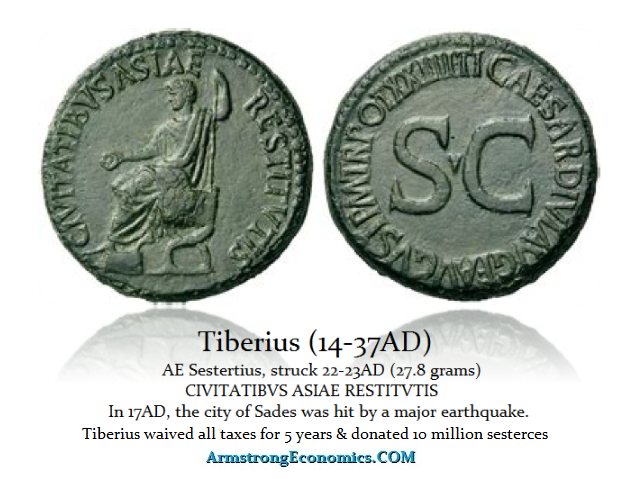
Perhaps we should just turn off the energy used by mainstream media and their propaganda as well as in Washington, and end taxes as Roman Emperor Tiberius did during an emergency. I would bet things will get a lot better and real fast.
Most people don’t have a clear understanding of the greenhouse effect (GHE). It is not complicated to understand, but it is usually not well explained. It is often described as “heat-trapping,” but that is incorrect. Greenhouse gases (GHG) do not trap heat, even if more heat resides within the climate system due to their presence in the atmosphere. The truth is that after adjusting to a change in GHG levels, the planet still returns all the energy it receives from the Sun. Otherwise, it would continue warming indefinitely. So, there is no change in the energy returned. How do GHGs produce GHE?
GHGs cause the atmosphere to be more opaque to infrared radiation. As solar radiation heats mainly the ocean and land surface of the planet, GHGs absorb thermal emission from the surface at the lower troposphere and immediately pass that energy along to other molecules (typically N2 and O2) through collisions that occur much faster than the time it would take to re-emit the radiation. This warms the lower troposphere. The density and temperature decrease rapidly through the troposphere, so molecules are colder and more separated at the upper troposphere. Now GHGs have a chance to emit IR radiation so when they finally collide with another molecule, they are colder so GHGs have a cooling effect in the upper troposphere and stratosphere.
Because GHGs make the atmosphere more opaque to IR radiation, when they are present the emission to space from the planet normally does not take place from the surface (as happens in the Moon). Part of it still takes place from the surface through the atmospheric window, but most of it takes place from higher in the atmosphere. We can define a theoretical effective emission height as the average height at which the Earth’s outgoing longwave radiation (OLR) is being emitted. The temperature at which the Earth emits is the temperature at the effective emission height in the atmosphere. That temperature, when measured from space is 250 K (-23°C), not 255 which is the calculated temperature for a theoretical blackbody Earth. That temperature corresponds to a height of about 5 km, which we call the effective emission height.
The last piece we need to understand the GHE is the lapse rate, which in the troposphere is positive, meaning that temperature decreases with height. Without a positive lapse rate, the GHE does not work. Since GHGs cause the planet to emit from a higher altitude, due to making the atmosphere more opaque to IR radiation, that altitude is colder due to the lapse rate. The Earth still needs to return all the energy received from the Sun, but colder molecules emit less. So, the planet will go through a period when it will emit less than it should, warming the surface and the lower troposphere until the new height of emission achieves the temperature necessary to return all the energy, at which point the planet stops warming.
The GHE simply states that the temperature at the surface (Ts) is just the temperature of emission (Te) plus the lapse rate (Γ) times the height of emission (Ze).
Ts = Te + ΓZe
Held & Soden (2000) illustrated it in figure 1:
This is how the GHE actually works. An increase in CO2 means an increase in the height of emission. Since the temperature of emission must remain the same, the temperature from the surface to the new height of emission must increase. The increase is small but significant. As Held and Soden say:
“The increase in opacity due to a doubling of CO2 causes Ze to rise by ≈150 meters. This results in a reduction in the effective temperature of the emission across the tropopause by ≈(6.5K/km) (150 m) ≈1 K.”Held and Soden
So, the temperature at the surface must increase by 1K. That’s the direct warming caused by the doubling of CO2, before the feedbacks (mainly water vapor) kick in, further raising the height of emission.
This also has an interesting prediction. If the warming is due to an increase in CO2 when the increase takes place and the altitude of emission increases, the planet should emit less OLR as the new altitude is colder and a reduced OLR is the warming mechanism. Once the warming takes place, the OLR will become the same as before the GHG increase. It says so in Held and Soden’s figure 1 caption: “Note that the effective emission temperature (Te) remains unchanged.” Same Te, same OLR. So, if CO2 is responsible for the surface temperature increase, we should first expect less OLR and then the same OLR. If at any time we detect more OLR that would indicate another cause for the warming. Anything that makes the surface warmer, except GHGs, will increase the temperature of emission, increasing OLR.
So, this is the test:
– Surface warming but less or same OLR: CO2 is guilty as charged
– Surface warming and more OLR: CO2 is innocent
And the test results can be evaluated for example with Derwitte and Clerbaux 2018:
“decadal changes of the Outgoing Longwave Radiation (OLR) as measured by the Clouds and Earth’s Radiant Energy System from 2000 to 2018, the Earth Radiation Budget Experiment from 1985 to 1998, and the High-resolution Infrared Radiation Sounder from 1985 to 2018 are analyzed. The OLR has been rising since 1985, and correlates well with the rising global temperature.“Derwitte and Clerbaux 2018
CO2 is innocent. Its fingerprint is not found at the crime scene. Something else is warming the planet and causing the increase in OLR.
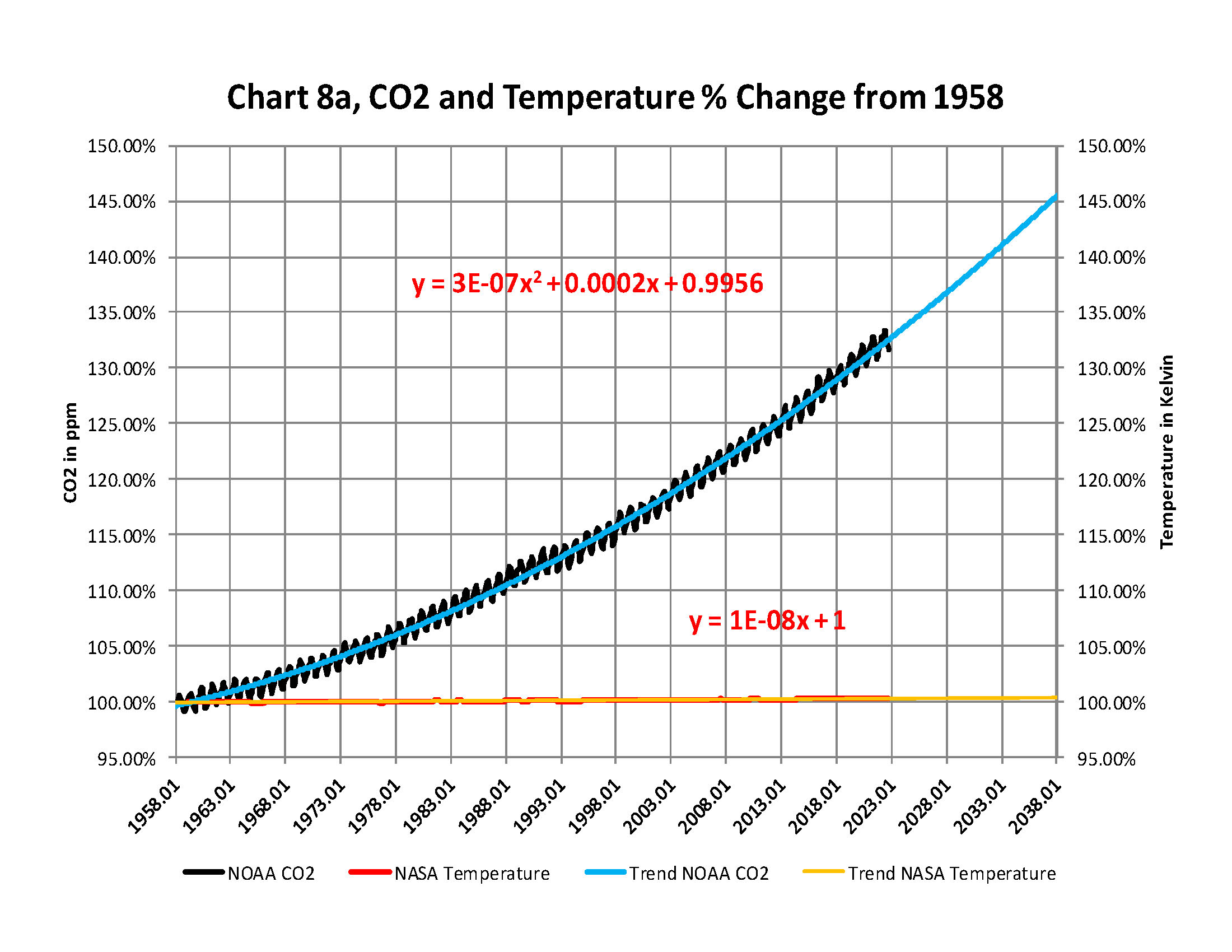
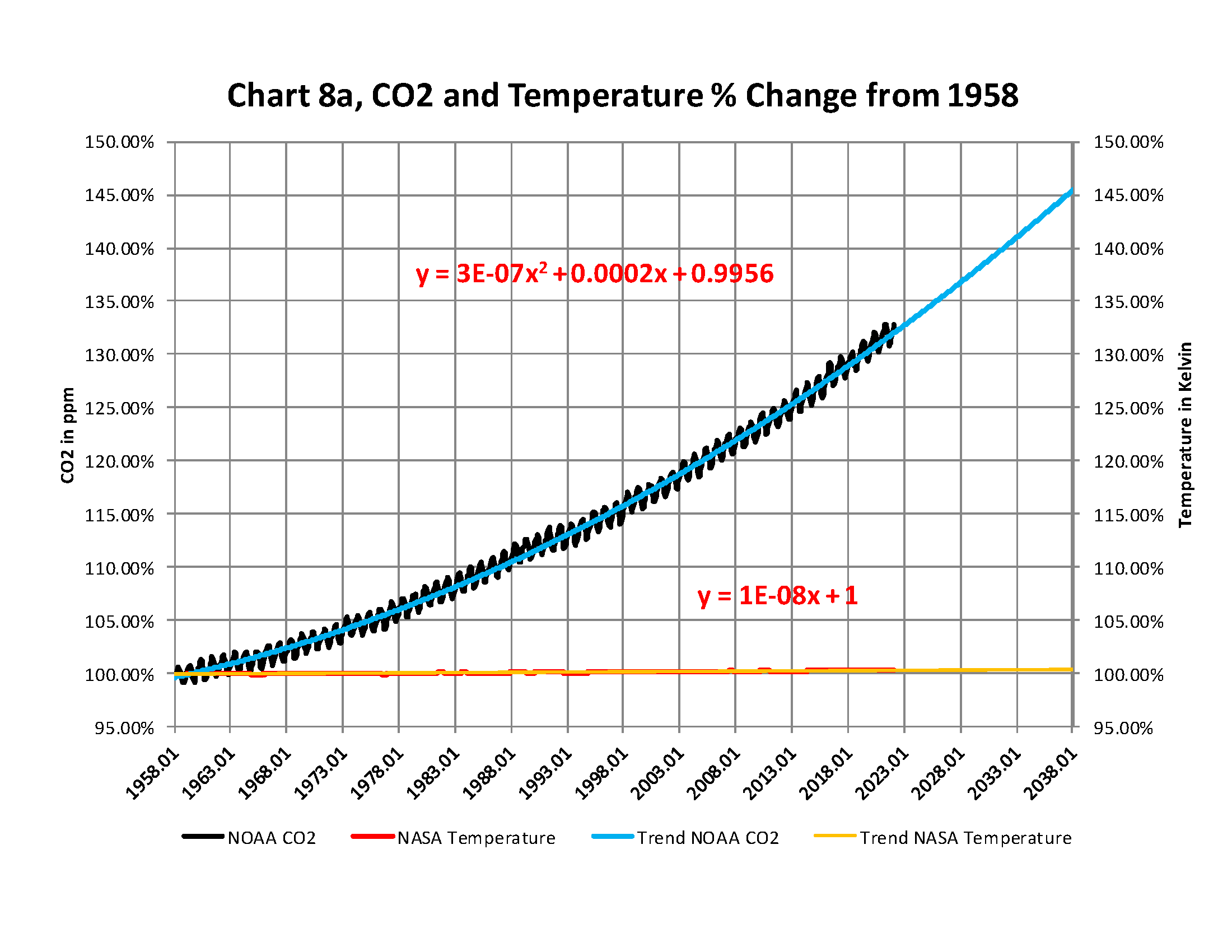
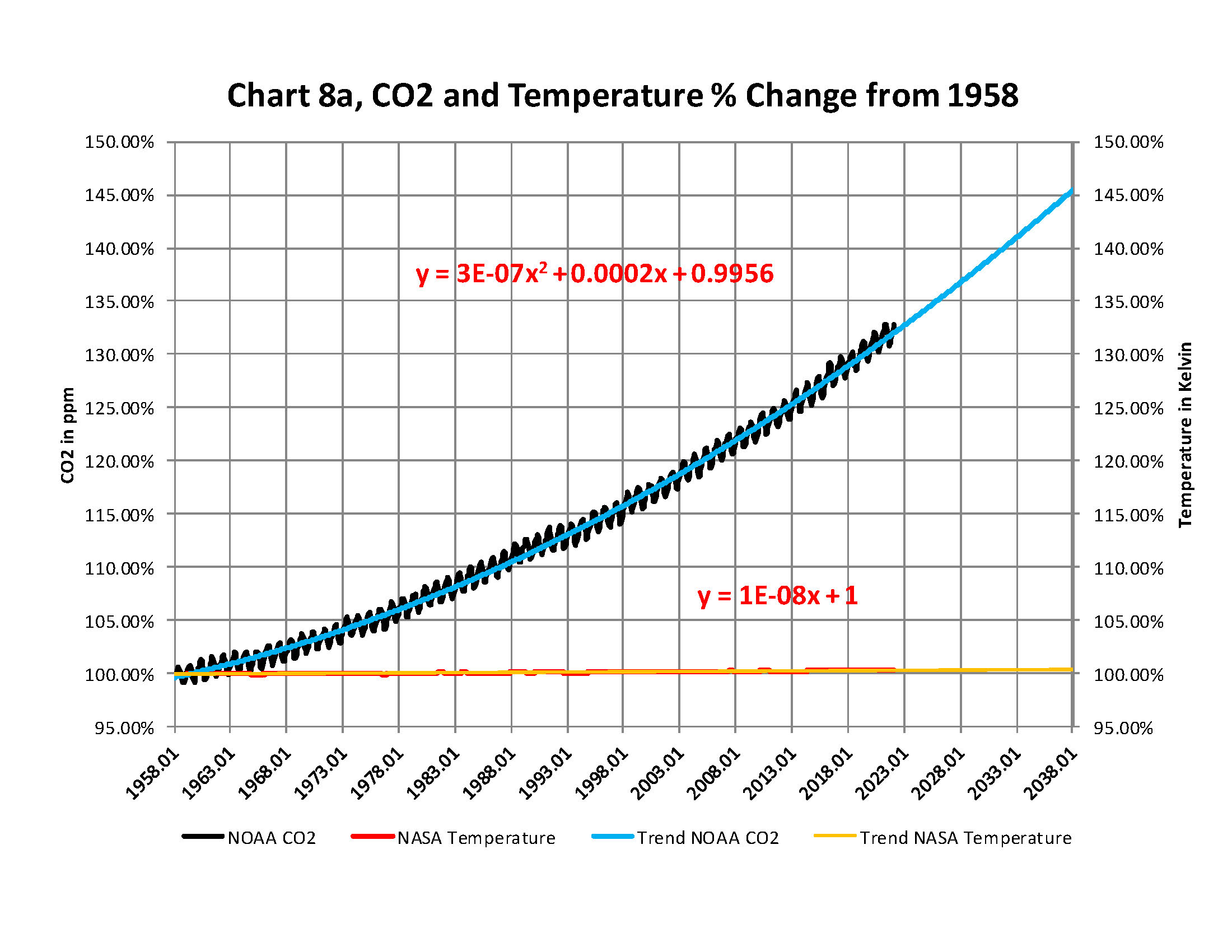
From the attached report on climate change for November 2022Data we have the two charts showing how much the global temperature has actually gone up since we started to measure CO2 in the atmosphere in 1958? To show this graphically Chart 8a was constructed by plotting CO2 as a percent increase from when it was first measured in 1958, the Black plot, the scale is on the left and it shows CO2 going up by about 32.4% from 1958 to November of 2022. That is a very large change as anyone would have to agree. Now how about temperature, well when we look at the percentage change in temperature also from 1958, using Kelvin (which does measure the change in heat), we find that the changes in global temperature (heat) is almost un-measurable at less than .4%.
As you see the increase in energy, heat, is not visually observably in this chart hence the need for another Chart 8 to show the minuscule increase in thermal energy shown by NASA in relationship to the change in CO2 Shown in the next Chart using a different scale.
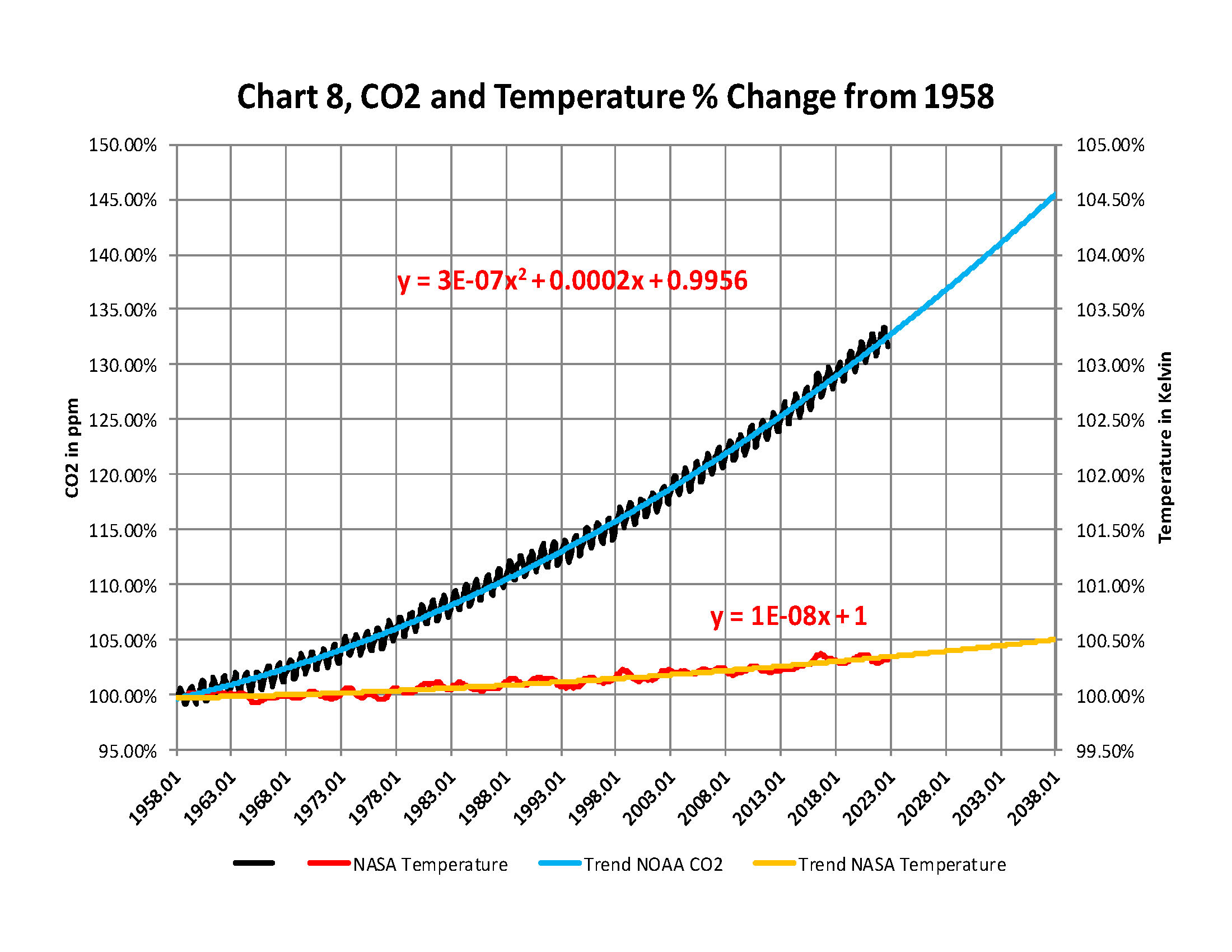
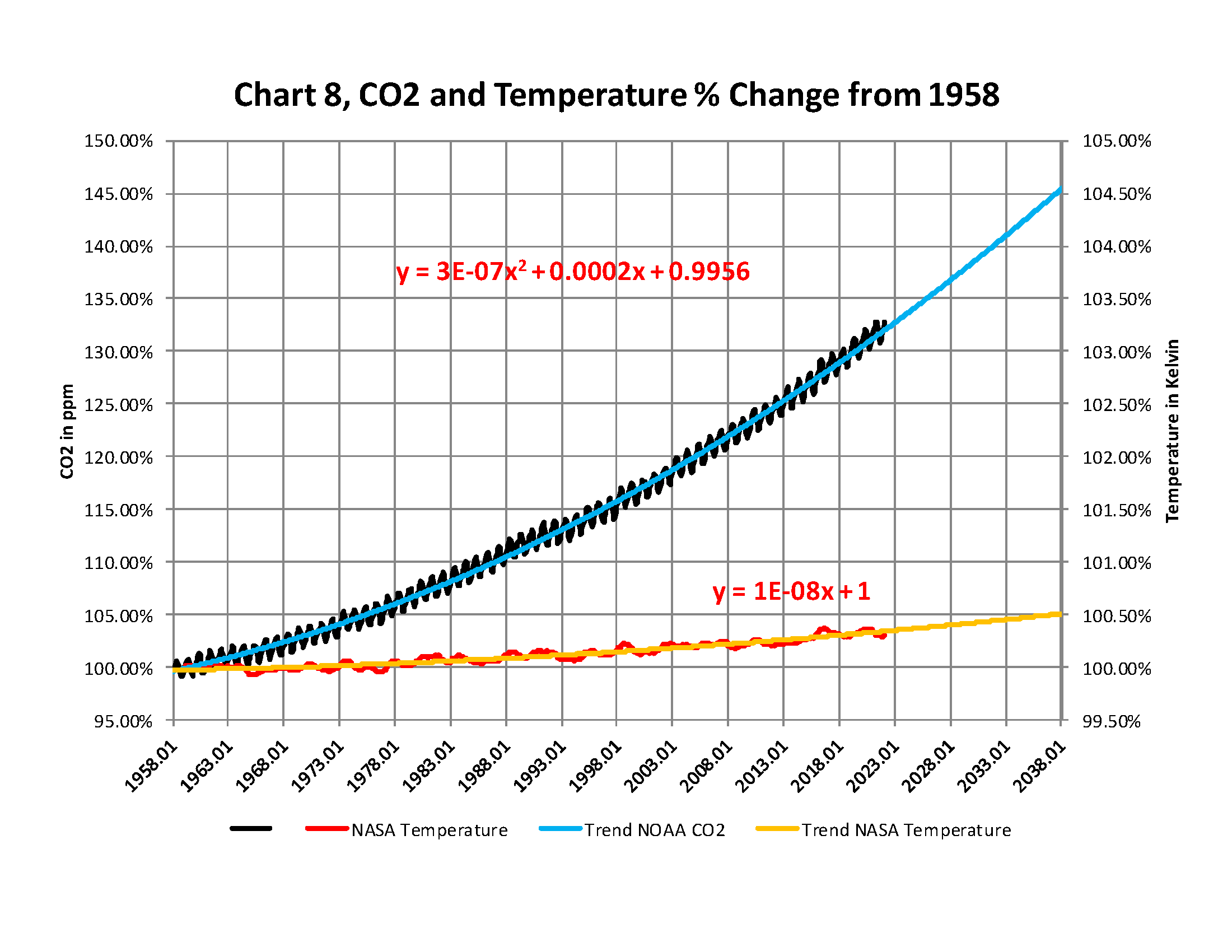
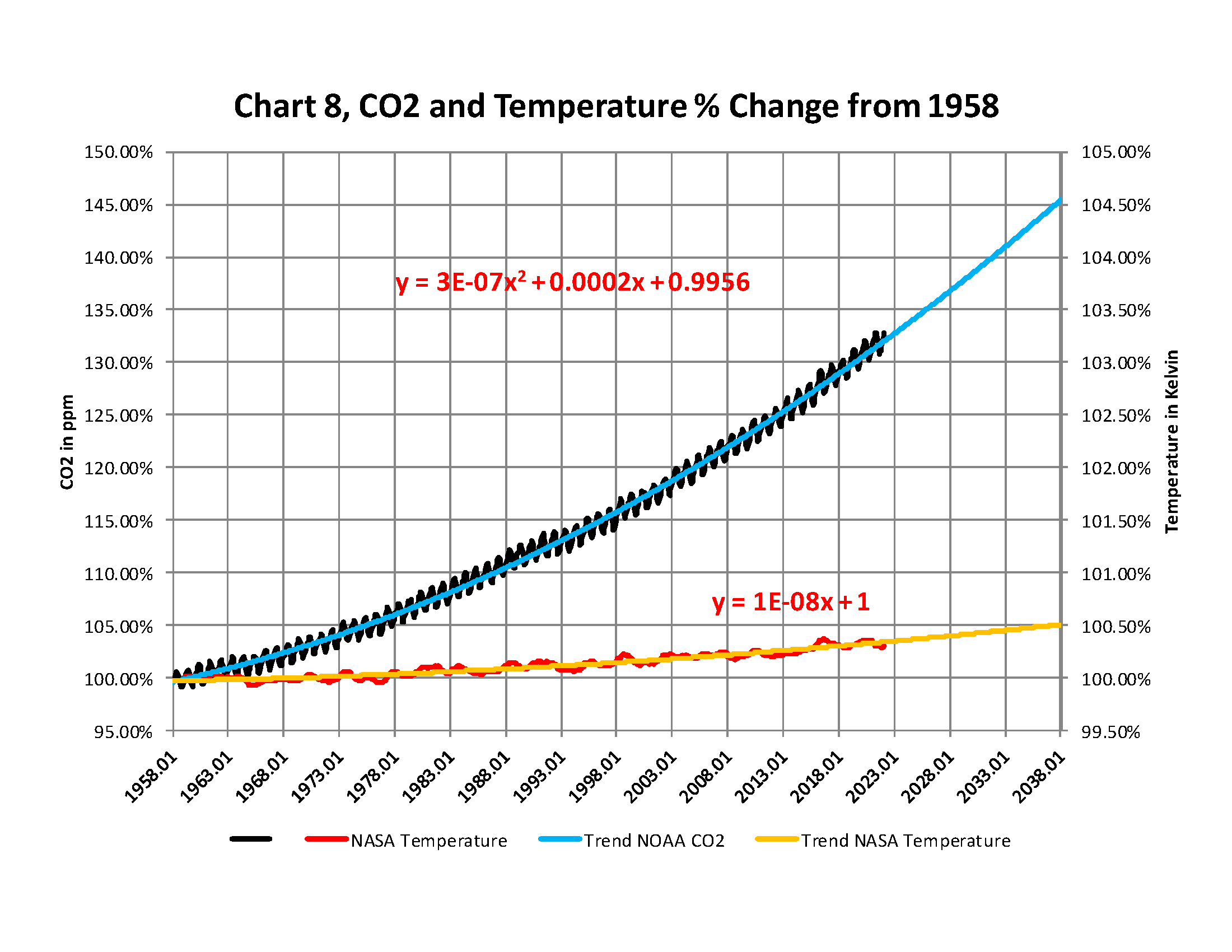
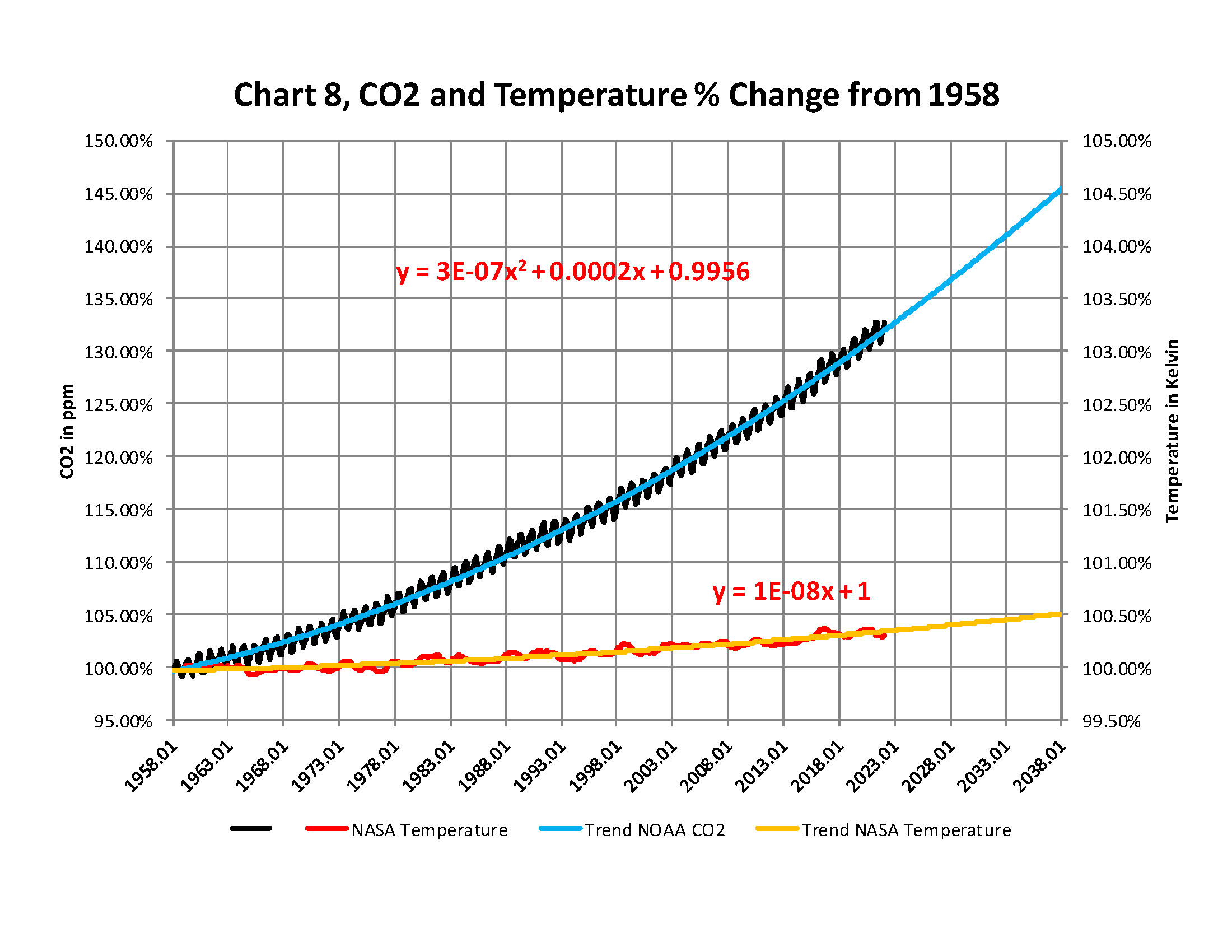
This is Chart 8 which is the same as Chart 8a except for the scales. The scale on the right side had to be expanded 10 times (the range is 50 % on the left and 5% on the right) to be able to see the plot in the same chart in any detail. The red plot, starting in 1958, shows that the thermal energy in the earth’s atmosphere increased by .40%; while CO2 has increased by 32.4% which is 80 times that of the increase in temperature. So is there really a meaningful link between them that would give as a major problem?
Based to these trends, determined by excel not me, in 2028 CO2 will be 428 ppm and temperatures will be a bit over 15.0o Celsius and in 2038 CO2 will be 458 ppm and temperatures will be 15.6O Celsius.
The NOAA and NASA numbers tell us the True story of the
Changes in the planets Atmosphere
The full 40 page report explains how these charts were developed .
Posted originally on the conservative tree house on November 24, 2022 | sundance
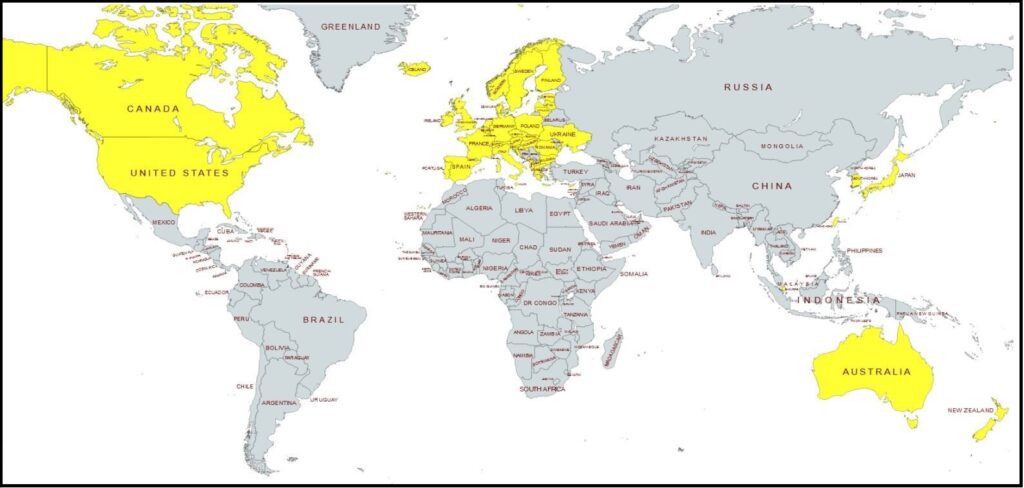
We have been closely monitoring the signs of a global cleaving around the energy sector taking place. Essentially, western governments’ following the “Build Back Better” climate change agenda which stops using coal, oil and gas to power their economic engine, while the rest of the growing economic world continues using the more efficient and traditional forms of energy to power their economies.
Within the BBB western group (identified on map in yellow), the logical consequences are increased living costs for those who live in the BBB zone, and increased prices for goods manufactured in the BBB zone. In the zone where traditional low-cost energy resources continue to be developed (grey on map), we would expect to see a lower cost of living and lower costs to create goods. Two divergent economic zones based on two different energy systems.
This potential outcome just seemed to track with the logical conclusion. The yellow zone also represented by the World Economic Forum, and the gray zone also represented by an expanding BRICS alliance. Against this predictable backdrop we have been watching various events unfold, some obvious and some less so.
Today, we get an obvious example:
NEW DELHI, Nov 24 (Reuters) – Fiat parent Stellantis (STLA.MI) has concluded it can’t currently make affordable electric vehicles (EVs) in Europe and is looking at lower-cost manufacturing in markets such as India, its chief executive told reporters.
If India, with its low-cost supplier base, is able to meet the company’s quality and cost targets by the end of 2023, it could open the door to exporting EVs to other markets, said Carlos Tavares, CEO of the group whose brands also include Peugeot and Chrysler.
“So far, Europe is unable to make affordable EVs. So the big opportunity for India would be to be able to sell EV compact cars at an affordable price, protecting profitability,” Tavares told reporters at a media roundtable in India late on Wednesday.
Stellantis is investing heavily in EVs and plans to produce dozens in the coming decade, but Tavares warned last month that affordable battery EVs were between five and six years away.
On his first visit to India since taking over as Stellantis CEO, he said the company was still working out a plan regarding EV exports from the country and had not yet taken any decisions. (read more)
.
Normally we would expect to see market forces determining the ultimate economic outcome. Historically, we would not expect government policy that puts their nation at an economic disadvantage. However, in this WEF controlled new western economic normal we see multinational corporations’ making decisions and government leaders creating policy to support the corporations.
There is money to be made by corporations within the climate change agenda, and there is money to be made by producing goods with low-cost wages and cheap materials. Eventually, if you keep following this to its natural conclusion, the entire yellow zone becomes a service driven economy.
Multinational corporations in control of government are what the BRICS assembly foresaw when they first assembled during the Obama administration. When multinational corporations run the policy of western government, there is going to be a problem. Brazil, Russia, India, China and South Africa (BRICS) saw President Obama sub-contracting, actually giving away, U.S. trade policy.
In the bigger picture, the BRICS assembly are essentially leaders who do not want corporations and multinational banks running their government. BRICS leaders want their government running their government; and yes, that means whatever form of government that exists in their nation, even if it is communist.
BRICS leaders are aligned as anti-corporatist. That doesn’t necessarily make those government leaders better stewards, it simply means they want to make the decisions, and they do not want corporations to become more powerful than they are. As a result, if you really boil it down to the common denominator, what you find is the BRICS group are the opposing element to the World Economic Forum assembly.
The BRICS team intend to create an alternative option for all the other nations. An alternative to the current western trade and financial platforms operated on the use of the dollar as a currency. Perhaps many nations will use both financial mechanisms depending on their need.
The objective of the BRICS group is simply to present an alternative trade mechanism that permits them to conduct business regardless of the opinion of the multinational corporations in the ‘western alliance.’
Again, if you follow the Build Back Better agenda to its natural conclusion, the entire yellow zone becomes a service driven economy.
The United Nations proposed a new method to funnel money out of developed nations during the COP27 meeting – climate reparations. The United Nations is still negotiating who will pay what, but rest assured, the US will likely pay the most. President Biden fully supports the idea in addition to the $1 billion he was granted last year to fight third-world climate change. China is considered a developing nation, according to the UN, and will not contribute to the global fund despite being the largest polluter in the world.
The ”loss and damage fund,” as it is known, would take money from rich nations in an attempt to change the weather and prevent natural disasters that would take place even if humans did not inhabit Earth. The funds would primarily be sent to countries in Latin America, Africa, and Asia. Fears are sparking that this would act as a confession, and developing nations could sue developed nations and/or businesses for additional compensation.
Trump attempted to get America out of the Paris Accord. The GOP-majority House will likely not vote in favor of this measure. Our best bet is to hope they kick the can down the road until Biden’s term has ended.
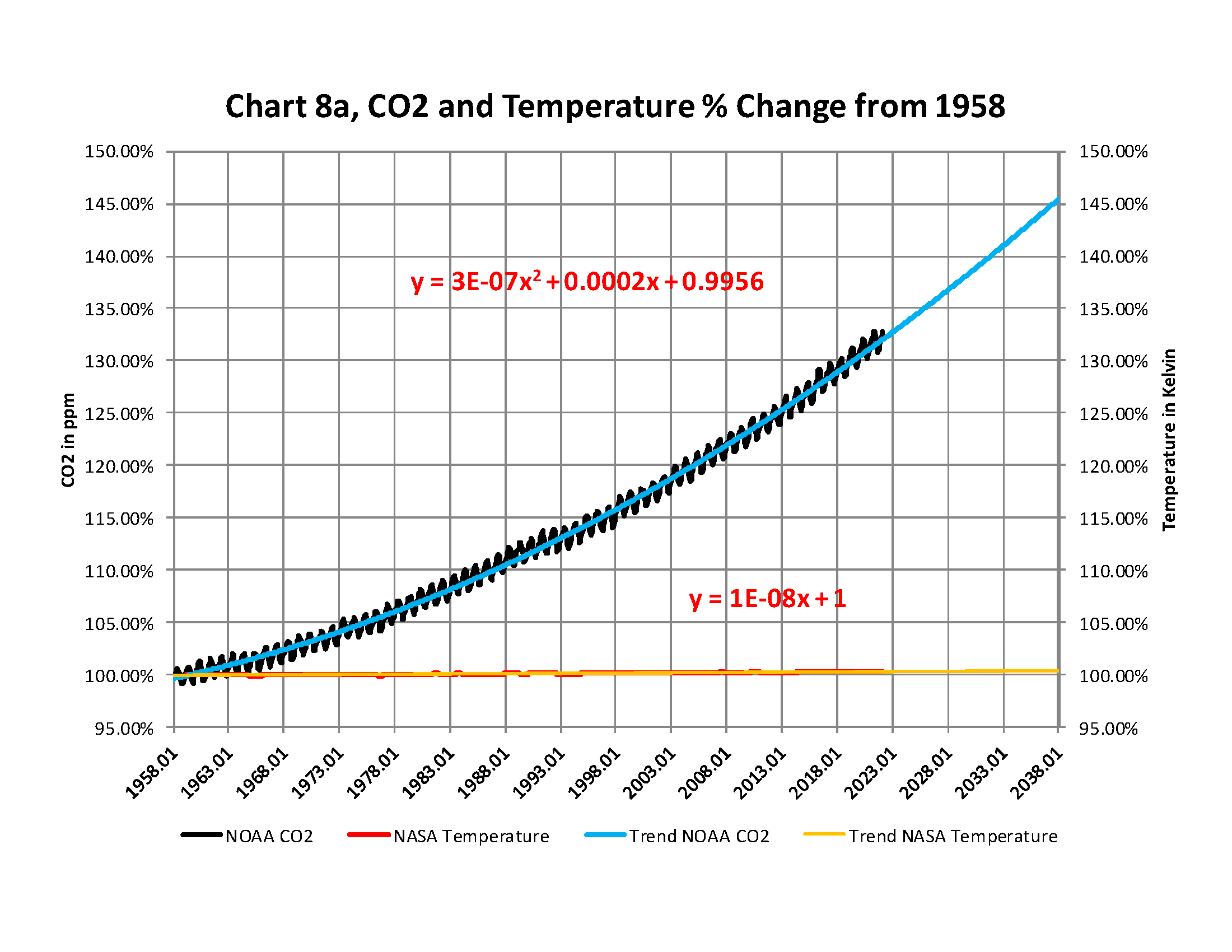
From the attached report on climate change for October 2022Data we have the two charts showing how much the global temperature has actually gone up since we started to measure CO2 in the atmosphere in 1958? To show this graphically Chart 8a was constructed by plotting CO2 as a percent increase from when it was first measured in 1958, the Black plot, the scale is on the left and it shows CO2 going up by about 32.4% from 1958 to October of 2022. That is a very large change as anyone would have to agree. Now how about temperature, well when we look at the percentage change in temperature also from 1958, using Kelvin (which does measure the change in heat), we find that the changes in global temperature (heat) is almost un-measurable at less than .4%.
As you see the increase in energy, heat, is not visually observably in this chart hence the need for another Chart 8 to show the minuscule increase in thermal energy shown by NASA in relationship to the change in CO2 Shown in the next Chart using a different scale.
This is Chart 8 which is the same as Chart 8a except for the scales. The scale on the right side had to be expanded 10 times (the range is 50 % on the left and 5% on the right) to be able to see the plot in the same chart in any detail. The red plot, starting in 1958, shows that the thermal energy in the earth’s atmosphere increased by .40%; while CO2 has increased by 32.4% which is 80 times that of the increase in temperature. So is there really a meaningful link between them that would give as a major problem?
Based to these trends, determined by excel not me, in 2028 CO2 will be 428 ppm and temperatures will be a bit over 15.0o Celsius and in 2038 CO2 will be 458 ppm and temperatures will be 15.6O Celsius.
The NOAA and NASA numbers tell us the True story of the
Changes in the planets Atmosphere
The full 40 page report explains how these charts were developed .
From the attached report on climate change for September 2022Data we have the two charts showing how much the global temperature has actually gone up since we started to measure CO2 in the atmosphere in 1958? To show this graphically Chart 8a was constructed by plotting CO2 as a percent increase from when it was first measured in 1958, the Black plot, the scale is on the left and it shows CO2 going up by about 32.4% from 1958 to September of 2022. That is a very large change as anyone would have to agree. Now how about temperature, well when we look at the percentage change in temperature also from 1958, using Kelvin (which does measure the change in heat), we find that the changes in global temperature (heat) is almost un-measurable at only .4%.
As you see the increase in energy, heat, is not visually observably in this chart hence the need for another Chart 8 to show the minuscule increase in thermal energy shown by NASA in relationship to the change in CO2 Shown in the next Chart using a different scale.
This is Chart 8 which is the same as Chart 8a except for the scales. The scale on the right side had to be expanded 10 times (the range is 50 % on the left and 5% on the right) to be able to see the plot in the same chart in any detail. The red plot, starting in 1958, shows that the thermal energy in the earth’s atmosphere increased by .40%; while CO2 has increased by 32.4% which is 80 times that of the increase in temperature. So is there really a meaningful link between them that would give as a major problem?
Based to these trends, determined by excel not me, in 2028 CO2 will be 428 ppm and temperatures will be a bit over 15.0o Celsius and in 2038 CO2 will be 458 ppm and temperatures will be 15.6O Celsius.
The NOAA and NASA numbers tell us the True story of the
Changes in the planets Atmosphere
The full 40 page report explains how these charts were developed .
From the attached report on climate change for August 2022Data we have the two charts showing how much the global temperature has actually gone up since we started to measure CO2 in the atmosphere in 1958? To show this graphically Chart 8a was constructed by plotting CO2 as a percent increase from when it was first measured in 1958, the Black plot, the scale is on the left and it shows CO2 going up by about 32.0% from 1958 to August of 2022. That is a very large change as anyone would have to agree. Now how about temperature, well when we look at the percentage change in temperature also from 1958, using Kelvin (which does measure the change in heat), we find that the changes in global temperature (heat) is almost un-measurable at only .4%.
As you see the increase in energy, heat, is not visually observably in this chart hence the need for another Chart 8 to show the minuscule increase in thermal energy shown by NASA in relationship to the change in CO2 Shown in the next Chart using a different scale.
This is Chart 8 which is the same as Chart 8a except for the scales. The scale on the right side had to be expanded 10 times (the range is 50 % on the left and 5% on the right) to be able to see the plot in the same chart in any detail. The red plot, starting in 1958, shows that the thermal energy in the earth’s atmosphere increased by .40%; while CO2 has increased by 32.0% which is 80 times that of the increase in temperature. So is there really a meaningful link between them that would give as a major problem?
Based to these trends, determined by excel not me, in 2028 CO2 will be 428 ppm and temperatures will be a bit over 15.0o Celsius and in 2038 CO2 will be 458 ppm and temperatures will be 15.6O Celsius.
The NOAA and NASA numbers tell us the True story of the
Changes in the planets Atmosphere
The full 40 page report explains how these charts were developed .
From the attached report on climate change for May 2022Data we have the two charts showing how much the global temperature has actually gone up since we started to measure CO2 in the atmosphere in 1958? To show this graphically Chart 8a was constructed by plotting CO2 as a percent increase from when it was first measured in 1958, the Black plot, the scale is on the left and it shows CO2 going up by about 32.0% from 1958 to May of 2022. That is a very large change as anyone would have to agree. Now how about temperature, well when we look at the percentage change in temperature also from 1958, using Kelvin (which does measure the change in heat), we find that the changes in global temperature (heat) is almost un-measurable at only .4%. As you see the increase in energy, heat, is not visually observably in this chart hence the need for another Chart 8 to show the minuscule increase in thermal energy shown by NASA in relationship to the change in CO2 Shown in the next Chart using a different scale.
This is Chart 8 which is the same as Chart 8a except for the scales. The scale on the right side had to be expanded 10 times (the range is 50 % on the left and 5% on the right) to be able to see the plot in the same chart in any detail. The red plot, starting in 1958, shows that the thermal energy in the earth’s atmosphere increased by .40%; while CO2 has increased by 32.0% which is 80 times that of the increase in temperature. So is there really a meaningful link between them that would give as a major problem?
Based to these trends, determined by excel not me, in 2028 CO2 will be 428 ppm and temperatures will be a bit over 15.0o Celsius and in 2038 CO2 will be 458 ppm and temperatures will be 15.6O Celsius.
The NOAA and NASA numbers tell us the True story of the Chan ages in planets Atmosphere
The full 40 page report explains how these charts were developed .
From the attached report on climate change for March 2022Data we have the two charts showing how much the global temperature has actually gone up since we started to measure CO2 in the atmosphere in 1958? To show this graphically Chart 8a was constructed by plotting CO2 as a percent increase from when it was first measured in 1958, the Black plot, the scale is on the left and it shows CO2 going up by about 32.0% from 1958 to April of 2022. That is a very large change as anyone would have to agree. Now how about temperature, well when we look at the percentage change in temperature also from 1958, using Kelvin (which does measure the change in heat), we find that the changes in global temperature (heat) is almost un-measurable at only .4%. As you see the increase in energy, heat, is not visually observably in this chart hence the need for another Chart 8 to show the minuscule increase in thermal energy shown by NASA in relationship to the change in CO2 Shown in the next Chart using a different scale.
This is Chart 8 which is the same as Chart 8a except for the scales. The scale on the right side had to be expanded 10 times (the range is 50 % on the left and 5% on the right) to be able to see the plot in the same chart in any detail. The red plot, starting in 1958, shows that the thermal energy in the earth’s atmosphere increased by .40%; while CO2 has increased by 32.0% which is 80 times that of the increase in temperature. So is there really a meaningful link between them that would give as a major problem?
Based to these trends, determined by excel not me, in 2028 CO2 will be 428 ppm and temperatures will be a bit over 15.0o Celsius and in 2038 CO2 will be 458 ppm and temperatures will be 15.6O Celsius.
The numbers tell us the story of the planets Atmosphere
The full 40 page report explains how these charts were developed .
I have created this site to help people have fun in the kitchen. I write about enjoying life both in and out of my kitchen. Life is short! Make the most of it and enjoy!
This is a library of News Events not reported by the Main Stream Media documenting & connecting the dots on How the Obama Marxist Liberal agenda is destroying America





 Centinel2012