Dying Shopping Malls and Wealth Managers


People talk about the changing environment. In the financial world around us, things are also changing dramatically. What use to be is no more. There are no real ticker-tape parades any more and future pits are closing opting for online trading. What is changing and why can we not see it? The internet has changed the way people shop around the world with the retail sector currently dominated by Amazon, accounting for almost 65% of online sales.   Amazon pasted Walmart (in market cap) back in 2015 and within the past two years has grown in value to be worth twice as much. Large department stores and the more traditional malls are closing but this is happening as retail spending continues to grow. Admittedly, online merchants have made it far easier, tap a button and our goods arrive at the doorstep the next day, but obviously at the expense of shop staff. The more comfortable we get with online retail the more intelligent we are shopping around and doing it ourselves. Is having the ease of service and renewed confidence a major influence upon why we are turning to index trackers and ETF’s rather than pay a money manager 2% to do it for us?

The ETF market has ballooned since the early 2000’s and is now worth approximately $2.5tn. With this “online” competition, the rumours are that the fees have been reduced to an almost nothing, with money managers taking just 20bp on the fund in the hope that they can make additional returns on the bid/offer spread. One of the problems we could face however, is that the derivative (ETF) becomes more liquid than the underlying. The relationship will work fine in an orderly market but will be tested in extremely or volatile conditions. The concern should be when will Market-Makers widen their spreads so just ensure you are not the last one to see the problems.

Macron & His Socialist Agenda


Macron’s funding reveals that elite Socialists were really behind him changing the label to sell a centrist agenda, but in reality, to maintain their agenda. Macron was able to raise funds from French abroad with the promises of change, and this targeted particularly the French who fled Hollande living in London and New York. He did a photo-op with Nobel Prize laureate Joseph E. Stiglitz before journalists who is critical of the management of globalization, against  laissez-faire economists who he classifies a “free market fundamentalists”, as well as international institutions such as the International Monetary Fund (IMF) and the World Bank.  

Stiglitz is an American economist and a professor at Columbia University and is a former senior vice president and chief economist of the World Bank. He was also a former member and chairman of the Council of Economic Advisers under Bill Clinton and supported Hillary over Obama saying she is more “liberal” (socialist) than Obama. Stiglitz believes in Georgism, which is a variety of Marxism whereby the State should own all the resources derived from land, which is an old Physicocrat (French) idea that wealth is derived from land. In this way, all natural resources should belong to government from mining to energy just for starters as if government operated industries ever ran efficient or were free from corruption. He also supported a single tax for all and believes that, while people should own the value what they produce themselves with everything derived from land should belong to government characterized as belonging equally to all members of society (government).

Joseph Stiglitz criticized Obama publicly saying that the Trans-Pacific Partnership (TTP)  trade deal should not be about “who makes the trade rules—China or the United States?’” Stiglitz said  “I think the big issue is, this is about who makes the rules of trade—the American people, our democratic process, or the corporations? And who they’re made for, which is, for the corporations or for all of us?”

Stiglitz is a core Marxist, which is why he is liked in France where Communism began and convinced Marx this was the way to go. In 2015, Stiglitz wrote two books, The Great Divide and Rewriting the Rules of the American Economy, which are based upon select years for research to support his idea rather than all history. Each book highlights a series of problems he maintains have led to the current state of economic inequality with the gap between the rich and the poor. Stiglitz merely maintains that taking from the rich in greater proportion is necessary to even the playing field and this somehow will make everything better ignoring the fact that as government grows, it consumes the wealth of a nation rather than raises the standard of living. He thus blames everything on a faulty tax code that rewards the rich and hampers the poor, an increase in behavior that boosts the economic gains of only a few while extracting more capital from the majority, and a misplaced focus on altering the economy in a way that benefits shareholders, executives, and investors, but not the average worker.

Macron publicly wanted to be photographed with Stiglitz who is a popular socialist in France. In total, he collected around €15 million, all from private individuals. 1.7% of the donors gave 45% of the funds. He collected €1.9 million when he was still an economic minister illustrating that he saw the collapse in popularity of Hollande, and decides to repackage the same old agenda pretending it was now centrist.

Even Stiglitz believes the Euro is a failure and should be split into a “flexible” euro creating separate groups within Europe, which by default would also be the end of the European Central Ban

Global Market Watch Window to the World Interconnectivity


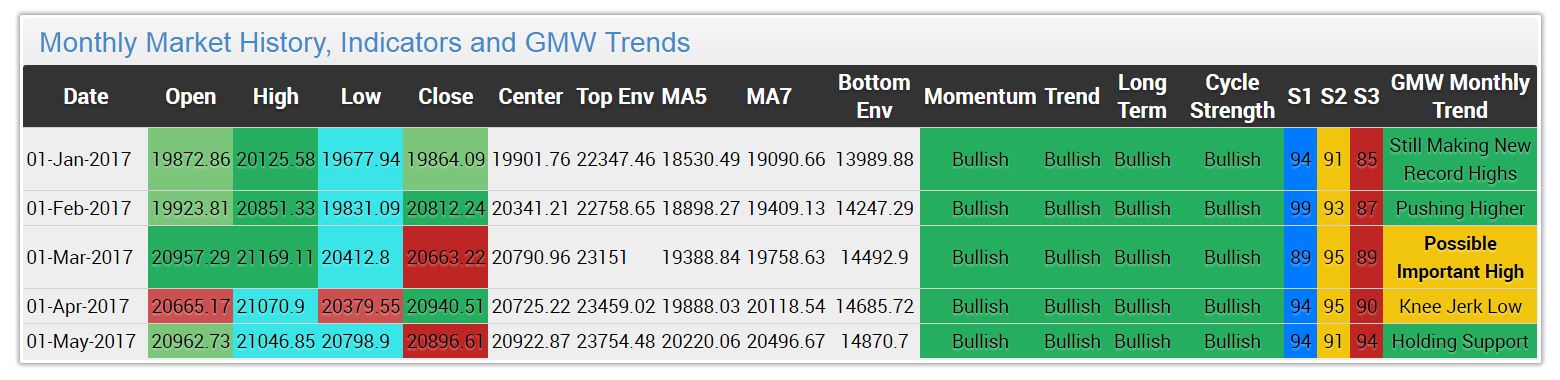
COMMENT: Mr. Armstrong, I have been on Socrates for about one year now on what you now call your standard edition. I have to say, you have done an amazing job of programming. To have a computer simply provide a comment that is short and to the point that you can look at the whole whole at your finer tips, is the most fantastic tool I have ever encountered. Its calls just on the Dow Jones have saved me countless multiples of the cost of service and I am a small investor. This is what you are expanding to over 5,000 instruments worldwide?

REPLY: Yes. The Global Market Watch was originally designed for hedge fund use and was inspired by one of our major institutional clients back in 1995. They did not have the time to read a written report on everything in their portfolio. They wanted a quick cheat-sheet that was visually a view of their portfolio. We use to sell this for $250,000 annually. However, since we are looking to simply open up Socrates to the world in hopes that it will ultimately help politically manage the economy rather than constantly shooting from the hip, the best way to prove the world is interconnected is to let everyone see for themselves.

Analysis is also changing. You still have the huxtsers who make up flashy headlines to sell stuff that is just opinion. Those days are fading. Under new EU Rules, investment banks charged fees for doing business and they gave you the research free if you did business with them. Indeed, that is how I started. The research was free as long as you were a client back in the days when I was a market-maker. When I retired, the clients still wanted the research. That was the beginning of our firm. Bit reports were delivered by telex so the communication costs would often reach $250,000 annually. That is why we were institutional only. Then came fax. The cost to deliver dropped from $50 to $3. Now we have the internet and the cost to deliver is basically zero.

We have institutions buying access per 100 for employees. For you see, research is changing. Under the new rules, research must be paid for separately. The London FT reported:

“Under draft rules published by the commission, the EU’s executive arm, last month, the fund industry’s decades-long practice of lumping together the fees they pay investment banks and brokers for research and trading will come to an end. Instead, for the first time, asset managers in Europe will have to make it clear to investors exactly what they are paying for.”

We have more people and institutions signing up than anyone would imagine. One bank just took 250 subscriptions for employees. Research has to be separate and accountable. It cannot be lumped in any more. Major institutions do not read the huxtsers who offer just opinion and all sorts of claims for they do not cover markets every day of a major scale. They also do not tell the press what they are doing until AFTER the fact. This is the only product like this in the world.

The Global Market Watch was designed as a wind into the inter-connectivity of the world. It does not matter if you are investing in India or Singapore and Greece. Being able to cover the world in a consistent manner that is completely computer driven so there is no human interaction and opinion is the key to the future. All other analysis will eventually die out and become obsolete. We live in a global economy and this domestic restricted view is primitive to say the least no much different from those who refused the believe that the Earth was not the center of the universe or the the Earth was no fla

Money Rushing in Emerging Markets & Europe – Really?


QUESTION: Martin; it seems the Emerging Markets are back in favor just as interest rates are on the rise and their dollar borrowings have exploded. Is this the final bubble that is unfolding? When the WSJ writes about a trend it is usually the end. They are noting that significant flows of funds are now going out of the US and into Europe. Is this time to sell the emerging markets and Europe? Picking up the rug here in Berlin, nothing seems to have really changed. Any comment?

ANSWER: Yes, the move back to Europe after the French election seems to be the relief rally that is always the case for hot money. The Emerging Market debt bubble is what I wrote about a few days ago that the rush to emerging markets has seen an explosion in new debt offerings. This is very alarming. People act like you should short the US stock market and buy Emerging Markets. You really have to wonder if they understand the global economy at all. The willingness of investors to buy debt securities is rooted in these bearish forecasts for U.S. equities. But the bulk of this is really desperate pensions funds who are in search of higher yields. This is by no means the start of some new Emerging Market boom of prosperity.  It reminds me of Andrew Melon’s comment when the stock market began to decline in 1929 before the bond meltdown in emerging markets back then: “Gentlemen buy bonds!”

The fool will jump in with both feet as always. You need people to buy the highs. The US equities have been in a sideways consolidation since February and their greatest vulnerability is Trump’s stupid firing of Comey that the Democrats are calling a Constitutional Crisis. Trump should have been wiser than this. The danger is this distraction holds off any tax reform for that has been the underpinning to the US equities.

A friend of mine was Chief of Staff in the White House years ago. We went to dinner after he won the position. He was so optimistic that he would be able to accomplish a lot. He knew my view he would never get to anything by the end of the day. After he left the White House we went to dinner. I said nothing. He burst out and said alright you SOB, I never got to a single thing I wanted to change. That is Washington for you. Trump’s greatest flaw is he fails to understand that. Stupid moves like firing Comey are costly. They will eat up time and delay everything if not block tax reform. Congress loves to investigate every leaf that falls to the ground and assign blame even in the middle of a wind storm. That’s just the way it goes in that city. Trump handed them a controversy on a gold platter.

As far as money rushing back to Europe, yes, there was the parking of money here for fear of the French election. But this is nothing more than a short-term knee-jerk reaction. European growth has nothing to offer long-term but higher taxes.

The US share market has been unable to make a significant correction and the numbers remains the same. The surge into emerging markets has been taking place over the past year and this has been the desperate search for higher yields. This is a bubble that is very dangerous and smells like the Russian one back in 1998.

The only way to bring about real economic change remains a rising dollar – not a lower one. That will kill the emerging markets. The US share market remains flat-to-lower and only a breakout to new highs will signal the next leg up. The main area to watch is the 20000 level in the Dow on a weekly closing basis.

Not a single European bank parking money at the Fed through their US branches have reversed that trade. Not a single major player among our clients has been a buyer of Emerging Market debt in this bubble. So the flows written about by the WSJ are indeed the tail-end and not some major brand new trend emerging

The Coming Central Bank Crisis


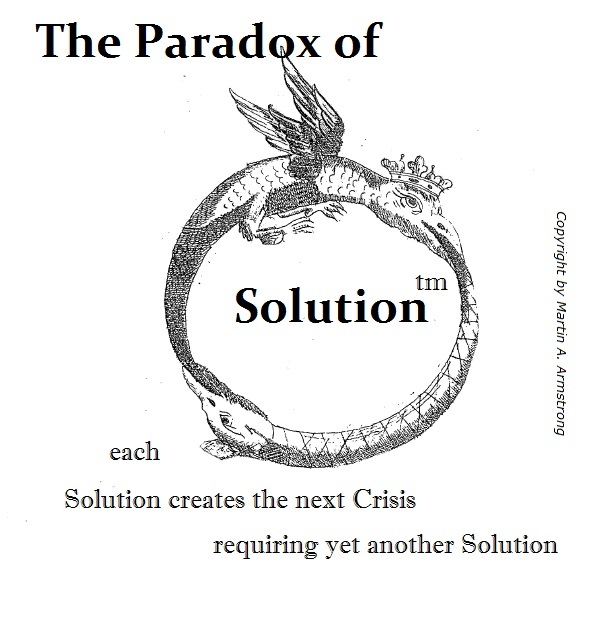
I have warned that whenever a government creates a solution to any crisis, that solution becomes the next crisis. This is what I have called the Paradox of Solution.The unfolding of the exit of the central banks from the Quantitative Easing monetary policy will become a much more serious threat to the financial markets than anyone suspects. The Federal Reserve has already exited and begun to raise rates while also announcing it will NOT be reinvesting the money when the government debt they bought expires. The Federal Reserve is already shortening their balance sheet. Bills of $426 billion will be due at the Fed in 2018, and again about $357 billion a year later. So the Fed will not repurchase that debt. The US economy is absorbing this because US dollars are effectively the only real reserve currency in the world right now.

The real problem lies with the European Central Bank (ECB) and the Japanese central bank and when they exit their Quantitative Easing programs, their economies are not the reserve currency and lack a solid bid from international capital. The end of QE will lead to a sharp increase in yields on the bond markets, and thus the financing costs for the states will explode far more rapidly today than at any time in past history. It is also possible that other sectors of the financial system, such as the stock markets and the foreign exchange markets in peripheral economies to the USA, will be cast into turmoil experiencing great difficulties without the financial support of the central banks.

Since 2008, the Bank of Japan recorded an increase of 107 trillion yen. The ECB has more than doubled its balance sheet from EUR 2 trillion to EUR 4.1 trillion and holds 40% of member state debt while tensions rise against the EU. The crisis emerges when governments, who are the ones who have been subsidized since 2008, find no bid for their paper. This will really send rates upward at a rapid pace.

As central banks appeared as omnipotent purchasers of government bonds to the un-savvy trader, the yields of the debt by no means reflect the risk of a default in the country’s payments. The decline in yields masked the rising risks from fiscal mismanagement that has been widespread.

While the Federal Reserve had recently announced that it would no longer reinvest its gains on government bonds that had matured into new US securities, the US bond market will need to find new buyers to absorb the additional supply. That may not be a problem right now, but as other government debt moves into crisis, we will see the capital flight from bonds to equities unfold.

The balance sheets of both the Japanese central bank and the ECB are unlikely to follow the Fed just yet. A withdrawal of the ECB’s purchases of securities could produced the most widespread damage in Europe since the Dark Ages.

BitCoin & Alternative Currencies


QUESTION: I very much look forward to reading your blog every day and feel that I am learning much. I don’t know much about BitCoin but I note that it has almost doubled since the beginning of the year. Does your model have any insight into the future of cryptocurrencies like BitCoin.

MR

ANSWER: The problem with BitCoin is precisely that. It is akin to the problem that existed when the bubble burst in 1966 with mutual funds because they were listed back then. People bid the funds up beyond net asset value so when the crash came, people lost everything when they though it was a secure investment. The net underlying assets may have dropped 20%, but they paid 20% over net asset value and then sold at 50% of net asset value. Ever since, mutual funds are no longer allowed to be listed. You go in and out at net asset value.

In this way, BitCoin is not ready for prime time. However, that is a separate and distinct problem from the technology. For now, BitCoin represents a threat to governments for it is used to get money out of places, avoid taxes, and is an alternative currency. Throughout history there have been alternative currencies and as long as people accept them, at times, they have become the major currency when government crash and burn. (see Two-Tier Monetary Systems & Local Alternative Currencies)

Longer-term, this technology may be the future after the crash and burn

California is Highest Taxes State in USA and should join the EU


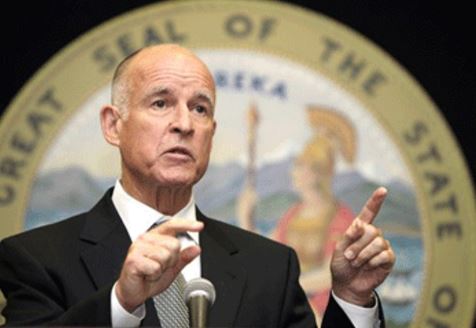
Governor Jerry Brown never saw a problem that could not be solved by just raising more taxes. This time, the state pension fund is going broke as we have been warning with the building Pension Crisis thanks to mismanagement and low interest rates thanks to Larry Summers. California has already increased its gasoline tax by 50% in the past decade. Now to bailout the state employee Pension fund,  Gov. Brown has proposed a 42% increase in gasoline taxes and, get this, a 141% increase in vehicle registration fees. Nobody talks about cutting government employee pensions. NEVER! Why when you have a population to milk like the cow

Interrogation By Bankers to Do Anything With Your Money


QUESTION: A bank manager at a local bank called and began asking questions about a wire transfer to Panama that we had some difficulty sending. We are purchasing a small house and land in Panama and this was the earnest money of $16,000. She was asking why I was buying the land, when I planned to move there, where I got the money, (I have several business accounts at this bank with large sums of cash in some of them). Do I have an obligation to give her the info? What are the repercussions if I refuse to answer her questions. The interrogation lasted for 25 minutes.

HW

ANSWER: The hunt for money is getting really bad. Everyone is now simply guilty and you must prove you have nothing to hide. It is getting really insane. We have 3 accounts at a major bank. I went to open another for a local company. I was told I had to mail a letter addressed to myself to our legal headquarters in Delaware to prove I received it and then mail it back to myself. When I pointed out that was just the incorporation address and this was a registered Florida company, it made no difference. When I pointed out we already had three accounts with them, they said that did not matter and they could not look at that and must treat every account as if they did not know who the person was. I just walked out and went to a different bank.

Everything these people are doing is just nuts. We cannot sell 1 year subscriptions anymore despite the fact we have done so for 40 years. Some person in the back office is making up rules they think are to prevent the bank from any liability and are filling files on everyone as a cover-your-ass requirement. The rules differ from bank to bank,

The repercussion are not legal. They will just close your current accounts.

IMF Proposed a Capital Levy – Tax on Money in Bank Accounts & Raise Property Taxes


The International Monetary Fund (IMF) is always the cheerleader to raise taxes to support government. They are instructing Germany to raise taxes and also talking about just imposing a 10% tax on all money that deposits in banks throughout Europe. Yes – you read that one correctly.

The IMF has told Germany it should raise its property tax, cut social welfare contributions and invest more to reduce income inequality. The demands are contentious in an election year. Once again the IMF has demanded higher taxes on savings deposits in Germany. Germany must do more for to raise taxes to impose more socialistic idea to somehow tax the rich to create a broader participation of all citizens in the fruits of economic growth, if somehow raising taxes actually ever creates economic growth. The IMF warns that there is a relatively high tax burden on lower incomes with a comparatively low burden on assets.

The IMF argues for higher taxes on property  are in fact necessary and that the government should demand higher wages to also give impetus to the growth in Germany, yet this is magically creating no inflationary impact. Years ago, Italy simply imposed a tax on money in one’s account. This was called a “capital levy”. This was a one-time charge as an exceptional measure to restore the sustainability of the debt. The IMF is also suggesting that measure be invoked to help the coming Sovereign Debt Crisis. The attractiveness of such a measure is that such a one-time tax can be levied before a tax evasion can even occur, especially if cash is eliminated and money can only exist in bank accounts. This requires the belief that this measure is unique and never repeated.

The IMF has already calculated how much the measure would cost every Eurozone citizen:

“The amount of the tax would have to bring the European sovereign debt back to the pre-crisis level. In order to reduce the debt to the level of 2007 (for example in the euro area countries), a tax of about 10 percent is needed for households with a positive asset. “

As you can see, there is NEVER any discussion about reducing taxes or the size of government. The solution is always to raise taxes and to not even look at the old Italian trick of a 10% seizure of all cash in your account. We highly recommend to diversify to assets that are MOVABLE and not subject to taxation merely to possess.

If the Majority Must Always Be Wrong – Can that Ever Change?


QUESTION: I find it interesting that you say the majority must always be wrong. I read Kenneth Rogoff’s comment on Davos and how the predictions there are always wrong. Do you think this can ever change or is it just how it works?

ANSWER: Yes, I reported on that comment by Rogoff. The MAJORITY must always be wrong for they are the fuel that moves markets as well as politics. I have been stating persistently that the Dow cannot “C R A S H” when the majority are bearish and retail participation is at historic lows. The question you pose is a very interesting one indeed.

I would have  to say NO. I do not believe that can ever change. Human nature is such that it never changes throughout the centuries. The issues may change with technology, but human responses will always be the same. A mother still cries for her son lost in war today as she did in ancient times.

What I do believe is we each have our own cycle. We progress through this journey of life hopefully learning from our mistakes. We buy the high and sell the low when we begin following the crowd. As we learn and progress with age, we end up being the person who sells the high to the novice just entering the cycle.

The best we can do is learn and survive ourselves. I do not believe we can change human nature. That is the same reason why Communism failed. It is also why politicians become corrupt. It’s too tempting for them, which is why they cannot stand Trump. He cannot be bought. No amount of money will change his life style of that of his family. It’s now all about accomplishment and being remembered.