People’s Bank of China Moves Against Shorts


It was only last week that the People’s Bank of China (PBOC) was rumoured to be competing in the currency market, which was coincidentally followed by a Moody’s downgrade. The action demonstrated signs that positions have been cut at a loss for anyone who attempted to short the Yuan. The O/N (overnight) and T/N (Tom-next) rates ballooned today which makes running currency short positions extremely expensive to finance. The currency traded from 6.85 down to below 6.77 (off-shore) as dealers scrambled to cover short positions as everyone chased for financing. The rates market moved from around 5.25% to over 21% to cover short-term (o/n and t/n) positions.
This is a popular move often undertaken by central banks if they fear the market is challenging them. The Bank of England when the GBP was forced out of the ERM raised rates to over 15% from then 11%. However, it is interesting that the options markets has (so far) seen this as a temporary move and has priced longer dated trades with only minimal impact. Many are speculating, given the new fixed approach China has taken against the USD, whether this is a friendly move to help a new President address his concerns over currency manipulation and assist a weaker USD

When Does Buying Gov’t Bonds Support Corrupt Governments?


The president of Venezuela’s opposition-run Congress led by Julio Borges came out and accused Goldman Sachs of “aiding and abetting the country’s dictatorial regime” after a report that Goldman had bought $2.8 billion in bonds from the cash-strapped country at 31 cents on the dollar. They paid $865 million.

There have been two months of opposition protests against President Nicolas Maduro in which almost 60 people have been killed. The collapse of the country’s socialist economy has left millions of people struggling to even eat. This is the problem with “socialism” that it is incapable of managing the economy from any centralized government. They hate people who make money, but government is just incompetent to manage anything. It takes an individual on the front lines to manage any operation.

I personally experienced this in my own company. When I first began to open offices overseas, it was a disaster. It was impossible to manage the offices from the United States. I had to switch to partnerships where people had to put up money and run offices in different countries. When their own capital was on the line, then they managed their local operation efficiently. Even the same centralized planning does not work in corporations. This is why big corporations die. They become inefficient and too bureaucratic just like governments and die.

Julio Borges wrote a letter to Goldman Goldman Sachs President Lloyd Blankfein:

“Goldman Sachs’ financial lifeline to the regime will serve to strengthen the brutal repression unleashed against the hundreds of thousands of Venezuelans peacefully protesting for political change in the country.”

“Given the unconstitutional nature of Nicolas Maduro’s administration, its unwillingness to hold democratic elections and its systematic violation of human rights, I am dismayed that Goldman Sachs decided to enter this transaction.”

Julio Borges is absolutely correct. But this is not unique to Goldman Sachs. Everyone who buys government debt is helping to sustain the socialistic agendas of the major Western countries and will pay dearly for this support since historically they are the people/firms who are wiped out in the end.

Goldman may think it is getting a great deal at 31 cents on the dollar. They assume if there is a revolution they will still get paid. They are dead wrong. You can buy plenty of government bonds that were defaulted on. They make great reminders that government debt is UNSECURED and becomes worthless.

Venezuela has been a country that historically has been a serial defaulter. Defaults have taken place in 1826, 1848, 1860, 1865, 1892, 1898, 1982, 1990, 1995–1997, 1998, and 2004. The likelihood of another default is EXTREMELY HIGH.

Goldman assumes they will have access to the White House to freeze Venezuelan assets in the USA to get paid. If there is a revolution and the the army finally switches sides because they see their own future is doomed, then everything will change. Dictators need money to pay troops to maintain control. When the money runs out, so will their support

Beware the Muni Bond Bubble


Municipal Bonds are in trouble in Europe as well as the United States. The local level cannot print money, nor are they ever capable of managing their economies. The general view is when short, just raise taxes. Everything comes to an end and we are looking at the end of a Muni-Bond Bubble. The strongest possible recommendation is get out before it is too late. Sure, not every municipality or state/province is in trouble – YET! Once the muni bond bubble bursts, there will be a contagion so even the ones that are not yet insolvent will tip over.

In the States, sell California and New England. The higher the tax rate, the deeper their debt will fall. Connecticut, for example, is hopeless as is New Jersey, New York, and just about all New England States. I was flying home from Hong Kong and upon landing in Newark, the next leg was back to Florida. I sat next to a woman from Connecticut who was going to visit her brother. She had a 1950s house 1600 square feet with taxes over $8,000 and could no longer afford to stay there for retirement. She was leaving as most people these days in what I call the Great Migration.

Connecticut’s general-obligation bonds are in deep trouble. The state’s tax collections are collapsing as people are getting out of town. Their debt is being downgraded and a $2.3 billion budget deficit is beyond hope. Tax receipts for the current fiscal year ending in June will be about $451 million short of estimates. Here too, it is the government employee pensions that are blowing everything apart at the seams. Public employees at least agreed to accept a 3-year wage freeze and to contribute more for their pension and health-care benefits under a tentative deal that would save more than $1.5 billion over the next two years. But that is just not enough.

The taxation has never been ending. Hedge fund managers are permanently relocating to Florida have been leaving New Jersey and Connecticut. When you count on taxing the rich, then one man can move out of and put the entire state budget at risk. Taxing the rich has its limits.

The motto of make the rich pay doesn’t work when the rich pick up and leave. You do not want to be the one still sitting. This game works opposite of the musical chairs game as a kid. This time, the one still sitting will have to pay the taxes for everyone who left. Then they will be unable to sell their house and leave because nobody wants to buy it because of the taxes.

Oil & Pegs


QUESTION: First question: Disappointed I have not heard an opinion concerning OPEC’s continuation of reducing oil out put. Can the US shale drillers fill the void and or can the Canadian and Mexican producers ramp up any shortfall into the US

Second Question: What is your opinion on the Chinese Yuan being pegged to the US dollar. In the past you have always stated that “pegs can’t survive” i.e Swiss Franc to the Euro.

ANSWER: Supply really has little to do with the price. The real issue is demand. Electric cars are coming rapidly. I have a BMW hybrid I8 sports car and it is fantastic. It is the fastest sports car I have ever owned off the line. It has two engines a gas and electric and this technology is being expanded to all models. My neighbor has a Tesla and that is fine for local use. Tesla vehicles are currently the only battery electric cars you can buy in the that have an official range of more than 200 miles per charge. When I went to Amsterdam, the taxis are Teslas. Europe is moving toward electric cars faster than the States.

Most major automakers, including GM and Volkswagen, have vowed to roll out more than one fully electric car by 2020. In Europe, the average emissions level of a new car  2015 was 130 g of CO2 per kilometre (g CO2/km) and those sold in 2016 was down to 118.1 grams. By 2021, this has to be down to 95 grams of CO2 per kilometre.

Sales of electric cars totaled over 315,000 units in 2014, up 48% from 2013 reaching 565,00 units in 2015. In the U.S. alone, 542,000 electric cars have been sold to date. Granted, that is still small in comparison to the overall number estimated to be 263.6 million cars registered in the United States in 2015. Nevertheless, the trend is in motion. Does it by itself kill oil? Not yet! This is why oil did not elect any yearly long-term bearish signals on our model.

Keep in mind there are a lot of new discoveries also in gas. Cars make up 51.4% of oil consumption and jet fuel is 12.3%. Historically, demand drops with the economy as people drive and travel less. That is clearly the trend we see ahead.

With regard to pegs, none will stand and that includes China, Hong Kong and Middle East. What will break the peg is the dollar rally for that will import deflation to those nations with dollar pegs.


Shari’ah Standard on Gold to Replace the Dollar? Really?


QUESTION: Mr. Armstrong; I have read where some people are claiming this “Shari’ah Standard on Gold” will become the new “reserve currency” and this seems really just nuts. I understand there are 2 billion Muslims in the world, but they seem to forget that this is once again wild speculation. Any thoughts?

OP

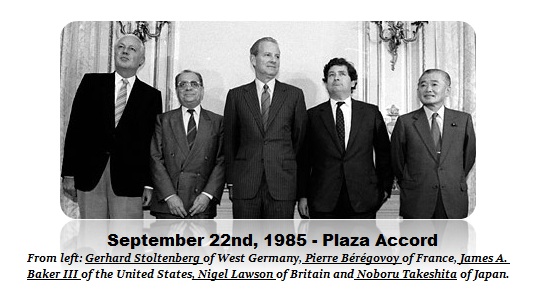
ANSWER: No. This is really rather absurd. First of all, not even the Euro could displace the dollar nor the Japanese yen, Chinese yuan and yet some meager 2 million average citizens will do so? I really hate to burst these people’s bubble in La-La-Land, but I have been in meeting and there are people in Washington who are trying to figure out how to get the dollar to be replaced somehow. The last failed attempt was the Plaza Accord in 1985 intended to push the dollar down and the Euro was born there and then. This is when James Baker encouraged Europe to create a single currency to “PLEASE” compete with the dollar. Every Administration has wanted a lower dollar to increase exports. Trump is no different. Sorry – they ALL HAVE FAILED!!!!!!!!!!!!!!!!!!!

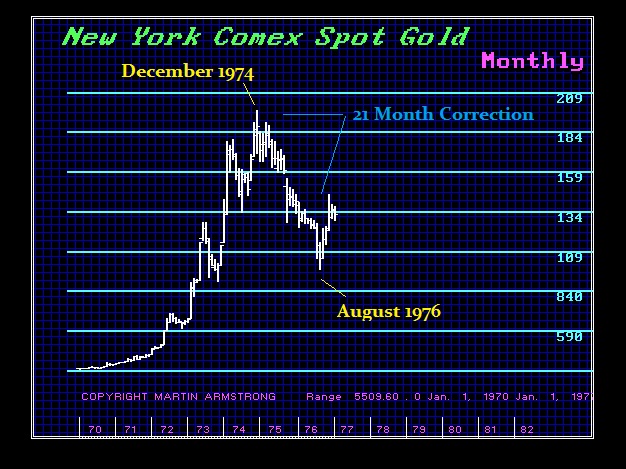
Secondly, this is really nuts and the very same hype I recall from 1975 when Americans were for the first time legally going to be able to buy gold starting January 1st and that is when gold futures began as well in New York. What happened? The hype drove the price of gold up to nearly $200 and on January 1st, 1975, it began a crash by almost 50% into 1976 for 21 months. They said the same thing about China and how the Chinese demand would make gold soar. Then they said the same thing about India and now its the Muslims. They keep switching groups to sell people gold like some used car salesman. In any other field it’s called consumer fraud.

Gold will rally ONLY when people begin to see that governments are failing. I am not talking about my readers. We all see what is coming. I am talking about the AVERAGE person on the street. Then you will see the gold breakout. We are getting closing. Patience is required when it comes to gold

US to Sell Off its Strategic Emergency Oil Reserves


The US government plans to sell half of the Strategic Emergency Oil Reserves and gasoline. The days of OPEC embargoes of the 1970s are now long past. The government plans to increase its budget for the financial year by $500 million. Therefore, over the next decade, the government wants to increase financial leeway by as much as $16.6 billion. With the US at a net exporter level and the shift toward electric cars, it becomes questionable if we need the Strategic Emergency Oil Reserves any more.

We still see support at the $32 level on a yearly closing basis. To stabilize, we need Crude to close above the 2016 high of $54.51. Both the oscillators as well as our Energy models imply that the high is in place for the near-term in real value. As long as Crude hold above the $32 level on an annual closing basis, then moving forward in time, new highs in nominal terms becomes possible but not in real value terms.

Schiller Cyclically Adjusted PE Ratio (CAPE) – Real or Mislead?


QUESTION: Hi Martin,

Long time… perhaps you can reflect on the indicator of the Shiller CAPE ratio?
Not that it is a predictive sell/buy signal in itself, but it is an indicator showing history
R

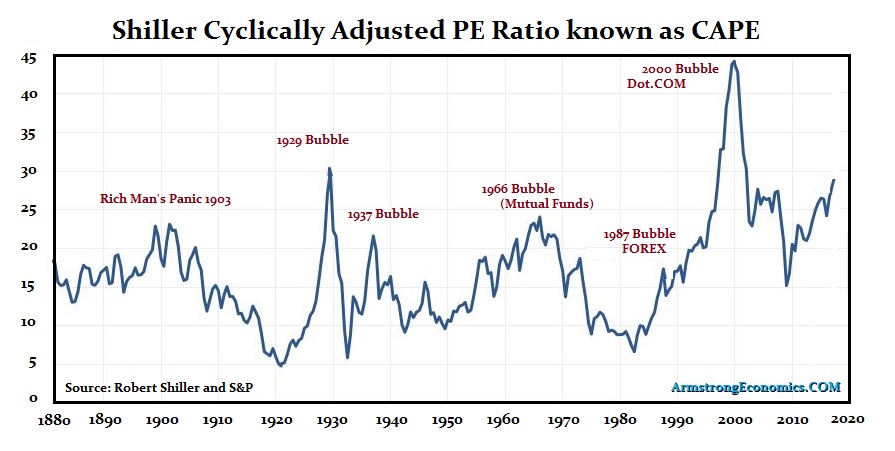
ANSWER: The Shiller Cyclically Adjusted PE Ratio known as CAPE,  is a particular PE ratio invented by Robert Shiller of Yale University. Unlike his index on real estate, this one tracking the period of 1870 to date is not very good. True, on will arrive at one of two conclusions that either the CAPE today is near the same level as in 1929, or it is higher today than it was just before the Panic of 2008. Does this really mean anything? Absolutely not!

When we filter this purely domestic view through the currency and capital flows, these two events are exactly opposite of each other. In 1929, the capital inflows were pouring into the USA whereas in 2008 then were exiting. The 2000 Dot.COM Bubble took place with a capital inflow.

The important difference is always the currency. Great bubbles unfold only when foreign capital is pouring into a domestic market. This is when the Japanese Nikkei Bubble took place in 1989. The capital left the USA as the Plaza Accord was pronouncing they wanted the dollar down by 40% to help trade. The swing in capital back to Japan looks like the brain wave of a real crazy person.

There is a risk of correction in the US Share Market after May. But this has nothing to do with the PE Ratio. We are looking at capital flows and that is the real key. The attempt by the Washington Post and New York Times to stir up a coup to oust Donald Trump will have far greater impact on the dollar and US assets than the PE Ratio, which is a very myopic domestic view.

Research – Where to find it


QUESTION: Mr, Armstrong; I read the research you provided for the Hong Kong WEC. I tried to see if I could find some of the Harper’s Weekly articles you photographed and perhaps others. They are not on line. May I ask, where do you get access to such material?

ANSWER: I have a very extensive library of bound volumes of newspapers from the USA as well as Britain. This has enabled me to conduct real research and see the thinking process and how it has evolved with the markets. First of all, I have to use the original source. Far too often when you dive into it, you find that people have made up quotes to support a predetermined agenda. This way, I can quote directly and not rely upon others.

Interest Rates Up & Bonds Up?


While the Fed may be raising rates, there is still a flight to quality underway that is giving a bid to US Treasury issues. Low Treasury yields may remain the norm even if the Federal Reserve raises rates again. At about 2.25%, 10-year yields have dropped to 2017 lows, even with the central bank signaling an imminent rate hike. Many still see the stock market crash and that also supplies a bit of an underlying bid right now. However, The Fed has also made it clear it will maintain a gradual approach to shrinking its massive bond portfolio thereby reversing the Quantitative Easing. We are in never-never-land where the Fed tightening will not yet have a direct impact upon the bonds on a one-for-one relationship.

When we compare the 10-year to the 30-year, we see strikingly different patterns. The high on the 30 year is 2016 in price (low in yield), whereas the high on the 10-year in price (low in yield) remains 2012.

Now look at the 2-year rate bottomed in September 2011 (high in price). Clearly, 2-year rates have been rising gradually for 6 years already.

Now when we look at the 30-year on our Proprietary Perpetual 30 Year Contract back to 1798, we gain true perspective in how rates have performed in the long-term. We are clearly looking at a bond bubble, but the breaking point appears to be 2018. Because of the extreme flight to quality, we can still see a pop up in the 10-year before this is all over. This depends entirely upon the capital flows.

US Pension Crisis Picking Up Full Speed


The Pension Crisis is serious and is the catalyst that will bring everything down. Nearly 600 State & Local governments are now in the hole and has reached nearly $1.2 trillion of unfunded pension liabilities in FY 2014. This reflects total pension liabilities of $4.798 trillion and total pension assets (or fiduciary net position) of $3.607 trillion. This staggering number is nearly 25% of the annual GDP and accounts for roughly 97% of all public pension funds in the United States. California is raising taxes to cover the short-fall for now, but this is going nowhere fast. Government pensions are what destroyed the Roman Empire and history is going to repeat.

I have stated before that there are people on Capitol Hill who support confiscating all private 401K plans in the country and replacing them with an allotment monthly. We know what will happen to that one, so you better have something else besides cash. The government cannot meet the promises for its own employees and they will turn to increasing taxes and confiscating private property.