Apple Wins Against FBI in Drug Case


Apple v FBI

The government is demanding Apple to create a program to hack phones under the excuse of “terrorism” as a threat to national security. The FBI in New York ordered Apple to unlock the phone of a local drug dealer, but Apple refused. On Monday, a federal magistrate judge in New York said no. Magistrate Judge James Orenstein denied the FBI’s request as part of the criminal case against Jun Feng, who had already pleaded guilty in October to drug charges. The FBI’s request as part of a drug case clearly shows what they are up to. The government wants to eliminate all encryption for anyone suspected of any crime, which would include taxes.

Apple is correct. There will be no end in sight if they create hacking software for the government. Once you establish a precedent, then they will apply it to every type of crime right down to just “investigating” if you owe taxes. There need not be any charges. All they would need to do is claim in court that they “suspect” there is a crime. That is how the system works.

In my own case, the government demanded I turn over all the tapes I had on the market manipulations by the New York banks. The excuse? Perhaps they might lead to missing assets. The bank later pleaded guilty and returned the “missing assets.” Of course, they never prosecute the banks in New York. They will say anything to get whatever it is they want, but they will NEVER say the truth. Apple is defending a major issue here and our freedom depends on it. This is NOT about a single phone in a terrorist case. They will expand this precedent to everything.

Tapes on Bank Manipulations in Armstrong's case TR 2-7-2000


An Ordinary Voter Writes To Donald Trump…


Troy wrote a great letter and nails it — His military training has come through with Trumps help and he is now saved. He is now truly a man and a real American!

Is There a Way Out of this Mess?


Thinking ProcessQUESTION: Marty

Thanks to bring such clear view of what is happening, but please, come to us with an “ideal solution”. I fully agree with your complaints, I am laughing with you sometime for silly questions, but you have not brought a little light so far showing the right direction. If at least we knew what to do, then your knowledge will become something concrete. As our “Pilgrim”, million of people are now expecting more from you. Thanks for all
 S
Einsteing-thinking
ANSWER: I have provided the Solution Conference and the DVD is available for purchase. I have signed a contract and they will be making a Hollywood feature film out of the Forecaster Movie. The character will be based on me, but they will present the goal which was to to provide the solution. Hopefully, this will help provide the idea to a broader audience. But understand this; we cannot reverse the trend. The best we can do is mitigate the fall. We are destined to fail and the Financial Capital of the World will move to Asia following 2032. We cannot alter the cycle because those in power will never alter their thinking. They see only their self-interest and therein is why no empire, nation, or city state has ever lasted indefinitely. No doubt some will argue I am wrong. I think given the odds that not a single society has EVER beaten the business cycle, I think you can bet on our outcome without any risk.

American Pie – Bye Bye miss American Pie – End of the World?


American Pie

Perhaps one of the most enigmatic songs ever written was American Pie by Don McLean. For decades this song was debated as to what it meant. Most assumed it had to do with the collapse of society. That seemed to be the general consensus. After all, its famous lyrics seemed to imply the end of the world:

And the three men I admire most
The Father, Son, and the Holy Ghost
They caught the last train for the coast
The day the music died
And they were singing

Bye, bye Miss American Pie
Drove my Chevy to the levee but the levee was dry
And them good ole boys were drinking whiskey and rye
Singin’ this’ll be the day that I die
This’ll be the day that I die

The song became number on in 1972 and has been one of the most played oldies that is actually timeless. For all of us growing up who debated the meaning, he finally revealed last year it was inspired by the death of Buddy Holly – the day the music died. The original manuscript sold for $1.2 million last year. Guess it just goes to show opinion rarely gets it right.

The EU is now past the point of No Return and will began to implode in March


ECM-Euro

QUESTION: Mr. Armstrong; The World Economic Conference was outstanding. Your theme that Europe was the focal point for the coming chaos has been proven valid with each passing day. You have mentioned this is the time that will begin the collapse in public confidence within the EU even surviving. I must ask. Do you believe if they call you in and followed everything you have said, is it just too late to save Europe?

Thank you so much

PB

ANSWER: Unfortunately, I know how to restructure Europe so it would function, but I do not believe that would even be sufficient at this stage in the game. We have probably reached the point of no return. All that is now left is the crash and burn. Only then will society reform. I simply believe we crossed that line last year. We began a new declining cycle in 2008 and that was the peak in the Euro as well. The start of the real decline in the Euro where mainstream capital begins to question when negative rates can really reverse or stimulate the economy unfolds after 2016.202. This comes into play March 13/14, 2016. This is not my personal opinion. This is just the modeling.

This seems to be so important we will try to put together a video on this matter.

Trump’s Reading of the Snake is Going Viral in Europe


The Snake is in with us right now be prepared!

Can Trump save the US?


POLITICS

Some people have asked if I am a Republican or Democrat/ Labour or Tory. Both political sides are wrong. They pander to their core constituents using the social issues to get everyone wound-up, but when it comes to economics; well there is no real difference. Neither side will reform or downsize government. Their solution will be as Christine Lagarde’s: grab more and more until it works for them.

1844 Phila Nativism Riot Againt Irish

1833MissBond

I have been asked if I really think Trump will be the man to save us. No. I do not believe anyone can do that at this late point in history. Trump’s reading of Al Wilson’s song “The Snake” is typical and part of the cycle. The state sovereign debt crisis of the mid-19th century was set in motion by Andrew Jackson’s war on the Bank of the United States because they funded his opponents. Jackson then destroyed the central bank, which set off the Age of Broken Banknotes. The Panic of 1837 became the Depression of the 1840s, and then states issued bonds to try to bailout their banks and then they defaulted. To this date, the Bank of England still has on its books bonds issued by States that they never paid on.

The economic pressures of that period produced the very same human response to immigration. Then it was the Irish. The movement against immigrants erupted into gun battles on the streets of Philadelphia in 1844 known as the Nativism Riots. These “native” Americans (white original immigrants) were against all immigrants as they felt they were taking their jobs. So Trump’s reading of “The Snake” is PRECISELY in line with history and is reflecting the very issue that is argued for the BREXIT by one side: STOP THE MIGRANTS.

The point is, quite frankly, that history repeats. We are in the midst of an economic decline. The standard of living is declining as government expands regardless of whom has been behind the uptrend since both sides have contributed to our demise as we approach our date with reality. Europeans hate Trump because they focus on some of his hardline statements and the fact that career politicians there see him as a very dangerous consequence because the same trend is emerging in Europe — oust the career politicians. But in the USA, the more Trump stands up against the career politicians, the louder his cheers. Meanwhile, the bankers are scared to death of both Trump and Bernie Sanders and see them as dangerous. Obviously, if they do not OWN the political candidate, he might actually prosecute them for crimes.

Euro Sinking

The Mayor of London, Boris Johnson, has come out in support of BREXIT. On the other side, you have British Prime Minister David Cameron making his pitch to remain within the European Union, claiming the UK could “have the best of both worlds” if it voted to remain in the bloc. We should expect the pound to decline as part of an official attack to convince people to stay in the EU. Then they will argue that the decline in the pound is proof that Britain should stay with a sinking ship.

So the point is this: Trump’s reading of “The Snake” is a sign of the times. He is tapping into the very same human response that ALWAYS unfolds during major economic declines. Merkel’s decision to open the floodgates for immigration occurred at EXACTLY the wrong time in the economic cycle. In a bull market, nobody would have noticed. Did it create the cycle? No. The downtrend was set in motion as our forecasts were laid out. Doing what she did was stupid and counter-trend so it was interpreted as a disaster.

War-Cycle-2014

Now, with hard times upon us, the Islamic immigrants will compete for jobs, take state assistance, and only cause the resentment to rise among those who see their living standards diminish. This is simply part of the War Cycle, which turned up in 2014 and nothing more. I have stated countless times that our correlation of all global trends demonstrates that war never comes when everyone is “fat and happy.” Turn down the economy and it all comes unraveled.

Trump’s reading of “The Snake” is feeding into the heat of the moment. It is perfect timing regardless of which side you are on for we just may be influenced by the entire cycle heading into the coming storm. So to me it is not abnormal; it is a sign that the cycle is indeed unfolding. I need not take sides. To me, this is indicative and confirmation of the trend in motion.

Can Trump prevent our demise? No. He probably does not realize the extent of the risk we face. People should by no means focus on Trump as an individual, for they will miss the entire trend. He is a symptom of the times and not the trendsetter himself. I have more faith in Trump insofar as he is NOT a career politician and that leaves a glimmer of hope that when he is wrong, he will change course. Career politicians will NEVER do that because they are incapable of admitting to mistake. That is simply what they are told in Politics 101.

stalincountthevote

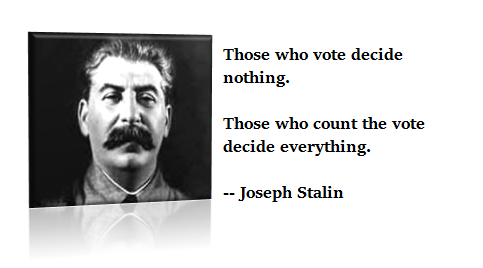
Cameron wanting to stay in the EU when it is a total disaster is indicative of someone who puts politics before his own country. If Britain votes to leave, and they will probably rig that vote as they did the Scottish Vote to separate from the UK, Europe will see a contagion of massive proportions and the EU will collapse because they tried to make this a political United States of Europe rather than an economic union. My guess: Cameron and the EU will rig any BREXIT vote to ensure it remains with the sinking ship. If Britain leaves, the EU collapses.

Whither Are We Going?


Post By Prof. Paul Eidelberg

Mankind is tottering on an abyss. Violence punctuates daily life in a world increasingly portrayed as meaningless. We are strangers, not only to each other but to ourselves. The “crisis of identity” has become a cliché. Familial and national ties have been eroded; we are homeless cosmopolitans. Indeed, no less than the President of the United States boasts of being a “cosmopolitan”! He emulates the Swedes, who replaced their heritage with multiculturalism.

Creación_de_Adán_(Miguel_Ángel)

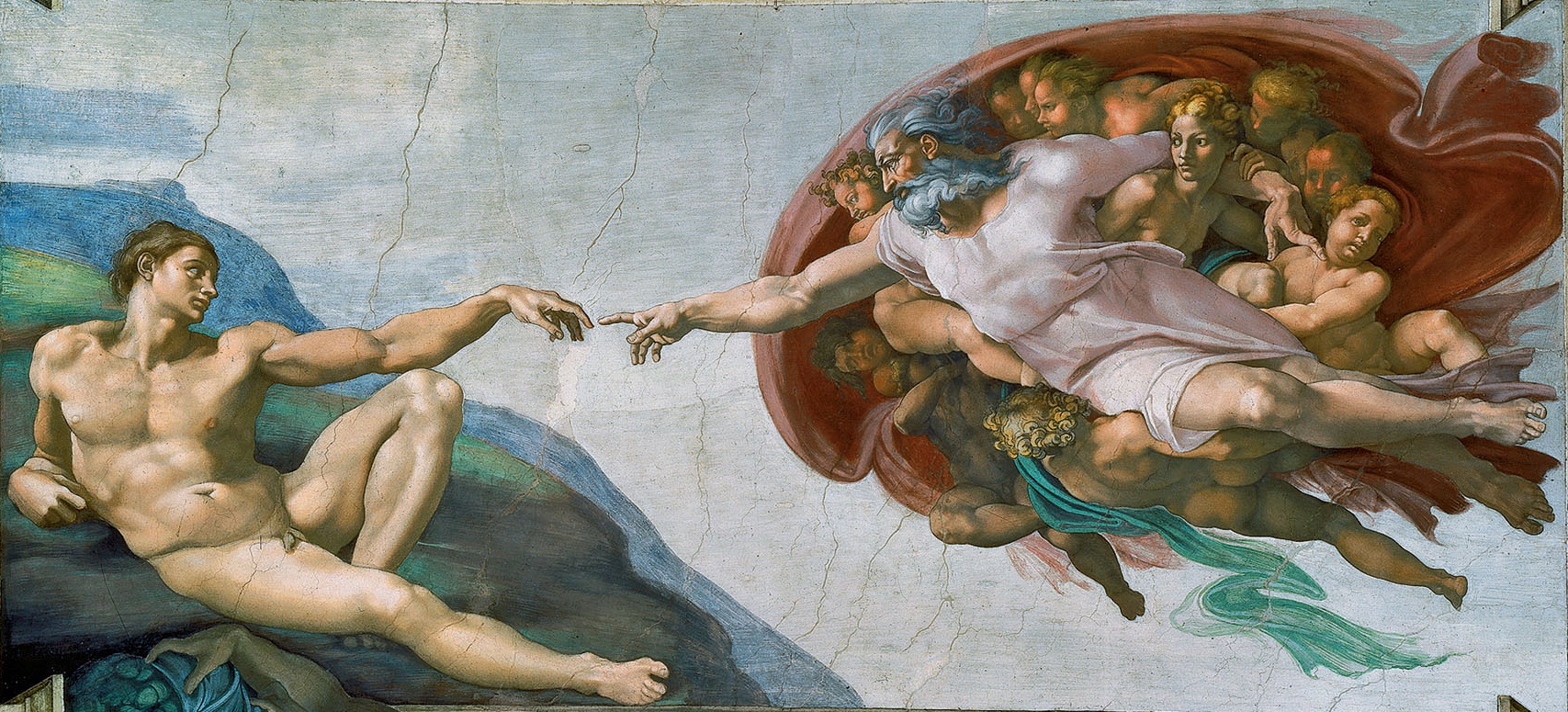
Not knowing who or what we are, we lack the hauteur and confidence of cosmopolitans of the past. They believed in Universal Man, in man sub specie aeternitatis; we believe in nothing.  Our humanism is empty; we can’t even take our own humanity seriously. Nihilism has rendered the distinction between man and beast problematic. What, indeed, is noble about man that anyone should boast of being a “humanist”?

When man becomes problematic, enter civilizational decay, but also the possibility of renewal. Such was the case some twenty-four hundred years ago when Greek sophists like Protagoras exulted in teaching youth that “man is the measure of all things.” This unheard of and skeptical doctrine (the dogma of today’s universities), signifies that all ideas concerning the True, the Good, and the Beautiful are human creations, relative to time and place. Socrates saw that this secularism and relativism would eventually destroy the Olympian gods and was even then undermining public morality in Athens. The sophists, the Greek counterparts of today’s “value-free” social scientists, were broadcasting the death of Zeus, the pagan god of justice. Without Zeus, what would hold society together?  Without the traditional understanding of right and wrong, men would devour each other like animals.

Enter Socrates. His task, completed by Plato and Aristotle, was to substitute a restrained skepticism for the sophists’ unrestrained skepticism, lest men revert to beasts. The world-historical function of these Athenians was to construct a philosophy of man and a world view that would replace the no longer credible mythology of the Homeric cosmos. Accordingly, and as dramatized in The Republic (when the god-fearing Cephalus leaves the dialogue), philosophy replaces religion and the philosopher replaces Zeus. No longer are the gods to rule mankind, but reason – unaided human reason – would henceforth determine how man should live.

Of course, neither Plato nor Aristotle was so naive as to expect the generality of mankind to defer to the rule of philosophers. Apart from other considerations, philosophers are not only as quarrelsome as the offspring of Zeus and Hera, but, unlike the Olympians, they are mortal: here today, gone tomorrow. Something impersonal as well as immutable and eternal was therefore needed to command the obedience of man. What else could this be but Nature – nature divested of Homeric deities. Neither the gods nor man but all-encompassing Nature was to be the measure of all things.  And this Nature, far from being arbitrary and mysterious, was fully accessible to the human mind.

The magnitude of Aristotle’s program has not been surpassed in the history of philosophy. He merely set out to comprehend the totality of existence, to reduce heaven and earth to an organized system of theoretical, practical, and productive sciences. To borrow the terminology of Rabbi J.B. Soloveitchik in Halakhic Man’ Aristotle would tolerate no randomness or particularity, no mystery to obscure the fleeting events of existence. Everything had to be fixed, clear, necessary, ordered. Nothing was beyond the grasp of the human mind because Nature, or the Cosmos, was an intelligent and therefore intelligible whole.

With Greek philosophy a new type of man appeared in the forefront of world history, Cognitive Man. Cognitive Man is a secularist who deifies the intellect. He must therefore be distinguished from his secular rivals, Volitional Man and Sensual Man. Whereas Cognitive Man seeks to understand the world, Volitional Man wishes to conquer and change it, while Sensual Man simply wants to enjoy it. Only with the ascendancy of Volitional Man, personified by Machiavelli, did secularism come into its own as the regnant force of history.

Of course, Machiavelli had collaborators: Hobbes, the father of modern psychology: “The thoughts are to the desires as scouts and spies to range abroad and find the way to the things desired”; Hume: “Reason is, and ought only to be the slave of the passions.” The influence of these two harbingers of Sensual Man explains why we are not used to thinking of Platonic-Aristotelian philosophy as secular.

Plato and Aristotle pay nothing more than lip service to the divine. True, the refinement of their writings conveys great piety. What gives the lie to this impression is that neither philosopher regarded piety as a virtue. We must also bear in mind their caution and civic-mindedness. Socrates, the master of irony, was given the hemlock for atheism. And what with the widespread corruption in Athens resulting from affluence, a disastrous war, and the unabashed atheism of so many intellectuals, it would have been reckless for these aristocrats of the mind to have joined the scoffers of a religion which, whatever its shortcomings, did provide some salutary restraints on the passions of men.

There are refined and vulgar forms of secularism. Plato and Aristotle’s is couched in pious language not only for political and pedagogical reasons, but because, in their species of humanism, the philosopher is virtually divine. By no means is the philosopher to be confused with the academic professor of philosophy. No one has portrayed the difference more powerfully than Nietzsche in Beyond Good and Evil (Part VI, “We Scholars).” For these giants of the intellect, Cognitive Man is the passionate lover of wisdom, where wisdom is nothing less than knowledge of the organizing principles of the universe.

But what is most distinctive of Cognitive Man, whether philosopher or scientist, is his attempt to reduce the fleeting phenomena of existence to lawfulness. This is as true of Platonic-Aristotelian philosophy as it is of Galilean-Newtonian physics, despite their very different conceptions of lawfulness. Both schools seek to discover the riddle of existence in some scientific order or pattern of the world. This is the aim of Cognitive Man.

However refined the quest of Cognitive Man, what unites him with his secular counterparts, Volitional and Sensual Man, is that, like them, he does not pursue the object of his desire to glorify God.  The reason is quite simple: for Cognitive Man such a God does not exist. Aristotle, like Spinoza, is a “pantheist.” His Prime Mover is an extrapolation from the principle of motion (Physics 251b17-25, 266a5).  As for Plato, his Demiurge is not a creator but an artificer that imposes order on a preexisting chaos (Timaeus 30a, 52d-55, 69b). One thing is clear: both philosophers rejected the idea of a personal God. Otherwise piety would be a virtue.

To be sure, the human psyche is not so easily compartmentalized. Cognitive Man may shade into Volitional Man. Thus Aristotle taught Alexander the Great political science; and politics. However, for Aristotle politics is but the application of philosophy to action. Let us see how Aristotle deals with this issue.

When Aristotle inherited the concept of nature from his teacher Plato, that concept had already been demythologized and transformed into the impersonal and immutable standard of how man should live. Aristotle enriched and systematized the idea by developing an organic and teleological theory of nature. Such was the success of this theory that it had no serious rivals in abodes of learning until the seventeenth century.  Vestiges of organicism may be found even in Kepler. However, not until the mechanistic theory of nature fathered by Galileo and Newton was organic concept of nature laid to rest.

What made the organic (and teleological) theory of nature so alluring and enduring is that it appealed to common sense.  Observe the growth of a tree from its seed and it will seem that the processes of nature are inwardly directed toward an end or telos. The end is that toward which a living thing strives in order to reach its completion. So it is with man.  Neither force imposed from without, nor chance, so much as an immanent impulse prompts man to form associations that can fulfill his potentialities. The most self-sufficient and comprehensive association is the political community, the polis, which alone can complete or perfect man’s nature. Whatever contributes to that end is called “good.” Nature is thus the standard for judging what is good (or bad); there is no other.

Could there be a more impersonal yet intimate and benign substitute for the Olympian gods?  Must we not marvel at Aristotle’s genius?  By creating a new foundation for morality, Aristotle became one of the greatest “legislators” of mankind.

This organic and teleological conception of man and nature was shattered by Galileo and Newton, the founders of modern science. Their mechanistic conception of nature left nature devoid any moral compass. Neither the quantum theory of Plank nor Einstein’s general theory of relativity provides a scintilla of light on how man should live.

When Nietzsche announced that “God is dead,” he was also announcing, wittingly or otherwise, the death of man. Modern man had become “human-all-too-human.” Thus was born Nietzsche’s desperate idea of the ubermensch. He asked “whither are we going?” and we are living today without an answer. This will compel us to return to Israel.

Monopoly Goes Cashless — The Coming New World Totalitarian Order


Monopoly-Cashless

Well, Monopoly is going cashless. It looks like the game company sees the writing on the wall and are preparing the kids for the new world order — a cashless society.

Plagues & Changes in Economics — The Hunt for Taxes


Justinian

QUESTION: Mr. Armstrong; I assume you have studied this hunt for money government goes through. Has it always ended in the collapse of government?

Thank you

PD

ANSWER: No. It really depends upon the economic system in place. There are two comparable plagues that devastated the world population. One ended in oppression and the other gave birth to capitalism. It is like the battle between public and private. It depends on what side you reside when it hits. In a public wave, taxes rise to compensate for the decline in population, whereas in the latter we find the birth of taxation applied to individuals who suddenly are free to earn money.

One of the worst such events coincided with the Justinian Plague (541-542AD) and was a pandemic involving Yersinia pestis, the organism responsible for bubonic plague. This hit the population on a monumental scale, creating a wave of devastation comparable to the Black Death that came about 600+ years later (2 x 309.6), which created capitalism by killing about 50% of the people and ended serfdom by reintroducing wages during the 14th century. It is estimated that about 25 million were impacted on its first wave but recurrences struck, bringing the total death toll to perhaps 50 million. The primary source describing this as a worldwide event in history has come to us from the noted contemporary historian during the 6th century, Procopius of Caesarea (Procopius Caesarensis; c. 500-560 AD).

Justinian-I-solidus follis - r

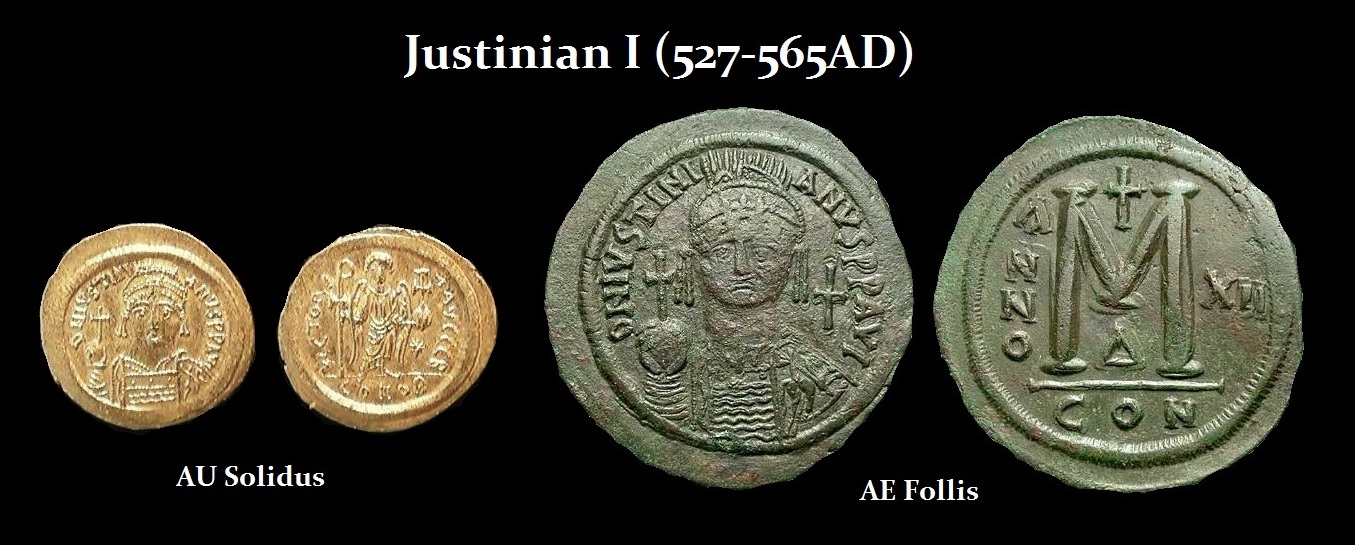
The Justinian Plague (541–542 AD) resulted in 5,000 deaths per day in Constantinople, but the Emperor responded with massive taxation as the pestilence swept through the known world; notably the Roman Empire. Justinian is remembered for his legal code reforms, but also for massive taxation for trying to restore the fallen glory of ancient Rome by waging a series of military campaigns to retake lands that had been overrun by barbarian tribes. The plague wiped out most of the farming community and impacted the tax revenue of the government. It was taxation that was different from the Black Death. Here taxation was applied to individuals, whereas latter taxes were minimal and applied only to landlords. Justinian showed no mercy whatsoever when it came to the collapse in his tax revenue. Despite the human desolation, Justinian hunted the ruined freeholders. He not only demanded they pay his annual tax even if they had no income, but he increased the tax on those living to compensate for the amount of taxation their deceased neighbors were liable to pay.

Justinian I was rather ruthless when it came to taxation. There was a tax revolt that boiled over on January 13, 532 AD, known as the Nika Revolt, which emerged when an angry populace arrived at the Hippodrome in Constantinople to watch the chariot races. The Hippodrome was next to the palace complex where Justinian could watch from the safety of the palace. The spectators were hurling insults at Justinian for his taxes. Initially, it was a contest between two opposing teams known as the “Blue” and “Green.” After race 22, the chants began to change to Nίκα (“Nika”, meaning “Win!” or “Conquer!”). The crowds became violent, and for the next five days the palace was under siege. They set fires that destroyed most of the city including the church, the Hagia Sophia, which Justinian would impose harsh taxes to later rebuild.

Therefore, in this instance, Justinian I raised taxes on the 50% who survived so his revenue would not decline. Since this was a period of capitalism where individuals earned money for their labor (in socialism/communism the state earns the profit from the labor of the population), taxes were raised on the people. The Black Death ended serfdom as labor became scarce and landlords had to offer more than 20% of the food and a free housing to work their land.