Sir Roger Scruton | Full Address and Q&A | Oxford Union


OxfordUnion

Published on Dec 21, 2017
SUBSCRIBE for more speakers ► http://is.gd/OxfordUnion Oxford Union on Facebook: https://www.facebook.com/theoxfordunion Oxford Union on Twitter: @OxfordUnion Website: http://www.oxford-union.org/ Sir Roger Vernon Scruton FBA FRSL is an English philosopher and writer who specialises in aesthetics and political philosophy, particularly in the furtherance of traditionalist conservative views. ABOUT THE OXFORD UNION SOCIETY: The Oxford Union is the world’s most prestigious debating society, with an unparalleled reputation for bringing international guests and speakers to Oxford. Since 1823, the Union has been promoting debate and discussion not just in Oxford University, but across the globe


Sir Roger Scruton/Dr. Jordan B. Peterson: Apprehending the Transcendent


Published on Dec 14, 2018

A conversation between Dr. Jordan Peterson and Sir Roger Scruton, moderated by Dr. Stephen Blackwood, introduced by Professor Douglas Hedley, presented by The Cambridge Centre for the Study of Platonism and Ralston College, held on Nov 2, 2018 in Cambridge, England. God willing (so to speak) I will be staying in Cambridge in October and November talking with the faculty at the Divinity School there about the book of Exodus prior to releasing a new series of videos about that biblical saga.


Thomas Sowell on the Origins of Economic Disparities


Published on May 17, 2019

Recorded on April 1, 2019 Is discrimination the reason behind economic inequality in the United States? Thomas Sowell dismisses that question with a newly revised edition of his book Discrimination and Disparities. He sits down with Peter Robinson to discuss the long history of disparities among humans around the world and throughout time. He argues that discrimination has significantly less of a role to play in inequality than contemporary politicians give it credit for, and that something as incontrovertible as birth order of children has a more significant and statistically higher impact on success than discrimination. He discusses why parental attention is the most important aspect of a child’s intellectual development. Sowell goes on to break down different minority groups around the world who went on to have more economic and political success than their majority counterparts, such as the Indians in East Africa, Jewish people in Eastern Europe, Cubans in the United States, and the Chinese in Malaysia. He argues that there is an underlying assumption that if discrimination was absent equality would prevail, which historically has been proven wrong. Sowell goes on to discuss changes in crime rates and poverty since the expansion of US welfare programs in the 1960s and how this has had a huge impact on the success of African Americans. He talks about his own experience growing up in New York, how housing projects used to be considered a positive place to live, and his experience as the first member of his family to enter the seventh grade. Robinson asks Sowell his thoughts on the case for reparations currently being made in Congress, and Sowell presents an argument about why a plan for reparations is not only illogical but also impossible to implement, with so many US citizens’ ancestors arriving long after the Civil War. He also explains that slavery was common throughout the known world for thousands of years and that abolition movements didn’t begin anywhere in the world until the late 18th century. He reminds us that the United States was not the only country guilty of participating in slavery and yet is the only country debating reparations.

Thomas Sowell discusses his newest book, Intellectuals and Race


Published on May 16, 2013

This week on Uncommon Knowledge, Hoover fellow and author Thomas Sowell discusses his newest book, Intellectuals and Race, which argues that the impact of intellectuals’ ideas and crusades on the larger society, both past and present, is the ultimate concern.


Between White Supremacy and Leftist Extremism – Understanding the New Cycle of American Violence


From TownHall

Oz Sultan

|
Re-Posted from Townhall: Aug 08, 2019 12:01 AM
The opinions expressed by columnists are their own and do not represent the views of Townhall.com.

Between White Supremacy and Leftist Extremism – Understanding the New Cycle of American Violence

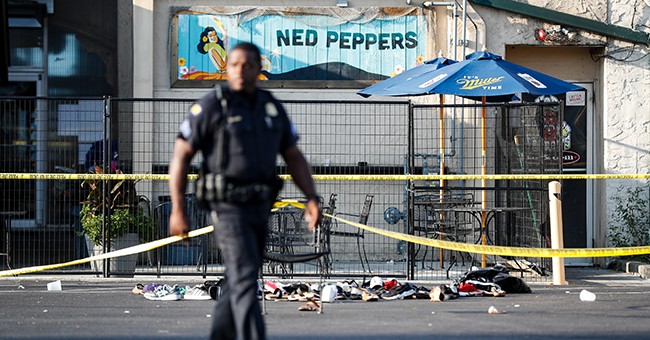
Source: AP Photo/John Minchillo

Earlier this year we completed a yearlong survey and analysis of troll propaganda coupled with online radicalization–and the growth of terrorist communities.  That research was published in the U.S. Army cyber defense review and includes a conversation that Spans from ISIS, to white supremacists and the newer left-wing radical groups, including ANTIFA.
While ISIS was on a decline, in terms of their global physical presence, we saw a significant uptick in  their recruiting –both online and on the dark web.  In the middle of this– ISIS came to the international spotlight by changing the nature of recruitment and how terrorism was conducted.  On a parallel path– we saw the movement from White Supremacist organizations, like Stormfront, that copycatted not only ISIS’s online engagement strategy but fundraising through Bitcoin.ANTIFA’s rise also became enmeshed in ISIS’s web, as ANTIFA leaders met with ISIS in London to discuss recruiting methods and to plot attacks on President Trump and G20 events.

While on opposite sides of the ideological coin – White Supremacist / Alt Right (WS/AR) and Left Extremist/ ANTIFA (LE/ANTIFA) groups both found common communication ground on platforms like Reddit, 4chan, the now defunct 8chan, as well as private channels on messenger platforms including WhatsApp, Discord, Telegram and Signal.

Meme and internet subculture played a large role in the proliferation of ideas – as lower Millennial and Gen Z’ers find the same “punk rock” catalysts of ISIS recruiting in WS and LE idea sharing. The echo chambers that get created allow for two problems to fester.

Firstly, that the rhetoric and community created is seductive and hard to leave. Secondly, that academics generally misunderstand the true nature of trolling and troll culture – as clearly evident in this Harvard Politics piece that assumes the remove kebab meme is analogous to ideological shaping – when in reality, it’s part of a layered troll of layered memes simply supporting people who have already fermented their anger and tied it to an ideology – whether WS or LE.

The Manifesto of the Christchurch shooter was the ultimate troll – a combination of memes, popular reddit commentary and sh*tposts woven into a “manifesto” that was little more than a finger to Muslims and the establishment in New Zealand.

A quick review of the Meme rise and fall of Belle Delphine should give you an idea of how you can’t fully grasp meme culture, unless you’re in it. Academics are failing at this.

Similarly, the conflict of ideologies between extreme right and extreme left, online, has led to echo chambers where we now have a proliferation of WS conversations that fear Migrant Gangs and Migrants, as well as LE conversations advocating socialism, socialist upheaval and anarchy. In 2018, the only thing missing was guns. By 2019, groups and individuals had begun arming themselves.

Our research last year identified that from WS to LE groups – there was a growing trend of cross contact with ISIS and cross-dialogue where further idea sharing occurred. Publicly available papers support the notion of cross dialogue.

However it’s more important to underscore that what WS and LE groups are doing is waging a new type of propaganda and ideological war online.

This new war is one that ISIS pioneered – and one that WS and LE groups demonstrated this week in both El Paso and Dayton – that of a new breed of “lone wolf” one that we have coined the “Laughing Man”.

The Laughing Man generally lives in our communities but illustrates their worldview and ire in online posts on popular platforms like Twitter and Instagram. They also fit a type – El Paso was a WS shooter who hated migrants and reportedly supported Trump. Dayton was an LE shooter who advocated Socialism and supported Elizabeth Warren.

Mental Health issues may have played a role in both cases and a general societal malaise egged on by meme culture within their echo chambers gave them the gumption to carry out heinous acts. 

Both of these killers existed on the fringe, in plain sight. To prevent this from happening again – we need to take a page out of the books of American Muslim communities – who reduced their terror threats through community engagement – or operational counterterrorism and couple it with sensible background check policy.

But, in an America where instafame means thousands of followers, but you still don’t know your neighbor’s name—we may have to turn back to building communities and investing in community policing, police auxiliaries, interfaith organizations and secular groups that have the mettle to address this culture war – if we’re going to stop mass shootings for good.