Posted originally on Aug 7, 2025 by Martin Armstrong |
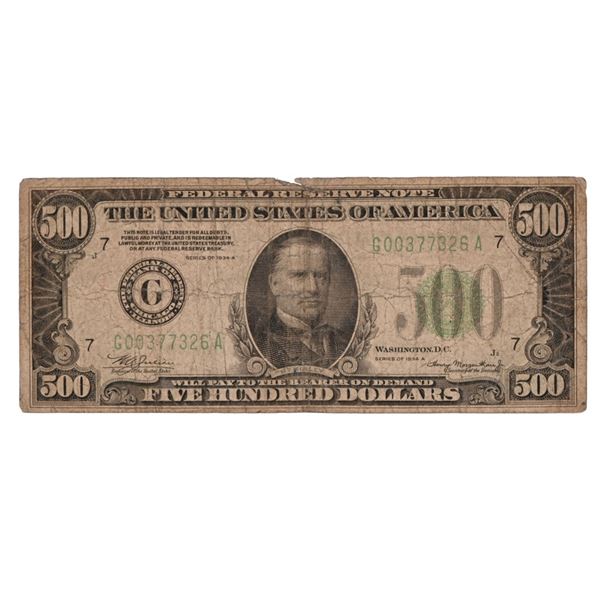
Rumors are circulating that the United States may begin to print $500 bills. The US Bureau of Engraving and Printing began printing $500 bills in 1861 until 1945, formally discontinuing them in 1969 when Nixon moved to close the gold window. The US Treasury has since required banks to send all $500 bills back to them to be destroyed, as the government claimed higher-denominated notes paved the way for criminal activity.
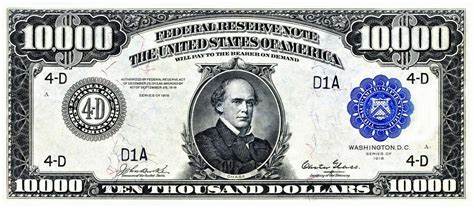
Collectors know that the US Treasury issued $1,000, $5,000, $10,000, and even $100,000 notes once upon a time. The $100,000 bill featured President Woodrow Wilson and was issued as a gold certificate from 1934 to 1935. That particular bill was not publicly circulated. No citizen needed to use such currency in day-to-day transactions. The $10,000 note was primarily used for transactions between domestic Federal Reserve Banks, as digitalization had not yet occurred, and they needed an efficient way to move capital.
The rumors about the $500 bill’s revival are not wholly unfounded. Rep. Paul Gosar (R-Ariz.) introduced a bill in 2024 to reintroduce the $500 bill, replacing William McKinley’s image with Donald Trump’s. This was more than political pandering; besides, Congress would certainly never approve of a note featuring Donald Trump’s image. However, the government could be enticed to reintroduce higher-denominated notes due to INFLATION. This is precisely why the pennywill be discontinued, as it represents absolutely nothing and is a reminder that our currency is becoming increasingly devalued.
A new $500 bill would mirror historical currency debasement as we saw in Rome under Diocletian, for example, which comes before a collapse. Printing higher-denomination notes is not just a reflection of price increases, but a sign that the people are losing trust in the value of the USD. Now, even the highest-denominated cash note will not get one far, paving the way for digitization as cash becomes an inconvenient burden. If the US were not eager to digitize banking, we would undoubtedly see higher-denominated notes in circulation once again to mask the effects that inflation has had on the value of the dollar.
America has never canceled its currency, and all of these notes are still deemed legal tender, although they are far more valuable to collectors than their face value. The Federal Reserve does not currently have plans to print the $500 bill despite rumors. The goal is to move the nation to digital currency, and cash is becoming increasingly worthless in transactions. Still, providing a limited-edition $500 note would not be unheard of in today’s economic landscape.
Posted originally on Aug 7, 2025 by Martin Armstrong |
The European Union pivoted its stance on US defense as soon as the funds began to flow to Ukraine again. Although leaders like Macron and Merz previously warned against relying on the US for aerospace and defense, four EU nations have announced a $1 billion arms deal with the US through a new initiative devised by the US and NATO.
“It’s either that or leave Ukraine without weapons,” one NATO official, speaking on condition of anonymity as they aren’t authorized to speak on the record, told RFE/RL in regard to purchasing from the US. “I think on the European side there is a hard realization that this has to happen in some fashion or another.” This comes after the Ukraine Defense Contact Group, an alliance of 50 nations, held a virtual meeting at the end of July to decide how they would continue funding the proxy war.
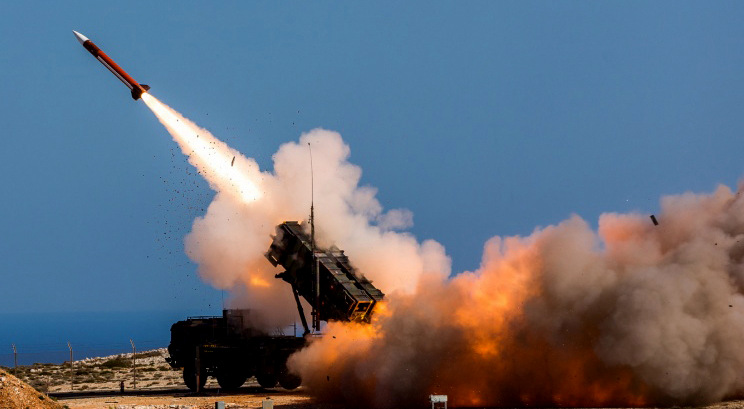
The Dutch government agreed to spend around $576 million on US Patriot missile defense systems for Ukraine. Sweden, Denmark, and Norway plan to spend another $500 million on American defense collectively. “By supporting Ukraine with determination, we are increasing the pressure on Russia to negotiate,” Dutch Defence Minister Ruben Brekelmans posted on X. “The more Russia dominates Ukraine, the greater the danger to the Netherlands and our NATO allies,” he said. Continually arming the opponent is not going to open the door to peace negotiations. It only alerts Russia that it must continue fighting for the foreseeable future, as this war is NOT against Ukraine but against the entire NATO alliance.
Swedish Defence Minister Pal Jonson said his nation plans to offer $275 million toward the deal. “Ukraine is not only fighting for its own security, but also for our security,” Jonson declared. Of course, all of this spending of public funds is being done under the premise of national security. European governments are lying to their people. They know Russia has no plans or desire to invade Europe, as there is nothing to gain by doing so.
NATO Secretary General Mark Rutte, the former Dutch prime minister, praised the northern European nations for their willingness to invest. “Since the earliest days of Russia’s full-scale invasion, Denmark, Norway and Sweden have been steadfast in their support for Ukraine. I commend these allies for their quick efforts to get this initiative off the ground,” Rutte said in a statement. As a reminder, all NATO members must up their spending to 5% of GDP, although they previously could not even meet the 2% target.
These deals will now go through the Priority Ukraine Requirements List (PURL), created by NATO and the US. Basically, Ukraine writes a list for Santa, or in this case, the US, listing its most requested weapons of choice. NATO’s Supreme Allied Commander Europe (SACEUR) then approves of the wish list and tells US manufacturers to deliver Ukraine anything it desires. The Netherlands’ half-billion-dollar purchase was the first gift basket to go through this program.
PURL plans to send $10 billion worth of American-manufactured arms to Ukraine. But the US is not Santa, and there are no elves creating weapons. Lockheed Martin and Raytheon are increasing their production of Patriot missiles, following Rutte’s suggestion that NATO nations will supply Ukraine with at least 17. NATO nations are required to pay upfront for their gifts to Ukraine to bypass the typical US arms sales process. The taxpayers did not vote to send $10 billion to Ukraine, but NATO and EU nations are beholden to unelected bureaucrats who dictate the rules.
Posted originally on Aug 4, 2025 by Martin Armstrong
Consumer sentiment remained elevated for the second consecutive month but remains worse than in December 2024, according to the University of Michigan’s Surveys of Consumers. Sentiment rose 1.6% in July from June, reaching a reading of 61.7 from 60.7. However, overall sentiment has been 17% beneath December’s reading, although it rebounded from April’s low when the market experienced a sharp downturn due to tariff fears.
“Although recent trends show sentiment moving in a favorable direction, sentiment remains broadly negative,” Surveys of Consumers Director Joanne Hsu said in the report. “Consumers are hardly optimistic about the trajectory of the economy, even as their worries have softened since April 2025.”
Inflationary fears declined for the second consecutive month as well, dropping from 5% in June to 4.5% in July after peaking at 6.6% in May, again, as a result of tariff uncertainty. Consumers believe inflation will wane in the long run for the third consecutive month, with the figure declining from 4% in June to 3.4% in July, which marks the lowest reading in 2025.
The Consumer Confidence Index, as reported by the Conference Board, rose 2 points to 97.2 in July, and June’s figure was revised to 95.2. The short-term outlook on the Expectations Index rose 4.5 points to 74.4, yet has been below the recession threshold of 80 since February. Business and labor market conditions, as measured by the Present Situation Index, fell 1.5 points to 131.5.
Yet, the Kansas City Fed noted that consumer sentiment is no longer an accurate reading for consumer spending. “Recent data suggest consumer sentiment has been declining for the past several months, signaling a potential slowdown in spending. However, most measures of actual spending, such as core retail sales and PCE, have remained relatively stable. This discrepancy raises the question of how useful consumer attitudes are in predicting actual spending,” the Fed questioned, later concluding, “Consistent with evidence from the prior 30 years, the near-term outlook for spending growth looks similar regardless of whether we account for the recent weakening in consumer sentiment.”
Federal Reserve Chair Jerome Powell also stated “the link between sentiment data and consumer spending has been weak. It’s not been a strong link at all…it wouldn’t be the case that we’re looking at [consumer sentiment] and just completely dismissing it. But it’s another reason to wait and see.”
Consumers are continually pessimistic, albeit less so, as prices remain elevated. We saw a sharp downturn in consumer sentiment with the peak in inflation during 2022. However, regardless of how one feels about the economy, consumers are forced to spend more on less. The FOMC will no longer use consumer sentiment as a strong gauge for future spending or GDP calculations since the correlation remains weak.
Posted originally on Aug 4, 2025 by Martin Armstrong
US employers have reduced their workforce more in the first seven months of 2025 than in all of 2024. The DOGE cuts to the public sector were the primary driver of layoffs; however, there has been a notable drop in retail and technology positions in the private sector.
July alone saw 62,000 jobs reduced from the workforce, a 30% increase from June and 140% from July 2024. Over 806,000 positions were removed from January to July, surpassing the 761,358 job cuts in all of 2024.
Public sector positions in government saw the largest reduction at 292,294 positions. The current administration implemented the largest public sector reduction in modern US history by offering over 2 million government employees a buyout. Around 65,000 people accepted the buyout offer within the first two weeks alone. Additionally, DOGE halted grant funding to various NGOs and non-profits, leading to 17,826 fires, which amounts to a 413% annual reduction. None of these positions contributed to the US GDP.
The private sector shed 33,000 positions in June 2025, marking the first contraction in the private sector in nearly two years. For 2025 overall, the sectors facing the steepest layoffs are technology (-89,251) and retail (-80,487).
A few major tech companies implemented large layoffs this year such as Intel (-21,000), Microsoft (-15,000), PayPal (-2,500), and HP (-2,000). The advancement of Artificial Intelligence has led to a drastic reduction in workers in the technology sector, with some reports believing that AI is replacing around 491 tech jobs per day. We’ve seen a 36% decline in tech jobs this year compared to last as technology advances. Another issue has been outsourcing positions to places like India. The US outsourced 300,000 tech-based jobs overall to India as offshoring trends continue. Not only is labor cheaper, but India produces over 1.5 million engineering graduates annually. Visa restrictions have less of an impact as remote work is commonplace.
Retail experienced the second-largest decline in private sector roles with a 249% annual decline. Brick and mortar stores are deteriorating as another casualty of creative destruction as consumers prefer to spend online. Various articles are blaming tariffs and price increases for the drop in retail positions, but consumers are simply spending less. Around 20,000 retail positions were lost to AI automation, especially for basic roles and inventory management. American consumers have never rebounded from the increased cost of living. Credit card delinquencies and bankruptcies continue to reach new highs, and every survey indicates that households are spending more on less and focusing their resources on the basics.
Technology and retail are sensitive to advancements in AI. Offshoring has drastically cut competitiveness for American workers in tech. There is an offshoring corporate tax penalty of 28% but it is safe to assume that this figure will rise. As for AI, the government hasn’t found a way to tax robotic systems, but rest assured they will find a way.
Posted originally on Jul 30, 2025 by Martin Armstrong
The fact that Trump is threatening sanctions against India for buying Russian oil and to hammer Russia to somehow force Putin to his knees and accept whatever terms Europe demands, proves that Trump is now taking advice from Lindsey Grachm, NATO, their puppet EU leaders, and the Neocons with the likes of Cheney in the background witgh a HUGE smile on her face.
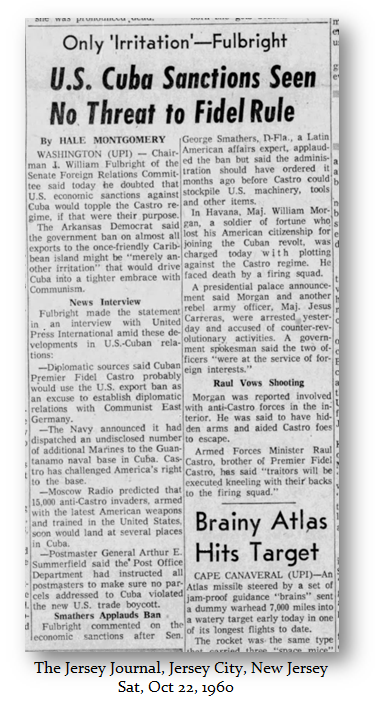
Cuba (1960s-present): U.S. sanctions have failed to topple the Castro regime or force democratic reforms. Despite economic hardship, the government adapted through alternative trade partners and domestic resilience, suggesting sanctions can entrench regimes and slter the world economy, which has taken place with the development of BRICS. The U.S. embargo (blockade) against Cuba remains in place, requiring Congressional action to lift it entirely. While some sanctions have been eased temporarily, no administration has completely ended them. After more than 60 years, this stands as a prime example of how sanctions have NEVER worked even once.
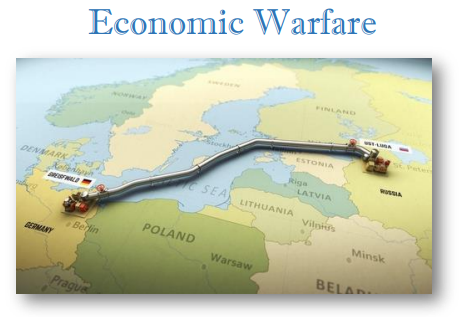
The United States has imposed sanctions on German and other European companies involved in the construction of the Nord Stream 2 gas pipeline, which was designed to transport Russian natural gas to Europe. In 2019–2021, the U.S. sanctioned firms like Swiss-based Allseas (forcing it to withdraw) and later targeted Russian and German entities.
The U.S. imposed sanctions on the Soviet-European gas pipeline in 1982 (under Reagan), targeting Western companies supplying equipment for the Urengoy–Pomary–Uzhhorod pipeline, which supplied gas to Western Europe. The U.S. opposed this project due to concerns over European energy dependence on the USSR. They, too, failed and had to be relaxed under Allied pressure.
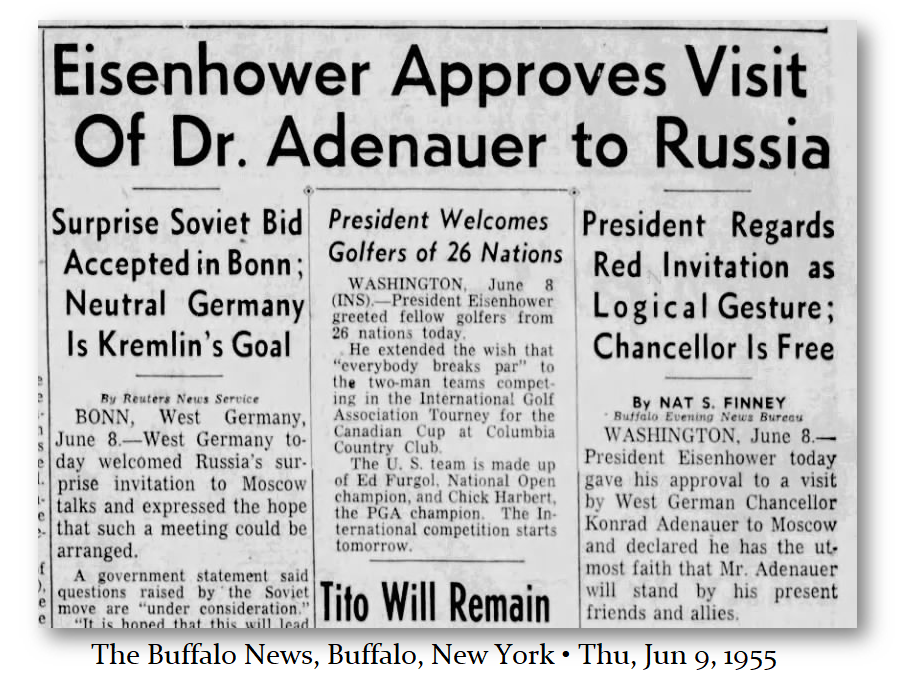
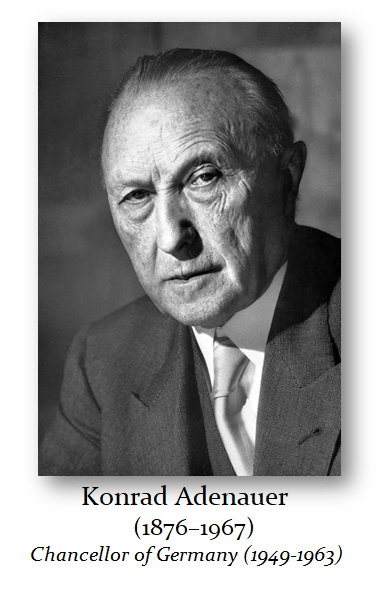
The Neocons, from the outset of any negotiations between Germany and Russia back in the communist days, did everything in their power to deny Germany access to Russian energy. It was 1955 when West German Chancellor Konrad Adenauer (1876-1967) visited Moscow in June and then established diplomatic relations for the first time between the new Federal Republic of Germany and the Soviet Union. The Neocons were outraged, but President Eisenhower saw it as no threat given Adenauer’s oppression by Hitler. The Necons wanted to prevent any meeting but Eisenhower declined.
Adenauer was Chancellor from 1949 to 1963. Adenauer was one of the first opponents of the leader of the Nazi Party. Konrad Adenauer helped draft a constitution completed in May 1949. He opened the door for the trade agreement that followed in 1958, and by 1960, bilateral trade between the countries was booming.
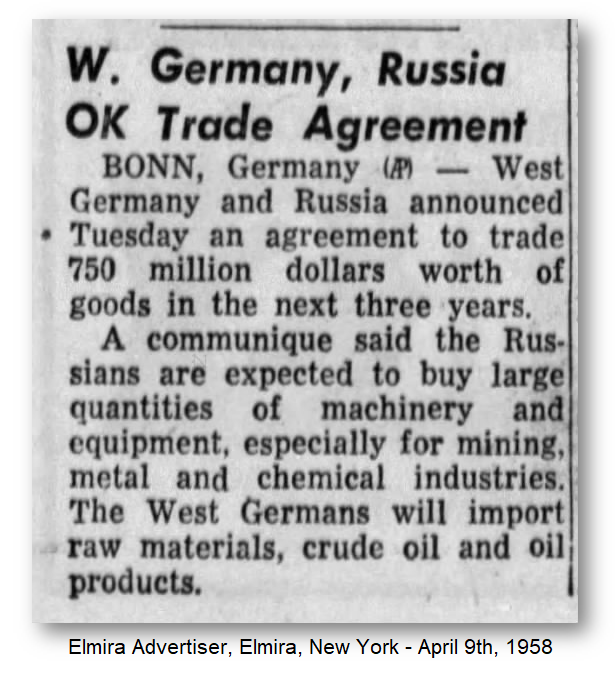
The Trade Agreement was reported worldwide by the Associated Press on April 9th, 1958 (1958.271). Even so, from the very beginning, that trade link between Germany and Russia was controversial, to say the least. The United States, at the direction of the Neocons, was always against it and would criticize Germany behind every closed-door session. However, the US intimidation failed because it was necessary for the German people and their future.
While the U.S. did not impose formal sanctions on German pipe producers in 1955–1958, it actively discouraged such trade, setting the stage for the 1960s pipe embargoes. The major crackdown came later, but diplomatic and economic pressure began in the late 1950s.
Iraq (1990s): UN sanctions after the Gulf War devastated the economy, reducing GDP by nearly 50%, but Saddam Hussein’s regime remained intact. Political change only occurred after the 2003 invasion, not sanctions alone, and civilian suffering often strengthened regime propaganda.
North Korea (2000s-present): Decades of sanctions have crippled the economy but haven’t shifted the Kim regime’s policies or structure. Black market trade and Chinese support have mitigated impacts, and the regime uses isolation to reinforce control.
South Africa (1980s-1990s): Comprehensive sanctions, including trade bans and financial restrictions, the Neocons insist, contributed to ending apartheid. However, there was already internal resistance. It still took 14 years before any democratic reforms took place by 1994. Studies estimate that the sanctions reduced South Africa’s GDP only by 1-2% annually.
Iran (2010s): Heavy U.S. and EU sanctions targeting oil exports and banking, which the Neocons insist forced Iran to negotiate the 2015 nuclear deal (JCPOA). Oil revenues dropped by over 50% from 2011 to 2013, and inflation soared, but the regime did not fall. The regime didn’t fundamentally change its political system, showing again that sanctions have NEVER even once overthrown the core governance.
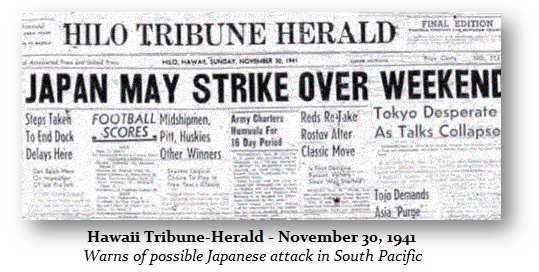
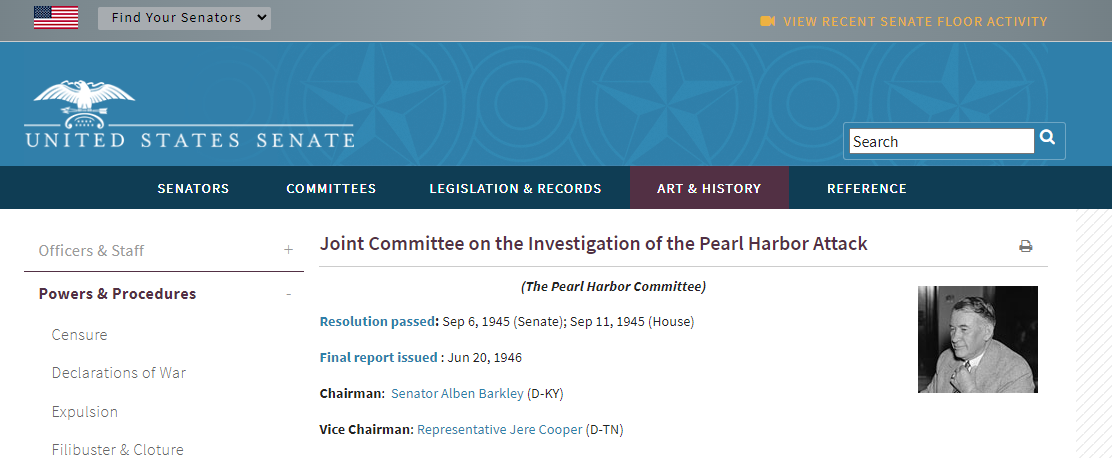
FDR deliberately imposed sanctions on Japan to get them to attack the United States, all because Congress would not authorize joining World War II in Europe. That led to a Senate investigation later because it became so obvious that FDR even knew when Pearl Harbor would take place and deliberately allowed thousands to be killed just so he could enter the war. It came out that US had broken the Japanese code and knew all about the attack. There was even a lead to the press a few days before reporting that they were about to be attacked.
Before the attack on Pearl Harbor on December 7, 1941, President Franklin D. Roosevelt (FDR) imposed a series of escalating economic sanctions on Japan in response to its aggressive expansion in Asia, particularly its invasion of China. These sanctions were meant to pressure Japan into halting its militaristic actions, but ultimately contributed to the tensions that led to war.
In 1938, FDR imposed a “moral embargo” on aircraft and aviation parts sales to Japan following its bombing of Chinese civilians. This was not a formal ban but a strong discouragement of exports. Then in July 1939, FDR announced the termination of the 1911 U.S.-Japan Treaty of Commerce and Navigation, removing legal barriers to future trade restrictions. This took effect in January 1940.
Now that the door was open for sanctions, in July 1940, the U.S. restricted exports of aviation fuel, lubricants, and high-grade scrap metal to Japan under the Export Control Act. That was followed by the September 1940 complete embargo on scrap iron and steel.
Then, FDR, like the West has done to Russia, froze all Japanese assets in the U.S. (July 26, 1941), effectively cutting off trade and financial transactions. That was followed by a complete oil embargo along with Britain and the Dutch government-in-exile. Since Japan relied on the U.S. for 80% of its oil, this was a crippling blow. FDR knew that Japan would take it as an act of war, as they then saw these sanctions as an existential threat, as they crippled its ability to fuel its military and industry.
The oil embargo, in particular, forced Japan to either negotiate a withdrawal from China (which it refused) or seize oil-rich territories in Southeast Asia (which risked war with the U.S.). The sanctions contributed to Japan’s decision to attack Pearl Harbor (December 7, 1941) to neutralize the U.S. Pacific Fleet before invading British and Dutch colonies. These sanctions deliberately pushed Japan toward a desperate military confrontation, culminating in the attack on Pearl Harbor and the U.S. entry into World War II, which was the objective of FDR from the outset. The outrage was so intense that in 1945, after the war, the Senate was forced to investigate FDR’s action and whitewashed the affair, claiming they were unsure if FDR had been fully advised of the Pearl Harbor attack in advance, even though leaks made the papers in advance.
There is NOT a single incident to demonstrate that sanctions have EVER worked. Nevertheless, the Neocons constantly advise heads of state to impose sanctions, hoping that they will bring about the collapse of that government. They will not work this time either and the real risk is that they will lead to war as we saw in FDR’s actions against Japan.
Posted originally on Jul 31, 2025 by Martin Armstrong
President Trump announced a 25% on India beginning August 1 due to its continued purchase of Russian oil. “Remember, while India is our friend, we have, over the years, done relatively little business with them because their Tariffs are far too high, among the highest in the World, and they have the most strenuous and obnoxious non-monetary Trade Barriers of any Country,” the president posted to Truth on Wednesday morning. “Also, they have always bought a vast majority of their military equipment from Russia, and are Russia’s largest buyer of ENERGY, along with China, at a time when everyone wants Russia to STOP THE KILLING IN UKRAINE,” he added.
India began drastically increasing its imports of Russian crude at the start of the Russia-Ukraine war in 2022, with good reason, as the oil became significantly cheaper and India was able to resell it at a premium to nations that simply wanted to bypass all things Russia. In January 2022, India was importing around 68,000 barrels per day (bpd) in Russian crude, which represented only 0.2% of crude imports. The war broke out a month later and by June India was importing 1.12 million bpd from Russia who overtook Iraq as the nation’s top supplier. Nearly a year later in May 2023, Russian imports peaked at 2.15 million bpd, with India currently importing around 1.7 million to 2.1 million bpd as of July 2025.
Around 35% to 40% of India’s crude oil now comes from Russia. Now, Russian crude was around $50 per barrel in May 2025 when imports to India peaked. Middle Eastern grades were around $10 to $20 higher at the time. The deal was a no-brainer.
India-US bilateral trade hit $118.4 billion in 2024. India exported approximately $79.4 billion in goods to the US and imported $39 billion. The current trade deficit with the US sits at $45.7 billion. A 25% tariff could cost India billions in lost revenue from exports and threaten jobs in key sectors such as autos, chemicals, jewelry, gems, electronics, and textiles. Other Asian exporters would become more desirable, but China actually purchases more Russian crude than India at this point and other nations in the region have drastically smaller economies. Estimates state India could risk losing $15 billion to $20 billion annually as a result of the 25% tariff.
Now, if India were forced to buy from the Middle East for $10 to $20 more per barrel, the nation would need to spend around $6 to $10 billion more on energy annually. India does refine and resells Russian crude and is said to bring in around $1.5 billion to $3.5 billion from that practice.
On paper, it would seem as if India has more to lose by continuing to purchase Russian oil. However, the US is showing the world that it has the ability to dictate political policy through economic warfare. India declared that it remains committed to continuing “mutually beneficial bilateral trade” with the US after the 25% tariff was announced. The US will go after all BRICS nations in an attempt to dismantle the alliance, but BRICS members have shown that they no longer need to rely on the West, and tariffs from the US may not hold the same leverage as they once did.
Posted originally on CTH on July 27, 2025 | Sundance
Office of Management and Budgets (OMB) Director Russ Vought appears on CNN to discuss the problems noted with the Federal Reserve (FED) as the organization viewed their ‘independent’ status as meaning beyond accountability. The FED has been operating without any oversight until President Trump and Russ Vought began a baseline review of how they spend taxpayer funds.
As noted by Director Vought, the FED can have independence and yet they must be held accountable to the American people. President Trump is that accountability piece and the FED were not familiar with scrutiny. They are now.
.
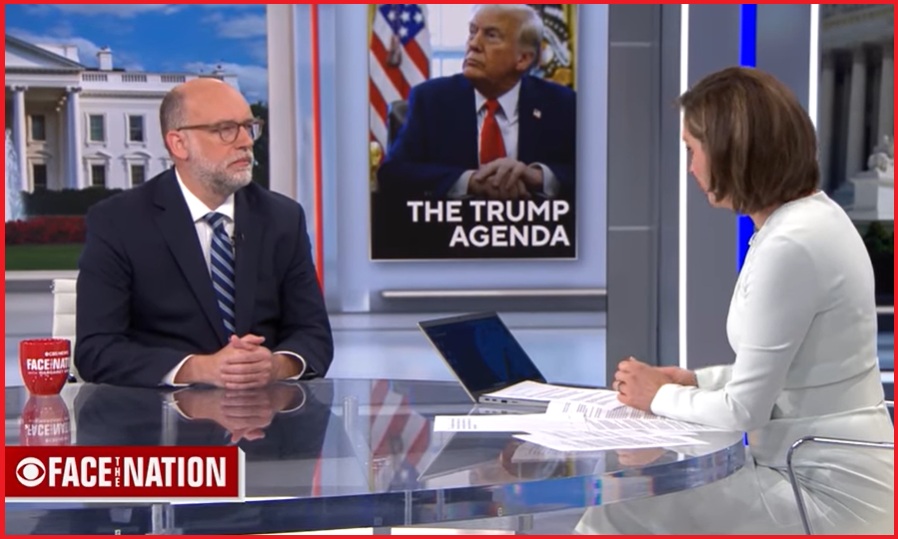
Russ Vought also appeared on Face the Nation to receive questions from the insufferable and ever-pontificating Margaret Brennan. Video and Transcript Below:
[Transcript] – MARGARET BRENNAN: We begin today with the director of the White House Office of Management and Budget, Russell Vought, welcome to ‘Face The Nation.’
DIRECTOR OF THE OFFICE OF MANAGEMENT AND BUDGET RUSSELL VOUGHT: Thanks for having me.
MARGARET BRENNAN: There’s so much to get to with you. Let’s start on what’s going on with the Federal Reserve. If you take the president at his word, he does not intend to fire the Federal Reserve Chair, Jerome Powell- though he’s still criticizing him. What is the President seeking in a successor when his term ends in May 2026?
VOUGHT: Well, I think he’s looking for a chairman that’s not continually too late to the developments in the economic marketplace. And I think what we’ve seen with Chairman Powell, he was very late in the Biden administration to raise rates, to articulate the concern with regard to the Biden administration’s spending. We all knew on the outside- even Larry Summers knew that we were going to have an issue with regard to inflation. And we saw, you know, recent, historical inflationary levels that we hadn’t seen before. And now he is too late to lower inflation rates and so that is the kind of thing that we want to see in the next chairman of the Federal Reserve. And one of the reasons why is–
MARGARET BRENNAN: –More of a focus on inflation?
VOUGHT: –want an ability to recognize the developments in the economic marketplace. In this case, we want to be able to see lower rates and to have an ability to get the economy going. And one of the things we saw with Powell is that one of the reasons he was so late was because he didn’t understand that inflation is largely a monetary phenomenon. He kept saying that inflation was transitory. He didn’t tackle the problem, and now he’s, again, too late, and you marry that with fiscal mismanagement at the Fed. It’s a huge problem that we’re trying to raise the country’s awareness level with.
MARGARET BRENNAN: But as you know, the Fed is structured in a way where he doesn’t have unilateral control. There’s a governing board. Others weigh in. You did work on Project 2025, and we went back and looked at what they said in there about the Fed. As people may know, that’s a Heritage Foundation product that got a lot of scrutiny during the campaign. the chapter on the Fed called for Congress to overhaul the Fed’s focus and powers. Is that what you’re looking to do in 2026?
VOUGHT: I don’t even know what that chapter says. All I know, in terms of the President, the President has run on an agenda. He’s been very clear about that. All that we’re doing is- in this administration is running on- is implementing his agenda.
MARGARET BRENNAN: You don’t want to overhaul the Fed?
VOUGHT: We want an economic system that works for the American people, that includes the Fed. And the President has been very clear that all he’s asking from the Fed is lower interest rates, because he thinks it’s important. When you look at across the across the globe, and you have countries lowering rates, and yet we don’t see that in this country, given all of the positive economic indicators that we’re seeing. And then we have fiscal mismanagement at the Fed with regard to this building renovation that I’m sure you will ask me about. Those are the kinds of things that we want to see from the Fed. This is not part of an existential issue with regard to the Federal Reserve.
MARGARET BRENNAN: Well, the Fed is indicating that they are trending towards a rate cut, though probably not as soon as this week. We mentioned those renovations at the top of the program, but I do want to ask about spending, or lack thereof, that the Trump administration is trying to direct. The White House said they will actually release the remaining $5 billion in education, funds that had been withheld from public schools until recently. There were 10 Republican senators very worried about this, and came out and said, your claim that the money goes to radical left wing programs was wrong. What changed your mind? What made you release this money?
VOUGHT: Well, we had been going through a programmatic review with these funds. These are programs that, as an administration, we don’t support. We’ve called for the elimination of them in the President’s budget for precisely the reasons of which they flow to often left wing organizations. Thankfully, the President came into office, put an executive order that said it can’t- these funds can’t go to these types of initiatives. I’ll just give you one example, English language acquisition was flowing to the New York school public education system to go into illegal immigration advocacy organizations. Preschool development grants doesn’t actually go to preschoolers. It goes to the curriculum for putting CRT into the school system for people as young- children as young as four years old.
MARGARET BRENNAN: Well, these senators said it goes to adult learners working to gain employment skills and after school programs.
VOUGHT: And what we–
MARGARET BRENNAN: So you deemed it is necessary?
VOUGHT: We believe that it’s important to get the money out right now, but we have taken an extended time frame to be able to make sure it doesn’t go to the types of things that we saw under the Biden administration.
MARGARET BRENNAN: Because, you know, Senator Lindsey Graham told the Washington Post, the administration is looking at considering clawbacks from the Department of Education. This, you know, rescissions process. Is that the plan? Are you seeking to claw back education funds in a rescissions package? And if so, when are you sending that up?
VOUGHT: We may be, we’re always looking at potential rescission options. This is an- this is a set of funding that we wanted to make sure it got out. We did our programmatic review. We wanted to make sure it got out before the school year, even though it’s multi-year funding. This is not funding that would expire at the end of this year. We are looking to do rescissions package. We’re always gauging the extent to which the Congress is willing to participate in that process, and we’re- be looking at a lot of different options along those lines, but certainly have nothing to announce here today. But we’re thrilled that we had the first rescissions package in decades, and we’ve got the process moving again.
MARGARET BRENNAN: So no rescissions package before September?
VOUGHT: Not here to say that. We’re looking at all of our options, we will look at it and assess where the Hill is, what are the particular funding opportunities that we have, but nothing that we’re going to announce today,
MARGARET BRENNAN: Because some of the funds that do expire in September have also been held up on the health front. Senator Katie Britt of Alabama, 13 other Republicans, came out with a letter saying that you’ve been slow in releasing funds for the National Institute of Health for research into cardiovascular disease, cancer. Are those funds going to be released?
VOUGHT: Again, we’re going through the same process with the NIH that we did with the education. I mean–
MARGARET BRENNAN: But there’s a time cost here.
VOUGHT: –$2 million for injecting dogs with cocaine that the NIH spent money on, $75,000 for Harvard to study blowing lizards off of trees with leaf blowers. That’s the kind of waste that we’ve seen at the NIH. And that’s not even getting to the extent to which the NIH was weaponized against the American people over the last several years, with regard to funding gain of function research that caused the pandemic. We have a- we have an agency that needs dramatic overhaul. Thankfully, we have a great new head of it, but we’re going to have to go line by line to make sure the NIH is funded properly.
MARGARET BRENNAN: Are you going to release the cancer funding research? And the cardiovascular disease research funding?
VOUGHT: We’re going to continue- we’re going to continue to go to the same process that we have gone through with regard to the Department of Education, that every one of these agencies–
MARGARET BRENNAN: Before September, that money will be released?
VOUGHT: –and we will release that funding when we are done with that review.
MARGARET BRENNAN: Because, as you know, there’s concern that you’re withholding the money, hoping it just won’t be spent. I mean, if you look at the White House budget, it does call for a 26% cut to HHS, $18 billion cut to NIH. Is this just a backdoor way to make those cuts happen?
VOUGHT: Well, I don’t want to speak to any specific program with regard to what we might do with regard to rescissions throughout the end of this fiscal year, but we certainly recognize that we have the ability and the executive tools to fund less than what Congress appropriated, and to use the tools that the Impoundment Control Act, a bill we’re not- a law that we’re not entirely thrilled with, gives us to- to send up rescissions towards the end of the fiscal year.
MARGARET BRENNAN: So just for our viewers, the Impoundment Control Act is the legal mechanism for the President to use to delay or avoid spending funds appropriated by Congress. You seem to want to have an argument, or Democrats think you want to have an argument, over the power of the purse and who holds it. Do you want that to go to the Supreme Court?
VOUGHT: Well, look, for 200 years, presidents have the ability to spend less than the congressional appropriations. No one would ever dispute, and our founders didn’t dispute that Congress has the ability to set the appropriation ceiling. But 200 years of presidents, up until the 1970s had the ability to spend less, if they could find efficiencies, or if they could find waste that an agency was doing.
MARGARET BRENNAN: — That sounds like a yes?–
VOUGHT:– We lost that ability in the 1970s. The president ran on restoring that funding authority to the presidency, and it’s vital. If you look at when we started to lose control fiscally, it was right around the time of the 1970s.
MARGARET BRENNAN: Well, many senators, Republican senators, are very uncomfortable with the tactics that you are using. Senator Murkowski, Senator Collins, that chair of the appropriations committee that is really running this- this funding process. And Senator Collins said you’re pushing the limits of what the executive can do without the consent of the- of the legislative branch. You need to work with her to get your budget through. And in fact, you need to also be able to get Democrats on board to get to that 60-vote threshold to pass any kind of government funding to avoid a government shutdown at the end of September.
VOUGHT: I have a great relationship with Senator Collins. I appreciate the work she does. She is the chairman of the Appropriations Committee, so obviously we’re going to have differences of opinion as to the extent to which these tools should be used. I mean, she had concerns with the rescissions package. The rescissions package was a vote that Congress had to make these cuts permanent–
MARGARET BRENNAN: — Under- on a party line vote, she says, you want to go do these clawbacks. You do it through regular order, and you can put- you can put rescissions into an appropriations bill–
VOUGHT: –But that was in fact, under regular order. That’s the challenge, is the appropriators want to use all the rescissions, they want to put them in their bills, and then they want to spend higher on other programs. We act- we’re $37 trillion in debt, Margaret. We actually need to reduce the deficit and have a dollar of cut go to $1 a deficit reduction. That’s not what the appropriators want, and it’s not news that the Trump administration is going to bring a paradigm shift to this town in terms of the business of spending.
MARGARET BRENNAN: You would acknowledge that you just added to the debt and to the deficit with this–
VOUGHT: — No, I would not acknowledge that. We reduced–
MARGARET BRENNAN: — The spending and tax bill that just passed?
VOUGHT: Correct.
MARGARET BRENNAN: Where you lifted the debt ceiling.
VOUGHT: The debt ceiling is an extension of the cap on what’s needed to pay your previous bills. In terms of the bill itself, it is $400 billion in deficit reduction, $1.5 trillion in mandatory savings reforms, the biggest we’ve seen in history.
MARGARET BRENNAN: Well, I want to make sure I get to the rest of this before I let you go here, because we’re running out of time. You said, a few weeks ago, that the appropriations process needs to be less bipartisan. You only have 53 Republicans. You do need Democrats to get on board, here. Is saying something like that intended to undermine negotiations? Do you actually want a government shutdown?
VOUGHT: No, of course not. We want to extend the funding at the end of this fiscal year. We understand, from a math perspective, we’re going to need Democrats to do that–
MARGARET BRENNAN: Well, what does less bipartisan mean?
VOUGHT: Well, Margaret, the whole week, the Democrats were making the argument that if you pass the rescission bill, that you were undermining the bipartisan appropriations process. So, if Brian Schatz and every other appropriator is making that argument for a week–
MARGARET BRENNAN: –The chair of the Senate Appropriations Committee is who said that–
VOUGHT: –you have to be able to respond and say, if you’re going to call a rescissions package that you told us during the month of January and February that we should use to do less spending, if you’re going to say that is undermining the bipartisan appropriations process, then maybe we should have a conversation about that. That is all it was meant to convey.
MARGARET BRENNAN: But, the alternative to this process is another continuing resolution, these stop-gap measures. Are you open to that, because that would lock in Biden-era funding? What is your alternative here? If you want a less bipartisan process, how do you solve for this? Because it sounds like you’re laying the predicate for a shutdown.
VOUGHT: We are not laying the predicate for a shutdown. We are laying the predicate for the fact that the only thing that has worked in this town- the bipartisan appropriations process is broken. It leads to omnibus bills. We want to prevent an omnibus bill, and all options are on the table to be able to do that.
MARGARET BRENNAN: All options are on the table?
VOUGHT: We need an appropriations process that functions. We’re going to go through the process. We’re going to work with them, and we’re going to do everything we possibly can to use that process to have cheaper results for the American taxpayer.
MARGARET BRENNAN: I’m told we’re out of time. Russell Vought, thank you for your time today.
I have created this site to help people have fun in the kitchen. I write about enjoying life both in and out of my kitchen. Life is short! Make the most of it and enjoy!
This is a library of News Events not reported by the Main Stream Media documenting & connecting the dots on How the Obama Marxist Liberal agenda is destroying America








 Centinel2012