Bank Insurance Clarification – A contagion eliminates all Rules!


The entire banking insurance schemes created during the aftermath of the Great Depression, are predicated upon an ASSUMPTION that a bank failure is a single isolated event. The contingency plan for a wide-scale banking collapse will default to a “per person” basis despite what anyone else says. I have been in meetings and that is the stated fallback position. The closest example was the S&L Crisis of the late 1980s caused by Congress raising taxes changing the tax credits for real estate which led to a sell-only market.

The S&L institutions were insured by the Federal Savings and Loan Insurance Corporation (FSLIC) which was established to provide insurance for individuals depositing funds into S&Ls. When S&L banks failed, the FSLIC was left holding a $20 billion check. They inevitably left the FSLIC corporation bankrupt. The Federal Deposit Insurance Corporation (FDIC) that oversees and ensures banking deposits today is what also comes into play. During the S&L crisis, the deposits of some 500 banks and financial institutions were backed by state-run funds. The collapse of these banks cost at least $185 million and destroyed the concept of state-run bank insurance funds since they could not cover the losses.

If we look at the fine print of the FDIC, the limit isn’t “per person, per bank,” as is sometimes stated. It’s “per depositor, per insured depository institution for each account ownership category.” So what does that actually mean? This turns on account ownership category and therefore checking, savings, and money market accounts all fall into this category. Therefore, the insurance depends upon the title of the account. Dodd-Frank raised the limit on FDIC from $100K to $250K. Therefore, the same individual can have $250,000 in each of these three types of accounts but that is considered all the same category so the individual accounts all contribute toward the same limit. The exception to this “category” would be an IRA account. There we have the risk of states trying to lobby to take those accounts to manage in order to bail out state pension funds. Therefore, you can exceed the $250,000 limit by placing a part in a spouse’s name or children’s names. Of course, that introduces other risks with divorce being as high as it is. You can create an irrevocable trust, but keep in mind that as governments become desperate for revenue, they can always change the trust laws as well. Splitting funds also into corporate accounts changes the legal status of a “depositor” to increase the limit.

However, the assumption that you are insured and will receive your money in a timely manner is dead wrong. There are countless lawsuits during the S&L Crisis by people trying to get paid. There is the Supreme Court decision of Coit Indep. Jt. Venture v. FSLIC, 489 U.S. 561 (1989) even stating that there should be some reasonable time limit that was absent in the legislation.

What government states on their websites is really immaterial. He who controls the pen controls reality. The government can change the law at any time whenever it goes against them. They can revert to the definition of income taxes which is applied to “household” income. Look at Obamacare. The IRS website clearly states that everyone in the household is responsible for everyone else. “The individual shared responsibility provision of the Affordable Care Act requires you and each member of your family to have qualifying health care coverage (called minimum essential coverage), qualify for a coverage exemption, or make an individual shared responsibility payment when you file your federal income tax return.”

Then there is the kiddie tax, which the Democrats introduced to get at the rich. On May 17, 2006, the kiddie tax was altered by the Tax Increase Prevention and Reconciliation Act designed to keep the parents’ tax rates in effect until the child turns 18. That was still not punishment enough, so they revised it again with the Small Business and Work Opportunity Tax Act of 2007. They extended the kiddie tax age limit to 19 and then made it even worse. After the child turns 19, the kiddie tax still applies to his or her investments if he or she is between ages 19 and 23 and a full-time student.

Keep in mind, under the tax code, the government does not look kindly upon trying to avoid taxes by giving assets to family members. Years ago, when I bought a house in New Jersey in 1991, I simply added my children’s names to the deed. There was no issue. When I purchased my place in Florida last year, I could not do so for they would have to pay tax on the value I was giving them. So many governments are targeting children and family members (see Canada). Australia is stalking children on their way to school to collect taxes.

When it comes to actually collecting on insurance from the FDIC, (1) you may starve to death before you get the first dime, (2) they can simply revert to the tax code and accuse you of trying to get more insurance than you are entitled to by dividing it among family members, and (3) they will no question limit it to “per depositor” which does not expressly guarantee per bank or institution. When push comes to shove, they hold all the cards, guns, and tanks as well as the courts. On a single bank failure, there is no real problem. A contagion eliminates all rules!

ECB & the Coming Banking Crisis


QUESTION: Mr. Armstrong; Your post of November 16th where you state that the ECB is looking to freeze accounts in a banking crisis, does that mean they will no longer honour the claimed insurance of €100,000 per account?

PH

ANSWER: No. They will not pretend to eliminate that insurance, they just will “suspend” it as a bank holiday. But you gloss over another problem. The insurance of  €100,000 is NOT per account, but PER PERSON. So taking €1 million euro and spreading among 10 banks does not thereby provide insurance for the whole lot. The same is true in the USA. The ECB is proposing supplementing it with discretionary powers to suspend bank withdrawals. To say that the entire program will be terminated is an exaggeration. Nevertheless, it reflects the realization that the European banking system is in serious trouble. I recommend that Europeans should have a stash of cash, and if you have a lot of cash in your account, put some into dollars in the States before it is too late.

Warning About People Soliciting Money for Trading


It has come to our attention that there are individuals soliciting clients for money to trade on their behalf claiming they have mastered our system and will use it. These people have NEVER managed money and handing them money is no different than asking a cab driver to conduct surgery on you because he sounds like he knows something about medicine. Managing money is a difficult task, to say the least. It takes nerves of steel and every study has shown that someone who trades a small amount of money even successfully, loses money when they try to trade size. In fact, 66% of large-cap active managers failed to top the S&P 500 in 2016. Some 58% of hedge fund managers reported a decline in assets under management in 2016 and 63% of funds-of-fund firms also reported a decline in assets under management.

Handing money to anyone without a LIVE TRADING background is suicidal!!!!! Emotion will ALWAYS overrule their decisions when it counts most! This is why I have NOT endorsed anyone. I am at that stage in life that money does not impress me. I am interested in demonstrating that there is a better way to manage our economy and our future. This service is about trying help clients stay on the RIGHT side of the market. I need not push any philosophy religious or otherwise.

Life is a journey of learning. We have all made mistakes in life. If you learn from your mistakes, that is the path to wisdom. If you fail to learn, that is the path to ruin. Most losses take place in trading because people try to find a trade or they are listening to the TV. There is far more at stake here than personal OPINION. A trader who follows his opinion and tries to claim he is better than someone else is a total fool. Success requires always assuming you are wrong and that demands you constant recheck what you are doing. NEVER marry a trade or form an inflexible opinion.


Historically, my best trades in life were usually the hardest to do. You have to fight your inner gut to stay calm and do what has to be done in the middle of everyone in a state of panic and chaos. If you have never been there, you will not know how to survive. Emotions will get the better of you every time.

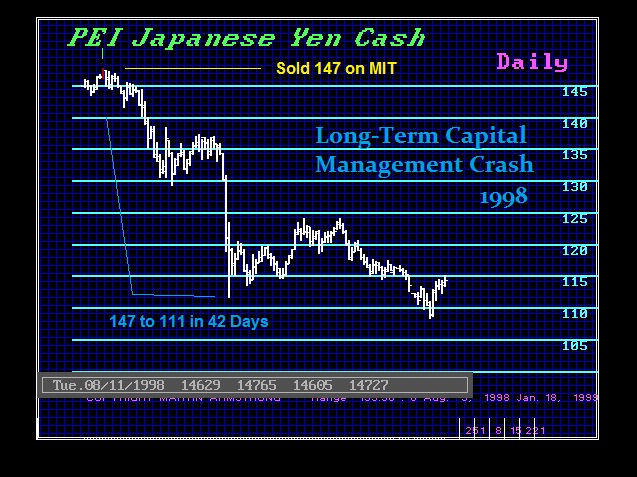
When I shorted the markets for the Russian collapse that manifested into the Long-Term Capital Management Crisis, that was easy to initiate. The hard part came when to take profits and reverse. I sold $1 billion against the Yearly Bullish Reversal in the yen at 147 and had to cope with a contagion that hit every market contrary to all fundamentals. It was a liquidity crisis so everything was sold without logic.

The Japanese yen fell to 103. I covered all my shorts in everything, flipped, and then left the office. It was a gut-wrench trade for I was truly alone. I put in my stops and it would work or not. Very black and white. This was a discipline that I knew I had to walk away and not second guess myself, which would be a disaster. The market would decide. The New Yorker Magazine reported:

“The hedge-fund manager who used to work for Armstrong remembers him coming out of his office in September, 1998, two months after he’d got short in front of the ruble crisis. Monica Lewinsky was on TV. “My oscillators just turned,” Armstrong announced. He booked his profits, pulled out of the market, and went to his beach house, on the Jersey Shore.”

I traded through many crashes. It was that EXPERIENCE that I drew on. Sometimes you just have to fight your emotions to go against the majority. They will all think you are insane. But the majority will also be wrong. This is not an easy thing to do when you are managing other people’s money. What is critical to trading is to see HOW someone acted in the middle of a panic. Were they calm? Did they join the majority or comprehend what was really at stake?


DeutscheBank-1


My drawdowns were less than 2%, which is unheard-of. Many people dubbed me the “legend” I supposed for trading. The best way to make money is to REDUCE your trading activity.  All the analysis starting funds found that 22% of emerging manager funds made a loss in their first year of trading. They are also more volatile and represent the risk of significant losses to investors. It takes a seasoned trader with a global perspective to survive. Someone who keeps their head in the middle of a panic. At the same time, a fund that grows in size too large, cannot trade like a small fund. Returns tend to decline with size, not expand.


Investors are regularly reminded that past performance is NO guarantee of future results, but track records continue to play an important role in manager selection. One reason for this is the
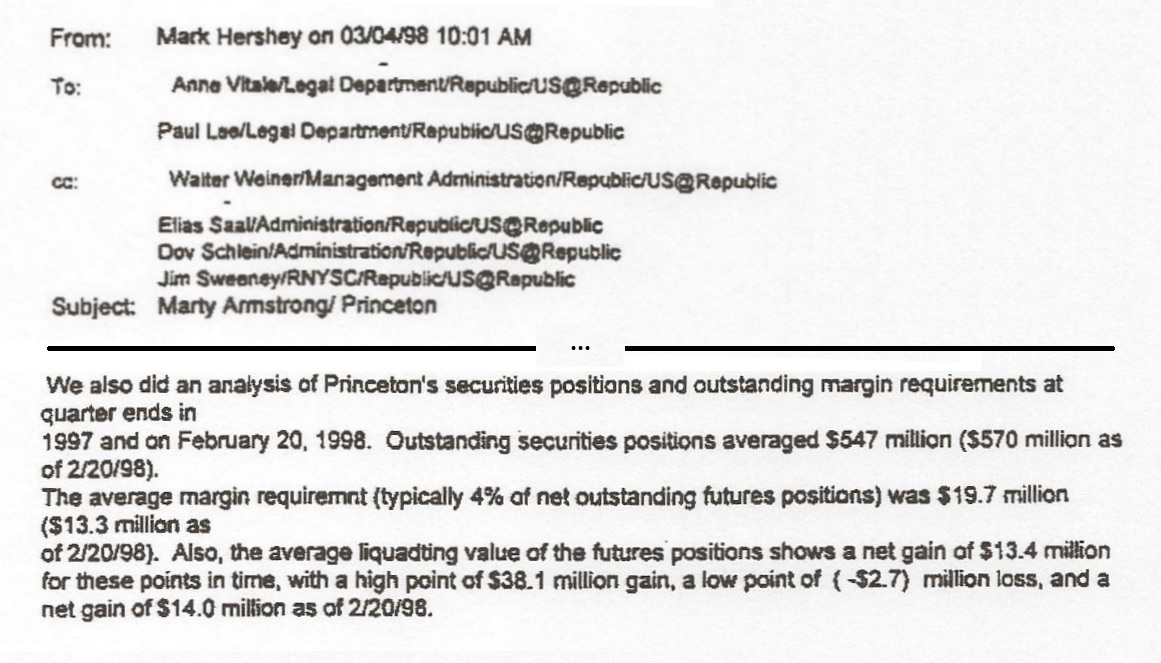
evidence of their decision making and survival. Here is an audit from Republic National Bank showing again the drawdown max for 1997 was $2.7 million compared to $38.1 million gain and I used only 4% of the cash for margin. You cannot guarantee the return made one year will be repeated the next for the basic reason that volatility rises and declines from one year to the next. Even the indexes do not perform the same from one year to the next.

However, a track record reveals something much more important. How did someone respond to abrupt market movements? Did they get out in advance? Did they just panic and follow the crowd? How quickly did the abandon a losing trade? This is where the seasoned trader comes in.

Many people dream of being a hedge fund manager and yearn to cut their teeth on other people’s money. If he puts forth trades that are hypothetical, does he have the courage of his convictions to trade in a flexible manner or refuse to admit when he is wrong? There is so much more to selecting a fund manager than meets the eye. The best hypothetical track record means nothing. Do they have the courage to actually trade?

We will be setting up a forum for our clients who are subscribers to Socrates run by people who have used the models for more than 20 years. You will be able to ask questions there that will be answered without soliciting you for money. We have a couple of major banks with EXPERIENCE in trading who we are looking at allowing our models to be used formally to prevent others from trying to solicit people using our track record pretending it is theirs.

I have stated I am not interested in returning to funds management. That is a job which is 7 days a week and you have to be on call 24 hrs a day. I still have a hard time sleeping more than 3 hours straight. I greatly appreciate all the offers and understand that the track record of the fund I managed for Deutsche Bank remains probably the best ever.  Nonetheless, we all have our shelf-expiration dates and I just have no interest in going back to that lifestyle – been there done that!

I will make an effort to find the right firm who I believe is seasoned to survive the chaos ahead because what lies ahead will be far greater than most are even capable to trading. We are entering a period of extreme volatility on just about every front. This will indeed try the character and soul of the best funds manager. So please do not listen to anyone who claims to have mastered our model. Emotions will override any model if they are not a truly seasoned trader. A lot of people think they can become rich as a hedge fund manager. It takes a hell of a lot more than simply a few good trades.

The Dow v S&P500 v NASDAQ – What’s the Difference?


QUESTION: Dear Mr. Armstrong


Why do you always use the Dow Jones Index? It seems to have the least logical construction of the major indices. Why not use the S&P500?

Many thanks for your informative and thought-provoking blog,

G

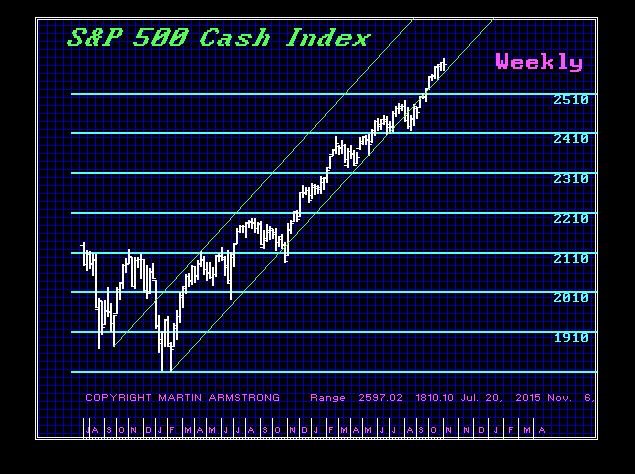
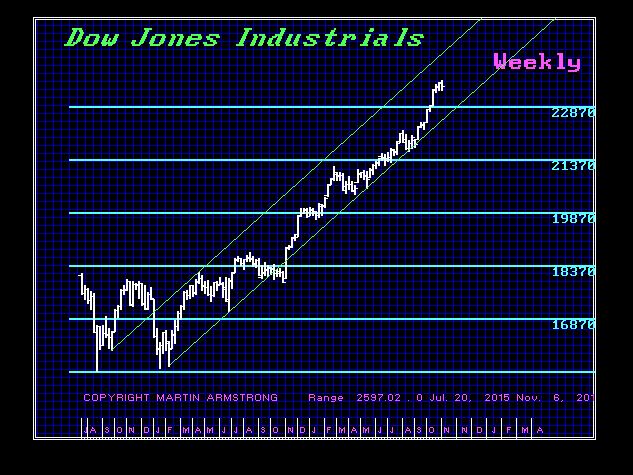
ANSWER: Each index offers a completely different perspective. The Dow Jones Industrials is the “big” money. You will notice that this index leads the way. It is the first out of a key low because it is typically the foreign capital that comes in based on currency. You will also notice it tend to top out first because the big money tends to start to pull out first also due to currency.

The S&P500 is domestic institutions and this tends to reflect the more serious money in the market.

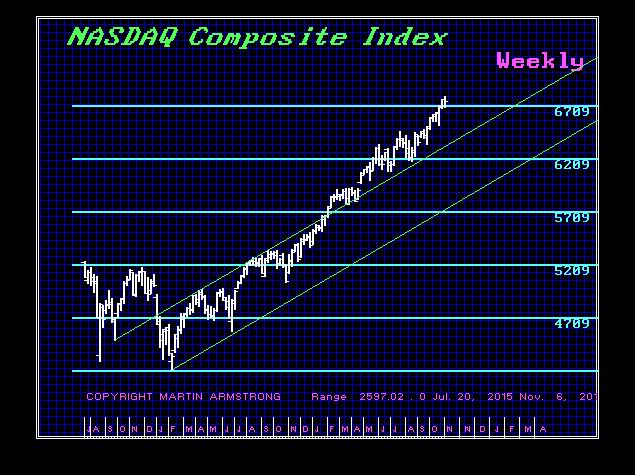
Last, but not least, is the NASDAQ. This is the retail market. You will see this is the last to peak and is the one that gets the retail all hot and bothered.

Each index has its place and reflects a different segment. The foreign capital always buys the big names. That is why the Dow is very important. It is also where big money parks in crisis.

Lithium – the new White Gold


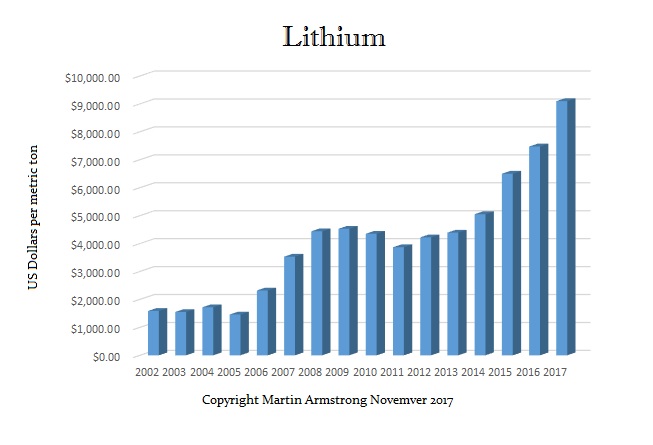
Lithium is known and “white gold” since electric cars require a lot of batteries. This has resulted in transforming the metal into a valuable and sought-after commodity. The demand keeps rising as there is a need for energy storage that can only be produced if lithium is available in sufficient quantities.

The price has soared from $1,550 to $9,100 a metric ton. This interesting metal was once used as a treatment for brain disorders. It was also the title of a song by Nirvana for its effect on the brain. Lithium is often found in salt flats when water repeatedly evaporates from a shallow lake, leaving behind a crusty layer of salt minerals. Consequently, Lithium is unique because it is the lightest known metal.

During the 1790s, it was a Brazilian naturalist who discovered the mineral called petalite on an island in Sweden. Then in 1817, a chemist in Sweden discovered that petalite contained a previously unknown element. He was able to isolate one of the salts, but he could not isolate the mineral itself. Nevertheless, he gave it its name – lithium, which meant “stone” in Greek.

Finally, 1855 a British and a German chemist were able to separate the metal from the salts. Once this was accomplished, commercial production of the lithium metal began in Germany in 1923. Because it is so light, it is known for its wide use in batteries.

The latest story involved a pair of exploding headphones on a plane. That incident came after the Samsung’s Galaxy Note 7 recall of their phones, which ended that line. You can’t chalk it all up to incompetence, either. At the famous Jet Propulsion Laboratory, a robot named RoboSimian blew-up thanks to a lithium battery. So what is so dangerous? Inside, there is a thin and porous slip of polypropylene that normally keeps the electrodes from touching. If that separator is breached, the electrodes come in contact, and things get very hot very quickly. So why even use them? Lithium-ion batteries are indeed the most efficient battery. They hold an amazing amount of energy in a tiny package that is light. They can keep a laptop running all day.

They have been used in batteries going back 25 years ago by Sony. However, they seem to get more volatile as time goes on because we are pushing the envelope. We want lighter products to last longer and they have to be cheap.

Devices containing lithium metal or lithium-ion batteries (laptops, smartphones, tablets, etc.) should be carried in carry-on baggage. Most airlines will not allow you to check them in baggage.

The Hunt for Taxes Destroying Healthcare in Britain


The Hunt for Taxes is now creating a crisis in healthcare in Britain. The UK government is gearing up for a massive tax clampdown targeting private sector contractors. The UK Treasury estimates in its budget that this taxing of private contractors in healthcare will create £185m in new taxes for the year 2017/18. This is known as the IR35 regime, which will apply to hundreds of thousands of freelancers outside the public sector.

At the core of this is the issue where someone who is incorporated pays less tax and national insurance than an employee on the same income working freelance under contract. Many suspects that this is just a test run and the government will extend the tax increases to the private sector in a year.


Because most are freelance contractors in the Public Sector healthcare, there is an immediate decline in patient care standards in NHS due to this hunt for taxes under IR35. UK healthcare is deteriorating rapidly. A survey of 450 healthcare locums by ContractorCalculator and the Independent Health Professionals Association(IHPA) has revealed that the NHS is failing to replace critical contract workers who have been forced out of the sector due to IR35 and questionable compliance procedures. It’s all about taxes.

And so many people in the USA think that public healthcare is free in Europe and so much better, they are just victims of propaganda. There is a major crisis unfolding in the British healthcare system all because of the hunt for taxes.

Remaining EU Member will have to pay 15% More upon BREXIT


QUESTION: Mr. Armstrong; All the news here in Britain is always how bad it will be if we leave the extortion ring in Brussels. You have mentioned that we are the biggest market for German cars. What will Brexit do to the EU?

Thanks

GD

ANSWER: Once the British exit from the EU “extortion” ring as you call it, the remaining nations will have to pay more than an additional €10 billion euros to keep Brussels floating in jobs and exorbitant pension. Besides the German auto-industry being clipped for political reasons as the EU punishes Britain to act as a deterrent to prevent others from leaving, Germany’s proportion of making up the shortfall from BREXIT will be almost €4 billion. With BREXIT, everyone will have to contribute an additional 15% so they can do nothing but make more miserable in Europeans.

European Parliament President Antonio Tajani calls for a doubling of the budget of the European Union. “We need twice as much money as today, so 280 billion euros instead of 140 billion euros per year,” said Tajani the spark newspapers. The doubled EU budget should not be financed by additional transfers from the Member States, but by the introduction of taxes.

“This will require new EU own resources, such as a financial transaction tax on stock exchanges,” Tajani said. The President of the European Parliament justified his initiative with the costs of dealing with the refugee crisis and the fight against terrorism, as well as the increased need for investment. “Europeans must invest more in energy and digitalization of the economy in the future,” the Italian said. Only in this way could the EU compete with the US, China, India or Russia in global competition.

The EU Parliament is currently negotiating with the finance ministers of the EU governments for the Community budget for the year 2018. The EU parliament demands funds of 146.7 billion euros for the coming year – 2.3 billion euros more than the finance ministers want to make available.

Almost 80 percent of the EU budget is covered by the contributions of the member countries, the remainder comes from so-called own resources of the EU – these are mainly customs revenue. Germany, the largest net contributor, contributes just under 20 percent to the EU budget.

On top of that, European Parliament President Antonio Tajani has called for a doubling of the budget of the European Union. Since the EU cannot issue debt, that means the doubling of the EU budget should not be financed by additional transfers from the Member States, but by the introduction of taxes. They are looking at increasing the tax burden even more on Europeans in the Eurozone.

The EU wants to impose its own tax resources, such as a financial transaction tax on stock exchanges. This is being justified, believe it or not, to cover the costs of dealing with the refugee crisis and the fight against terrorism as they claim. They are right now negotiating with the finance ministers of the EU governments for the Community budget for the year 2018. They now want 146.7 billion euros for the coming year – 2.3 billion euros more than the finance ministers want to make available. Brussels knows how to spend money. Almost 80 % of the EU budget is covered by the contributions of the member states. The rest is primarily customs revenue. Germany, the largest net contributor, contributes just under 20 percent to the EU budget.

Is the Dollar Really a Petrodollar anymore?


QUESTION: Mr. Armstrong; I want to thank you so much for shedding light on what can only be deranged forecasts on the dollar and gold and never change regardless of how much money they lose people year after year. I received this email with the headline How Much Longer Can the Petrodollar Survive? They claim that now adversarial nations like “China, Russia and Iran” are threatening the petrodollar hegemony by establishing their own trading and banking infrastructure that excludes dollars for trade. Suddenly Iran is now a world power and as you said at the conference, the dollar support is not trade or oil, but where big money parks.

My question is, just how can these people sleep at night putting out false information all the time? Isn’t that what the investment banks pled guilty to putting out false forecasts to support their own positions during the Dotcom bubble?

ANSWER: Yes, you are correct. It is one thing to put out analysis that is unbiased and it is raw corruption to put out forecasts that support your own investments creating a conflict of interest. It would not be a criminal act as long as they disclose what their portfolio is. Only the government gets a free get out of jail card for fake forecasts.

The decline in commodities was was due to a number of factors, including an economic slowdown in China, a severe recession in Brazil, with falling prices for oil and other commodities, and exchange rate volatility that saw the dollar rise. Despite positive growth in trade volume terms, the current dollar value of world merchandise exports declined by 14% in 2015, to US$ 16.0 trillion, as export prices fell by 15%. Even the dollar value of world commercial services exports also fell 6% in 2015 to US$ 4.7 trillion, although the decline was less severe than for merchandise.

All these claims that the “petrodollar” is going to collapse are just a total joke. Oil is less than 10% of world trade. These people are living in the ’70s. Hey, cut the hair and get rid of the bell bottoms. It’s 40+ years later!

There is not even an attempt to be a true honest analysis of the subject. Just look at the figures. The oil and gas drilling sector make up between 4.6% and 6.5% of the global economy.  The FX market DAILY trading volume is about $5.3 trillion which dwarfs the equities and futures markets no less oil and gold.

The support behind the dollar is (1) it can be used worldwide without permission from the USA as is the case with the Japanese yen. It is a single currency with a single federal debt market where BIG money can park – that is not the case for the Euro, Ruble, or Yuan. The Iranian Rial has gone through major inflation. It will be devalued and called the “toman” despite the aliollah Seif, the governor of the Central Bank of Iran (CBI), who confirmed that the CBI has sent a bill to the government requesting the removal of a zero from the currency to reflect the public’s use of the term “toman” to refer to 10 rials. Any revaluation must wait until inflation has stabilized. And this is the currency that will dethrone the dollar? Give me a break!

Ethereum Cryptocurrency – Almost $400 Million Vanishes


Thanks to a string of screw-ups and bugs, an unsuspecting developer recently took possession of an estimated $US390 million worth of the Ethereum cryptocurrency by accident. In an attempt to give back the money, however, the guy ended up locking up the funds permanently. Essentially, the money has just evaporated.

It turns out that hackers started the trouble getting into the cryptocurrency wallet service stealing about $42 million. To then patch the vulnerability to their block-chain technology, they introduced a bug that affected multi-signature wallets. These are wallets which require several people to enter keys before funds get transferred. This was intended to be top security for Ether which is the second largest cryptocurrency. Somehow, a guy called “devops199” triggered the bug and took control of all multi-sig wallets unintendedly. Then devops199 attempted to reverse the process to give back the money which then triggered they bug. The result was the destruction all of the funds. The bug caused a chain reaction of events that locked all multi-signature wallets that cannot now be unlocked.

Welcome to the world of Cryptocurrency.

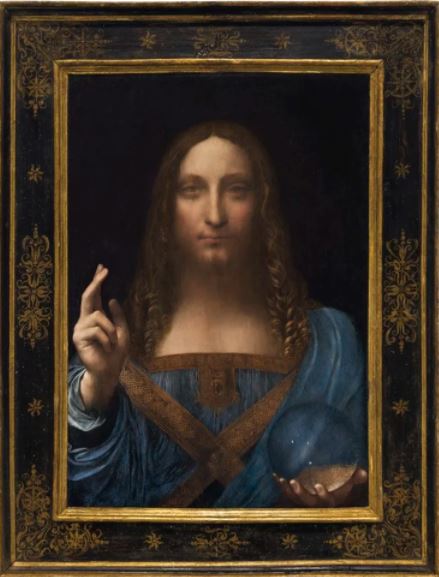
Leonardo da Vinci’s Salvator Mundi sells for record $450m


Leonardo da Vinci’s 500-year-old painting known as Salvator Mundi (Saviour of the World) is the only work in private hands. It just sold at Christie’s auction room in New York for a record $450m – almost half-billion. The painting apparently once belonged to King Charles I of England back in the 1600s. The last time it was sold at auction was 1958 when it was sold in London for a mere £45. At that time, it was generally believed to have been the work of a follower of Leonardo rather than the work of Leonardo himself.

The painting was sold by the family trust of the Russian billionaire collector Dmitry E Rybolovlev, who is reported to have bought it in a private sale in May 2013 for $127.5m. So that’s a pretty good profit. It is the highest auction price ever paid for any work of art.  There are fewer than 20 of Leonardo paintings in existence. The Salvator Mundi, is believed to have been painted sometime after 1505. The bidding began at $100m and the final bid for the work was $400m, with the buyer’s premium, the full price up to $450.3m. The unidentified buyer was involved in a bidding contest, via telephone, that lasted nearly 20 minutes. The mystery buyer hopefully lives outside of New York so that avoids the sales tax. Purchases above $110 are subject to a 4.5% New York City Sales Tax and a 4% NY State Sales Tax. That makes anything bought in New York City subject to a total Sales and Use Tax of 8.875%. What is astonishing, is that with taxes, rates rise with the more people. That is counter to capitalism which dictates that prices decline with scale. Government costs rise with the scale showing something is just not right!

Obviously, this is serious money still moving off the grid!