Government Confusion = Incompetence (Politics v Bankers)


QUESTION: Dear Martin Armstrong

About The post, “Is There a Way Out of This Financial Mess? “
In the second last paragraph you write, “Taxes have risen as deficits expand because government thinks inflation is the danger.” Link:
Shouldn’t that be Deflation?
Thank you for doing what you do.
U


ANSWER: No. I agree it makes no sense but logic is not a talent of government. You have central banks trying to stimulate by increasing the supply of money, but then you have politicians worried about their deficits and being criticized so the they raise taxes. The two placed in the same room could never have a true dialog of any meaning.

The bankers are worried about deflation and the politicians, like Merkel, are worried about inflation. It is confusing, but hey, anyone who actually thinks electing people without trading experience is the way to run an economy should ask the parking attendant who parks a car if they are free to fix a cavity in your tooth.

Identifying Complexity


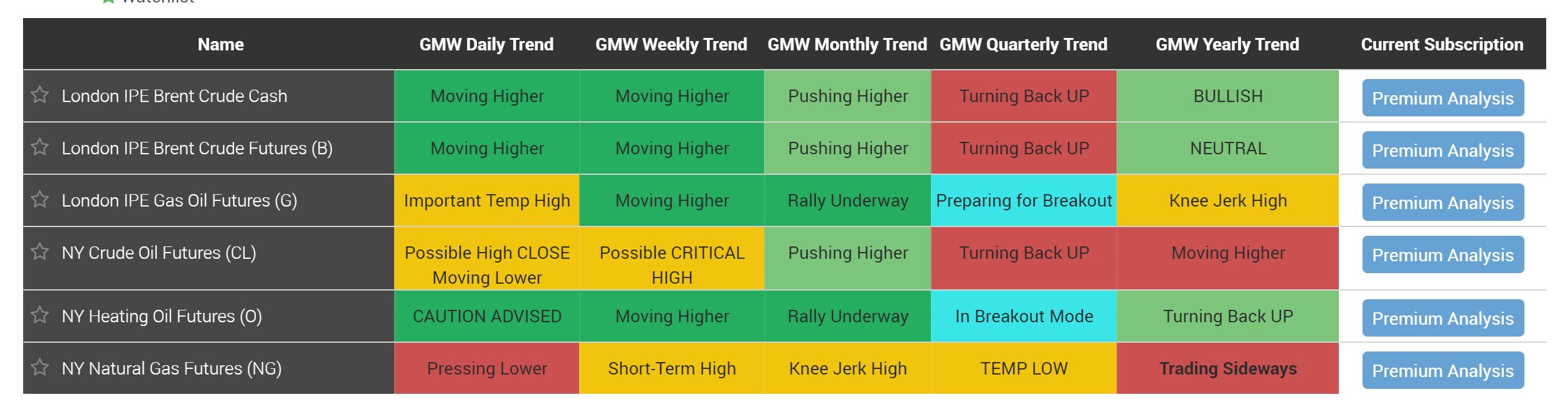
QUESTION: Marty, I have followed your Global Market Watch and it is really amazing. I notice on IPE gas it came up and warned it was about to breakout to the upside. You said this is purely a pattern recognition system. Are there patterns that precede events and this is what your model is picking up on?

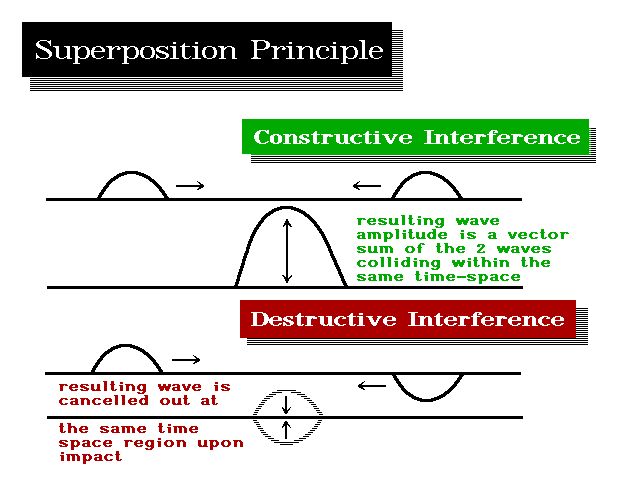
great-waveANSWER: In many fields there are these sudden Phase Transitions which are extreme events. I have explained that sailors always told of rogue waves that rise up from calm waters and sink ships. The rogue wave appears out of nowhere in the eternal sea of global economics just as it does the oceans of the world. They are caused by the synchronization of many trends suddenly coming together to produce a giant wave.

There is an instability inside a gas turbine that suddenly appears, or a sudden extinction of a previous ecosystems – mass extinctions of which there have been five so far with another one due probably at the end of the next 309.6 year cycle in the 2300-2400 time period.

These extreme Phase Transitions or extreme events occur without warning to the untrained eye. It’s often impossible to predict when such bursts of instability will strike in markets where there are a huge amount of variables from news to players from a human perspective. The GMW identifies key patterns that precede an extreme event. The framework is being applied to all markets and economies and allows us to see things through complexity that the human eye will never see.

Is There a Way Out of This Financial Mess?


We need to open the door to the future but that is only possible by understanding the past. Paul Volcker back in 1979 in his Rediscovery of the Business Cycle “Not much more than a decade ago, in what now seems a more innocent age, the ‘New Economics’ had become orthodoxy. Its basic tenet, repeated in similar words in speech after speech, in article after article, was described by one of its leaders as ‘the conviction that business cycles were not inevitable, that government policy could and should keep the economy close to a path of steady real growth at a constant target rate of unemployment. … But it was not until the events of 1974 and 1975, when a recession sprung on an unsuspecting world with an intensity unmatched in the post-World War II period, that the lessons of the ‘New Economics’ were seriously challenged.”
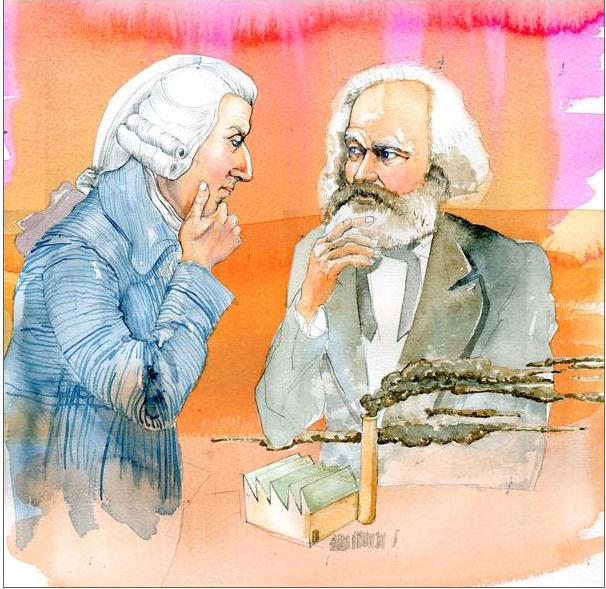
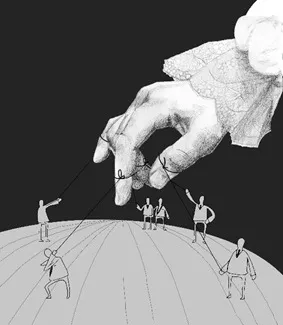
It gives me no please to point out all out problems. My objective is straight forward. If we understand what is unfolding and why, then we can apply the correct solutions rather than turn toward more government authoritarian control. Make no mistake about this, we are in a battle for our freedom. This era of “New Economics” was set in motion by Karl Marx who advocated that government could control the economy and thus create Utopia. While Russia embraced the Communism of Marx, the West adopted his position trying to be just a little bit pregnant. We rejected everything that Adam Smith discovered and the Invisible Hand, rushing into Socialism for it empowered government rather than the private sector and Laissezfaire.

Our crisis therefore originates with government. Of course we need government which provides a stable rule of law and is benevolent rather than authoritarian. This is a battle to the death of Marxism which in all its various flavors empowers government which seeks to turn people against one another in order to retain power. Because government just keeps growing consuming an ever larger portion of GDP, it has sharply reduced economic growth which is now colliding with the new age of technology reducing employment. Constantly arguing class warfare and pretending that they can raise the minimum wage as if this will somehow benefit society, only furthers the dangers we face ahead. The rising taxation upon labor creates the incentive to replace workers with robots. Even the government is trying to replace soldiers with robots. This is a trend that is on all sides. Russia has its robot soldiers, and the USA has been following suit. Using drones carrying machine guns is a dangerous development for they can be turned against the people in civil unrest. Those who think that would never happen need only look at Barcelona where the Madrid government just sent in 16,500 soldier to invade Catalonia  and stop any Independence Referendum.

Unfortunately, we are in a battle for our freedom and that of our posterity. Governments are broke. Everything is moving against them from every possible angle. They borrow with no intentional of paying anything off and are blind to the trend they have been caught up in. How can we make them see that this is not going to work nor will it end nicely?
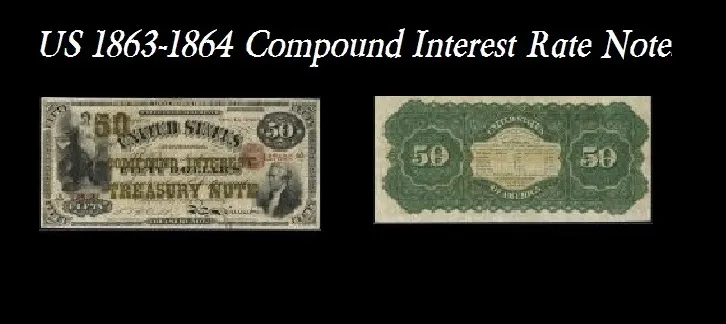
We need to stop the borrowing, we need to drastically reduce the size of government and various departments should be PRIVATIZED because government is incapable of managing anything. At least then any pensions offered would actually be there for private companies cannot default and then refuse to prosecute themselves as does government. There is simply no checks and balance when prosecutions are a political decision and judges are political appointments. When paper money first began, it paid interest to entice the people to accept it. Then we adopted the idea put forth in this New Economics was that government could “stimulate” by borrowing and that would be less inflationary than printing. This became the Quantity of Money Theory, which has been proven to be complete wrong.
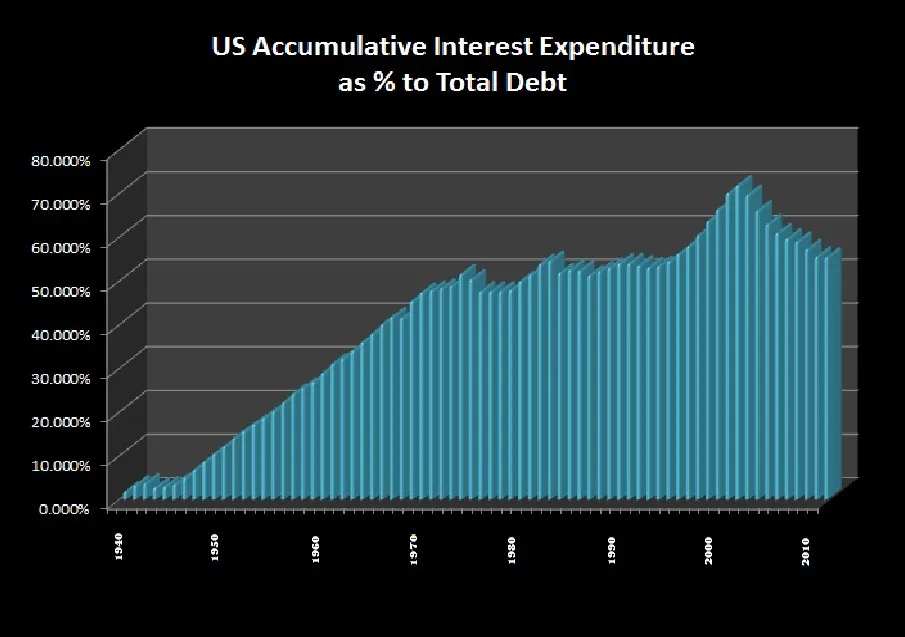
While Draghi has expanded the money supply for almost 10 years, deflation has prevailed.  This entire idea of borrowing would be less inflationary is just insane. We have reached at time 70% of the entire national debt was composed of accumulative interest expenditures. So the money never went to build roads, schools, or help the poor as politicians pretend. So we are only fooling ourselves. Taxes have risen as deficits expand because government thinks inflation is the danger. They have been systemically reducing the standard of living and job creation.

Until we are ready to review this theory of “New Economics” and deal with it, our future is doomed. If we cannot start a dialog, there is no hope. The press is bought and paid for and is no longer truly free to protect our rights. There is hope, but only if we start to push the right issues.


Germany To Tax VAT Just Billing People Before they Pay


The German government is desperate for money and what they are doing now is just unbelievable. Germany is looking to order companies to prepay VAT tax before they even collect it.  Companies in Germany will now have to pay the VAT immediately to the government on any amount they have billed to a customer. This is very drastic. Normally, someone who pays a bill in installments would pay the VAT on that amount that they pay. Under this new scheme, the company must pay the full VAT tax before they get the money. Even a sports contract would require paying the VAT on the entire contract which may be for 5 years up-front.

European Banking Crisis


Perhaps this period will be looked back upon as the Draghi Deflation. After nearly 10 years of this failed policy, the European banking industry is contracting on every possible level. The merger of Commerzbank to Merge with French BNP is one possibility. Commerzbank is a takeover candidate or shotgun wedding candidate, for good reasons. Its shares have fallen and are trading now at half their book value. When interest rates rise to bring back deposits, then the bank could perhaps get out of its deep hole. The German government, which has a 15 percent stake after a bailout in 2009, is ready to sell looking to raise cash itself.

The Draghi era of negative interest rates has proven to be a complete disaster. People have withdrawn money and preferred to buy safes. Major banks with branches in the USA have shipped their cash to the American branch and deposited at the Fed in excessive reserves. Meanwhile, with deflation dominating the European economy and rising taxation, the average person is just not interested in borrowing until they see the economy turn around.

On top of these issues, to survive, European banks have been withdrawing from proprietary trading, firing expensive staff with experience, and replacing them with inexperienced kids. Additionally, the low-interest environment and the decline in deposits has resulted in a major contraction in bank branches. As banks also move to online banking, they have been able to reduce staff. In 2016, the banks let go some 50,000 jobs. They were also able to close some 9100 branches throughout the EU, according to the European Banking Association.Consequently, now the banking work force has been reduced to 2.8 million people contracting back to 1997 levels. We will most likely see a further reduction of at least 5% going into early 2018. We will see further mergers and consolidation reducing jobs and branches into 2020.

Commerzbank to Merge with French BNP


According to a the latest spin, the German federal government’s withdrawal from the Commerzbank has left the favored shotgun wedding merger. Commerzbank is the Frankfurt money house which will be merged with the French BNP Paribas. This is being presented as if it were a strong German-French merger which is suggesting that there is a deeper European banking union unfolding. Additionally, they are also going to merge a troubled Italian bank into BNP.

Behind the curtain, the concern is that Commerzbank could not be merged with Deutsche bank because they have the same portfolios that are in trouble. BNP Paribas is about 10 times the size of Commerzbank. Therefore, the real world view is this is just a shotgun wedding rather than a new German-French merger.

Spanish Stock Market Reflects The Bearish Outlook for Spain


The one thing I have always said, markets never lie. The fact that Spain is showing that its government is still fascist is reflected in the performance of the share market. Spain has never exceeded its 2007 high and it is warning that a lower closing for 2017 may just see this market collapse into 2020. We will be looking at Spain closely at the WEC. This chart has been screaming – all is not well in the European project.

Dow High or Low


QUESTION: Hi Martin,

I am confused with the Dow Jones Index, could the index explode up through 23,000 to 40,000 from here or does there need a downward move then explode up through 23,00 (a sling shot).  Could you tell us what you see for the next 6 to 9 months.  Probably the most important investment for us all!
Thank you for all your help!
KC
ANSWER: The cycle is in the basing mode. Therefore, it need not drop sharply. Remaining within the channel is perfectly fine. A Slingshot would be more powerful to retest the bottom of the channel.  The explosion to the upside is still not yet unfolding and we need to be concerned about 2018 and the year-end closing. We will issue a special report to deal with that issue.
Part of the basing is concluding this year from political hell. The German elections are the 24th. Keep in mind that AfD will gain seats for the first time. Merkel has NEVER won a majority and she relies upon the FDP to hold power. The more the FDP declines and seats are taken by the AfD, the more chaos will unfold.

Central Banks Investing in Equities


QUESTION: There is a new trend that central banks are investing in the stock markets Is this true? What is the impact of this move?

ANSWER: Yes. The reason has been rather straight forward. The only game in town has been US government bonds. Many have seen this as a problem the defeats diversification. Consequently, there has been a major effort to attempt to diversify into the private sector when there has been such uncertainty in the public sector. Behind the Curtain many are simply asking of Europe: What the hell is going on? This has been a “euro crisis” that simply never seems to end. What has happened to Greece, Portugal, Italy, Spain, Holland and now even France. Many outside of Europe are simply asking has Europe just lost its mind? Hence, there has been a move to diversify out of government debt by central banks themselves.

Louvre Accord v Plaza Accord


QUESTION: I notice you often cite the *Plaza Accord* when on the topic of central bank currency manipulation. That accord was signed in 1985 with an aim to devalue the USD. Could you write a little on the *Louvre Accord” signed just two years later, in 1987, with an aim to reverse the unwanted effects of the *Plaza Accord*. Thanks – cheers,

TGM

ANSWER: The Louvre Accord was an agreement, signed on February 22, 1987 in Paris, that aimed to stabilize the international currency markets and halt the continued decline of the US Dollar caused by the Plaza Accord. The agreement was signed by France, West Germany, Japan, Canada, the United States and the United Kingdom. Italy declined to sign the agreement.

The G7 meeting of central bankers and finance ministers in Paris announced that the dollar was now “consistent with economic fundamentals.” The announced that they would only intervene when required to ensure foreign exchange stability. The objective was then to manage the floating currency system. Democrats gained control of Congress in 1986 and immediately called for protectionist measures. The dollar depreciation agreed to in 1985 at the Plaza Accord, failed to really improve the trade perspective. In 1986, the trade deficit actually rose to approximately $166 billion with exports at about $370 billion and imports at about $520 billion. The object of manipulating currency to try to create jobs and alter trade flows proved to be completely false.

My concerns warning that volatility would increase made back in 1985 were materializing. What they did not understand was the lowering the dollar in value also led to a shift in capital flows and the selling of US assets. Foreigners were suffering loses by financing U.S. trade through purchasing United States Treasury bonds in an attempt to ease the trade deficit criticism. We were advising Japanese to buy gold on the New York COMEX, export it, and then resell which would also make it appear that the US exports were increasing. However, the lower dollar was then resulting in the importation of inflation into their own nations.

We can see that first of all the dollar had already begun a decline prior to the Plaza Accord in August 1985. By the time we arrived at the  Louvre Accord, you can also see that the dollar continued to decline. The attempt to manipulate the foreign exchange markets proved to beyond the capacity of the G5 which had been expanded to G7 and today is now G20. We can see the capital flow data between the USA and Japan began to move in early 1984 establishing the trend that nobody seemed to pay attention to at that moment.

The price action of the dollar clearly proves that the central banks lacked the power to truly influence the markets. The trend had begun prior to the Plaza Accord and it continued to decline following the Louvre Accord.