East Coast U.S. – Keep Eye on Hurricane Lee, Expected to Become Major Slow Moving Hurricane Today, Still a Week Away


Posted originally on the CTH on September 7, 2023 | Sundance 

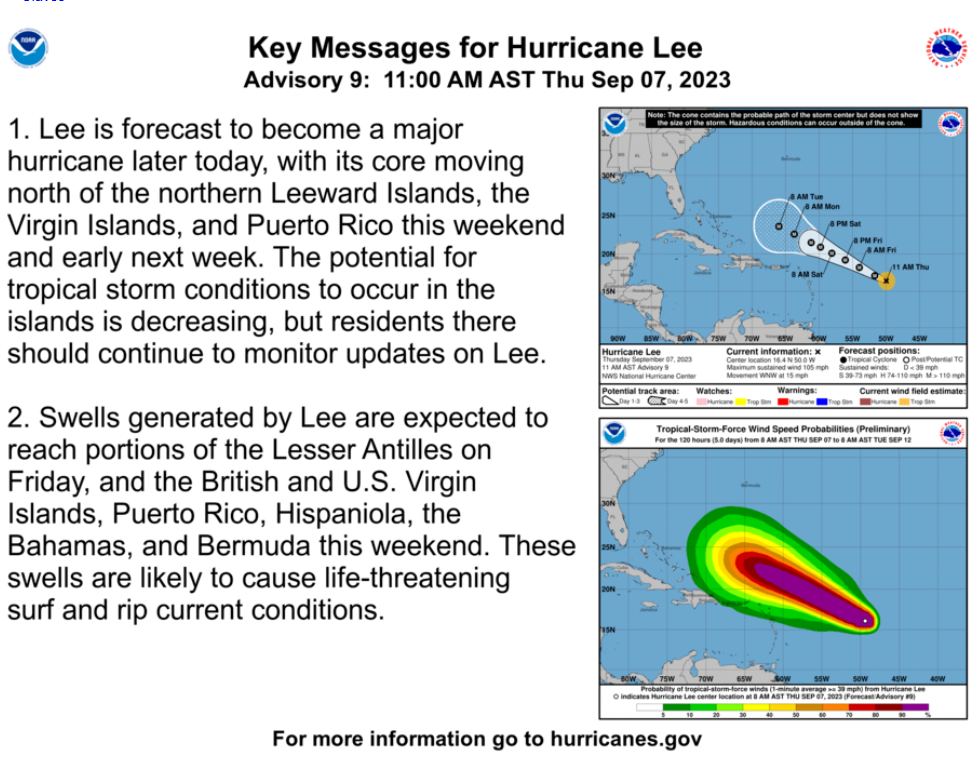
Hurricane Lee is moving slowly in the southern Atlantic approaching the Leeward Islands. [NHC DATA HERE] Residents on the Southeast coast of the USA should monitor. Lee is expected to become a major hurricane later tonight as it moves toward the west-northwest over the next few days.

Hurricane Lee is still a long distance from presenting any immediate risk, but prudent checks and evaluations of your situation should take place.  Keep an eye on the National Hurricane Center for updates.  The storm is not anticipated to be a major focus until mid-week next week.
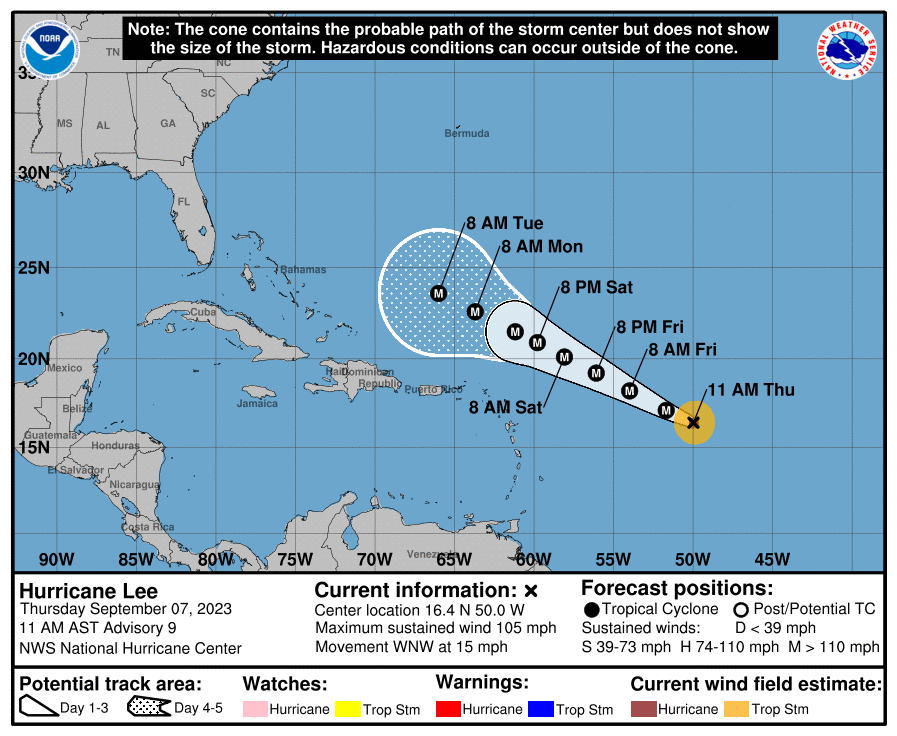
At 1100 AM AST (1500 UTC), the center of Hurricane Lee was located near latitude 16.4 North, longitude 50.0 West. Lee is moving toward the west-northwest near 15 mph (24 km/h), and this motion is expected to continue through Friday. A slower motion toward the west-northwest is forecast over the weekend. On the forecast track,the core of Lee will move north of the northern Leeward islands during the next few days. (link)

Obviously, this is currently a long way from the eastern U.S.  However, coastal residents should keep an eye on Lee and evaluate their pre-existing preparedness plans.
In my last set of proactive suggestions, {GO DEEP HERE} I focused first and foremost on something few discuss, mental capability.  Due to what I witnessed in Hurricane Ian with the people of the area, I am always going to put this into the analysis now to provide consideration that few understand.  I saw Ian literally break strong people down and create a PTSD demographic I have never experienced before.

What follows below are things to consider if you are prepping for a hurricane impact and/or deciding whether to stay in your home or evacuate.  Standard hurricane preparations should always be followed.  Protect your family, secure your property and belongings, and prepare for the aftermath.

What you do before the hurricane hits is going to determine where you are in the recovery phase.

Additionally, and this should be emphasized and discussed within your family, if you cannot be self-sufficient in the aftermath – for any reason, then you should evacuate.  Self-sufficiency in this context requires being able to cope for up to several weeks:

(1) potentially without power; (2) potentially without potable running water (3) potentially without internet service; (4) potentially without communication outside the region; and (5) with limited municipal and private sector assistance.   If you decide you cannot deal with these outcomes, you should evacuate.

Additionally, as a family or individual, you should also honestly evaluate:

(1) your physical abilities; (2) your emotional and psychological ability to withstand extreme pressures; and (3) your comfort in losing daily routines, familiar schedules and often overlooked things you might take for granted.

Post hurricane recovery is fraught with stress, frustration and unforeseeable challenges.  {GO DEEP}

For those in the cone of uncertainty next week, remember, planning and proactive measures taken now can significantly reduce stress in the days ahead.  Plan when to make the best decision on any evacuation (if needed). For now, just keep monitoring the progress of the storm.  As a general rule: take cover from wind – but evacuate away from water.

DAY ONE (_____)

  • Determine Your Risk
  • Make a Written Plan
  • Develop and Evacuation Plan
  • Inventory hurricane/storm supplies.

DAY TWO (______)

  • Get Storm Update
  • Assemble and Purchase Hurricane Supplies
  • Contact Insurance Company – Updates
  • Secure Important Papers.
  • Strengthen and Secure Your Home
  • Make Evacuation Decision for your Family.

DAY THREE (______)

  • Get Storm Update
  • Re-Evaluate your Supplies based on storm update.
  • Finish last minute preparation.
  • Assist Your Neighbors
  • If Needed – Evacuate Your Family

Communication is important.  Update your contact list. Stay in touch with family and friends, let them know your plans. Select a single point of contact for communication from you that all others can then contact for updates if needed.  There is plenty of time to organize your important papers, insurance forms, personal papers and place them in one ‘ready-to-go’ location.

Evaluate your personal hurricane and storm supplies; update and replace anything you might have used. Assess, modify and/or update any possible evacuation plans based on your location, and/or any changes to your family status.

Check your shutters and window coverings; test your generator; re-organize and familiarize yourself with all of your supplies and hardware. Check batteries in portable tools; locate tools you might need; walk your property to consider what you may need to do based on the storms path. All decisions are yours. You are in control.

Consider travel plans based on roads and traffic density. Being proactive now helps to keep any future stress level low. You are in control. If you have pets, additional plans may be needed.

One possible proactive measure is to make a list of hotels further inland that you would consider evacuating to.  Make that list and follow updates of the storms’ progress.

Depending on information next week you might call in advance and make a reservation; you can always cancel if not needed.  It is better to have a secondary evacuation place established in advance.  Being proactive reduces stress.  Even if you wait until much later to cancel, it is better to pay a cancellation fee (usually one night charge) than to not have a plan on where to go.   Trust me, it’s worth it.

Protect your family. Make the list of possibilities in the next few days.

Look over the National Hurricane Center resources for planning assistance.

Deciding whether to evacuate:

• If you do not handle stress well, leave.

• If you cannot be self-sufficient in the aftermath, leave.

• If you choose to stay pay super close attention to the exact path of the storm.  A few miles make a massive difference when you are dealing with the possibility of encountering the eyewall of a hurricane.

This is a fury of nature, a battle where the odds are against you, that you may or may not be aware you are contemplating when you are choosing to stay or evacuate.  It’s not the hurricane per se’, it’s that much smaller killer buzzsaw – the eyewall- that you are rolling the dice, never to see.

When it comes to the eyewall, the truest measure of the “cone of uncertainty“, the difference between scared out of your mind (victim) and a fight to avoid death (survivor), is literally a matter of a few miles. And there ain’t no changing your mind once it starts.

♦ Hardening your home is a matter of careful thought and physical work.  However, every opening into your structure must be protected, leaving yourself with one small exit opportunity just in case. Hopefully you have a bolted door with no glass windows you can use as an emergency exit.  If not, select a small window and leave only enough room uncovered for you to get out in case of emergency or structural collapse.

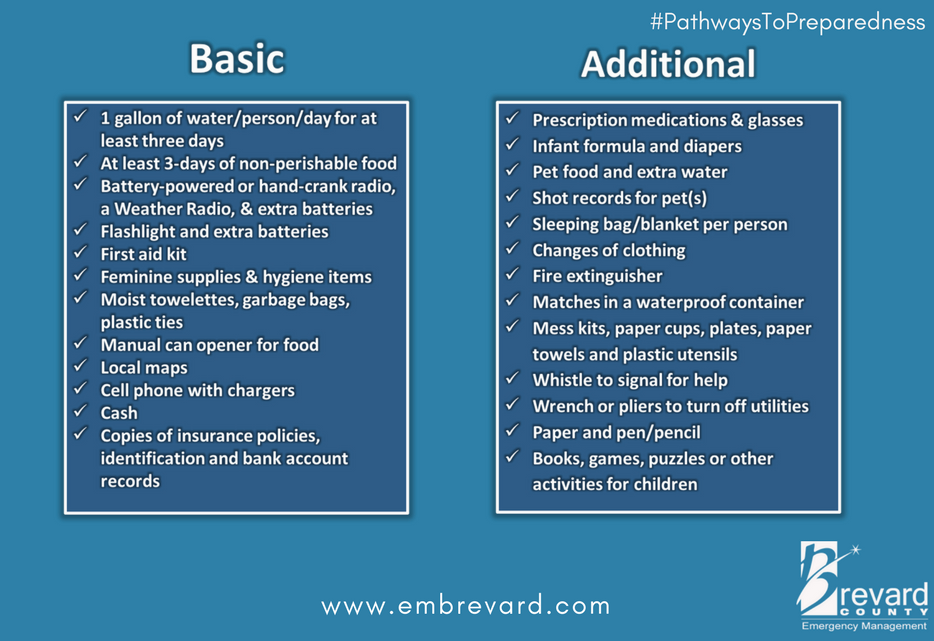
Beyond the ordinary supplies like drinking water, batteries, flashlights, battery or hand-crank radio, generators, gasoline, etc.  Evaluate the scale of what you have against the likelihood of weeks without power or water.   A few pro tips below:

♦ Put three 30-gallon trash cans in the shower and fill them with water before the storm.  This will give you 90 gallons of water for cooking and personal hygiene.  You will also need water to manually flush your toilets.  Bottled water is great for drinking, hydrating and toothbrushing, but you will need much more potable water if the municipal supply is compromised or broken.

♦ A standard 6,500-to-8,500-watt generator will run for approximately 8 hours on five gallons of gasoline.   Do not run it all the time.  Turn it on, chill the fridge, make coffee, use the microwave or charge stuff, then turn it off.  Do this in 4-hour shifts and the fridge will be ok and your gasoline will last longer.  Gasoline is a scarce and rare commodity in the aftermath of a hurricane.  Gas stations don’t work without power.  Check the oil in the generator every few days.  Also, have a can of quick start or butane available in case the generator starts acting up.

♦ Extension cords.  If you are purchasing them buy at least one 50 to 100′ extension cord with a triple ponytail.  This way you can use one cord into a central location to charge up your electronic devices.  Establish a central recharging station for phones, pads, laptops, and rechargeable stuff.

♦ Purchase a box of “contractor garbage bags” and just keep them in the garage.  These are large, thick, industrial trash bags that fit 40-gallon drums. They can be used for trash, or even cut open for tarps in the aftermath of a storm.  These thick mil contractor bags have multiple uses following a hurricane.

♦ Do all of your laundry before the hurricane hits.  You will likely not have the ability again for a few weeks.

♦ Cook a week’s worth of meals in advance of the hurricane. Store in fridge so you can microwave for a meal.  Eating a constant diet of sandwiches gets old after the first week.  Dinty Moore canned beef stew and or Chef-boy-ardee raviolis can make a nice break…. anything, except another sandwich.

♦ Have bleach for use in disinfecting stuff before and after a hurricane.  Also have antibiotics and antiseptics for use.  Hygiene and not getting simple infections after a hurricane is critical and often forgotten.  Again, this is where the extra potable water becomes important.  Simple cuts and scrapes become big deals when clean potable water is not regularly available.  Keep your scrapes and abrasions clean and use antiseptic creams immediately.

♦ Do not forget sunscreen and things to relieve muscle aches and pains.  Hurricane recovery involves physical effort.  You will be sore and/or exposed to the elements.  Remember, it’s all about self-sufficiency because the normal services are not available.  A well-equipped first aid kit is a must have.

♦ Buy a small camping stove.  Nothing big or expensive, just something you can cook on outside in case of emergency.  It will be a luxury when you are 2+ weeks without power and all the stores and restaurants are closed for miles.

♦ Those small flashlights that you can strap around your head that take a few AAA batteries?  Yup, GOLD.  Those types of handsfree flashlights are lifesavers inside and outside when you need to see your way around.  Nighttime is especially dark without electricity in the entire town.  Doing stuff like filling a generator with gasoline in the middle of the night is much easier with one of those head strap flashlights.  Strongly advise getting a few, they’re inexpensive too.

♦ Cash.  You will need it.  Without power anything you may need to purchase will require cash, especially gasoline.  Additionally, anyone you hire to help or support your immediate efforts will need to be paid.  Cash is critical.  How much, depends on your individual situation, but your cash burn rate will likely go into the thousands in the first few days.  Also keep in mind, you may or may not be able to work and without internet access even getting funds into place could be challenging.

♦ Hardware. A box of self-tapping sheet metal screws (short and long) is important, along with a box or two of various wood screws or Tyvex screws.  A battery drill or screw gun is another necessity.  Check all of this stuff during hurricane prep.
ps. Thanks to those who have written and shared their appreciation for the planning prior to Idalia impact. We are blessed and thankful to live in a beautiful world provided by a loving God. Sit with Him, talk to Him, make time for Him. Never lose faith and heed the instinct of your prayer filled gut for your best counsel.

Food For Thought


Armstrong Economics Blog/Climate Re-Posted Sep 6, 2023 by Martin Armstrong

How is it that the government can’t rig elections but they can rig weather by regulation to stop what they call global warming?

Oil Prices Surge After Saudi Arabia and Russia Announce Extended Oil Production Cuts Through End of 2023


Posted originally on the CTH on September 6, 2023 | Sundance 

Oil prices shot passed $90/bbl today after Saudi Arabia and then Russia announced a continuance of production cuts through the end of this year.

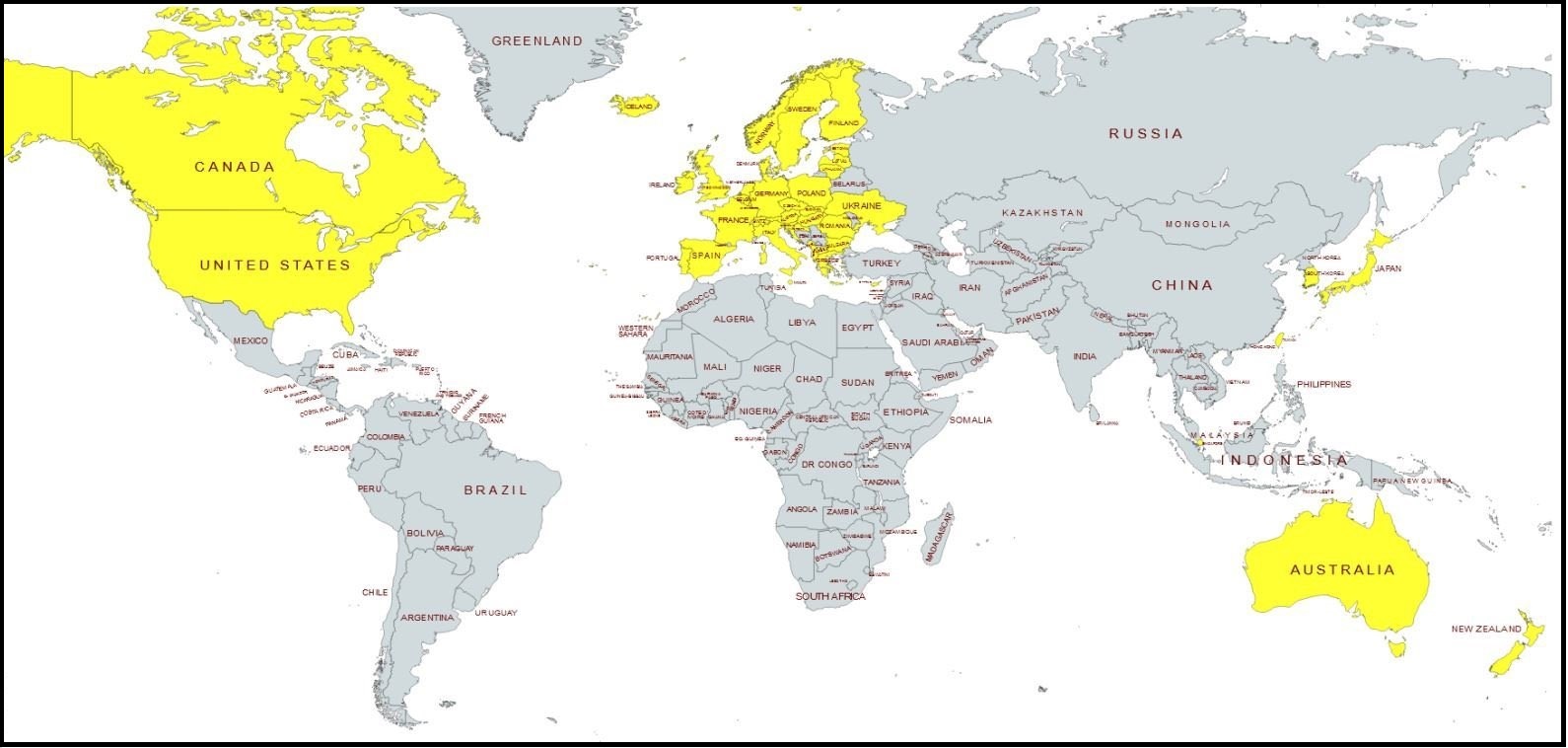
The BRICS alliance is going to deliver some pain to the Western alliance.  Those people living in the yellow zone, with leadership chasing climate change and Green New Deal policies, are going to see more durable inflation as the cost of oil is attached to just about every product and service.

Gasoline, energy products, petroleum products, home heating oil, groceries, everything will cost more as the geopolitical battle continues; but we are supposed to pretend we are unaware of the global political dynamic.

(Zero Hedge) – […] Just after 9am ET, Saudi Arabia said it would extend the voluntary cut of 1 million b/d of for another 3 months, from October until the end of December, well beyond the expectation of just 1 more month. Saudi press agency SPA notes that the voluntary cut decision will be reviewed monthly to consider deepening the cut or increasing production.

The extension of cuts is meant to reinforce the precautionary efforts made by OPEC countries with the aim of supporting the stability of the oil market. The Saudi announcement came a shock to market as 20 of 25 traders and analysts surveyed by Bloomberg last week had predicted the additional cutback would be continued for just one additional month.

And then, literally seconds after the Saudi decision, Russian deputy PM Novak said Russia would also extend its reduction of oil exports until the end of the year, reducing its oil output by 300kb/d in voluntary cuts until December 2023.

Similar to the Saudis, Russia said that the decision to reduce oil production to be reviewed monthly to consider possibility of deepening reduction or increasing production depending on situation on the world market. (read more)

“The U.S. Strategic Petroleum Reserve is empty, my friend”… 

(Yahoo) – […] Higher oil prices are bad news for the world’s central banks, which have been trying to tame high inflation since last year. Energy is a key input for economic activities, so higher oil prices generally lead to inflation.

But Saudi Arabia and Russia’s keeping their oil supply cuts for longer means “they have no interest in what central banks are worried about,” Naeem Aslam, the chief investment officer of Zaye Capital Markets, wrote in a Tuesday note seen by Insider. (read more

.

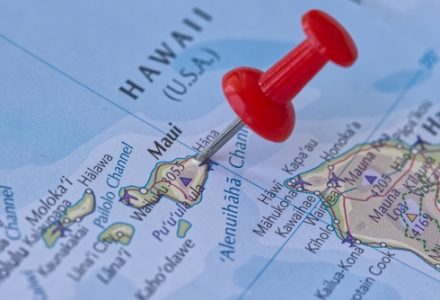
Maui Fires


Armstrong Economics Blog/Conspiracy Re-Posted Sep 4, 2023 by Martin Armstrong

A Series of Unfortunate Coincidences


The reduction of the population has began in Hawaii

US Real Estate Market


Armstrong Economics Blog/Real Estate R-Posted Sep 2, 2023 by Martin Armstrong

QUESTION: Mr. Armstrong, You were the only one who forecasted that real estate would continue to rise in conjunction with the rate increases by the Fed. I have been following you only since 2020 and COVID-19. I am impressed with your computer and your analysis, which does not change with every passing headline. Can you elaborate on the real estate market a bit?

Thank you very much for the education.

FH

ANSWER: The traditional forecast on real estate is always one-dimensional. Homeownership has historically been in the top 5 of surveys about what Americans most want in life. Property values have been rising despite rising high prices combined with higher mortgage rates. There is little sign on the horizon before the ECM peaks in May 2024. Analysts have been confused and caught up in this economic conundrum of the continued economic growth that has defied all their recession predictions.

Normally, housing has been one of the sectors that has been the most sensitive to interest rates. Over the past two years, mortgage rates have risen from less than 3% to more than 7%. That means that the median family today faces mortgage payments that have doubled from roughly 14% of monthly household income in 2020 to nearly 29%  by mid-2023. This is the strongest rise since the economic turm on our ECM when it bottomed in 1985.65.

Nevertheless, the conundrum that has baffled traditional analysts has not led to a decline in house prices as they expected. They paused during the COVID-19 lockdowns and fell in the Blue States, which had the most draconian COVID-19 measures. Currently, housing prices during the second quarter of this year rose at an annualized pace of 15% according to the S&P Case-Shiller index.

There is a tight supply in the South, where much of the migration has taken place. I get, on average three calls a week asking if I want to sell my house here in Florida. The annual sales of property nationally have been around $2 trillion.  Smart institutional investors have been shifting from public unsecured debt to private mortgages. The average person does not look at CPI numbers or GDP numbers. They look at the cost of this rising, and the confidence in the Biden Administration has been collapsing. When people no longer trust the government, they shift to the private sector. So add to that the great migration from Democratic states to the southern red states, and you will see collapsing real estate values in places like San Francisco and Chicago in comparison to even Wall Street, have been quietly moving to the Miami region. There are still buyers in the market and a shortage of supply in the Red States like Florida. Thus, sales have declined, but this appears to be more the result of the decline in supply.

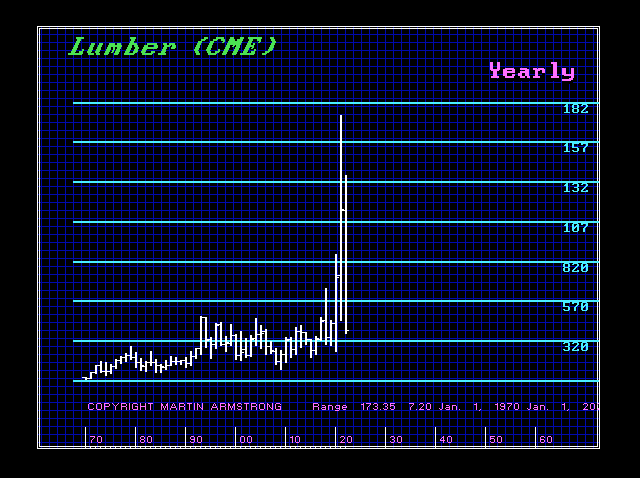
Additionally, the rising inflation in materials means that the replacement cost of homes is often higher than the prices being paid, not to mention the waiting time for construction. The sheer replacement costs of housing have skyrocketed. Even pain was in short supply thanks to the COVID-19 lockdowns. This has impacted the market, and traditional analysis simply never considered that the replacement costs on preexisting houses, in many cases, are 40% to 100% higher. Add to that the shortage in labor. It was very hard to find a contractor in Florida who even was available. Most contractors I talked to were booked beyond 2024.

Newly built homes account for about one-third of active listings in 2023. This was up from an average of 13% over the two decades before pre-COVID-19. Add to all of this is the influx of foreign money looking at US property as a hedge against future wars and destabilization of the monetary system. Then we have had funds like Blackrock buying property and renting them out.

The Most Deadly Storm in History


Armstrong Economics Blog/Press Re-Posted Aug 30, 2023 by Martin Armstrong

Hurricane Idalia – I’m Supposed to be Dead – But I think I Survived


Armstrong Economics Blog/Press Re-Posted Aug 30, 2023 by Martin Armstrong

Thank you for all the emails concerned about the storm and my survivability. If I listened to the news, I surely must be dead, so I am writing this from upstairs. I hunkered down this time. I have had enough of the news for all they do is go to the worst place they can find and stay there. The last storm, I went to Orlando so I could be in the middle of it for it did not touch my house. Then, I did not know if it was safe to drive home, for the news never says anything about the places that are fine. I had to ask a worker in the hotel who said he drives to work each day, and there was no problem on I4.

Mainstream Media is just FAKE news on every subject. All they care about is ratings. They provide no actual public service. This time, I refused to leave, and everything was fine. The water barely reached my wall, and there was no flooding. I have been in far worse storms, even in New Jersey.

My home is a fortress. It is all block – not wood, I am 17 feet up not on the ground, and all the ground around my house is covered in concrete. It would be nice to have a real news agency that would tell the truth without all the hype. I could not believe a girl on Fox News standing on a road in Tampa talking about seeing the storm surge – OMG. It was, at best 3 inches on the road.

Honestly, they offer no public service whatsoever. They focus on the disaster and never tell the full story in anything.

Idalia Now Forecast to Become Major Intensity Hurricane Approaching Florida West Coast Wednesday


Posted originally on the CTH on August 28, 2023 | Sundance 

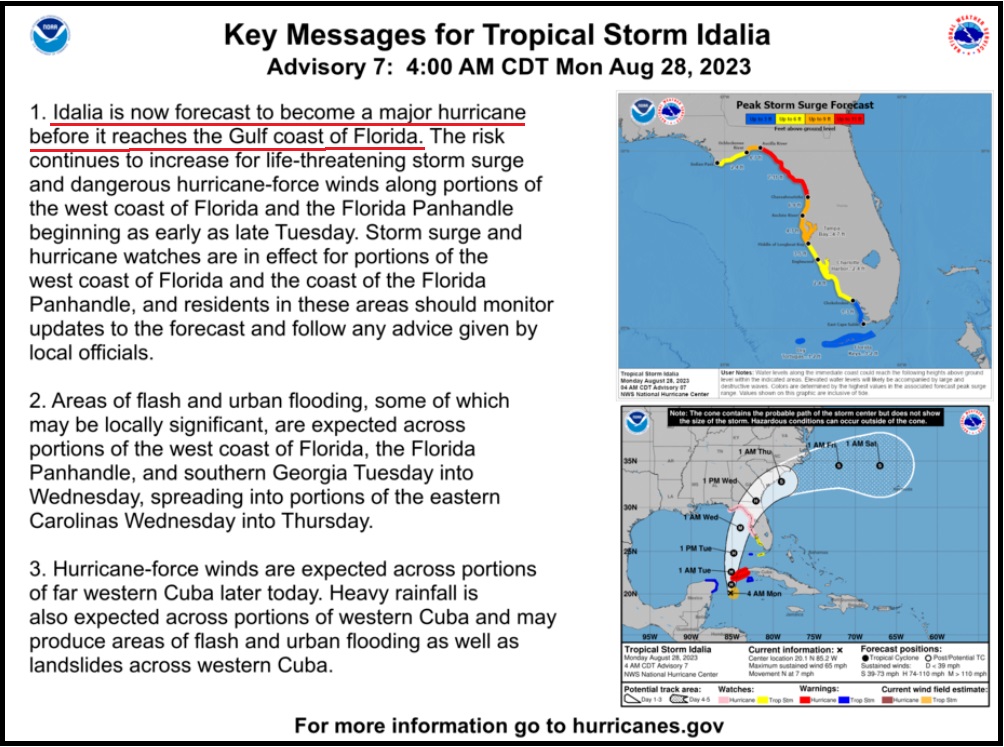
Forecast updates provide a mix of good and bad news. [National Hurricane Center] On the good side, Idalia looks like she will be fast in forward movement as she arrives in Florida.  On the bad side of the updates Idalia will be bigger, stronger, and the faster forward movement means the hurricane will be felt further inland potentially into southern Georgia.  All advance preparations should be moved to completion within the next 48 hours.

Remember, you are in control.  There is no need for panic or dark imaginings. Calm, prudent preparations should be taken if you are in the zone of uncertainty.  Specific interests in the Tampa/St Pete region should be playing close attention.  A a lot of change in impact zone can happen quickly with these northerly moving storms. Storm surge is expected to be significant.

[National Hurricane Center] – ..”At 700 AM CDT (1200 UTC), the center of Tropical Storm Idalia was located near latitude 20.6 North, longitude 85.2 West. Idalia is moving toward the north near 8 mph (13 km/h). A northward motion is expected through tonight, followed by a faster north-northeast motion on Tuesday and Wednesday. On the forecast track, the center of Idalia is forecast to pass near or over western Cuba tonight, over the extreme southeastern Gulf of Mexico by early Tuesday, and reach the Gulf coast of Florida on Wednesday.

Maximum sustained winds are near 65 mph (100 km/h) with higher gusts. Idalia is forecast to become a hurricane later today and a dangerous major hurricane in the Gulf of Mexico by early Wednesday.”.. (more)

Idalia will come fast, now predicted to make landfall as a category 3+ hurricane.  Those in the cone of uncertainty should pay attention, and people in the Tampa and St Pete region who have really lucked out in the past 30 years, should pay very close attention.

I hope you will understand why my proactive tips, advice and planning have modified since our experience with the September 2022 Hurricane, Ian. {Go Deep} Thankfully Idalia is not expected to be anything similar to slow moving Ian.   Prior preparation advice remains solid and follows below.

In my last set of proactive suggestions, {GO DEEP HERE} I focused first and foremost on something few discuss, mental capability.  Due to what I witnessed in Hurricane Ian with the people of the area, I am always going to put this into the analysis now to provide consideration that few understand.  I saw Ian break strong people down and create a PTSD demographic I have never experienced before.

What follows below are things to consider if you are prepping for a hurricane impact and/or deciding whether to stay in your home or evacuate.  Standard hurricane preparations should always be followed.  Protect your family, secure your property and belongings, and prepare for the aftermath.

This is not a message of alarm. This is a message of prudent action that can assist your consideration, as each person evaluates their situation. What you do before the hurricane hits is going to determine where you are in the recovery phase.

Additionally, and this should be emphasized and discussed within your family, if you cannot be self-sufficient in the aftermath – for any reason, then you should evacuate.  Self-sufficiency in this context requires being able to cope for up to several weeks:

(1) potentially without power; (2) potentially without potable running water (3) potentially without internet service; (4) potentially without communication outside the region; and (5) with limited municipal and private sector assistance.   If you decide you cannot deal with these outcomes, you should evacuate.

Additionally, as a family or individual, you should also honestly evaluate:

(1) your physical abilities; (2) your emotional and psychological ability to withstand extreme pressures; and (3) your comfort in losing daily routines, familiar schedules and often overlooked things you might take for granted.

Post hurricane recovery is fraught with stress, frustration and unforeseeable challenges.  {GO DEEP}

For those in the cone of uncertainty, remember, planning and proactive measures taken now can significantly reduce stress in the days ahead.  Plan when to make the best decision on any evacuation (if needed). For now, consider Tuesday night the decision timeframe. As a general rule: take cover from wind – but evacuate away from water.

DAY ONE (Sunday)

  • Determine Your Risk
  • Make a Written Plan
  • Develop and Evacuation Plan
  • Inventory hurricane/storm supplies.

DAY TWO (Monday)

  • Get Storm Update
  • Assemble and Purchase Hurricane Supplies
  • Contact Insurance Company – Updates
  • Secure Important Papers.
  • Strengthen and Secure Your Home √
  • Make Evacuation plan for your Family.

DAY THREE (Tuesday)

  • Get Storm Update
  • Re-Evaluate your Supplies based on storm update.
  • Finish last minute preparation.
  • Assist Your Neighbors
  • If Needed – Tuesday night – Evacuate Your Family

Communication is important.  Update your contact list. Stay in touch with family and friends, let them know your plans. Select a single point of contact for communication from you that all others can then contact for updates if needed.  Today/tomorrow are good days to organize your important papers, insurance forms, personal papers and place them in one ‘ready-to-go’ location.

Evaluate your personal hurricane and storm supplies; update and replace anything you might have used. Assess, modify and/or update any possible evacuation plans based on your location, and/or any changes to your family status.

Check your shutters and window coverings; test your generator; re-organize and familiarize yourself with all of your supplies and hardware. Check batteries in portable tools; locate tools you might need; walk your property to consider what you may need to do based on the storms path. All decisions are yours. You are in control.

Consider travel plans based on roads and traffic density. Being proactive now helps to keep any future stress level low. You are in control. If you have pets, additional plans may be needed.

One possible proactive measure is to make a list of hotels further inland that you would consider evacuating to.  Make that list today and follow updates of the storms’ progress.

Depending on information later today, tomorrow you might call in advance and make a reservation; you can always cancel if not needed.  It is better to have a secondary evacuation place established in advance.  Being proactive reduces stress.  Even if you wait until much later to cancel, it is better to pay a cancellation fee (usually one night charge) than to not have a plan on where to go.   Trust me, it’s worth it.

Protect your family. Make the list of possibilities today, make the booking decision in the next 24 hrs.

Look over the National Hurricane Center resources for planning assistance.

If you do not handle stress well, leave.

If you cannot be self-sufficient in the aftermath, leave.

If you choose to stay pay super close attention to the exact path of the storm.  A few miles make a massive difference when you are dealing with the possibility of encountering the eyewall of a hurricane.

This is a fury of nature, a battle where the odds are against you, that you may or may not be aware you are contemplating when you are choosing to stay or evacuate.  It’s not the hurricane per se’, it’s that much smaller killer buzzsaw – the eyewall- that you are rolling the dice, never to see.

When it comes to the eyewall, the truest measure of the “cone of uncertainty“, the difference between scared out of your mind (victim) and a fight to avoid death (survivor), is literally a matter of a few miles. And there ain’t no changing your mind once it starts.

The worst part of the storm surge will happen immediately to the south of the arriving storm.  The onshore winds will push the water.  Fortunately, with Idalia, it will likely be only one tidal cycle in duration as the storm is moving quickly.

♦ Hardening your home is a matter of careful thought and physical work.  However, every opening into your structure must be protected, leaving yourself with one small exit opportunity just in case. Hopefully you have a bolted door with no glass windows you can use as an emergency exit.  If not, select a small window and leave only enough room uncovered for you to get out in case of emergency or structural collapse.

Beyond the ordinary supplies like drinking water, batteries, flashlights, battery or hand-crank radio, generators, gasoline, etc.  Evaluate the scale of what you have against the likelihood of weeks without power or water.   A few pro tips below:

♦ You can always tell those people who have been through direct hurricane impacts by how they park their cars. If you lose your Florida garage door, you will more than likely lose your roof.  [Example Here] That’s just the reality of having a massive opening in your structure to 150 mph winds that will lift the trusses.

If you have two vehicles, put one vehicle inside the garage with the front bumper against the door to help stop the flex (do this carefully).  Put the other vehicle outside blocking the garage door facing down the driveway or facing parallel to the garage.  The goal is to use the aero dynamics of the car to push the wind away from the door and provide protection.

Purchase a cheap car cover to protect the outside vehicle and/or use old blankets (cable ties, bungee cords) to stop the outside vehicle from getting sandblasted and destroyed.  Place double folded corrugated cardboard in front of the radiator to protect it from storm debris.  [Example: A five-inch piece of asphalt roof shingle sliced through the grill of my truck during Ian and embedded in the radiator like a razor blade. I found it when the truck overheated.]

Additionally, if you live in a flood zone, or if you are concerned about storm surge, the day before impact take your #1 car to the nearest airport or hotel with a parking garage and park in the upper levels.  Take an uber back home if you don’t have a friend or partner to help you.  This way you know you will have one workable vehicle, just in case.

♦ Throw all of your patio furniture in the swimming pool if you cannot bring it inside.  You can also use your pool water and a bucket to manually flush the toilets after the storm.  Also dump extra chlorine into the pool because if your power goes out your pump will not run.  The pool will turn into an algae filled mess quickly.

♦ Put three clean and sanitized 30-gallon trash cans in the shower and fill them with water before the storm.  This will give you 90 gallons of water for cooking and personal hygiene.  You will also need water to manually flush your toilets (if you have a swimming pool, use that water).  Bottled water is great for drinking, hydrating and toothbrushing, but you will need much more potable water if the municipal supply is compromised or broken.

♦ A standard 6,500-to-8,500-watt generator will run for approximately 8 hours on five gallons of gasoline.   Do not run it all the time.  Turn it on, chill the fridge, make coffee, use the microwave or charge stuff, then turn it off.  Do this in 4-hour shifts and the fridge will be ok and your gasoline will last longer.  Gasoline is a scarce and rare commodity in the aftermath of a hurricane.  Gas stations don’t work without power.  Check the oil in the generator every few days.  Also, have a can of quick start or butane available in case the generator starts acting up.

♦ Extension cords.  If you are purchasing them buy at least one 50 to 100′ extension cord with a triple ponytail.  This way you can use one cord into a central location to charge up your electronic devices.  Establish a central recharging station for phones, pads, laptops, and rechargeable stuff.

♦ Purchase a box of “contractor garbage bags” and just keep them in the garage.  These are large, thick, industrial trash bags that fit 40-gallon drums (Home Depot or Lowes). They can be used for trash, or even cut open for tarps in the aftermath of a storm.  These thick mil contractor bags have multiple uses following a hurricane.

♦ Do all of your laundry before the hurricane hits.  You will likely not have the ability again for a few weeks.

♦ Fill any empty freezer space with bottled water, remove some water to allow for expansion beforehand.  You can move those frozen jugs of water into the fridge to help keep temp down after storm, if no power.

♦ Cook a week’s worth of meals in advance of the hurricane. Store in fridge so you can microwave for a meal.  Eating a constant diet of sandwiches gets old after the first week.  Dinty Moore canned beef stew and or Chef-boy-ardee raviolis can make a nice break…. anything, except another sandwich.

♦ Have bleach for use in disinfecting stuff before and after a hurricane.  Also have antibiotics and antiseptics for use.  Hygiene and not getting simple infections after a hurricane is critical and often forgotten.  Again, this is where the extra potable water becomes important.  Simple cuts and scrapes become big deals when clean potable water is not regularly available.  Keep your scrapes and abrasions clean and use antiseptic creams immediately.

♦ Do not forget sunscreen and things to relieve muscle aches and pains.  Hurricane recovery involves physical effort.  You will be sore and/or exposed to the elements.  Remember, it’s all about self-sufficiency because the normal services are not available.  A well-equipped first aid kit is a must have.

♦ Buy a small camping stove.  Nothing big or expensive, just something you can cook on outside in case of emergency.  It will be a luxury when you are 2+ weeks without power and all the stores and restaurants are closed for miles.

♦ Those small flashlights that you can strap around your head that take a few AAA batteries?  Yup, GOLD.  Those types of handsfree flashlights are lifesavers inside and outside when you need to see your way around.  Nighttime is especially dark without electricity in the entire town.  Doing stuff like filling a generator with gasoline in the middle of the night is much easier with one of those head strap flashlights.  Strongly advise getting a few, they’re inexpensive too.

♦ Cash.  You will need it.  Without power anything you may need to purchase will require cash, especially gasoline.  Additionally, anyone you hire to help or support your immediate efforts will need to be paid.  Cash is critical.  How much, depends on your individual situation, but your cash burn rate will likely go into the thousands in the first few days.  Also keep in mind, you may or may not be able to work and without internet access even getting funds into place could be challenging.

♦ Hardware. A box of self-tapping sheet metal screws (short and long) is important, along with a box or two of various wood screws or Tyvex screws.  A battery drill or screw gun is another necessity.  These are for use in securing stuff now, and in temporary repairs after the damage of the storm has subsided. Check all of this stuff during hurricane prep.

Tropical Storm Idalia Likely to Become Hurricane Headed to Florida West Coast


Posted originally on the CTH on August 27, 2023 | Sundance 

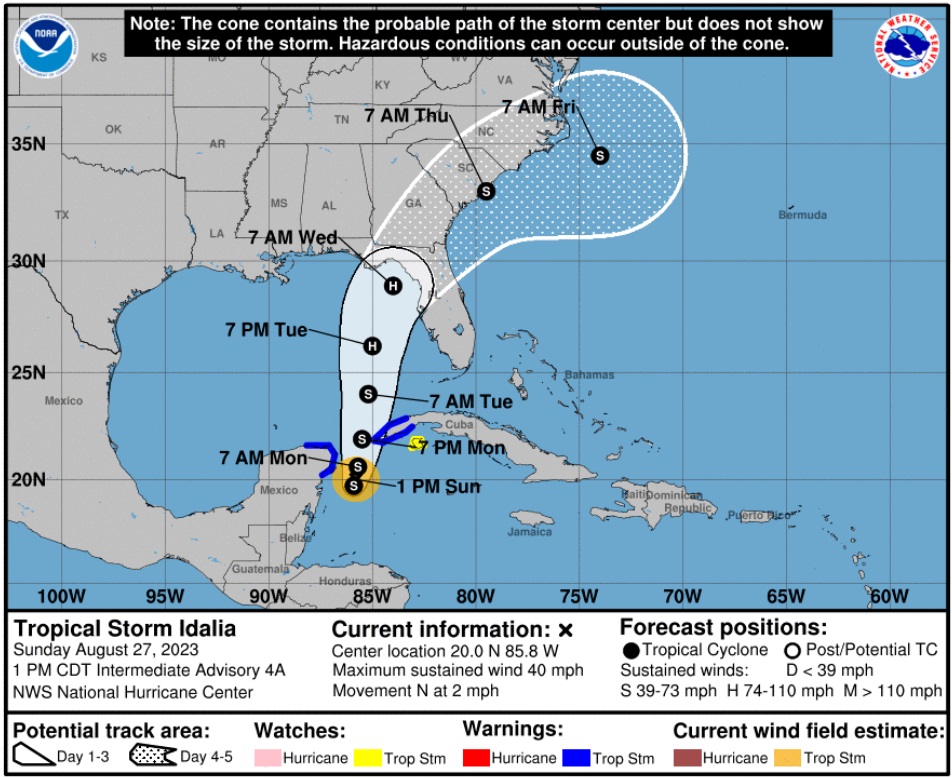
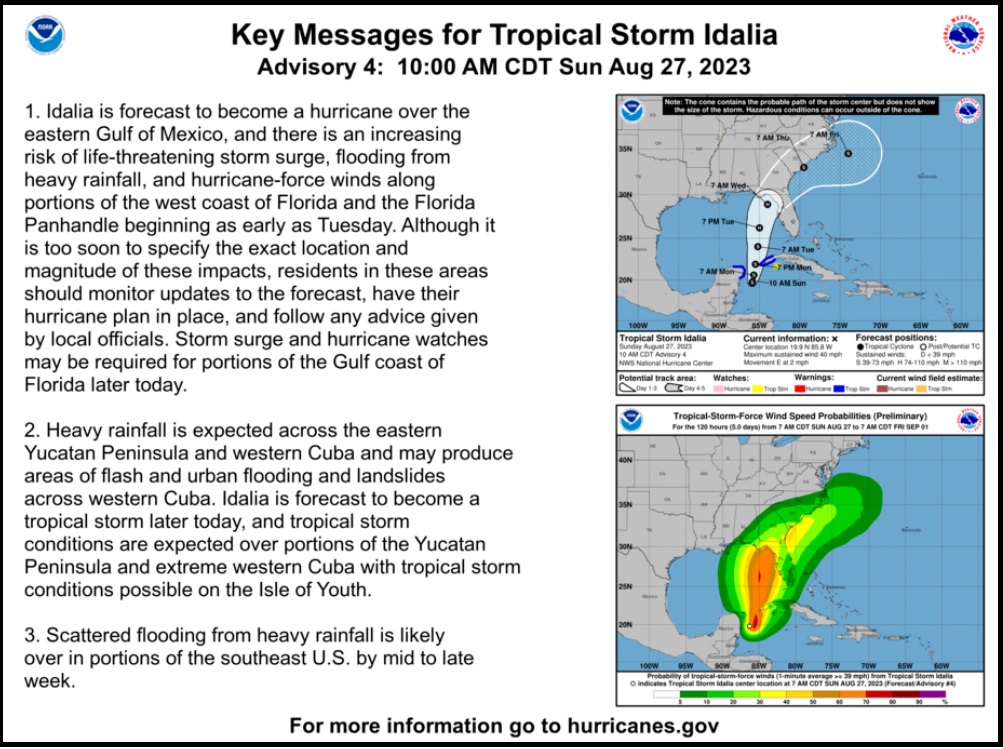
Information from the National Hurricane Center [DATA HERE] indicates currently slow-moving Tropical Storm Idalia will likely speed up quickly tomorrow and form a Hurricane in the Gulf of Mexico on Tuesday.  The current cone of uncertainty puts the Northern and Western portion of Florida at greatest risk.

At 100 PM CDT (1800 UTC), the center of Tropical Storm Idalia was located near latitude 20.0 North, longitude 85.8 West. Idalia is moving toward the north near 2 mph (4 km/h), and it is likely to meander near the Yucatan Channel through tonight. A faster motion toward the north is expected on Monday, bringing the system over the eastern Gulf of Mexico.

Maximum sustained winds remain near 40 mph (65 km/h) with higher gusts. Strengthening is forecast, and Idalia is expected to become a hurricane by Tuesday.

Idalia will come fast, most likely making landfall at a category 2 hurricane.  Those in the cone of uncertainty should pay attention, and people in the Tampa and St Pete region who have really lucked out in the past 30 years, should pay very close attention.

I hope you will understand why my proactive tips, advice and planning have modified since our experience with the September 2022 Hurricane, Ian. {Go Deep} Thankfully Idalia is not expected to be anything similar to Ian.  However, for those in the Tampa/St Pete area, do not be complacent.   This is a large metropolitan area with a similar demographic to the impact zone of Ian.

In my last set of proactive suggestions, {GO DEEP HERE} I focused first and foremost on something few discuss, mental capability.  Due to what I witnessed in Hurricane Ian with the people of the area, I am always going to put this into the analysis now to provide consideration that few understand.  I saw Ian literally break strong people down and create a PTSD demographic I have never experienced before.

What follows below are things to consider if you are prepping for a hurricane impact and/or deciding whether to stay in your home or evacuate.  Standard hurricane preparations should always be followed.  Protect your family, secure your property and belongings, and prepare for the aftermath.

What you do before the hurricane hits is going to determine where you are in the recovery phase.

Additionally, and this should be emphasized and discussed within your family, if you cannot be self-sufficient in the aftermath – for any reason, then you should evacuate.  Self-sufficiency in this context requires being able to cope for up to several weeks:

(1) potentially without power; (2) potentially without potable running water (3) potentially without internet service; (4) potentially without communication outside the region; and (5) with limited municipal and private sector assistance.   If you decide you cannot deal with these outcomes, you should evacuate.

Additionally, as a family or individual, you should also honestly evaluate:

(1) your physical abilities; (2) your emotional and psychological ability to withstand extreme pressures; and (3) your comfort in losing daily routines, familiar schedules and often overlooked things you might take for granted.

Post hurricane recovery is fraught with stress, frustration and unforeseeable challenges.  {GO DEEP}

For those in the cone of uncertainty, remember, planning and proactive measures taken now can significantly reduce stress in the days ahead.  Plan when to make the best decision on any evacuation (if needed). For now, consider Tuesday night the decision timeframe. As a general rule: take cover from wind – but evacuate away from water.

DAY ONE (Today)

  • Determine Your Risk
  • Make a Written Plan
  • Develop and Evacuation Plan
  • Inventory hurricane/storm supplies.

DAY TWO (Monday)

  • Get Storm Update
  • Assemble and Purchase Hurricane Supplies
  • Contact Insurance Company – Updates
  • Secure Important Papers.
  • Strengthen and Secure Your Home
  • Make Evacuation Decision for your Family.

DAY THREE (Tuesday)

  • Get Storm Update
  • Re-Evaluate your Supplies based on storm update.
  • Finish last minute preparation.
  • Assist Your Neighbors
  • If Needed – Evacuate Your Family

Communication is important.  Update your contact list. Stay in touch with family and friends, let them know your plans. Select a single point of contact for communication from you that all others can then contact for updates if needed.  Today/tomorrow are good days to organize your important papers, insurance forms, personal papers and place them in one ‘ready-to-go’ location.

Evaluate your personal hurricane and storm supplies; update and replace anything you might have used. Assess, modify and/or update any possible evacuation plans based on your location, and/or any changes to your family status.

Check your shutters and window coverings; test your generator; re-organize and familiarize yourself with all of your supplies and hardware. Check batteries in portable tools; locate tools you might need; walk your property to consider what you may need to do based on the storms path. All decisions are yours. You are in control.

Consider travel plans based on roads and traffic density. Being proactive now helps to keep any future stress level low. You are in control. If you have pets, additional plans may be needed.

One possible proactive measure is to make a list of hotels further inland that you would consider evacuating to.  Make that list today and follow updates of the storms’ progress.

Depending on information tomorrow you might call in advance and make a reservation; you can always cancel if not needed.  It is better to have a secondary evacuation place established in advance.  Being proactive reduces stress.  Even if you wait until much later to cancel, it is better to pay a cancellation fee (usually one night charge) than to not have a plan on where to go.   Trust me, it’s worth it.

Protect your family. Make the list of possibilities today, make the booking decision in the next 24 hrs.

Look over the National Hurricane Center resources for planning assistance.

If you do not handle stress well, leave.

If you cannot be self-sufficient in the aftermath, leave.

If you choose to stay pay super close attention to the exact path of the storm.  A few miles make a massive difference when you are dealing with the possibility of encountering the eyewall of a hurricane.

This is a fury of nature, a battle where the odds are against you, that you may or may not be aware you are contemplating when you are choosing to stay or evacuate.  It’s not the hurricane per se’, it’s that much smaller killer buzzsaw – the eyewall- that you are rolling the dice, never to see.

When it comes to the eyewall, the truest measure of the “cone of uncertainty“, the difference between scared out of your mind (victim) and a fight to avoid death (survivor), is literally a matter of a few miles. And there ain’t no changing your mind once it starts.

♦ Hardening your home is a matter of careful thought and physical work.  However, every opening into your structure must be protected, leaving yourself with one small exit opportunity just in case. Hopefully you have a bolted door with no glass windows you can use as an emergency exit.  If not, select a small window and leave only enough room uncovered for you to get out in case of emergency or structural collapse.

Beyond the ordinary supplies like drinking water, batteries, flashlights, battery or hand-crank radio, generators, gasoline, etc.  Evaluate the scale of what you have against the likelihood of weeks without power or water.   A few pro tips below:

♦ Put three 30-gallon trash cans in the shower and fill them with water before the storm.  This will give you 90 gallons of water for cooking and personal hygiene.  You will also need water to manually flush your toilets.  Bottled water is great for drinking, hydrating and toothbrushing, but you will need much more potable water if the municipal supply is compromised or broken.

♦ A standard 6,500-to-8,500-watt generator will run for approximately 8 hours on five gallons of gasoline.   Do not run it all the time.  Turn it on, chill the fridge, make coffee, use the microwave or charge stuff, then turn it off.  Do this in 4-hour shifts and the fridge will be ok and your gasoline will last longer.  Gasoline is a scarce and rare commodity in the aftermath of a hurricane.  Gas stations don’t work without power.  Check the oil in the generator every few days.  Also, have a can of quick start or butane available in case the generator starts acting up.

♦ Extension cords.  If you are purchasing them buy at least one 50 to 100′ extension cord with a triple ponytail.  This way you can use one cord into a central location to charge up your electronic devices.  Establish a central recharging station for phones, pads, laptops, and rechargeable stuff.

♦ Purchase a box of “contractor garbage bags” and just keep them in the garage.  These are large, thick, industrial trash bags that fit 40-gallon drums. They can be used for trash, or even cut open for tarps in the aftermath of a storm.  These thick mil contractor bags have multiple uses following a hurricane.

♦ Do all of your laundry before the hurricane hits.  You will likely not have the ability again for a few weeks.

♦ Cook a week’s worth of meals in advance of the hurricane. Store in fridge so you can microwave for a meal.  Eating a constant diet of sandwiches gets old after the first week.  Dinty Moore canned beef stew and or Chef-boy-ardee raviolis can make a nice break…. anything, except another sandwich.

♦ Have bleach for use in disinfecting stuff before and after a hurricane.  Also have antibiotics and antiseptics for use.  Hygiene and not getting simple infections after a hurricane is critical and often forgotten.  Again, this is where the extra potable water becomes important.  Simple cuts and scrapes become big deals when clean potable water is not regularly available.  Keep your scrapes and abrasions clean and use antiseptic creams immediately.

♦ Do not forget sunscreen and things to relieve muscle aches and pains.  Hurricane recovery involves physical effort.  You will be sore and/or exposed to the elements.  Remember, it’s all about self-sufficiency because the normal services are not available.  A well-equipped first aid kit is a must have.

♦ Buy a small camping stove.  Nothing big or expensive, just something you can cook on outside in case of emergency.  It will be a luxury when you are 2+ weeks without power and all the stores and restaurants are closed for miles.

♦ Those small flashlights that you can strap around your head that take a few AAA batteries?  Yup, GOLD.  Those types of handsfree flashlights are lifesavers inside and outside when you need to see your way around.  Nighttime is especially dark without electricity in the entire town.  Doing stuff like filling a generator with gasoline in the middle of the night is much easier with one of those head strap flashlights.  Strongly advise getting a few, they’re inexpensive too.

♦ Cash.  You will need it.  Without power anything you may need to purchase will require cash, especially gasoline.  Additionally, anyone you hire to help or support your immediate efforts will need to be paid.  Cash is critical.  How much, depends on your individual situation, but your cash burn rate will likely go into the thousands in the first few days.  Also keep in mind, you may or may not be able to work and without internet access even getting funds into place could be challenging.

♦ Hardware. A box of self-tapping sheet metal screws (short and long) is important, along with a box or two of various wood screws or Tyvex screws.  A battery drill or screw gun is another necessity.  Check all of this stuff during hurricane prep.