Senator Whitehouse -vs- AG Barr Debating the Word “Spy”…


Sen. Sheldon Whitehouse (D-R.I.), asks Attorney General William Barr during the committee hearing about the content of the Mueller letter dated March 27, 2019 (provided below) which was leaked to the Washington Post and New York Times by Mueller officials.

Additionally, Whitehouse then goes on to debate the term “spy” with the Attorney General.

AG William Barr Outlines Scope/Timeline of OIG FISA Review…


During a round of questioning with Senator Thom Tillis (R-N.C.) AG William Barr was asked about scale and scope of the current IG investigation [04:22 prompted].  In response to the question AG Barr replies:

“I don’t want to be too specific; I talked to Mike Horowitz a few weeks ago about it, and its focused on the FISA, the basis for the FISA, and the handling of the FISA application. But by necessity it looks back a little bit earlier than that.  The people I have helping me with my review will be working very closely with Mr. Horowitz.”

AG Bill Barr Senate Testimony on Mueller Report


U.S. Attorney General William Barr testifies to the Senate Judiciary Committee about the Mueller/Weissmann/Rosenstein report.  The hearing begins at 10:00am EDT.

UPDATE: VIDEO ADDED (Two Segments – Morning Session and Afternoon Session)

Morning Session:

Afternoon Session:

.

Fox News Livestream – Fox Business Livestream – Alternate Livestream – ABC Livestream

.

Victor Davis Hanson – The Case for Trump (Part 2)


Published on Apr 30, 2019

SUBSCRIBE 47K
March 7, 2019 – Victor Davis Hanson discussed the campaign, election, and presidency of Donald Trump. He’s interviewed by former Congressman Dave Brat (R-VA).

All fakers are equal, but some are more equal than others. 


by Andrei Nekrasov / April 27, 2019
The case of Claas Relotius, an award winning Spiegel writer, who was caught writing fiction and selling it as true stories, seemed to be a game changer in the world of journalism. Yet it soon became just yesterday’s news. And, as Thomas Beschorner of the University of St. Gallen in Switzerland, wrote, it was surprising in the first place that people found the lying in the media so surprising. “Scientists manipulate results of research, managers lie. We know all that happens. Everywhere, but not in journalism?”
Somewhat paradoxically, given his suggestion that lying was routine and common, the same Prof. Beschorner continued: “Whether this is an isolated case, or the problem is systemic and therefore widespread, we don’t know yet.”

Then a similar case was discovered. An award winning contributor to Sueddeutsche Zeitung Magazine, Dirk Gieselmann, had invented a main protagonist in a story he wrote. The SZ stated the forgery had taken place, but revealed few details, while suggesting the case was not as severe as that of Relotius.

One way or another, do two known recent cases of fictitious journalism in Germany make the problem systemic?

But what about the infamous fake news? And alternative facts? Those have been around for a while. Is that something totally different from making up plots and characters as in the above mentioned cases?

Even though it was Donald Trump who was credited with creating the fake-news brand, it was largely applied to his own statements, as well as various stories, posts and tweets coming out of Russia, on its behalf, in favour of its perceived friends, and against its perceived enemies.

Yet, has the fake news era really started with Trump and his collusion with Russia, that never actually was? While some call the Trump era “post-truth”, how should we refer to the times when, for example, a Labour prime minister was lying blatantly to justify a war that was to kill tens of thousands of innocent civilians? Or what was the director of National Intelligence in the administration of a progressive predecessor of President Trump doing as he denied NSA were spying on Americans? He was lying, as it became obvious from Edward Snowden’s revelations a little later, but it was a lie before the post-truth era kicked off “officially”.

I had to do my fair share of pondering on the fake news issue while dealing with the story of Sergei Magnitsky and William Browder. I started investigating the story well before the Trump era, but the consequences of my findings revealed in a film played out fully in the context of the new ideological war between Russia and the West.

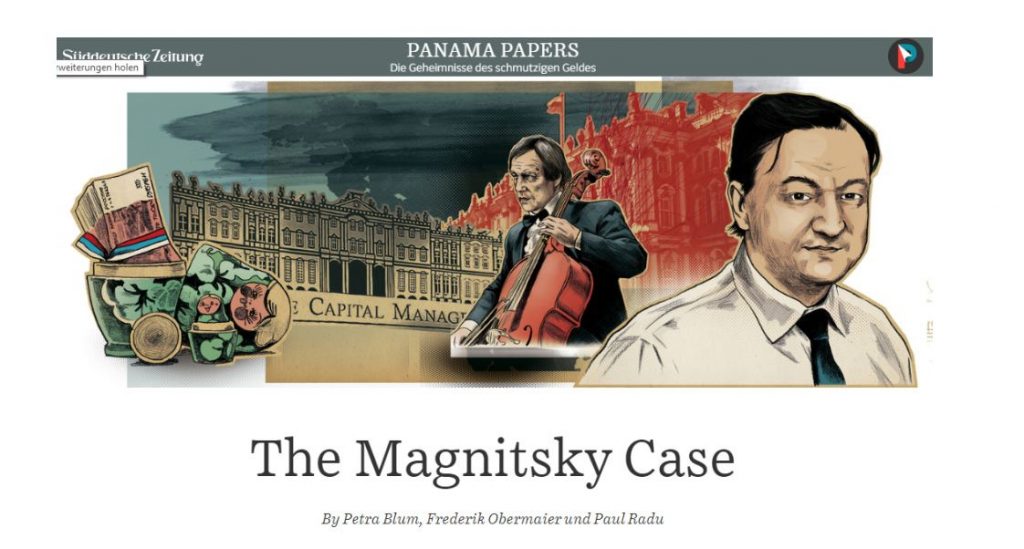
In the course of the preparations for a new film I am to shoot this year, I wrote to Frederik Obermaier, a Munich based journalist known for the investigation of the famous Panama Papers leak. Obermaier won a Pulitzer Prize for his work on the Panama Papers, as part of an ICIJ (International Consortium of Investigative Journalists) team. Mr Obermaier was one of the authors of the article “The Cellist and the dead Lawyer” (in the English version: “The Magnitsky Case“) published by Suedeutsche on 27 April 2016.

My new film deals, inter alia, with the ways money is laundered, and I wanted to interview Mr Obermeier, who, along with his ICIJ colleagues, has become an authority on the subject. The article Mr Obermeier co-wrote was of a particular interest to me as it appeared to have traced the money stolen in the fraud associated with the name of Sergei Magnitsky. ICIJ has recently reminded its subscribers of the great investigative article by the German colleagues, published exactly three years ago.

The article seems to have established a connection between the Magnitsky Affair (which my previous film was about) and a friend of Vladimir Putin, Sergei Roldugin. My forthcoming film is in many ways a sequel to the film about the fraud at the centre of the Magnitsky Case.

While studying Frederik Obermaier’s article and its sources I realised that it was full of mistakes. I made a list of the most obvious ones and emailed it to Mr Obermaier on the 23 October 2018. Having not heard back I sent another email on 21 November attaching an updated list of mistakes complete with explanations and links to documents disproving the majority of the claims in the article. The first time round I asked Mr Obermaier for an interview, but then I suggested we discuss the matter off the record. Anyone can make mistakes, but the ability to admit them is as important as the talent for authoring good stories, in my humble opinion. I got no response from Frederik Obermaier whatsoever.

Illustration: Sueddeutsche Zeitung
His Sueddeutsche Zeitung article seems to have essentially re-transmitted the false story of Sergei Magntisky, told by Bill Browder, a hedge fund manager, for whom Magnitsky worked as an accountant.

Browder is wanted by Russia for tax evasion. He claims that the Russian criminal charges are politically motivated. Yet, the tax evasion (as well as a number of related crimes) Browder is being accused of happened in 2001, the criminal probe into it starting in 2004. It is well known, and easily evidenced, that Browder was an outspoken supporter of Putin and his government until at least 2005.

But investor William F. Browder sees it differently. Never mind the arguments about a creeping coup by Putin’s KGB colleagues, the war in Chechnya, the state takeover of television or even the jailing of Russia’s richest man. To Browder, Putin is a true reformer, “the one ally” of Western capitalists who have come to Russia to create a new market economy but have found themselves adrift “in a sea of corrupt bullies.”
 Susan B. Glasser, in:”Investors Rally Around Putin, Discounting Alarm of Critics“, The Washington Post, February 26, 2004
Instead of pushing the country back, Putin has implemented a reform program that is far more liberal than anything that could have been cooked up at the most radical think tank in Washington. (…)

Putin understood that the country would never succeed with seven oligarchs at the helm — particularly since their interests were so counter to those of the nation. He has set clear limits to the oligarchs’ power and their meddling in the affairs of state. While there may be some things about Putin that we disagree with, we should give him the benefit of the doubt in this area and fully support him in his task of taking back control of the country from the oligarchs.

 William Browder, in: “Making the Case for Putin“, The Moscow Times, January 21, 2004
In 2007, as a result of an elaborate tax rebate scam 230 million dollars were paid into the accounts of three Browder’s companies in Russia. No one (neither Browder nor the Russian authorities) deny the tax rebate fraud took place, except that Browder claims he had lost control of his companies before the money was paid out. I investigated Browder’s claims, and found that they were false.

To divert attention from the the proven 2001-2004 tax evasion case, as well as the suspicion that he may have been involved in the 230 million dollar tax rebate, Browder invented a figure of the crusading anti-corruption lawyer, whistleblower, Sergei Magnitsky. Magnitsky existed of course, but he was Browder’s accountant, not a lawyer, and he never blew whistle on anything.

Tragically, Magnitsky died while in pre-trial detention. Browder claims he was beaten to death by eight “riot guards”. Browder presents no evidence for that, apart from selective quotations from Russian documents. Studied in full those documents, as well as an American report commissioned by Browder himself, make no mention of a murder, let alone a murder by beating. The author of the Parliamentary Assembly of the Council of Europe report on Magnitsky, Andreas Gross told me on camera that Magnitsky had not been murdered but died of the “lack of care”.

The investigative journalists at Sueddeutsche Zeitung claim to have traced money flows from the Magnitsky affair, but appear unwilling to recognise that they had uncritically embraced the affair’s interpretation by someone with a vested interest in it.

It is also highly ironic that the journalists, writing about Browder’s Russian business, chose to ignore that Browder himself used off-shore schemes extensively, with the help of his Russian staff that included Magnitsky. Companies controlled by Browder have also appeared in Panama papers, e.g Berkeley Advisors and Starcliff.

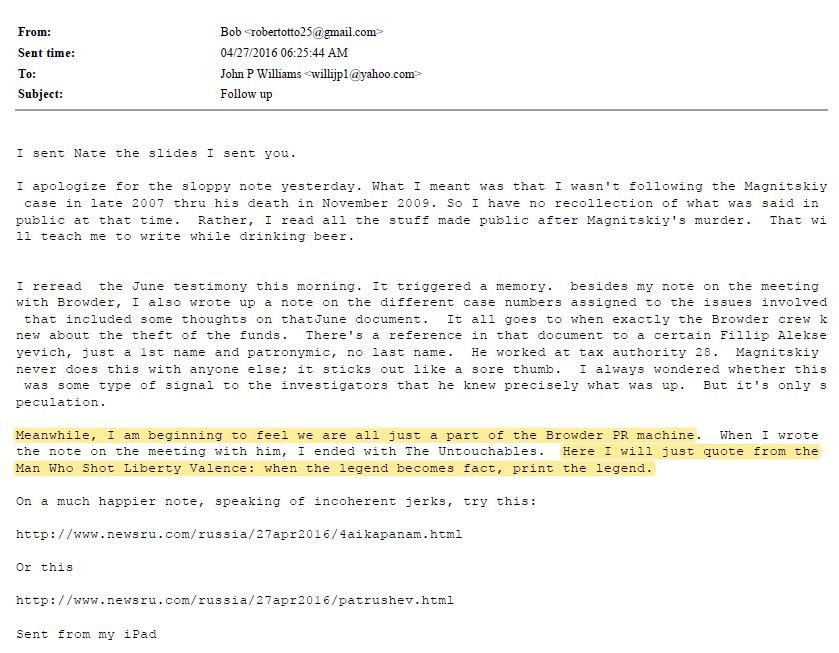
In the spring of 2016 my film was secretly, and possibly illegally, seen by U.S. government officials before its premiere at the European parliament was stopped on the 27th of April, and the ARTE transmission cancelled on the 3rd of May. One of those officials was Robert Otto, a top intelligence officer at the State Department who wrote in one of many e-mails that were later leaked online. “I am beginning to feel we are all just part of the Browder P.R. machine.” – Mr Otto wrote.

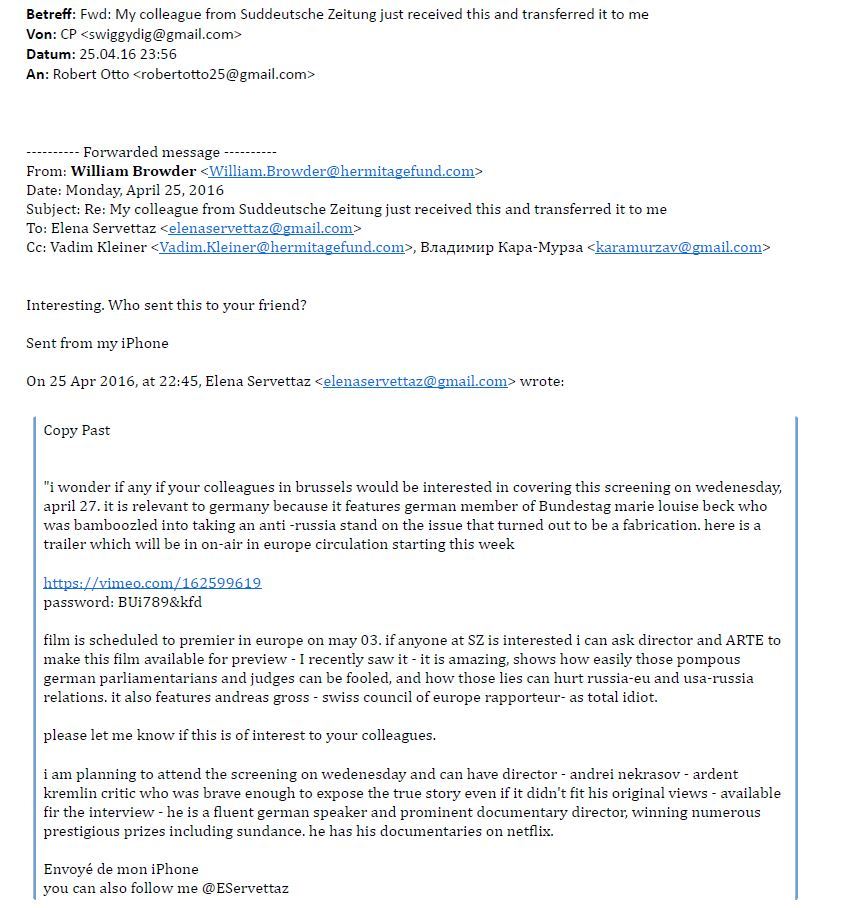
Another of those emails concerned Sueddeutsche Zeitung, my film and myself:
I recently managed to find out who the recipient of the email about me and my film was: Hubert Wetzel. The email was received at the time of the publication of the “The Cellist and the dead Lawyer“. Mr Wetzel had clearly passed the information to Browder’s acolyte Elena Servettaz, or to another “colleague from Suddeutsche Zeitung” (sic), who then swiftly passed it to Elena Servettaz.

I was not contacted by the SZ, either before the cancelled European Parliament screening or thereafter.

On 13 June 2018 Telepolis organised a screening of my film in Munich, with a following discussion. Frederik Obermaier and Tim Neshitov, who had written about the Magntisky case for the SZ were invited. No-one turned up, nor replied to the invitation.

The “money tracing” SZ/Panama Papers used trying to connect the Magnitsky fraud to Sergei Roldugin, was in its main part presented in the U.S. case against Prevezon Holdings Ltd (2013-2017). After almost five years of trying to prove that Prevezon received and laundered money from the Magnitsky fraud, the American government decided to avoid the litigation and to settle the case with no guilt admitted by Prevezon.

Prevezon lawyers questioned Browder as a witness under oath. It was Browder (as he himself admitted) who had personally handed Preet Bharara, then the U.S. attorney for the Southern District of New York, the version of the Magnitsky story that I disprove in my film. William Felix Browder was the source of the whole sprawling, costly case. And it’s his Magnitsky story that was essentially disproved in a court of law.

Yet the mainstream media, including the Sueddeutsche Zeitung, had no interest in taking another look at their articles which had faithfully re-transmitted Browder’s false story. And a stony, arrogant silence was all I got trying politely and tactfully to point out serious mistakes.

Panama papers became a brand name for the press standing up to corruption and wrongful secrecy of those in the position of power, whether financial or political. It would be paradoxical and particularly regrettable if a journalist, a colleague, would use a power he has acquired through a reputation for openness and association with mainstream German and international investigative networks, to obfuscate legitimate questions and documented objections.

Q.: What steps did you take in finding Mr. Browder to be credible?
A.: Well, we reviewed his documentation, we reviewed some of his statements and verified some of his statements via the internet.
Q.: What did he tell you?
A.: Well, he told us the story of Sergei Magnitsky.
Q.: What public source documents did he refer you to?
A.: He referred me on his website, he referred me to a Russian language newspaper.
Q.: What else?
A.: And the documents that he provided.
Q.: What documents did he provide?
A.: Copies of the bank records, copies of wire transactions
Q.: Did you get in touch with the banks to see if they were accurate?
A.: No, I did not.
Q.: And you obtained flow charts; is that correct?
A.: That’s correct.
Q.: And those were also from Hermitage that you obtained them?
A.: Correct.
Q.: So every transfer here is based on copies that are not authenticated, of records that are incomplete, based on an accounting assumption. Is that right?
A.: That would be correct.
 a scene from the film “The Magnitsky Act – Behind the Scenes”: Deposition of Todd Hymann, a special agent with the Department of Homeland Security, Homeland Security Investigations (United States District Court Southern District of New York)
April 27 / 2019

back to the homepage

The Magnitsky Act & the Thirst for War


Andrei Nekrasov has put out an article on the fake news that was behind the Magnitsky Case. He documents how there was never any evidence behind Bill Browder’s claims. Nevertheless, we are left with a question. Was all of this created fraud by Bill Browder or was there those in power who could care less if the story was true, they have been able to use it to create isolation of Russia and paint Putin as an evil warlord.

Western powers immediate moved nukes into place and pushed up against the borders of Russia. The neocons hate Trump and for whatever reason, they simply want war without purpose other than they seem to want to dominate the world and they accuse others. Every president before Trump strived for world peace. Here they are desperate to tie Trump to Putin to maintain a cold war if not turn it hot.

The Magnitsky Case is a great film. It has been banned and that is why it is the real story. If it was fake, they would let it air. But they are desperate to ban the Magnitsky Case as they were with our movie the Forecaster. There is something sinister behind the curtain and you can bet it is more than the Democrats – it involved the neocons as well.

California Collapse Approaching Despite Silicon Valley’s Huge Supply of Tax Dollars


Published on Mar 1, 2019

SUBSCRIBE 89K
Now more then ever we need your help keeping this channel producing REAL content for REAL people https://www.paypal.me/ConservativeRes… The Day California Died Even as the 2018 midterms were a rather mixed bag for the GOP nationwide, it’s only natural that one of the few bright areas for the Democratic Party was in the progressive utopia of California. Despite some hype over internal polls suggesting a close race for governor, or a contentious push to repeal a recently enacted gas tax, the California Republican Party once again fell short, even of its own meager expectations. One Step Forward, Two Steps Backward Whatever small consolations California Republicans can take away from election night were overwhelmed by more losses, as the Democratic tide inevitably engulfed them. There is currently only one undecided race that the California GOP was hoping to flip. In the State Assembly’s 60th District, located in Riverside, Republican Bill Essayli was hoping to oust Democratic incumbent Sabrina Cervantes. With a lot of votes still left to be counted over the next few days, the race is a literal dead heat: At the time of writing this, Cervantes leads by just three votes—26,731 to Essayli’s 26,728. Unfortunately, other hotly contested races in the lower chamber (Districts 32, 44, 65, and 66) were all tenaciously defended by their Democratic incumbents. In addition, the Democrats made two flips of their own, taking seats from outgoing moderate Republicans Marc Steinorth in San Bernardino’s 40th District and Rocky Chavez in Orange County’s 76th District. Thus, the overall net change in the Assembly is D+1, slightly expanding their supermajority. The state senate was even worse, with both losses for the GOP coming from the San Joaquin Valley. In the 12th District, Democrat Anna Caballero managed narrowly to defeat Republican Rob Poythress for the seat being vacated by another moderate Republican, Anthony Cannella, and in the process won the seat that she narrowly lost to Cannella in 2010. But in a more shocking result, the neighboring 14th District saw a sizeable Democratic upset against the popular incumbent Republican Andy Vidak, who was defeated by Democrat Melissa Hurtado. With these two flips, the Democrats erased the minimal gain made by the Republicans’ successful recall of Democrat Josh Newman in Orange County in June, and once again brought this year’s net change to D+1. This gives the Democrats another supermajority in the upper chamber after it was briefly taken from them with Newman’s loss. While Republicans managed to defend most of the open U.S. House races, there were still three devastating losses, two in neighboring Orange County districts and one in Los Angeles. In the 48th, the senior-most Republican congressman in the state of California, Dana Rohrabacher, narrowly lost his re-election bid to radical Democrat Harley Rouda. In the race to succeed outgoing Republican Darrell Issa in the 49th District, Bernie Sanders-endorsed progressive Mike Levin handily defeated Republican Diane Harkey. And in the Los Angeles-based 25th, incumbent Steve Knight was defeated by Democratic challenger Katie Hill. Not only did the Republican delegation to Congress shrink by three, but it did so by losing two of the longest-serving Republicans in the state. Dominant Democrats The poor performance in local races was a clear result of the Democrats’ usual routing of Republicans at the statewide level. In state races, every single office was won by Democrats in the double digits, with some margins easily as high as 20 percent. This included the top race of governor, with ultra-liberal Lt. Governor Gavin Newsom besting former Illinois businessman John Cox by almost the same margin of victory by which his predecessor Jerry Brown beat his Republican challenger, Neel Kashkari. Even in the unusual race for insurance commissioner, despite strong support for Republican-turned-Independent Steve Poizner, Democrat Ricardo Lara apparently managed to eke out a narrow win. This is by far the closest Democrats have come to losing a statewide contest since 2006, yet it is still telling that in order to get that close, the popular Poizner had to change his registration to “no party preference,” Republican being too toxic a word in California. Link to Article: https://amgreatness.com/2019/02/27/ca… https://amgreatness.com/2018/11/08/th…

Victor Davis Hanson – Carnage and Culture: Landmark Battles in the Rise to Western Power


Published on Feb 15, 2017

SUBSCRIBE 47K
September 15, 2001 – Examining nine landmark battles from ancient to modern times–from Salamis, where outnumbered Greeks devastated the slave army of Xerxes, to Cortes’s conquest of Mexico to the Tet offensive–Victor Davis Hanson explains why the armies of the West have been the most lethal and effective of any fighting forces in the world. Looking beyond popular explanations such as geography or superior technology, Hanson argues that it is in fact Western culture and values–the tradition of dissent, the value placed on inventiveness and adaptation, the concept of citizenship–which have consistently produced superior arms and soldiers. Offering riveting battle narratives and a balanced perspective that avoids simple triumphalism, Carnage and Culture demonstrates how armies cannot be separated from the cultures that produce them and explains why an army produced by a free culture will always have the advantage.

The Ancient Greeks and Western Civilization: Then and Now, Pt 1


Published on Dec 21, 2017

SUBSCRIBE 397
Victor Davis Hanson, Senior Fellow, Hoover Institution; Professor Emeritus, California State University, Fresno February 15, 2007


Trump’s not the problem. He’s a symbol of 4 bigger issues. | Ian Bremmer


Published on Aug 1, 2018

SUBSCRIBED 2.5M
Read more at BigThink.com: Follow Big Think here: YouTube: http://goo.gl/CPTsV5 Facebook: https://www.facebook.com/BigThinkdotcom Twitter: https://twitter.com/bigthink