The School Funding Inequity Farce


By James D. Agresti
November 25, 2019

Leading presidential candidates and major media outlets are claiming that school districts with high concentrations of minorities and poor children generally receive less funding per student than other districts. That hasn’t been true for at least half a century, but people are spreading this myth through deceptive studies that exclude federal funds.

In reality, a broad range of credible studies that include all funding sources show that such school districts are as well-financed as others.

The Claims

According to Democrat presidential hopeful and U.S. Senator Elizabeth Warren, “our current approach to school funding at the federal, state, and local level underfunds our schools and results in many students from low-income backgrounds receiving less funding than other students on a per-student basis.”

Along the same lines:

  • Sarah Mervosh of the New York Times reported in early 2019 that “on average, nonwhite districts received about $2,200 less per student than districts that were predominantly white….”
  • Maria Danilova of the Associated Press (AP) reported in 2018 that “the highest-poverty” school districts “receive an average of $1,200 less per child than the least-poor districts, while districts serving the largest numbers of minority students get about $2,000 less than those serving the fewest students of color….”
  • Democrat presidential contender and U.S. Senator Bernie Sanders claims that “less is invested in the education of children from low-income families compared with their more affluent peers” because “school districts are funded out of local property taxes.”
  • Clare Lombardo of National Public Radio (NPR) reported in 2019 that “high-poverty districts serving mostly students of color receive about $1,600 less per student than the national average.”

With the exception of Sanders—who provides no evidence to support his claim—all of the others misrepresent their sources by failing to reveal that they ignore federal funds. Moreover, their sources obscure this fact in the following ways:

  • Warren cites a study by the Education Law Center, which refers to federal funding on page 2 but then never accounts for any of it. Instead, the study mentions on page 5 that it uses “actual state and local revenues” for its analysis.
  • The New York Times and NPR cite a report from EdBuild, which doesn’t say a word about the exclusion of federal revenues. Instead, it tacitly slips this into a separate webpage of “research methods“ that references “revenues from state and local sources” while ignoring federal revenues except when subtracting out charter school funding.
  • The AP cites a report from the U.S. Commission on Civil Rights that repeatedly mentions federal funding, but when it presents the $1,200 and $2,000 underfunding figures quoted by the AP, it cites a study from the Education Trust that explicitly excludes “federal sources.” The Commission on Civil Rights doesn’t even allude to this fact—and to discover it, readers must go to the footnote and then locate the study from a citation with an unclickable link.

In short, these politicians and journalists never hint that their statistics exclude federal funds, and the sources they appeal to bury this crucial caveat. This ensures that only diligent readers with time to investigate will learn the truth.

Moreover, those who propagate this falsehood often call for more federal funds to fix this contrived disparity. But since they ignore federal funding, their proposals to increase it will not change the statistics they present.

Warren’s K–12 education plan, for instance, makes the false claim quoted above and then calls for “quadrupling Title I funding—an additional $450 billion over the next 10 years—to help ensure that all children get a high-quality public education.” Title I is the largest source of federal K–12 education funding, but because Warren doesn’t count this money in her statistics, her plan won’t affect her own measure of school funding.

The Reality

Wide-ranging studies that include all education funding—like those conducted by the U.S. Department of Education (1996), Ph.D. economist Derek Neal (2006), the left-leaning Urban Institute (2008), and the conservative Heritage Foundation (2011)—have all found that school districts with higher portions of minority students spend about the same amount per student as districts with smaller portions of minorities.

The Urban Institute study, which looks the furthest back in time, found that “differences in spending per pupil in districts serving nonwhite and white students are very small” since at least 1972.

Likewise, a study published by the journal Education Next in 2017 found that “per-student K–12 education funding from all sources (local, state, and federal) is similar, on average, at the districts attended by poor students ($12,961) and non-poor students ($12,640), a difference of 2.5 percent in favor of poor students.” The study also found that “this difference has not changed much since 1994–95,” the earliest data in the study.

Within school districts, research published by the Brookings Institution in 2017 found that “on average, poor and minority students receive between 1-2 percent more resources than non-poor or white students in their districts, equivalent to about $65 per pupil.”

The Property Tax Charade

Warren alleges that “school systems rely heavily on local property taxes, shortchanging students in low-income areas.” This was previously the case, but it hasn’t been so for decades. As explained by the Urban Institute:

In the past, because public schools were funded largely by local property taxes, property-rich and -poor school districts differed greatly in expenditures per pupil. Since the early 1970s, however, state legislatures have, on their own initiative or at the behest of state courts, implemented school finance equalization programs to reduce the disparity in within-state education spending.

Consequently, data from the U.S. Department of Education show that local revenues have declined from 83% of all school funding in 1920 to 45% in 2016:
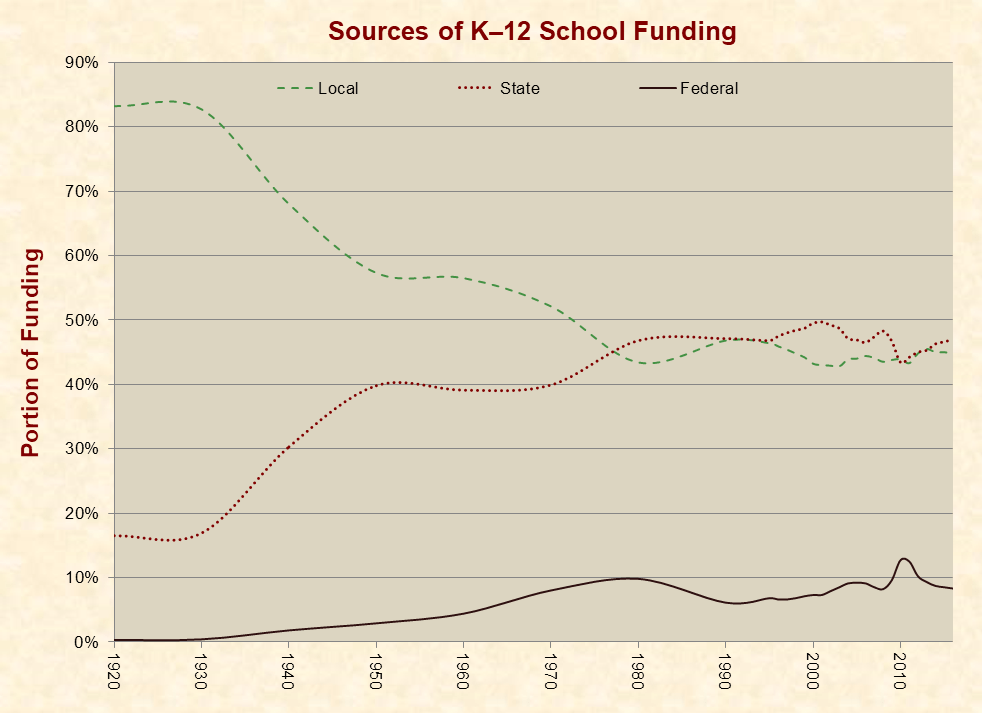
Furthermore, the chart above only shows national averages. These don’t reveal the fact that school districts in low-income areas typically receive greater portions of their budgets from state and federal funds. For example, the U.S. Government Accountability Office reported in 2011 that some school districts receive no federal Title I education funding, while others receive as much as 36% of their budget from it.

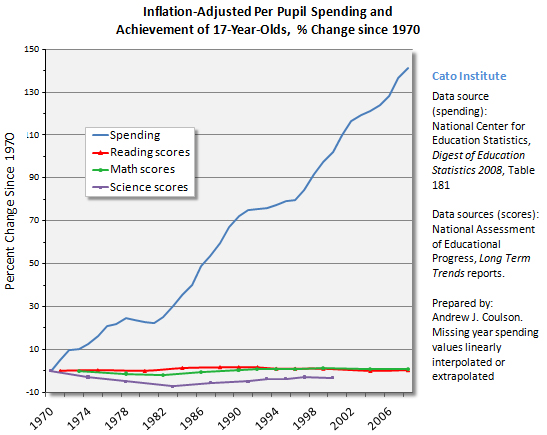
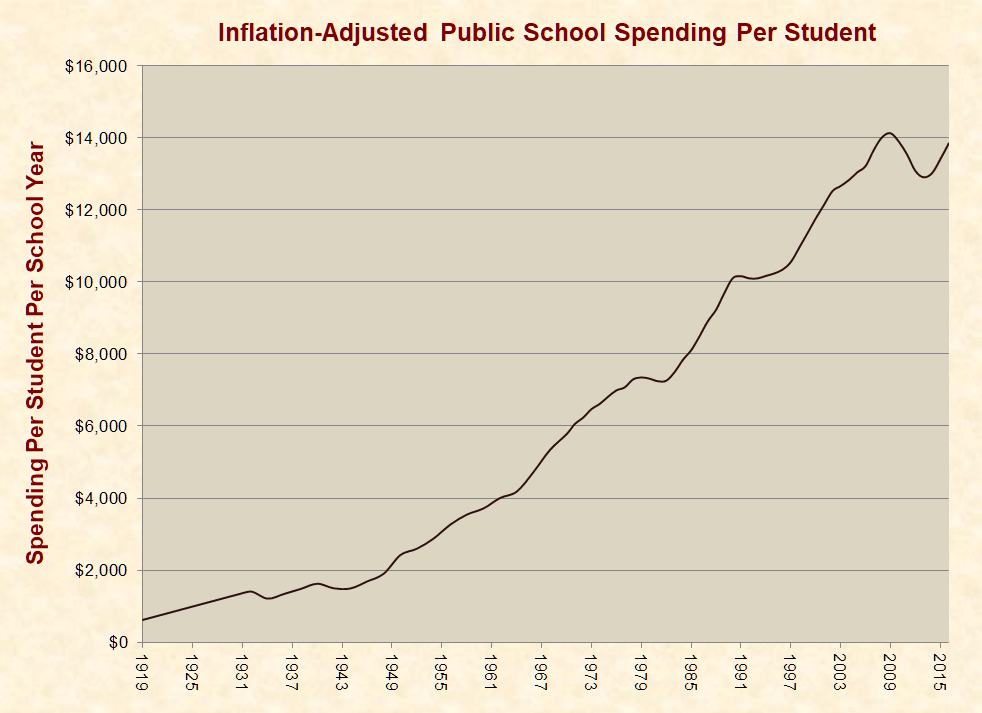
Along with increasing shares of school funding paid by state and federal taxpayers, the inflation-adjusted average spending per student grew by 22 times in the same era:
False Justifications

Some people openly argue that federal funding should be ignored when comparing schools, because this money is meant to help disadvantaged students. However, federal law is at odds with such logic.

The Education Trust, for example, writes that it excludes such funds from its analysis because “federal dollars are intended—and targeted—to provide supplemental services to such specific groups of students as those in poverty, English learners, and students with disabilities.”

In accord with that view, the Obama administration published an issue paper stating that federal education funding “is intended to provide the extra help low-income students need to succeed, but it cannot do that if state and local funds are not evenly distributed to start with.” The administration also drafted regulations to impose this requirement on school districts.

In contrast, the applicable federal law explicitly states that “nothing in this subchapter shall be construed to mandate equalized spending per pupil for a state, local educational agency, or school.” Thus, the Congressional Research Service determined that the Obama administration’s proposed regulations “appear to directly conflict” with the law.

Federal law does require that states and localities not reduce their funding to schools when they receive federal funds. This provision says that states and localities can only use federal funds “to supplement the funds that would, in the absence of such federal funds, be made available from state and local sources,” “not to supplant such funds.” This does not require that funding be equal before or even after federal funding. It simply requires that states and localities don’t cut other funding just because they receive federal funds.

The law also requires that local school districts provide services that “are at least comparable” to all schools within their district before they receive federal funds. New York City, for example, cannot provide unequal services to schools and then use federal funds to equalize them. To meet this requirement, districts must provide similar staff-to-student ratios, “curriculum materials,” and “instructional supplies” to schools in their district in order to receive federal funds.

Nevertheless, politicians and unions sometimes create funding disparities within local school districts by agreeing to contracts that give senior teachers more pay and discretion to choose the schools where they work. These higher-paid teachers tend to avoid inner-city schools with high rates of crime and student discipline problems, resulting in lower spending-per student in poor neighborhoods. Federal law permits this practice by excluding “staff salary differentials for years of employment” from its compliance provisions.

Conclusion

Regardless of any rationale for excluding federal funds from school funding comparisons, it is deceitful to omit such money without even a hint. Yet, Elizabeth Warren, Bernie Sanders, the New York Times, National Public Radio, and the Associated Press are doing just that.

Such disinformation is enabled by advocacy groups like EdBuild and the Education Law Center, which publish reports that exclude federal funds while burying this vital fact.

Warren takes the deception even further by leading people to believe that she actually accounts for federal funds. She does this by claiming that “the current investment in Title I—$15.8 billion—is not nearly enough to make up for state-level funding inequities,” but her supposed evidence for this is a study that excludes all of this money. This provides false grounds to continually demand more from taxpayers and to portray the U.S. education system as systemically racist.

President Trump Delivers Remarks at National Border Patrol Council Event….


Earlier today President Trump delivered remarks to National Border Patrol Council members. The National Border Patrol Council (NBPC) is the exclusive representative of approximately 18,000 Border Patrol Agents and support personnel assigned to the U.S. Border Patrol.

The U.S. Border Patrol falls under the Department of Homeland Security (DHS). Under DHS, the Border Patrol is under the direction of Customs and Border Protection (CBP).  [Video Below – Transcript Will Follow]


Hope Hicks Returns to White House as Senior Advisor…


Good News.  Hope Hicks is returning to the White House as counselor to the president and senior adviser.  Ms. Hicks was one of the original members of the Trump campaign in 2015 and carried the role of communications director during the first year of the administration through March 2018.

(Via Politico) […] White House press secretary Stephanie Grisham confirmed, calling Hicks “one of the most talented and savvy individuals I have come across.” Hicks departed the White House in March 2018 after working as communications director for Trump. She then moved to Los Angeles to work in a senior communications role at Fox Corporation.

[…] Hicks’ return to the White House gives Trump an ally who’s adept at translating his wishes to the broader staff.

Hicks was always well-liked among the communications and press staff, getting along well with the competing factions from the 2016 campaign and the Republican National Committee. (more)

Additionally, it is being reported that Johnny McEntee is being promoted to run the White House personnel office responsible for filling hundreds of top political jobs throughout various federal agencies.  Mr. McEntee will replace Sean Doocey, who is moving over to the State Department.

The personnel office has been a key point of contention for the administration as several political appointments later became weak points with people not in alignment with the policies and objectives of President Trump.  Hopefully McEntee can assist in finding and vetting the right person, with the right skillset, for the right job.

President Trump Will Attend Daytona 500 NASCAR Race on Sunday…


The White House has confirmed that President Trump will attend the 63rd running of the Daytona 500 at Daytona International Speedway on Sunday, February 16th. The big race starts at 1:00pm on Fox.  [On Saturday Joe Nemecheck will race Trump/Pence 2020]

The U.S. Secret Service tweeted Wednesday that it was securing the Daytona Speedway. The security team noted drones are banned within a 30-mile radius of the event.

Also, Joe Nemechek will be using patriotic colors of ‘TRUMP / PENCE 2020’ in the NASCAR Xfinity Series season opener on Saturday for the Racing Experience 300.

[NASCAR] “The Daytona 500 is one of the greatest events in sports and the prestigious season-opening event to the NASCAR Cup Series,” track president Chip Wile said in a statement. “Daytona International Speedway has been privileged to have hosted several sitting Presidents of the United States over our history. We’re honored that the President of the United States has chosen to experience the pageantry and excitement of ‘The Great American Race’ by attending Sunday’s 62nd annual Daytona 500.”

Previously, Ronald Reagan attended the 1984 July race at Daytona, which was Richard Petty’s 200th career Cup Series win.  George H.W. Bush also attended a summer Daytona race, in 1992. George W. Bush attended the 2004 Daytona 500, won by Dale Earnhardt Jr.  (link)

The White House

@WhiteHouse

President @realDonaldTrump will attend the @NASCAR Daytona 500 on Sunday! 🏎️🏁 https://www.mynews13.com/fl/orlando/politics/2020/02/12/president-trump-coming-to-daytona-beach-sunday 

President Trump Coming to Daytona Beach Sunday

Secret Service issued a No Drone Zone at the speedway.

mynews13.com

3,654 people are talking about this

U.S. Secret Service

@SecretService

Ladies and Gentlemen start your engines but not your drones. The Secret Service is securing the @NASCAR Daytona 500 by providing a 30 mile “No Drone Zone”. Enjoy the race.

View image on Twitter
617 people are talking about this

Nicole Griffin@NicoleNews13

JUST IN: @DISupdates confirms @realDonaldTrump will be at the this weekend @MyNews13

View image on Twitter
65 people are talking about this


The Post Impeachment Landscape!


152K subscribers

Joe Biden’s electability meets the voters, with the same historical results as always. Meanwhile, President Donald Trump, comes off his impeachment with record high popularity, awash in so much winning. Let’s take a look at the post-impeachment landscape with a look toward the 2020 election with Bill Whittle, Stephen Green and Scott Ott. Have you signed up for our 3-night Caribbean cruise yet? http://bit.ly/StratoCruise2020 Are you already a Member? https://BillWhittle.com/register/

President Trump Remarks During Meeting with President Moreno of Ecuador – Video and Transcript…


President Trump and Ecuadorian President Lenin Moreno deliver remarks to the press pool prior to a bilateral meeting in the White House. [Video and Transcript Below]

.

[Transcript] – PRESIDENT TRUMP: Well, thank you very much. It’s great to be with the President of Ecuador — and it’s one of the most beautiful countries in the world — and perhaps equally as important, and maybe even more importantly, your great First Lady. Thank you very much for being here. This is a tremendous honor. Some of the most beautiful landscapes in the world and one of the most beautiful places on Earth, they say. I’ve heard that for a long time.

And we are working on trade deals, we’re working on military options, including the purchase of a lot of our military equipment. We do make the best equipment in the world, by far. And we’re negotiating some very important pacts between Ecuador and the United States.

So, Mr. President, Madam First Lady, thank you very much. Thank you very much. Appreciate it. Please.

PRESIDENT MORENO: (As interpreted.) I would like to first thank everyone for — especially Mr. President, for his kindness and to invite us over to talk about these very important topics — topics which are common to both countries. I’d like to thank the President for the warmth with which he has greeted us.

And I have to stress the fact that our relationship between Ecuador and the USA is a relationship of fraternity that has been going — that dates back a very long time.

We actually have taken the foundational principles of the U.S. to — as a basis for our own foundational principles to create the first Republic of Ecuador.

We are going to be discussing issues that are common to both nations, such as democracy, liberty, freedom, respect of human rights, the fight against organized crime, the fight against drug trafficking, the fight against corruption.

And we are going to also be speaking about the importance of investment, trade, technology transfer that are all common principles to us. We know that both our peoples want to be governed with justice and equality, and that is what both of us are striving for.

PRESIDENT TRUMP: We want to thank you very much. This is a great honor to be with you.

Okay. Do you have any questions? Yeah.

Q On Roger Stone, sir. On Roger Stone: Isn’t your tweet political interference?

PRESIDENT TRUMP: No, not at all. He was treated very badly. Nine years recommended by four people that — perhaps they were Mueller people. I don’t know who they were. Prosecutors. And they — I don’t know what happened. They all hit the road pretty quickly.

Look, you had somebody — just recently, you saw what happened. He got two months. He got sentenced to two months for leaking classified information at the highest level.

Q Who’s that that you’re referring to?

PRESIDENT TRUMP: They treated Roger Stone very badly. They treated everybody very badly. And if you look at the Mueller investigation, it was a scam because it was illegally set up. It was set up based on false documentation and false documents.

If you look at what happened — how many people were hurt. Their lives were destroyed. And nothing happened with all the people that did it and launched this scam. Where’s Comey? Why — where is Comey? What’s happening to McCabe? What’s happening to Lisa and — to Pete Strzok and Lisa Page? What’s happening with them? It was a whole setup, it was a disgrace for our country, and everyone knows it too — everyone — including NBC, which gives a lot of fake news.

The fact is that Roger Stone was treated horribly and so were many other people. And their lives were destroyed.

And it turns out — if you look at the FISA warrants and what just happened with FISA, where they found out it was fixed, that it was a dirty, rotten deal. So when you look at that, and you see what happened to Roger Stone —

But think of it: A man leaks classified information — highly classified. They give him two months — Roger Stone — for doing — nobody even knows what he did. In fact, they said he intimidated somebody. That person said he had no idea he was going to jail for that. That person didn’t want to press charges. They put him in for nine years. It’s a disgrace.

And, frankly, they ought to apologize to a lot of the people whose lives they’ve ruined.

All right. Next question. Go ahead.

Q Mr. President, it’s the first time —

Q Mr. President —

PRESIDENT TRUMP: Yeah. Please, Steve.

Q — are you considering a pardon for Roger Stone?

Q — that (inaudible) official visit —

PRESIDENT TRUMP: Wait, wait, wait. What?

Q Oh, sorry.

Q Are you considering a pardon for Roger Stone?

PRESIDENT TRUMP: I don’t want to say that yet. But I tell you what: People were hurt viciously and badly by these corrupt people.

And I want to thank — if you look at what happened, I want to thank the Justice Department for seeing this horrible thing. And I didn’t speak to them, by the way, just so you understand. They saw the horribleness of a nine-year sentence for doing nothing. You have murderers and drugs addicts; they don’t get nine years. Nine years for doing something that nobody even can define what he did.

Somebody said he put out a tweet, and the tweet — you based it on that. We have killers, we have murderers all over the place — nothing happens. And then they put a man in jail and destroy his life, his family, his wife, his children. Nine years in jail. It’s a disgrace.

In the meantime, Comey walks around making book deals. The people that launched this scam investigation — and what they did is a disgrace. And, hopefully, it’ll be treated fairly; everything else will be treated fairly.

Q Sir, aren’t you speaking — aren’t you speaking to the Attorney General through your tweets?

Q Mr. Donald Trump —

PRESIDENT TRUMP: Go ahead, please.

Q (As interpreted.) Mr. President, I’d like to congratulate you for the macroeconomic indicators; they’re excellent. But in that number, the growth expectations are going down, especially for the growth in Ecuador, which is at zero. How can we help Latin American economies? How can we help Ecuador, Mr. President? And congratulations.

PRESIDENT TRUMP: Well, thank you. I love that question. I wish we had some people like that here. He’s congratulating us on our great success as a country. And I want to congratulate you, too, because what you’ve done in Ecuador and your President have done a fantastic job. Thank you very much.

Q Mr. President, are you concerned about the four prosecutors?

Q Thank you, Mr. President —

PRESIDENT TRUMP: I’m not concerned about anything; concerned about nothing.

Q Does it show that there’s something wrong at DOJ?

PRESIDENT TRUMP: I’m not concerned about anything. They ought to go back to school and learn, because I’ll tell you, with the way they treated people, nobody should be treated like that.

Go ahead.

Q Mr. President, thank you so much. It’s been 17 years since the last time a President from Ecuador visited the White House and a President of the United States did an official visit with them —

PRESIDENT TRUMP: And when was it? When was it?

Q Seventeen years ago.

PRESIDENT TRUMP: Wow.

Q It was with George W. Bush in 2003. What changed now? What is your specific interest with Ecuador now?

Thank you, Mr. President.

PRESIDENT TRUMP: She did a good job. Go ahead. I think I understood it.

PRESIDENT MORENO: (As interpreted.) Ecuador has — after having gone through very hard times, and especially in regards to its international relationships — has decided to come together again with the international community and bring refreshed relationships to those who are — who have the same way of thinking as we do. We wanted to come closer to them.

(Continues answer in Spanish.) (Interpreter pauses translation.)

(Cross-talk by reporters.)

PRESIDENT TRUMP: Don’t interrupt. Don’t interrupt.

(Interpreter resumes translation.)

PRESIDENT MORENO: (As interpreted.) We need to remember that the USA is the main trade partner for Ecuador. And this is not only in terms of trade, but because we share many common values such as the love for liberty, democracy, justice, solidarity, fraternity, and the respect of human rights.

PRESIDENT TRUMP: And I can tell you the thing that has changed from our standpoint: We’re the number-one economy in the world, by far. We’ve never done better. We have the strongest markets we’ve ever had. The market is up very substantially today: 250 points, when I last looked.

And our country has never done better, militarily. We’ve rebuilt our military. We’ve cut our taxes; we’ve cut regulations at a level that nobody has ever been able to cut them.

And our country is doing great, and we’ve really reestablished a lot of relationships, but we have certainly reestablished it with Ecuador. Ecuador had a very unusual outlook on life, but with your great President, he realizes how important it is to get along with the United States.

And I want to just congratulate him, because our relationship is very good. He’s made tremendous progress.

Q Mr. President, are you open to working on a trade deal with Ecuador?

PRESIDENT TRUMP: Yeah, sure, we will. And they have incredible product. And they grow it and they make it, and we like it. So, we will. Sure. And they need our product, too.

Q Is it going to be like the USMCA? That’s your model for that?

PRESIDENT TRUMP: Well, that’s a great model. We just finished that, and it’s a great model with Mexico and with Canada. USMCA has been very successful. Already, the fruits are really taking place. You take a look at what’s happening in terms of the kind of numbers we’ll be doing with the USMCA. And this, on a much smaller scale, would be interesting. We are looking at that kind of a model, yes.

Q And on Venezuela, are you going to talk about that? And are you worried about the assault on Juan Guaidó yesterday when he arrived in Caracas?

PRESIDENT TRUMP: Yeah, we’ll be looking at and talking about Venezuela. And it’s always close to our heart. We have millions of people from Venezuela living in the United States very successfully. They love our country and they love Venezuela. We’ll take care of the Venezuelan people.

Q Sir, some Republicans said they hope you learned a lesson from impeachment. What lesson did you learn from impeachment?

I think you were — you weren’t chosen. Steve, go ahead.

Q Thank you, sir. The Filipino President decided to —

Q (Asks question in Spanish.)

PRESIDENT TRUMP: Excuse me, one second. We’ll do this gentleman and then you. Go ahead. Steve?

Q The President of the Philippines decided to sever a U.S. military pact with the United States. What was your reaction to that, sir? Is there anything to convince him otherwise?

PRESIDENT TRUMP: Well, I — I never minded that very much, to be honest. We helped the Philippines very much. We helped them defeat ISIS. I get along — actually, I have a very good relationship there. But I — I really don’t mind. If they would like to do that, that’s fine. We’ll save a lot of money. You know, my views are different than other people. I view it as, “Thank you very much. We save a lot of money.”

But if you look back — if you go back three years ago, when ISIS was overrunning the Philippines, we came in and, literally, single-handedly were able to save them from vicious attacks on their islands. But I haven’t heard exactly that, what you — the way you expressed the question.

And my relationship, as you know, is a very good one with their leader. And we’ll see what happens. They’ll have to tell me that.

Q Thank you, and good afternoon, Mr. President. (Asks question in Spanish.)

(Repeats question in English.) My question is about security. We know that Ecuador has a problem with narco-traffic and some other problems. So one of the topics you’re going to talk about is security. I want to know what Ecuador wants to learn from the United States in that topic.

PRESIDENT TRUMP: Well, we’re doing very well on our southern border. We’re doing incredibly well. We built over 100 miles now. It’s substantially more than that, of wall. Very powerful wall. It’s got all sorts of protections on it. We have alarm systems, we have lighting systems, we have everything you can have. It’s pretty much the ultimate of what you can do in terms of that. We have great protection. We have great protection with our military.

We’ve been dealing also with Mexico. Mexico has 27,000 soldiers on our southern border, and they’ve been great. And we just set another record. As you saw, the numbers have come way down in terms of people coming through our border. Way down. They’re going to be very low.

And after the wall is complete, even in the areas where we’re now over 100 miles, incredibly, the traffic has virtually stopped. It’s come to a halt. The wall has been a tremendous — a tremendous thing.

So we’ll have that finished by the end of next year. And sometime during next year, we’ll have it finished. And we’ll probably be up to close — by the end of this year, close to 400 miles of wall. And it’s made a tremendous difference.

So we have great security. We’ll be discussing with Ecuador their situation and their security. They do have a problem with the narcos, and that’s not good. And we will be working with them to help, okay?

Q (In Spanish.)

Q Mr. President, why (inaudible) nomination?

PRESIDENT TRUMP: One second. She’s going to just answer the question.

Q He’s going to answer my question.

PRESIDENT MORENO: (In Spanish.) (No translation provided.)

PRESIDENT TRUMP: Last night, as you know, we had a very interesting election, and from the standpoint of the Republican Party and myself, but from the standpoint of the Republican Party, it was a tremendous success. I got more votes than any incumbent President in many decades. That includes a lot of Presidents. And it was really incredible — the love in New Hampshire.

And, by the way, we did the same thing in Iowa, and we were actually able to quickly count our votes. We knew within minutes after the poll how many votes we had, unlike the Democrats.

So we had a tremendous success in Iowa. And last night, we had a tremendous — a very powerful success in New Hampshire. So it was a great honor.

But setting that record in both states was terrific, and now we’re off to some areas that I like very much: Nevada, you look at that; South Carolina, you look at that. And I think we’re going to do very well there. Probably setting up a major rally in South Carolina. We already have one in Nevada. So we’ll be in those two locations, and we’ll be at a few others also. But it’s been incredible.

The rally we had in New Hampshire and in Iowa — again, it was almost the same; it was — they were both spectacular. You could have put them in a big stadium. We were already in large arenas, but you could’ve put them in a big stadium. We could’ve sold it out numerous times, so it was really, really terrific. And we appreciate it. Yeah, we appreciate it.

Q Who is the Democratic front-runner, sir?

PRESIDENT TRUMP: That’s a good question. I would say Bernie looks like he’s doing very well.

Q Why is he surging?

PRESIDENT TRUMP: I think people like his message. He’s got energy. His people have energy. But they like his message. But a lot of people don’t like that particular message. But there is a group that probably agrees with it. And, you know, whoever it is, we’ll take them on. But it would certainly seem that Bernie Sanders has the advantage right now.

Q Will you debate whoever wins? Will you debate whoever wins?

PRESIDENT TRUMP: Sure. I look forward to it, actually.

Q Lisa Murkowski, moments ago — Lisa Murkowski, earlier, said that you shouldn’t have gotten involved with the Roger Stone case. She said it’s just bad. Some Republicans have said they hoped you would learn a lesson from impeachment. What lesson did you learn from impeachment?

PRESIDENT TRUMP: That the Democrats are crooked. They’ve got a lot of crooked things going. That they’re vicious. That they shouldn’t have brought impeachment.

Q Anything about yourself?

PRESIDENT TRUMP: And that my poll numbers are 10 points higher because of fake news like NBC, which reports the news very inaccurately. Probably more inaccurately than CNN, if that’s possible. “MSDNC” and you’re “MS…” and if you take a look at NBC. No, I think they’re among the most dishonest reporters of the news.

Okay. Thank you very much, everybody. I appreciate it. Thank you very much. Thank you. Thank you very much.

END 3:01 P.M. EST

President Trump and First Lady Melania Welcome President Lenin Moreno and Mrs. Rocio Gonzales De Moreno to the White House – Video…


Earlier today President Trump and First Lady Melania Trump welcomed the President of the Republic of Ecuador and Mrs. Rocio Gonzales De Moreno to the White House.

Ecuador is a key country for stability in central America.  A key topic of discussion between the two leaders will be Venezuela.  Ecuador is suffering firsthand the effects of Nicolas Maduro and his dictatorship in Venezuela with waves of economic migrants from Venezuela arriving through Colombia to Ecuador.   The refugee crisis represents a fiscal strain and also a security threat. There are 400,000 Venezuela refugees in Ecuador.

Counter-narcotics and a trade agreement are also a priority for this meeting. The United States and Ecuador are very close to a free trade agreement. USTR Robert Lighthizer has held a successful round-one negotiation for trade and investment with the Ecuadorian Commerce Ministry; and a second round is likely very soon.

.

Ecuador and the United States are working toward an energy and infrastructure framework agreement under America Crece.  Brazil is likely to join in March and they will join Panama, Chile, Argentina, Jamaica, Colombia, El Salvador, and hopefully Ecuador.

President Trump New Hampshire Primary Vote Crushes All Prior Incumbents…


Interesting conversation. President Trump’s 2020 Strategic Communications Director, Marc Lotter, appears for an interview with Stu Varney and discusses Trump’s reelection campaign and performance last night in the New Hampshire primary.

Mr. Lotter highlights some upcoming Trump rallies and events being coordinated by the reelection campaign in key 2020 states.   Additionally, Lotter highlights the New Hampshire result last night showing President Trump receiving far more votes than any incumbent president in history.

.

It’s also worth noting that during the 2016 GOP primary contest in New Hampshire President Trump received 30,000 more votes (against Marco Rubio, Ted Cruz and Jeb Bush) than Bernie Sanders received last night (against Pete Buttigieg, Elizabeth Warren and Amy Klobuchar) during the Democrat primary.

Antifascism, a worthy cause


by Tabitha Korol and Kevin O’Neil

We can all fight for a cause, but “The function of wisdom is to discriminate between good and evil. – Marcus Tullius Cicero

They began as idealists, working to save the French-Jewish army Captain Alfred Dreyfus who’d been falsely accused of conspiring with the Prussian army.  The Dreyfus Affair of the mid-1890s and early 1900s was the impulsion for people to unite in support of the rights of the individual before a military authority that was rightly seen to be draconian and dismissive.  A worthy cause, yet the case divided France into the anti-Dreyfusards, fascist, Jew-hating ultranationalists, and the “Dreyfusards,” the anti-fascists who formed associations and humanitarian consensus to gain his exoneration.                

Today’s anti-fascists, “Antifa,” miss the point if they see themselves as successors to the Dreyfusards.  The latter were inspired by love of the individual, a positive inspiration, whereas Antifa is motivated by negative hatred for the establishment and the abuse of the individual who happens to disagree with them

Defining the term fascism has proven notoriously difficult.  There were German antifascists in the early 1900s who joined the Jewish working class to fight for dignity and better wages, and Italian antifascists who fought against Benito Mussolini’s Fascist Party and Hitler’s growing influence.  There were also Spanish antifascists both before and during Spain’s civil war, with writers Orwell and Hemingway among their ranks.

But there are sufficient differences between the various fascist regimes that make it virtually impossible to identify a commonality.  However, most leading scholars agree that all fascists support the violent revolutionary overthrow of the state’s entire government to be replaced with a totalitarian system that diminishes the value of the individual to a mere component of the whole.  Any difference of opinion is seen as fair game to be silenced.

Antifa are a burgeoning collection of discontented militant-leftist groups who, convinced that white supremacism was responsible for chattel slavery and the Holocaust, are allied in their attempt to overthrow “white” western government by any means available, including violence.

British political theorist Roger Griffin, author of “The Nature of Fascism,” wrote, “Fascism is a genus of political ideology whose mythic core in its various permutations is … palingenetic,”  which means that a “rebirth” would follow the demolition of the existing political order.  By this scholarly definition, Antifa’s own methods and goals fulfill the criteria – not of anti-fascism – but of Fascism!

After interviewing 61 current members in 17 countries, Mark Bray, author of “Antifa: The Anti-Fascist Handbook,” asserts that militant antifascism is a “reasonable, historically informed response to the fascist threat that persisted” after World War II and into recent years. They argue that every fascist or white-supremacist group has the potential of being the start of Mussolini’s original hundred or Hitler’s first fifty-four members of the German Workers’ Party.  Hence, they believe they have a righteous obligation to stop what they regard as fascist “violence, incivility, discrimination, and speeches that stimulate further white supremacy, oppression and genocide.”

      And fascism, real fascism, must be opposed.  Edmund Burke’s statement was never more apposite, “The only thing necessary for the triumph of evil is for good men to do nothing.”

In “The View from My Window:  The Ethics of Using Violence to Fight Fascism,” Elie Wiesel recalled familiar riots while he was watching one play out below his fifth-floor window in Berkeley.  It brought to mind the millions of people who fought fascism throughout Europe and he suitably wondered at what point resistance to fascism may be justifiable.

A very sobering question!  And whatever the “point” is at which action is justified, one thing is certain: we must be able to define fascism and be convinced that the group we oppose is truly fascistic.

Not only had Wiesel witnessed real fascism at work, but had suffered from it, and lost both parents and a sister to the Nazis.  He recalled the brave month-long resistance of the Jews in the Warsaw Ghetto when the Nazis came to liquidate it, April 19, 1943.   Move than fifty-six thousand Jews were killed, very few escaping.  This is the face of real fascism.

America is not Warsaw; neither is it remotely similar.  We are not ruled by an authoritarian power, and our laws are not for the subjugation of the individual but for his/her protection.  Antifa must ask themselves if they are even capable of actually recognizing true Fascism.

Columnist Mark Thiessen wrote in The Washington Times (6.30.17) that Antifa was the “moral equivalent of neo-Nazis.”  The statement may or may not be prescient, but it will not be the first time in history that a movement that began as an ideological liberator abandoned reason and descended into violence and incoherent rage.  In the famous words of Goya, “The sleep of reason produces monsters.”

If Antifa truly aspire to being worthy successors to the antifascist groups of history, they must urgently learn the meaning and methods of fascism and be prepared to come to some very disturbing conclusions.

abitha Korol

https://tinyurl.com/y7e6z63d


President Trump Signs Bill Supporting Veterans For STEM Jobs, With Oval Office Presser…


Earlier today President Trump signed a bill supporting the retraining and re-skilling of military service members for important Science, Technology, Engineering and Math (STEM) jobs. S. 153, the “Supporting Veterans in STEM Careers Act,” which promotes veteran participation in science, technology, engineering, and mathematics (STEM) education, computer science, and scientific research.

At the conclusion of the remarks celebrating the bill, President Trump took questions from the media (press remarks @21:10) [Video Below – Transcript Will Follow]

During the press portion President Trump took questions on a variety of topics to include the DOJ, the outrageous Roger Stone sentence, Michael Bloomberg, the upcoming trip to India and interestingly President Trump says he is aware who “anonymous” is, but doesn’t want to say… “you’d be surprised, you’d be surprised”. Much more: