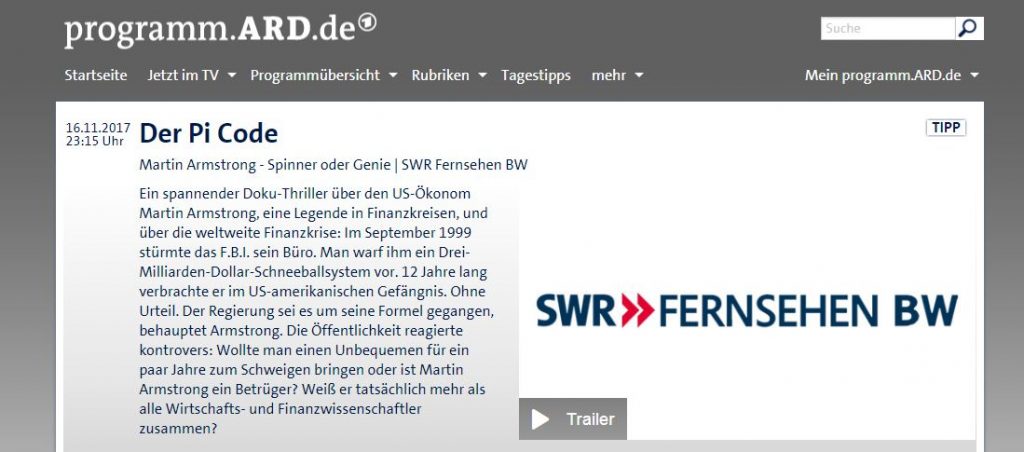
The Forecaster on German TV November 16th, 2017


While the Forecaster has been banned in the USA because it reveals that the USA was interfering with the Russian Elections, it has been a worldwide hit outside the land of the free and home of the brave where censorship is not supposed to take place. It was to appear on Netflix, until the word came down and the high-ups pulled it. Interesting how when things expose corruption and government abuse, suddenly you are not allowed to watch it.

China Open Gold Trade in Yuan as Proxy for the Yuan


China keeps moving gradually to open up their economy to international forces. The People’s Republic of China has expanded the trade in gold in yuan and thus the internationalization of the national currency is moving closer. Gold merchants from the industrial metropolis of Shenzhen have been trading their yuan gold at the Hong Kong Stock Exchange since last week. Previously, this was only possible for Hong Kong gold traders. While some immediate claim this is China attacking the dollar, they are completely ignorant of international capital necessities.

This new connection between Shenzhen and Hong Kong follows the Hong Kong-Shanghai agreement reached in July 2015, which allowed Hong Kong dealers to trade gold in mainland China for the first time. Trading gold in yuan has one primary advantage. It is not going to unseat the dollar, it is all about trying to make the currency free-floating on the world market. Because gold can be traded in yuan, the common converter becomes gold between that and the dollar. It is NOT really a gold trade as much as it is an indirect means to trade the currency.

To unseat the dollar requires a place to PARK big money in yuan. That does not exist right now. That day is coming after 2031. This is another step in moving toward a free-floating yuan contract. Essentially, this is a formal proxy for a free-floating yuan and will replace the Bitcoin trading that has been used as the proxy to get money out of China

The Coming Pension Rehabilitation Administration


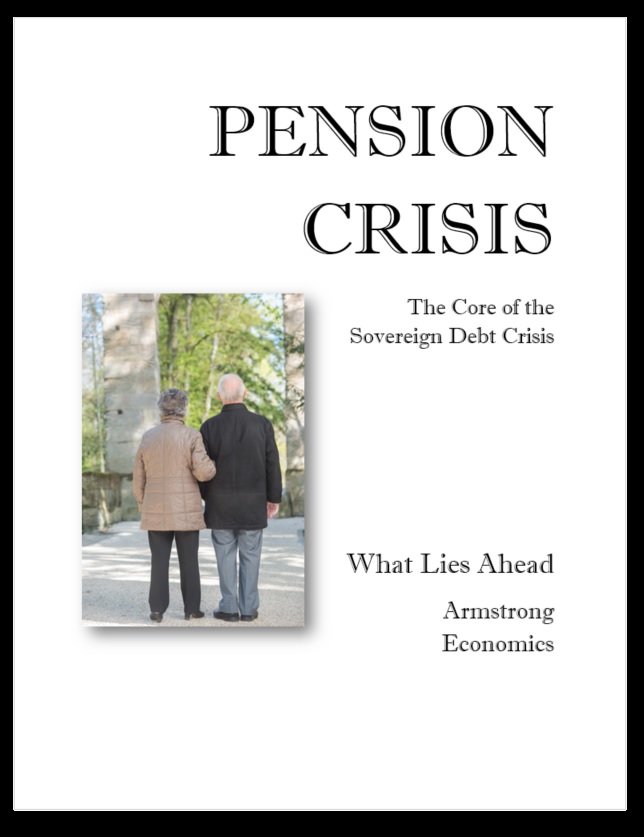
Remember the S&L Crisis, well welcome to the Pension Crisis. It is becoming well known behind the curtain that we have a global pension crisis. I first reported this event more than 15 years ago. This at the WEC, we had more than 10 major pension funds attending from around the world. The crisis has been set in motion by the lowering of interest rates with the Crash of 2007. This is why the Fed Char Yellon has been talking about the need to “normalize” interest rates. The crisis in Europe is reaching catastrophic proportions.

In the USA, Senator Sherrod Brown, a Democrat from Ohio, intends to introduce legislation that would allow struggling multiemployer pension funds to borrow from the U.S. Treasury to remain solvent. The proposal being kicked around would create a new office within the Treasury Department called the Pension Rehabilitation Administration (PRA). The funds would come from the sale of Treasury-issued bonds to financial institutions. The pension funds could borrow for 30 years at low-interest rates. One restriction for borrowers is they could not make risky investments. That will mean they must buy government bonds since the government assumes whatever it issues in debt is risk-free, That propaganda is supported by the big accounting firms.

Pension Crisis


Detroit Bankruptcy UnionsAfter 2015.75, we will begin to observe the Pension Crisis manifest before our eyes. There are few governmental exceptions within Western Society without this serious trouble. While they keep everyone occupied between soccer and football, governments have done an incredible job of committing massive fraud upon the public. Public unions are simply demanding that governments raise taxes and extort money from other sectors to hand to them.

Government pension funds are a joke. Even in Britain,  pensions will run out of cash next year: Amount handed out to future generations will be disastrous. Those under 35 should not expect anything for their taxes. (see also the Mail). This will be part of the ever increasing civil unrest that we see coming after 2015.75 moving into January 2020.

European Banking Crisis


There is intense resistance building against the stricter new rules on bad loans among the European banks. This will hit Italy hard and may push off the edge more than one Italian bank. With the elections coming next year in Italy, the banking rules may be the straw that breaks the back.

The background to the dispute is the demand of the ECB’s banking supervisor that banks must withhold higher reserves for the default-prone loans in their portfolios. The crisis stems from the fact that as taxes have increased, the economy has declined. The total bad loans in the Eurozone add up to about €844 billion euros. About 25% of this figure is concentrated in Italian banks.

A good stiff wind may blow over the European banking system

Draghi Knew About Hiding Losses by Italian Banks


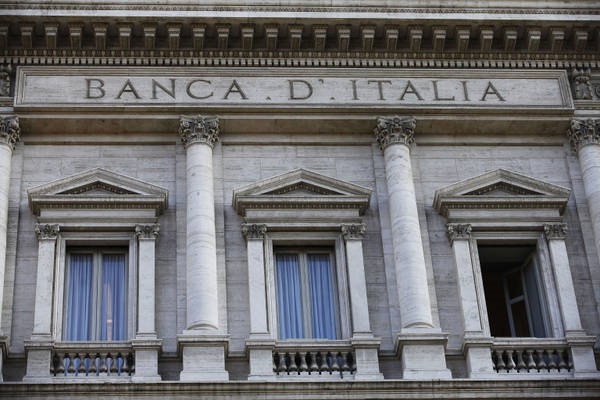
The Bank of Italy, when it was headed at the time by Mario Draghi, knew Banca Monte dei Paschi di Siena SpA hid the loss of almost half a billion dollars using derivatives two years before prosecutors were alerted to the complex transactions, according to documents revealed in a Milan court.

Mario Draghi, now president of the European Central Bank, was fully aware of how derivatives were being used to hide losses. Goldman Sachs did that for Greece, which blew up in 2010. It is now showing that Draghi was aware of the problems stemming from a 2008 trade entered into with Deutsche Bank AG which was the mirror image of an earlier deal Monte Paschi had with the same bank. The Italian bank was losing about €370 million euros on the earlier transaction, internally they called “Santorini” named after the island that blew up in a volcano. The new trade posted a gain of roughly the same amount and allowed losses to be spread out over a longer period. We use to call these tax straddles.

The report was dated September 17th, 2010, and marked “private” demonstrating that the Bank of Italy was aware that by choosing not to book the trade at fair value Monte Paschi avoided showing a loss at the time. If the bank had used a mark-to-market valuation in the fourth quarter of 2008, it would have been included in its year-end report as the credit crisis was cresting.

This is the real picture behind the curtain. Draghi has known all about using derivatives to mask-over losses and pretend they are not there. The entire Greece Crisis was caused by Goldman Sachs constructing derivatives to pretend Greece made the criteria for the Eurozone.

Greece joined the Euro in 2001 under Costas Simitis. At the time, Greece owed about €3.4 billion euros it had borrowed. Goldman engineered a currency swap whereby the Greek debt, issued in dollars and yen, was exchanged for euros that were priced at a “historical” or entirely fictitious currency rate. Of course, swapping dollar and yen debt at nearly the low of 2000 when the euro was only 82 cents to the dollar became a nightmare. Greece’s debt doubled in real terms as the euro then rose to $1.60 by 2008. Obviously, Goldman offered no advice but structured a deal that only benefited itself by directing Greece to sell the dollar at the low. Goldman also set up an off-market interest-rate swap to repay the loan off the books, which was a currency position and therefore not technically a “loan” outside any reporting requirement as debt. The trade kept this part of the Greek debt off the books and cleverly hidden from scrutiny. This falsely created the idea that the Greek debt was moving in the right direction to meet the Maastricht rules eventually. Goldman overpriced the deal to such an extent that 12% of their $6.35 billion in trading and investment revenue for 2001 came from restructuring Greece. In total, they pocketed a premium fee of $300 million. Goldman also warned, as they typically do, Goldman would cancel the offer that if Greece shopped the deal around for a better price. Goldman further demanded that Greece pledge landing fees from Greek airports and revenue from the national lottery as part of the transaction to secure their own profits strip-mining Greece.

Within just three months of signing the deal, the bond markets took a major swing following the September 11 attack in New York during 2001. Furthermore, the dollar declined and the Euro soared. Greek officials began to realize that the deal was not going well in the least. The Greek national debt nearly doubled in size, and in real terms (currency adjusted), the debt would double by 2008 just in Euro terms nominally. Greece faced another financial crisis in 2005, which few understood. Goldman Sachs “restructured” the deal once again, but this time they were selling the interest rate swap to the National Bank of Greece under the new government that came to power in 2004 under Karamanlis. This increased the debt even further stretching-out the payments beyond 2032. Goldman managed to extract $500 million from the Greeks, according to numerous press stories (Independent Friday 10 July 2015; Greek debt crisis: Goldman Sachs could be sued for helping hide debts when it joined euro).
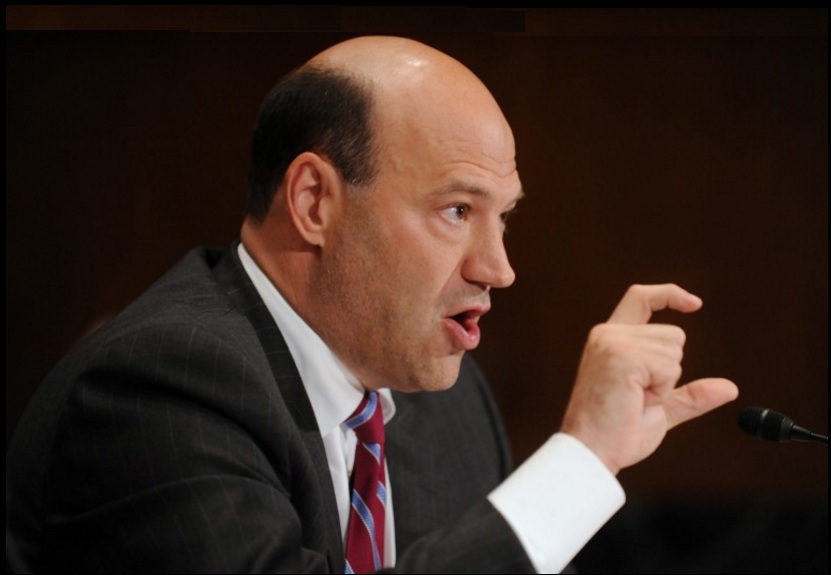
Goldman didn’t even blink and went to Athens to try to sell another deal. Goldman Sachs’ president Gary Cohn personally traveled there and offered to finance the country’s health care system debt, pushing that debt even further into the future. Goldman did not merely make huge fees, it even allegedly placed a bet on the economy of Greece that it would fail based upon its inside information. Goldman is known as Government Sachs and has been apparently beyond the reach of any law anywhere. Papandreou wisely declined Goldman’s 2009 deal and this is when he blew the lid off of what Goldman had done to his country.

Now Gary Cohen is in the White House orchestrating the resurrection of Glass Steagall to knock all the commercial banks out of the investment bank business leaving Goldman Sachs (Government Sachs) with just one competitor – Morgan Stanley.

Meanwhile, because the ECB will cut its bond purchases by 50% next year, Draghi will be unable to help the Italian government and rules against bailing out the banks may just explode in everyone’s face next year.

Iraq & Hunt for Taxes from American Contractors


Iraq has been accused of employing strong-arm tactics to make American military contractors operating in Iraq to pay exorbitant income taxes. They are running to Trump complaining that this is hampering the fight against Islamic State extremists – of course.

The Iraq government is demanding millions of dollars in taxes that these contractors earn providing services in Iraq. Iraqi government officials have refused to issue, or have delayed, the delivery of work visas to employees of companies that refuse to pay income taxes. They are running to Trump crying that the Iraqi authorities have held up delivery of essential supplies, such as food, fuel, and water according to The Associated Press.

Interesting how the hunt for taxes is impacting everything. Of course, any foreign company doing business in the USA has to pay taxes to the USA on what they earn. Why should this be any different?

Interest Rates will Double


QUESTION: Mr. Armstrong; Thank you for an excellent conference. I have been attending since 2011. Each time you deliver a different conference and they are always better than the last. I could not help to notice on Zero Hedge they ran a piece about a Harvard University’s visiting scholar at the Bank of England who claims:

“We trace the use of the dominant risk-free asset over time, starting with sovereign rates in the Italian city states in the 14th and 15th centuries, later switching to long-term rates in Spain, followed by the Province of Holland, since 1703 the UK, subsequently Germany, and finally the US.”

Besides claiming to calculate the 700-year average real rate at 4.78% suggesting that rates will rise sharply when your models are 5,000 years, the two ridiculous statements are a 700-year average as if this really means something in the near-term when rates have been below that for nearly 10 years, and second the statement that he traces “the dominant risk-free asset over time.” You have demonstrated that moving averages are not valid in forecasting and that government routinely defaults.

You forecast at the conference that rates would rise very rapidly as we move into the Monetary Crisis Cycle. When I returned home to Greece, the latest news here is that so many people do not even have the money left to pay taxes. Is this part of the first stone in the water that sets off the waves of the Monetary Crisis Cycle?

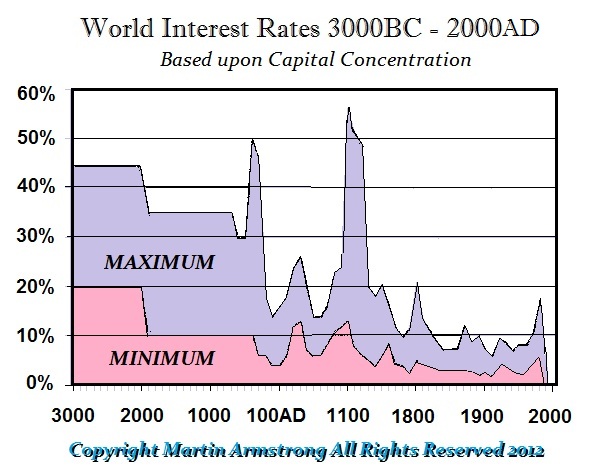
ANSWER: It is very nice to trace 700 years and come up with the average of 4.78% by switching to the dominant economy as the financial capital of the world moved. However, starting the study in the 14th century skips the crazy part. There was the Great Financial Crisis of 1092 in Byzantium. This was really a watermark event that set in motion the decline thereafter. This study of moving from Spain to Holland, UK, Germany, and then the USA, is interesting, but regionally biased.

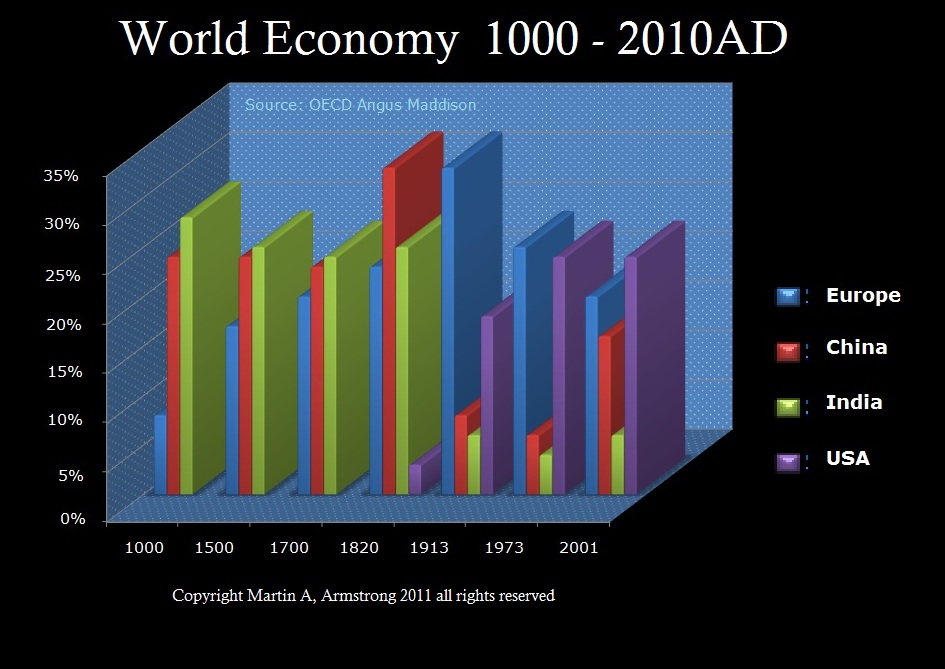
The fall of Byzantium resulting in the financial capital of the world moving to India – not Spain. That is why Columbus set sail trying to get to India, which was the financial capital of the world after Byzantium.

We hit a 5,000 year low. The Reversals we provided at the conference show we are looking at a near doubling in rates when we cross that number.

Tax Reform & the Dow


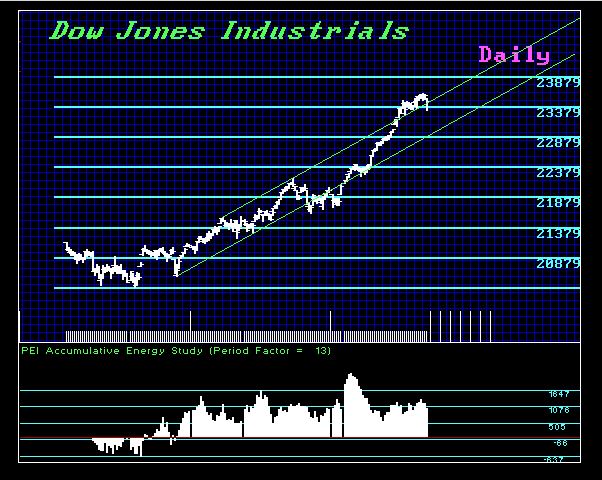
Trump’s tax reform to cut the corporate income tax rate from 35% to 20% will be a huge boost for the economy and place tremendous pressure on the rest of the world. But already we have Republicans playing games for personal careers. They want to postpone the cut for corporations until 2019 AFTER, of course, the 2018 mid-term elections. As always, they are afraid that the Democrats will point to the rich and regain seats.

The longer they delay, the greater the economic decline. This may be the fundamental behind our model which targeted November for a temporary high. Nonetheless, our Energy Models have peaked on the Daily level suggesting that we are still not really in a serious overbought position. That implies a correction is possible, but not a major crash and change in long-term trend.

Bank of England & Real World


Without real-world experience, today’s move by the Bank of England would have cost you serious money. Yes, finally after more than a decade the BOE finally raised rates by 25 basis points to 0.50%. The move has been well telegraphed in recent days and having been confirmed the first thing we see is a 1.5% drop in Sterling. There are always reasons why and this one was no exception. Talk that future hikes will be gradual is the top excuse traders are using for sterling’s decline.
Inflation hit 3% in September of this year well above the 2% inflation BOE target so it was only a matter of time for the hike. However, with the future still uncertain ahead of April 2019 and the end of BREXIT talks, it is likely to take a steady hand to drive the 3% back towards target. Gradual rate increases are not what the currency markets wanted to hear but are has been helpful for the long end of the Gilt curve.
It is going to be an extremely difficult task for the Old Lady as she also tries to encourage foreign investment at a time when all help is needed. A weaker currency will not help that hand, but without it, the labour market will suffer.
Weekly bearish Reversal is down at 1.2811 which may well be the target for tomorrow if we see a 300K Non-Farms Payroll report. The close today will have elected Daily Reversals down from 1.3087.