Does the SCOTUS Support Capital Gains Taxes?


Posted Jun 25, 2024 By Martin Armstrong 
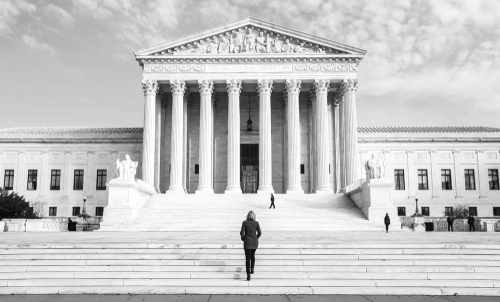
Supreme Court BW

The government believes it has unlimited power to tax the citizens of the United States. The idea of capital gains taxes on unrealized earnings will be an economic nuclear disaster. The Democrat-appointed Supreme Justices believe that Moore v. United States does not exceed Congress’s Constitutional authority to tax unrealized gains. America’s entire future is on the line.

On June 20, 2024, the US Supreme Court voted 7-2 to uphold federal taxes on foreign income. There will be a one-time tax on shares of undistributed profits, and they anticipate the move will earn the Fed $340 billion. Only Justices Gorsuch and Thomas argued that Moore v. United States is unconstitutional and must be abolished.  Kavanaugh stated that this ruling need not be interpreted at the court authorizing taxation on unrealized income. Yet it is a major step in that direction.
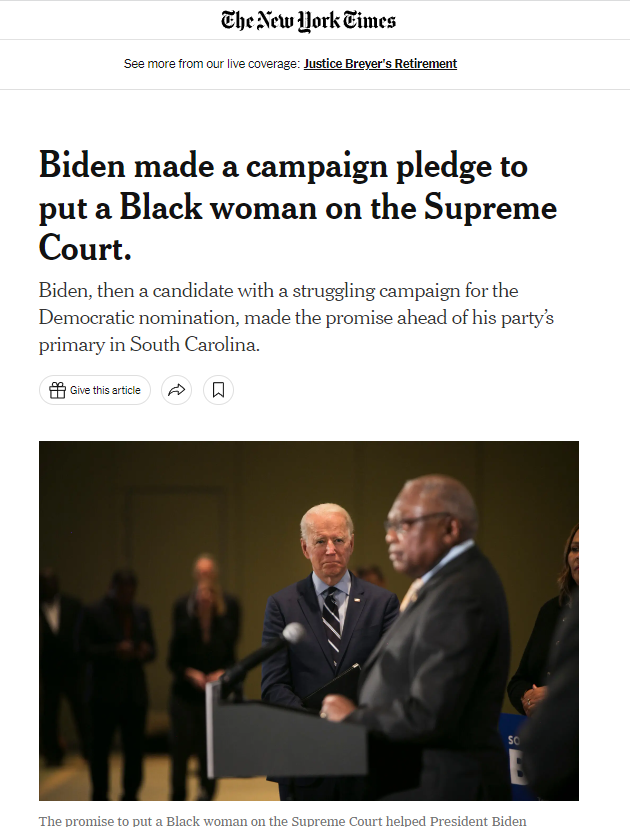
Biden_Promised_to_Put_a_Black_Woman_on_the_Supreme_Court_The_New_York_Times

Biden’s appointee to the bench, Justice Ketanji Brown Jackson, supports capital gains taxation. This is the first time a Justice has spoken directly on the topic in favor of the practice. She argued that the income need not be realized before it can be taxed. She feels it is not a Constitutional right but rather a principle founded on equality. Jackson has extremely far-left views regarding wealth in America that are outright racist. While Sotomayor stated race must not be factored in when analyzing the Constitution, Jackson wrote a separate piece last June “to expound upon the universal benefits of considering race in this context.” But this isn’t about race for the Biden Administration. He appointed Jackson to have a socialist voice on the bench to promote “equality,” which ultimately amounts to everyone having nothing – you will own nothing and be happy.
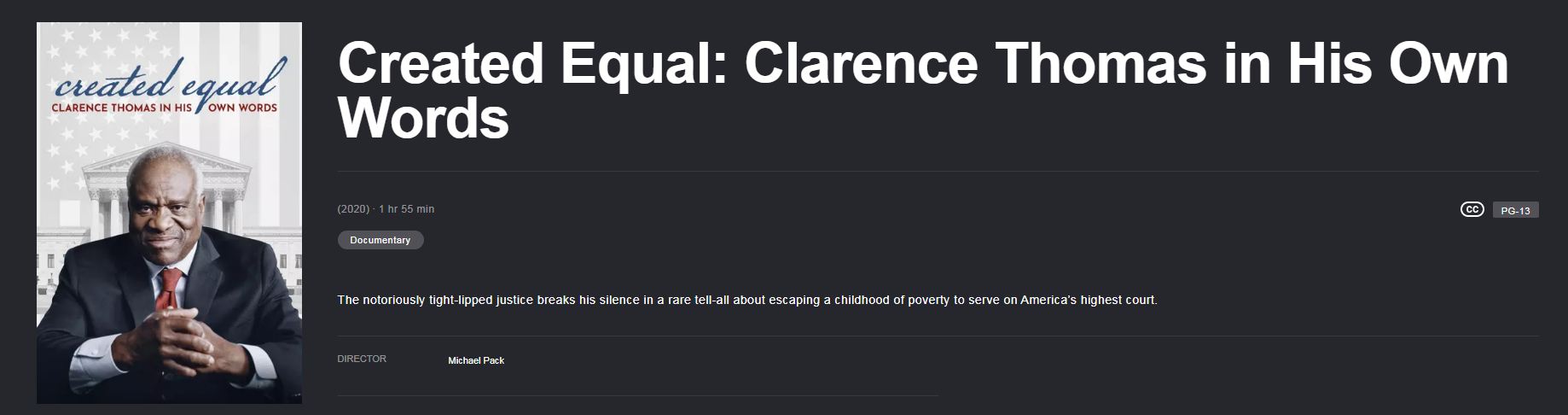
Thomas Justice

The far left is stumped by Justice Clarence Thomas, who upholds the Constitution in favor of its original intentions. You never hear Thomas speak of his race when discussing a ruling as it simply DOES NOT MATTER — we are all protected under one nation, indivisible. He called affirmative action “rudderless, race-based preferences designed to ensure a particular racial mix in their entering classes.” He believes “all men are created equal, are equal citizens, and must be treated equally before the law” and rejects the notion that one should feel victimized based on race. Racial politics is merely a method to divide the people. It certainly has no place in America’s top court.

President Biden has proposed a 25% tax on income and unrealized gains for the wealthiest Americans earning over $100 million. This opens the door to creating a third income tax. They always begin by taxing the wealthiest, but sooner than later, it will pass on to everyone. The proposal also suggests taxing estates of over $5 million on unrealized capital gains in the event of a death to prevent generational wealth.

Eisner v. Macomber stated that unrealized gains were NOT income during the ratification of the Sixteenth Amendment. This would punish anyone from owning an appreciating asset, even homeownership would be a taxable penalty if unrealized gains were grabbed by the government. Taxes are never repealed. The government will continue to tax the people into poverty if permitted to do so, and that is precisely how empires fall. The government is utterly desperate for funding and believes shaking down Americans is a better solution than curtailing its own spending.

Pope Attended First G7 Meeting – Are AI Systems Sentient Beings?


Posted originally on Jun 17, 2024 By Martin Armstrong 

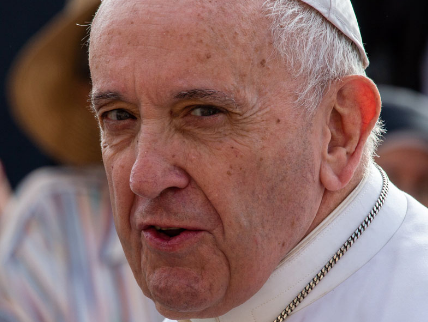
Pope Francis

This week marked the first time in history that a Catholic pope attended a G7 summit. Italy’s Prime Minister Giorgia Meloni, host of the summit, first announced the pontiff’s involvement a week before the summit. Although all ears have been on the alleged peace talks and the future of the West’s involvement in the Russia-Ukraine war, the Catholic Church was present for another reason. Artificial Intelligence has become a common message for the church, and it was also announced in Pope Francis’ new year’s declaration. The church has not been hesitant to say they fear the future of living among increasingly intelligent AI.

In addition to the pope, India’s Narendra Modi and Recep Tayyip Erdogan of Turkey were in attendance, as well as three African presidents – Abdelmadjid Tebboune of Algeria, Kenya’s William Ruto and Tunisia’s Kais Saied. Italy is seeking to tap into trade with Africa to use it as a way to transfer energy. The issues surrounding migration were also up for discussion.

Italy and the Vatican stand in opposition to the United States and most of the West on the issue of abortion. US President Joe Biden “felt very strongly that we needed to have at the very least the language that references what we did in Hiroshima on women’s health and reproductive rights,” an unnamed senior US administration official said ahead of the summit. Even Catholic France encoded abortion in their constitution this year under President Macron. Yet, the G7 nations have agreed not to discuss abortion at length as Italy is the summit’s host this year.

The Catholic Church has historically declined political speaking engagements as they are seen as beneath the pope. “The pope already has the floor,” an Italian church historian, Alberto Melloni, told the NY Times. The Pontifical Academy for Life signed a declaration in 2020 along with tech giants IBM and Microsoft to urge for the ethical usage of AI technology.

consciousness

The church has not commented on whether AI robots will be seen as sentient beings. Can they obtain consciousness? The church remains vague on its views but has grown increasingly concerned at the prospect of advancing AI technology.

The church insists that the public must know whether they are interacting with a human or AI robot and privacy must be respected. Human life should come before robotic, man-made “life” whether sentient or not. “Alignment,” aligning the outcome of AI to the benefit of humanity, has become a commonly raised topic. “The urgent need to orient the concept and use of artificial intelligence in a responsible way, so that it may be at the service of humanity and the protection of our common home, requires that ethical reflection be extended to the sphere of education and law.” At the G7, the pope said that we must not allow AI to take away people’s “ability to make decisions about themselves and their lives, by dooming them to depend on the choices of machines.”

Artificial Inteligence 1

Pope Francis said he believes machines should not be used in these ongoing wars. “No machine should ever choose to take the life of a human being,” the pontiff said, adding, “”We would condemn humanity to a future without hope if we took away people’s ability to make decisions about themselves and their lives, by dooming them to depend on the choices of machines.” World leaders have a powerful tool at their disposal that is capable of claiming countless casualties.

Bill Gates predicts that AI will transform the world in just five years. The International Monetary Fund predicts that the rise of AI could affect about 40% of jobs worldwide. In my research, I have found that AI systems are not sentient beings. This all stems from the distorted idea that our brains are supercomputers and there is no God, for our consciousness is simply created by throwing in a bunch of data, shaking it well, and out comes a person. Thus, the thrust to mimic the brain led to the creation of neural nets, but that effort also failed to create original thought.

AI will never replace human judgement, but it remains to be seen whether politicians will treat AI robots as if they were indeed human as technology advances and the untrained eye cannot distinguish humans from robots.

Why is Keynesian Economics Collapsing?


Posted originally on Jun 10, 2024 By Martin Armstrong 

Keynes 5

John Maynard Keynes in his 1936 book, ‘The General Theory of Employment, Interest and Money,” argued aggregate demand was too volatile to be stable and would lead to inflation or recessions. His theory honed in on spending as a means of price control. Low aggregate demand, Keynes argues, would lead to high unemployment and stagflation. Government could intervene through fiscal policies to increase aggregate demand, as an example, increased government spending could tame inflation. Interest rates, according to Keynes, could also be modified to encourage spending and stimulate demand. So why are these theories failing miserably today?

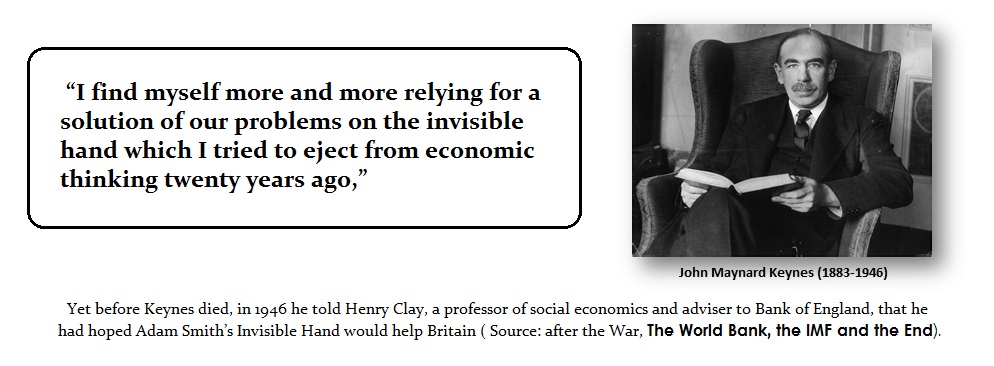
To begin, the United States had a balanced budget when Keynes presented his theory. The government is now the biggest borrower, acting in its own self interest under Adam Smith’s theory of the invisible hand that Keynes spent his career attempting to deny. According to Keynes, “there is no self-correcting mechanism in a free market economy that automatically restores full employment.” He believed that the government could change the business cycle but arguably regretted this notion on his deathbed.

Keynesian economics gave the government the green light to manipulate the economy, or at least make numerous failed attempted to do so. There is that old joke about communism that you can vote your way in but must shoot your way out, seemingly fitting to the utter disaster governments have created in regards to our economic situation.

Keynes quote on Invisible Hand

The government is by far the biggest borrower. Raising interest rates can have no impact on demand, as the government will simply borrow more, and the central banks simply have no say. During the Great Depression, for example, Washington forced the Federal Reserve to implement QE policies to artificially lower rates to increase demand. Yet, when Washington ordered the Federal Reserve to do the same during the Korean War in 1951, the central bank first broke with Washinton and refused to comply as it knew it would hurt the economy as America’s budget was no longer balanced.

Quantitative Easing destroyed the Keynesian model, and there is now no other alternative for central banks to control the economy. If they raise rates, the budget explodes. The Keynesians advocate manipulating demand and advocate fiscal spending that the central bank cannot control. However, the other part of Keynesianism is the manipulation of taxes. Keynes argued that to stimulate demand, you lower taxes. He saw this correctly, but again, it does not fit with government agendas.

There is no limit to what the government will spend with “money” that simply does not exist. Governments continue to borrow perpetually with no real intention of paying back their debts. This is one piece of the Sovereign Debt Crisis that will implode like a nuclear bomb the likes of which we have never witnessed. The business cycle cannot be manipulated, and what’s more, the Keynesian model cannot account for declining confidence in both government and the economy.

Idaho Shut Down Water Resources to Farmers


Posted originally on Jun 9, 2024 By Martin Armstrong 

Fed President Says Americans Would Prefer a Recession to Inflation


Posted originally on Jun 5, 2024 By Martin Armstrong 

Fed Ship in STorm

Federal Reserve Bank of Minneapolis President Neel Kashkari has advised against anticipating near-term rate cuts. While speaking to the Financial Times, the Fed president stated that people would simply prefer a recession to continued inflation.

“I have learned that the American people—and maybe people in Europe equally—really hate high inflation. I mean, really viscerally hate high inflation,” he told the Financial Times’ The Economics Show podcast. Kashkari is speaking as if we are not already in a recession. It is not difficult to understand the “visceral” hatred people around the world feel toward rising prices. The effects of inflation are felt with every purchase, causing the average person to adjust their entire lifestyle.

3 faces of Inflation Dragon

Vague issues such as rising unemployment or declining wages do not impact everyone. “I lose my job, I lean on my sister or my parents or my friends, and they help me through it. But high inflation affects everybody. There’s no one I can lean on for help because everyone in my network is experiencing the same thing I’m experiencing,” Kashkari explained. Mass layoffs, for example, would only impact a fragment of the overall population, and people would feel lucky simply to keep their jobs.

“In the US, GDP has been remarkably strong, very strong,” he noted. “The labor market has been resilient. Wage growth has been mostly resilient. And we’re seeing even the housing market has shown signs of resilience. So if I look at this resilience and economic activity, that does not look like an economy that is under pressure of very high, very tight monetary policy.” Yet, inflation is outpacing wage increases and people are watching their savings dwindle while spending less. The average person cares not of the health of the overall economy as they simply want to be able to continue maintaining or improving their standard of living. Most Americans, for example, do not invest and live paycheck to paycheck.

CPI Formula

Real prices have far surpassed anything they calculate in CPI. Everyone understands that prices have risen far more than the arbitrary number the Fed provides us. Taxes are continually increasing for everyone in every tax bracket. The government not only adds to inflationary issues with their spending but then expects their citizens to foot a portion of the bill with taxes, which will simply never be enough.

Then we have Washington telling the masses to blame corporations for price gouging while raising their taxes and making it increasingly difficult to conduct business and maintain a large workforce. It is not that the people would prefer to be in a recession, the real issue is that countless people are entering survival mode. People everywhere want to hold onto whatever they may have out of fear for the future, but they are unable even to hoard as real prices now demand they hand over whatever they have to maintain their lives.

The Problem with K-Waves


Posted originally on May 29, 2024 By Martin Armstrong 

K Wave MAA

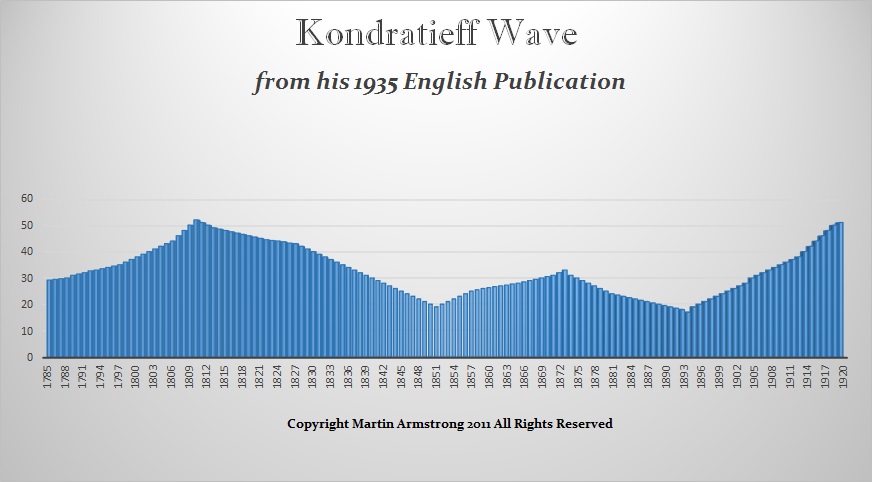
All those investigating cycles within the economy made a simple mistake. Kondratieff followed agriculture/commodity prices when agriculture accounted for 70% of the GDP pre-19th century. That only began to decline from 1850 forward, dropping to 40% by 1900 as the Industrial Revolution emerged with the invention of the steam engine. Moreover, aside from climate impacting the food supply, there were also wars. So the Kondratieff Wave failed to take into account all of the external forces.

If we extend the K-Wave 54 years from the commodity high in 1919, that brings us to 1973, which was close to the end of Bretton Woods in 1971 and the OPEC Oil crisis. Another 54 years from there will bring us to 2027. Therefore, this may be based entirely on commodities, but they were impacted by weather and war. Note that 2027 is the ideal target on our model for war derived from entirely different sources.

KONDRATF

There is a cycle of industrialization as well. Rome began as an agrarian society and moved toward trade, which brought them into conflict with Carthage. Rome itself became more like New York and grain was imported from Egypt. As agriculture became more of an import, Rome blossomed like New York into the arts and culture. The shift toward industrialization also resulted in a decline in birth rates for children. Large families were needed in an agrarian society but not so much in a developed society – hence the family laws of Augustus.

The first known Clean Air Act occurred in 535 AD by Emperor Justinian in Constantinople. He proclaimed the importance of clean air as a birthright. “By the law of nature these things are common to mankind—the air, running water, the sea.” Even Cicero wrote about pollution in the ancient city of Rome. This went hand and hand with developed societies and urbanization.

Consequently, when looking at long-term cycles, a few hundred years is not enough data. If Kondratieff were alive today and based his study on the current system, he would focus on services rather than commodity-based economies. Agriculture has fallen to just 1.2% of the civil workforce, so we cannot follow K-Waves as the innovator intended.

Commodities Trade Differently


Posted originally on May 29, 2024 By Martin Armstrong 

Wheat1220 1375

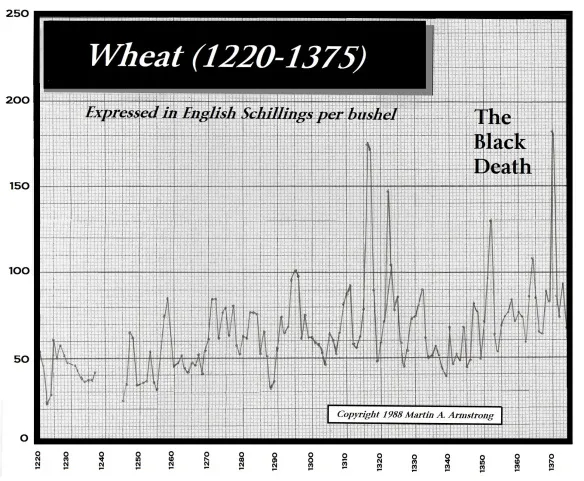
All commodities, including gold, trade substantially differently than stocks or real estate. Pictured here is wheat back to 1200. Note that you see what appears to be a brain wave. Commodities trade differently because they are subject to nature. Manufactured items can be produced on a more regular basis. However, commodities are subject to weather, and even mining is subject to discovering supply.

Look at energy. The US was dependent on imports and was virtually self-sufficient from foreign production until Biden was appointed.

Here is wheat impacted during the Black Death. Two trends were clashing. There was a 50% drop in population, so demand dropped, but also there was a collapse in labor, so production declined. Prices rose because there was still a shortage of supply because land went vacant and that forced landlords to begin paying wages. There are always far more complicated trends involved in commodities.

WheatWholesaleWWI

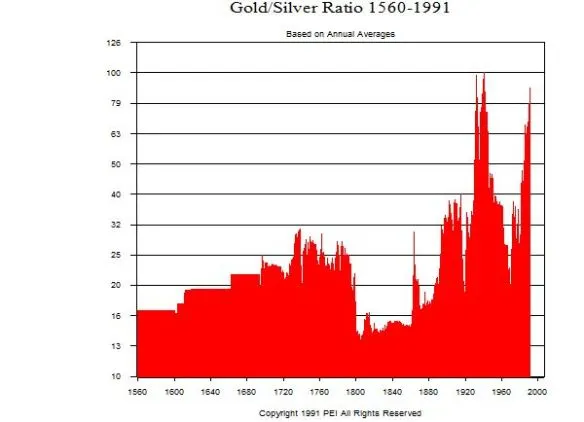
War has also impacted commodities. But when gold was MONEY, it declined in purchasing power WITH inflation. When gold is a free market as present, it moves opposite to inflation because, yes, it too is then a commodity. Making gold money will NEVER prevent the cycles as illustrated above and it will decline in purchasing power with inflation that is in part driven by nature.

GOLD1560to1991

Consequently, even gold makes runs to the upside (bursts) that are largely catch-ups. It does not remain constant even against silver. Gold is the worst investment from an inflationary standpoint if you expect it to track inflation, for it does not and will not. Right now, we are in a cycle where CONFIDENCE has waned, and we will see gold rise with the stock market, but it trades far differently from stocks.

Cyclical analysis is all about defining WHEN such events will take place. Price is entirely a different aspect. The burst is just that – a rally that appears to come from nowhere playing catch-up because EVERYTHING has an international value.

Does an Increase in the Money Supply Lead to Inflation?


Posted originally on May 29, 2024 By Martin Armstrong 

Supply Demand

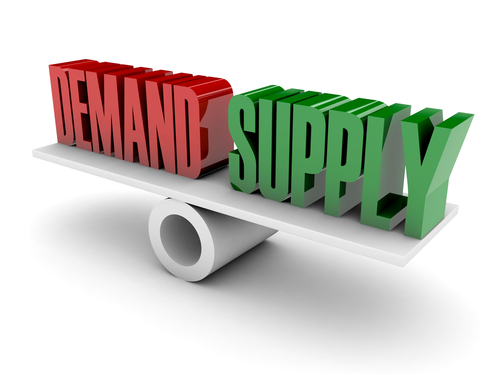
The old idea that inflation is created by an increase in money supply has distorted the minds of many people. Inflation is caused by numerous factors for it is not a one-dimensional aspect. For example, say a bird flu has rendered half of the egg production to be worthless, which would send egg prices soaring. This would have nothing to do with the quantity of money. So, obviously, a decline in the supply of some service or commodity can also lead to rising prices. Supply and demand.

Then there can be cost-push inflation as we saw during the 1970s due to OPEC. The first OPEC price shock was October 1973 from where we should see the next low in 2016 (43 years later). The sudden rise in oil sent a shockwave through the economy, driving up prices because the entire economy had to readjust to higher energy. This was not the result of an increase in demand nor an increase in the money supply.

When gold was used for money during the 19th century, it fell sharply in value with each new discovery from California, Australia, and Alaska. Inflation rose because of a dramatic increase in the money supply, which is exactly what took place in Europe when Spain brought back ship after ship of gold from the New World. The sudden dramatic rise in the supply of money unleashed inflation, and during both periods, money (gold) failed to provide a store of value.

Steady, slow growth in the supply of money does not lead to inflationary waves. We find that major waves of inflation are often tied to waves of speculation, which differ with each wave moving from real estate, commodities, stocks, or bonds, constantly rotating over decades within a domestic economy and then this movement of capital takes place internationally.

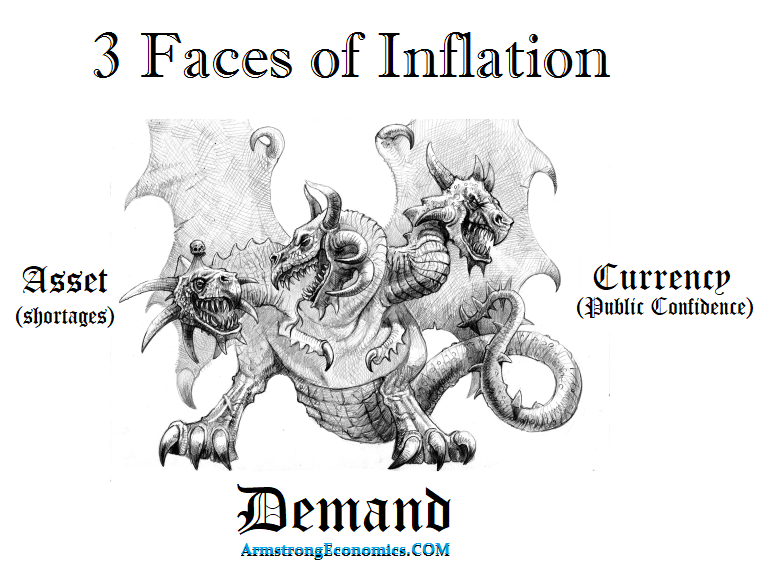
Inflation is not a single one-dimensional aspect. It moves up and down between the rise and fall in the demand for private assets vs. hoarding and uncertainty.

Is the population decrease a bad thing? Unpacking why population increase is an overall good


Posted originally on Rumble By Charlie Kirk show on: May 24, 2024 at 5:30 pm EST

Free Vodka and Beer for the Homeless in San Francisco


Posted originally on May 23, 2024 By Martin Armstrong 

Suicide

California is a socialistic cesspool of failed policies that funnel money through inefficient charities. I recently reported that the state, which boasts the largest homeless population in the United States, failed an audit that found nine agencies misused $24 billion in government funds intended to combat homelessness. Now, new reports state that San Francisco alone has been spending $5 per year on alcohol for the homeless.

The “managed alcohol program” states that it aims to keep homeless people physically dependent on alcohol out of jail or the hospital systems by providing them with “controlled doses” of beer and vodka. The program apparently has only served 65 clients, but the public sector has found a way to spend an astounding $5 million annually on a bar tab for the homeless.

The audit I originally referenced found that all of California’s efforts to combat homelessness have miserably failed. In fact, homelessness has shot up by 56.7% since 2015, when a number of these programs were first implemented. It’s almost as if these non-profits could not survive if they were to actually focus on recovery and rehabilitation efforts instead of fueling addictions.

Video Player

These people are not receiving medical care, and yes, alcohol withdrawal can be fatal but these individuals are simply receiving free drugs funded by the state in order to boost California’s homelessness problem. It would be akin to giving free lines of credit to people with gambling addictions – utter nonsense.

So, while families struggle to afford food and healthcare, Pelosi’s city of San Francisco is prioritizing the money pit that is the public sector. America’s public sector is multiplying under Biden-Harris and there are countless useless agencies spending our tax dollars on worsening our communities for profit.