Scottish Independence & BREXIT


QUESTION: Marty,
Big fat question for you regarding the UK and the SNP.
You seemed to support Scotland breaking away from the UK in 2014, but since then you’ve voiced your concern on the socialist policies of the SNP. I share that concern, as do a growing number of people here, in not so sunny Scotland.

Unfortunately, SNP seems to have introduced a few more taxes into the system in the last year. One of which is that the higher tax band in the rest of the UK has been raised to 50K, whilst in Scotland, it has been kept at 43k. The other latest tax is that if the company you work for have parking spaces and you drive to work and park your car there, you can be hit with around £450 per year.

Looking back on the history of UK general elections, the SNP hit a high point in the October 1974 general election, polling almost a third of all votes in Scotland and returning 11 MPs to Westminster. They then dropped to under 6 seats till the 2015 election, where they went from 6 seats (in 2010) to 56 in 2015. You could argue the rise to 56 seats was due to the fact people either wanted independence or voted for them as they were happy to be led by them in Scotland but not wanting to be independent. They dropped to 35 seats in 2017, primarily due to people being fed up with the independence record being regurgitated over and over.

To summarise then, the large rise in ’74 followed by a big drop in its support at the 1979 General election, followed by a further drop at the 1983 election. Will we see this again? Big rise in 2015, followed by a large drop in 2017 and the same again in the next election?

Personally, I think the tax rises will take a big toll on their support and they will get hammered in the next election.

Many thanks for your thoughts and wisdom.

G

 

ANSWER: I love Scotland. Every time I flew in to Edinburgh to do an institutional conference for a day, I was introduced as a 7th generation Scotsman – never an American. The separatist movement is separate and distinct from the SNP, which is one step to the right of communism. I was living in London when “Braveheart” came out. I remember going to the movies there, and on the way out everyone was saying how some member of their family was Scottish.

That said, the SNP socialist policies are brain dead and this idea that they must remain part of the EU is beyond stupidity even for someone who is dead mentally. There is absolutely no economic validity to remaining inside the EU. The British have NEVER won anything of significance in the European court. What will it take to make the British realize that they are not really welcome in the EU for resentment remains that it was the Brits who saved Europe from both Napoleon and Hitler.

Ann-Medal-Union-Scotland - 2The Scots voted for independence in a referendum which was clearly rigged by London and the EU. But that was the prelude to BREXIT, which the government is doing its best muck up again over this unwarranted fear over trade. The economy will turn down very hard in Europe in 2019 into 2020 before bottoming. This will alter the politics ahead rather significantly. In Brussels, they will be blaming the Brits, while the Italians will begin to voice their opinion that the Brits got it right after all.

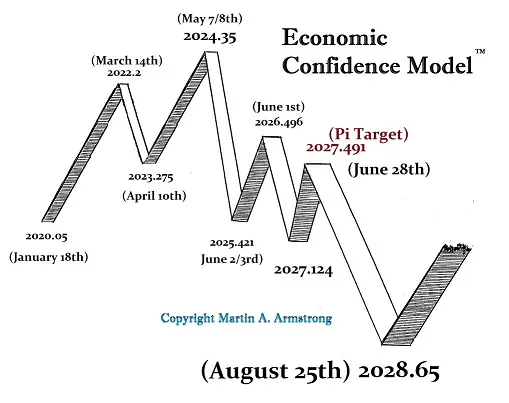
Cyclically, the United Kingdom that was first created back on May 1st, 1707, under Queen Anne (1707.331). On the 309.6 year cycle of the Economic Confidence Model, we arrived at 2016.9315. The BREXIT vote took place on June 23rd, 2016 (2016.476). A referendum on Scottish independence from the United Kingdom took place on Thursday, September 18th, 2014 (2014.715). That meant the Scottish vote was 307.384-years from inception. This was cyclically a confirmation that BREXITwould, in fact, succeed in 2016.

However, the true Scottish Separatist/Nationalism Movement actually began back in 1934 during the economic hard times of the Great Depression. It was in 1934 when the Scottish National Party (SNP) was founded, making its primary goal the future independence of Scotland. The party gradually began gaining ground after World War II, which was propelled by the discovery of rich oil resources in the North Sea during the 1970s. Then in 1974, the SNP won 30% of the Scottish vote and 11 seats in Parliament after campaigning on the slogan “It’s Scotland’s oil!”

Of course, the first major step toward Scottish independence came in 1995. The first and greatest reason for creating a Scottish Parliament in 1999 was that the people of Scotland demanded and deserved the human right to democracy. The UK Government’s white paper on Scottish devolution, Scotland’s Parliament, was published in July 1997. It set out proposals for a new Scottish Parliament and drew heavily on the Scottish Constitutional Convention’s 1995 (see the report: Scotland’s Parliament, Scotland’s Right).

A referendum was held on September 11th, 1997 to ask the Scottish people whether they wanted a Scottish Parliament and whether it should have tax-varying powers. In that 1997 referendum, the Scots voted in favor of devolution of powers, which meant that although Scotland remained part of the United Kingdom, its government gained a broad range of new powers. It would have the power to set its own tax rates as well. Among these new powers was also the right to control education and healthcare. This lead to the creation of a Scottish Parliament for the first time since it was dissolved in 1707. At the peak of the economy in 2007, the SNP won an upset victory in the Scottish parliamentary elections, ending some 50 years of Labour Party dominance. Then the SNP leader Alex Salmond became the first elected minister of Scotland. He won a second term in 2011 and was able to use his party’s historic mandate to secure approval for a referendum on independence for Scotland.

It took just two 8.6-year cycles from 1995 to the beginning of the separatist movement in 2012. In 2012, Salmond and British Prime Minister David Cameron signed an agreement to hold that referendum in 2014. Subsequent negotiations lowered the voting age in the referendum for 16 and determined that it will pose a single question: “Should Scotland be an independent country?”

The problem the SNP faces is they have mixed up independence, socialism, and remaining in the EU rather than the UK. In this regard, they have truly lost their way and do not comprehend either trade of the fact that socialism is collapsing right in front of their face.
 

How Did Socrates do at the 1929 High?


QUESTION: You said Socrates has been back tested. What did it write technical the day of the high in 1929?

PO

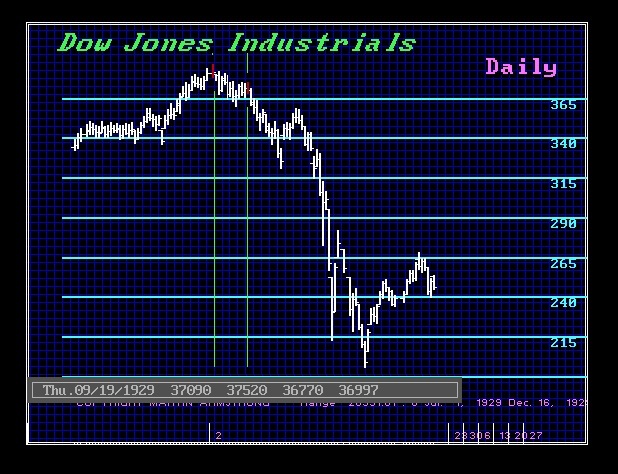
ANSWER: It has learned from all the data globally. Here is the technical analysis it wrote for 9/3/1929 without human editing:

The market scored a new major high on 09/03/1929 which is up 4 days from the last cyclical low. The broader rally has been over the past 17 days with a rise of 14%. This market has exceeded intraday 2 of three projected resistance points and it has closed below 2 others. Our underlying pivot providing some support lies at 37806. At the moment, the projected extreme resistance stands at 39120. Given the closing was weak, a lower opening followed by a break of this low of 37823 would warn that we may have an important temporary high in place as of this session.

The Uptrend Channel Resistance stands above the market at 39415 while the bottom of this Channel rests at 37966. Meanwhile, resistance provided by the top of this Channel will stand at 39648 for the next session.

The view from our Energy Models, the fact that the market is making new intraday highs in price and our Energy Models are declining, this warns of a divergence, which has been going on for the past day. Therefore, this immediate rally may prove to be unsustainable when such a divergence appears.


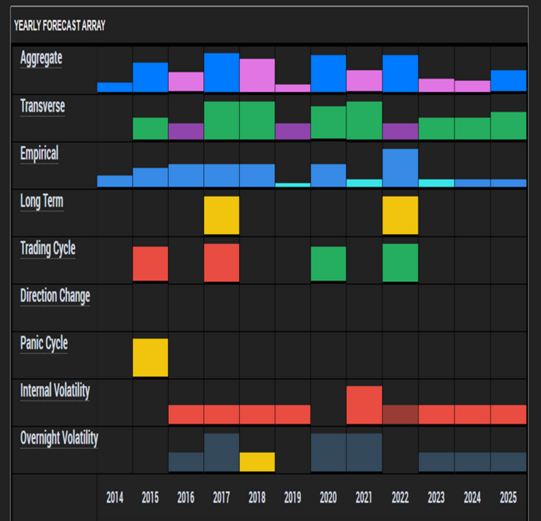
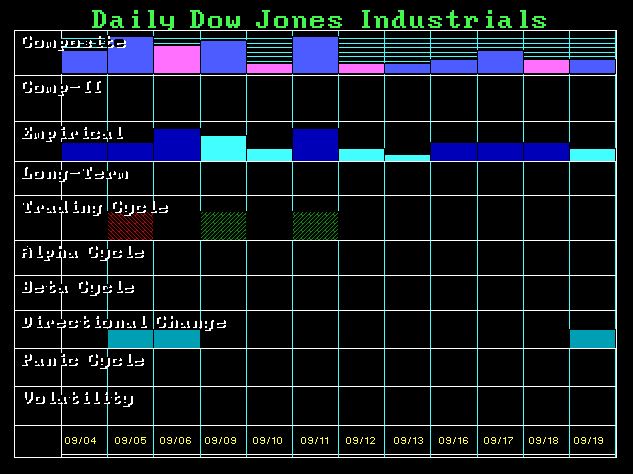
Here was the array. Note that it called for a 2-day correction into the 5th a bounce with a back to back Directional Change. There was a low on the 13th with a 4-day rally/consolidation and the 19th was the next Directional Change. The Panic then began on that Friday 20th. The Directional Changes are pretty good indicators.


Note: The Alpha cycles have been combined in the new arrays for display purposes. They were cycles only from high. The Beta Cycles were derived exclusively from lows

The Hong Kong Dollar Peg – When Will it Break?


Hong Kong’s intervened to support the Hong Kong dollar for the first time since August 2018 after the exchange rate fell to the lower end of its trading band against the greenback. The Hong Kong Monetary Authority bought HK$1.507 billion ($192 million) of their own currency during London and New York trading hours on Saturday.

The Hong Kong dollar peg to the US dollar has come under a lot of pressure. The problem they face is simply that such a peg also imports the inflation or deflation of the currency to which a peg is created. As the Greenback rises in the political-economic sea of international finance, it will become impossible to hold the peg.


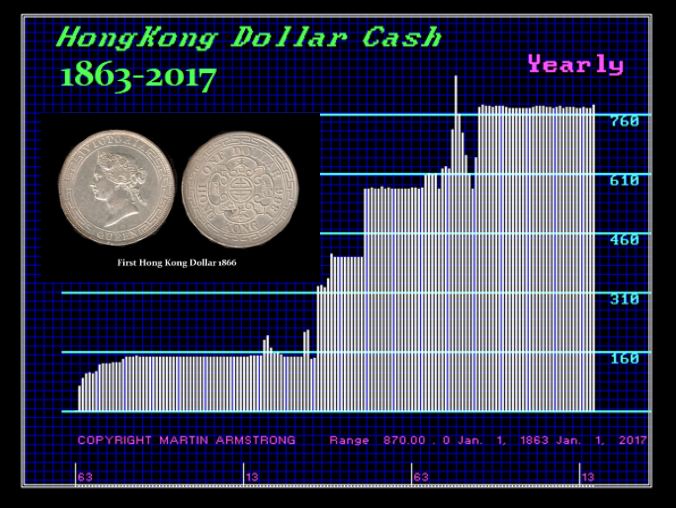
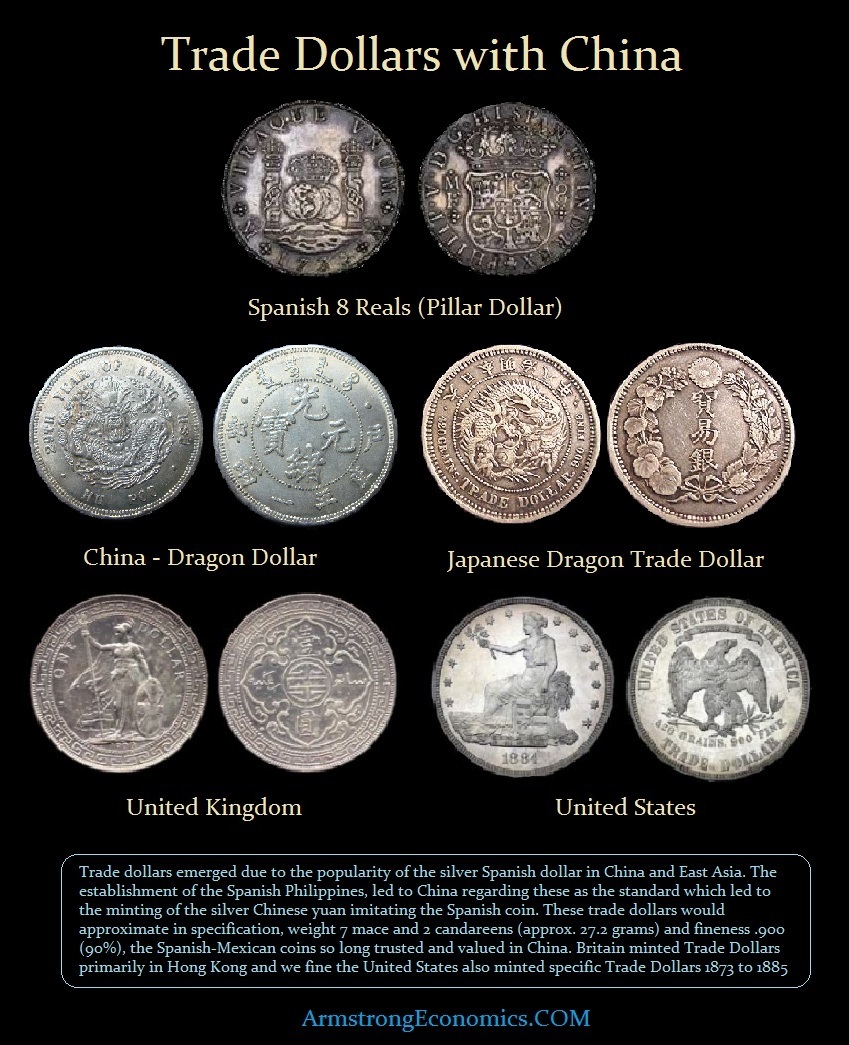
In 1863 the Hong Kong Government declared the silver dollar – then a kind of international currency issued by many nations – to be the legal tender for Hong Kong, and in 1866 began issuing a Hong Kong version of the silver dollar. The silver standard became the basis of Hong Kong’s monetary system until 1935, when, during a world silver crisis, the Government announced that the Hong Kong dollar would be taken off the silver standard and linked to the pound sterling at the rate of HK$16 to the pound.

In 1972, the Hong Kong dollar was pegged to the U.S.dollar at a rate of HK$5.65 = US$1. … Between 1974 and 1983, the Hong Kong dollar floated. On 17 October 1983, the currency was pegged at a rate of HK$7.8 = US$1, through the currency board system.

The problem Hong Kong will face is as the financial crisis in Europe erupts, this will push the Greenback higher. If Hong Kong keeps desperately trying to hold the peg, they will import DEFLATIONand turn their economy down very hard all because of international events. The models we showed at the Singapore Conference targeted 2019 for an important turning point.

Socrates Progress Report


We are progressing in uploading all the memory modules. Soon, we will have all modules plugged in. I had an interesting meeting with one institution. One CFO still questioned if there was any human involvement in the reports. He said that the writing was too good for just a machine and assumed someone had to be editing them. I laughed, and explained with covering over 1,000 instruments currently and about 9,000 more to go, I asked how many people would it take to do that? There cannot be any human involvement for the sheer size of the project would consume probably every person who has ever lived that was interested in analysis.

For example, Socrates will employ technical analysis itself and write its conclusions. Once again, there is no human behind this for it would be impossible to put out over 3,000 individual reports every day using humans. This is what it wrote for the Dow Jones Industrial Index on the daily level.

After the historical high was established during 2018, a major low was created on 12/26/2018 at 2171253 which was 51 days from that major high.

Meanwhile, the Downtrend Line from that major high of 2018 to the subsequent reaction high of 2627782 formed 26 days thereafter resides at 2404847. This had provided the original technical resistance which has been exceeded and can potentially become support going forward. The post high low was established at 2171253. We have not elected the two short-term Bullish Reversals from that important post high low on the daily level but we have elected both the long-term Bullish Reversals.

The more recent Downtrend Line constructed from the last high of 2624142 to the subsequent reaction high of 2615598 stands at 2608763 while drawing a channel provides us with support at 2557422. The market has already penetrated intraday this support provided by the bottom of the channel. However, the market has bounced back and closed above it warning that it is holding right now.

The whole object here is to provide consistent analysis that is FREE from any human bias, conflict of interest, or personal opinion. Here you have Larry Williams stating that they cannot forecast the economy because it is far too complex like the weather.  I believe even our forecasts on the downturn toward cold rather than warm has been correct and it has done so years in advance. ONLY by connecting everything globally can we see the real trend.

It is my hope that Socrates will provide the best management tool for society moving into the future. Kind of like the Biblical story of Joeseph and the Pharoh when he forecast 7 years of plenty followed by 7 years of drought. We cannot alter the cycles in motion and we should not try as Marx and Keynes did. We should understand the trends and prepare thereby living with them in harmony. The weather is turning toward global cooling. This is when disease increases (plagues) set in motion by malnutrition. If we understand the trend, we simply prepare for it instead of blaming everyone else but reality.

The BP Oil Spill was a disaster. However, any company that could show it had a loss in 2008 got in line with their hand out and were paid. They did not have to show any connection to the oil spill that caused their loss. The 2007-2009 economic decline produced losses by itself. There is always someone who has to be blamed.

The Red Tide of 2018 actually disrupted more businesses than the BP Oil Spill. But the Red Tide could not be blamed on a single company with deep pockets. You could not sue God or nature. A simple model on Red Tide demonstrated it was not farmers and chemicals but a 13-year cycle. On top of that, such events extended back to 1648 and predate chemicals or the Industrial Revolution.

While there are people in New York who hate our models because when they have lost big time in their attempts to manipulate markets like 2007-2009, they turn to blame our model claiming we are always too influential. They shift the blame rather than admit that their own corruption has led so many times to blow up the world economy. If we really understood the world and how everything is connected, we could manage the economy far better and even eliminate war which seems to rise as a means to shift blame to someone else when it is often our own governments that skew everything up.

This is what I hope to leave behind.


Socrates’ Forecasts Are Already Identifying the Approach of a New Business Cycle


The Socrates’ Array on Vancouver real estate published back in 2015 picked the high in 2017 and the crash into 2019. The high in the top line was forecasting 2017 rather nicely. Note that things begin to change in 2020-2021. Not that prices in real terms rise, but this is lining up with the ECM turn in January 2020 and the start of a new business cycle. This next one will be more dominated by the decline in confidence in government and the rise of political tension that will be worldwide from separatist movements to the fracture of political parties.

No matter where we look, markets are beginning to reflect a new business cycle is approaching. While this will be one of the focuses at the upcoming Rome WEC May 3rd/4th, the shift in global trends is really amazing. We will also be providing a training session on Channel Moves, which in themselves, is rather rare.

World Economy – Which End is Up?


QUESTION: Hey Martin
First of all, great work with the new Socrates. Thank you very much for getting it to us.

You have said that rates are exploding with fed raising rates for the pension funds and because of the lost confidence in government, at least here in Europe.
Am I correct when I take what you have said, as European, to invest in short term US government paper, short term US corporate paper?
That way I won’t get much yield but I get to benefit from the currency also?
Isn’t floating rate paper also good in times like this?

I also get that there is no other place, so the Dow will go up so I want some exposure to that also?
The commodities are bottoming in 2020 so I want to get some exposure to them also?
But how about real estate?

We as small investors don’t have any other choice but REITs, especially apartment REITs and you have talked against them, saying that they are volatile. So is it best to AVOID REITs and that way real estate all together?
Even if it is a hard asset and a inflation hedge? Also as a European it would not hurt to have some USD income?

With the taxes going up and socialists getting in to power all over I guess it is better to invest in accumulating funds instead of distributing ones?
If you could please find the time to comment on this. I know that there are lots of people asking the same questions as I am.

JP

ANSWER: We are all connected. There is no possible way for any country to move counter-trend to the whole. The European Central Bank and the Bank of Japan have destroyed their bond markets. Their stupid idea of Quantitative Easing and lowering rates to zero and negative was under their theory that people would borrow if it was cheap enough. Over the years, I have received calls from banks asking me if I wanted to borrow money. They call because we run high cash balances and have no debt. They always want to lend money to people who do not need it, but that then begs the question, what would I do with it anyway? If you have nothing in mind you want to buy then you are not interested in borrowing. Yes, there are margin loans for investors in shares. But I am talking about borrowing to expand or buy some business. That is what the Central Banks failed to grasp. If there is no CONFIDENCE in the future, you will not borrow at any rate.

The Bank of Japan could simply agree to tear up its federal bonds. That would impact its balance sheet whereas Japanese bonds are not really held outside the country. The ECB, on the other hand, has no such option for the debt it holds is of individual member states since there was never any consolidation of the debt federally. As far as the US Federal Reserve, its holding of federal debt is under 20% of the $22 trillion and 30% of the debt is held by foreign governments with 28% held by interagency. The US could not be saved if the Fed tore up its bonds. It is not enough.

The pension funds are also linked to government debt. Defaulting on government debt would wipe out all pension funds. The interconnectivity is not considered by so many who summarily assume we can just tear it all up.

Rates will rise to start 2020/2021 as the general public begins to see there is trouble in the wind. The Bank of Japan and the ECB have already destroyed their bond markets and there will be no going back. There will be no buyers when they need them. This is why you need to stay short-term as a buyer of debt and if you are a borrower, then lock it in for as long as you can at a fixed rate.

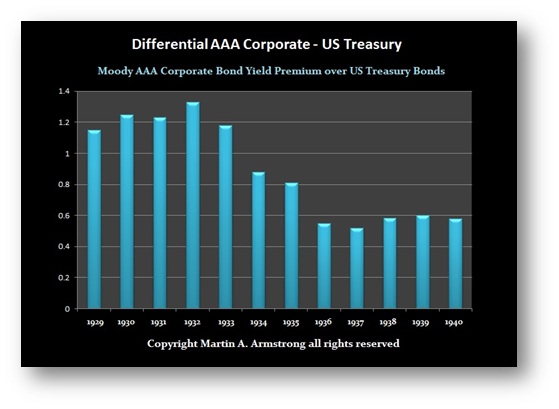
This is a cycle where governments are collapsing. Clearly, stay in the private sector.  Blue-Chip corporate debt SHORT-TERM is better than a government. Even during the Great Depression, AAA corporate debt appreciated. The spread above US Treasury dropped from about 1.3% to 0.5% and the US was the safe haven back then as well. It was Europe which defaulted along with South America and Asia.

Real Estate is not a movable asset so it can be taxed and you cannot leave. They will raise taxes dramatically trying to survive. But governments cannot avoid their collapse for nobody is willing to step up and take decisions for the long-term.

Equities are liquid. This is going to be a game between value and liquidity. Remember! The City of Detroit suspended all debt in 1937. They resumed and paid it off with cheaper dollars in 1963. So they claim they never defaulted. Liquidity is also a top priorit

Britain & Labour’s Proposal for a Permanent Customs Union


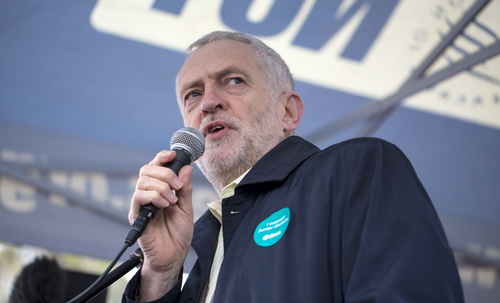
The leader of the British Labour Party, Jeremy Corbyn, is desperately trying to prevent the Labour Party from fracturing and splitting into two parties. Most Labour Party members want a second referendum in the hope that the people would vote to Remain this time around. Many Labour members remain under the impression that the policy agreed at a conference last year was that the party would support a second referendum if it could not force a general election. However, that policy maintained that as “a public vote” was one of the options that had to remain on the table.

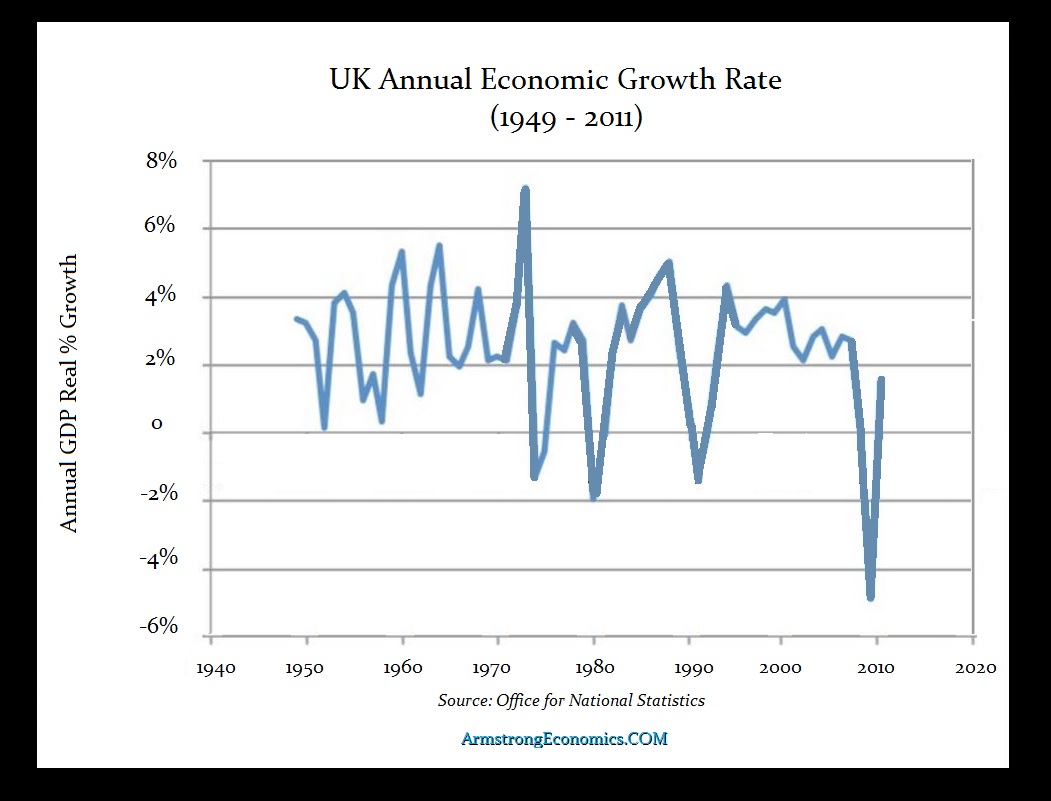
Instead of moving that option to the forefront, Corbyn has abandoned that posture and asked for a permanent customs union – one “that includes a UK say on future EU trade deals.” This means that Labour is proposing a new permanent customs union with the European Union (EU) after Brexit which would allow the UK “a say” in future trade deals. Britain never wins any trade deal anyway and it has witnessed nothing but a declining economic trend ever since it joined the EU.

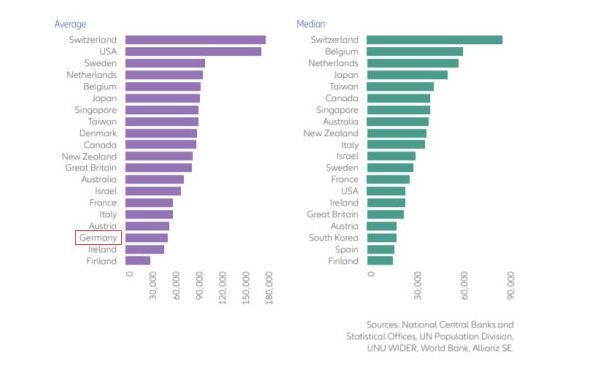
Anyone who would bother to look at trade would immediately see that the EU needs the UK. The biggest market for Germany to sell cars is the UK since it maintains the old-world mercantilist economic model. That means that the UK has a better consumer market that supports Europe – not the other way around. Belgium and the Netherlands have a higher per capita income compared to Britain which is significantly higher than that of Germany. Remaining in the customs union would be a disaster. The UK could not negotiate its own deal with the USA for France would be able to veto it from the start.

European Tour – The Calm Before the Chaos?


I am writing from Frankfurt here for meetings ahead of the chaos awaiting the May elections. In Frankfurt, while the economy is clearly slowing, the financial capital is booming. New skyscrapers are rising to join those of Commerzbank, Deutsche Bank, DZ Bank, Helaba and others on Frankfurt’s skyline. This is another sign that there is a disparity between the financial world and the main street.

Nevertheless, behind the facade is a weakening banking sector that the ECB seems to be inspiring. Forcing negative interest rates where the banks must pay the ECB 0.4%, their rate of return on equity has fallen into a crash mode. The German banks’ average earnings have dwindled from once 4% back in 2010 to barely 1% into last year. Deutsche Bank, the biggest, tried to compete with Wall Street and paid the price. After four years of losses, finally, in 2018, Deutsche Bank made its first annual profit which was just a 0.4% return on equity.

As always, politics enters the game rather than logic. The German government wanted to see a Commerzbank and Deutsche Bank merge and offered some undisclosed assistance.  That assistance would most likely be writing off a portion of the 15% the German government still owns of Commerzbank, which is the legacy of a bail-out and a merger with the stricken Dresdner Bank back in 2008-2009. The government does not own shares in  Deutsche Bank.

The books of Commerzbank show the same problems as in Deutsche Bank so a merger between the two does not appear to solve any crisis. There are in addition rumors that Commerzbank is being considered by both French and Italian banks for a takeover. The prospects of a merger with Deutsche Bank from a non-German bank may be too ambitious politically speaking.

The German government is coming under great stress for the two biggest banks are not really very healthy at this moment and suitors are foreign – not German. Deutsche Bank could be merged with the French BNP, but that would be a loss of pride. Meanwhile,  the management at Deutsche Bank would prefer a deal with Switzerland’s UBS. A previous German bank, HVB of Munich, was taken over by Italy’s UniCredit. That was one embarrassment politicians seem reluctant to repeat. The bail-in policy was devised because politicians did not want to have to contribute to bank failures they saw as inevitable in Southern Europe. To have foreign banks eying up German banks, the pillar of the EU, somehow strike a deep blow into the political heart of the EU.

The ECB’s negative interest rate policy is seriously harming European banks yet they cannot figure out an alternative without having to admit there is a major flaw in the entire structural system in Europe. Forcing banks to pay the ECB to deposit reserves is really absurd.

What is most interesting is that the emotions are running high over issues such as BREXIT and the Euro Crisis. It appears that analysts from major institutions are not allowed to discuss anything to do with debt consolidation. This appears to be off the table for discussion. The proposals to create a Euro Bond are separate and distinct leaving the current national debts to be held by each member state. That hardly removes the threat of one member failure impacting the whole of the EU.

Meanwhile, there is a silent move to reduce exposure to Italian debt held by non-Italian institutions. There remains a concern that Italy could possibly follow Britain. There is growing respect that even the hint of such a possibility that Italy would withdraw from the Eurozone can result in a sharp decline in the value of Italian debt even if they never move to actually exit the Eurozone. Italy was one of the original founders of the Euro.

Overall, there appears to be a general consensus that everyone should just keep the Euro at all costs. However, without major structural reforms, it is hard to see how the problems will not take on a life of itself. The refusal to consider a debt consolidation leaves the Euro vulnerable to the politics of each member with rising popular trends in politics.

The Eurozone’s third-largest economy, Italy, already has debts of about €2.3 trillion euros, which is the equivalent to 132% of its GDP. However, it takes more than 4% of Italy’s GDP is now being used to service its debt load and this is with historically low interest rates. There are concerns behind the curtail that Italy can play a game of chicken. If they decide to leave the Eurozone, what about all the Italian debt held by the ECB? Who will lose? The Italians, Brussels or the financial markets as a whole?

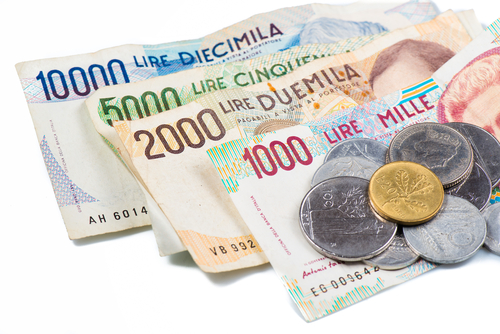
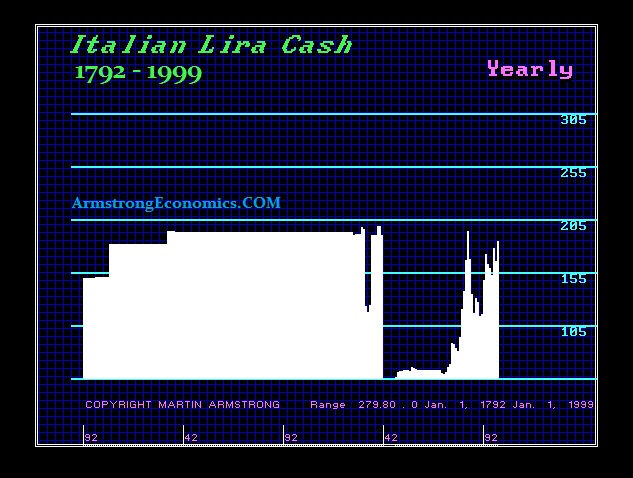
The lira was the official unit of currency in Italy until January 1, 1999, when it was replaced by the euro (euro coins and notes were not introduced until 2002). Old lira-denominated currency ceased to be legal tender on February 28, 2002. Beginning on January 1, 1999, all bonds and other forms of government debt by Eurozone nations were denominated in Euros. The value of the Euro, which started at USD 1.1686 on December 31st, 1998, rose during its first day of trading, Monday, January 4th, 1999, closing at approximately US$1.18. The Euro replaced the former European Currency Unit (ECU) at a ratio of 1:1 (US$1.1743).


Converting its national debt at 1.18, only resulted in economic chaos that devasted Italy. Whatever it owed previously in lira was suddenly now Euro. They experience their national debt doubling in real value the same as if you borrowed in Swiss franc for a mortgage that saw the Swiss franc double in value.  With the Euro trading in the 1.13 level, it is finally below the original conversion rate but even that ignores all the costs of services at high price levels.


By no means did Italy benefit from joining the Eurozone. To participate in the new currency, member states had to meet strict criteria such as a budget deficit of less than 3% of their GDP, a debt ratio of less than 60% of GDP, low inflation, and interest rates close to the EU average. Both France and Germany have been over that 60% level. France’s debt is currently at 97% of GDP while Germany is at 64% of GDP. Italy is 138% of GDP and Greece is at 178%. The Netherlands is at 56.7% of GDP, Austria is at 78.4%, Belgium is at 103% while Spain is at 98%. For comparison, the USA stands at 78%. This strict criterion has really failed to work and it was all mandatory simply because they refused to consolidate the national debts from the outset.

Greece failed to meet the criteria and was excluded from participating on January 1st, 1999. Eventually, Greece joined the Euro with the help of manipulations by Goldman Sachs on June 19th, 2000 when the drachma was fixed at 340.75.

This tour here in Europe is most interesting for the concerns are rising and there is a clear flight from Italian debt. Some of the most conservative portfolios in Europe have raised their exposure to the dollar from 5% to 30% which was attributed to the significant rally in the Dow since December. We even have central banks buying gold in search of diversification and a hedge against the uncertainty on the horizon come May. Needless to say, we have selected Rome for this year’s midterm WEC for this is the center of political attention behind the curtain.

Peak in Investment Grade Corporate Debt Matures by 2021


We have a very interesting crisis building in addition to the political chaos we see coming in 2020. By the time we reach 2021, we will have over $2 trillion in investment grade corporate debt maturing. This is going to present some very interesting problems. Up to now, we have advised our corporate clients to borrow at these rates and lock it in for 30 to 100 years. The bulk of corporations, who we do not advise, funded themselves short-term. With about $2 trillion maturing by 2021, they will end up pushing interest rates higher from there onward.

GDP Release: 4th Quarter Growth 2.6%, 2018 Annualized 2.9%, 2018 Yearly Real GDP 3.1%…


The Bureau of Economic Analysis, BEA, finally released the fourth quarter growth rate estimate for 2018.  The 4th quarter growth result at 2.6% exceeded expectations, and shows the U.S. economy is growing stronger than almost all economic forecasts.

WASHINGTON DC – In the fourth-quarter, U.S. gross domestic product grew at an annualized rate of 2.6%, according to the latest data from the Bureau of Economic Analysis.

Thursday’s report beat expectations, with consensus economists polled by Bloomberg looking for growth to slow to 2.2% during the final three months of the year. The domestic economy grew at a pace of 3.4% in the third quarter and 4.2% in the second quarter.

Despite the softening in GDP in the fourth quarter, overall growth in 2018 was solid. Real GDP grew at a pace of 3.1% in 2018, measured from the fourth quarter of 2017 to the final quarter of 2018. This represented a stronger pace of annual growth than the 3% targeted by the Trump administration. (read more)

The professional political class and corporate financial media are once again trying to talk down the strength of the U.S. economy.  However, the Main Street economy is powering through despite their efforts.

There is a visible connection between the Wall Street multinationals and the financial media; both are riddled with anxiety over Trump’s economic policies that favor Main Street over Wall Street and it shows in the media coverage.  I digress.

“Consumer spending continued to grow solidly and, most encouragingly, business investment growth recovered sharply after a dip in the third quarter. Despite big external headwinds and financial market volatility in the fourth quarter, U.S. firms are not retrenching sharply on capex. Labor market strength and ongoing fiscal stimulus should see domestic demand expanding by enough to keep GDP growth above potential in 2019, despite a rising drag from net trade.”

— Brian Coulton, Fitch Ratings.

“Business investment was a big positive surprise, with nonresidential spending soaring 6.2% on the back of a 6.7% jump in equipment spending and a honking 13.1% increase in intellectual property products.”

— Sal Guatieri, BMO Capital Markets.

The rate of import goods, a deduction from GDP, slowed down between the third and fourth quarter and consumer spending was higher than anticipated.  That’s good news, but that’s not the whole story….. for Main Street it gets even better.

The current inflation rate (PCE index) was once again measured at 1.6%.  However incomes are rising faster than inflation.  This leads to more “disposable income”:

Disposable personal income increased $218.7 billion, or 5.7 percent, in the fourth quarter, compared with an increase of $160.9 billion, or 4.2 percent, in the third quarter. (TABLE 8)

(pdf – BEA source)

BEA: During 2018 (measured from the fourth quarter of 2017 to the fourth quarter of 2018), real GDP increased 3.1 percent, compared with an increase of 2.5 percent during 2017.

The Full Picture: Business investment into Main Street USA continues to increase.  Manufacturing jobs and durable good employment in Main Street continues to increase.  Wages continue to rise.  Inflation on most consumer goods remains low.  Disposable income is growing, which means more consumer spending.  More consumer spending means higher rates of economic growth and an expanding economy.

MAGAnomics is working.

TheLastRefuge@TheLastRefuge2

U.S. economy grew faster than expected in Q4 https://news.yahoo.com/4q18-gdp-first-and-second-estimate-130025490.html?soc_src=hl-viewer&soc_trk=tw  via @YahooNews

U.S. economy grew faster than expected in Q4

In the fourth-quarter, U.S. gross domestic product grew at an annualized rate of 2.6%, according to the latest data from the Bureau of Economic Analysis.

news.yahoo.com

67 people are talking about this

TheLastRefuge@TheLastRefuge2

GDP surprise chalked up to unexpected consumer spending during shutdown, R&D growth https://on.mktw.net/2TgXj0M 

Consumer spending during shutdown, R&D growth led to GDP surprise, economists say

Here’s what economists are saying about the 2.6% growth in gross domestic product during the fourth quarter, which was faster than consensus expectations.

marketwatch.com

49 people are talking about this