The Bubble of 1825 was Also a Contagion


The Most Profitable Canal of the 19th Century Today is a Tourist Cruise

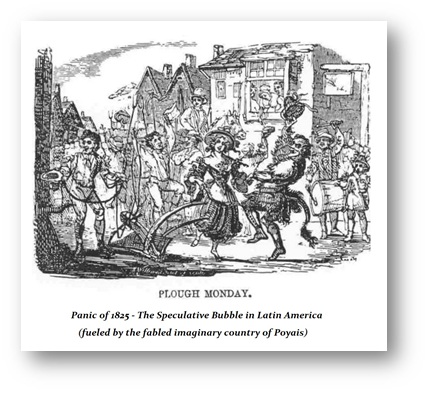
Besides the speculative bubble that resulted in the Panic of 1825 involving the imaginary country of Poyais, when such a bubble unfolds, there is often a contagion. The events that led to the Panic of 1825 also resulted in the Canal Bubble, but this was rather different and quite distinct. Here there was the Loughborough Canal Navigation Co. which consistently paid the highest dividend of any canal company in England and it was the leading share at that time domestically. In 1824 its share price actually hit £5000, which was an incredible amount of money. Their share price never split and the annual dividend reached £200. Shareholders were getting paid a dividend that was MORE than what the had paid for the share, to begin with. It was not a huge float. There were only 70 shares even available. Nevertheless, there was trading in these shares that left behind price data.

Panic-1792Since the Loughborough Canal was so profitable, interestingly enough there was active trading so the shares were rather liquid well into the latter 1800s. They began paying a £5 dividend in 1780, which by 1793 reached £30. It was 1793 which was the first high in the Canal Bubble, which was not alone. The early warning signed appeared even in the United States with wild speculation in the shares of the Bank of the United States create at first a Panic of 1791. The price swings from its original Loughborough Canal Navigation Co price of par 100, rose dramatically in a bidding war reaching 195 followed by a When When the Bubble burst in the Poyaisthe Panic of 1825 took place collapse back to 110 with a reaction rally to 145.

The Panic of 1792 in the United States was the first financial bubble and crisis to take place involving real estate. It was a combination of land speculation and stock speculation that resulted in William Duer (1743-1799), a lawyer from New York City who helped to draft the New York State Constitution and served as a member of the Continental Congress in 1778 and 1779, sentenced to debtor’s prison where he died. Alexander Macomb (1782-1841) was an American merchant who was one of the richest men in New York City whose home was rented to George Washington for his Presidency. He would write to a friend, William Constable (1752-1803) an international merchant trading between England and American ports. In his letter of April 1792, he lamented that he lost everything in “less than three months” and would be sent to debtor’s prison and never regain his fortune.

The real estate speculation dominated the United States whereas in England it was speculation involving land for digging canals. However, after this initial flurry into shares of canal companies which never really panned out, the Loughborough Canal Navigation Co in England was the leader, but it was very real. The shares saw wild price swings that would also result in numerous people suffering a complete loss of their wealth on speculation. The dividend reached £110 by 1818 and then soared to £200 in 1824.  The dividend was now far more than the shares originally sold for. Shares in Loughborough Canal stock, which were £100 back in 1776, had soared in value to over £300 during the Canal Bubble in 1792. However, as the dividends skyrocketed, so did the price. The share price reached £2400 in 1819 and then exploded to £5000 going into 1824.  Unlike BitCoin, this was real and not anticipation of the distant future.

When the Bubble burst in 1825 by the speculation in the imaginary country of Poyais, like the Long-Term Capital Management Panic of 1998 when Russian bonds collapsed, people needed cash. Profitable ventures such as the Loughborough Canal Navigation Co were liquidated to raise money to cover losses elsewhere. The CONTAGION was born – selling good assets to cover the losses in others. Thereafter, the price of Loughborough Canal shares continued a steady decline as the speculative atmosphere collapsed. Today, the most profitable canal probably in history is a lovely cruise for tourists.

Using the Global Market Watch


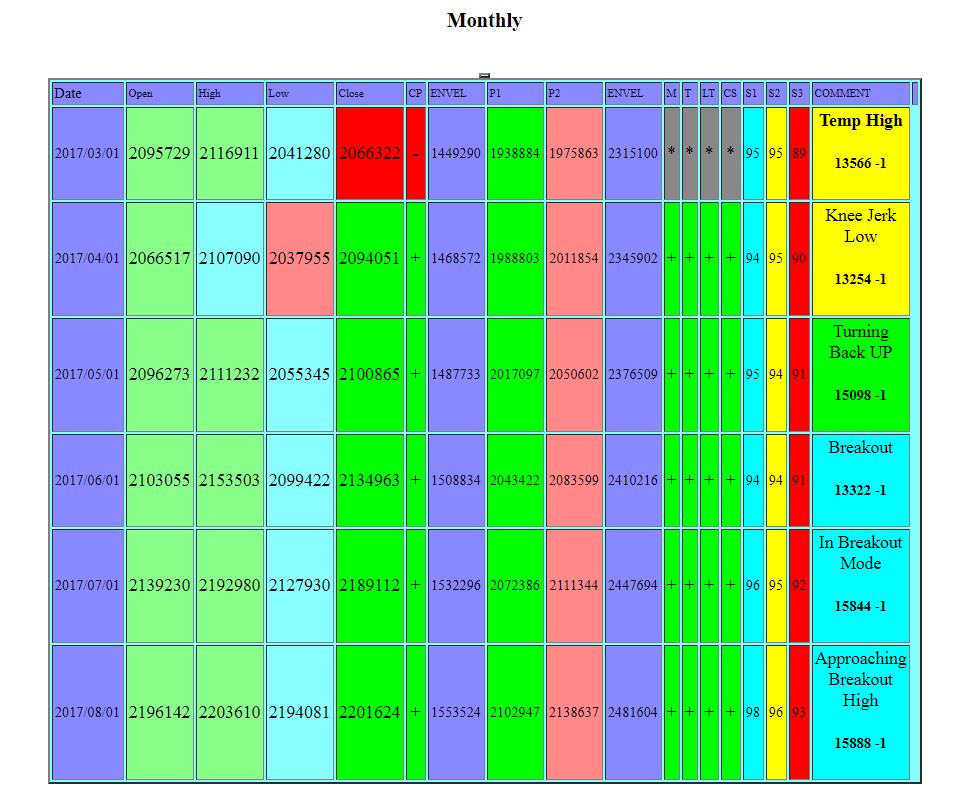
The Global Market Watch (GMW) is PURELY an alert system. It is not intended to be a trading tool. It is simply an alert to allow you to see the entire world collectively and is only a pattern recognition model EXCLUSIVELY The last entry is dynamic and it will change during the course of that period (weekly to yearly) until it is final with the close of that period. It merely reflects what the pattern would be if the week to year had closed that day. We never buy or sell on this model since it is ONLY an alert and thus a confirming tool. Reversals and Arrays are the only forecasting methods that provide price and time. Th GMW is just an alert which is better on some more developed markets than less traded instruments. It is also more reliable on the higher monthly time levels up to yearly for there the patterns are less complicated. One the daily level, what is astonishing has been that this is an AI system which is constantly learning and has therefore identified more than 50,000 patterns so far. The mere fact that there are so many patterns that it has identified demonstrates the complexity of markets and how impossible it is for a human to actually forecast a market consistently. I have always found the long-term term easier to see than the short-term.

Interest Expenditures Will Now Exceed Military Spending – We are being Walled-In by our Own Debt


I have been warning for years at the World Economic Conferences that interest expenditures will reach the point that they will crowd out everything else. Well at last, as we enter 2019 and the War Cycle heats up, interest expenditures will now EXCEED even military spending. Welcome to the SOVEREIGN DEBT CRISIS. I have also stated for years that we elect people to run a government with absolutely NO QUALIFICATION whatsoever. There were people who want Oprah to run for President because she is (1) black and (2) a woman. This is the standard of expertise far too many people apply when it comes to politics. I have also made the analogy that this is like asking a cab driver to conduct open-heart-surgery on you because he smiles nice and holds a good conversation.
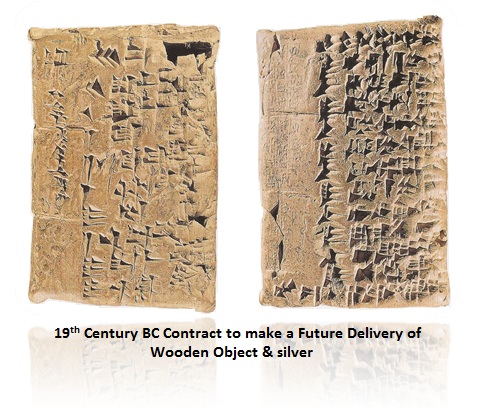
Historically, society has always gone through a major debt crisis. Perhaps that is why the Bible talked about a debt jubilee where debt is simply forgiven every 49/50 years. One question that jumps out at us is rather blunt. Does the Old Testament Debt Jubilee present a solution to our modern financial crisis? The mere fact that this is in the Bible suggests that there must have been major debt crisis even before the Bible. We do know that Hammurabi’s Law Code imposed regulation on interest. It also imposed Contract Law and required people to reduce agreements to writing that were witnessed. By implication, such a law must have meant that one person said he lent money and the other denied it. We have legal records that have survived from Babylon which even demonstrate they had an active futures market where people bought a crop for future delivery creating even options.

One of the earliest Debt Crisis in recorded history that is well documented by contemporary writers was the Debt Crisis in Athens of 354BC. Corruption between government and the bankers is nothing new. The banks were the Temples since money was donated to the gods who had no use for it. Typically, the government would borrow from this hoard of Temple money to fund wars. The priests became the bankers. In Athens during 354BC, there was one of the early banking crisis events involving what we would call the Secretary of the Treasury so to speak and his banking friends. The money grew to a vast sum in the Temple which kept all these donations in the Opisthodomos. The Temple was not earning interest on its hoard of money which just sat there funding the lavish lifestyle of the priests. The treasurer agreed to lend the money to personal banking friends who would then pay the treasurer interest that he could then personally put that in his pocket. When the banking crisis hit and there was a liquidity problem, the banks could not repay the loans to the Temple.

Most of the loans were going to real estate. When the business cycle hit and real estate turned down, people could not pay their debts and could not sell the property in a down market. Suddenly, the bankers could not repay the priests so they then tried to cover up their scheme by setting fire to the Opisthodomos. Nevertheless, the scheme was detected and the Treasurers of the Temple of Athena were seized and imprisoned, about 377-376BC. In 1989, government ministers of Crete pulled the same scam. They were depositing government funds in the Bank of Crete and interest was being diverted to themselves. It was the failure of the Bank of Crete that exposed the scam (See NY Times, 9/21/89, A14; 9/27/89, A3). So you see, history repeats like a Shakespeare play – just the actors change over the centuries while the storyline remains unchanged.

Obviously, debt and contracts have been around for thousands of years. Is there a dramatic and simple way out of all this? Some argue that there is a “debt jubilee” they take from the Old Testament book of Deuteronomy, the concept derives from the biblical injunction for a day of rest one day out of every week, a “sabbath” day. There appears to be a fractal system which is laid out in the Bible. The next injunction is for a Sabbath year every 7th year. Here, people are to not work. The next injunction appears on the year after the 7th of those sabbatical years, i.e. the 50th, (one year after the 49th). This is where we find there would be a jubilee year during which any slaves would be emancipated and everyone would return to their land and family to live off of natural providence. A clear implication of this teaching is that all obligations, including debt obligations, would be forgiven in the process. I do find it curious that this lines up fairly closely with the Economic Confidence Model (ECM) and its 6 waves of 8.6-year intervals which build up to major events every 51.6 years. Is the Bible saying that there is a debt crisis every 50 years where the solution is to default on all debts? The next 51.6-year target on the ECM will come in 2032 and our model does show that the West will yield the crown of the Financial Capital of the World to China. So does the Biblical Debt Jubilee suggest we “should” forgive all debts at the 50th interval of the 7th year or does it forecast that debts will be forgiven simply because everything will crash at that point?
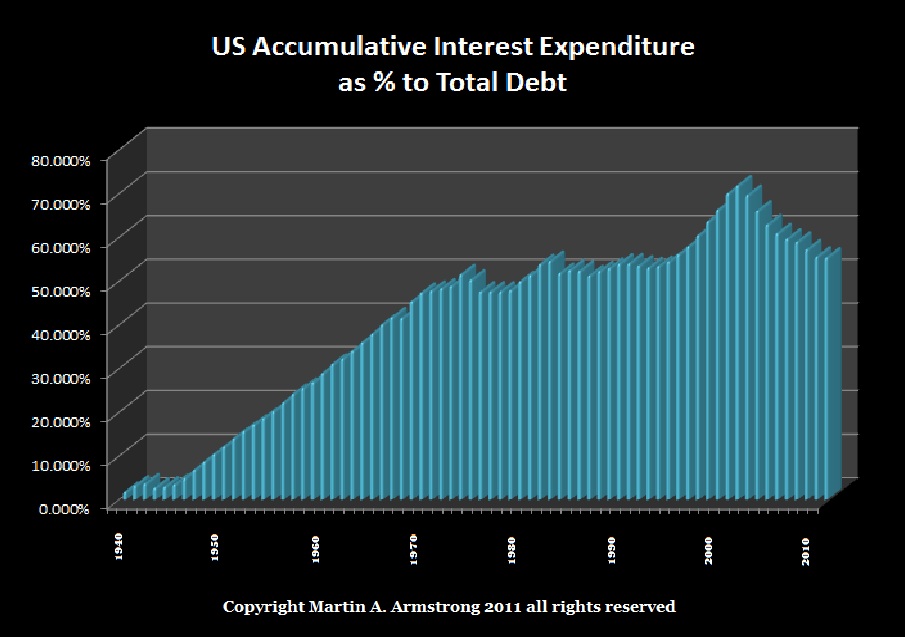
 

I have further warned that our elected officials could not even run a bubblegum machine as a business. When they spend all the money they took in on themselves, they have nothing left to buy more gum to refills the machine. Their solution is just to raise taxes and refill the machine and spend it all again on themselves with lavish perks and pensions. The Sovereign Debt Crisis is alive and well. This is now when it is going to begin to surface to where it will become more obvious to people around the world. Indeed, I am off to Europe today for this very reason with two weeks of meetings. The risk is beginning to become obvious as interest expenditures will crowd out everything other areas of spending. Governments will try to keep the debt revolving by raising taxes and this will only further reduce both the economy and our living standards. We are being walled-in by our own debt with no place to go except default if we do not act NOW!!!!!!!

Some Bubbles are Just Outright Frauds


QUESTION: BitCoin has crashed and it looks like it will never be what people dreamed as some replacement for the dollar. Are bubbles always involving some failed product? A dream that is just unrealistic like the Tulip bubble?

JE

ANSWER: No. There have been many, many, many “bubbles” throughout history. Some have been just crazy like the Tulip Bubble and others have been outright frauds like the Panic of 1825 which was a stock market crash following the same idea as the South Sea and Mississippi Bubble of 1720. This time, it was again a new emerging market country that was completely just a fraud. It was a wild speculative investment in Latin America, that was all about an imaginary country of Poyais. The stock market boom became a bubble and banks caught up in the euphoria made risky loans all on this imaginary new market.

The Sovereign Debt Crisis has Spread to 119 Countries


QUESTION: Mr. Armstrong; For the past two WEC events you have warned that the Sovereign Debt Crisis will strike first outside the USA and the rise in the dollar and US interest rates will push emerging markets into default. Since you also said that pension funds had rushed into emerging market debt to get higher yield not available in USA and Europe, then this will also feed into the pension crisis. I recently read here in Germany that almost 100 nations are on the brink of a debt crisis. Only now people are starting to talk about it. Do you still see this as a catalyst for a strong dollar along with war?

I am really looking forward to this year’s WEC.

LR

ANSWER: The Sovereign Debt Crisis is on schedule to be noticed starting here in 2018. We have 13 governments now who are already in default of their debt payments. There are more than 100 nations who are on the verge of a debt crisis. The rise in US interest rates and the strength behind the dollar pushes these nations over the edge. I have been warning that this trend would emerge as part of the turning point back in 2015.75. It will now intensify as we head into 2020. China’s debt to GDP is more than TWICE that of the United States. DEBT is our worst enemy and there are no viable solutions coming forward because anything implied by others is tinkering with the current system. There is no solution is valued circles, other than mine, which calls for the complete revision of the debt system. Everything being proposed so far is tinkering with raising taxes and reducing benefits as well as raising the age for pensions.

I fear that all we can do is protect ourselves. Nobody is willing to listen to me. When they will, it will be too late. Hence – the crash & burn becomes unavoidable. Nobody will scrap the system before it crashes. It is against human nature.

Armstrong on the Solution


Interest Rates and Bonds


Draghi Confirms ECB Will not End QE


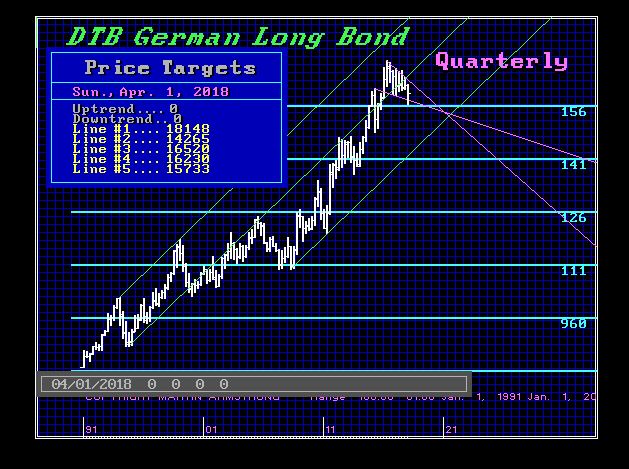
Mario Draghi is by no means going to stop his Quantitative Easing program. All my sources behind the curtain express fear what will happen when Draghi leaves. Who will buy the government debt and who will keep subsidizing the governments of the Eurozone? Draghi has not merely declined to end Quantitative Easing, he has pledged to continue to reinvest in debt which it matures because he knows there will be no bidders. The ECB is exceeding 40% of all Eurozone debt on its balance sheet. There will be no bid for Eurozone debt and even the German bunds are reflecting weakness.

Draghi has publicly even distanced the ECB from the monetary policy considerations of Austria’s central bank chief Ewald Nowotny, a board member. Nowotny told Reuters interview on that future of bond purchases would decline and possible interest rate moves to the upside were coming. The ECB came out and publicly stated that the views of Governor Nowotny did not represent the view of the Governing Council. This is confirming our sources which have been stating that Draghi realizes he is trapped and he is trying to hold it together until he leaves so he will not be blamed for the mess he has created in the world economy after he leaves in 2019. I hate to tell him, but I do not think he will win that race out the door before chaos hits.