The US Blows Hot And Cold


  •   Sunday, March 12, 2023

Watts Up With That?

The world’s most viewed site on global warming and climate change

Land Surface Air Temperature Data

The US Blows Hot And Cold

1 day ago

Willis Eschenbach

130 Comments

Guest Post by Willis Eschenbach

I got to thinking about the raw unadjusted temperature station data. Despite the many flaws in individual weather stations making up the US Historical Climate Network (USHCN), as revealed by Anthony Watts’ SurfaceStations project, the USHCN is arguably one of the best country networks. So I thought I’d take a look at what it reveals.

The data is available here, with further information about the dataset here. The page says:

UNITED STATES HISTORICAL CLIMATOLOGY NETWORK (USHCN) Daily Dataset M.J. Menne, C.N. Williams, Jr., and R.S. Vose National Climatic Data Center, National Oceanic and Atmospheric Administration

These files comprise CDIAC’s most current version of USHCN daily data.

These appear to be the raw, unhomogenized, unadjusted daily data files. Works for me. I started by looking at the lengths of the various records.

Figure 1. Lengths of the 1,218 USHCN temperature records. The picture shows a “Stevenson Screen”, the enclosure used to protect the instruments from direct sunlight so that they are measuring actual air temperature.

This is good news. 97.4% of the temperature records are longer than 30 years, and 99.7% are longer than 20 years. So I chose to use them all.

Next, I considered the trends of the minimum and maximum temperatures. I purposely did not consider the mean (average) trend, for a simple reason. We experience the daily maximum and minimum temperatures, the warmest and coldest times of the day. But nobody ever experiences an average temperature. It’s a mathematical construct. And I wanted to look at what we actually can sense and feel.

First I considered minimum temperatures. I began by looking at which stations were warming and which were cooling. Figure 2 shows that result.

Figure 2. USHCN minimum temperature trends by station. White is cooling, red is warming.

Interesting. Clearly, “global” warming isn’t. The minimum temperature at 30% of the USHCN stations is getting colder, not warmer. However, overall, the median trend is still warming. Here’s a histogram of the minimum temperature trends.

Figure 3. Histogram of 1,218 USHCN minimum temperature trends. See Menne et al. for estimates of what the various adjustments would do to this raw data.

Overall, the daily minimum temperatures have been warming. However, they’re only warming at a median rate of 1.1°C per century … hardly noticeable. And I have to say that I’m not terrified of warmer nights, particularly since most of the warmer nights are occurring in the winter. In my youth, I spent a couple of winter nights sleeping on a piece of cardboard on the street in New York, with newspapers wrapped around my legs under my pants for warmth.

I can assure you that I would have welcomed a warmer nighttime temperature …

The truth that climate alarmists don’t want you to notice is that extreme cold kills far more people than extreme warmth. A study in the British Medical Journal The Lancet showed that from 2000 to 2019, extreme cold killed about four and a half million people per year, and extreme warmth only killed a half million.

Figure 4. Excess deaths from extreme heat and cold, 2000-2019

So I’m not worried about an increase in minimum temperatures—that can only reduce mortality for plants, animals, and humanoids alike.

But what about maximum temperatures? Here are the trends of the USHCN stations as in Figure 2, but for maximum temperatures.

Figure 5. USHCN maximum temperature trends by station. White is cooling, red is warming.

I see a lot more white. Recall from Figure 2 that 30% of minimum temperature stations are cooling. But with maximum temperatures, about half of them are cooling (49.2%).

And here is the histogram of maximum temperatures. Basically, half warming, half cooling.

Figure 6. Histogram of 1,218 USHCN maximum temperature trends.

For maximum temperatures, the overall median trend is a trivial 0.07°C per century … color me unimpressed.

Call me crazy, but I say this is not any kind of an “existential threat”, “problem of the century”, or “climate emergency” as is often claimed by climate alarmists. Instead, it is a mild warming of the nights and no warming of the days. In fact, there’s no “climate emergency” at all.

And if you are suffering from what the American Psychiatric Association describes as “the mental health consequences of events linked to a changing global climate including mild stress and distress, high-risk coping behavior such as increased alcohol use and, occasionally, mental disorders such as depression, anxiety and post-traumatic stress” … well, I’d suggest you find a new excuse for your alcoholism, anxiety, or depression. That dog won’t hunt.

My very best to everyone from a very rainy California. When we had drought over the last couple of years, people blamed evil “climate change” … and now that we’re getting lots of rain, guess what people are blaming?

Yep, you guessed it.

w.

As Always: I ask that when you comment you quote the exact words you’re discussing. This avoids endless misunderstandings.

Adjustments: This raw data I’ve used above is often subjected to several different adjustments, as discussed here. One of the largest adjustments is for the time of observation, usually referred to as TOBS. The effect of the TOBS adjustment is to increase the overall trend in maximum temperatures by about 0.15°C per century (±0.02) and in minimum temperatures by about 0.22°C per century (±0.02). So if you wish, you can add those values to the trends shown above. Me, I’m not too fussed about an adjustment of a tenth or two of a degree per century, I’m not even sure if the network can measure to that level of precision. And it certainly is not perceptible to humans.

There are also adjustments for “homogeneity”, for station moves, instrument changes, and changes in conditions surrounding the instrument site.

Are these adjustments all valid? Unknown. For example, the adjustments for “homgeneity” assume that one station’s record should be similar to a nearby station … but a look at the maps above show that’s not the case. I know that where I live, it very rarely freezes. But less than a quarter mile (1/8 km) away, on the opposite side of the hill, it freezes a half-dozen times a year or so … homogeneous? I don’t think so.

The underlying problem is that in almost all cases there is no overlap in the pre- and post-change records. This makes it very difficult to determine the effects of the changes directly, and so indirect methods have to be used. There’s a description of the method for the TOBS adjustment here.

This also makes it very hard to estimate the effect of the adjustments. For example:

To calculate the effect of the TOB adjustments on the HCN version 2 temperature trends, the monthly TOB adjusted temperatures at each HCN station were converted to an anomaly relative to the 1961–90 station mean. Anomalies were then interpolated to the nodes of a 0.25° × 0.25° latitude–longitude grid using the method described by Willmott et al. (1985). Finally, gridpoint values were area weighted into a mean anomaly for the CONUS for each month and year. The process was then repeated for the unadjusted temperature data, and a difference series was formed between the TOB adjusted and unadjusted data.

To avoid all of that uncertainty, I’ve used the raw unadjusted data. 

Addendum Regarding The Title: There’s an Aesop’s Fable, #35:

“A Man had lost his way in a wood one bitter winter’s night. As he was roaming about, a Satyr came up to him, and finding that he had lost his way, promised to give him a lodging for the night, and guide him out of the forest in the morning. As he went along to the Satyr’s cell, the Man raised both his hands to his mouth and kept on blowing at them. ‘What do you do that for?’ said the Satyr. ‘My hands are numb with the cold,’ said the Man, ‘and my breath warms them.’ After this they arrived at the Satyr’s home, and soon the Satyr put a smoking dish of porridge before him. But when the Man raised his spoon to his mouth he began blowing upon it. ‘And what do you do that for?’ said the Satyr. ‘The porridge is too hot, and my breath will cool it.’ ‘Out you go,’ said the Satyr, ‘I will have nought to do with a man who can blow hot and cold with the same breath.’”

The actual moral of the story is not the usual one that people draw from the fable, that the Man is fickle and the Satyr can’t trust him.

The Man is not fickle. His breath is always the same temperature … but what’s changing are the temperatures of his surroundings, just as they have been changing since time immemorial.

We call it “weather”.

The test that exonerates CO2


The test that exonerates CO2

6 days ago

Guest Blogger

521 Comments

By Javier Vinós

Most people don’t have a clear understanding of the greenhouse effect (GHE). It is not complicated to understand, but it is usually not well explained. It is often described as “heat-trapping,” but that is incorrect. Greenhouse gases (GHG) do not trap heat, even if more heat resides within the climate system due to their presence in the atmosphere. The truth is that after adjusting to a change in GHG levels, the planet still returns all the energy it receives from the Sun. Otherwise, it would continue warming indefinitely. So, there is no change in the energy returned. How do GHGs produce GHE?

GHGs cause the atmosphere to be more opaque to infrared radiation. As solar radiation heats mainly the ocean and land surface of the planet, GHGs absorb thermal emission from the surface at the lower troposphere and immediately pass that energy along to other molecules (typically N2 and O2) through collisions that occur much faster than the time it would take to re-emit the radiation. This warms the lower troposphere. The density and temperature decrease rapidly through the troposphere, so molecules are colder and more separated at the upper troposphere. Now GHGs have a chance to emit IR radiation so when they finally collide with another molecule, they are colder so GHGs have a cooling effect in the upper troposphere and stratosphere.

Because GHGs make the atmosphere more opaque to IR radiation, when they are present the emission to space from the planet normally does not take place from the surface (as happens in the Moon). Part of it still takes place from the surface through the atmospheric window, but most of it takes place from higher in the atmosphere. We can define a theoretical effective emission height as the average height at which the Earth’s outgoing longwave radiation (OLR) is being emitted. The temperature at which the Earth emits is the temperature at the effective emission height in the atmosphere. That temperature, when measured from space is 250 K (-23°C), not 255 which is the calculated temperature for a theoretical blackbody Earth. That temperature corresponds to a height of about 5 km, which we call the effective emission height.

The last piece we need to understand the GHE is the lapse rate, which in the troposphere is positive, meaning that temperature decreases with height. Without a positive lapse rate, the GHE does not work. Since GHGs cause the planet to emit from a higher altitude, due to making the atmosphere more opaque to IR radiation, that altitude is colder due to the lapse rate. The Earth still needs to return all the energy received from the Sun, but colder molecules emit less. So, the planet will go through a period when it will emit less than it should, warming the surface and the lower troposphere until the new height of emission achieves the temperature necessary to return all the energy, at which point the planet stops warming.

The GHE simply states that the temperature at the surface (Ts) is just the temperature of emission (Te) plus the lapse rate (Γ) times the height of emission (Ze).


Ts = Te + ΓZe

Held & Soden (2000) illustrated it in figure 1:


This is how the GHE actually works. An increase in CO2 means an increase in the height of emission. Since the temperature of emission must remain the same, the temperature from the surface to the new height of emission must increase. The increase is small but significant. As Held and Soden say:


“The increase in opacity due to a doubling of CO2 causes Ze to rise by ≈150 meters. This results in a reduction in the effective temperature of the emission across the tropopause by ≈(6.5K/km) (150 m) ≈1 K.”Held and Soden

So, the temperature at the surface must increase by 1K. That’s the direct warming caused by the doubling of CO2, before the feedbacks (mainly water vapor) kick in, further raising the height of emission.

This also has an interesting prediction. If the warming is due to an increase in CO2 when the increase takes place and the altitude of emission increases, the planet should emit less OLR as the new altitude is colder and a reduced OLR is the warming mechanism. Once the warming takes place, the OLR will become the same as before the GHG increase. It says so in Held and Soden’s figure 1 caption: “Note that the effective emission temperature (Te) remains unchanged.” Same Te, same OLR. So, if CO2 is responsible for the surface temperature increase, we should first expect less OLR and then the same OLR. If at any time we detect more OLR that would indicate another cause for the warming. Anything that makes the surface warmer, except GHGs, will increase the temperature of emission, increasing OLR.

So, this is the test:

– Surface warming but less or same OLR: CO2 is guilty as charged

– Surface warming and more OLR: CO2 is innocent

And the test results can be evaluated for example with Derwitte and Clerbaux 2018:


“decadal changes of the Outgoing Longwave Radiation (OLR) as measured by the Clouds and Earth’s Radiant Energy System from 2000 to 2018, the Earth Radiation Budget Experiment from 1985 to 1998, and the High-resolution Infrared Radiation Sounder from 1985 to 2018 are analyzed. The OLR has been rising since 1985, and correlates well with the rising global temperature.Derwitte and Clerbaux 2018

CO2 is innocent. Its fingerprint is not found at the crime scene. Something else is warming the planet and causing the increase in OLR.

Bibliography:

Dewitte, S. and Clerbaux, N., 2018. Decadal changes of earth’s outgoing longwave radiation. Remote Sensing, 10(10), p.1539.
https://www.mdpi.com/2072-4292/10/10/1539/pdf

Held, I.M. and Soden, B.J., 2000. Water vapor feedback and global warming. Annual review of energy and the environment, 25(1), pp.441-475.
https://www.annualreviews.org/doi/pdf/10.1146/annurev.energy.25.1.441

Stephens, G.L., O’Brien, D., Webster, P.J., Pilewski, P., Kato, S. and Li, J.L., 2015. The albedo of Earth. Reviews of geophysics, 53(1), pp.141-163.

5

What Will our Collective Future Look Like in the Year 2050? Part One, the Background


The picture below is a good visual example of what those that want to rule us i.e. Klaus Schwab, Bill Gates, George Soros, Barack Obama and yes even Anthony Fauci would like it to be. I do not, for one second, think this is an exaggeration.  

Obviously, this is not a picture that any one that is not a multi billionaire would want to experience but there is one person on the planet that demands that this is what our future will be. That person is Klaus Schwab the creator of the World Economic Form (WEF). So what is the WEF? The WEF is an international non-government organization (NGO) founded by Klaus Schwab on January 24, 1971and located in Switzerland. The stated goal is to improving the status of the entire world. This is accomplished by training potential Global leaders on how best to rule the world and conducting an annual meeting in Davos Switzerland.  

Schwab’s goal is to have every country on the planet be a member of the United Nations (UN) and relinquish their sovereignty to the UN. The UN would then after this was achieved be run by the unelected people that Schwab has trained in his Young Leaders program; comprising tens of thousands of people today. Most of the international corporations and governments are now run by these Schwab people.  

His programs can be found in two books he wrote; The Fourth Industrial Revolution published in 2016 and COVID-19: The Great Reset published in 2020. The core of Schwab’s vision is a modification of the theories of Karl Marx undated to the modern world. The basic essence of Schwab’s vision can be derived from the work of Patrick M. Woods in his book Technocracy Rising The Trojan House of Global Transformation published in 2015. 

Schwab is not an uneducated man; and and has multiple degrees. And like many men of his intellect he dreams of creating the perfect world, written about for the first time by Thomas More in his book Utopia published in 1516. Since then others have tried to find the way to accomplish the lofty goal with that last serious attempt by Karl Marx in his works Capital Volumes I, II and III resulting in the deaths of hundreds of millions in the twentieth century mostly in Russia and China which all failed.

The current attempt by Schwab in creating this elusive goal of a Utopia is The Great Reset and Build Back Better program; which has been adopted by most of the countries in Western Civilization. The Great Reset was started with the planned introduction of the COVID-19 pandemic. Yes I did say planned and the two men responsible for it were Bill Gates and Anthony Fauci. The prove of it in all the initial planning for a pandemic and the work of Fauci in creating the virus (COVID-19) as identified in the book publish by Robert F. Kennedy Jr. The Real Anthony Fauci. Gates, from a family of hard core Eugenic promoters, masterminded his reduction of the world population in the late 1990’s or early 2000’s by adopting the Global Warming narrative developed by the Environmental crowd of Marxists after they took over the movement from the real scientists looking at the real environmental issues.  

Patrick Moore one of the founders of Green Peace was drummed out when that changed accrued  and is the only one left from that movement that truly understands what happened and how the Climate change narrative has no basis in fact as you can read about in his book Confessions of a Greenpeace Dropout. There is absolutely no truth in the current narrative that Carbon dioxide is a Clear and Present Danger to the world and must be eliminated. There is actually solid scientific evidence that Carbon dioxide is “not” a Clear and Present Danger to us or the planet.

  What Schwab and Gates have done is combine the views of both of men into one master program that will be discussed in Part Two.

Mining Expansion for Green Energy


Armstrong Economics Blog/Uncategorized Re-Posted Feb 15, 2023 by Martin Armstrong

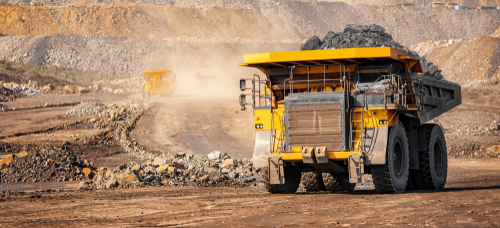
MiningWatch Canada is estimating that 3 billion tons of mined metals and minerals will be needed to power the energy transition. All of this nonsense for climate change means that mining for minerals will escalate dramatically. There will be an incredible expansion in the mining industry for six critical minerals: lithium, graphite, copper, cobalt, nickel, and rare earth minerals. What is really just insane is that even if this green energy were to last, over the next 30 years, we will have to increase the production of these minerals consuming more that all the past generations combined.  Our What-If models project copper at 9-10 by 2028 shutting down fossil fuels.

Death Toll in Turkey/Syria Earthquake Climbs Above 20,000 – With an Estimated 6,500 Buildings Collapsed


Posted originally on the CTH on February 9, 2023 | Sundance 

Hopes are fading amid the rescue and recovery workers in the aftermath of the horrific earthquake that hit southern Turkey and northern Syria.  Reuters is providing an update on the devastation in the region.  The scale of the impact is widespread and devastating as even more recovery workers continue arriving.

ANTAKYA, Turkey/JANDARIS, Syria, Feb 9, (Reuters) – Cold, hunger and despair gripped hundreds of thousands of people left homeless after the earthquakes that struck Turkey and Syria three days ago as the death toll passed 20,000 on Thursday.

The rescue of a 2-year-old boy after 79 hours trapped in the rubble of a collapsed building in Hatay, Turkey, and several other people raised spirits among weary search crews. But hopes were fading that many more would be found alive in the ruins of towns and cities.

[…] Hundreds of thousands of people in both countries have been left homeless in the middle of winter. Many have camped out in makeshift shelters in supermarket car parks, mosques, roadsides or amid the ruins, often desperate for food, water and heat.

[…] Authorities say some 6,500 buildings in Turkey collapsed and countless more were damaged.

The death toll in Turkey rose to 17,406, Health Minister Fahrettin Koca said. In Syria, already devastated by nearly 12 years of civil war, more than 3,300 people have died, according to the government and a rescue service in the rebel-held northwest.

In the devastated Syrian town of Jandaris, Ibrahim Khalil Menkaween walked in the rubble-strewn streets clutching a white body bag. He said he had lost seven members of his family, including his wife and two of his brothers.

“I’m holding this bag for when they bring out my brother, and my brother’s young son, and both of their wives, so we can pack them in bags,” he said. “The situation is very bad. And there is no aid.”

Turkish officials say some 13.5 million people were affected in an area spanning roughly 450 km (280 miles) from Adana in the west to Diyarbakir in the east. In Syria, people were killed as far south as Hama, 250 km from the epicentre.

Rescue crews looked for survivors at the site of a collapsed building in the dark in the city of Adiyaman with temperatures below freezing, Turkish broadcasters showed.

[…] There were still some signs of hope.

A 2-year-old boy was picked out of the rubble by a Romanian and Polish rescue team in Hatay 79 hours after the earthquake, video released by Turkey’s Humanitarian Relief Foundation (IHH) on Thursday showed.

The boy, wearing a blue, white and black striped sweater, cried as he was gently lifted from the hole where he had been trapped. He was carried away on a blanket. No other details were immediately available.

Another video from IHH showed a helmeted and dust-streaked rescuer weeping with emotion after successfully freeing a little girl from the rubble of a collapsed building in Kahramanmaras. (read more)

All-powerful Father, as we see all of the destruction caused by this natural disaster, we mourn for all that has been lost and the fragility of this life.

Lord God of mercy, please comfort those who have lost somebody they love, and those who are yet still searching. Give them comfort and peace.

Heavenly Father, be a protective wing for those who have survived, but lost their home. Grant the men, women and children the needed fortitude and assistance they need to recover and rebuild.  Show me how best to pray for their needs and guide my prayer. 

Lord God of all creation, be strong with directed purpose for those whose job it is to search through the rubble for those lost.  Give them endurance and strength as they complete their responsibilities.

God of comfort and mercy, help us come together as one body in You during this time of tragedy.

You are the redeemer, the source of all strength and courage, please provide us with reassurance, humanity and faith. 

In Your holy and merciful name, we humbly kneel and pray. 

~ Amen.

Earthquakes in Turkey/Syria


Armstrong Economics Blog/Nature Re-Posted Feb 8, 2023 by Martin Armstrong

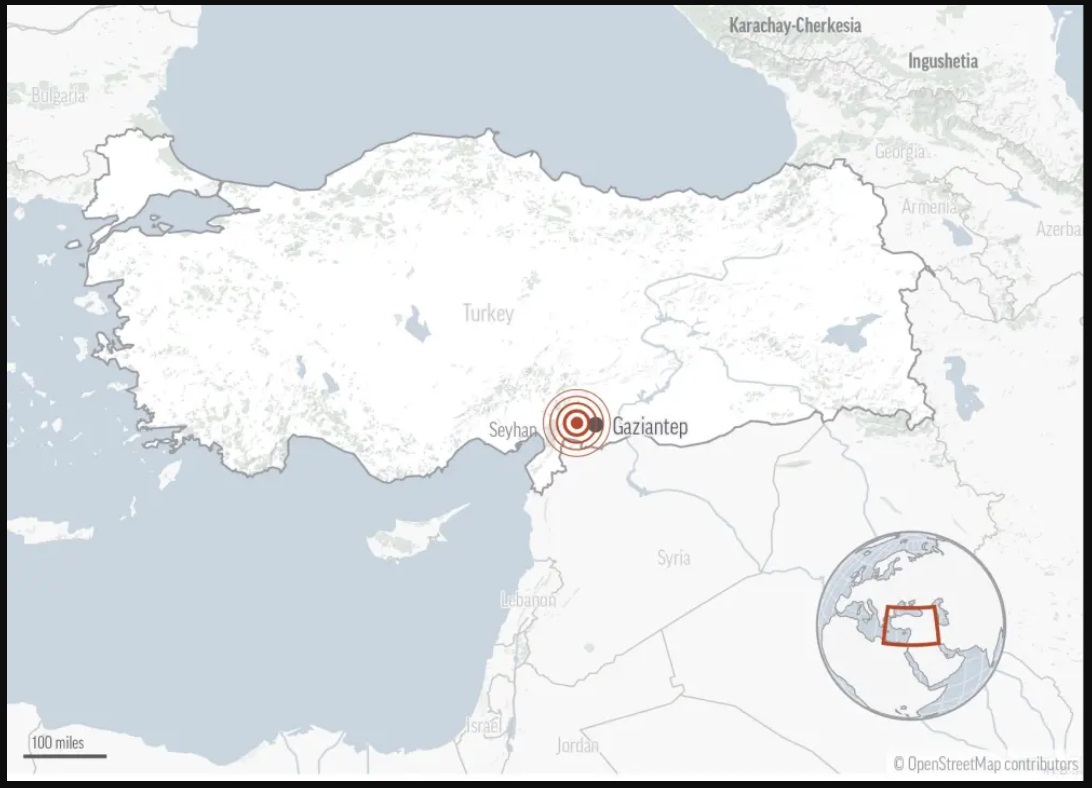
The Double Earthquake that hit Turkey & Syria has been extraordinary. The first quake was a 7.8 magnitude sticking in southeastern Turkey and northwestern Syria early Monday morning local time. Then 9 hours later, a second quake, which recorded a magnitude of 7.5, struck hard. Both countries have witnessed the devastating aftermath as rescue workers on the ground are reporting that nearly 12,000 people have been killed as a result of the quakes, and tens of thousands more have been injured. Thousands of buildings have also been reduced to rubble.

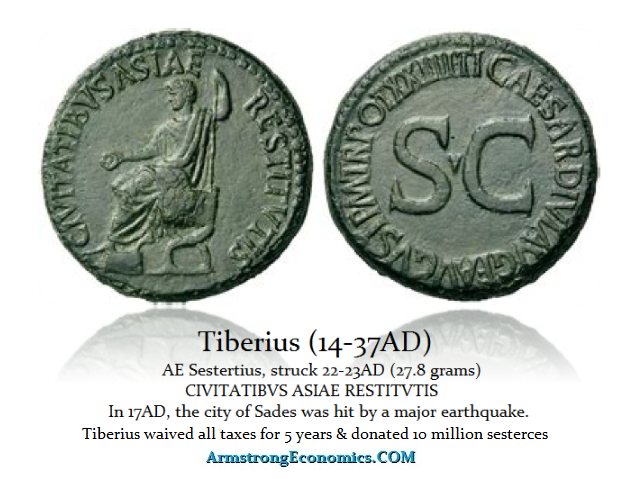
This region is prone to these major DOUBLE earthquakes. Overall, since the major earthquake of 17AD that was so created a financial panic in Rome and forced Emperor Tiberius to issue these coins noting that they were for the relief of that region,  there have been 81 major earthquakes. There have been many double earthquakes and the previous was in 2017 June 12th and July 21st. Before that in 2011, there was a Double Earthquake on the 23rd of October and then on November 9th.

What is unusual this time is the time differential was only 9 hours rather than days. This raises the concern that this event may not be over just yet.

Horrific Death Toll Continues Rising from Earthquake in Turkey/Syria as Aftershocks Continue – So Far 5,600 Buildings Have Collapsed


Posted originally on the CTH on February 6, 2023 | Sundance

I did not have internet access for most of today, another long-term recovery issue.  However, now that I am seeing the footage of the earthquake in Southern Turkey and Northern Syria, my prayers are for all of those in the region.  The devastation is just incredible.

According to the Associated Press, 5,600 buildings have collapsed and several of them came down today during aftershocks amid search and rescue operations.  The current recorded death toll is over 4,300 people, with the World Health Organization (WHO) predicting the total loss of life could exceed 20,000.  This is just horrific.

The estimated 7.8 magnitude earthquake hit over an area of several major population centers. The Guardian reports, “the population of the ten provinces in southern Turkey affected by the earthquakes are home to 13.5 million people. So far, according to the Andalou agency, more than 5,600 buildings have collapsed.

It is just after 6am in Turkey, and we’re seeing stories of people rescued after a very long day and night, which means they survived not only the rubble’s collapse but the cold. There are many, many more who have not yet been found, with the WHO predicting the death toll could reach 20,000 in the coming days. For now, here are videos of a three-year-old toddler and a woman who were freed from collapsed buildings by rescuers.” (link)

(Via Reuters) […] The magnitude 7.8 quake brought down whole apartment blocks in Turkish cities and piled more devastation on millions of Syrians displaced by years of war. It struck before sunrise in harsh weather and was followed in the early afternoon by another large quake.

In Diyarbakir in southeast Turkey, a woman speaking next to the wreckage of the seven-storey block where she lived said: “We were shaken like a cradle. There were nine of us at home. Two sons of mine are still in the rubble, I’m waiting for them.”

She was nursing a broken arm and had injuries to her face.

“It was like the apocalypse,” said Abdul Salam al-Mahmoud, a Syrian in the northern town of Atareb. “It’s bitterly cold and there’s heavy rain, and people need saving.” (more)

All-powerful Father, as we see all of the destruction caused by this natural disaster, we mourn for all that has been lost and the fragility of this life.

Lord God of mercy, please comfort those who have lost somebody they love, and those who are yet still searching. Give them comfort and peace.

Heavenly Father, be a protective wing for those who have survived, but lost their home. Grant the men, women and children the needed fortitude and assistance they need to recover and rebuild.  Show me how best to pray for their needs and guide my prayer. 

Lord God of all creation, be strong with directed purpose for those whose job it is to search through the rubble for those lost.  Give them endurance and strength as they complete their responsibilities.

God of comfort and mercy, help us come together as one body in You during this time of tragedy.

You are the redeemer, the source of our strength and courage, please provide us with reassurance, humanity and faith. 

In Your holy and merciful name, we humbly kneel and pray. 

Amen.

Shortage of Bread Contributed to French Revolution


Armstrong Economics Blog/Agriculture Re-Posted Jan 27, 2023 by Martin Armstrong

Food shortages have historically contributed to revolutions more so than just international war. Poor grain harvests led to riots as far back as 1529 in the French city of Lyon. During the French Petite Rebeyne of 1436. (Great Rebellion), sparked by the high price of wheat, thousands looted and destroyed the houses of rich citizens, eventually spilling the grain from the municipal granary onto the streets. Back then, it was to go get the rich.

There was a climate change cycle at work and today’s climate zealots ignore their history altogether for it did not involve fossil fuels. The climate got worse at the bottom of the Mini Ice Age which was about 1650. It really did not warm up substantially until the mid-1800s. During the 18th century, the climate resulted in very poor crops. Since the 1760s, the king had been counseled by Physiocrats, who were a group of economists that believed that the wealth of nations was derived solely from the value of land and thereby agricultural products should be highly priced. This is why Adam Smith wrote his Wealth of Nations as a retort to the Physiocrats. It was their theory that justified imperialism – the quest to conquer more land for wealth; the days of empire-building.

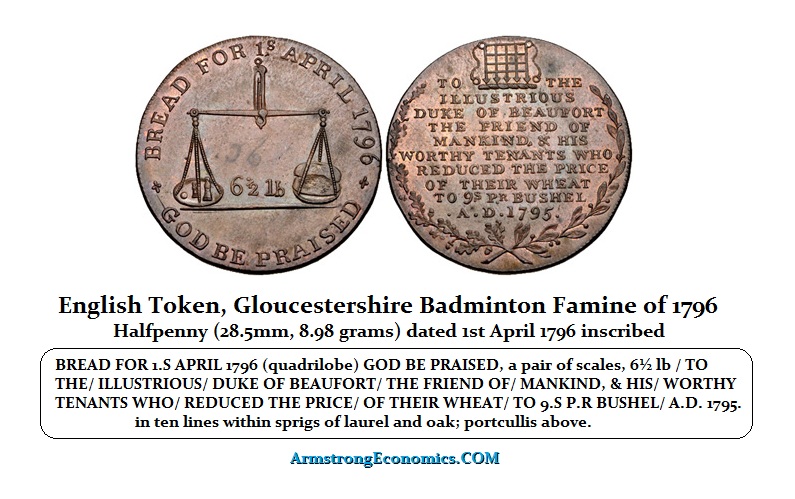
The King of France had listened to the Physiocrats who counseled him to intermittently deregulate the domestic grain trade and introduce a form of free trade. That did not go very well for there was a shortage of grain and this only led to a bidding war – hence the high price of wheat. We even see English political tokens of the era campaigning about the high price of grain and the shortage of food to where a man is gnawing on a bone.

Voltaire once remarked that Parisians required only “the comic opera and white bread.” Indeed, bread has also played a very critical role in French history that is overlooked. The French Revolution that began with the storming of the Bastille on July 14th, 1789 was not just looking for guns, but also grains to make bread.

The price of bread and the shortages played a very significant role during the revolution. We must understand Marie Antoinette’s supposed quote upon hearing that her subjects had no bread: “Let them eat cake!” which was just propaganda at the time. The “cake” was not the cake as we know it today, but the crust was still left in the pan after taking the bread out. This shows the magnitude that the shortage of bread played in the revolution.

In late April and May of 1775, the food shortages and high prices of grain ignited an explosion of such popular anger in the surrounding regions of Paris. There were more than 300 riots and looking for grain over just three weeks (3.14 weeks). The historians dubbed this the Flour War. The people even stormed the place at Versailles before the riots spread into Paris and outward into the countryside.

The food shortage became so acute during the 1780s that it was exacerbated by the influx of immigration to France during that period. It was a period of changing social values where we heard similar cries for equality. Eventually, this became one of the virtues on which the French Republic was founded. Most importantly, the French Constitution of 1791 explicitly stipulated a right to freedom of movement. It was mostly perceived to be a food shortage and the reason was the greedy rich. Thus, a huge rise in population was also contributed in part by immigration whereas it reached around 5-6 million more people in France in 1789 than in 1720.

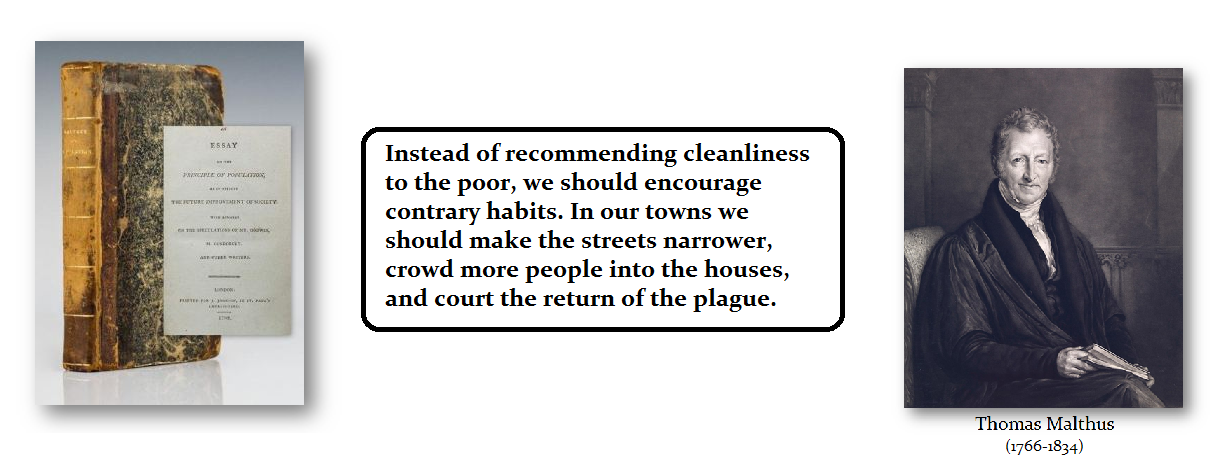
Against this backdrop, we have the publication by Thomas Malthus (1766-1834) An Essay on the Principle of Population was first published anonymously in 1798. He theorized that the population would outgrow the ability to produce food. We can see how his thinking formed because of the Mini Ice Age that bottomed in 1650. All of this was because of climate change which instigated food shortages. Therefore, it was commonly accepted that without a corresponding increase in native grain production, there would be a serious crisis.

The refusal on the part of most of the French to eat anything but a cereal-based diet was another major issue. Bread likely accounted for 60-80 percent of the budget of a wage-earner’s family at that point in time. Consequently, even a small rise in grain prices could spark political tensions. Because this was such an issue, and probably the major cause of the French Revolution among the majority, Finance Minister Jacques Necker (1732–1804) claimed that, to show solidarity with the people, King Louis XVI was eating the lower-class maslin bread. Maslin bread is from a mix of wheat and rye, rather than the elite manchet, white bread that is achieved by sifting wholemeal flour to remove the wheatgerm and bran.

That solidarity was seen as propaganda and the instigators made up the Marie Antoinette quote: Let them eat cake. . Then there was a plot drawn up at Passy in 1789 that fomented the rebellion against the crown shortly before the people stormed the Bastille. It declared “do everything in our power to ensure that the lack of bread is total, so that the bourgeoisie are forced to take up arms.” 

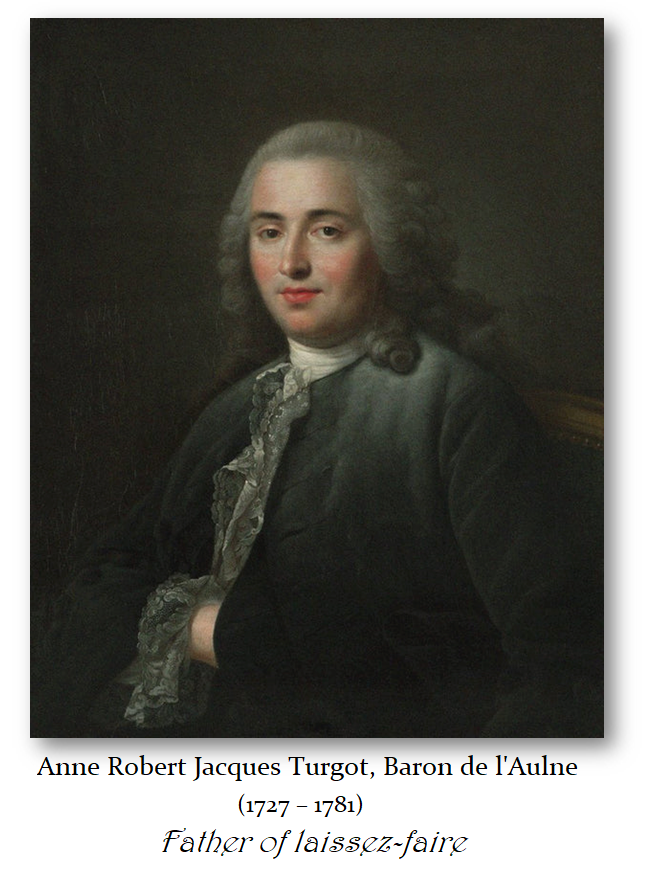
It was also at this time when Anne Robert Jacques Turgot (1727-1781), Baron de l’Aulne, was a French economist and statesman. He was originally considered a physiocrat, but he kept an open mind and became the first economist to have recognized the law of diminishing marginal returns in agriculture. He became the father of economic liberalism which we call today laissez-faire for he put it into action. He saw the overregulation of grain production was behind also contributing to the food shortages. He once said: “Ne vous mêlez pas du pain”—Do not meddle with bread.

The French Revolution overthrew the monarchy and they began beheading anyone who supported the Monarchy and confiscated their wealth as well as the land belonging to the Catholic Church.  Nevertheless, the revolution did not end French anxiety over bread. On August 29th, 1789, only two days after completing the Declaration of the Rights of Man and of the Citizen, the Constituent Assembly completely deregulated domestic grain markets. The move raised fears about speculation, hoarding, and exportation.

Then on October 21st, 1789, a baker, Denis François, was accused of hiding loaves from sale as part of a conspiracy to deprive the people of bread. Despite a hearing which proved him innocent, the crowd dragged François to the Place de Grève, hanged and decapitated him, and made his pregnant wife kiss his bloodied lips. Immediately thereafter, the National Constituent Assembly instituted martial law. At first sight, this act appears as a callous lynching by the mob, yet it led to social sanctions against the general public. The deputies decided to meet popular violence with force.

So, food has often been a MAJOR factor in revolutions. We are entering a cold period. Ukraine has been the breadbasket for Europe. Escalating this war will also lead to accelerating the food shortages post-2024. It is interesting how we learn nothing from history. Wars are instigated by political leaders while revolutions are instigated by the people.

Two More Bodies Recovered in Aftermath of Hurricane Ian


Posted originally on the CTh on January 14, 2023 | Sundance

Their names will not make national headlines, and generally everyone has moved on, but to their families and friends Ilonka Knes and James Hurst mattered.  As CTH readers may remember, in the aftermath of Hurricane Ian we shared that many missing people would be found in the months after the storm, and unfortunately many more will likely never be found.

The body of Mrs Ilonka Knes (82) was found in the mangroves and back bay salt marsh near Fort Myers Beach and has been positively identified. The body of her husband Robert was found in the days immediately following Hurricane Ian.

Additionally, the sailboat “Good Girl” was found submerged with human remains believed to be the body of James ‘Denny’ Hurst (73).

Mrs. Knes and Mr Hurst bring the total number of Hurricane Ian victims in Lee County, Florida, to seventy-five.  Mr. Hurst was the final “official” missing person on the local list; however, there are many more yet unaccounted that were not from this immediate area.   The physical devastation is widespread, but the emotional toll on the families and friends of the missing has been beyond imagining.  Tonight, two more families have answers.

(FLORIDA) – During Thursday’s news conference, Lee County Sheriff Carmine Marceno released new information regarding the area’s recovery.

“Most of us have gotten back to a sense of the new normal. For some, still missing their loved ones, every day since the storm has been difficult,” said Marceno.

The sheriff said his agency originally attempted a well-being check at what was left at the home of Ilonka and Robert Knes in the aftermath of the storm.

The body of Robert Knes was found shortly after Ian struck, but there were no signs of his wife during the days and weeks following the disaster.

Marceno said it wasn’t until mid-January that a debris removal crew found remains in a dense patch of mangroves, that later tested positive, through the use of dental records, to be that of Ilonka. (more)

The power and duration of Hurricane Ian killed more people than Hurricane Andrew and the storm that hit Southwest Florida last September is now recorded as the deadliest storm in the past 87 years.

If you live anywhere along the coastline of the United States, inland to about 50 miles, please remember to always take these storms seriously.

After this storm, and having been through four previous direct impacts, including Homestead AFB (Andrew), I would say this….  If there is even a remote chance you would ever encounter this type of a hurricane event, EVACUATE.  Do not try and hunker down if there is a looming possibility of having to rely on a structure to withstand 150+ mph wind for a full day.  Just leave.  With all of my preparations in place, and all of the knowledge I possess in storm survival, I would never attempt it again.

It is more than three months since Hurricane Ian hit Southwest Florida and beyond the chaos and debris that still remains visible almost everywhere, they are still recovering bodies.  Please take hurricane preparations seriously.

Lessons from Ian – Part One

Lessons from Ian – Part Two