This is a Technical Study of the Relationships in Solar Flux, Water vapor and all the other Gasses in the Atmosphere, Using the February, 2025 NASA & NOAA Data


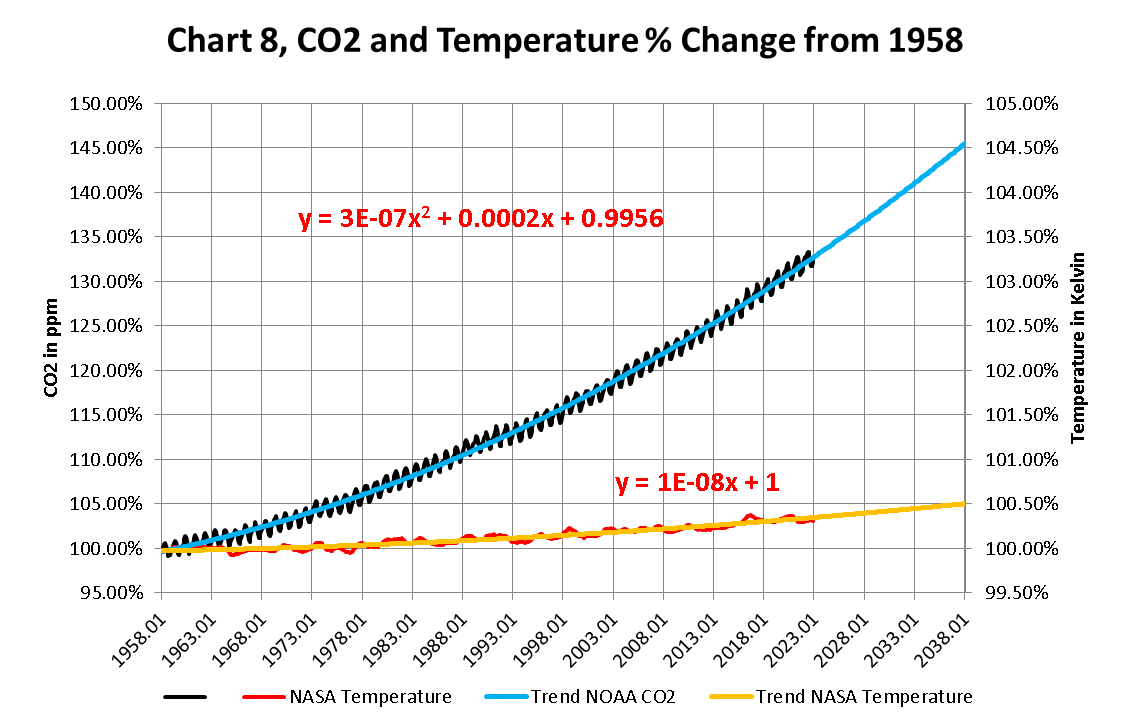
The attached report on Global Weather for February 2025 Data has charts showing the relationship between CO2 growth and Temperature increases going up since we started to accurately measure CO2 in the atmosphere in 1958. These Charts were created by showing CO2 as a percent increase from when it was first measured in 1958, the Black plot, the scale is on the left and it shows CO2 going up by about ~34.0% from 1958 to January 2024. That is a very large change as anyone would have to agree. 

Now how about temperature, well when we look at the percentage change in temperature also from 1958, using Kelvin (which does measure the actual change in heat), we find that the changes in global temperature (heat) is about ~.3% and may reach .5% by 2028. To even be able to see this minuscule change we had to reduce the scale of the Temperature Axis by a factor of ten.

This Chart 8 uses unaltered values from NOAA and NASA properly displayed ,and the Blue and Yellow projections are created by Microsoft Excel not me.

The NOAA and NASA numbers tell us the story of the Very Small Changes in the temperature of the planets Atmosphere As Carbon Dioxide goes up geometrically.

Arkansas Tornadoes: Two Twisters in Lake City and Monette Touch Down


Posted originally on Rumble on Bright Bart News Network on: Apr 4, at 2:00 pm EST

Yikes! High-Rise Infinity Pool Turns into Waterfall After Thailand


Posted originally on Rumble on Bright Bart New Network on: Mar 28, on 1:30 pm EST

People Run in Terror as Bangkok Earthquake Shakes Building in Thailand


Posted originally on Rumble on Bright Bart New Network on: Mar 28, on 1:30 pm EST

Earthquake Rocks Bangkok: Entire Building Topples


Posted originally on Rumble on Bright Bart New Network on: Mar 28, on 1:30 pm EST

Through the Fire and Flames: Firefighters Battle and Contain 2300 Acre Wildfire in New Jersey


Posted originally on Rumble on Bright Bart New Network on Mar 24, at 3:00 pm EST

Gates Focuses on Europe for Net Zero Aspirations


Posted originally on Mar 25, 2025 by Martin Armstrong 

Climate Change Warming

Few know that Bill Gates heavily lobbied for the Inflation Reduction Act, which former President Joe Biden later admitted was intended to combat climate change and not inflation. Gates met with key lawmakers like Senator Joe Manchin ahead of the 2022 legislation. Another tool utilized by Gates was Breakthrough Energy, a venture fund he established in 2015 to promote net zero policies. The group recently laid off most of their employees in Washington, D.C., as Gates shifts methods for “climate” advocacy.

“We need to go from 51 billion tons of emissions per year to zero,” Breakthrough Energy stated on its website. “The only way to avoid the worst impacts of climate change is to reduce global greenhouse gas emissions from 51 billion tons a year, where they are now, to net-zero—and we need to do it by 2050. That means we need unprecedented technological transformations in almost every sector of modern life.”

Gates has every intention of continuing to push for net zero by 2050. However, Gates admitted that he needed to shift his policy amidst the new political landscape where he cannot directly influence policy. And what better way to do that than to throw money at the private sector. The focus is now on creating clean energy technology rather than manipulating public policy. Gates admitted he had to shift course because Donald Trump was revitalizing the energy sector and lifting restrictions on fossil fuels.

Breakthrough Energy and Gates are now focusing on Europe, where leaders are still on board with the Paris Accord. Instead of acknowledging that Europe’s economy is failing due to these initiatives, Breakthrough claims that key companies like Volkswagen, ThyssenKrupp Steel, Northvolt, and ACC Gigafactories are failing because Europe is not adopting clean energy fast enough.

As the website states:

“Europe is at a crossroads. In his analysis published in September 2024, Mario Draghi highlighted an “existential risk” and forecast Europe’s “slow agony” if it doesn’t radically change course to reverse declining productivity, investment, and innovation. Recent announcements only seem to confirm this dire prediction: industries are reducing production across Europe (Volkswagen, thyssenkrupp Steel); announced investments are being cancelled or put on hold (Northvolt, ACC Gigafactories), and industrial output in Europe’s four largest economies is declining, with Germany, France, Italy and Spain having recorded a year-on-year drop in the production of capital goods and consumer durables.

There is no denying it: Europe is in crisis, one in which its established industrial base is eroding while new sectors fail to get off the ground. This is particularly concerning for cleantech where Europe’s ambitions are high, but the economic realities are sobering. As the recent bankruptcy of Northvolt reminds us, even with solid industrial policy in place, it is hard to scale up in Europe. Turning this situation around will be one of the overriding priorities of the new European Commission, which has recently unveiled the Competitiveness Compass and will soon produce the Clean Industrial Deal, two new (long overdue) economic and industrial policy programs. In a volatile security and fractured geopolitical environment, with looming threats of trade wars and deepening systemic competition, European policymakers have their work cut out for them.”

The European Commission welcomes Gates’ proposal and believes it can perpetually spend to achieve net zero by 2050. I explained in another blog post how scientists have stated that this goal is IMPOSSIBLE. Moreover, the World Economic Forum has pushed the EU to create the Clean Industrial Deal (CID) through a €100 billion spending package. It is no conspiracy to point out that globalist organizations are pushing Europe into economic ruin.

Mt Spurr Alaska – Activity Rising


Posted originally on Mar 23, 2025 by Martin Armstrong 

Mt Spurr 1992

COMMENT: Marty, Here in Alaska, we have been put on alert that Mt Spurr may erupt soon. Your computer has been remarkable projecting these trend of rising volcanic activity here in 2025 and we are still in the first quarter. Do you have any historical analysis of Mt. Spurr?

Rob

REPLY: Mount Spurr, a stratovolcano in Alaska’s Aleutian Arc, had no confirmed historical eruptions that have been documented in human records prior to its significant 1953 eruption. However, geological studies reveal prehistoric activity:

  1. Holocene Eruptions:
    • The most recent major eruptive period occurred approximately 8,000–9,000 years ago, involving pyroclastic flows and lava dome formation that shaped the current structure of the volcano. These eruptions were identified through tephrochronology and radiocarbon dating of volcanic deposits.
  2. Late Pleistocene Activity:
    • Evidence suggests earlier eruptions during the late Pleistocene, though precise dates are less well-constrained. These events contributed to the volcano’s formation and growth.

It is under watch right now for a possible eruption. Before 1953, Mount Spurr’s eruptions were prehistoric, with no written records or observations. Mount Spurr’s prehistoric eruptions are primarily studied through geology, but their ash layers provide valuable tools for archaeologists.

The 1953 eruption of Mount Spurr in Alaska was classified as a VEI 3 (Volcanic Explosivity Index 3) event. This eruption on July 9, 1953, produced a significant Plinian ash column reaching approximately 21 km (70,000 feet) in height. However, the volume of erupted material (tephra) was estimated at around 0.021 km³, placing it within the VEI 3 range (0.01–0.1 km³).

There were earthquakes in 2004 and debris flows by 2005. That was 51 years from 1953. Since this should be fractal, I would suspect there was probably a big one around 5200 years prior. This could be building to a big one above VEI 5 by 2031/2032. It should be coming alive here of the 72-year cycle from 1953 which brings us to 2025. We may still be looking at a VEI3 or VEI4 for that would leave the door open for a bigger one by 2031/2032.

For comparison, Mount Spurr’s 1992 eruption was rated VEI3/VEI 4, with a slightly higher tephra volume (-0.055 km³) and a plume height of 14 km. The distinction underscores that VEI considers both eruptive volume and secondary factors like plume height and eruption duration. The 1953 event, while explosive and impactful, did not meet the volume threshold for VEI 4.

Understanding the VEI

Each VEI level represents a tenfold increase in erupted material (e.g., VEI 4 is 10x larger than VEI 3). Higher VEI eruptions produce taller plumes, injecting ash and gases into the stratosphere (VEI 5+ can affect global climate). More significant eruptions (VEI 5+) are less frequent but more destructive.

VEI 7: Tambora (1815) ejected 160 km³ of material into the atmosphere, thereby reducing global temperatures by -3°C, known as the Year without a Summer in 1816.

VEI 6: Pinatubo (1991) released 10 km³, causing global cooling by -0.5°C.

VEI 5: Mount St. Helens (1980) erupted 1 km³, but did not alter the climate yet it was devastating 600 km²

Alabama Twister Wreckage: School Gym Wrecked with Bus Tossed on Roof


Posted originally on Rumble on Bright Bart New Network on: Mar 21, on 3:00 pm EST

Nature into 2032 – Here We Go


Posted originally on Mar 17, 2025 by Martin Armstrong 

Solar Flare 2

QUESTION: NASA believes that this next solar maximum will be less than the last. Do you agree with that, or should I ask Socrates to agree with that? My second question is the coming asteroid. They say it will hit the earth in 2032. Is that part of Socrates’ forecast?

Fred

2025_03_16_22_08_30_NASA_says_yes_an_asteroid_buzzing_by_in_2032_could_hit_Earth

ANSWER: Well, as for the asteroid hitting the Earth in 2032, they are playing it down really hard, like it has less than 3%. However, they are already looking at ways to try to destroy it because the odds are much higher than they are telling you. All I can say is that the 8.6-year cycle functions on a fractal basis, and it is extremely accurate. The precession of the equinox is nearly 25,800 years in duration, and that is 3 x 8.6. The fact that this is arriving in 2032 may simply be destiny and part of the universe’s timing.

Now, as to the next solar cycle, we show it should arrive here in 2025, but our computer disagrees with NASA, and it should be stronger than the last. This is the trend into 2032 for solar energy to intensify, meaning more significant flares and possible disruption to power grids, etc. This will be part of the trend into 2032 that will also impact the commodity markets.