Why Does the Fed Need to Raise Rates?


QUESTION: Hello Mr Armstrong
I would like first to thank u for all the good information u give to us
i have just a question : why do u write the fed need to increase rates to save the us pensionneers
Not realy clear for me ( and maybe a lot of people)
Thanks again and i wish u a wonderful 2019 year !
regards
T

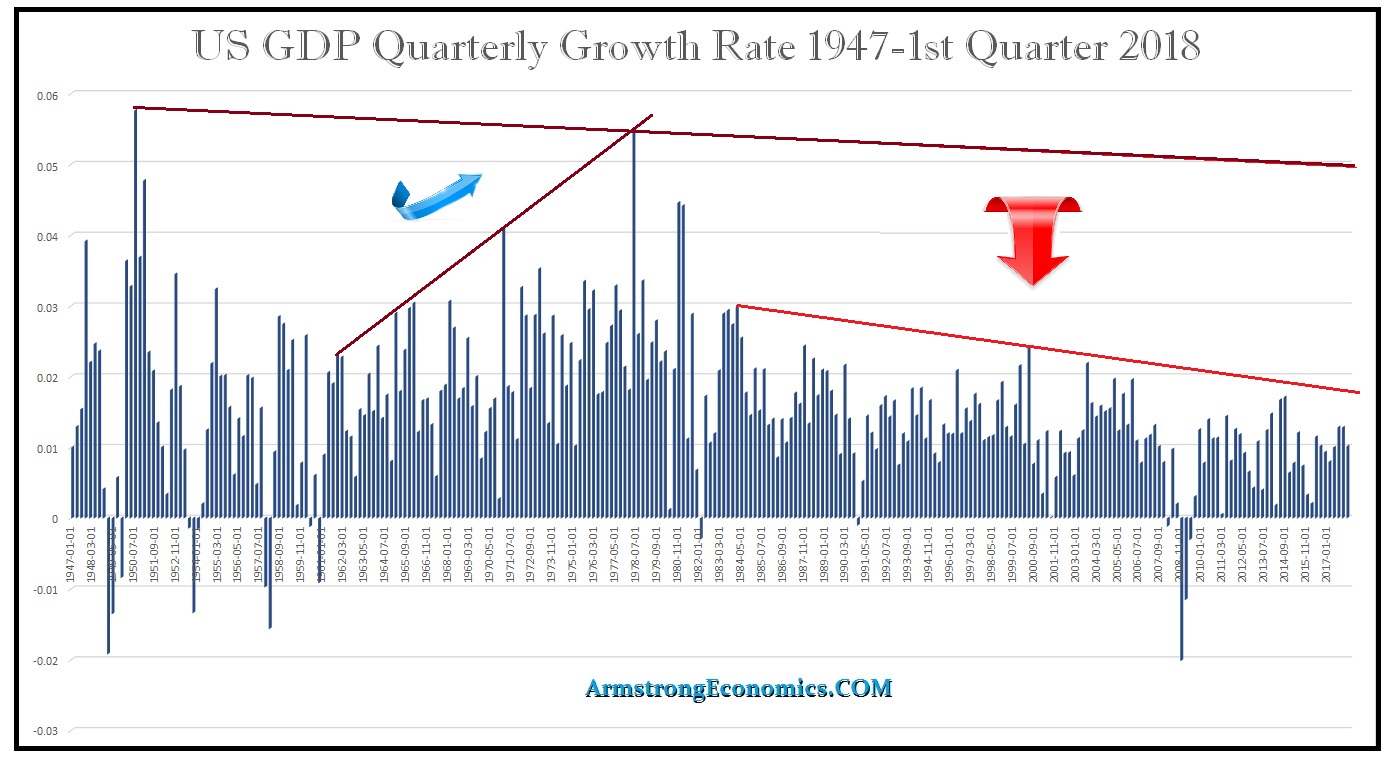
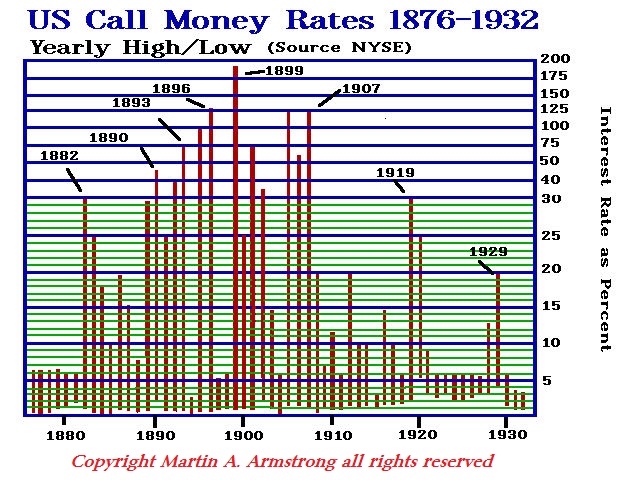
ANSWER: The entire problem of lowering interest rates to “stimulate” the economy demonstrates that central banks cannot really manage anything. This theory is based upon the idea that if rates are cheap then you will borrow. They fail to even understand HOW the economy functions. The stock market and the economy has NEVER peaked with the same level of interest rates TWICE in history. If you BELIEVE the market will double you will pay 20% interest for a year. If you do not BELIEVE the market will rise at all, you will not borrow at 1%.

Pension funds were based upon the idea that at 8% you double your money in less than 10 years compounded. The system of a pension cannot function at interest rates of 1-3%. This is why states are raising taxes and going broke. They have to make up the losses on investments. Then throw in the corruption of governments. They directed pensions to be “conservative” and thus must own typically more than 50% government bonds up to 85% generally and some are at 100% like Social Security. The lower rates on government bonds, the greater the losses and thus taxes must be raised to compensate for state pensions.

Then, so many funds ran into Emerging Markets to try to compensate for the losses on government bond holdings. Spanish banks ran into Turkish debt which they assumed would become a member of the Eurozone. Turkey was one of the first members of the Council of Europe in 1949, and it became an associate member of the EEC in 1963, joined the EU Customs Union in 1995 and started accession negotiations with the European Union in 2005. However, ever since Erdogan, all negotiations with Turkey to join the EU came to an end in 2017.

Therefore, the Fed realizes that the next crisis is a pension crisis and they need to raise rates to help try to bail out the pension funds. They will not be able to raise the rates fast enough to avoid the crisis coming very rapidly which will contribute to raising tax rates and further suppressing economic growth into the future

Why do Cycles Work?


QUESTION: Mr. Armstrong; Your analysis is really remarkable. When the Dow was making new highs in October you said it was not breaking out. Then you said it would correct to retest the monthly support. You even warned that the bulk of the decline was always before the holiday as fears would grow for what would happen after the market reopened. You always get the highs and you even named the day of the low this week the week before. How can your arrays do this? I know that they do. My question is have you put any effort into discovering why cycles work in the first place?

HD

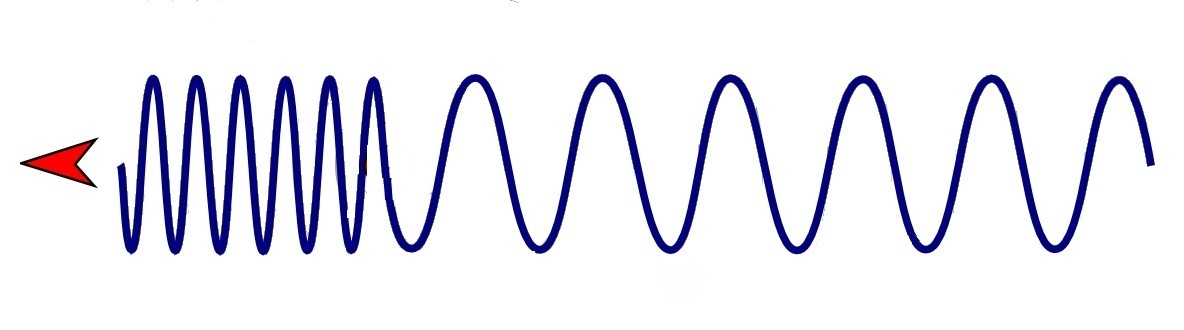
ANSWER: That is a question I get often and it seems to me to be up there with is there God and what is the meaning of life? All I can say is the foundation of EVERYTHING is a cycle. Here is how sound travels known as the Doppler effect.

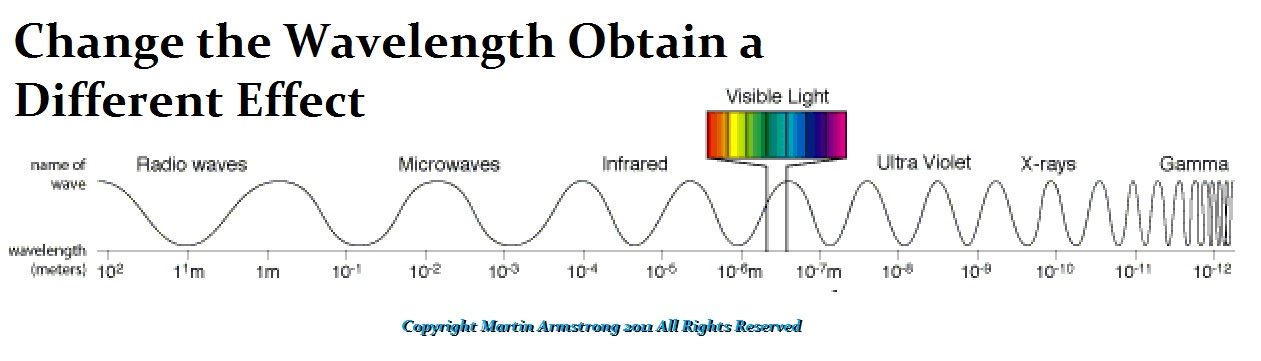
Sunlight also travels in waves. Change the frequency and you get a different effect. There is a cycle to absolutely everything around us. The Arrays are composed of a correlation of 72 individual models. Then there is a global correlation to the frequencies of all other markets. So there is not a single cycle that you can reverse-engineer from an array. It just does not work that way. We simply do cycles differently than most people in the cyclical analysis arena.

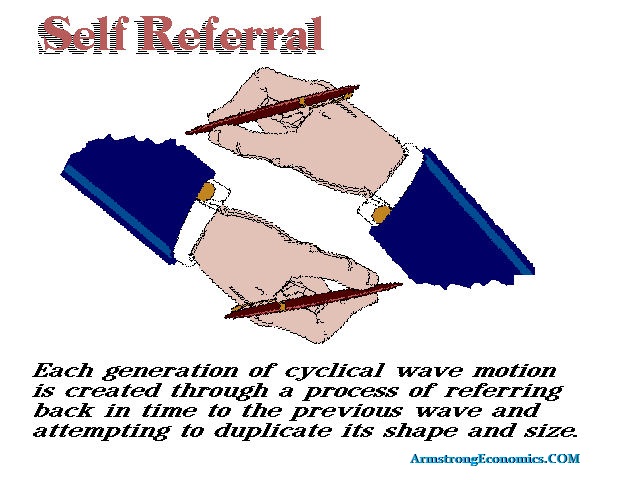
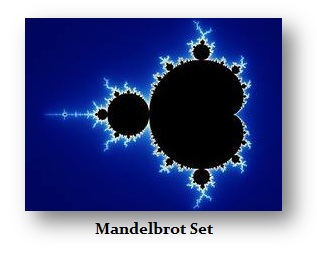
So why do they work? Perhaps that is just the key to the universe itself. The earth travels around the universe and reaches the same spot once every 25,800 years. We also are born, we live, and then we die – the cycle of life. Then at the core of everything lies the fractal design within nature. It is more than just a Mandelbrot Set. We have children who are copies our ourselves taking bits of both parent’s DNA. That is the process of cyclical reproduction by self-referral.

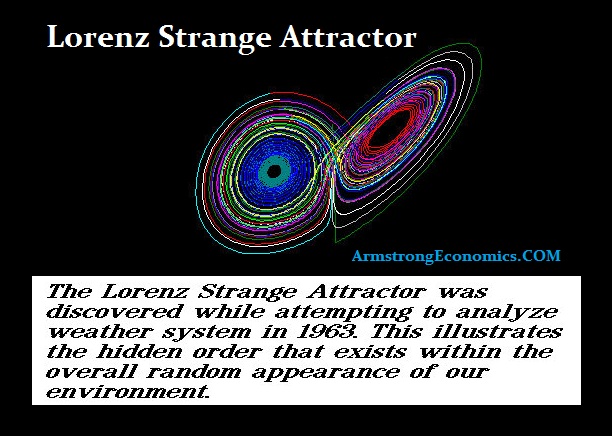
Then there is the Lorenz Stange Attractor which was the fascinating cyclical behavior of weather systems, which of course are ignored by the Global Warming people. In effect, they are no different from the people who executed others who dared to say the earth was round instead of flat.

Trump v the Federal Reserve


QUESTION: Mr. Armstrong; A spectacular call. You gave the day and the market bottomed within 100 points of your number. You always nail it. I find it curious how they blamed Trump and the Fed. Can Trump fire the head of the Fed? I really think he seriously needs to attend your WEC. He would have seen this move coming.

Congrats!

FG

ANSWER: No. President Trump’s comments about firing Federal Reserve Chairman Jerome Powell are really off the wall. The problem is he has the classic TV talking heads view that stocks will crash with higher interest rates. Trump’s frustration with the central bank chief intensified following the interest-rate increase and months of stock-market losses. He is oblivious to the real crisis which is the low-interest rates are destroying the pension funds.

Meanwhile, the media blames Trump for his tweets and the talking heads attribute the decline to interest rates. Powell cannot publicly state why rates have to rise or he would create a real debt panic. Trump is clueless as is Capitol Hill with the monumental crisis in global debt.

For now, the news will bash the stocks when down, and when investors/traders see there can be no flight to bonds as quality, the real panic will begin. I wish I could reverse this mess, but reality states Trump’s handlers are rooting for the Deep State and would never let me near him.

The Democrats want the stocks to crash for they can blame Trump and try to win the losers to vote for their team. The shame here is this is not about running the nation or the economy to benefit all, it is just about winning the 2020 election. Since the ECM turns in January 2020 rather than the elections in November 2020, this is indicating that we may have a psychological shift prior to the elections.

German Hyperinflation & the Dawes Plan


The German Hyperinflation was by NO MEANS about inflation created by an increase in the money supply under the Quantity Theory of Money (QTM). Today, Angela Merkel has forcefully imposed Austerity upon the whole of Europe because she really does not understand what even caused the hyperinflation. It was at the Palace of Versailles outside Paris when Germany signed the Treaty of Versailles on June 28th, 1919 with the Allies, officially ending World War I. AT that time, the English economist John Maynard Keynes attended the peace conference. However, Keynes left in protest of the treaty becoming the first outspoken critic of what would prove to be the most punitive agreement that only set the stage for World War II and the rise of Adolf Hitler in 1933.

John Maynard Keynes wrote in his The Economic Consequences of the Peace, which he published in December 1919, that the harsh war reparation payments and other harsh terms that they were to impose on Germany by the treaty would lead to the financial collapse of the country. Keynes further warned that this Treaty would result in serious economic and political repercussions on Europe and the world as a whole. The political trend at the time refused to listen. This was all about punishing Germany.
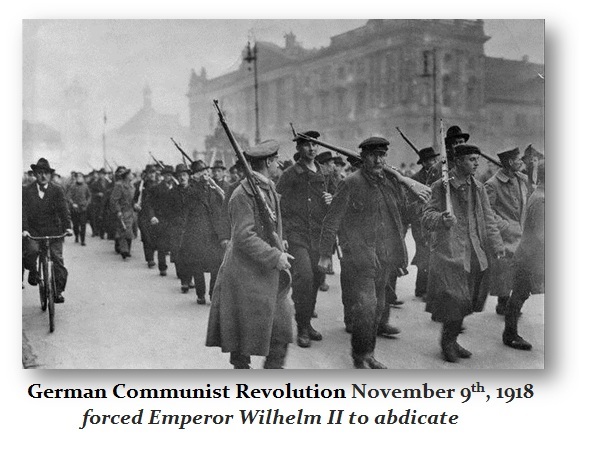
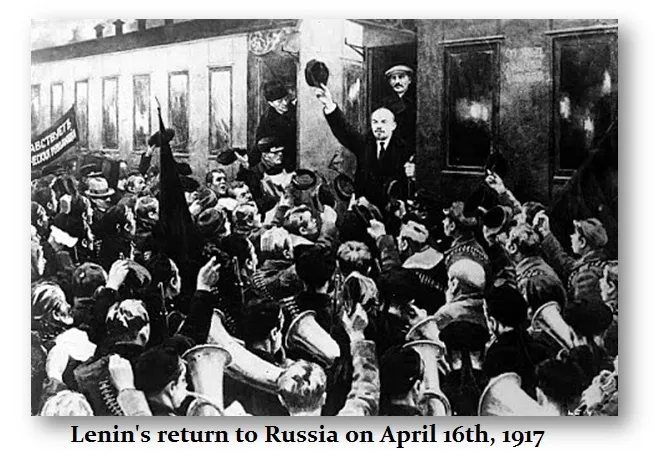
We must also understand that wars are created by politicians – not the people. Prior to the Treaty of Versailles signed in June 1919there was the German Communist Revolution which began the Weimar Republic. It was this 1918 German Communist Revolution which was inspired by the 1917 Russian Revolution that resulted in the overthrown of the monarchy in Germany ending the Emperors and the king of Prussia. The revolutionary period lasted from November 1918 until the adoption in August 1919. But what also seems to be omitted from many accounts taught in school, is the simple fact that the German government interfered in the Russian Revolution and was instrumental in creating the Russian Revolution.
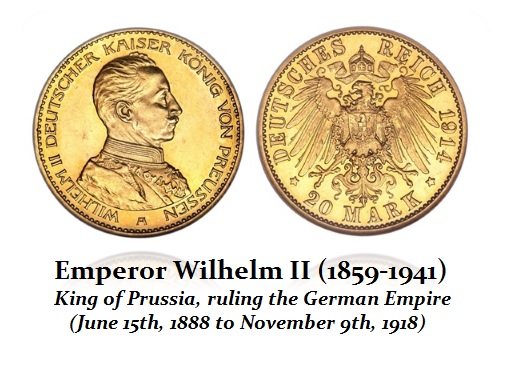
The German Emperor Wilhelm II Imperial Government actually feared that Russia would enter World War I. The rising communist movement in Russia was anti-war. Germany saw a chance for victory in Europe if it kept Russia out of the war. Hence, Germany supported the Communist anti-war sentiment of the Bolsheviks in Russia. Germany permitted Vladimir Lenin (1870-1924) to travel in a sealed train wagon from his place of exile in Switzerland through Germany, Sweden, and Finland to Petrograd. Since the start of the February Revolution in Russia, Lenin was trying to figure out a way to get back into Russia. Germany aided his return assuming he was anti-war and would thus keep Russia out of World War I. Lenin returned to Russian on April 16th, 1917. Within months of arriving, Lenin led the October Revolution in Russia and the Bolsheviks seized power and indeed Russia withdrew from the world war. According to Leon Trotsky, the October Revolution would not have succeeded without Lenin.

With the success of the October Revolution in Russia and the Dream of a new Marxist Utopia, the Germans entered into a civil war and invited Lenin to please take Germany. Clearly, the scheme of the Imperial German government had backfired. It not only was instrumental in creating the Soviet Union by turning over Russia’s socialist transformation decisively into the hands of the Bolsheviks, its plan led to the overthrow of its own hold on power. This is all recorded in contemporary newspapers (see New York Times Nov 11, 1918).
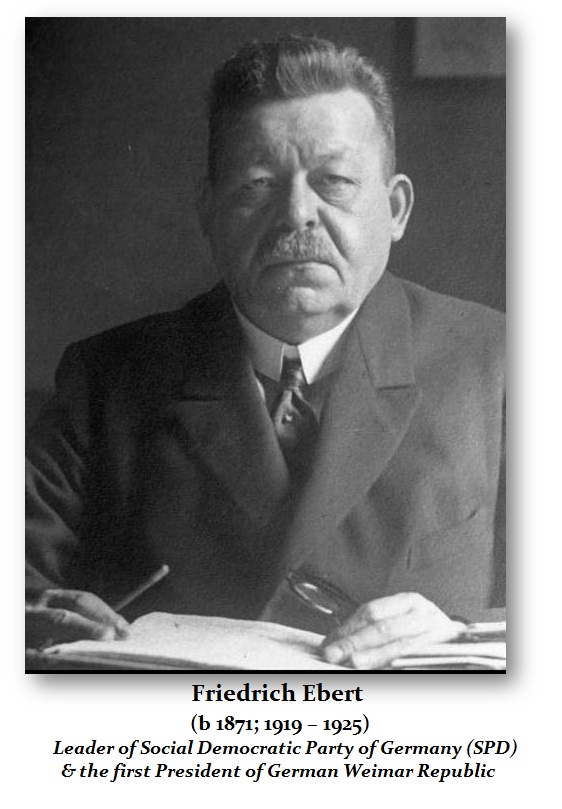
The Prussian Emperor Wilhelm II (1859-1941) found himself in the midst of troubling economic and social disorder. A series of mutinies by German sailors and soldiers undermined Wilhelm II’s government and he lost the support of his military which enabled the German people to revolt. Wilhelm II was forced to abdicate on November 9th, 1918. The very following day, a provisional government was announced composed of the Social Democratic Party (SDP) and the Independent Social Democratic Party of Germany (USDP). To this day, the SDP has remained as a major part against all opposition. Then in December 1918, German elections were held for a National Assembly with the goal of creating a new parliamentary constitution. On February 6th, 1919, the National Assembly met in the town of Weimar and formed the Weimar Coalition. They also elected SDP leader Friedrich Ebert (1871-1925) as President of the Weimar Republic who served from 1919 until 1925.

It was Friedrich Ebert who had to deal with the Treaty of Versailles. When the terms became known on May 7th, 1919, the German people rose in protest. Ebert himself did denounce the treaty as “unrealizable and unbearable” yet he understood that Germany was not allowed to negotiate nor reject the treaty. Ebert even asked Hindenburg if the army could put up a defense if the Allies renewed hostilities. Hindenburg said that the army was not capable of resuming the war even on a limited scale. Ebert then advised the National Assembly to approve the treaty, which it did by a large majority on July 9th, 1919.

The Treaty of Versailles commanded Germany to reduce its military, take responsibility for the World War I, relinquish some of its territories and pay exorbitant reparations to the Allies. It also prevented Germany from joining the League of Nations at that time. Thus, the treaty punished the German people for the sins of its government. Indeed, the military created World War I for it is generally accepted that Wilhelm II was largely just a ceremonial figurehead. During the Sarajevo crisis with the assassination of the Archduke Franz Ferdinand of Austria on June 28th, 1914, he was Wilhelm’s friend and he offered to support Austria-Hungary in crushing the opposition who assassinated the Archduke. Wilhelm went on his annual cruise of the North Sea July 6th, 1914. Wilhelm returned to Berlin on the 28th of July that year and eagerly read a copy of the Serbian reply. Wilhelm wrote his comment on it:

“A brilliant solution—and in barely 48 hours! This is more than could have been expected. A great moral victory for Vienna; but with it every pretext for war falls to the ground, and [the Ambassador] Giesl had better have stayed quietly at Belgrade. On this document, I should never have given orders for mobilization.”
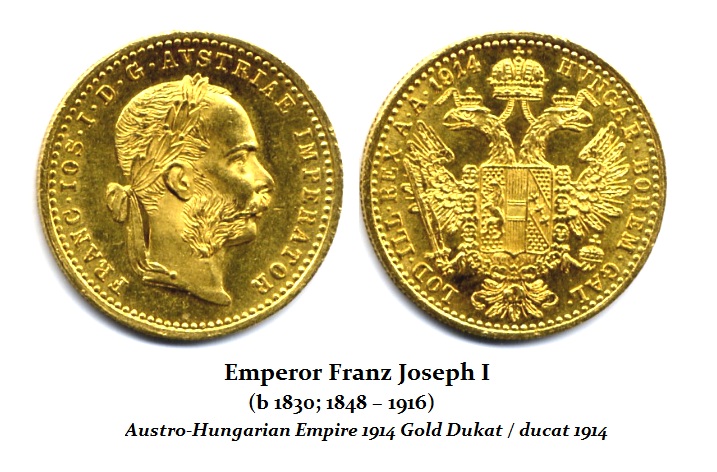
Wilhelm did not know at the time that the military had convinced the Emperor of the Austro-Hungarian Empire, Franz Joseph I (b 1830; 1848 – 1916), to sign a declaration of war against Serbia. As a direct consequence, Russia began a general mobilization to attack Austria in defense of Serbia. Wilhelm wrote a lengthy commentary containing his observations:

“… For I no longer have any doubt that England, Russia and France have agreed among themselves—knowing that our treaty obligations compel us to support Austria—to use the Austro-Serb conflict as a pretext for waging a war of annihilation against us … Our dilemma over keeping faith with the old and honourable Emperor has been exploited to create a situation which gives England the excuse she has been seeking to annihilate us with a spurious appearance of justice on the pretext that she is helping France and maintaining the well-known Balance of Power in Europe.”

In school, I remember being taught that World War I was the result of treaties among governments which then force one to come to the aid of another. Clearly, the Treaty of Versailles set the stage for World War II by its very crushing terms that nobody would be able to meet. The Treaty of Versailles set out a plan for reparations to be paid by Germany requiring to them to pay 20 billion gold marks, as an interim measure, with the final amount to be decided upon at later date. In 1921, the London Schedule of Payments set the German reparation figure at 132 billion gold marks divided into various classes, of which only 50 billion gold marks were required to be paid.

Meanwhile, the industrialists of Germany’s Ruhr Valley lost their factories in Lorraine. Germany had seized Lorraine back in 1870 and now this was to also part of the demands be returned to France. There was also an occupation of the Ruhr industrial area by France and Belgium. The Germans affected by the Treaty and the seizure of their property by France and Belgium now demanded hundreds of millions of marks as compensation from the German government and they paid the Ruhr Valley industrialists for their losses. This also contributed to the German Hyperinflation crisis and it effectively reduced the ability of the German economy to recover.

While the narrow neo-classical economic theory, hyperinflation is rooted in a deterioration of the monetary base, there is little attention paid to the collapse in public confidence that there is a store of value that the currency will be able to command later. Hence, people do not save and the velocity of money increases as people attempt to spend it as fast as they get it. There is a perceived risk of holding currency which rises dramatically at the core. Interest rates rise because they are the premiums people expect in the future when loans are repaid to make a profit. The hyperinflation that was set in motion by the Treaty of V was not limited to Germany. We also saw hyperinflations that I defined as a sharp and sudden doubling in prices (50% decline in the purchasing power of a currency) is less than three months in Austria and Hungary as well during this same period. In the case of Austria, hyperinflation began in October 1921 and continued into September 1922. In Hungary, the hyperinflation unfolded between March 1923 and February 1924. Philip Cagan’s (1956) The Monetary Dynamics of Hyperinflation widely accepted a definition which defines it as a price-level increase of at least 50% per month. However, even Cagan had to make exceptions because this cannot be defined precisely as some percent that is crossed will result definitively in hyperinflation. Therefore, the accepted definition remains rather vague and ill-defined.

In the case of Austria. here there was a separate treaty known as the Treaty of St. Germain which declared that the Austro-Hungarian Empire was to be dissolved. Under article 177 Austria, along with the other Central Powers, accepted responsibility for starting the war. The new Republic of Austria was to then consist of most of the German-speaking Danubian and Alpine provinces in former Cisleithania. Hungary was now split and Austria was commanded to recognize the independence of Hungary, Czechoslovakia, Poland, and the Kingdom of Slovenes, Croats, and Serbs. The Treaty of St. Germain also included ‘war reparations’ of vast sums of money that could also never economically be paid.

In the case of the Austrian Hyperinflation, the foreign-exchange value of the Austrian crown reflected the catastrophic depreciation of this event. In January 1919 one dollar could buy 16.1 crowns on the Vienna foreign-exchange market; by May 1923, a dollar traded for 70,800 crowns. According to the provisions of the Treaty of St. Germain, the newly created Republic of Austria had to overstamp the old paper money of the former Austro-Hungarian Empire still circulating in its territory, then had to replace the overstamped banknotes with new ones, and finally had to introduce an entirely new currency. To complete the first step, the circulating banknotes had to be overstamped with the inscription DEUTSCHÖSTERREICH, and new banknotes were also issued with this feature. Later, still under the name Oesterreichisch-ungarische Bank, banknotes were printed using the German-language clichés on both sides yet still displayed the DEUTSCHÖSTERREICH inscription. From 1920 onward, a new stamp appeared on banknotes: “Ausgegeben nach dem 4. Oktober 1920”. Next, in 1922 a new series of Krone banknotes was introduced with a completely new design to complete the second step. This series contained 1 Krone, 2, 10, 20, 100, 1000, 5000, 50 000, 100 000 and 500 000 Kronen, later 10 000 Kronen (1 000 000 Kronen was planned but not issued). Finally, in 1925, as the third step was to issue a new series of Austrian Schilling banknotes.

During this period, the printing presses worked night and day churning out the currency. At the meeting of the Verein für Sozialpolitik (Society for Social Policy) in 1925, Austrian economist Ludwig von Mises told the audience:
During the first five years after World War I, coal was scarce in Europe. France sought coal for its steelmakers from Germany. But the Germans needed coal for home heating and for their own steel industry, having lost many of their steel plants in Lorraine to the French. As a means of protecting their own growing German steel industry, the German coal producers—whose directors also sat on the boards of the German state railways and German steel companies—began to leverage high costs though shipping rates on coal exports to France.[3]

In early 1923, Germany defaulted on its war reparations payments and German coal producers refused to ship any more coal across the border. In response to this, French and Belgian troops occupied the Ruhr River valley inside the borders of Germany in order to compel the German government to continue to ship coal and coke in the quantities demanded by the Versailles Treaty, which, Germany which characterized as onerous under its post war condition (60% of what Germany had been shipping into the same area before the war began).[4]

This occupation by the French military of the Ruhr, the centre of the German coal and steel industries outraged the German people. They passively resisted the occupation, and the economy suffered, contributing further to the German hyperinflation.

Hyperinflation thus unfolded in Germany because those with money saw what Lenin had done in Russia and sent whatever wealth they had to other places, particularly the United States.  They got their wealth out through using foreign coins, but also collectibles such as stamps and coins in particular. By the end of World War II, most German rare stamps and coins were actually in the United States and were slowly making their way back to Germany during the 1960s and 1970s.

The Weimar Republic then just printed money to pay reparation payments and the entire system collapsed.

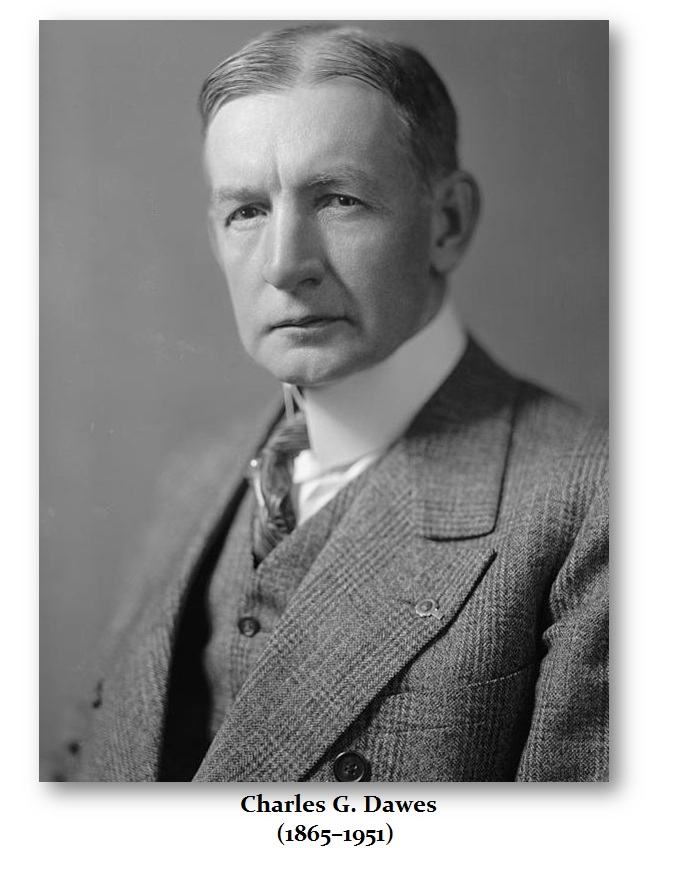
The Dawes Plan (as proposed by the Dawes Committee, chaired by Charles G. Dawes) was an initial plan in 1924 to resolve the World War I reparations that Germany had to pay, which had strained diplomacy following World War I and the Treaty of Versailles.

The Dawes plan provided for an end to the Allied occupation, and a staggered payment plan for Germany’s payment of war reparations. Because the Plan resolved a serious international crisis, Dawes shared the Nobel Peace Prize in 1925 for his work.

It was an interim measure and proved unworkable. The Young Plan was adopted in 1929 to replace it.

Dow & the Future


QUESTION: Mr. Armstrong; I understand at the WEC you told the audience the stock market would correct sharply into January/February. For those of us who could not afford to attend a WEC, are we to expect the slingshot you have been warning should take place?

Thank you;

HP

ANSWER: Yes. Timing is absolutely everything. DO NOT ANTICIPATE anything. Time is more important than price. But we also act on the reversals in conjunction with time. We have people already declaring this is a bear market. Many may not even be old enough to have traded a bear market. Let me explain one thing. We are NOT dealing with a bear market. We are dealing with a period where we must set up everything for what is to come. I have been warning that normally after an 8-year bull market, there is traditionally a correction.

The final prognosticate on time will arrive with this year’s closing. We need the year-end closings and the computer will then forecast what is to come between now and the end of this cycle wave in January 2020.

How we approach this will be critical. Nonetheless, we have a lot on the horizon. Besides BREXIT in March, we then have the May elections for the EU. The number of people who may be elected that are actually anti-EU is likely to rise. The European election will be as chaotic and we expect the Democrats to make the entire world economy unstable as they make a lot of noise in hopes of driving Trump from office in 2020.

The market will have to absorb a lot of political turmoil in 2019 and we are witnessing the rise of tensions on a grand scale.

We will have the 2019 Outlook Report out in January. We are trying to finalize the contracts for a European WEC in Rome during the first week of May. We will let everything know when that is confirmed.

The First BREXIT – 260AD


QUESTION: Mr. Armstrong, thank you for your excellent commentary. Could you comment on the monetary system in Britain during the period following Rome’s waterfall event? I would be especially interested in the period following the capture of Valerian I through the 9th century.

MG

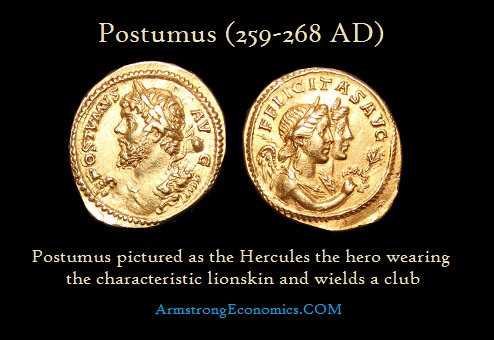
Postumus AU Aureus as Hercules - R

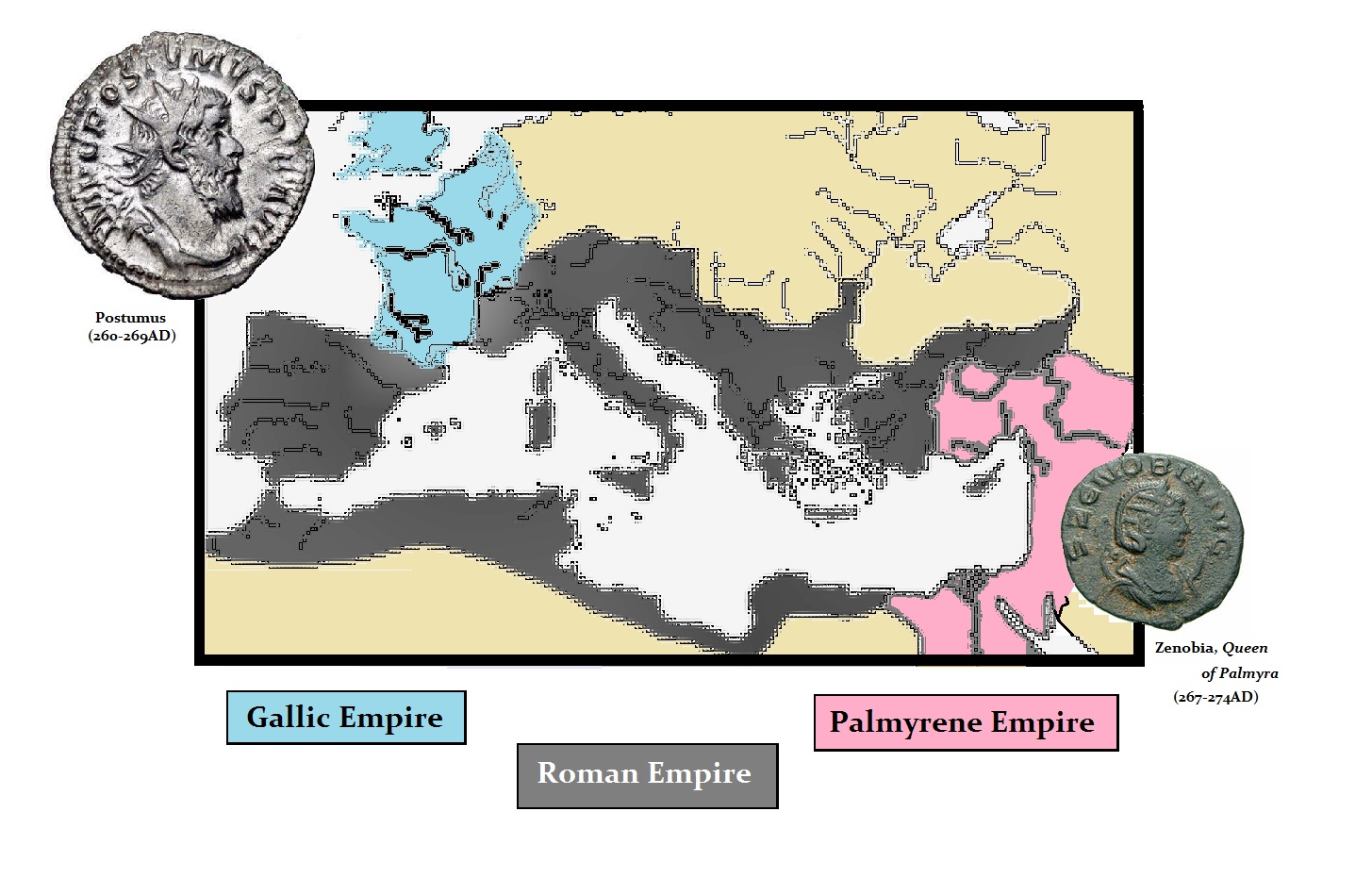
ANSWER: I suspect that the purpose of your inquiry is the loose history taught in Britain that there was a usurper in Britain by the name of Carausius (287-293AD). Effectively, there was a previous usurpation which was really a separatist movement you can call ancient BREXIT. That was led by Postumus (260-268AD) who made his move for power upon the capture of Valerian in 260AD. Interestingly, there we 34 intervals of 51.6 years from 260 that brought us to 2014/2015 for the rise of BREXIT. At least cyclically, it was on time and this was just one component that the computer attributed to the success of the BREXIT referendum.

Image result for Constantius I gold medallion

I have written the full account of the rise of the next attempted usurpation by Carausius. While the first separatist movement failed when Postumus’s successor Tetricus I surrendered in 273AD ending the Gallic Empire, the next usurpation came into play 14 years later in 287AD with Carausius. This attempt at a separatist movement was ended by the father of Constantine the GreatConstantius I Chlorus. This is a medallion showing him entering London.


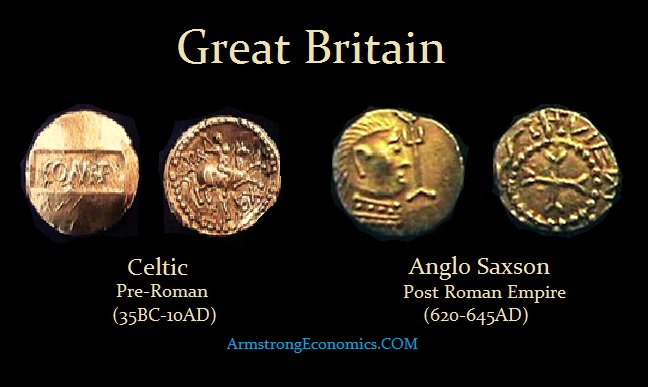
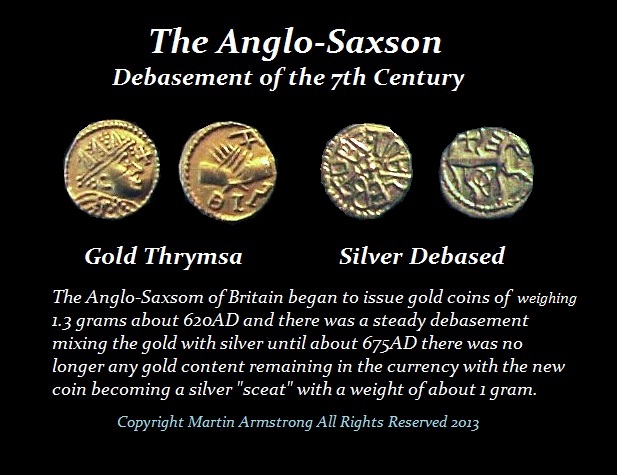
After the fall of Rome, we see gold Thrymsa appear in Britain around 620AD. There begins a debasement process and by 675AD what use to be gold vanishes and is replaced with silver. We see a brief political issue of gold under Offa(757-796). Other than that issue, gold does not reappear again until Henry III in 1257.


BREXIT Vote in Parliament


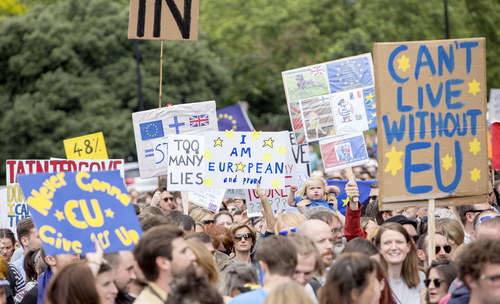
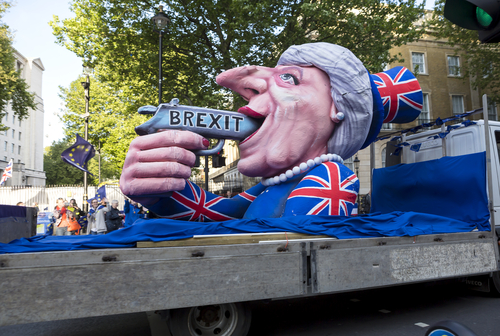
The House of Commons in the British Parliament will vote on Tuesday amid growing calls for the PM to go back to Brussels to renegotiate. Prime Minister Theresa May (PM) could remain in office even if the MPs reject her Brexit plan. The PM has come out and warned Tory rebels that their rejection could lead to a general election, and there was a “very real risk of no Brexit” which would really be far better. The EU will then suddenly witness just how important Britain is from the German car market on down. Britain is the Financial Capital of Europe and that is something Brussels just hates.

The withdrawal deal negotiated between the UK and EU has been endorsed by EU leaders but must also be backed by Parliament if it is to come into force. The whole sticky point is the EU wants a hard border in Ireland to prevent goods from moving with their pound of taxes.

So the votes will take place tomorrow and it looks to be rather interesting, to say the least. The deal May has made ties Britain to the EU forever without any rights whatsoever in the future. Britain will be ruled by Brussels and there really will be no BREXIT deal that the people voted for. May’s deal is being called a “huge step into the unknown.”

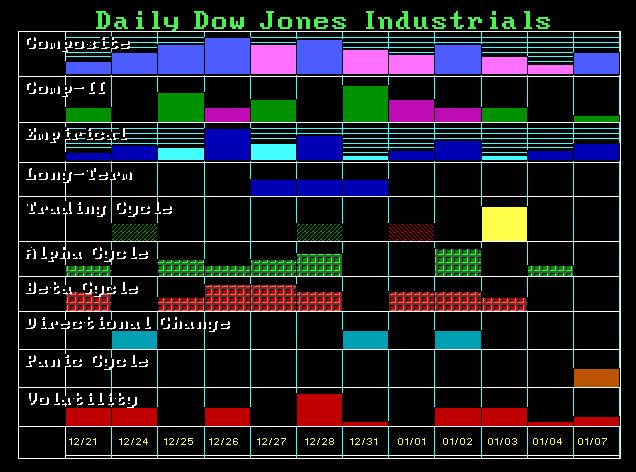
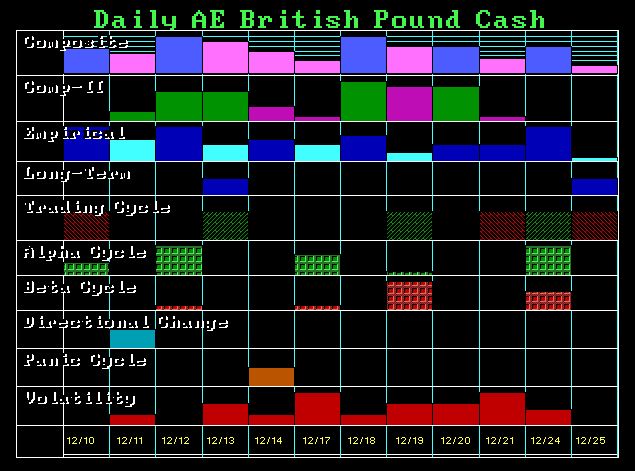
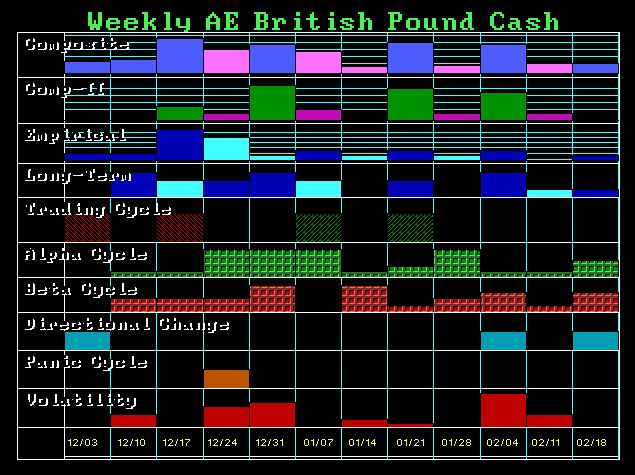
The computer has targeted the 11th as a Directional Change, which is the day of the vote. It also appears that the key target week will be that of the 17th with high volatility going into year-end. The fact that May had to be held in contempt to force her to provide the details of what they were to vote own shows clearly it is not a good deal for Britain and that is the only reason to have withheld it

Do Coins Reveal the Futility of our Times?


The study of coins, numismatics, has constantly expanded our knowledge of antiquity in recent decades through new discoveries which have proven so many old theories wrong and turned academics on their head when it comes to their theories. Without the consideration of the coins, many questions of ancient history would never be answered. Nevertheless, many ancient historians still have a great reluctance to deal with this special discipline and to use their often valuable results. Conversely, many numismatists fail to comprehend the vast importance money has played in the history of humankind. It becomes increasingly rare to find the two fields merged to answer important questions from a larger historical context.

I have written before how the academics declared Historiae Augusta fake because it listed people they never heard of such as Gaius Julius Saturninus. Then, two gold coins were discovered in Egypt with his name and suddenly that book was proven to be history. To this day, you will find still notes saying Historiae Augusta is questionable. Academics just hate to admit a mistake even when you prove it to any rational human being.

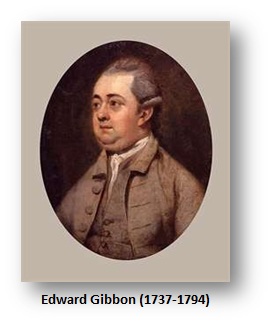
I have stated many times that we were all taught in school about the Decline & Fall of the Roman Empire. The seminal work by that name was of course written by the English historian Edward Gibbon. However, his work was the assembly of contemporary accounts with no real input from coins. His conclusions were primarily fundamental explanations based upon his opinion. Because of that, his work was highly criticized because of its view on religion since we have the rise of both Christianity and Islam covered in his work.

According to Gibbon, the Roman Empire succumbed to barbarian invasions in large part due to the gradual loss of civic virtue among its citizens of which included the role of Christianity. This certainly provoked an ongoing controversy about the role of Christianity historically. He did, however, also attribute weight to other causes of the internal decline of corruption in addition to external invasions from various barbarians in the north and Persians in the East.

Some have argued that the fall of the Roman Empire should not be a surprise but the question should be how did it last for so long. The military legions enabled the fall of the Republic and then they violated the authority of Emperors. The Emperors, looking to secure their power, in turn, overpaid troops to try to maintain loyalty which like love cannot be bought. This, in succession, reduced the dignity of the military corrupting the discipline which created internal enemies following a general in search of power, money, and the throne of glory. This, Gibbons asserts, enabled the Roman world to be overwhelmed by a deluge of Barbarians. We must keep in mind that Gibbon was influenced by the events of the 18th century as the British had entered a period of intense anti-Catholicism.

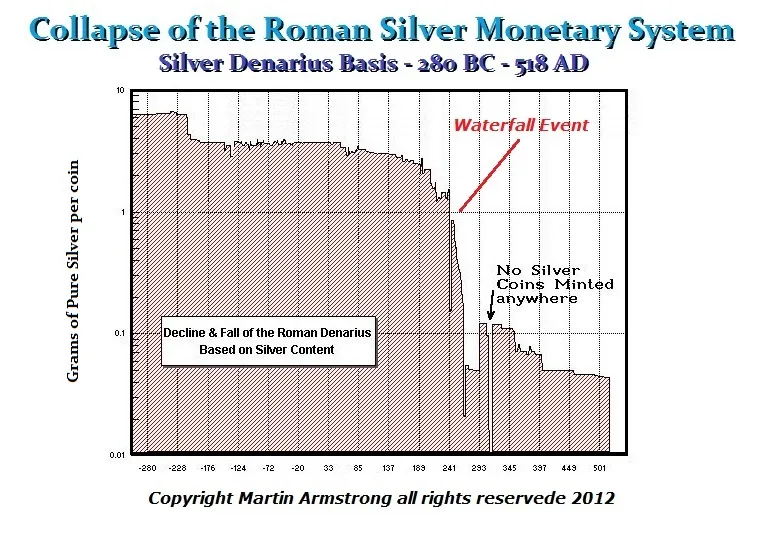
Roman decline silver content monetary system - Armstrong Waterfall effect

What was clearly missing from Edward Gibbon’s work was any bridge between ancient history and ancient numismatics. My work has been directed at eliminating human opinion. Where Gibbon was colored by the intense anti-Catholicism in Britain as a remanent from the Civil War and beheading of the Catholic King Charles I, my efforts are colored by simple economics. The background to the origins of the coinage is essential to comprehend the dynamics in the rise and fall of ALL great empires. The political dimension of the coinage is rarely taken into account. This failure has still left much of history in the dark.

I recreated the monetary history of Rome from the coinage for the simple reason to answer a question: How did Rome Fall? Was it gradual or a crash & burn? The coinage allows us to sort out the fact from the opinion. Gibbon clearly had a bias against religion for he saw how that tore Britain apart. He colored the fall of Rome with that bias. What Gibbon failed to understand was the economics came first and the capture of Valerian in 260AD sent a panic through the Empire. People turned to Christianity AFTER Rome was falling and prayers to their gods failed. The Christian persecutions took place at that time during the 3rd century AD because many took the positions the Empire was failing because the gods were angry at the Christians. The coinage reflects the economic crisis providing us with a timeline rather than just opinion.

The religious conflicts between Puritans and Catholics in Britain during the 17th and 18th centuries was rooted in a completely different mechanism. Even when John F. Kennedy was elected president in the USA, there were many who still took the anti-Catholicism position asserting that the Pope would then be running the United States. This was a divisionary attitude in Christianity (Protestant v Catholic) which was significantly different from the religious conflict in Rome during the 3rd century (Paganism v Christianity), not a question of a Pope usurping power over government.

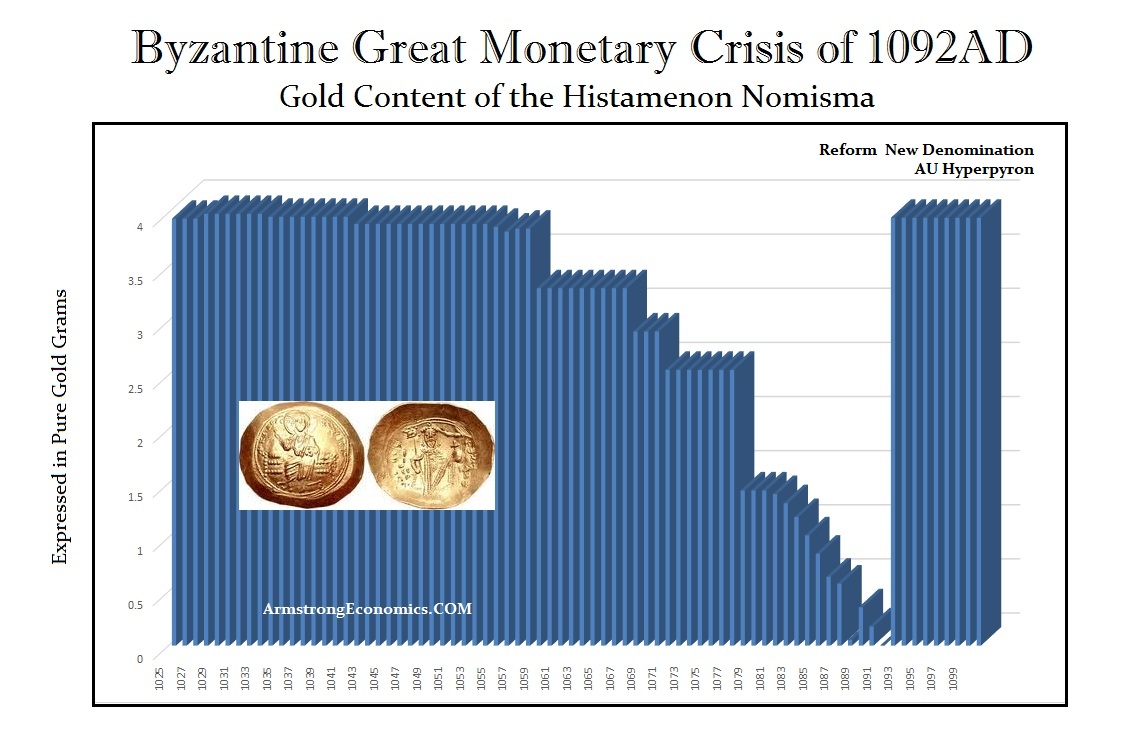
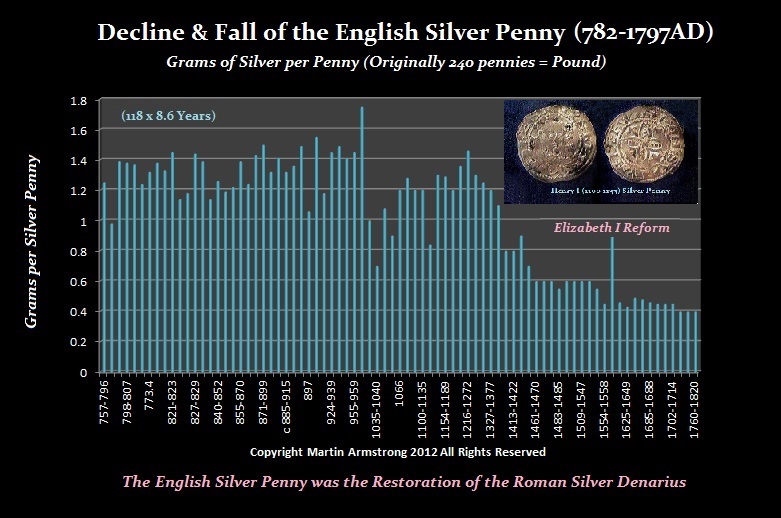
Reconstructing history from coins provides a timeline that is definitive and not subject to speculation or opinion. In this manner, we can actually determine not just cycles, but why history repeats when given the same economic conditions, humans will ALWAYS respond in the same manner. We have used the coinage to reconstruct the entire monetary history of the world. When we accomplished this research effort, then and there we could suddenly see not merely how the rise and fall of empires, nations, and city-states was reflected in the monetary system, but the consistency across all political systems.


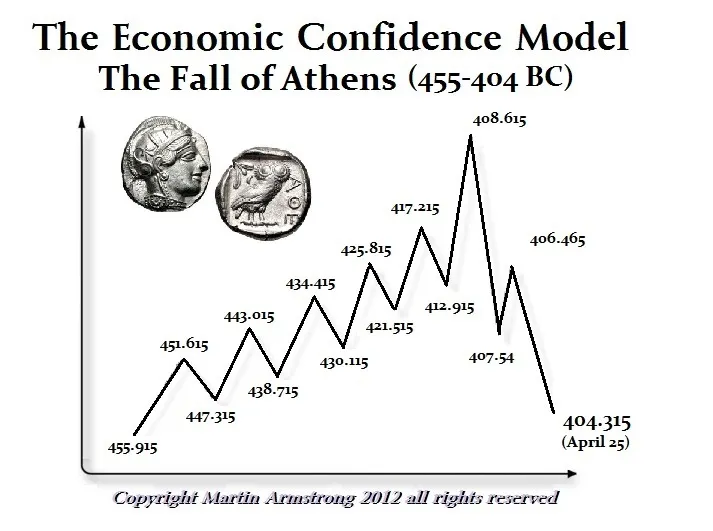
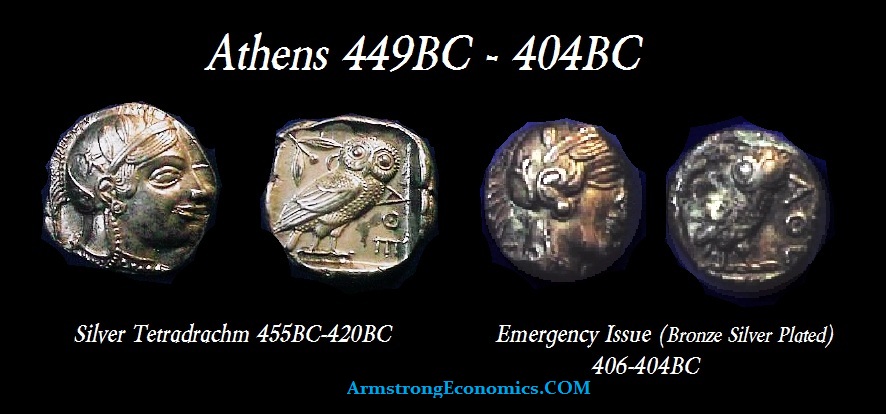
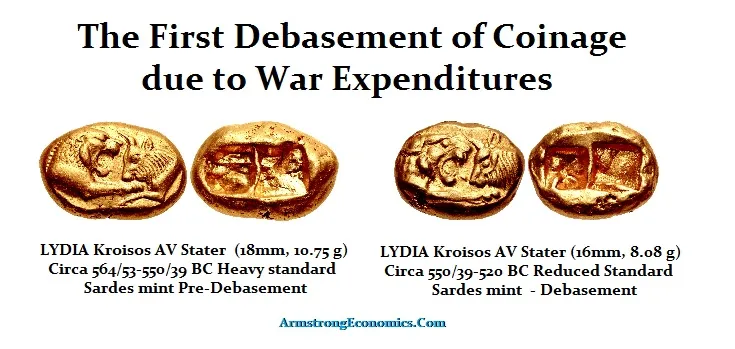
The cost of the Peloponnesian War and the loss of Athens to Sparta was clearly visible in its coinage. Two years before the surrender of Athens, its coinage was debased to bronze silver plated. The coinage stands as a witness to the same patterns of inflation created by war.

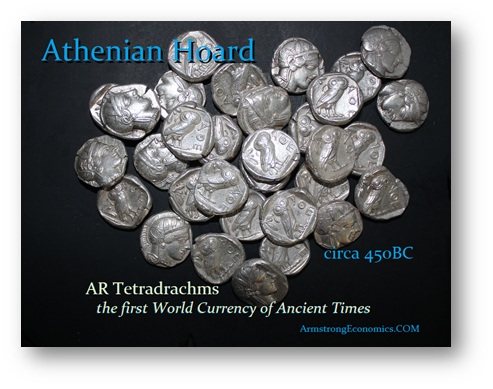
The Hoard of Athenian silver Tetradrachms we have used for study is from the period just prior to or at the beginning of the Peloponnesian War (431–404 BC). They are still of the finest silver and the condition of the coins is really exceptional. They have very little evidence of circulation confirming that they were stashed at the beginning of the war and were hoarded. Many still have underlying luster from recently being struck. Obviously, the person who buried then coins did not survive to reclaim them.

Coins may be purchased in our online store using this link https://squareup.com/store/ae-global-solutions-inc/

The cost of war has historically had always been inflationary. In Lydia, where coins were first invested, we can see the reduced weight as the cost of war increased against Cyrus the Great of Persia. In ancient times, the profits to the victor were often great. But the loss to the vanquished often led to their citizens being sold into slavery. Today, governments wage war more often for the private benefit of select groups rather than the state. The invasion of Iraq made billionaires out of Cheney’s friends and left the American people with endless trillions in debt that will last collecting interest to constantly roll indefinitely until the crash and burn.

Perhaps nobody wants to look at the evidence coins provide us because they do not like the conclusion. The one thing this research has provided is a glimpse of the futility of our situation and how governments will never learn anything from history.

Qatar Leaving OPEC


QUESTION: Mr. Armstrong; You are a personal friend of the royal family of Qatar. Would you care to share your inside knowledge of Qatar leaving OPEC?

KR

Sheikh Saud bin Mohammed Al-Thani of Qatar,ANSWER: Just for the record, I was a friend of Sheikh Saud bin Mohammed al-Thani who was a member of the Royal family of Qatar. We were probably the two biggest collectors of ancient coins in the world. He was always trying to buy me out, with a smile of course. Yes, he came to our office to see me with the royal bodyguards and the whole bit a few weeks before he died in 2014 and yes, I visited him at his home in London. Because of our friendship, he offered Qatar as the headquarters for our operation, but could not grant me a citizenship because I was Christian. We set up our office instead of in Abu Dhabi.

That said, Qatar is the richest nation on Earth on a Per capita basis. Abu Nakhlah Airport (Arabic:مطار أبو نخلة) in Qatar houses both the Qatari Air Force and U.S. Air Force as well as other Coalition personnel. It is also the headquarters of United States Central Command. Its conflict between other member states when the government supported Iran created a real feud. Even their airline was banned from other airports. That is a very complex issue that would take more than a blog to explain.
I have also written that the US desire to invade Syria had NOTHING to do with gassing people. It was simply about to get a gas pipeline through Syria to Europe in order to compete with Russia. The US wanted to choke off Russia from serving Europe. That is why Putin went into Syria and this is the real story behind the pretended human right nonsense. There are plenty of human rights issues in Africa we do nothing about because there is no profit or political gain. North Korea really had weapons of mass destruction yet we did not invade them as we did in Iraq because there was no profit to be had. Just follow the money. Those in power BELIEVE they can bullshit the people ALL THE TIME because the press is in their back pocket and will never report the truth. Mainstream media is no different than Pravda (truth) of Communist USSR.
Now the small, gas-rich state of Qatar state said that it will leave the oil cartel on January 1st, 2019 after nearly 60 years. Why? (1) there is the political conflict with its neighbors. (2) The country’s state oil company, Qatar Petroleum, said its withdrawal decision reflects “Qatar’s desire to focus its efforts on plans to develop and increase its natural gas production.”
Qatar has been under a diplomatic and economic embargo by its Arab neighbors, including OPEC members Saudi Arabia and the United Arab Emirates, for the past 18 months. In response, Qatar has actually been increasing its gas production in retaliation for gas, not oil, is its primary source of revenue – hence the gas pipeline proposal through Syria. In reality, OPEC is concerned about oil – not natural gas. It is only logical that Qatar would withdraw from OPEC based upon its output, but at the same time, there is the diplomatic and economic embargo dispute with other Gulf states. Qatar policy has been to further its position as the world’s leading supplier of gas. Its exports currently account for about 30% of global demand.

US Bank Reserves 10% – EU Bank Reserves 1%


QUESTION: What mechanism prevents banks from creating fraudulent electronic deposits of currency?
As an IT systems admin, I have the ability to add / subtract / adjust ERP systems inventory / costing outside the normal users ability. I could add widgets to the system at will, but fraud can’t be sustained very long, as the physical widgets can’t be sold, they only exist in the system. Electronic currency, however, is only a ledger entry, and since new currency units are created as loans – What prevents any bank from just changing the numbers in their systems to create more currency units at will? Can’t get my head around this.

Thanks for all you do from a little guy just trying to get by!

ANSWER: The creation of money electronically in the banking system is the degree of leverage. Reserve Requirement Ratio at the Federal Reserve was increased on January 18th, 2018. It required that all banks with more than $122.3 million on deposit maintain a reserve of 10% of deposits. Banks with $16 million to $122.3 million must reserve 3% of all deposits. They create money that is purely electronic and we do not see it. I deposit $100 and they lend it to you. Now we both have $100 on deposit and the reserve requirement will be $20 for most banks. They then lend it out a third time and there is now $300 on deposit requiring $30. They cannot create entries out of thin air. They are audited and the reserve ratio is strictly enforced in the USA. The Fed will raise and lower that reserve ratio as they see fit based upon economic conditions.

At the European Central Bank, things are substantially different. Eurozone banks are required to hold a specified amount of funds as reserves on AVERAGE in their current accounts at their national central bank in each member state which are called “minimum reserves”. Remember, each member retained its own central bank!  A bank’s minimum reserve requirement is set for six-week periods called maintenance periods. This minimum reserves level is therefore calculated on the basis of the bank’s balance sheet prior to the start of each six-week maintenance period.

Banks have to make sure that they meet the minimum reserve requirement only on an AVERAGE over the course of the maintenance period. This introduces serious risk. The bank can dip below the minimum reserve in the middle of a crisis and at the end of the six-week period, there can be no reserves remaining. So they do not have to hold the total sum in their current accounts at the central bank on a daily basis! Therefore, this is a flexible arrangement that allows the banks to react to short-term changes in the money markets, but it exposes them to tremendous risk in a financial panic. The design was claimed to help stabilize the interest rate banks charge each other for short-term funds. I totally disagree with this concept.


Up until January 2012, European banks had to hold a minimum of only 2% of certain liabilities, mainly customers’ deposits, at their national central bank. As the economic crisis has continued in Europe, this 2% level has been to 1%! The total reserve requirements for Eurozone banks stand at only around 113 billion euro currently.

Perhaps now people will understand why I have been warning about a MAJOR financial crisis starting in Europe and spreading thereafter around the globe. The general media and the public will NOT understand the reserve ratio disparity so a banking crisis in Europe will be assumed to be the same around the world. Unfortunately, what happens in Europe will NOT stay in Europe. This is also why I STRONGLY urge Europeans to create a stash in the US banks for now. The ECB is seriously looking at creating a cryptocurrency to defeat hoarding just canceling Euro notes. That will end hoarding and they will be able to then enforce negative interest rates. From the ECB view, they are concerned about the coming bank crisis in Europe so the best way to prevent a bank run is to eliminate cash! Europeans should open accounts outside the Eurozone before it is too late.

And Prime Minister Theresa May wants to stay linked to Europe. This is when we need people who REALLY are qualified to understand the world financial system. I cannot express how dangerous it has become with politicians who are clueless about how the world economy even functions. UK banks operate under a completely different scheme.

In May 2006, the Bank of England began paying interest on bank reserve deposits at its official Bank Rate. This inspired US banks to demand the Fed pay interest on excess reserves. The Bank of England had the ‘reserves averaging’ regime back then whereby the quantity of each bank’s reserves that the Bank of England would pay interest on was restricted to a range around a ‘target’ level of reserves that the bank was obliged to pre-declare. The used to be set on a daily basis but was changed at this time to an average over each monthly maintenance period. The objective was to establish a marginal cost of reserves to the banks which would remain very near to Bank Rate. However, this was dependent upon the provision if the Bank of England supplied the right amount of reserves to enable the banks’ reserve deposits to be within this range.

In view of the Bank of England’s desire that wholesale market rates should remain close to Bank Rate was considered to be an improvement over earlier procedures prior to 2006 when reserves were mot paid interest and the Bank of England then had to supply reserves in quantities that exactly matched demand. Consequently, market interest rates tended to move towards the boundaries of the corridor formed by the Bank of England’s deposit and lending facilities. Nonetheless, under the new reserves-averaging regime post-2006, the Bank of England still had to supply reserves in appropriate amounts to meet demand, but it was more flexible. However, the new regime was still ill-equipped to cope with the expansion of reserve supply that the Bank of England then undertook to overcome the breakdown of interbank markets during the financial crisis of 2007-2009. To maintain interest rate transmission within the reserves averaging regime, the Bank of England then widened the range of reserve deposits that they paid interest on from 1% to 60% trading around the Bank of England’s targets. This required the Bank of England to then take steps to reabsorb the excess reserves.

The introduction of Quantitative Easing, which began in March 2009, merely created another problem from the reserve perspective. Suddenly, Quantitative Easing caused another larger expansion increase in reserve deposits. Rather than trying to offset this by selling other assets or making further adjustments to the reserves averaging scheme, the entire scheme was simply suspended in favor of paying interest unconditionally on ALL reserve balances.

Consequently, I have stated NUMEROUS times before, all central banks are NOT the same!!!!!!!!!!!!!!!!!!!


Central Bank Reserve Ratios
COUNTRY Bank Reserve Ratio
ALBANIA 10.00%
ANGOLA 24-May-18 19.00%
ARMENIA 24-Feb-14 2.00%
ARGENTINA 28-Sep-18 44.00%
ARUBA 11.00%
AZERBAIJAN 1-Mar-15 0.50%
BANGLADESH 3-Apr-18 5.50%
BARBADOS 5.00%
BELARUS 16-Mar-16 7.50%
BULGARIA 28-Nov-08 10.00%
CAMEROON 7-Apr-16 5.88%
CAPE VERDE 16-Feb-15 15.00%
CEN. AFRICA REP 7-Apr-16 0.00%
CHAD 7-Apr-16 3.88%
CHINA 15-Oct-18 14.50%
DEM. 8-Apr-15 2.00%
REPUBLIC 7-Apr-16 5.88%
COSTA 15.00%
CROATIA 11-Dec-13 12.00%
CZECH REPUBLIC 20-May-99 2.00%
CURACAO 10-Oct-13 18.00%
DENMARK 2.00%
EGYPT 3-Oct-17 14.00%
EQUATORIAL 7-Apr-16 5.88%
EUROZONE 18-Jan-12 1.00%
FIJI 7-Jul-10 10.00%
GABON 7-Apr-16 5.88%
GAMBIA 19-Jun-13 15.00%
GEORGIA 13-Jun-18 5.00%
GHANA 12-Nov-14 10.00%
HUNGARY 1-Dec-16 1.00%
ICELAND 1-Jun-16 2.00%
INDIA 1-Jul-13 4.00%
INDONESIA 18-Feb-16 6.50%
IRAQ 1-Sep-10 15.00%
ISRAEL 6.00%
JAMAICA 1-Jul-10 12.00%
JORDAN 12-Mar-09 8.00%
KAZAKHSTAN 2.50%
KENYA 5.25%
KYRGYZ REPUBLIC 14-Dec-15 4.00%
LITHUANIA 3.00%
MACEDONIA 9-Sep-13 8.00%
MALAWI 23-May-08 15.50%
MALAYSIA 16-May-11 3.00%
MALDIVES 20-Aug-15 10.00%
MAURITIUS 2-May-14 9.00%
MOLDOVA 4-Sep-18 42.50%
MONGOLIA 23-Mar-18 10.50%
MOROCCO 21-Jun-16 5.00%
MOZAMBIQUE 26-Oct-17 14.00%
NEPAL 11-Jul-18 4.00%
NICARAGUA 15-Jun-18 10.00%
NIGERIA 22-Mar-16 22.50%
PAKISTAN 12-Oct-12 3.00%
PERU 30-Apr-17 5.00%
PHILIPPINES 24-May-18 18.00%
POLAND 31-Dec-10 3.50%
QATAR 16-Mar-17 4.50%
ROMANIA 6-May-15 8.00%
RUSSIA 27-Jun-16 5.00%
RWANDA 5.00%
SERBIA 19-Jan-11 5.00%
SOUTH 2.50%
SRI LANKA 14-Nov-18 6.00%
TAIWAN 1-Jan-11 10.75%
TAJIKISTAN 20-Mar-17 3.00%
TANZANIA 21-Mar-17 8.00%
TRINIDAD & TOBAGO 17.00%
TUNISIA 1.00%
TURKEY 13-Aug-18 8.00%
UNITED STATES 27-Oct-16 10.00%
URUGUAY 1-Apr-13 25.00%
UZBEKISTAN 1-Sep-09 15.00%
VENEZUELA 25-Oct-13 19.00%
VIETNAM 1-Sep-11 3.00%
WEST 16-Mar-17 3.00%
ZAMBIA 21-Feb-18 5.00%