Why Capital Flows Are the Only Real Guide to Market Trends


QUESTION: Hello Martin

I wish all the best for you. The work you make every day to rise up our understanding about the world is amazing and make me feel a huge respect. it is very inspiring. I’m a small customer of your private blog. I don’t know if you answer that kind of request.

I want and I need to understand WHY the dxy was in bull market between march 2000 and feb 2002, from 102 to 113.

you are unbelievable when times come to understand economic history. I can’t find any explanation about this period
M2 supply decreased softly the twin deficit stood around 2% with no hope of getting better and it reversed after 2002 to 8% !!!

Interest rates were declining stock indexes were very bear from the tech turnmoil

Gold was bottoming from 420 to 380 with a reverse pattern during summer 2001. the dxy rise more than 3% after the bottom of gold in 1 year !
how could this DXY get up 10% higher in 2 years ??? what is the secret of history I miss ???? I believe there is something to learn with that period !
kind regards

CD

ANSWER: While the Euro began really in 1999, the physical notes did not come into circulation until 2000. The euro hit its all-time high shortly after its launch at the start of 1999 at that point in history which marked the euphoria of the talking heads on TV and how the Euro would crush the dollar. As always, they talked everyone into buying the high. As we say, buy the rumor and sell the news. That is an INCREDIBLY good market rule.

But The Euro began to slide thereafter, falling to a record low of 82.3 US cents in October 2000. However, both the euro and sterling then recovered at the lows when rumors began that an intervention by the European Central Bank and the Bank of Japan was imminent. In late afternoon trading that day, one euro bought 82.74 and one pound was worth $1.4329. They also spread rumors that Iraq would soon start to price its oil exports in euro and abandon the dollar.

The entire rally has absolutely NOTHING to do with the economic numbers in the United States. The capital inflows to the USA began over FEARS of the Euro. One major central bank was leaking inside info to us to get it out because we were NOT mainstream press and the info was going DIRECTLY to the real institutional money. They were deeply against the Euro because of the faulty design. It was a political creation that nobody in their right mind would have created such a currency under this structure. So the capital fled Europe and this was one of the reasons why the DOT.COM bubble was so big. It was aided by foreign capital fleeing Europe, to begin with.

The economic numbers are nice. But they are NEVER the entire story. Capital can flee one region because of events there and they may be going to a place that is not up to par, but still, it is the best alternative. Capital Flow Analysis which we developed is by far the only way to grasp the full extent of the economy.

Silver v Gold Standard


QUESTION: Mr. Armstrong; You do not give much credence to the world returning to a gold standard. Didn’t the entire world use the gold standard before?

Thank you for your input

JK


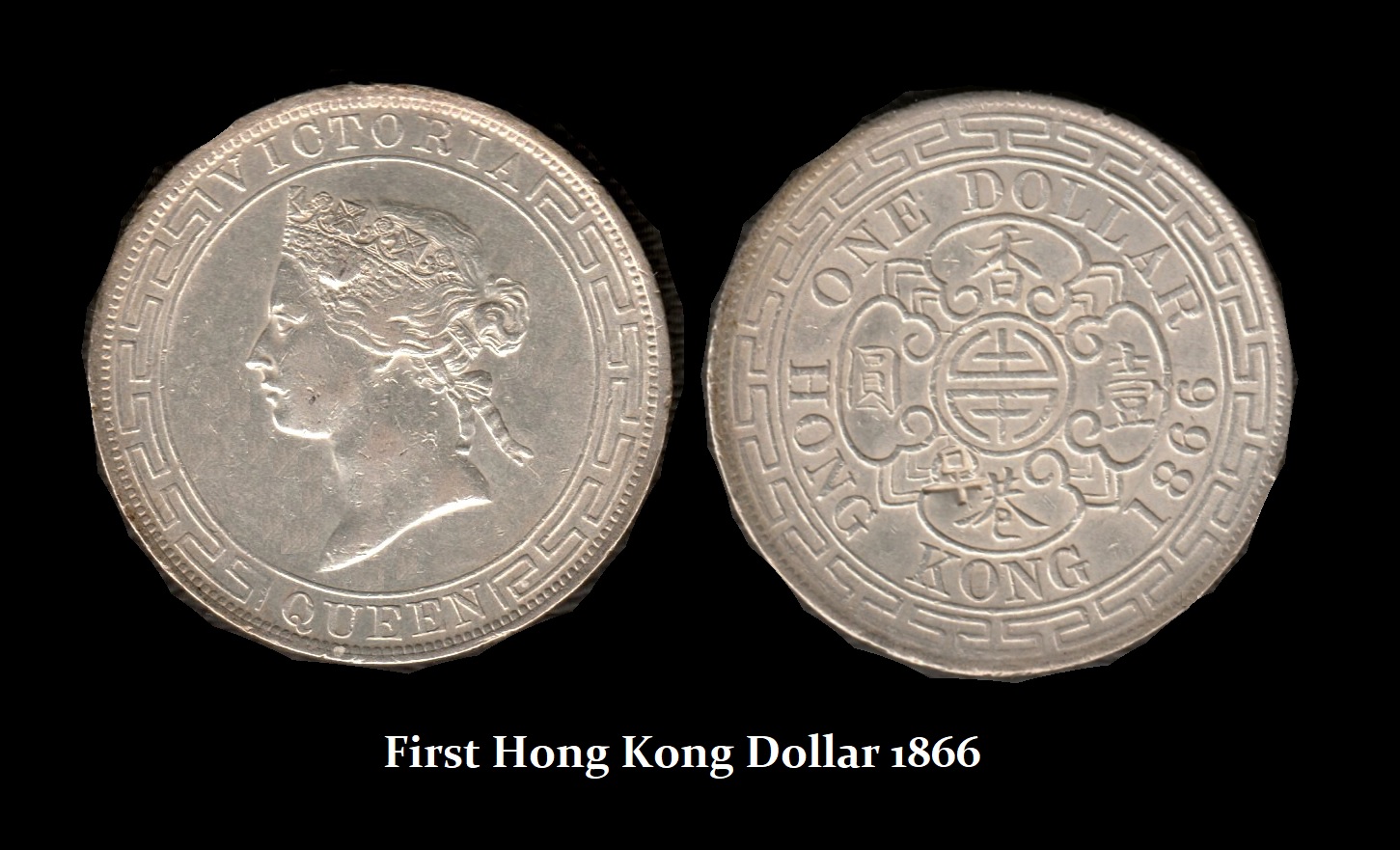
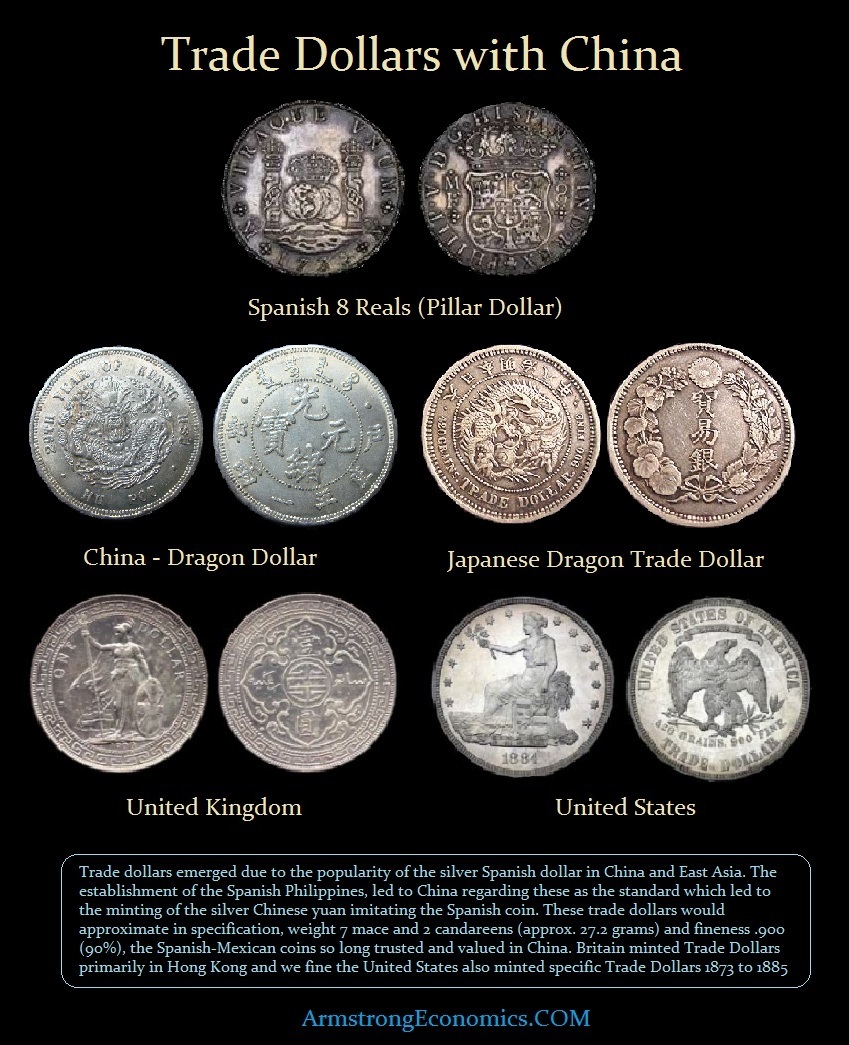
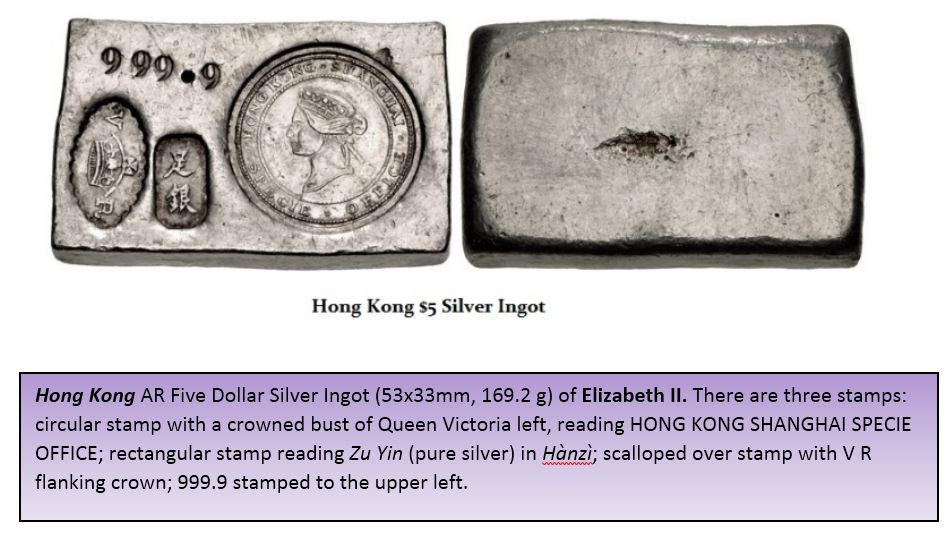
ANSWER: The entire world has NEVER been on the gold standard simultaneously. Asia was on a silver standard while the West was on a gold standard. Above is the first coin struck in Hong Kong in 1866 which was the Hong Kong Dollar. The West struck Trade Dollars during the 19th century to pay for goods from Asia and they were silver – never gold. Here is an example of both the British and American trade dollars used in payments particularly with China.


It is just not practical that we have a monetary system that is based upon a commodity. The true value of money is the productive-capability of its people. China, Germany, Japan, all rose from economic depression WITHOUT gold. They did it with the productive capacity of the people. The produce whatever and sell it to someone else and then get gold or whatever in return. This theory that you have nothing without gold is just stupid. It would mean that no nation could ever rise no matter how good their people are because they lack a natural source of gold.

The collapse of the Turkish lira is a reflection of the collapse in confidence in the government. The same has taken place in Venezuela. China and Japan rose from the ashes, not because of their possession of commodities, but because they could bring their people to bear and produce various items efficiently and cost-effective. It was the people first that produced the economic recovery and then they bought even gold.

HYPERINFLATION has nothing to do with the quantity of money – that unfolds when the CONFIDENCE in the government collapses. You cross that line from normal inflation all nations experience into the realm of a collapse in the faith and trust of government. This is HOW revolutions even unfold. They have nothing to do with the quantity of money.

India & the Emerging Market Crisis


India’s financial markets are in the throes of this Emerging Market crisis. The Mumbai-based Infrastructure Leasing & Financial Services (IL&FS) is an over 30-year-old infrastructure lending giant that claims to have helped develop and finance projects worth $25 billion in Asia’s fastest-growing economy. The company recently defaulted on debt payments because it ran out of cash. This is illustrating what we have been warning about. As interest rates rise and the dollar, the first casualty will be the Emerging Markets (EM). Because interest rates were driven to absurdly low levels in Europe and the USA, those who need yield ran off to the EM field.

Central Banks cannot manage the economies anymore. We live in a porous global economy. The Fed buying back 30-years bonds to lower real estate loan yields was absurd. The false assumption was that only American owned such debt. But the dollar is the reserve currency. That meant that more than 40% of such debt resided outside the USA. Central Banks can no longer manipulate the economy using the demand side economic models. They drove capital rushing into the EM sector desperate for yield – especially state operated pension funds.

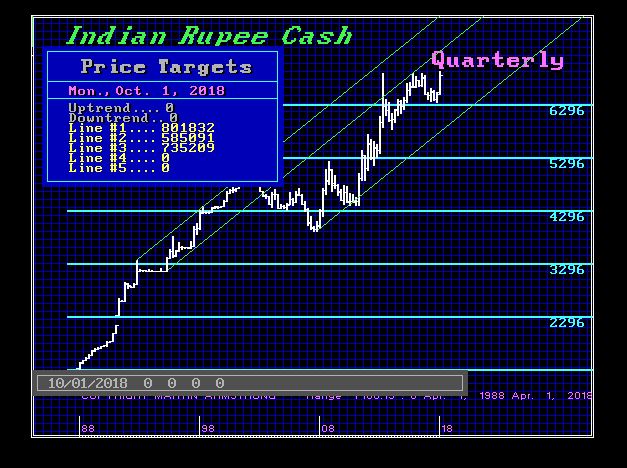
This is why we have a serious debt crisis on our hands. The greenback is STILL going to press higher against the rupee. Just look at the pattern. This is NOT an isolated high. We are looking at a significant rally still on the horizon for the dollar.

The Millennial Crisis


There is a serious economic crisis brewing that few seem to be paying attention. According to a new survey from Zillow Group Inc. (ZG – Get Report), approximately 22.5% of millennials ages 24 through 36 are living at home with their moms or both parents, up nine percentage points since 2005  which was 13.5% and the most in any year in the last decade. Between the student loans which cannot be discharged thanks to the Clintons (to get the support of bankers) even after they find that degrees are worthless when 60% of graduates cannot find employment with such a degree and the fact that taxes have escalated to nearly doubling over the last 20 years that is predominantly state and local, the affordability of buying a home has been fading fast. Despite the fact that millennials are eager to enter the real estate market, they’re bearing the brunt of the challenge directly caused by the combination of taxes and nondischargeable student loans.

Sixty-three percent of millennials under 29 cannot afford the cost of homeownership, according to a CoreLogic and RTi Research study. The expense, in fact, is their No. 1 reason for remaining a renter. In their research, they concluded that one-third of millennial renters reported feeling they cannot afford a down payment to buy a home. This is a sad response that is not being taken into consideration by governments. Where home prices have not risen sharply, taxes have. First-time homebuyers face ever-growing challenges to find and buy affordable entry-level homes as the economics of inefficient governments at the state and local levels have refused to reform and raise taxes to meet pension costs they promised themselves. California and Illinois are just two major examples at the top of the list. It is this net affordability factor that has begun to encumber sales of real estate softening prices and turning many millennials into renters rather than home buyers. Then add the rise creep up in interest rates and we have an economic cocktail of taxes that is beginning to kill the real estate market in a slow death drip by drip.

Taxes and the rise in interest rates will further erode affordability and is beginning to slow existing-home sales in some markets already. As this trend continues, home prices and mortgage rates over the next year will likely dampen sales and home price growth. There was another study conducted by Freddie Mac which also found that affordability challenges are contributing to a downtrend in young adult homeownership

IMF Warns Britain not Brussels About Hard Exit – Another Political Forecast


QUESTION: Mr. Armstrong; I have tracked the IMF forecasts alongside yours and it clearly appears that they are mimicking you very closely. However, something strange has taken place, for now, their latest warning it seems to be politically motivated. Lagarde warns that the U.K. economy will contract with a hard Brexit. Is this coming from you or is it political?

All the best

PB


ANSWER: Christine Lagard’s forecast or warning is political in nature. Stating that the UK economy would rapidly start to contract in the event of a disruptive exit from the EU next spring with a no-deal Brexit is really just absurd. This is political in nature and this statement itself reveals the political nonsense. Britain is the BIGGEST export market for German cars in Europe. A no deal would by NO MEANS only impact Britain. You would see Germany turn down hard as well.

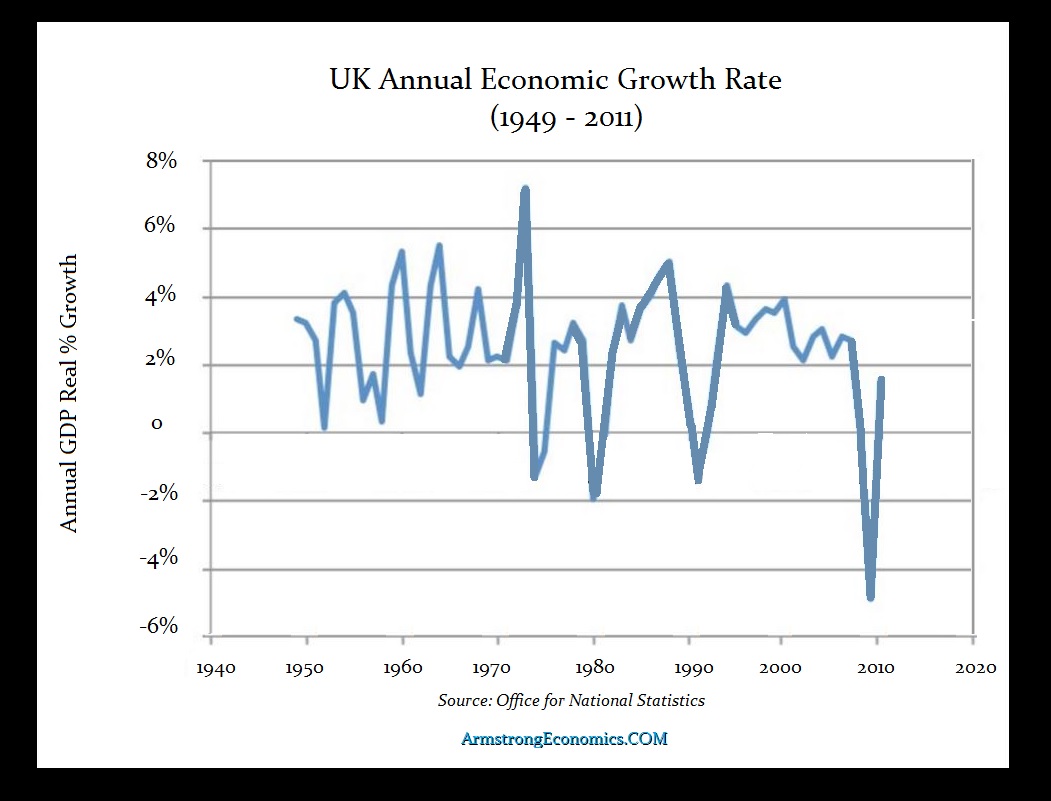
A BREXIT would allow the UK to cut its own trade deal with the USA and everyone else outside of Europe. As it stands now, whatever Britain wants is subject to vote in Europe and the French have a tendency to veto whatever Britain wants anyhow. All the evidence point to exactly the opposite of Lagarde’s warning. Whatever loss in trade with Europe that takes place will be more than offset with trade around the world. Britain has been in declining economic growth ever since it joined the EU. This entire issue of a hard BREXIT is taking place because Theresa May does not want to leave the EU personally and has sabotaged the entire effort placing the politics of Britain at risk as a whole by dividing the Conservatives, to begin with. Brussels is more interested in PUNISHING Britain as an example to prevent others from leaving because the Euro is their only power and if that goes, there go all the pensions for those in Brussels. This is NOT about what is good for even the German car manufacturers. This is now about protecting EU political jobs, not the people or the economy.

Directional Changes & the Worst in 40-Years


QUESTION: Marty; Your directional changes are amazing. They signal a change but it can be a turn as well as a sudden blast to the upside. You also mention that this is the worst you have ever seen personally in 40 years on the private blog. Could you elaborate?

Thank you for being here. There are a lot of us who are really grateful for what you are contributing. You show know that.

GR

ANSWER: Thank you. We are all in this together. This is not merely trying to pick the next trade. This is about surviving what is really unfolding.

To be a hedge fund manager, you have to look at the entire world compared to a domestic investment manager who operates exclusively in the domestic market and is oblivious to events externally. I get called in all the time into various crisis events around the world. They just need someone who can see the whole rather than has a myopic perspective. There seem to be few of us in such a position. Friends who have worked on desks at the banks internationally have just retired. It is not easy to do this sort of thing. I just have a 40-year track record and in the middle of a crisis, they really do not want someone who may have created the greatest quantitative model in history all in theory but has never actually been in the trenches. You are asking others to stake their entire career on your theory and you are wrong, they lose their job. So it gets hectic to say the least during times like this.

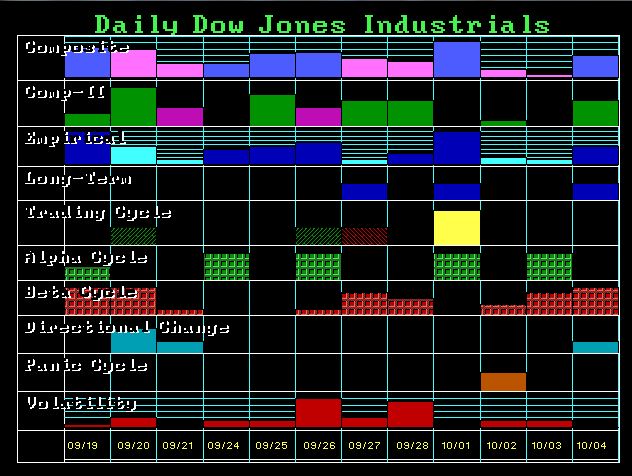
The Directional Change came today and yes it was a blast off. We opened in the Dow ABOVE the previous high which is an extremely bullish technical signal. A Directional Change can be a turn, but it can also be a launch pad. The Panic Cycle can also be a big move in one direction, but they are often outside reversals meaning that they can exceed the previous high and then penetrate the previous low.

Now, as to the comment I wrote today which has sparked a lot of emails. I wrote on the Private Blog ” Anyone who pretends they can forecast this based upon a personal ‘I think’ will be just luck or a fool. I have been an international hedge fund manager and analyst my whole life and this is the worst I have EVER seen in 40 years!!!!!!!!!!!!!!!!!!!!!!!!!!!!!”

There is complete political chaos everywhere you turn. This is not simply supporting or bashing Trump. We are fooling here with the very foundation of CONFIDENCE in the governmental system. Now throw into this cauldron the chaos politically in Europe. Stir in the insanity in Britain, the trade dispute with China, the Russian stupid sanctions, and what we get is complete chaos. Normally, capital flows have been logical. They fled to the USA for World War I and II. They fled the USA during the Civil War. Capital attempts to move away from uncertainty. What I mean as to this is the worst I have personally seen in 40 years is that we have uncertainty absolutely everywhere globally. There is no safe place for capital to hide. This is why we have seen a new record high in the Dow.


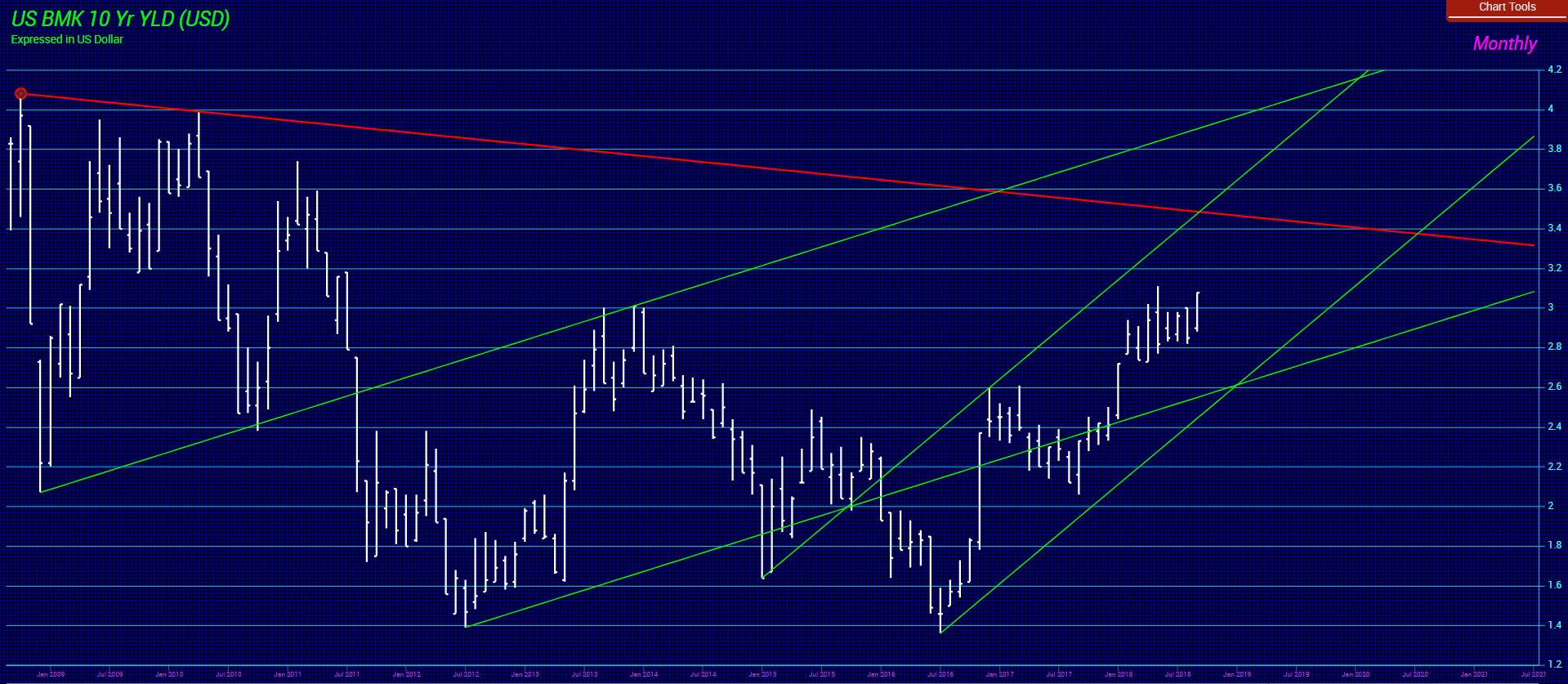
Add to this, the chaos our computer is showing in interest rates starting from October onward. On the 10-year yield, we have elected all four Monthly Bullish Reversals and that confirms a long-term change in trend which is really obvious at this point. A Quarterly closing above 3.16% and we are off to the races. We are looking at everything starting to get crazy in sovereign debt issues globally beginning in October. With the Dow Jones Industrials now making a new high for the year, the Fed will be looking more comfortable about raising rates to help the pension fund crisis that is brewing. So pay attention to interest rates in October!!!!!!!!

This is what the Reversal System was designed for. To be objective in the midst of total chaos and uncertainty. November is shaping up as a Panic Cycle in the Euro, not in the share market. In the Pound, we have a Directional Change and a Panic Cycle in October. The political risks around the world are just everywhere. This is also why we scheduled the WEC in November and just after the US elections. Personally, this is a real challenge. I cannot be everywhere around the world at the same time. The best we can do is watch the arrays and the Reversals. Just let the numbers speak for themselves. I warned that we had a Double Bullish Reversal in the Dow at 25800. Once that was elected, it has been off and running to new highs.

Boulders of Gold Discovered in Kalgoorlie


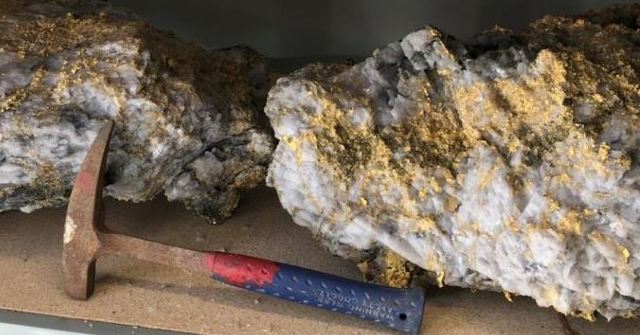
The Australian Gold Rush began in following gold discoveries at Coolgardie in 1892 and Kalgoorlie in 1893 located 370 miles (595 km) east-northeast of Perth. Once again, miners discovered two huge boulders with an extremely high gold content. Kalgoorlie is one of Australia’s most famous gold rush events because it was largely credited drawing people from around the world to search for the precious metals. Western Australia’s population grew from a meager 49,782 in 1891 to a booming 184,124 by 1901. In just those 10 years, the region became known as the Goldfields-Esperance region, often called the Golden Mile. It has typically been called in mining the most naturally rich square mile in all the earth.

Now we have boulders worth millions of dollars. The biggest one weighing 95kg and contains over 2,400 ounces of gold. The company has now begun to dig for gold they believe is worth at least $11 million. This is a rare find given this area was the center of attraction for gold miners.

The gold content of these rocks is very high. Some hope that they will lead to an even bigger discovery in the months ahead.

The Treasure Fleet that Sunk & Set in Motion the Decline of Spain


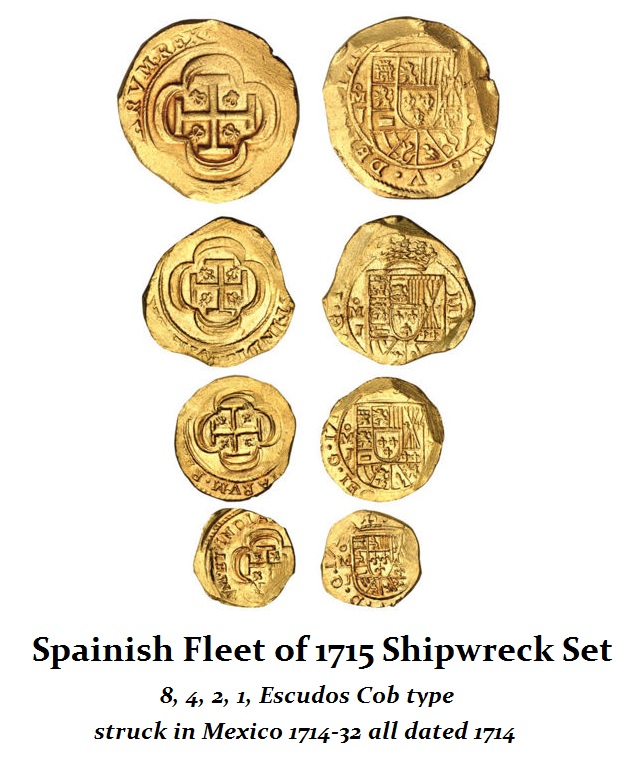
There is little doubt that Spain was once the Financial Capital of the West. Their discovery of America produced mountains of gold and silver to the point that they really impacted the European economy creating significant waves of inflation. However, there was the War of the Spanish Succession (1701–1714) which was why the famous Spanish Fleet that sank on July 31st, 1715 took place. This was a massive treasure fleet that remained in the New World until the war was over because the risk of being attacked by the British was too high. The British sought to prevent the Spanish from funding themselves for the war by preventing ships carrying gold to make it to Spain. The fleet was 11 ships and they are said to have been carrying not just gold and silver, but the dowry for the Queen called the Queen’s Jewels.

When the Spanish Colonial authorities heard of the great disaster, they responded from Havana and St. Augustine. Over 1,000 men died and the survivors were few on the beach. The authorities tried to direct their efforts at salvaging the galleons. By September 1715, some survivors were still at the camp on the beach. The Spanish authorities had turned the beach into a base of salvage operations. The Spaniards claimed that they were able to recover large portions of the treasure. This may have been a tactic of the Spanish exaggerating the amount of the recovery to deter others. Nevertheless, there were pirates were responding to the wreck perhaps even as fast as the Spanish. One English privateer named Jennings was a very successful pirate in early 1716. Given the vast number of coins that have still been recovered, obviously, the Spanish never recovered any significant portion.

The War of the Spanish Succession was a European conflict of the early 18th century that was triggered by the death of the childless Charles II of Spain in November 1700. His closest heirs were members of the Austrian Habsburg and French Bourbon families. With the riches of the New World at stake, who would rule Spain was a major economic prize. This also was a critical issue in changing the European balance of power. Charles II had actually left the undivided Spanish monarchy to Louis XIV’s grandson Philip of France who was proclaimed King of Spain on November 16th, 1700. Disputes erupted over the separation of the Spanish and French crowns. In reality, in an effort to regulate the impending succession there were three principal claimants, England, the Dutch Republic, and France. During October 1698, they signed the First Treaty of Partition. They all agreed that on the death of Charles II, Prince Joseph Ferdinand, son of the elector of Bavaria, should inherit Spain, the Spanish Netherlands, and the Spanish colonies. They also allocated Spain’s Italian dependencies would be partitioned between Austria which would get the Duchy of Milan and France Naples and Sicily.

Then in February 1699, Joseph Ferdinand died. Now a second treaty was drafted and signed on June 11th, 1699, by England and France and in March 1700 by the Dutch Republic and Spain. Leopold, however, refused to sign the treaty and demanded that Charles receive all the Spanish territories intact. Therefore, we see the contest between the Bourbons of France and Spain against the Grand Alliance. Bavaria joined France in September 1702 while Savoy and Portugal joined the Grand Alliance with Austria, whose candidate was Archduke Charles, the younger son of Habsburg Emperor Leopold. This led to war breaking out in 1701.

By 1710, fighting was really at a stalemate. France was unable to conquer Italy and the Low Countries. Philip V was the secure ruler in Spain. When Archduke Charles unexpectedly succeeded as Emperor Charles VI in 1711, Britain effectively withdrew. This then forced the Allies to make peace which produced the 1713 Treaty of Utrecht, followed in 1714 with Rastatt and Baden. With the British withdrawing and peace was restored, then Philip V could be confirmed as King of Spain and, in exchange, he renounced the French throne. The European territories were divided between Austria, Britain, and Savoy. Britain emerged as the key European maritime and commercial power overshadowing the Spanish and the Dutch.

Spain had borrowed heavily for this War of Succession because it could not risk bringing in its treasure fleets. Spain had become a serial defaulter beginning in 1557 followed by 1570, 1575, 1596, 1607, and 1647 ending in a 3rd world status. The loss of the treasure fleet of 11 ships in 1715 was a crushing blow to Spain. The lost of the 1715 Treasure fleet reduced Philip V to the status of a beleaguered monarch. Philip V had badly needed all the gold and silver to pay loans. The New World wealth that had made Spain a world power in the 16th and 17th Century had now become a fraction of what it once was. Spain’s role in world affairs declined in proportion with the loss of the 1715 Treasure Fleet.

Nobody has yet found the gold, silver, and jewels that were designated as part of the dowry for his new 22-year-old wife. He had married Elisabeth Farnese of Parma by proxy in 1714 and was still trying to make a good impression on the reluctant lady. Her dowry was to be the greatest of any queen in Europe. More than 1200 pieces of rare jewelry were said to have gone down with the fleet. She was demanding that her dowry be the greatest in Europe. She requested a heart made of 130 pearls, 14-carat pearl earrings, a pure coral rosary with large sized beads and an emerald ring weighing 74 carats. The Queen’s dowry was reported to have been stored in the personal cabin of the Fleet’s senior officer. She gives a new meaning to the term “gold digger” and no doubt was a woman worthy of the title – high maintenance. Of course, they were never marriages for love or even physical attraction.

The loss of the 1715 fleet immediately resulted in the debasement of silver coins which began in 1716. The Spanish mints flooded Spain with debased silver based on the real sencillo of 3·067 g, containing 2·556 g silver. These silver coins were called plata provincial. The silver minted in America was now officially called plata nacional, but was also called plata vieja (old silver) or plata gruesa (heavy silver), and occasionally plata doble (double silver).


British Economy Booming After BREXIT


COMMENT: Marty; You are not only the only person to forecast BREXIT, you also said the British Economy would do far better after BREXIT. There was absolutely nobody that agreed with you. I read every bank report in the city and every single one said the British economy would take a nose dive in the Thames. Well, all the official numbers are out and they have all proved Socrates to be an astonishing tool.  No wonder Maggie loved you.

HWM

REPLY: Yes, a good friend of mine who has a retail business there disagreed with me and said he would probably have to move to Frankfurt. He said that after the vote. I spoke to him last week and he said he reduced his staff in Zurich and hired more people in Britain. When I asked why? He responded it was half the price.

The numbers have shown that pay growth for British workers has “unexpectedly increased at the strongest rate for three years amid the lowest levels of unemployment since the mid-1970s” wrote the Guardian. It is because Britain is getting out of the EU which has been the most damaging to Britain’s economy because it gets the short stick on every negotiation. I cannot think of even one dispute that Britain has EVER won in the EU court. The typical idiom Fool me once, shame on you; fool me twice, shame on me, in the case of British politicians it should be Fool me once Ok you got me; Fool me twice alright shame of me; Fool me again, I must be just an idiot so no worries I will never figure it out anyway. I do not know how many times the numbers show joining the EU was a VERY, VERY, VERY, stupid idea. Europe has always hated the Brits. The French view if Napoleon won at Waterloo, then the world would be speaking French not English.


I have shown this chart to several UK politicians. They were surprised, but still never used it publicly.  If you just put aside all the opinions and what-ifs, just look at the numbers, you may begin to see the light.

Secretary Wilbur Ross Discusses Florence and the Economy….


Secretary Wilbur Ross is in North Carolina today touring the NOAA facility and listening to projections of how long Hurricane Florence may disrupt rail, road and shipping transport.  Mr. Ross then calculates the economic impact.