Illinois Supreme Court Rules Against Pensions


The Illinois Supreme Court has used STRICT CONSTRUCTION to defend the State against State Employee pensions that have been bankrupting the State. Previously, back in 2014, the  Supreme Court ruled that health care benefits provided to state employees were a “permanent benefit” guaranteed by the state constitution. That has led to a complete disaster as healthcare costs have risen out of control thanks to Obamacare, which handed insurance companies more money and a monopoly status that everyone had to have insurance even the y7outh who never used it.

Those health care costs are destroying the fabric of the entire economy pushing pension costs over the top. The Supreme Court is mindful of the disaster he caused with its 2014 ruling and they have been obvious under political pressure to reverse it. They figured a way to do this using STRICT CONSTRUCTION. Therefore, the benefit cannot be greater than what was expressed in the statute. Consequently, they now delivered a six-word ruling on Thanksgiving eve refusing to hear the retirees’ appeal of a state Appellate Court ruling that essentially upheld Mayor Rahm Emanuel’s now-completed, three-year phase-out of retiree health care coverage.

The Supreme Court magically taketh away with one hand what the previous hand gave.“For the city, this is a huge benefit. The amount in government pensions for health care is dropping from $137 million a year to between $7 million and $8 million. Effectively, The courts have now held that you cannot rely on anything the city tells you unless you can prove that person had authority to bind the city.

In December 2015, the court ruled that the city employee pension funds have an obligation to provide and subsidize retiree health care with funds provided by the city, but only at levels outlined in 1983 and 1985 amendments to the state’s pension code. That is the key. The statue only guaranteed subsidy amounts to $55-a-month for police and fire retirees not eligible for Medicare and $21 for those who are. For retirees covered by the Municipal Employees and Laborers pension funds, the guaranteed monthly subsidy amounts to just $25. The explosion in health care insurance which Congress has done nothing about is undermining the pensions and will explode in crisis resulting in civil unrest over the next 5 years.

Courts are put in place by politicians. When ruling will go against the government, judges are word-smiths. They know how to ignore the law when they must. This is all part of how the system collapses. Once the Rule of Law fails, nothing will SURVIVE. It is time to turn out the lights.

Renminbi v the Dollar


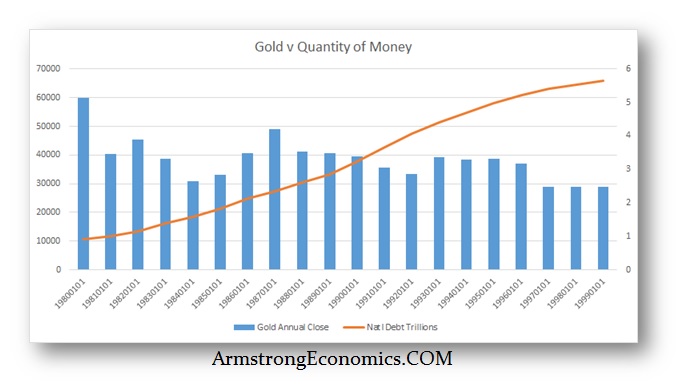
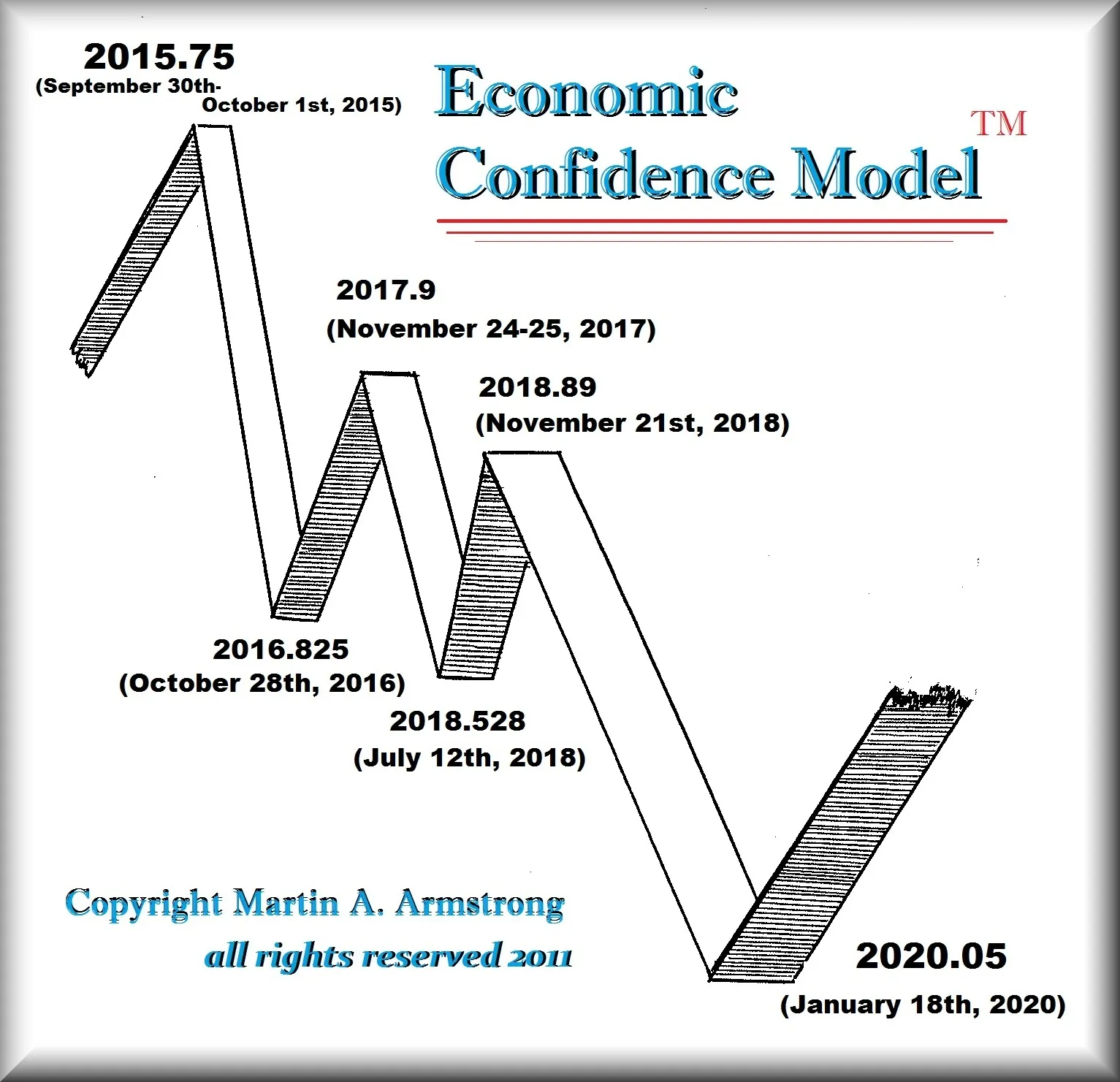
The dollar haters have been touting that the Chinese yuan, or otherwise known as the renminbi, would kill the dollar and gold will soar. I have warned that China will take the spotlight as the Financial Capital of the World once again but only after 2032. A real assessment of international capital flows reveals the truth. The Chinese renminbi accounts for only a share of 1.85% share of the international cash flows. In fact, the renminbi’s global share has declined from nearly 2.5% of total global capital flows in 2015, for that was its peak in September 2015 actually on target with the Economic Confidence Model. So despite all the fanfare, China has entered a decline since 2015 – not a rally to kill the dollar.

gold-natl-debt-quantity-of-money

The Beijing government has opened foreign capital markets in recent years. Since 2016, China’s currency has officially been the fifth world currency of the International Monetary Fund alongside the dollar, euro, yen and British pound. That was supposed to kill the dollar. That had zero impact contrary to the dollar haters who concoct endless scenarios to paint the picture of the end of the dollar. One has to wonder why people continue to read these people. They have NEVER been right. They have used the scare-tactics that increasing the money supply would devastate the dollar and create hyperinflation. Another failed scenario. They there was the one about China was going to trade “real” gold, not paper futures as in New York COMEX. That one was supposed to kill the COMEX and everyone would rush to China. Well, that did not happen either. They lack any comprehension of how the world functions and were blind to the fact that by starting with gold trading in yuan, it was a tiny test market for the floating of the yuan itself. It would allow arbitrage between New York and China yielding the next difference being the yuan. Buy gold in China and sell it in New York, and the difference is the currency. So they got that one wrong and the both the COMEX and the dollar managed to survive.

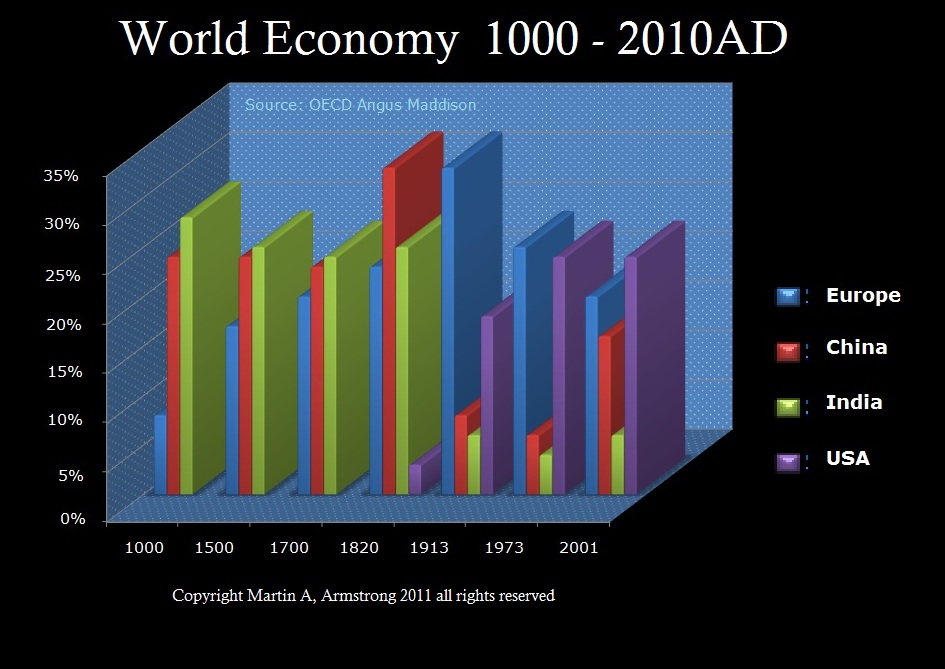
There continues to be a willingness of Chinese policymakers and business leaders to help shape the currency, which is the world’s second-largest economy. For example, the Chinese will soon offer oil contracts in yuan as well and all of this is an indirect way of floating the currency. This willingness on the part of the Chineses government is why it will take time, but their economy will become the biggest in the world after 2032. What makes the US economy the biggest? The American consumer and lower taxes than Europe. When you leave more money in the hands of the people, they spend it creating jobs for everyone. Europe is following Marx. They think the government is better equipped to spend other people’s money. That produces corruption, not economic growth.

As long as China keeps its tax rate low and allows the people to spend the benefits of their labour, then it will continue to rise to displace the West and they are blinded by power and pursue this Hunt forever more Taxes.

Middle East Heating Up


An attack on a Mosque in Egypt has left 235 dead. The assault even opened fired on ambulances taking the wounded to the hospital. Meanwhile, the war of words between Saudi Arabia and Iran are heating up. Saudi Prince Mohammad bin Salman compared Iran’s supreme leader Ayatollah Ali Khamenei to Nazi dictator Adolf Hitler. In return, Tehran has responded saying that with regard to the Crown Prince:  “No one in the world and in the international arena gives credit to him because of his immature and weak-minded behavior and remarks.”

Tensions in the Middle East continue to expand.

ECM Turning Point this Weekend


The Turning Point on the ECM is this weekend. We do happen to have a Directional Change next week in the Dow with the next turning point due the week of 12/04 and that is followed by the week of 12/18. What is most curious, is the fact that the Dow, Euro, Gold, and Oil all have the same timing targets, with oil showing the week of 12/04 is the strongest.

We are witnessing the global markets beginning to align. This is implying that international expectations are starting to dominate domestic or isolated market fundamentals.

We do not expect this turning point to be a monumental one. What this reflects is the markets are starting to align preparing for 2018 and the beginning of a new round of fun and games.

EU Concern Rising About Italian Debt


The EU Commission is deeply concerned that Italy is under pressure to spend frivolously because of the upcoming elections. The EU is apply more scrutiny for Italy’s huge sovereign debt. Because of the vast size of the Italian economy, the high level of total debt is a major cause for the Eurozone as a whole. The EU Commission sent a letter to the Italian government warning them not to deviate from the course of fiscal consolidation before the parliamentary elections in the spring.

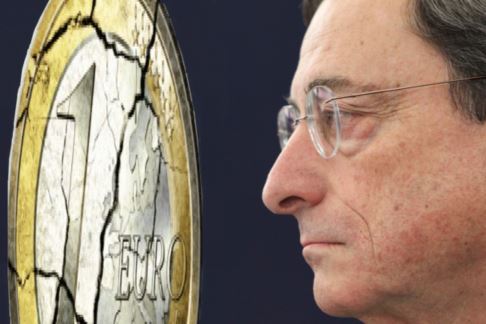
Instead of creating simply a trade union, the idea that a single currency would save the day has seriously distorted reality. This idea of surrendering sovereignty by each member state to maintain a single currency if the worst possible design. Had the EU consolidated the debts and thereby created a federal EU debt, then each member state would have been responsible for themselves. In the USA, we have 50 states issuing debt in dollars, yet they have no part in the dollar. Had Europe consolidated the debts and drew the line in the sand at that moment, then states would be able to issue whatever debt the market would accept. This way, Brussels imposes austerity upon member states simply because they failed completely to comprehend the nation of the system they were creating.

Fed Admits it Does Not Understand The Markets


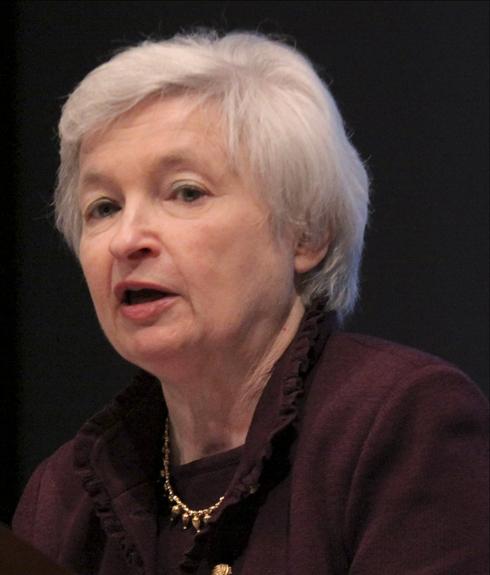
COMMENT: Mr. Armstrong; I must congratulate you on a fantastic conference. You explained that the central banks were clueless and that the Quantity Theory of Money was wrong and was being misapplied. Your Vertical Market Report explain that there were two types of vertical markets and nobody has ever discussed. Then this week, the London Financial Times reported that your head of the Fed, Janet Yellen, publicly admitted that the US Federal Reserve can not explain the development of inflation rates in the US this year. I was really taken back for you said exactly that at the conference.

You really do know what is going on behind the curtain.

Well done

Cheers

KT

REPLY. Yes, I am aware that Janet Yellen admitted on Tuesday that she does not understand the comparatively low rates of inflation, according to the Financial Times. This confirms what I have been saying that there are fundamental questions regarding the use of monetary policy of the central bank and the Quantity Theory of Money. The theory does not function as touted and it has been proven to be another myth along side rising interest rates causes the stock market to decline.

All of these theories have been created by attempting to create a single dimension cause and effect. There is much more complexity at stake which is just never taken into account. I went into great detail in the How to Trade a Vertical Market report to show WHY such booms and busts take place and they cannot be attributed to a single theory or monetary policy of the central banks. Such events took place long before there were even central banks.

German Property Market – A Real Estate Bubble?


Asking €747,000

QUESTION: Possible Correlation with ECM-peak in Nov. 2017? Mr. Armstrong, just today I became aware of your story and your life’s work. Your theory is captivating, especially in the light of a series of unsettling changes in my work environment. All of this near Nov. 24-25, a predicted turning point within your ECM forecast. I am a self-employed agent, working mainly on behalf of a … German finance [company] which specializes in selling mortgages for public housing projects ….

Since it´s foundation … [we] operated with a strict lending limit of 80%. Upon so-called “customer-demand”, those limits have now been raised to enable 100% lending at almost the same interest rates (Nov. 9. 2017) while additionally allowing fixed interest rates for 25 years and amortization terms up to ca. 40 years. I have seen even more outrageous offers from competitors. These factors, combined with the unnaturally low-interest rates caused by the ECB, enable almost every household to acquire a house of one’s own.

However, these amortization terms fail to include future investments and a possible future increase in interest rates. In my opinion, households with an average income have a high risk of debt overload or at least a risk of constantly living in debt. It seems to me as if the public model of never repaying one’s debt is slowly being transferred to the private sector.

My observation might just be a small part of the picture, probably a peak in one minor cycle you observe. Yet it does make me feel uneasy, for this peak correlates with your next predicted ECM turning point. Although the public opinion states the opposite, I fear a massive housing bubble on the German market. Even minor changes in interest rates or household income could cause substantial problems for the average homeowner.

I would very much like to hear your thoughts on this subject. Please excuse my rusty English, I did not have practice for a very long time. Thank you in advance for your response. Also, I want you to know that I have the highest respect for your resolve in those times of imprisonment.

From Germany, FW

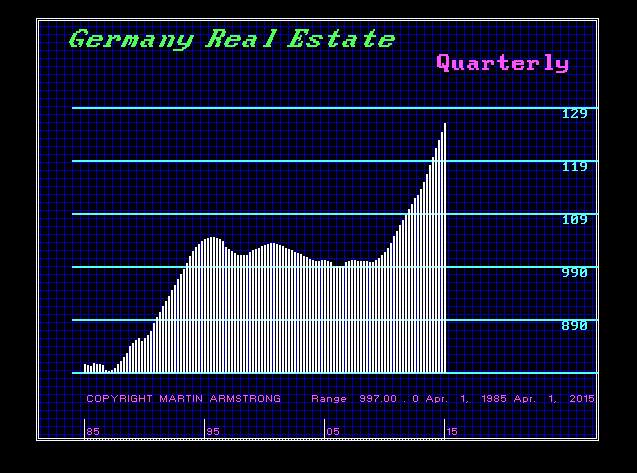
ANSWER: Unfortunately, Germany has allowed its own housing bubble not much different from the USA that burst in 2007. Normally, like fashion, things tend to start in Europe and then migrate to the USA. In the case of real estate, the value of property in areas such as Bavaria was very cheap compared to international levels. The market has been rising since 1996. Even back in 2015, Sparda Bank (http://www.sparda-bw.de) was offering just over 1% fixed rate mortgages for 10 years.

Our timing models do suggest that there is a pause in the trend due here in November (4th quarter). There should be a decline of softening in the market going into the first quarter of 2018. Thereafter, the trend will shift and the next big turning point will be the 4th quarter 2018.

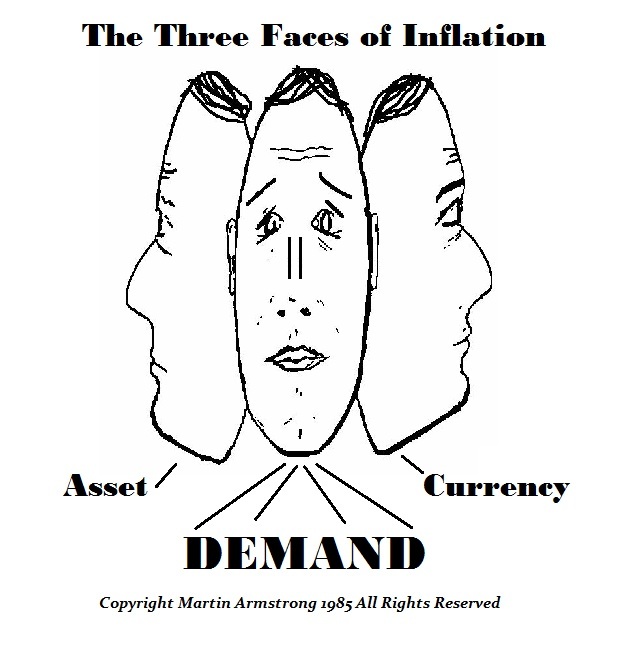
The risk of fixed rates even out now for 25 years will not be on the back of the home-buyer. That risk will belong to the lenders. Yes, the ECB with its negative rates has caused tremendous distortions in the debt markets. They were unsuccessful in creating inflation or expanding the economy. What they have created is asset inflation, which does not show up in the economic statistics as they are focused upon by the media.

The central banks are focused on DEMAND inflation. That has been defeated by any expansion in the money supply is sterilized by a net rise in taxation. Consequently, the consumer is buying assets and hoarding cash. They are not spending it frivolously in dinner, wine, cloths, and song.

The risk to the borrower will be the rise in taxation that then eats into their disposable income. Lending 100%+ to buy houses is insane. Those who have no equity are highly prone to default. As this group defaults, they increase the supply of property coming to the market and thus all prices are suppressed. This is the process that creates the major high in REAL TERMS.

The homeowner who has equity will lose short-term. However, the euro will crack and in this regard, a low FIXED rate mortgage that they can maintain will be a HEDGE against the currency. The market will shift from asset inflation and cross-over to currency inflation.

Nonetheless, in terms of INTERNATIONAL VALUE, the market is peaking now in November. Housing prices have risen to world standards so the foreign capital will back off and not see this as cheap anymore. As the euro declines, then the property in real value terms globally will also decline.

Are We Losing the Training Ground for Trading?


COMMENT: Dear Mr. Armstrong,

Really glad that you again warn us of impending famine moving into 2020 – 2030 and give us ample time to prepare though many still do not believe in your forecast. Your blog have done a great service to humankind.

Also pertaining to your recent article pertaining to skills needed to be a successful traders or fund managers. I tend to agree that going against majority view at important turning points require nerve of steel to pull the trigger. Not many can do it as emotions can overwhelm our decisions. Being a fund manager myself, I find that how we perform and react during bear markets, crisis and panic moments will distinguish me from others (my peers). During rising tide, our performance mask our real ability to handle crisis.

As you say, life is a journey of learning. Socrates provides a valuable tool for my investing journey while your blog helps in allowing me to view the world in different dimensions. I do make mistakes along the way but thank God I become a better investor as day goes by.

Regards,

SS
Malaysia

REPLY: Yes. Funds that are just a buy and hold are not traders. The regulation also creates much of the problem. Because we have the CFTC and the SEC, these two agencies do FAR MORE HARM than good. They each have their own lobbyists to retain and expand their power. I was once offered a fund to manage in the USA with $50 billion+. The problem that confronted me was the blunt fact it was a buy and hold affair. Because it was equity, it would come under the SEC. I would not be allowed to hedge using futures greater than 15% at the time or else I would then violate the CFTC rules and cross into a futures fund. This was all because of a turf war between the two agencies. In other words, if I saw an imminent crash, I could not protect my clients by hedging more than 15%. You had to sell outright everything, which would then also raise red flags. I turned down the offer for I felt my reputation would be destroyed because I would have to suffer a serious loss and could not prevent it. That was while hedge funds were created offshore because you could not trade everything do to regulation to create government jobs rather than provide the best management service for investors.

Because of the regulation, the field is dominated by buy-and-hold managers who have no real trading skill because they were never allowed to trade. Then you have exchanges closing the floor pits and going all electronic. It was the floor trading that forged the souls of traders. You could smell the blood from the screams on the floor. Today, that is reduced to just flashes of light. Actually trading with other people is who you learned to trade. Dealing Rooms were set up with everybody on one floor – not in cubicles. You heard the phones ringing on every desk when the markets were hot. It was that interaction that made great traders. Eliminating that human interaction makes me wonder if we are not losing the core of understanding markets.

NAFTA Round #5 Reaches Impasse on Critical Auto Sector – Canada/Mexico Balk At Rules of Origin…


$64 billion of the current annual trade deficit with Mexico stems from the auto sector alone.

For over a decade auto manufacturers have moved to Mexico in order to import parts from Asia, assemble and install them, and then ship the completed cars into the U.S. through NAFTA without duties (tariffs).

The U.S. auto ancillary business groups (parts suppliers) have been pushed out of competition in the auto sector by this corporate profit strategy.  Thousands of U.S. jobs have been lost in both the plant assembly and the ‘auto-parts’ manufacturing sector.

CTH has called attention to this bastardized supply chain for years.  Foreign auto-parts, made by foreign workers, assembled into U.S. owned manufacturing, and sold as U.S. automobiles. The weird supply chain and assembly process is essentially a multinational corporate scheme (in the auto sector) which exploits one of the loopholes in the 25-year-old NAFTA agreement.

If the assembly plant was on U.S. soil the foreign (mostly Asian) parts would be taxed as imported parts.  However, so long as the assembly is in Mexico (or Canada), the origin of the parts is currently irrelevant, and the finished automobile crosses the border into the U.S. avoiding the taxes using NAFTA.

Keep in mind, the auto manufacturing sector, not just U.S. assembly plants but also European auto-makers, have made capital investments into Mexico, based on this NAFTA loophole as part of their business model. They don’t want this cost/profit plan disrupted.

Along comes U.S. Trade Rep. Robert Lighthizer and U.S. Commerce Secretary Wilbur Ross and say: NO MORE.

If you are going to consider it a North American Free Trade Agreement vehicle,  then an established percentage of that vehicle should actually have to come from North America; just as importantly, that percentage should be high.

That’s the basic argument behind the “rules of origin” part of NAFTA. If you are going to call it a “North American vehicle”, then the parts should come from North America.  Makes rational sense, no?

The U.S.A. position is that half of content for ‘American-built’ autos should be produced in the United States; and the regional (NAFTA) vehicle part content requirement should be increased to 85 percent from the current 62.5 percent.

Mexico and Canada do not want rules of origin because they want to use their workers to assemble vehicle parts from other nations and sell into the U.S. as “American Autos”.  They correctly fear that if American cars must actually contain American content, and be assembled by actual Americans, then the American Auto-Manufacturers will move their auto plants to America.

The auto-industry, who have invested tens-of-millions in the current scheme, wants to keep the entire source of origination a hidden secret from the public.  They are not too keen on American consumers finding out that Japanese, Chinese, Indonesian, Korean and Vietnamese parts are actually behind the American badges.

Additionally, the European Auto-Manufacturers who are also building in Mexico and Canada don’t want to lose the NAFTA loophole that lets them assemble outside the U.S. and get their vehicles into the American market.

The current system employs lots of Mexican and Canadian workers who assemble foreign parts into American vehicles that are then sold into the U.S. as “American Cars”.

If “rules of origin” are forced upon them, there’s no incentive -beyond labor- for the U.S. auto corporations to continue making cars in Mexico and/or Canada.  Simultaneously, the vast majority of the assembly is now automated (with human assistance), so the labor costs are currently smaller as a percentage of the overall cost of manufacturing.

Automation and modern efficiencies in human assisted robotics mean the labor cost incentive is not as valuable as it once was for manufacturing.  In the modern auto-era it’s the quest for cheaper parts that is now driving the business model; hence, the “rules of origin” exploitation.

MEXICO CITY (Reuters) – Canada and Mexico will rebuff the United States over its demand for tougher NAFTA automotive content rules, top officials said on Monday as negotiations to renew the treaty bogged down with only a few months to go.

[…]  Canadian and Mexican negotiators will address the U.S. auto demands on Tuesday, the final day of the fifth round of talks to update the North American Free Trade Agreement, chief Mexican negotiator Ken Smith told reporters.

Although the talks are due to wrap up in March 2018 after a seventh and final round, they are deadlocked over a series of hard-line proposals the United States unveiled at the fourth round last month.

“It’s definitely slowed down from the previous round,” said a Canadian source with direct knowledge of the talks. “There has been no progress in the contentious chapters.”

Canadian and Mexican officials have complained repeatedly about what they see as U.S. inflexibility. A spokeswoman for the U.S. Trade Representative declined to comment.

Mexico and Canada fear Trump will follow through on a promise to pull out of NAFTA, causing disruption and economic damage. The Canadian dollar edged lower against its U.S. counterpart on Monday, in part because of concerns about the negotiations. (read more)

This is where we must fight the lobbyists.

You must remain engaged and understanding of the issues within these and other trade disputes.  President Trump is wearing the bullet-proof vest, but you must engage your congressman to let him/her know you support the administration and their objectives in these Trade deals.

Your congressional representative is being lured with millions of millions of dollars from lobbyists who work for the multinational corporations.  They will try to retain their financial position.  YOU must educate yourself and your family on these issues.

Together we must engage and fight.  This is the president we have been waiting for.  Don’t expect he can do this on his own.  Make your voice heard.

Will Spain be the First to Default on Pensions?


The Pension Crisis is brewing rapidly and we will begin to see this make headlines much more so around the world. There is hardly a country not in trouble (Norway the exception), where pensions are underfunded as governments have relied upon tax revenue. As the crisis in Spain brews, it will be the pension crisis there which blows the lid off of the entire problem. The Spanish pension system is moving rapidly toward a major crisis threatening its collapse. The Madrid government needs to issue debt to close the huge gaps as, without new debt, the pension crisis would have a meltdown this year. The question becomes when will buyers of debt realize that it is not even backed by economic growth.  This is similar to a person without a job borrowing from the bank just to pay the rent. What governments have done in the management of pensions is criminal for anyone in the private sector.

Spain faces a major social crisis as we cross the threshold of 2018. The situation keeps getting worse by the day. For years, the Spanish government, like so many others, has been using funds from its pension reserves to finance expenses elsewhere in the budget ever since 2012. Billions have been used to offset the widening deficits in the welfare system. Consequently, the pension fund has collapsed from 66 billion euros in 2011 to only about 15 Billion euros in 2016. At this rate, Spain goes into default in 2018. The crisis materializes when those who buy debt suddenly see there is no possible way to repay the debt from future revenues. A default becomes possible when there is NO BID for new debt.

This is how it will begin. The peripheral economies will go bust and then a contagion begins as traders look around and say –OMG! They are all the same!