Norway – the Confusion in Trend


QUESTION: Dear Mr. Armstrong.
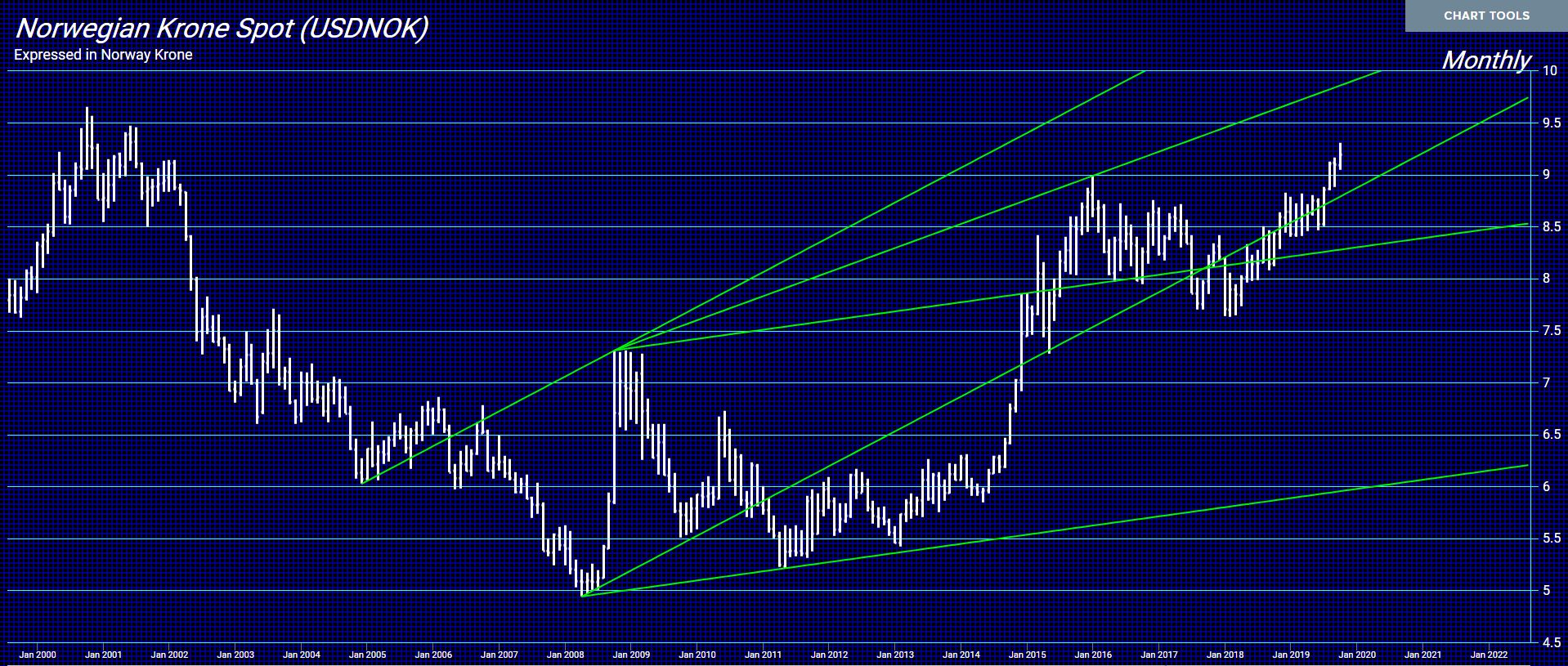
Does Socrates have an explanation of what is happening to the Norwegian Kroner? All the financial newspapers and banks here in Norway are scratching their heads and don’t have an explanation of why it’s devaluating against the Euro and Dollar. The central bank of Norway has an interest rate of 1.50%, while Euro has an interest rate of -0.5%.
BT

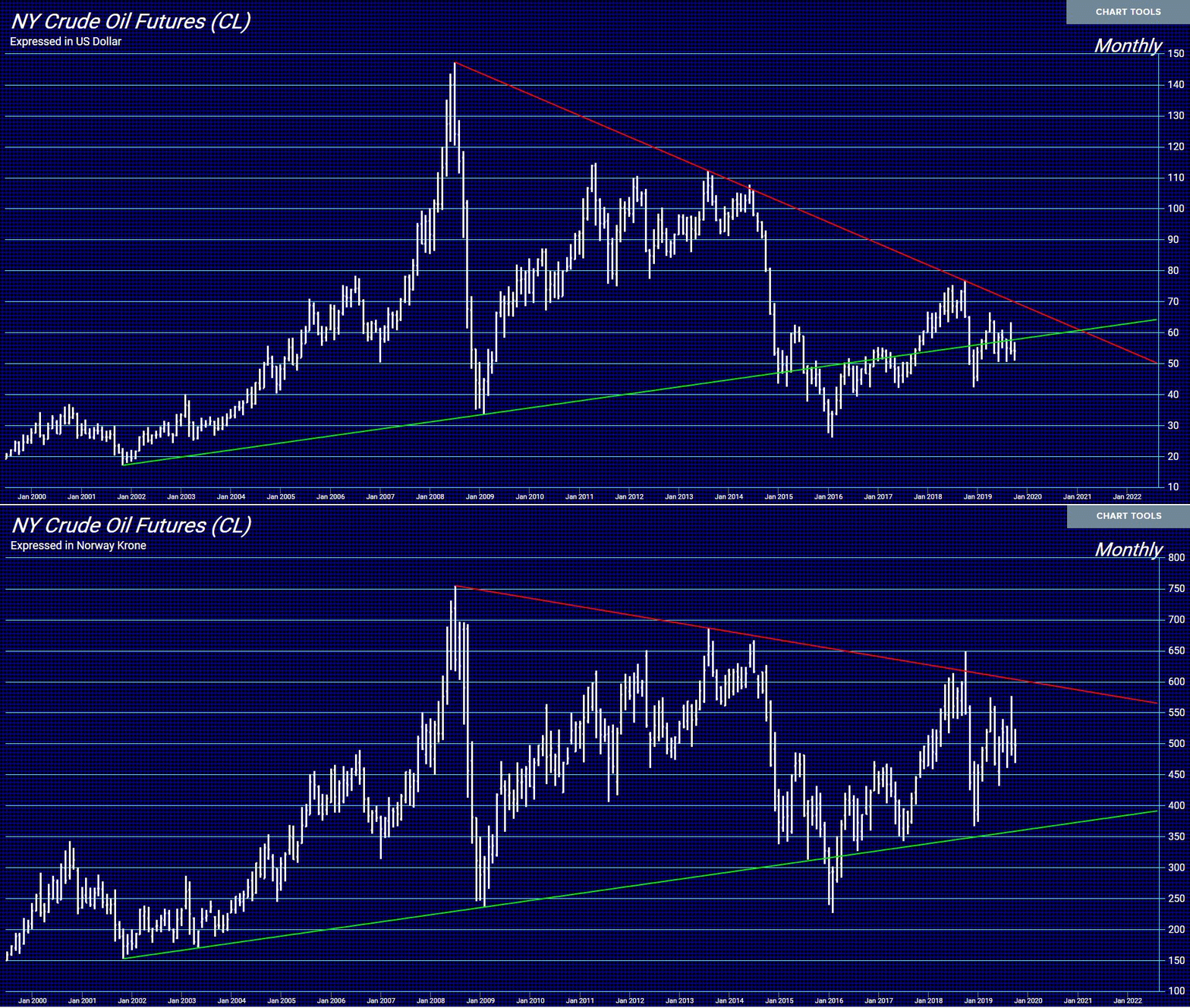
ANSWER: Norway’s currency has been declining recently over concerns with regard to the US-China trade dispute given the fact that it is highly exposed to the US-China trade situation. Additionally, the sharp decline in crude oil prices has also impacted the currency given the oil and gas industry accounts for more than 1/20th of Norway’s gross domestic product and about 2/3rds of its exports. Therefore, Norway’s economy has been highly correlated with oil prices.

Nevertheless, in Korona, the price of oil is rising given the decline in the currency (click on the image). The analysis never looks at everything from an international perspective. Your currency is retesting the 2000 high in the dollar.

Mortgage Backed Securities Still Defaulting – Bad Omen for Real Estate?


During the last Mortgaged Backed Security scandal which undermined the entire world economy, they created mortgage modifications which enabled millions of delinquent homeowners to avoid having their home foreclosed. Since 2007, it has been estimated that some 8.7 million permanent mortgage modifications were created. There are still over $800 billion of these bubble-era loans outstanding. How were they allowed to survive? For at least the past five years, between 75% and 95% of all mortgage modifications have taken the past interest due that was in default, included it in a capitalization of interest arrears, which means the resolution was never for the benefit of the homebuyer.

By adding the past-due interest, they have been paying interest on the interest. This failure to address the issue by some partial debt forgiveness with respect to prior interest means that the mortgage crisis has been simply postponed. If a new financial crisis hits, the old one will simply be sent off into foreclosure and real estate values can still plummet even more in the low-end of the market.

Barrons did a good review of the problem. They came to the conclusion that re-defaults will be more likely as home values fail to get back to par and these people will just walk away. Indeed, the resolution should have been the forgiveness of past-due interest. Then the value of the homes would have been less impacted. But the bankers refused to accept the loss and as a result, real estate has been unable to recover on the low end of the market which is why the economy has not been robust as it should be boosted more by capital inflows than true economic recovery.


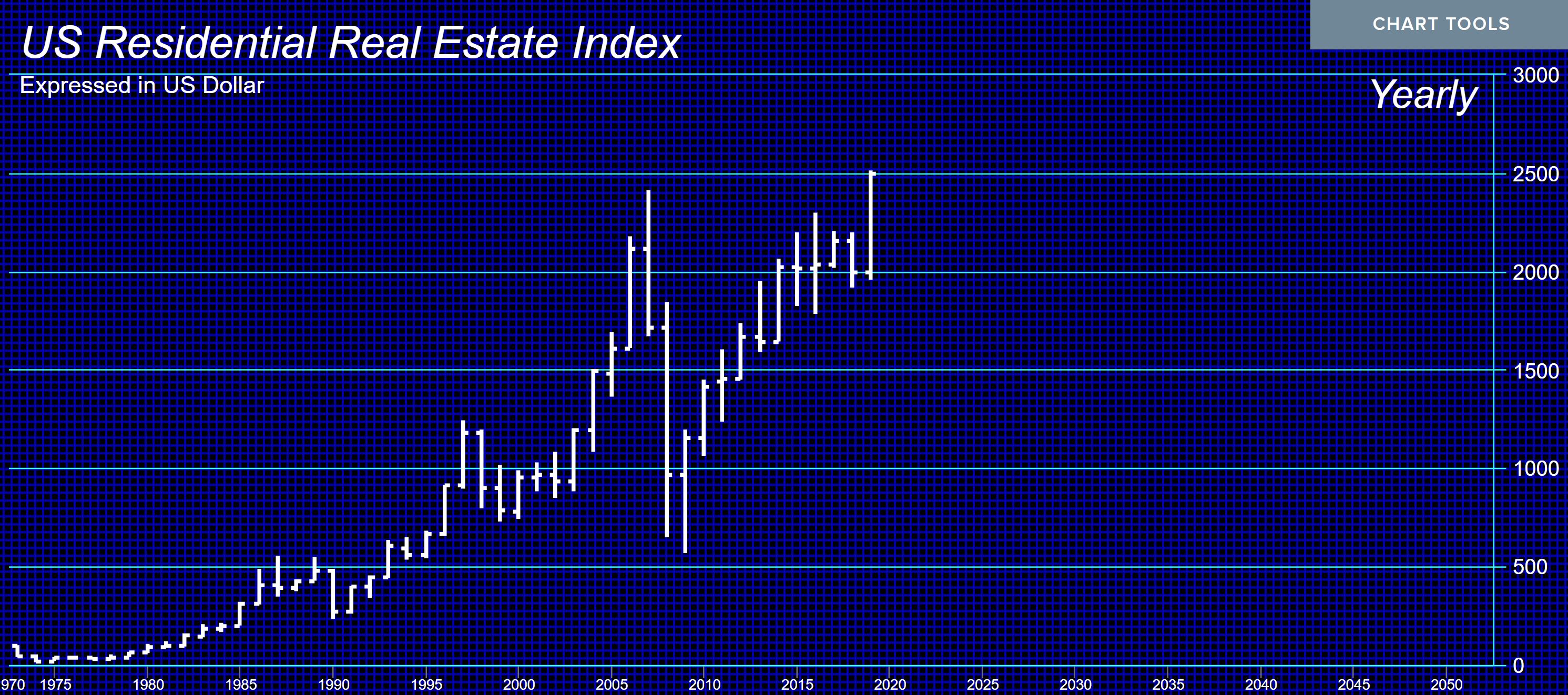
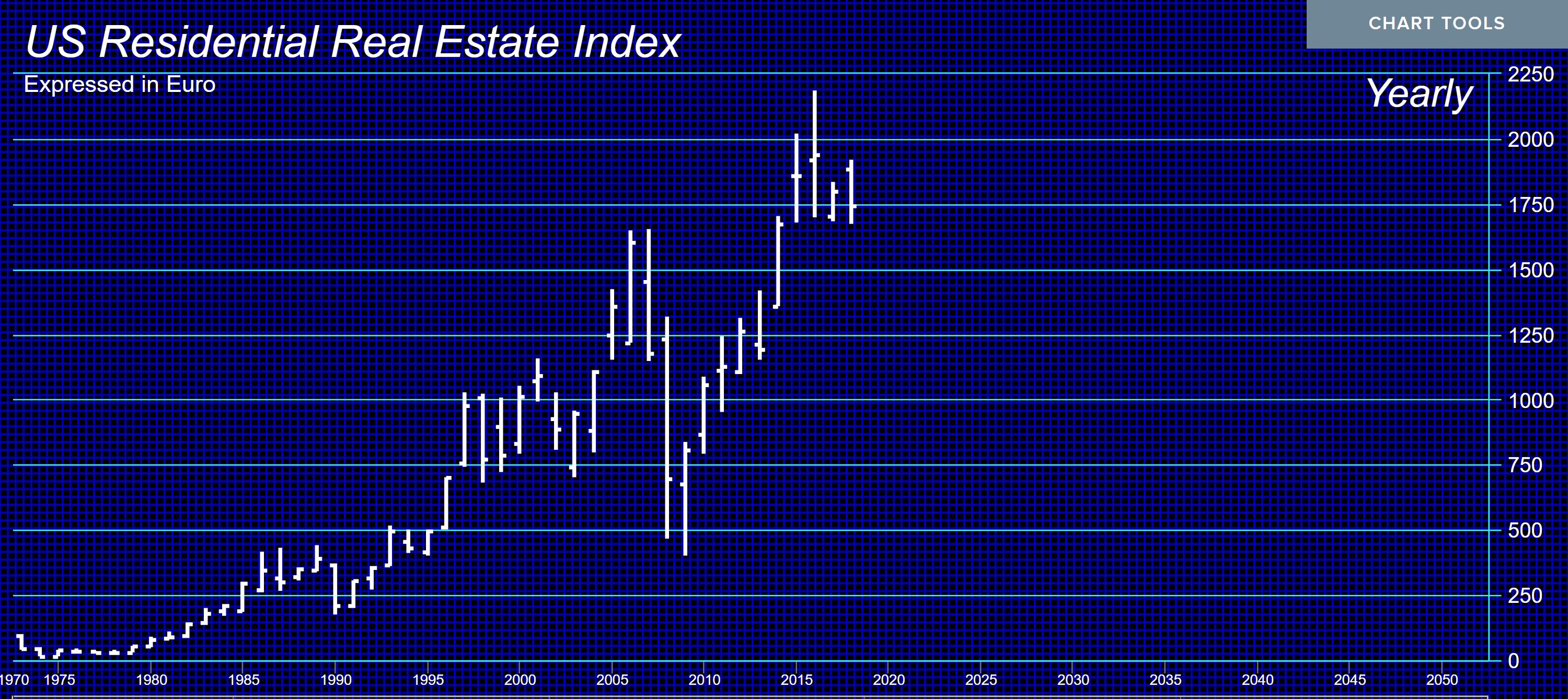
When we look at our broad real estate index, it has been making new highs in 2019. However, when we plot this in Euro, we can see why there have been foreign capital inflows. But the foreign capital has been buying the high-end, not the class where the mortgage bubble of 2007 impacted. From a foreign perspective, the high investment end of the markets has been above the 2007 high for the past 4 years. This is why the new highs have tended to be concentrated in the major centers like New York City and Miami – not local main streets.

Barrons reported that if we look at JPMorgan Chase (JPM) which holds the second-largest residential mortgage portfolio in the nation, we see in its second quarter of 2019 report, that almost $10 billion of modified loans (known as troubled debt restructuring)remained outstanding. Of this restructured debt, 43% were listed as having re-defaulted. Bank of America (BAC) has stated that 41% of its modified loans had re-defaulted.


Howie Baetjer explains what Communism is!


How is Communism described in theory, and how does it play out in the real world? Join us for our question and answer series with Prof. Howard Baetjer

Using Other People’s Money


QUESTION: Mr. Armstrong; You had said you retired from market-making in the precious metals when in the early ’80s people were claiming to sell Krugerrands for spot with delayed delivery. I think they went bust and went to jail if I recall you said back in 1985. Is this the same thing happening in online brokerage with this no commission scheme? How are they making money?

SY

ANSWER: No, it’s not the same. If I remember correctly, it was a firm delaying the delivery of the gold coins by 90 days. They were playing the bear market, assuming gold prices would always be lower based on the fact that the Fed raised interest rates to 14% in 1981. Back then, I was making more money on the float in my account than I was on the gold. The cost on the Krugerrands was spot +4%, so they were making +15% using the money in overnight markets, plus delaying delivery, and they would not buy the coins until the price declined from where they sold them to you. That was pure speculation and I decided I would retire rather than play that game. If I had to speculate to pay salaries it made no sense. They went bust in 1985 and ended up in jail, if I recall, when gold rallied out of the 1985 low and they could not cover all the promises they had made on the coins.

Here we have a similar issue with making money indirectly. Stockbrokers get kickbacks or rebates from the market-makers for steering the business and they make money on the spread between bid and ask. So the retail brokers are still making money that way. But then they also get to use your funds to earn interest. In place of commissions, they make money from charging traders who buy stocks on margin.

Therefore, you have:

  • Interest they earn on your money
  • Rebates from market-makers
  • Interest they charge on margin

This is more legitimate than the gold brokers who were speculating with other people’s money back in the ’80s

Should Americans Hoard Cash?


QUESTION: Martin, I appreciate all the information that you provide and just got done reading about money shortage and hoarding. Would it be good for US citizens to hoard also? Is there any difference in hoarding dollars or gold and silver coins? Thanks for your comments.
DM

ANSWER: In order for gold and silver to be a medium of exchange, it requires the general population to accept that. The older generations know what a silver quarter or a $20 gold coin might be. However, the younger generation does not. Paper dollars will still be best to hoard for every day use until about 2022. At that time, we will have to reassess the climate of the monetary system. There are those videos where people were offered a 10 oz bar of silver of a chocolate bar. They took the chocolate.

Gold and silver should be in coin form. Bars will not be easily used among the average person.

Precious Metals Desk at JP Morgan Criminally Charged


The precious metals Desk at JP Morgan Chase on September 16, 2019, was criminally charged by the U.S. Department of Justice with being a criminal enterprise for approximately eight years in its manipulation of the prices of gold, silver, and other precious metals. The head of that desk and two other precious metals traders were charged with racketeering under the RICO statute which was originally passed to target organized crime.

The Justice Department said that the traders and their co-conspirators “conducted the affairs of the desk through a pattern of racketeering activity, specifically, wire fraud affecting a financial institution and bank fraud.”


Why Did the Dollar Rally Only After the 1929 High?


QUESTION: Hello, I am having trouble understanding how capital flows into the US, which helped the Dow double from ’27-29 didn’t move the dollar. Instead, the dollar moved up abruptly when inflows collapsed. It doesn’t make sense to me. Can Marty cover this at the WEC or help me understand in an email or blog response.

Thanks,

Norm

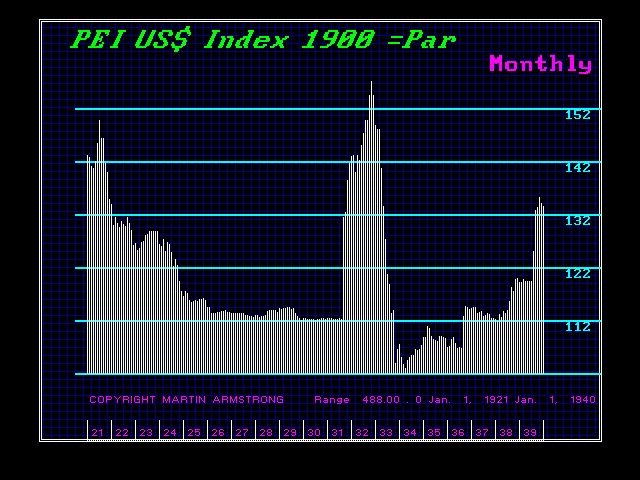
ANSWER: This period was when there was a fixed exchange rate so you will not see the change in the dollar. The capital flows turned out as the crisis took place in Europe and they needed to repatriate capital to cover losses at home.

However, 1931 was the Sovereign Debt Default, which meant the fixed exchange rate system collapsed. This is when the dollar really rose for this was the true value of the dollar during the 1920s due to capital inflows, but it was fixed and sort of like what happened with the Swiss peg.

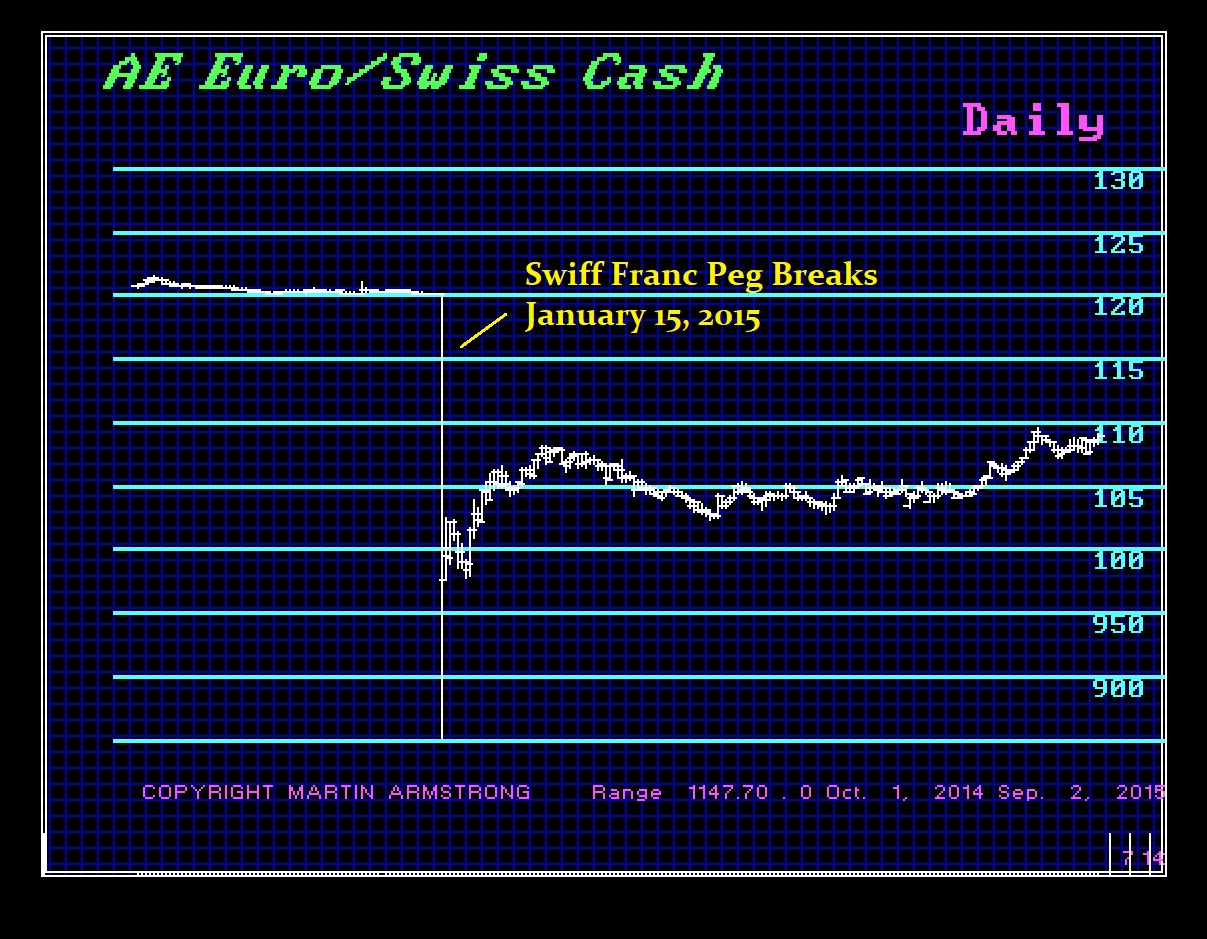
You see the same identical issue with the Swiss franc. The capital inflows were intense as people were buying the Swiss and selling the euro. The capital inflows reflected the move, but the peg was holding. It was that intense capital inflow that broke the peg. The same pattern took place during the 1920s. The capital inflows to the dollar were intense as capital fled Europe due to the war. However, you do not see it in the currency because of the fixed exchange rate. It was this intense inflow that caused the Sovereign Debt Crisis in 1931 and suddenly you see what the dollar would have been in a free market.

I have explained that there is also currency inflation. The tangible assets will rise in a country when the currency declines IF there remains underlying confidence in the nation at large. If not, the tangible assets may rise in hopes of a revolution, which may be bloodless as in Germany 1923, but there must still be confidence in the nation surviving. When there is no confidence as in Communist takeovers in Russia, China, Venezuela, tangible assets will NOT rise.

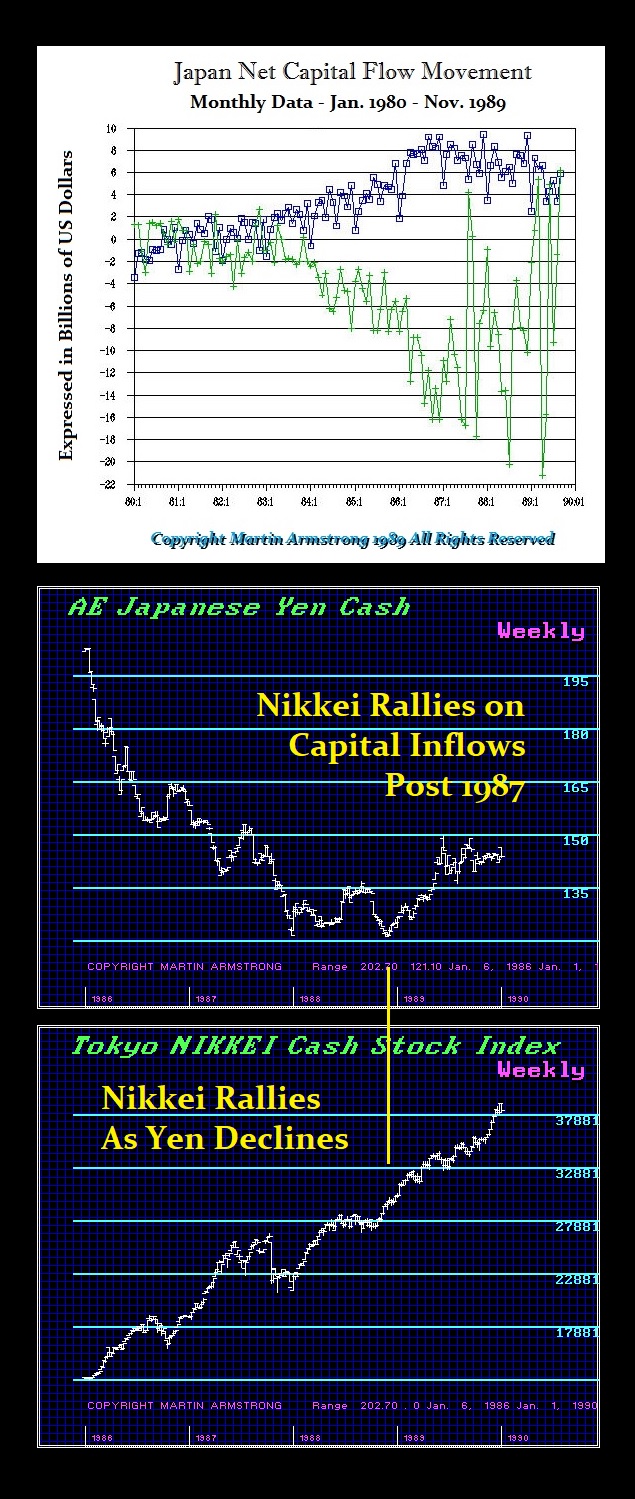
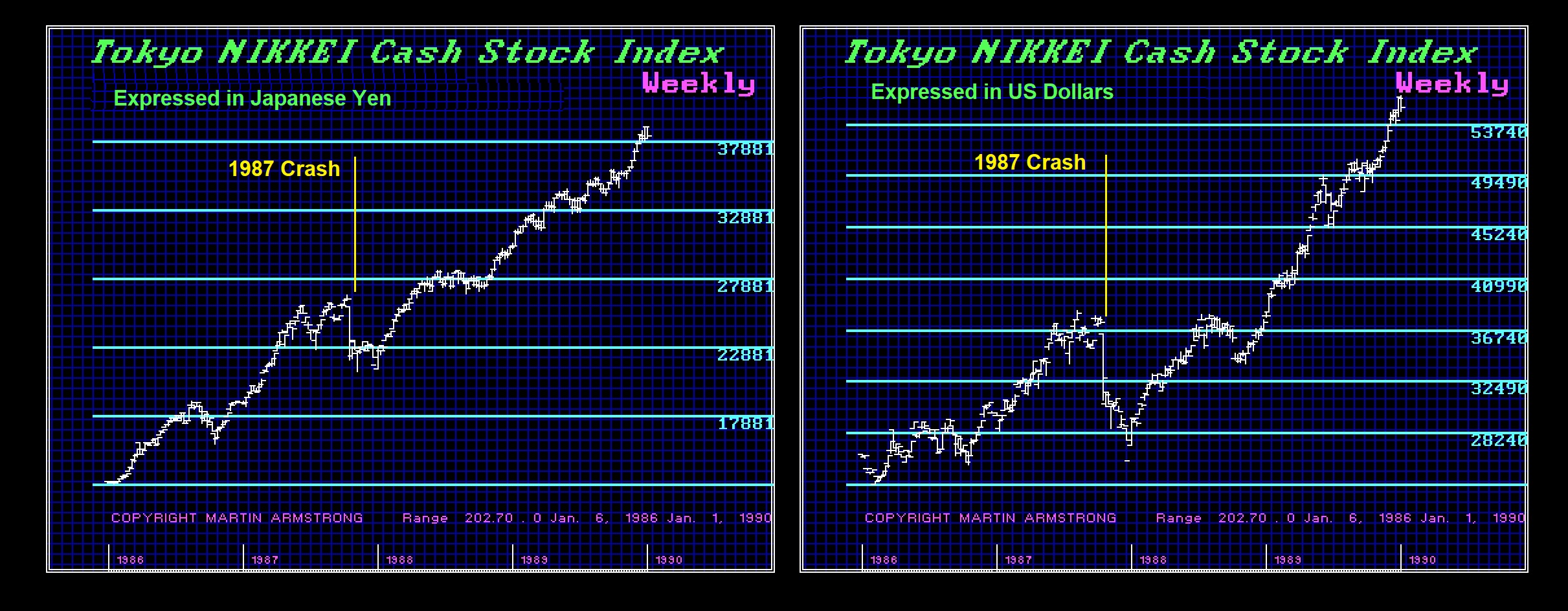
Applying this understand to Japan for the Bubble 1989 top, we see the combination of the rise in the Nikkei in proportion to the decline in the currency which was orchestrated by the Plaza Accord in September 1985. Confidence in Japan was not in question politically. However, the 1987 Crash was a currency move where the fear became whether the dollar would fall another 40%. This caused the Japanese to sell US assets and repatriate their capital home, which then was causing the Nikkei to rise WITH the currency.

If you look closely, you will see that the Nikkei rallied more in US$ than in yen going into the 1989 Bubble top. This is the same pattern currently of how the Dow has rallied from 2009 into 2019 leading the S&P 500 and NASDAQ because it was rising more in euros than in dollars. The 1989 Bubble top in Japan was so severe like 1929 BECAUSE it had attracted capital from around the world which intensified the rally. But when the foreign investors sold, Japan crashed and burned because nobody understood the consequences of capital flows.

Even when the CIA came to us and wanted me to build this model for them and I declined, they understood we invented capital flow analysis and it was the key to the rise and fall of nations.


We All Have Little Bubbles


COMMENT: Marty, I love you Man! I was sitting in my office back in April of 2005, reading the WSJ. There was a story where Greenspan declared he would begin raising rates. I was, “thinking out loud” when I said, “Oh Shit!?!?”. The fellow I shared the office with asked, “What’s wrong?”. I proceeded to explain that there would be a crisis (2008/2009). I think the DJIA was somewhere around 7000, then it went to 14000. If only I knew you back then. The first time I read one of your emails where you pointed out that the market goes up when rates go up, I finally got it, almost like a religious conversion, like Paul on the road to Damascus. Rates go up = my bond values go down, so I sell my bonds to end/limit my losses, and I park/invest in stocks. Do I have that right? Dude, you are so right on. When anybody criticizes you, just say “FTB” (Forget That Bitch) or FTSB (Forget Those Stoopid Bitches) or FTBS (Forget That Bull Shit) or just say all of it. Evidently some University did a study about using foul language, they concluded it lowers the pain by up to 30%. It kills me, this just happened, just ten years ago, and people want to argue with you, can’t they simply remember? (Ask a stupid question). You have helped me figure out a ton of stuff,

THANK YOU!!!

God Bless You My Great Brother!!!

REPLY: I don’t angry. I just consider the source. As they say, you can lead a horse to water, but you cannot make it drink. Some people just cannot see outside their little bubble. It is like a trader who cannot understand the thinking process of a non-trader, and likewise the non-trader cannot understand the actions of a trader. Then there is the institutional trader. He has to answer to a board that has no concept of trading and they are supposed to oversee the trading division. They cannot say, “Look, the reversals were elected, the oscillators flipped, or you broke technical resistance or support.” They have to say some logical fundamental explanation to offer the board and then everything is OK.

We all have a little bubble. The most important thing is to ALWAYS try to understand the thinking process of the other groups. I always wrote for just institutions. I have made an effort to try to see the world from the non-trader or professional position in order to be able to write for an audience that does not look at the world from either a trader or institutional pair of eyes

The Dollar Shortage & Liquidity Crisis?


The NY Federal Reserve announced last week that they will continue their repo operation until October 10th, 2019. The repurchase agreements will amount to up to $75 billion per day. Additionally, they plan to offer three two-week repo operations of up to $30 billion each round.

The constant intervention of the Federal Reserve into the REPO market is the result of a global dollar shortage on a monumental scale. There is a liquidity crisis unfolding as CONFIDENCE is collapsing in Europe and Asia. The Federal Reserve has been intervening into the REPO market in a desperate effort to maintain its lower target on interest rates.

I have been warning that about 70% of physical paper dollars is now circulating outside the USA. There are also now more $100 bills in circulation than $1. With the rising pressure outside the USA to eliminate cash in order to confiscate money from their citizens to support the broadening collapse of socialism, there has been a MAJOR panic pushing into the dollar.

Despite the fact that early in 2019 the headlines were that foreign governments were dumping US debt spinning this into stories that the dollar would crash. In reality, selling of US debt at that point in time was an effort to stop the dollar’s rise. However, as the world economy continues to implode going into the bottom of the business cycle as measured by the Economic Confidence Model, exactly the opposite has been taking place. As of July 2019, the foreign holding of US debt rose to $6,630.5 billion up from July 2018 $6,254.4 billion.

(SEE Fed Data: US Debt Foreign Holding July 2019)

The increase from $6.2 trillion to $6.6 trillion is showing the scramble into dollars even on an official level. As more and more US debt is taken up overseas as a hedge against the rising risk of  the punitive sanctions of canceling foreign currencies as Christine Lagarde is preparing to take charge of the European Central Bank in October, the panic into the dollar assets is removing US debt from domestic holdings resulting in a LIQUIDITY CRISIS beyond anything you will find in the traditional economic textbooks.

We invented Capital Flows analysis. We have the only real database tracking capital flows historically. There will be numerous people who will now repeat what is written here as if it were their original analysis.  Without a database, it is hard to imagine how they can make such claims since this is NOT based upon opinions or reading news headlines.

So welcome to the new world where economic theories are crumbling before our eyes and falling to the floor as dust in a world that no longer exists. We are entering a new period of reality where whatever you thought was happening may prove to be the opposite.

The Panic in Interest Rates is Just Getting Started


QUESTION: Marty; You warned that there would begin a cash shortage and real rates would rise in the private sector starting in September after Labor Day. Ok, it’s about 15 days past that marker and Repo rates have gone completely nuts hitting 10% forcing the Fed to intervene. They were calling it Armstrong’s revenge here in the dealing room. It certainly appears the Fed has lost control of short-term rates as you warned. Is this the start of the chaos you have warned about?

GD

ANSWER: It’s not my revenge, it’s fiscal mismanagement. Look, this is the chaos we have coming and sorry, it is the beginning, not the end. It’s not even a fluke or a blip. So get used to it. Indeed, the Fed has lost control of short-term rates. Trump can jawbone all he wants for zero to negative rates. Sorry! The free markets are showing something else lies in wait.

The Repo Rate reached a high of 10% by about 9 am just before the stock market opened. The fed funds rate was testing the Fed’s upper limit. The Fed was forced to intervene I believe for the first time since the 2008 crisis.

On Tuesday, the Fed offered $75 billion through its facility and received $53 billion of demand from borrowers who swap AAA Treasury holdings for cash at minimal rates. On Wednesday, the Fed again offered the same $75 billion facility and received this time $80 billion in bids.

Overnight financing (REPO Rate) is a basic function which holds the economy together. Those who trade on leverage rely on the REPO market (Broker-dealers, hedge funds, and institutional). It is rarely written about for it is not generally seen by the public. The events of the past few days is a clear warning sign of what I have been yelling about which is on the horizon. The central banks are TRAPPED and in Europe, they have destroyed their bond market with more than $15 trillion and perhaps up to $17 trillion in negative-yielding bonds ($1 trillion is corporate).

Before the 2007-2009 crisis, the Repo Rate was actually the only financial instrument which paid a rate of return that could become NEGATIVE under normal market conditions. NEGATIVE Repo Rates can happen when there is a shortage of cash or particular collateral security, like negative-yielding bonds, are put up to borrow against. Therefore, trying to borrow against a negative-yielding bond can present a crisis. The standard Repo contracts, such as the Global Master Repurchase Agreement (GMRA), have been drafted under the implicit assumption that general collateral (GC) Repo Rates would only ever be positive.

What has transpired is the buyers of these negative bonds have been simply traders. They have not bought this stuff to actually hold to maturity. They have been happy to trade them assuming rates would continue lower so it would be a bond rally. We are looking at SERIOUS credit risk once again but instead of the time bombs being mortgage-backed securities, this time it will be negative-yielding bonds issued by governments. The bond markets have been converted into a child’s game of musical chairs. When the music stops, someone will be left holding negative-yielding bonds that will only be salable at even deeper discounts of perhaps as great as 50% in a few years.

About 30% of the bonds issued by governments and companies worldwide are trading at negative yields which is now about $17tn of outstanding debt. This unprecedented reversal of normal practice has raised profound questions about the outlook for bonds. This is seriously impacting core holding for institutional investors.

The interest rate risk that negative-yielding bonds carry is beyond unbelievable. It is totally artificial supported only by punters. The financial system simply doesn’t work with negative rates and this is also contributing to shortages of cash for Repo markets. A slight rise in interest rates will create a massive debt crisis and if you undermine the bond market, that is what creates great depressions. Negative yields have been confined to places outside the USA and the intervention of the Fed implies they are not prepared to allow negative rates to undermine the US economy as they have done in Europe.

Unlike the 2008 crisis where the time bombs were private debt, Tuesday’s abrupt rise in short-term rates wasn’t obvious that the financial system was in trouble because sovereign debt is assumed to be AAA and risk-free. Not sure whoever started that huge lie.

Nevertheless, we have a convergence of forces which are creating the perfect financial storm on the horizon. Immediately, corporate tax payments are due so corps have less cash to sell overnight. Then there are big Treasury auctions as deficits continue to rise for governments always borrow, yet never pay off the debt as if this can continue without end.
I have been warning that we are headed into a major financial crisis that will be a liquidity event which involves government – not simply the private sector as was the case in 2008. So buckle-up. I have been warning this is something NOBODY has ever witnessed before and if Socrates was actually alive, he would be screaming bloody-murder by now. The Institutional Bond Report will be going out to all our Institutional Clients. Those who have been thinking about joining our Institutional client base can purchase a copy $3,500