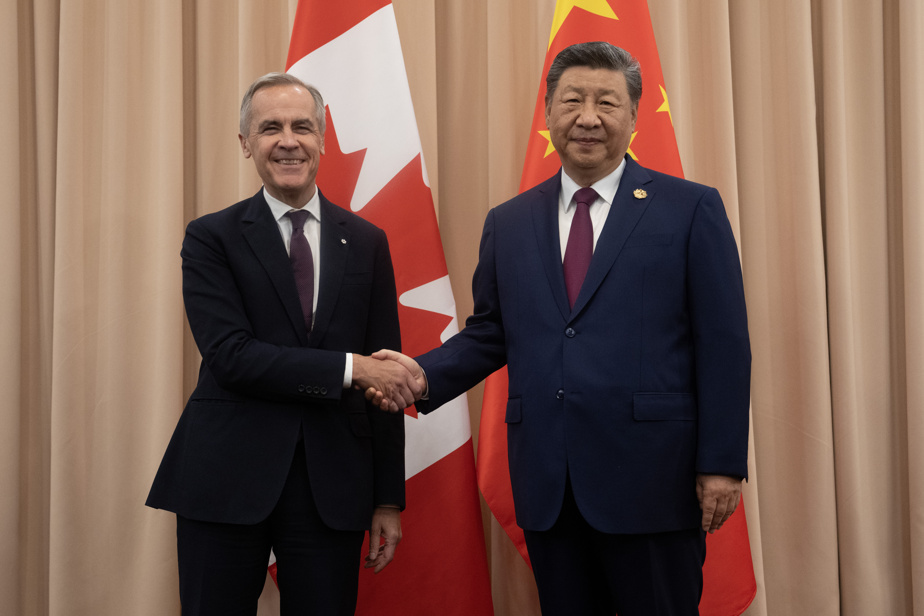
With the recent agreement by Canadian Prime Minister Mark Carney, Chinese auto manufacturers are now rushing to establish the dealerships, before the Beijing-Canada deal becomes an issue in the USMCA negotiation.
China is NOT going into Canada because they foresee a great market of Snow Mexicans purchasing their low price EVs. They are going into Canada as a proactive measure to establish a North American footprint with an eye toward the USA.
(VIA MSM) – BYD and Chery are accelerating plans to establish a dealership network in Canada after the country introduced a quota allowing tens of thousands of Chinese-made EVs to enter at reduced tariffs. The rollout will begin in Toronto before expanding to other major cities, with BYD targeting about 20 dealerships in its first year. This marks a significant new front in North American EV competition, as Chinese automakers seek growth outside the U.S., where prohibitive tariffs keep them out.
Canada’s updated trade policy allows 24,500 Chinese-made EVs annually at a reduced 6.1% duty, giving BYD and Chery a rare North American entry point. This follows China’s surge to become the world’s top vehicle exporter, with similar pushes into Mexico, Europe, and Latin America. The quota’s scale is modest but strategically valuable for testing market response and building brand awareness.
The companies will launch in Toronto before moving into Vancouver, Montreal, and Calgary. BYD aims for around 20 dealerships in its first year, using consultants and internal teams to secure prime sites. While the network could strengthen visibility in key urban markets, experts warn the quota’s limited volume may test the viability of multiple outlets.
With U.S. tariffs exceeding 100% effectively barring entry, Canada offers Chinese automakers a platform to establish presence, gauge consumer interest, and potentially influence future trade talks. Similar strategies have been used in Europe, where Chinese EV makers have gained ground despite strong local competition. Success in Canada could pave the way for local assembly or increased quotas. (read more)
Posted originally on CTH on March 23, 2026 | Sundance
This is one of those small stories that carries the potential for significant domestic economic gains.
As many are aware, the U.S. imports a lot of softwood lumber from Canada. Combined with the energy products the lumber sector represents the top two U.S. imports from Canada. With Venezuela now potentially positioned to replace the former, USDA Rural Development now stimulates domestic lumber development potentially positioned to replace the latter.
Taken as a whole, these two approaches significantly weaken the Canadian leverage that could be deployed in a Free Trade Agreement negotiation. Assuming, of course, the USMCA is dissolved in favor of two bilateral FTAs.
USDA Press Release – At the Advanced Bioeconomy Leadership Conference today, U.S. Department of Agriculture Administrator for the Rural Business and Cooperative Service J.R. Claeys announced the U.S. Department of Agriculture is guaranteeing $115.2 million across eight states through the Timber Production Expansion Guaranteed Loan Program (TPEP) to ensure sawmills and other wood processing facilities have the necessary funding to establish, reopen, expand, or improve their operations.
Today’s announcement includes recipients in the states of California, Idaho, Kansas, Louisiana, Maine, Oklahoma, Virginia, and Wisconsin.
These investments represent a commitment by the Trump Administration to expand American timber production by 25%, reduce wildfire risk, and save American lives and communities by strengthening domestic wood processing capacity.
“We cannot allow wildfires to devastate and destroy our rural communities,” said Administrator Claeys. “That’s why the USDA is taking bold action to stop the destruction of our forestlands by investing in sawmills and wood processing facilities that support sustainable timber harvesting. These actions strengthen local businesses, support rural prosperity, and create jobs for hardworking Americans.” (source)
This is not to say that expanded U.S. sawmill production would completely eliminate Canadian softwood lumber imports. However, it does create inventory and a stronger domestic supply chain that would diminish any applied leverage that Canadian trade negotiators would seek to deploy.
Without pipelines flowing East or West, Canada is stuck pumping their heavy oil south for processing. Nothing about that is likely to change in the next few years, even if Canada abandoned their climate change policy (highly unlikely).
Then comes the cross-border auto manufacturing industry, and the realization that -sans USMCA- both U.S. and Japanese automakers are likely to stick with the manufacturing center where their greatest customer base exists, the USA.
Now overlay softwood lumber, and you can see the top three economic dependencies of the U.S and Canada are slowly being uncoupled, simultaneous with the trilateral USMCA provisions being reviewed starting with the U.S. and Mexico having direct conversations.
Posted originally on CTH on March 12, 2026 | Sundance
It is transparently obvious now that Canada is going to rely on UniParty (Corporate) opposition to President Trump in the dissolution of the USMCA (CUSMA) in favor of two distinctly different bilateral trade agreements; one with Canada and one with Mexico.
A bilateral trade negotiation between the United States and Canada would be devastating to the interests of the Canadian government. Particularly after the Venezuela operation and new strategic relationship with the United States, Canada has almost zero points of leverage to negotiate anything similar to their current exploitative trade position.
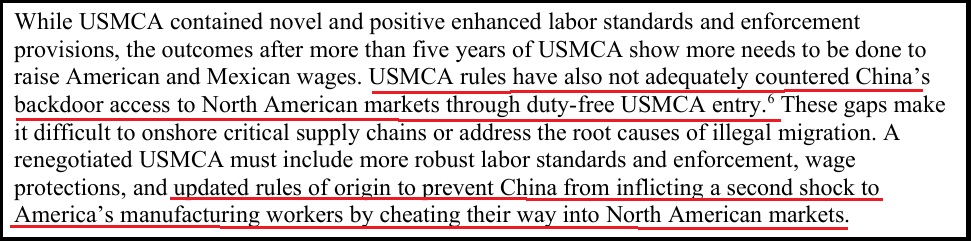
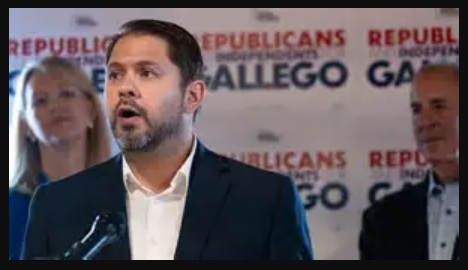
Canada is going to rely on congress to stop Trump from forcing reciprocity in the bilateral discussions. However, as a positive indicator that President Trump will factually have congressional support for the elimination of the USMCA, Democrat Senator Ruben Gallego has written a letter to President Trump requesting a comprehensive review. [LETTER HERE]
This is a key Senate democrat who notes the problem. One of Gallego’s top points of concern is the loophole that Canada uses to assemble Chinese component parts into finished goods for tariff free distribution into the United States.
Ever since President Trump won the 2024 election, Mexico has been taking proactive independent action to block Chinese component goods. But Canada has done the opposite and begun to enhance their trade relationship with China to take even more Chinese component and finished goods.
Gallego writes to U.S. Trade Representative Jamieson Greer from the position of wanting to increase wages and enhance jobs in both Mexico and the USA, growing both economies. However, Gallego’s advocacy simultaneously bolsters why the USMCA should be dissolved and also puts Canada at a distinct disadvantage.
MEXICO – Mexico’s President Claudia Sheinbaum told reporters during her morning news briefing on Wednesday that her U.S. counterpart, Donald Trump, is open to doing away with the U.S.-Mexico-Canada trade agreement (USMCA) and replace it with individual trade deals with each country.
[…] “There might be revisions that create bilateral deals instead of involving the three countries because some things are more important between Mexico and the United Sates or between Canada and the United States,” said Sheinbaum. “Not everything has to be trilateral.”
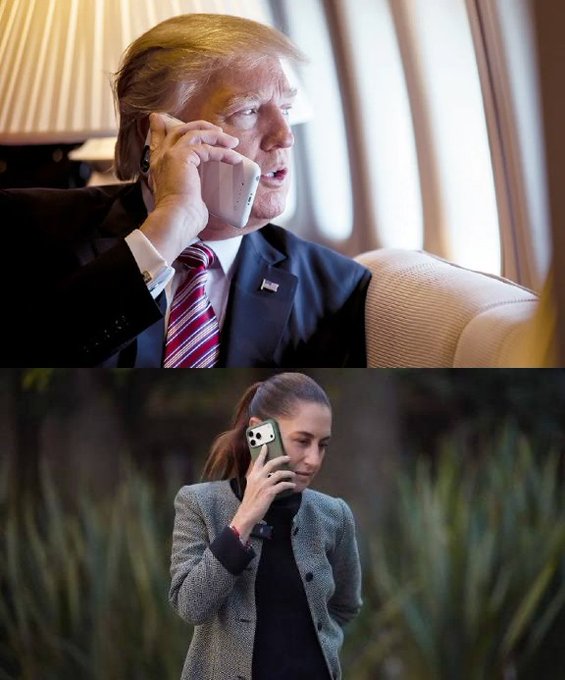
Mexico’s president said the subject was brought up by Trump during a Tuesday phone conversation. […] According to Sheinbaum, her country is ready to consider possible changes. (read more)
Just like the original NAFTA dissolution, if Senate democrats agree the USMCA is structurally flawed then Canada will lose its only hope to retain the trilateral agreement.
It appears that some Senate democrats like Gallego recognize this issue and support the need for exceptional change.
There is a significant difference between Mexico and Canada as it pertains to trade. Two distinctly different bilateral trade agreements would be the best outcome for the USA.
Team Mexico have already been holding bilateral discussions with USTR Jamieson Greer, and I suspect the broad outlines of a free trade agreement between the U.S and Mexico have already been agreed.
While Mexico has been working diligently for 16 months to get into alignment with the USA on a new free trade agreement, Canada has been doing everything possible to retain their “elbows up” position in opposition to the USA. This will not work out well for Canada.
“The key thing that has struck me, and I think it has struck all Canadians, is so many of these guys in the Trump administration, frankly, they just hate Canada,” said Brian Clow, former Prime Minister Justin Trudeau’s deputy chief of staff who led Canada-U.S. affairs. {source}
Posted originally on CTH on March 8, 2026 | Sundance
One of the most curious aspects to the predictable USMCA review, ie. dissolution, has been the incapacity of the Canadian government or trade delegation to accept the United States is going to create two distinctly different bilateral trade agreements and eliminate the trilateral USMCA.
For 16 months the Canadians have refused to fathom the reality of what is going to happen this year.
The Canadians just cannot believe it is possible they will be forced to negotiate a free trade agreement without the cover of a multilateral construct. It has been remarkable to watch their dissonance.
Last week President Donald Trump and Mexican President Claudia Sheinbaum held a phone call. At the conclusion of the call, Sheinbaum publicly asserted the reality the Canadians just refuse to accept.
MEXICO – Mexico’s President Claudia Sheinbaum told reporters during her morning news briefing on Wednesday that her U.S. counterpart, Donald Trump, is open to doing away with the U.S.-Mexico-Canada trade agreement (USMCA) and replace it with individual trade deals with each country.
[…] “There might be revisions that create bilateral deals instead of involving the three countries because some things are more important between Mexico and the United Sates or between Canada and the United States,” said Sheinbaum. “Not everything has to be trilateral.”
Mexico’s president said the subject was brought up by Trump during a Tuesday phone conversation. […] According to Sheinbaum, her country is ready to consider possible changes. (read more)
Canadian Prime Minister Mark Carney finally started to realize President Trump was likely to ignore Canada and begin direct discussions with Sheinbaum. So, Carney went to Mexico to try and get assurances from Sheinbaum that Mexico would not proceed without Canadian interests in mind.
Essentially, Carney wanted Sheinbaum to be on his team. However, as diplomatically noted in the phone call with President Trump, President Sheinbaum politely rejected the Canadian partnership. [Insert Trump’s position toward Mexican cartels as an overriding thought]
The Canadians have been talking to U.S. media looking for sympathetic ‘Orange man bad’ coverage. However, within the contacts between Canadian government officials and U.S. corporate allies, the sentiment from team Trump is very clear:
“The key thing that has struck me, and I think it has struck all Canadians, is so many of these guys in the Trump administration, frankly, they just hate Canada,” said Brian Clow, former Prime Minister Justin Trudeau’s deputy chief of staff who led Canada-U.S. affairs. {source}
It’s not hatred, it’s annoyance.
Years of compounding parasitic annoyances and sanctimonious, ‘holier-than-thou’ pontifications from the arrogant and uppity Canadian government.
The only time Canada has been honest with themselves and with President Trump was when Justin Trudeau was exiting office and admitted Canada cannot function without all of the one-way benefits it receives from the USA {GO DEEP}.
That’s it. That’s the only time Canada has ever been honest about the nature of the economic relationship. A time when Trudeau had already quit and would not be around to deal with the consequences. However, the level of Canadian arrogance is not only visible to President Trump, even the Japanese can see it.
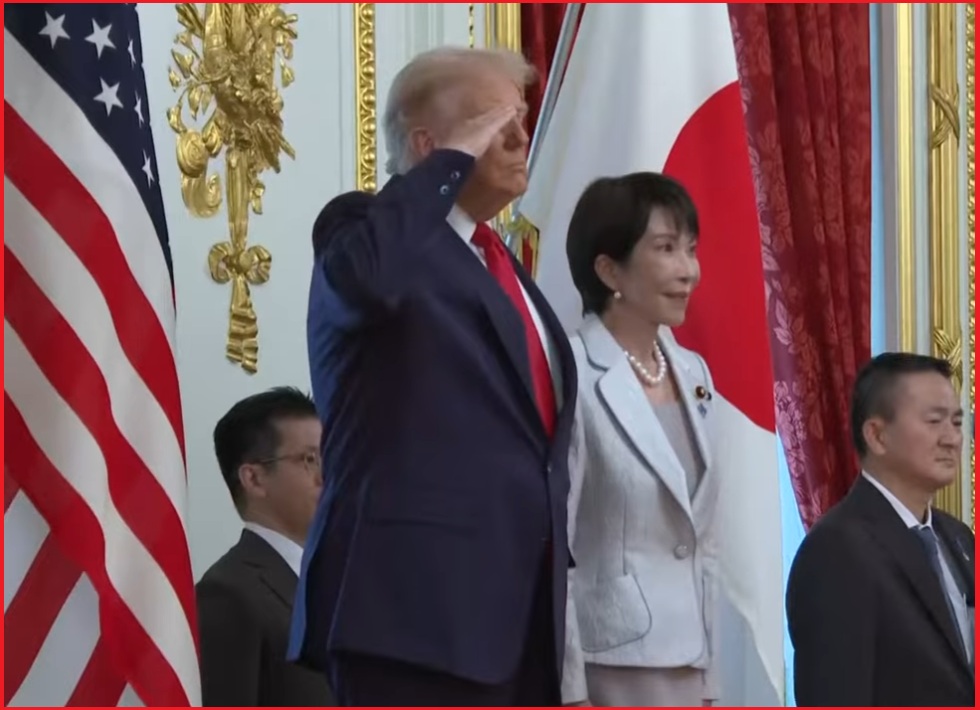
Remember that very close relationship between Japanese Prime Minister Sanae Takaichi and President Trump. That professional, personal and respectful relationship is going to become strategically important this year.
Japan’s economic and trade representatives have told the Canadians that if the USMCA is dissolved, and if Canada no longer has the same trade access current available in the trilateral format, then Japan would rethink its entire investment portfolio in Canada, specifically the auto sector.
In essence, specifically as it pertains to the auto industry, Japan is saying if the USMCA is gone, Japan may pull all their cross-border manufacturing out of Canada and transfer it to the United States.
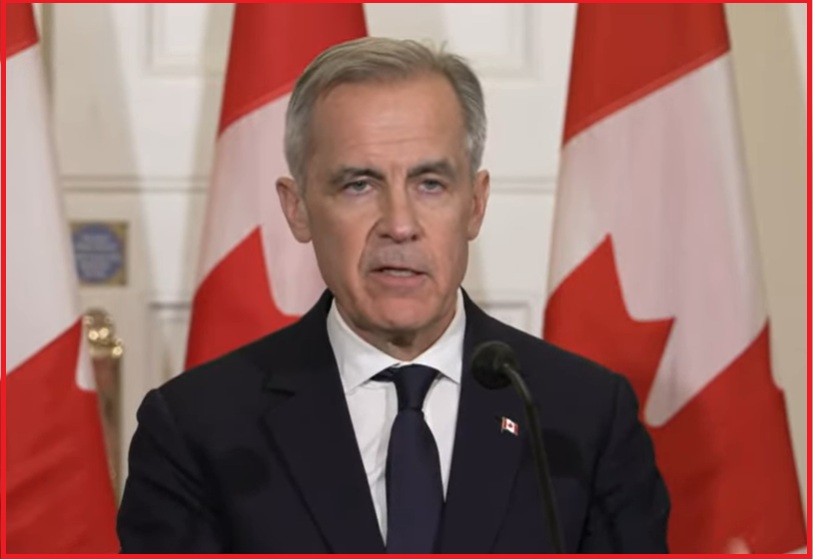
Prime Minister Mark Carney was recently questioned about the statements from Japan and he waxed nonsensically [SEE HERE] about how Canada would use Chinese BYD electric autos to replace lost Toyota manufacturing.
It’s a hot mess for Canada and getting worse.
Last Friday, Canada’s worst nightmare began unfolding:
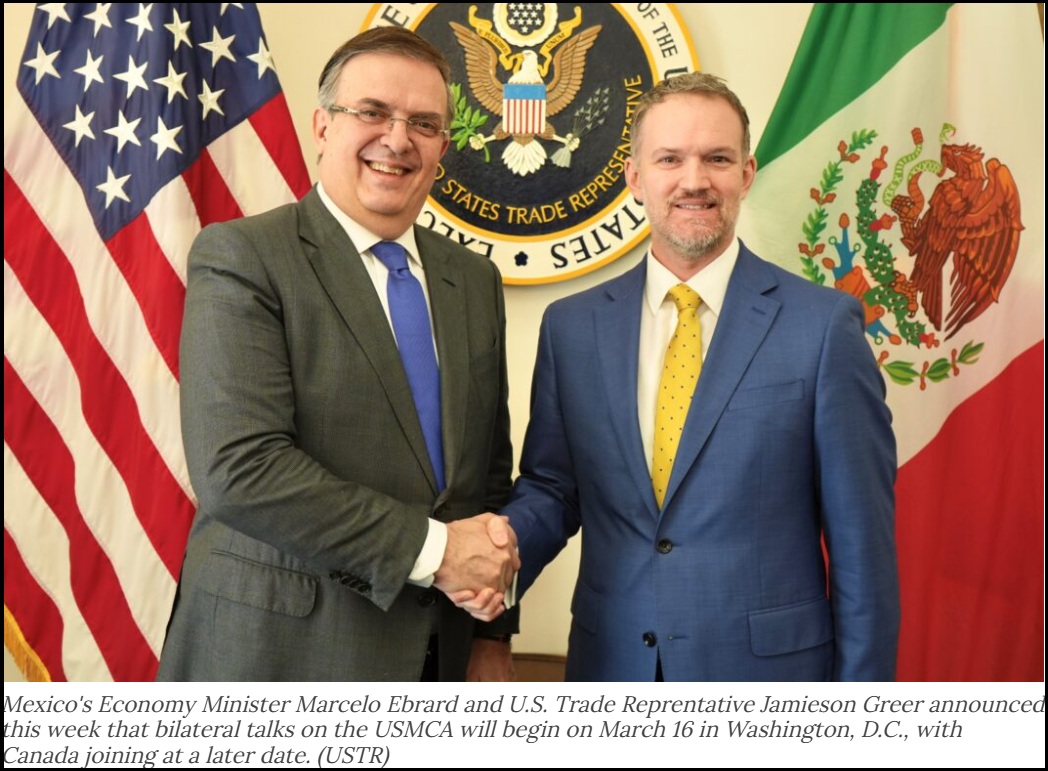
WASHINGTON– Today, U.S Trade Representative Jamieson Greer and Mexican Secretary of Economy Marcelo Ebrard announced the first round of bilateral discussions in preparation for the Joint Review of the United States–Mexico–Canada Agreement (USMCA).
The ministers instructed negotiators to begin a scoping discussion on the necessary measures to ensure the benefits of the Agreement accrue primarily to the parties, including by reducing dependence on imports from outside the region, strengthening rules of origin, and enhancing the security of North American supply chains.
Ministers expect negotiators to hold the first meeting the week of March 16 and meet regularly thereafter as part of the Joint Review. [LINK]
Right there, you can see the exact same thing that took place in early 2017, when President Trump began organizing a bilateral trade discussion with Mexico only, in advance of his preferred approach to dissolve NAFTA and use two distinctly different bilateral trade agreements to replace it. USTR Robert Lighthizer was working with Mexico only.
USTR Jamieson Greer, the studious protege’ of Lighthizer, now has the task of organizing the USA and Mexico while delaying any substantive contact/discussions with Canada until President Trump is ready to drop the hammer.
I can assuredly say President Trump wants everything outlined and in place for a U.S-Mexico deal before he announces the dissolution (joint review withdrawal) to end the USMCA.
There is little to no chance President Trump wants to renew a trilateral trade agreement that allows Canada to keep exploiting their market access to the U.S. without accepting reciprocity.
Remember, Canada’s main export is energy, and Trump has diminished that leverage through the Venezuela operation. Perhaps another ‘ah-ha’ moment for deep weed walkers. Yes, in addition to giving China a body blow, taking control of Venezuela oil and minerals also weakens the leverage position of Mark Carney. Can you see it now?
Canada has one key card they can leverage, congress.
Prime Minister Mark Carney is counting on the UniParty in Washington DC to stand in his corner against President Donald Trump and block any attempt to end the USMCA. However, this is not going to be a surprise to President Trump, because Justin Trudeau did the same thing in 2018 when he coordinated his approach toward NAFTA through then Speaker of the House, Nancy Pelosi.
As I have said with great eagerness, it is going to be a lot of fun to watch this unfold.
Posted originally on CTH on February 17, 2026 | Sundance
While the government of Canadian Prime Minister Mark Carney has inked a trade agreement with China to accept cheap imported vehicles in exchange for Beijing purchasing some agricultural products, President Trump has promised those cheap Chinese EVs will never cross the border into the USA.
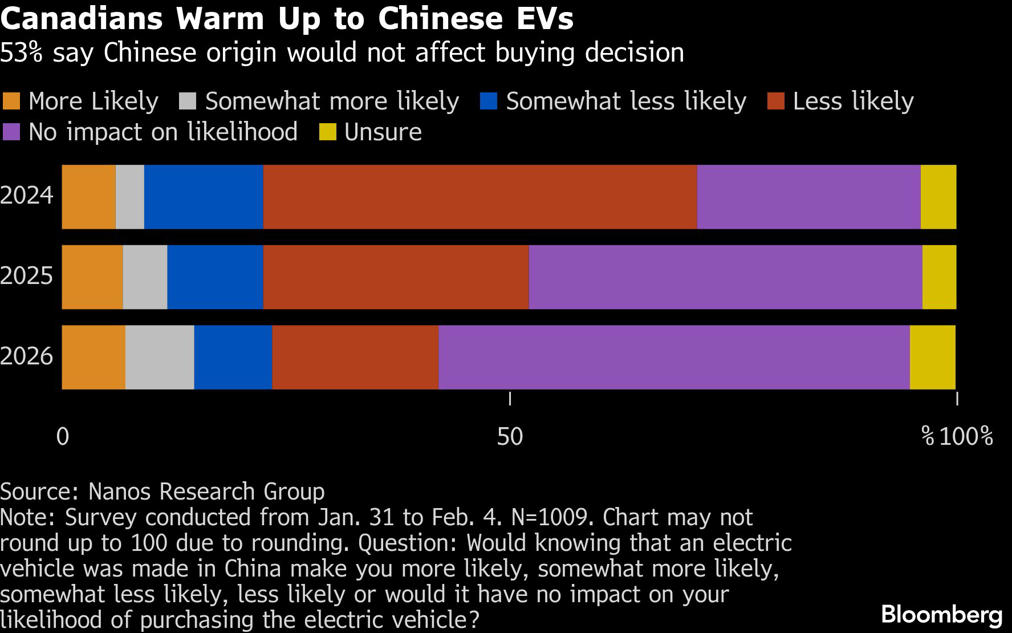
The Canadian polling on the issue has done a remarkable chang in the past few years. Now, the majority of Canadians are willing to purchase cheap Chinese EVs. As outlined by Bloomberg, “More than half of Canadians, or 53%, say that knowing an EV was made in China would have no effect on their purchasing decision, according to a new poll by Nanos Research Group for Bloomberg News.”
Approximately 50,000 Chinese electric vehicles will enter the Canadian market in the first year. “The pact with China includes a provision that part of the quota will be reserved for electric vehicles priced at C$35,000 ($25,700) or less, the government has said.” {SOURCE}
The Canadian government wants a Chinese auto manufacturer, any Chinese auto manufacturer, to build factories in Canada to produce these electric vehicles. Canada wants the jobs and economic activity because Canada is currently bleeding jobs and economic activity due to the trade conflict with the U.S.
Building cheap Chinese EVs in Canada might help offset a few thousand job losses, but building Chinese EVs in Canada only further ensures there will not be a substantive trade agreement between the USA and Canada once the USMCA (CUSMA) is dissolved. [More on that coming]
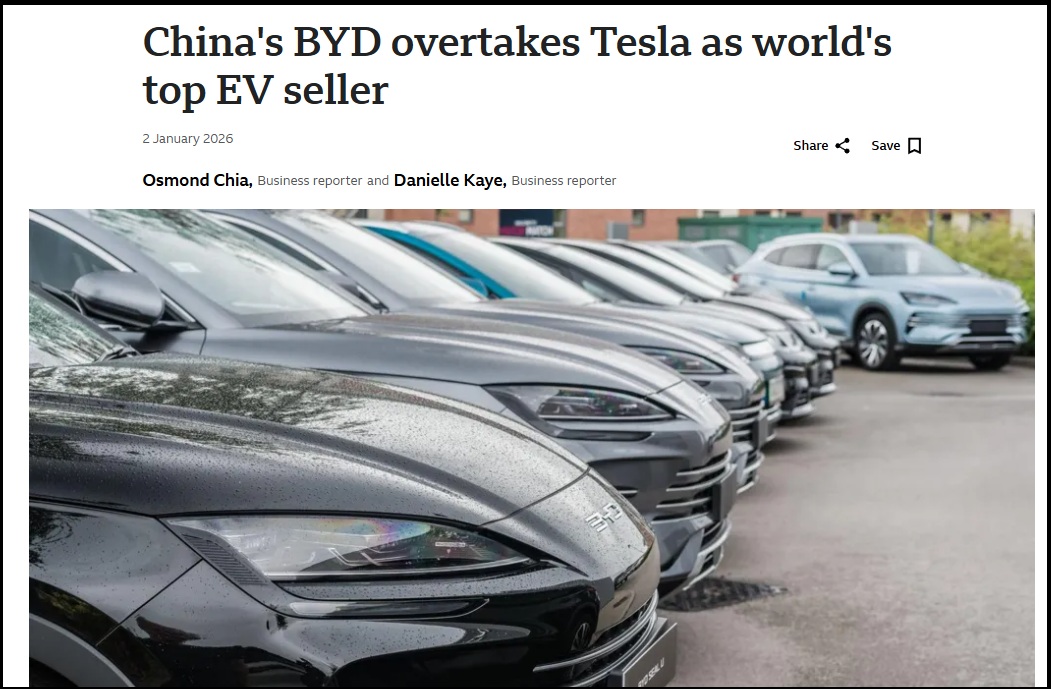
Meanwhile, Chinese EV company Build Your Dream (BYD) has announced they sold 4.6 million vehicles worldwide last year, far surpassing Tesla and even surpassing all of the Ford global auto manufacturing. BYD is now the sixth largest auto manufacturing company in the world.
[Auto News] […] The 2025 sales figures place BYD at sixth largest among global automakers, meaning Ford slipped to seventh in total global deliveries. Toyota remains the dominant global seller with sales exceeding 10 million units followed by Volkswagen Group, Hyundai Motor (including Kia and Genesis), General Motors, and Stellantis.
BYD’s sixth position in the global automotive sales index is particularly notable for an auto maker that focuses almost exclusively on new energy vehicles (NEVs) — a category that includes battery-electric vehicles (BEVs) and plug-in hybrid vehicles (PHEVs). (more)
CTH previously outlined the specific explosion in BYD auto sales HERE. Europe, Russia, Asia and Australia are flooded with cheap Chinese EVs particularly from the BYD brand. Canada is now opening themselves to face the same issue.
Posted originally on CTH on January 30, 2026 | Sundance January 30, 2026 | Sundance
President Trump speaks to President Sheinbaum about upcoming USMCA renegotiation, while Mexican Economy Minister Marcelo Ebrard meets simultaneously in Washington with US Commerce Secretary Howard Lutnick and U.S. Trade Representative Jamieson Greer to discuss the upcoming trade review.
(VIA BLOOMBERG) Mexican President Claudia Sheinbaum said she had a “cordial” conversation with Donald Trump on Thursday, discussing trade and security issues ahead of the review of the North American free trade deal.
Sheinbaum said the review of the United States-Mexico-Canada Agreement will continue as planned and that she and the president discussed tariffs and non-tariff barriers in their latest call.
Mexico’s leader added that Trump invited her to the US but that no date has been set for what would be their second in-person meeting.
On security, Sheinbaum offered that both leaders are pleased with the level of cooperation so far between their two countries. Trump agrees “that we are making progress in the general understanding we have,” she told reporters at her regular daily media briefing, without offering more details.
We all know what is likely to happen, these small articles are like aperitifs while we await the main performance. Meanwhile, the overwhelming majority of Canadians -sans possibly Alberta residents- are clueless.
Posted originally on CTH on January 27, 2026 | Sundance
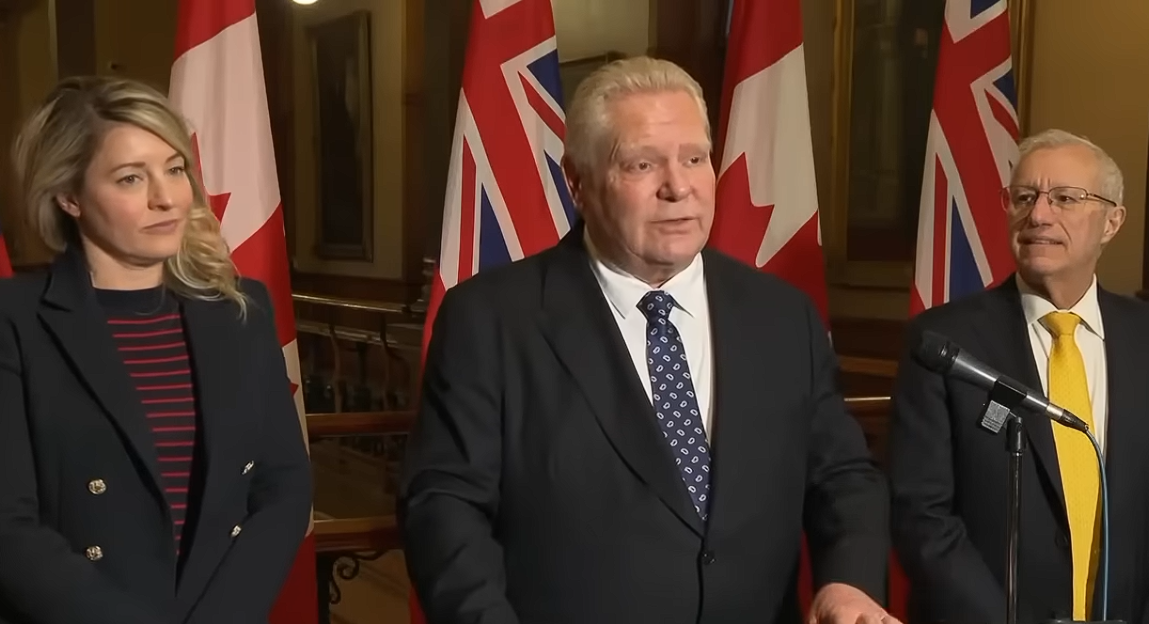
Ontario Premier Doug Ford went for a pizza with Canadian Prime Minister Mark Carney. Following the meeting Doug Ford appears on camera for a debrief to explain how he has reversed his opposition to Chinese EV imports. The presser looks like a hostage video (prompted):
“A Party intending to negotiate a free trade agreement with a non-market country shall inform the other Parties at least three months prior to commencing negotiations and, upon request, provide information regarding the objectives of those negotiations.
A Party that enters into a free trade agreement with a non-market country shall provide the other Parties with the full text of the agreement prior to signing.
If a Party enters into a free trade agreement with a non-market country, the other Parties may terminate this Agreement on six months’ notice and replace it with a bilateral agreement.” [SOURCE]
Posted originally on CTH on January 25, 2026 | Sundance
Canadian Ambassador to the U.S., Kirsten Hillman, appears on CBS Face The Nation to discuss ongoing political and trade relations between Canada and the United States – Video and Transcript below.
During one segment of the interview, Ambassador Hillman is asked about the dissolution of the USMCA (CUSMA) trade agreement, and immediately Hillman falls back upon the same Justin Trudeau position of the government. The U.S. politicians will not allow President Trump to dissolve the USMCA.
“I think that we have to believe that our political leaders are going to be listening to the people in the constituencies for whom that instrument was drawn up, and they’re saying, this is vital to us, do no harm.”
Canada is counting on American political opposition to defend the economic interests of Canada. This is exactly the same position that former Canadian Prime Minister Justin Trudeau espoused in 2017 and 2018.
[Transcript] – So a lot is going on in the relationship between our two countries. We are so deeply integrated here on trade, you buy more from the U.S. than any other country. We have the world’s longest land border. We have shared defense interests through NATO, shared air defense with NORAD. Are we like in the middle of a divorce? Like, how do you describe the relationship?
AMB HILLMAN I- I- we’re not in the middle of a divorce, but we are in the middle of a change. There’s no question about it. I think that we are finding ourselves, quite frankly, in- in a situation where some of the foundations that have governed our relationship for a long time, that you know, integrated supply chains are good, that working together on strategic issues is- are important, that looking out for each other in important ways is- is a number one priority. I think in some quarters, Canadians feel that those foundations are being tested. We will adapt. We will make it through, I have no doubt about that, but it’s yeah, it’s a complicated time.
MARGARET BRENNAN
Well, you know, Canada had agreed to join this Board of Peace that President Trump announced out at Davos, and then overnight Thursday, the president disinvited Canada. Is this kind of public snub interfering in the relationship, and- and what does that indicate to you about what this Board of Peace is that Canada had said it did want to be a part of?
AMB HILLMAN
So we had expressed an interest in the Board of Peace a number of weeks ago, and essentially, a Board of Peace that is seeking to find peace, in particular, in Gaza and stability, is something that Canada was very much supportive of. The- the parameters of that Board of Peace had just really started to come out and- and our government was considering it, but hadn’t- hadn’t really made a decision. But I think that- that honestly, I think that the most important thing to say here, from the perspective of Canada, is that we have always and will always be promoting peace and stability and human rights around the world. We’ll do it with our allies in various fora, at NATO, at the U.N. bilaterally with like minded countries. So we’re not going to change that and- and we will give it our all in- in any fora that- that is available to us.
MARGARET BRENNAN
It- It’s kind of now described as an alternative to the United Nations. Is that something you’re comfortable with?
AMB HILLMAN
Well, we are deep supporters of the United Nations. We feel that it’s, you know, it’s not perfect, no large institution is, but having a place where the whole world can get together and express their views on issues that are important to the globe is vital. And as I say, NATO is vital, and we work with our EU counterparts and EU-Canada, you know, security discussions and in- in various other configurations. So probably all of these different fora are- are essential. The Board of Peace has yet to be fully, I think, understood, and we’ll see- we’ll- we’ll see where that goes, but the outcomes are what matter to Canada.
MARGARET BRENNAN
So your prime minister gave a national address on Thursday, and I understand he denounced authoritarianism and exclusion. He did not mention President Trump by name, but he did rebuke the claim that Trump made at Davos, that Canada lives because of the United States. You’re talking about what people receive at home, everyone has local politics, so when something like that is said, do you fear that this is starting not just a spat, but this is like a generational split between our two countries, like, how are people receiving this at home?
AMB HILLMAN
Look, I think Canadians- Canadians know that Canada lives because of Canadians, because what Canadians do for Canada, and right now, that’s where we’re trying to focus our attention. By doing what- you know, focusing our attention on what we can control as a nation for ourselves and our own economy and our own security and our own relationships around the world. The United States is always going to be a vital partner. Geography, as you said in your opener, 5,500 miles of border, deep ties, millions of Canadians and Americans that work together every day, that- that you know, do research and study and have families across the border so that- that is there, and that is something that I actually think brings strength to the relationship at times where, you know, in other- at other levels, and maybe at the political level, it- it’s more complicated.
MARGARET BRENNAN
It’s very complicated. I mean, it- it’s almost unthinkable that a phrase like authoritarianism and exclusion that that could be thought to be referring to the leader of the president of the United States?
AMB HILLMAN
Well, I think that there are concerns globally for- by our government, that we have institutions and norms, rules that have governed our countries, yours, mine, and all like minded countries for generations that are really being tested, really being tested. And- and I think what matters is how we react in the face of these tests, and for us, for our country, for our prime minister, you know, there are important implications for our country. And he’s- he’s trying to articulate a vision. And I think he is articulating a very strong vision for how we must adapt. And again, it’s- it’s about being pragmatic and principled, and that’s- that’s what we’re going to continue to be.
MARGARET BRENNAN
You have had a long career here in the United States, deeply involved with trade in particular. You helped to negotiate that free trade deal known as USMCA during the first Trump administration. President Trump was asked about it, January 13. He said, I really don’t care in terms of renewing it, there’s no real advantage. We don’t need Canada products here. Is that free trade deal doomed?
AMB HILLMAN
No, it is not doomed. That is my view. All three countries, Canada, the U.S. and Mexico did broad consultations, national consultations, with their business communities in particular, on what- how that agreement works for them. And really without exception, the American comments back were sure we’d like to maybe update this or change this a little bit, but job number one is to do no harm to this agreement, which is the economic foundation of our continental partnership and leads to very important U.S. competitiveness, and Canadian and Mexican competitiveness vis-a-vis other parts of this world. So I think there’s- I think that we have to believe that our political leaders are going to be listening to the people in the constituencies for whom that instrument was drawn up, and they’re saying, this is vital to us, do no harm.
MARGARET BRENNAN
So do you think there’s a bilateral trade deal here? Is that what the Trump administration is going for, rather than the three way deal or–
AMB HILLMAN
I- you know, I think- I- I- we hear- we hear that sometimes, we hear different things. It is important to remember that even within that agreement, there are a lot of bilateral elements, but there is- there are advantages to doing things trilaterally. There’s a lot of supply chain movement that happens between our three countries. And if you, if you break it into two, you could have different rules and disconnects there that are inefficient for business. So we’re driven- look, Canada will be driven by what the best thing to do is, as I say, for the companies and constituencies that are relying on that agreement to create jobs.
MARGARET BRENNAN
Because you heard the commerce secretary say at Davos, you know, globalism isn’t working. I mean, these free trade deals are part of that globalism. And it was just a week ago, your prime minister was in Beijing, and he described Canada’s relationship with China as more predictable than its relationship with the United States. He really meant more predictable than the Trump administration’s United States.
AMB HILLMAN
Look, there’s no question that the last number of months have been unpredictable for us in our relationship with the United States. You know, we have a trade agreement that had us virtually tariff free between our two countries, and now we have very serious tariffs on steel, aluminum, autos, lumber, and that’s causing a lot of challenges within our country. There are people that are losing their jobs. There are industries that are being reoriented, and it’s very difficult. So that is seen as, yes, unpredictable.
MARGARET BRENNAN: But fortress North America had been an idea. I mean, the treasury secretary talked about it, that the United States, Mexico, Canada, we could stand up together, you know, have shared values, and stand up to China. That seems dead, if Canada is really describing a new alliance here with Beijing.
AMB HILLMAN: Well, I think- I think we have to put this in perspective. The- the agreement that we did with China a few weeks ago was a very focused and surgical agreement that was largely, or almost exclusively, designed to de-escalate some tariff escalation that had happened over the past year and a bit. So over the past year and a bit, China had put very punitive tariffs on Canadian agricultural products and fish and seafood, shutting Canadians out from one of their primary markets, if not for some of them, their primary market. And so we went to Beijing to re-establish market access for our farmers and our fishers. It’s exactly what the U.S. administration did in October when they re-established market access for U.S. soy farmers, and in exchange, rolled back some tariffs and fees. So this is a very pragmatic, very focused approach. I think it’s important to put it in context.
MARGARET BRENNAN: But even Ontario’s premier said this is letting Chinese “spy cars” into your country. I think he means electric vehicles that will be cheaply made in China. Are you worried about becoming too beholden to China and its cheap manufacturing?
AMB HILLMAN: No, we’re not, because, we- the- the auto side of this agreement was again to take us back to 2023, we had the importation of vehicles made in China. Many of those were Teslas, as a matter of fact, and we’ve gone back and stuck to the level of 2023 for those imports. So this isn’t a revolutionary new thing. This is really just trying to roll back or de-escalate what had been escalated over the past year and a bit.
MARGARET BRENNAN
Well, the treasury secretary is saying that Albertans are going to have a referendum on succeeding from Canada. He seems to be urging that. What do you make of this–
AMB HILLMAN: Well–
MARGARET BRENNAN: –and comments like that?
AMB HILLMAN: I think it’s important to let Albertans and Canadians manage their own very delicate domestic, you know, politics themselves. I think that that’s probably wise counsel. Having grown up in Alberta, you know, it’s a- it’s a- it’s a province that has lots of strong views about the way in which it interacts with the rest of the country, as do other parts of our nation. And those are important debates to be had, but they’re debates for our country to have within its own citizenry.
MARGARET BRENNAN: It seems to be stirring the pot there a bit, but I want to ask you what your prime minister said at Davos. He got a standing ovation for this speech. He described a ruptured global order, the end of a nice story, and the beginning of a new brutal reality, which he described as a predatory one. Take a listen.
MARK CARNEY, PRIME MINISTER OF CANADA: Stop invoking rules-based international order as though it still functions as advertised. Call it what it is: a system of intensifying great power rivalry, where the most powerful pursue their interests using economic integration as coercion.
[SOUNDS ON TAPE ENDS]
MARGARET BRENNAN: He said, if you’re not at the table, then you’re on the menu. What does this new world order look like?
AMB HILLMAN
Well, that’s a good question. I mean, I think he laid out in his- his discussion, his speech, his- his view of what is happening in our world. And it’s- it’s a world in which rules that governed every player in the globe, every country were maybe not perfectly abided by, as he said, maybe not always exactly exercised as one would hope, but still were sufficient to form the basis of the prosperity, the stability, the predictability that we all used to maximize peace and stability and- and maximize economic reality. So we’re moving away our economic benefits, and we’re moving away from that, and we have to- countries like ours, have to figure out what that means for us. I think that what it does mean for us is that we can’t walk away from our principles. We can’t walk away from our belief in rules that are to be abided by by everyone if they commit to them. But at the same time, we have to be pragmatic and we have to look inward to control what we can within our own economies to be as resilient as we possibly can within our own economies, and part of that means engaging pragmatically with a broad array of countries around the world, in trade agreements, in investment relationships and in partnerships.
MARGARET BRENNAN: Sounds like Canada is picking off our friends.
AMB HILLMAN: You know, I- no, I think Canada is trying to make sure that it is the most resilient it can be for our own benefit.
MARGARET BRENNAN: I’m being told that President Trump posted on social media just a few moments ago that Canada is against the Golden Dome over Greenland and has voted against it to choose to be closer to China. That’s how it was described to me. Yet President Trump had previously talked about Canada participating in this Golden Dome project, which isn’t yet built, but it’s supposed to be missile- layered missile defense, as I understand it. Do you know what he’s talking about, that Canada has rejected being involved?
AMB HILLMAN: No, I’m afraid I don’t, but what I can say about the Golden Dome is this, Canada is- is investing over $80 billion over the next five years in our defens-, in our defense systems, and a big part of that is Arctic defense. And a big part of our Arctic defense investments are something called over-the-horizon radar, which is a system that allows us to see the threats that are coming into the Arctic before they arrive. So that is part- and when we have talked to the president about protecting our hemisphere, we have talked about ways in which our different capabilities can work together so that we have eyes on the region and we cooperate in a way that protects both of our countries.
MARGARET BRENNAN: So the president has described that as Canada wanting to plug in to the system. As you understand it, that’s the better description, your own system that would coordinate?
AMB HILLMAN: Right. Much as we do across all sorts of defense systems, where we’re interoperable. We- we work together. We make our investments that make sense for Canada and defending our territory and defending our sovereignty, but we work with the Americans and- and other allies to maximize the benefits of those.
MARGARET BRENNAN: So in- in short, you do think there needs to be more focus on Arctic defense, but you’re on board to help do that?
AMB HILLMAN: We’re deeply committed to Arctic defense. Absolutely.
MARGARET BRENNAN: I need to ask you about NATO, because you’re also a partner at NATO. The only time that NATO’s Article 5 was ever invoked, and you know this, was after the 9/11 attacks on this country. That collective defense clause, an attack on one is an attack on all, meant that Europe and Canada, they sent troops right alongside American troops on the battlefield in Afghanistan. Here’s what President Trump said.
[SOUND ON TAPE BEGINS]
PRESIDENT DONALD TRUMP: We’ve never needed them. We have never really asked anything of them. You know, they’ll say they sent some troops to Afghanistan, or this or that. And they did. They stayed a little back, little off the front lines.
[SOUNDS ON TAPE ENDS]
MARGARET BRENNAN
He was speaking about all NATO troops. But we did check and about 40,000 Canadians deployed to Afghanistan between 2001 and 2014. 158 were killed, 635 wounded in action. What is a remark like that do to people at home?
AMB HILLMAN: You know, I think what’s most important is that we know what our Canadians have done, and I know that your American armed forces are deeply respectful and deeply appreciative of having stood side by side with Canadians in those very, very treacherous and difficult fights. We know that to be true. They know that to be true, and that’s what matters.
MARGARET BRENNAN: Ambassador, thank you for your time as it wraps up here in Washington.
AMB HILLMAN: Thank you for having me.
MARGARET BRENNAN: Great to have you. We’ll be back in a moment.
Posted originally on CTH on January 23, 2026 | Sundance
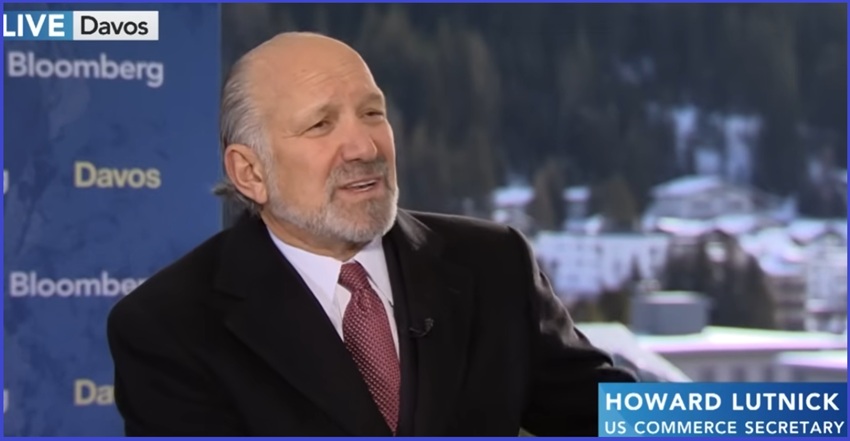
Hilarious Bloomberg interview with Commerce Secretary Howard Lutnick. The topics are European trade and politics combined with the overlay of Canadian trade and politics. The Bloomberg panelists question Lutnick about the similar “feelings” of the Europeans and Canadians, as it pertains to the outcome of trade discussions. It’s the feelings that make things difficult to negotiate.
Secretary Lutnick doesn’t dismiss the narrative but deconstructs the substance of the topic brilliantly. Lutnick notes the ridiculous nature of the Canadian trade position and their decision to go running to China because their feelings are hurt. Lutnick then affirms the USMCA is going to be dissolved mid-summer and fall of this year.
As we noted at the end of last year, splitting the USMCA into two bilateral trade deals, one for Mexico and one for Canada, will be one of the most interesting and long-term economically significant moves in U.S. trade history. It is going to be a lot of fun to watch these negotiations, and the pre-positioning gives us a preview of what is to come.
Mexico is doing everything almost perfectly in preparation for their bilateral deal. Canada is doing exactly the opposite and positioning themselves for the worst possible outcome of a deal with the USA. The disparity in approaches is so different, even now it is remarkable to watch. PROMPTED:
(VIA BLOOMBERG) – […] Canada has “the second-best deal in the world” with its access to the US market, Lutnick said, behind only Mexico. The Commerce chief also indicated that Canada’s tilt toward China could become an issue in talks over revamping the US-Mexico-Canada trade agreement known as USMCA.
If Ottawa opts to import Chinese electric vehicles and other trade-strengthening steps with Beijing, “do you think the president of the United States is going to say you should keep having the second-best deal in the world” during USMCA talks, Lutnick questioned.
[…] Canada’s Finance Minister Francois-Philippe Champagne told reporters in Quebec City that every Group of Seven nation is charting its own strategic path forward with China, and Canada is no different.
“We’ll continue to work hand in hand with our US partner,” he said. “At the same time, I think Canadians have understood by now that diversification is key. We need to be more resilient.”
Mexico’s President Claudia Sheinbaum said separately Thursday that her nation will work to maintain the USMCA trade deal despite recent disputes between Carney and US President Donald Trump. Speaking at her daily press briefing, she also said she would try to talk with Carney.
Next week, Mexico’s Economy Minister Marcelo Ebrard will travel to Washington for trade talks, Sheinbaum also said, speaking in Puebla, Mexico. (read full article)
Having travelled to regions of the world in discussions with people who factually determine economic outcomes, it is clear that every single policy shift undertaken by the Canadian government of Mark Carney is exactly the opposite of what is needed. In the next 24 months, the lifestyle of every Canadian will forever change.
President Trump is reestablishing an entirely new economic, trade and finance system. The era of the Marshal Plan is over; it has been factually deconstructed in the past 12 months.
Canadians and Europeans are desperately trying to offset the ramifications, hold on to their economic benefits and find a new mechanism to afford the domestic indulgences now eliminated by President Trump and the absence of money.
The EU and Canada have chased ‘climate change’ and ‘green energy’ schemes into a dead end of economic crisis. German Chancellor Merz has admitted the problem to the world. The direct and collateral damage is generational, and only just now beginning to surface.
When combined with their intransigent resistance to adapt to President Trump’s global economic and trade reset, core issue “reciprocity”, this reality takes both economies down a path that becomes a self-fulfilling prophecy.
Choosing to embrace China in lieu of modifying bilateral trade agreements with the USA is a short-sighted fool’s errand. Unfortunately, with political calculations each entity, Canada and/or the EU collective, are pandering to their “feeling” base out of an unwillingness to change trade behavior as demanded by Trump.
From Ottawa to London, to Paris, Berlin and Brussels the geopolitical landscape is changing permanently as President Donald Trump resets their global trade relationship to the United States.
President Trump is leveraging the largest consumer market in the world to the benefit of the customer; that’s America. Trump’s direct and specific intent is transactional, to rebuild an industrial and self-sufficient nation that is the envy of the world.
For several generations, Canada and the EU have exploited their biggest customer and taken the U.S. for granted. Both the EU and Canadian economies are stalled and soon to be shrinking. The USA economy will easily grow above 5% GDP and Mexico is likely to be the biggest beneficiary of their proactive positioning.
It’s not about ‘feelings’ it is just the cold reality of the economics.
Posted originally on CTH on December 6, 2025 | Sundance |
U.S. Trade Representative Jamieson Greer is questioned about the Trump administration strategy or lack thereof. “Yes, there’s a strategy,” Greer says in this new interview. “First of all, you don’t change 70 years of trade policy overnight. And second of all, when some people say, ‘Oh, well, this is chaos. What’s your strategy?’, what they really want to know is can we go back to how it was before? And that’s not going to happen.”
The interview is in an audio file presented by Politico and shared below. This is some really good information on the various free trade agreements and the regions represented by some of our largest trade partners. Well worth listening to as you go about your day and travels today. Embed below:
USTR Greer notes how the tariffs are being used, the upcoming Supreme Court decision, the need for congress to codify the tariff regime in legislation and the various regional strategies for the deployment of countervailing duties.
I have created this site to help people have fun in the kitchen. I write about enjoying life both in and out of my kitchen. Life is short! Make the most of it and enjoy!
This is a library of News Events not reported by the Main Stream Media documenting & connecting the dots on How the Obama Marxist Liberal agenda is destroying America






 Centinel2012