Opportunity Costs: The Parable of the Broken Window – Learn Liberty


Published on Nov 17, 2016

SUBSCRIBE 190K
Some people argue that natural disasters and other acts of destruction create wealth and employment as we repair the damage they’ve caused. Professor Dan Russell explains that this fallacy fails to take into “opportunity costs” into consideration. Whenever we use a resource for one purpose, like fixing a window, we give up the opportunity to use that resource for another purpose. We only know if the use of a resource has created value if we compare it with the the alternate uses we had to forego. forego.


The Unprecedented Equality of the 21st Century


Published on Aug 7, 2017

SUBSCRIBE 190K
The rich get richer, and the poor get … cell phones, cars, and nice TVs? Prof. Mike Munger says we’re actually more equal than ever. Full interview here: https://www.youtube.com/watch?v=-FlQ1… SUBSCRIBE: http://bit.ly/2dUx6wg LEARN MORE: Debate: Is There Too Much Inequality in America? (video): The question of income inequality has become a key issue in contemporary politics. The Institute for Humane Studies asked two professors– Prof. Steve Horwitz, economist at St. Lawrence University, and Prof. Jeffrey Reiman, philosopher at American University- to answer questions about wealth, fairness, and inequality in the United States. This is their debate: https://www.youtube.com/watch?v=p047t… Income Inequality and the Effects of Globalization (video): Income inequality in America is a serious issue. People are worried about a widening gap between the rich and the poor in the United States. But is the global story the same? Professor Tyler Cowen explains how globally, income inequality worldwide is on the decline. https://www.youtube.com/watch?v=ja15p… How to Fight Global Poverty (video): Have you heard the news? The number of people living in abject poverty—defined as living on less than $1.25 per day—has been halved since 1990. How did that happen? Prof. Stephen Davies explains that extreme poverty has been on the decline in part because two of the world’s most populous countries, China and India, have embarked on a path of economic liberalization and development over the past two to three decades. https://www.youtube.com/watch?v=JzmxQ…

5 Inequality Myths


Published on Oct 2, 2017

SUBSCRIBE 190K
If you really want to understand how the world works today, you need to rethink almost everything you’ve been told about inequality. Prof. Antony Davies explains.

Yield v Reason


QUESTION: I see all of these people calling for a major crash of 50%+. With interest rates so low and the dividends on the Dow twice that of interest rates, does anyone look at yield anymore?

PH

ANSWER: I fully agree. The yield on the Dow Jones is 5.34%, which is about double the 10-year rate. Back in 1983, I presented these two charts that show the earnings and book value of the Dow Jones Industrials. The majority were calling for a crash and our computer warned of a Phase Transition and a 600% rise in the Dow. I was blamed for creating the takeover boom, but it was clear that the earnings were at least 5% and the stocks were trading out of a major historical low on price v book value. So earnings do come into the mix

Capital Controls v Protectionism


QUESTION: Marty; You mentioned at the cocktail party in Rome, which was spectacular BTW, that your concern would be capital controls emerging when the euro starts to break hard. Do you have a time frame for that?

WJ

ANSWER: Yes, the view from the cocktail party was spectacular. A bit cold; we could have used that global warming.

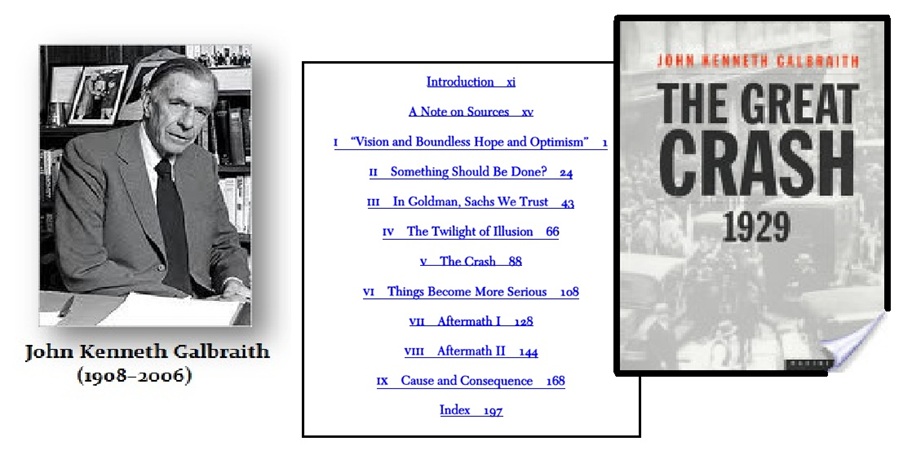
We saw Turkey move to entertain that which set off the contagion in emerging markets overnight. While the history books tend to put the blame for the Great Depression at the feet of corporation, as did Galbraith, they never mention the Sovereign Defaults of 1931 or the fact that there were capital controls imposed.

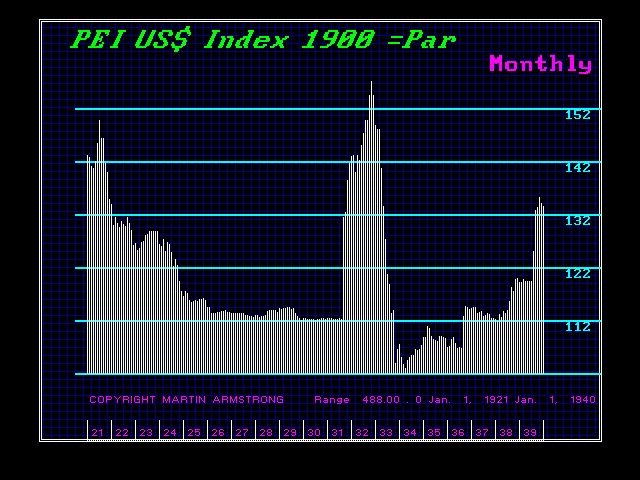
The flight of capital to the dollar was met by imposing capital controls. These capital controls may have solved the flight of capital immediately, but at the cost of a complete collapse in confidence in Europe as a whole. The lesson from 1931 was not that of PROTECTIONISM, which killed trade, but it was the imposition of capital controls that brought international trade to a halt. If capital could not be exported, then commerce could not buy any goods. This was far more drastic than protectionism with tariffs. There just seems to be very questionable analysis applied which was either by true idiots, or more likely, the analysis deliberately hid the actions of government to justify the takeover by Marxist Socialism.

The time frame where we may see governments resort to capital controls may arrive in 2021-2022. We MUST be realistic that capital controls are far worse that trade disputes.

QE & Its Failure


QUESTION: Dear Martin,
During WEC in Rome I came to understand that the issue with QE is that it did not create any inflation in the USA. On the other hand, as you mentioned the inflation is being calculated in a different way that it used to be in the future. How come then the US does not just change the way of calculating the inflation in a way which would show it’s there? Wouldn’t that be an easier way than to do more QEs?
Thank you,

MK

ANSWER: The primary reason QE fails is because the economy is global. Central banks can no longer manage the economy, for the money does not remain in isolation. Additionally, as I pointed out in Rome, they may have negative interest rates, but that does not pass through. You cannot borrow money from a bank at negative rates.

The Threat of Protectionism


QUESTION: Marty:

I read you every day and I am one of the fortunate people to have a financial advisor that attends your Conference every year in the US.

I am wondering how Airbus will be affected in the future as the Euro further declines.

Thanks, RM

ANSWER: This is one of the aspects that caused the protectionism during the 1930s. As the turmoil in Europe unfolded, capital fled to the dollar pushing it higher. This invoked protectionism also propelled by the decline in commodity prices. The protectionism began with the agricultural sector and then spread to other areas.

As the dollar is pushed higher, we will see protectionism rise again probably 2021-2022. European companies that do not have professional hedging departments will suffer greatly.

Moving from QE to Just Monetizing Government


QUESTION: Mr, Armstrong; Why the push for lower interest rates again in developed markets? You have stated the QE has been a total failure. Are they incapable of doing anything else?

KE

ANSWER: We are switching from QE to a new reality of budget management. If interest rates rise on government bonds, the budget blows out. At this stage, the Fed is toying with the idea of setting benchmark rates for 2 to 10-year instruments. This will be different than QE. It will be the collapse of government bond markets on a global scale.

ETF v Mutual Fund


QUESTION: Are ETFs really better than a mutual fund for tax purposes?

HS

ANSWER: The primary difference between mutual funds and ETFs (exchange-traded funds) is that while an open-end mutual fund is priced once based upon the market closing, ETFs as well as a closed-end mutual funds trade all day. This actually goes back to the Panic of 1966 when mutual funds were open-ended but traded on the exchange and were bid up and down based on emotion rather than net asset value. The crash took place because mutual funds were at times selling well above net asset value.

If we look at the reforms post-1966, investors in mutual funds buy or sell them directly from the mutual-fund companies themselves. That creates a different tax structure than an ETF in which purchases go to the market and the ETF is simply created by purchasing the underlying basket.

Mutual funds and most ETFs are governed by the Investment Company Act of 1940. Therefore, this legislation treats them like a pass-through company. When a mutual-fund investor wants to sell, the fund sells shares of appreciated stock to generate cash which creates a taxable capital gain. Since most funds operate as simple pass-through vehicles, those tax liabilities from the gains accrue to all investors in the fund including those who have not sold any holding.

ETFs actually do avoid that type of tax issue. ETFs are not direct buyers or sellers of shares as a mutual fund. The ETF is created by a market maker with a special contract with the ETF provider. The investor has the newly created ETF share which is created by purchasing all of the holdings in the underlying ETF. This basket of shares is given to the ETF issuer thereby creating the ETF shares.

Because an ETF is not a direct buyer of the underlying shares as in a mutual fund, the ETF itself is not a buyer or seller. The basket of shares are swapped and are therefore in-kind transactions, thus there is no pass-through capital-gains tax bill. This is the tax advantage of an ETF over a mutual fund.

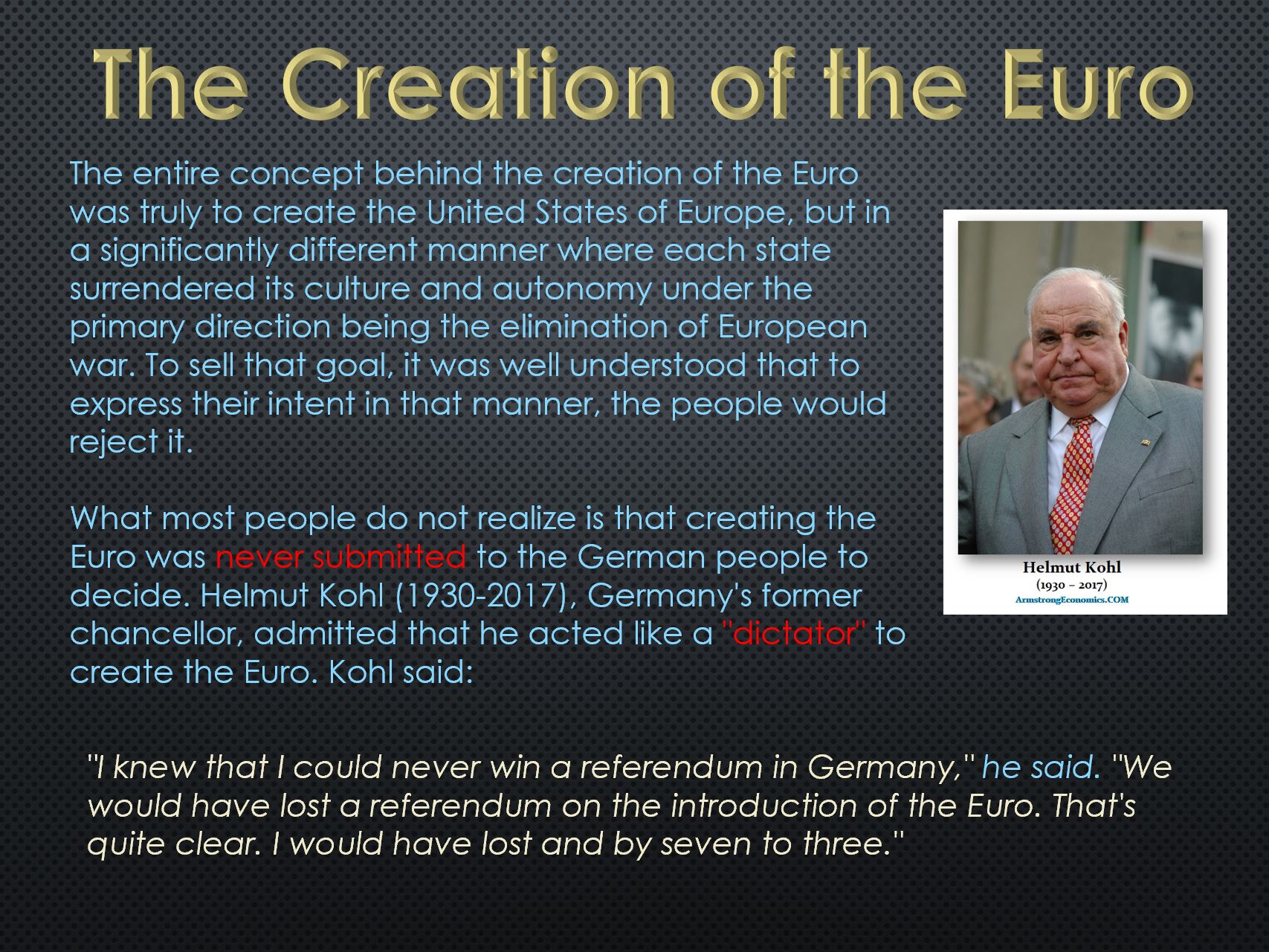
Creating the Euro & Germany Was Denied the Right to Ever Vote to join the Euro


COMMENT: Marty; I just wanted to say that this WEC in Rome was one of your best, NOt that Nigel Farage was there calling you the alternative to Davos, but you really do your research and your contacts behind the curtain become self-evident. Nobody in the audience every knew that the German people were denied the right to vote on joining the euro. The most important economy was denied any democratic process.

See you in Orlando

PG

ANSWER: Yes, I was amazed at how even the central bankers who attended were unaware of that fact. This is part of the reason for the rise in the AfD in Germany. From the outset, the theory has been to federalize Europe to prevent a world war. They assumed the people would never vote for it so they hide the real agenda. The people are not those who create wars – it is always those in power.

What they have done is to fuel the flames of history that remind people of the differences that are culturally embodied within the languages.